1939: Six assassins of Armand Calinescu

On this date in 1939, Romanian Prime Minister Armand Calinescu was gunned down on a Bucharest street in an ambush by the Iron Guard. (Romanian link)

Before the day was out, six of members of the hit squad were lined up and machine-gunned on the very same spot.

Armand Calinescu

Calinescu was a conservative politician trying to fight off the rising fascist movement in his country — that aforesaid Iron Guard — and preferred to keep Romania in politic neutrality and friendly with England and France rather than hitching its fate to Nazi Germany.

This entailed an increasingly acrimonious struggle throughout the 1930s against the fascists. Calinescu once called the Guard “an association of assassins,” and the prospect of taking a bullet from them can’t have been far from his mind. Calinescu’s fingerprints were all over press closures, pre-emptive arrests, and still worse offenses to outrage the far right. After years in the cabinet working hand-in-glove with the hated-by-fascists King Carol II, Calinescu finally became Prime Minister in March of 1939. Carol hoped he could be the bulwark against a Legionary takeover.

If by his enemies ye may know a man, know that Calinescu was taken seriously enough for a multilateral meeting between representatives of the Iron Guard, fascist Italy, and Nazi Germany in order to make the arrangements for his murder. But Calinescu would probably have just as soon have preferred his life to this tribute of his foes.

Upon news of the assassination, Calinescu’s place was immediately filled by Gen. Gheorghe Argesanu, whose one week as head of government was distinguished by a ruthless crackdown on his country’s homegrown terrorists.* The very next day’s British papers, in the same stories reporting the assassination, carried news “of an exemplary punishment” delivered within hours: “Last night, under the glare of powerful arc lamps, the murderers were publicly executed by machine-gun on the spot where the crime had been committed.” (London Times, September 22, 1939)

Nor was that the last exemplar.

The Times reported on September 25th that the ensuing days had seen “more than 300 former Iron Guards were shot” all around the country, including many “in the open street as a public example, on the pattern of the machine-gun executions in public at the scene of the crime.”

The “example” did not have the intended effect: in the span of another year, a fascist-aligned government had control of Bucharest and King Carol had hightailed it to Mexico, never to return.

* The Iron Guard would pay back Argesanu a year later by killing him during the Jilava massacre of its political prisoners.

On this day..

1951: King Abdullah’s assassins

AMMAN, Jordan, Sept. 4 — Four men sentenced to death here last week for complicity in the assassination of King Abdullah in July were hanged today in Amman prison. Regent Emire Naif had confirmed the sentences of the special tribunal.

Those put to death were Musa Abdulla el-Husseini, Abed Okkeh, Abdulkadir Farhat and Zakariya Okkeh.

Col. Abdulla el-Tell, former governor of Jerusalem, and Musa Ayyubi who were sentenced to death in absentia are reported to be living in Egypt.

New York Times, September 5, 1951*

The men hanged this day were among the authors of “the most dastardly crime Jordan ever witnessed”: the July 20, 1951 assassination of independent Jordan’s first king.

The cagey Hashemite monarch Abdullah I had been emir of Transjordan, an artificial British mandate jigsaw-piece that Abdullah got by virtue of cutting a deal with Winston Churchill.

This sinecure came with the significant drawback of dependency on London’s reach and interests, and Abdullah’s great achievement was to set Transjordan-cum-Jordan** on firm enough footing to survive the postwar sunset of the British Empire.

Abdullah faced an early test of Jordan’s chops shortly after his country’s 1946 independence when the Arab-Israeli War erupted. For Abdullah, this was a state-building opportunity; indeed, his government had for years backed Palestinian-partition plans that other Arab states had opposed — with the expectation that Jordan could help itself to the eastern part of that partition.

Abdullah did just that in 1948, invading and annexing the Jordan River’s West Bank all the way to East Jerusalem … while willingly acceding to (some have said actively colluding in) the creation of a partitioned Jewish state that was theoretically anathema to Jordan’s allies.

Jordanian territorial aggrandizement, however, brought with it the West Bank’s Palestinian population, severely aggrieved at having seen their aspirations to statehood cynically sacrificed by Abdullah. They got, into the bargain, Jordanian citizenship and a severe suppression of independence agitation.

So when Abdullah came to visit Jerusalem’s Al-Aqsa Mosque, a Palestinian gunman murdered him.

While the assassin himself was immediately shot dead by the king’s bodyguards, ten allegedly in on the plot were very hastily tried in mid-August … eight in the Amman courtroom, and two overseas in Egypt tried in absentia. Dr. Musa Abdullah el Husseini, Abdel Kadir Farahat, and the brothers Abed and Zakariya Okka were condemned to die, along with the absconded Abdulla el Tel and Musa Ahmed el Ayoubi. (The latter two would never be executed.)

According to the London Times‘ Aug. 29, 1951 wrap of the legal proceedings,

The events leading up to the murder, as they were described during the hearing, began with two meetings in Egypt, in September and October [1950], between el Tel and el Ayoubi, who decided then that the king should die. El Tel then met el Husseini i Cairo, and henceforth directed and financed the plot with el Ayoubi as his chief lieutenant. Abed Okka acted as an intermediary, and Zachariya Okka and Farahat were later drawn into the plot, the latter ultimately providing the murderer with a revolver.

The remaining four men who faced trial — Dr. Daud el Husseini, Franciscan Father Ibrahim Ayyad, Tawfik el Husseini, and Kamil Kaluti — were acquitted.

This event, which might have been feared to prefigure a more terrible disruption within Jordan, within Palestine, even in the entire Middle East, did nothing of the sort. Power transitioned to the long reign of Abdullah’s grandson King Hussein, who was actually present at his grandfather’s assassination. (And might have shared his fate, save for a medal the teenaged Hussein had pinned to his breast that deflected a bullet.)

As Mary Cristina Wilson writes,

There was an element of cover-up in the conduct of the trial. The grievances and frustrations of the accused were not broached … The idea of an independent Palestine was, for the moment, dead. Abdullah’s assassination was a terrible revenge wreaked for the death of that idea, but it signified retribution for events that were already history, not the beginning of the new order … Though not without parallels in the future, it was without echoes.

Jordan would govern the West Bank, albeit absent virtually any internationally-recognized legitimacy there, until Israel attacked and occupied the territory in the Six-Day War in 1967. The legacy of this event will be familiar to the reader.

In 1988, Jordan officially resigned its own claims on the West Bank to the Palestine Liberation Organization, “the sole legitimate representative of the Palestinian people.”

* Any number of online sites say this hanging occurred on September 6. Given the existence of September 5 papers reporting the execution, I think it’s safe to rule those erroneous. Wikipedia sources this version to James Lunt’s Hussein of Jordan.

** “Transjordan” officially became simply “Jordan” in 1949. Events in this post span either side of that re-branding, so for the sake of clarity, we’re just going to use “Jordan” throughout.

On this day..

1584: Balthasar Gerard, assassin of William the Silent

“If you succeed in your enterprise, the King will fulfill all his promises, and you will gain an immortal name besides.”

Christoffel d’Assonleville, to Balthasar Gérard

After 4 days of torture, on this date in 1584, Balthasar Gérard (Geeraerts) finally met his end by beheading on the wheel.
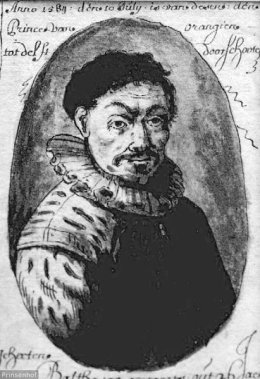
Gérard managed to be both historically important and wholly forgettable: an assassin working for Spain against the Netherlands, his regicide was met with a predictably stiff punishment. Then, no fault of his own, the subsequent course of history** pushed the assassin into obscurity while elevating his prey.

A lawyer by trade, Gérard was a fervent Catholic and supporter of the Spanish crown, which controlled the territory up the coast through the present-day Netherlands. At the peak of its power, Spain’s monarchy — led by King Philip II — had significant cause for concern at the rise in Protestantism.

The Spanish were Europe’s paladins of staunch Catholicism, and the sight of her troops did little to endear Spain to her colonized neighbors to the North.

For both religious reasons and political ones, the Dutch were looking for a way out from under the Spanish thumb, and a former noble named William, Duke of Orange, was a major instigator in the struggle. In his collected letters and addresses from the period, An apology or defence of William the First of Nassau, William states that, starting in 1559, he became increasingly concerned with plans against Protestants by the Spanish monarchy.

That also happens to be the year William was bestowed with stadtholdership of Holland, Zeeland, and Utrecht; in effect, he controlled the Dutch coast.

Though he was known as William the Silent, the Duke was endowed with both financial resources and widespread popularity, and he didn’t keep his mouth shut when it came to Inquisition courts in his realms.†

When the head enforcer of that policy, Cardinal Antoine Perrenot de Granvelle, left town, William got even noisier — declaring before the Council of State that Spanish policies were squelching religious freedom.

In 1566, the nobleman signed onto the Compromise of Nobles and began funding insurgencies across the northern provinces. As religious unrest grew, Calvinists and Protestants in the French and Germanic portions of Spain’s holdings quickly formed up behind William. An early attempt in 1568 to invade the Netherlands using German mercenaries and French Huguenots failed, but the resultant executions of Egmont and Hoorn put Spain on a long and winding road toward defeat.

The Dutch War was afoot, with William leading the way.

It would take and dozens of small-scale military victories over the next 15 years (during which William declared himself a Calvinist and fully broke his Spanish ties) for the Dutch to move to independence. The 1580 Union of Utrecht and 1581 Act of Abjuration officially ousted King Phillip II from the Netherlands and installed a new government.

Needless to say, Phillip reciprocated William’s love.

In 1580, Spain’s top man put a price on William’s head. Juan de Jáuregui tried to collect two years later by shooting the stadtholder, but the man holding the new title of Prince William I of Nassau recovered, while de Jáuregui was killed on the spot.

With 25,000 crowns at stake, there were bound to be other takers.

Our man Balthasar Gérard started looking for a close encounter with William the Target. At first, he joined the army in Luxembourg, which didn’t get him very far. It was time to gin up a real plot, which Gérard shopped to the Duke of Parma, Alessandro Farnese, in April 1584. Though the Duke offered no funding for the operation — Gérard ponied up the startup money he needed for the trip — and held out little hope that the lawyer would be successful, he gave Gérard assurances that his family would be taken care of in case of disaster.

Gérard first presented himself to William in June as the son of a martyred Calvinist from France. On 8 July, he returned and, badly in need of new clothes, managed to beg 50 crowns for a new set.

Instead, he bought a pair of pistols and, on 10 July, made history with a point-blank shot to William’s chest.
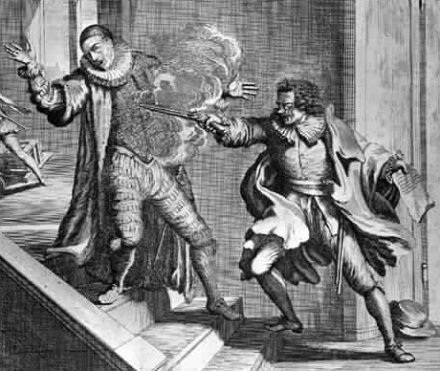

Detail view (click for the full image) of William the Silent’s 1585 assassination at the hands of Balthasar Gerard.

This assassination attempt didn’t fail. William became the second head of state to be killed by an assassin’s bullet,† — and his shooter the first such man to be juridically punished for the deed.

And, oh, how he was punished.

The regicide was beaten immediately after his capture, then subjected to a variety of cruelties, from wet leather boots which, when heated, both crushed and burned the feet, to daily floggings while hanging on a post outside the jail.

But on this day, his time of torture was up, and Gérard was finally put to death. You know, the usual:

It was decreed the right hand of Gerard should be burned off with a red-hot iron, that his flesh should be torn from his bones with pincers in six different places, that he should be quartered and disembowelled alive, that his heart should be torn from his bosom and flung in his face, and that, finally, his head should be taken off.


Gerard’s execution.

For all that he suffered as a regicide, Gérard left his family an impressive inheritance. Making good Parma’s assurances, King Phillip II gave them William’s former lands in three French provinces and took his siblings and their issue into his peerage.

Gérard’s cause carried on for another 60 years, until it was finally extinguished by the signing of the Peace of Münster by the Republic of the Seven United Netherlands and Spain.

* Foucault mistakenly identifies the torture as lasting 18 days, and the additional details he lays down for Gérard’s time on death row may be less-than-believable. However, all sources indicate that the tortures Gérard endured were quite spectacular, even by the standards of the day.

** See Dissident identities in the early modern Low Countries for a complete treatment of this period in The Netherlands and Belgium.

† For example, the city of Antwerp (Belgium), then under possession of the Spanish crown and considered the mercantile center of Europe for its vast sugar trade, featured over 100 executions for heresy from 1557-1562, twice as many as in all of Spain during that time.

‡ The first was James Stewart, 1st Earl of Moray, then Regent of Scotland. Stewart’s shooter, James Hamilton, escaped into exile, though others of the Hamilton clan answered for the murder.

On this day..

1776: Thomas Hickey, plotting against George Washington

“A most infernal plot has lately been discovered here, which, had it been put into execution, would have made America tremble, and been as fatal a stroke to us, this Country, as Gun Powder Treason would to England, had it succeeded.”

Continental Army surgeon Solomon Drowne, July 13, 1776

On this date in 1776, Continental Army soldier Thomas Hickey was hanged before “a vast concourse of people” for a plot that might have strangled the American Revolution in its crib.

That revolution was a highly uncertain venture at this moment, and in a different timeline Thomas Hickey might have been a British hero for squelching it. “These are the times that try men’s souls,” revolutionary firebrand Thomas Paine wrote late in 1776. Hickey had to face his trial in the flesh.

George Washington had holed up in New York City in the spring to fortify it against an expected British invasion — an invasion that did indeed arrive and eventually drove the Continental Army all the way to Philadelphia.* As Paine beheld, the wrong turn of events here could have been decisive. The Continental Army was badly outnumbered and afflicted by desertion. The Continental Congress itself had to abandon Philadelphia not long after boldly declaring independence on July 4.

Whatever one might say of the great-man historiographical mood, you’d have to think that knocking out the rebel army’s top general at this juncture would have been a coup for the British.

In June of 1776, New York was tense ahead of the fighting. A British ship of the line sat forebodingly in the harbor, and even as she awaited the coming British force, her crew members rowed freely ashore for provisions. Plots went abroad among the mixed population of “Patriot” and “Loyalist” citizens. Nathan Hale would soon earn his martyr’s laurels in New York, trying to reconnoiter behind enemy lines as Washington staged a series of losing battles and a gradual retreat.

Somewhat below this plane of world-shaping combat and statecraft, a guy named Isaac Ketcham (or Ketchum) found himself clapped in gaol for counterfeiting the easily-counterfeited colonial paper currency. There, Ketcham caught jailhouse scuttlebutt of Loyalist plots afoot in New York. Realizing this could be his ticket out of prison, Ketcham wrote New York’s Provincial Congress informing on the schemes.

Sadly, Ketcham’s full memorandum has been lost, and as the ensuing trial records are circumspect the “plot” or “plots” in question are a bit of a historical muddle. Roughly, there are two discernible thrusts:

  • A fifth-column plot against the patriot position in New York, with Loyalist-inclined soldiers set to desert back to the arriving British army.
  • A plot against the person of George Washington himself.

Ketcham was eagerly interrogated by the Provincial Congress on these matters, and returned to his dungeon in the capacity of an informant. There, he made the acquaintance of the Irish-born Thomas Hickey, a member of George Washington‘s personal guards who had on June 15th been committed for doing his own bit of private currency-printing.

Representing himself as a Tory loyalist, Ketcham apparently induced Hickey to boast about something quite a bit more serious than counterfeiting.

“In different conversations he informed me that the Army was become damnably corrupted,” Ketcham told the court-martial that tried Hickey. “That the fleet was soon expected; and that he and a number of others were in a band to turn against the American Army when the King’s troops should arrive.”

The whole scheme went under the pay of Loyalist New York mayor David Mathews, who was also arrested by patriot troops — although Mathews, whose execution might have turned the British very nasty in the various diplomatic conferences ongoing during the New York campaign, was never even tried.** He escaped to British protection shortly after capture.

No kid gloves were available to the treacherous Irishman Hickey, however. Word of the conspiracy against the patriots had also been obtained from a businessman, William Leary, who reported the attempt of his former employee to recruit him into it. The sheer quantity of highly indiscreet men blabbing about it in taverns and jails and the like makes the whole thing seem crazy in retrospect, but if it had succeeded in, say, destroying Kingsbridge, it might have trapped the Continental Army on Manhattan where they would have been easy pickings for the vastly superior British. Someone surely had to pay for this.

Several of Hickey’s accomplices provided evidence against him, and the speedy conclusion of the military commission that tried him was that Hickey should hang in order to, as Washington wrote the Continental Congress, “produce many salutary consequences, and deter others from entering into like traitorous practices.” So far as is known, however, Hickey was the only person to suffer this extremity.

The unhappy fate of Thomas Hickey, executed this day for mutiny, sedition, and treachery, the General hopes will be a warning to every soldier in the Army to avoid those crimes, and all others, so disgraceful to the character of a soldier, and pernicious to his country, whose pay he receives and bread he eats. And in order to avoid those crimes, the most certain method is to keep out of the temptation of them, and particularly to avoid lewd women, who, by the dying confession of this poor criminal, first led him into practices which ended in an untimely and ignominious death.

-Washington’s general order, June 28, 1776

Physician William Eustis (eventually the U.S. Secretary of War), who was among the 20,000 to see Hickey hanged, wrote a friend that afternoon of the execution.

Their design was, upon the first engagement which took place, to have murdered (with trembling I say it) the best man on earth: Genl Washington was to have been the first subject of their unheard of Sacricide: our magazines which, as you know, are very capacious, were to have been blown up: every General Officer and every other who was active in serving his country in the field was to have been assassinated: our cannon were to be spiked up: and in short every the most accursed scheme was laid to give us into the hands of the enemy, and to ruin us. (Source)

The scarcity of original documentation makes it very difficult to say with confidence just how impressive this accursed scheme really was. One can see from Eustis’s letter that it was understood immediately to have compassed the murder of George Washington. This prospective “Sacricide” of America’s founding father par excellence has been worth a good bit of embellishment; one bit of utterly insupportable folklore congenial to vegetable-hating schoolchildren is that Hickey arranged to have General Washington’s peas poisoned with arsenic, but the faithful housekeeper exposed the scheme in the nick of time.

Only a bit more fantastical is the video game Assassins Creed III, whose representation of the death of Thomas Hickey — this version of Hickey is a Templar agent — uses a wacky sequence that begins with the public execution of the game player’s own assassin character, complete with first-person, inside-the-hood perspective.

It might well be that Hickey had been engaged in a plot not to murder but to kidnap the rebel general. David Mathews, the New York mayor, would later tell a royal commission in London autopsying Britain’s Revolutionary War defeat, “I formed a plan for the taking of Mr. Washington and his Guard prisoners but which was not effected.” It’s been speculated that the Continental Army itself chose to play up the “murder” angle for public consumption in preference to “kidnap” — perhaps because the notion that the Tories had the strength to contemplate the more complex objective of snatching Washington away from his own army, and were in a position to use his very own guards to accomplish it, implied a weakness in the revolutionary cause far too grave to acknowledge openly.

* It’s from this position that Washington would [re-]cross the Delaware amid December ice floes to conduct a morale-salvaging raid on Hessian troops in New Jersey after many long months of reversals. The British, for their part, held New York for the balance of the war, and this helped make adjacent New Jersey a battleground between pro-British and pro-American militias.

** Mathews administered New York until 1783, when the British ceded it to the victorious colonists.

On this day..

1882: Stepan Khalturin, Winter Palace bomber

On this date in 1882* Stepan Khalturin** was hanged in Odessa, Ukraine … but not for his most (in)famous crime.

Khalturin (English Wikipedia entry | Russian) came from a well-off peasant family near the city of Vyatka (today, Kirov; it was renamed for an assassinated Bolshevik). As a young carpenter in 1870s St. Petersburg, he fell in with revolutionary circles and became a distinguished propagandist and organizer. Khalturin helped found the first political labor labor organization in Russia, the “Northern Russian Workers’ Union”.

He’s said by other leftist agitators who knew him to have “persuaded his student workers with tears in his eyes to continue propagandizing, but in no event go down the path of terror. From this, there is no return.”

If that used to be his sentiment, Khalturin’s thinking … evolved.

By February 1880, Khalturin was for all intents and purposes in on the terrorism strategy. He took advantage of a workman’s gig at the Winter Palace to pack the cellar full of dynamite,† two floors below the imperial dining room.

But Tsar Alexander II and party had not yet returned when it blew. Eleven people, mostly guardsmen in the intervening room below the dining hall, died in the blast; dozens of others were injured.

Khalturin watched in frustration from the iron gates of the Winter Palace, and slipped away — never detected. His co-conspirator Zhelyabov consoled him with the prospects of mass recruitment sure to be unleashed by this spectacular propaganda of the deed. “An explosion in the king’s lair — the first attack on the autocracy! Your deed will live forever.” (Russian source)

The tsar, at any rate, was running out of luck.

A year later, Narodnaya Volya finally succeeded in assassinating Alexander II in St. Petersburg. Zhelyabov and five others hanged for that.

Khalturin wasn’t involved in that plot: he had escaped to Odessa.

There, he shot a police officer named Strelnikov. He was captured and hanged under a bogus alias, nobody realizing that they were also executing the mysterious Winter Palace bomber.

Unusually considering Lenin’s distaste for terrorism and Narodnaya Volya, Khalturin was elevated in post-Soviet times into an officially-approved revolutionary exemplar. The street Millionnaya running to the Winter Palace in St. Petersburg was cheekily renamed for him (it’s subsequently been changed back). Public monuments went up for the bomber, especially in the environs of his native soil around Kirov.


(cc) image from Zeder.

* April 3 by the Gregorian calendar; March 22 by the Julian calendar still in use in 19th century Russia.

** Appropriately given Khalturin’s Winter Palace work, khaltura is Russian for an item of shoddy construction. The word has no etymological connection to our man, however. (Linguistic tip courtesy of Sonechka.)

† He was able to manage the feat by bringing in explosives little by little and secreting them in the room where he bunked on-site.

On this day..

1872: Sher Ali Afridi, assassin of the viceroy

On this date in 1872, Sher Ali Afridi was hanged at Viper Island for knifing to death the British Viceroy of India 32 days before.

Richard Bourke, the 6th Earl of Mayo, had stopped off to visit the convict settlement at the Andaman Islands.

Little remembered today, Great Britain shipped tens of thousands of Indian convicts to that Bay of Bengal archipelago in the latter half of the 19th century (and continuing into the 1930s).

One of them was Sher Ali.

This former cavalryman in the UK’s Indian military forces had murdered a relative in a private feud, and was dispatched to the prison colony for his trouble. Evidently he nursed a terrible grudge at being judicially punished for what, in his opinion, was no crime at all. The standard story* is that he dreamed of wreaking revenge on the person of “some high British official.”

They don’t come much higher than the Viceroy to India.

So despite his sterling conduct record as a prisoner, Sher Ali was ready with an opportunistic blade when Lord Mayo took the wrong pause at the wrong spot.

Notwithstanding the enormity of the blow — the Viceroy of India was literally one of the most powerful figures in the British Empire — the incident was relatively downplayed, perhaps to avoid stoking any wider sectarian martyr-making or conveying the impression of colonies in turmoil. Arrested on the spot, Sher Ali was condemned quickly and hanged with little fanfare.

An Indian paper quoted by the April 15 London Times reported the assassin’s last hours thus:

I had a long interview with the prisoner the evening previous to his execution. He talked quite freely, and appeared to think he had done a fine thing. He had been told about an hour before I saw him that he was to be hanged next morning. We got up steam early next morning and went to Chatham, passing him with his police guard in a boat on the way. As soon as we were moored we got over to Viper Island, where the gaol is. There was no unusual preparation for the affair, and the convicts were at work as usual. Indeed, it was not generally known that it was to be. There were from 30 to 40 Europeans present, no natives except the police and sepoys, and no European soldiers. About a quarter to 8 the fellow was led out. He was smiling and quite collected. The police officer who came down to investigate the affair, as he ascended the steps leading up to the scaffold, asked him a question. He shook his head with a smile, as he said nahin sahib. As soon as he got up he asked the hangman to turn his face towards Mecca, and then began to pray very loudly and quickly. He said two prayers, and kept on repeating the Mussulman’s creed. The drop fell at seven minutes to 8 o’clock exactly. The knot slipped round to the back of his neck, and although he had nearly seven feet of a drop, his neck was not broken, so he died very hard. He was hanging about ten minutes before he ceased to struggle. As he was scantily clothed, and his legs and most of his body naked, his struggles were distinctly visible. We were quite close to the scaffold. After he was dead we adjourned, and returned to see him cut down at 9. His face was not distorted in the least, but wore an expression of pain. We afterwards went to see the post mortem examination. There were only eight persons present. The prisoner’s lungs, liver, heart, &c., were taken out and weighed. The top of his head was cut off, and his brain taken out: the latter weighed 47 ounces.

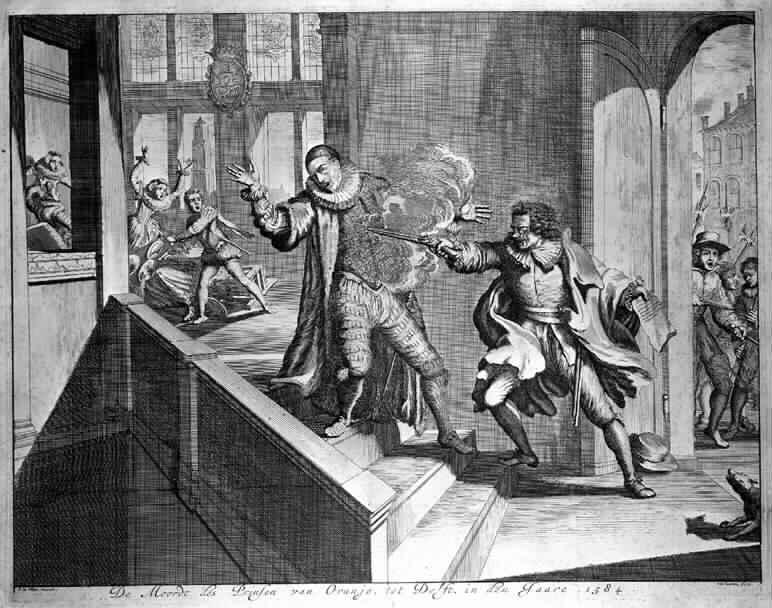
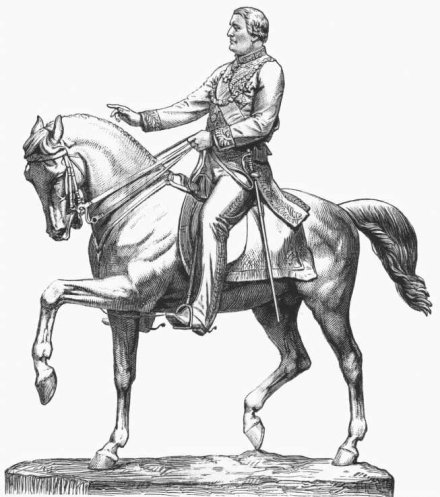
Despite not making a particularly big deal about Lord Mayo’s murder, the Empire did favor its Indian subjects with a Calcutta equestrian statue of the assassinated viceroy.


This monument and other former public memorials from the British imperial period now squirreled out of view in independent India can be found on a fun Flickr gallery, Forgotten Statuary of the British Raj. Brits can find the Earl of Mayo in marble closer to home in Cockermouth.

Mayo was also the namesake of the Mayo School of Arts in Lahore, present-day Pakistan (it’s now known as the National College of Arts). The school’s first principal was Lockwood Kipling, and this man was able to hook his 16-year-old son up with an assistant-editorship at a Lahore newspaper … from which young Rudyard Kipling launched his literary career.

* The “lone nut with a grudge” version has been latterly disputed with attempts to reconstruct Sher Ali as an Islamic revolutionary.

On this day..

2012: Three drone strike spies in Yemen

It was reported that a year ago today, Islamic militants beheaded three in the South Yemen towns of Ja’ar (in the Abyan Governorate) and ‘Azzan (in the adjacent Shabwa Governorate) on charges of providing intelligence to help the U.S. to conduct drone strikes.

The executions were announced to the media by text message.

The ongoing shadow drone war in Yemen has steadily drummed that fractious Arabian peninsula state with missiles from flying death robots, piloted from afar (under separate command structures, little difference though that makes to those on the receiving end) by the CIA or the U.S. military’s Joint Special Operations Command.

The deaths one year ago took place in the sunset of President Ali Abdullah Saleh‘s government, when much of southern Yemen was functionally controlled by militants for several months. The Obama administration significantly ramped up drone strikes in south Yemen from late 2011, and kept right on ramping throughout 2012.

The stated target of all this remote-controlled ordnance is Al Qaeda in the Arabian Peninsula, but it’s more than clear that many of the nameless casualties are not militants.

For instance (and this was obviously not the strike being avenged by our February 12 execution in that same city), a May 2012 drone raid on Ja’ar was decried by locals who insisted that not one militant was among the dead.* “Our lives are valueless in the eyes of our government, and that is why civilians are being killed without a crime,” one man told CNN.

Then again, as this post goes to press, Americans have themselves had a bracing reminder of their own killability, courtesy of a leaked memo giving a partial glimpse of the Obama administration’s startlingly expansive assertion of the right to murder American citizens or whomever else on the unilateral say-so of somebody sufficiently senior.

A generation ago, the U.S. had explicit state policies abjuring assassination. Today, there are routine “Terror Tuesdays” at which the chief executive reviews proposed additions to an official kill list.** All of this is claimed as a power of a planetwide war that can never end, but in practice bears an uncomfortable resemblance to something our militants in Ja’ar and ‘Azzan would surely appreciate — extrajudicial execution.†

* Official story: two terrorists dead, “only” eight civilians; locals said around 17 to 26 killed, none of whom were terrorists. The U.S. has been accused of using Vietnam-era “body count” rules and claiming every military-aged male killed by a drone counts as a “militant.” (Contra Vietnam, Washington depresses rather than exaggerates the overall casualty counts.)

** Many drone attacks target not named individuals, but unknown people whose activities from drone or satellite surveillance are held to match a terrorist’s pattern.

† There’s even been a Congressional proposal for a secret court to decide who goes on the secret kill list.

On this day..

1923: Eligiusz Niewiadomski, assassin-artist

On this date in 1923, Polish nationalist painter Eligiusz Niewiadomski was executed for assassinating Poland’s first president.

After more than a century under German, Austrian, and (most especially hated) Russian domination, Poland had established itself an independent republic in the first world war’s imperial wreckage.

Niewiadomski (English Wikipedia entry | Polish), whose father had taken part in the 19th century’s anti-Russian January Uprising, was a talented painter with a serious nationalist streak.

And that was really the done thing for his time and generation: his painting career from the 1890’s into the early 20th century maps the Young Poland movement of up-and-coming artists experimenting with new forms and celebrating romantic attachment to their prostrate homeland.


“The conscience of Polish literature,” Young Poland writer Stefan Zeromski, as depicted by Niewiadomski.

When not promoting patriotic appreciation of the Tatra Mountains, Niewiadomski enjoyed supporting Polish National Democracy, a right-wing movement raging against the Cossack yoke.

Niewiadomski was a true enough believer to serve time in a tsarist prison, but he was far from the leading light of either the artistic or political movements. By the time Poland attained independence (Niewiadomski worked for Polish intelligence during World War I, and even finagled a cameo on the front lines), he was in his fifties and seemingly settling in for a slow moulder into obsolescence in bureaucratic posts and artistic monographs.

(Of course, had he done so, the next decades would have brought him their own surprises.)

Instead, the 1922 election for President of the Polish Republic, which was decided in that country’s National Assembly, saw parliamentary horsetrading elevate an engineer on the strength of the left parties’ votes — a shock victory over Niewiadomski’s preferred right-wing candidate Count Maurycy Klemens Zamoyski, the infant republic’s Bush v. Gore.

It came to street disturbances, to assaulting members of parliament, to demonstrations “for” and “against.” There were casualties. Lumps of dirty snow were thrown at the carriage of the president-elect as it drove across the town. Newspapers dreamt of “a lump of snow that will change into an avalanche” and about removal of that man-“hindrance,” that man-“obstacle.” … The infamous ride through the streets of Warsaw was a ride down death’s lane. Someone hit the first president of the republic in the head with a stick, someone else waved brass knuckles in his face …

-Anna Bojarska in From the Polish Underground

So, five days into Gabriel Narutowicz‘s term, Niewiadomski did what any violent, disaffected patriot would do: he gunned down the new Polish president at the Zacheta art gallery. It’s always great to see artists participating in the political dialogue.

This event is the subject of the 1977 Polish film Smierc prezydenta (Death of a President).

The shots by Niewiadomski marked an end to the week of hatred. Poland suffered a shock — even the Right did. National reconciliation bloomed like a thousand flowers. The president’s funeral became an occasion for a deeply disturbed society to demonstrate. Half a million people walked in the funeral procession!

-Bojarska, again

Less than seven weeks later, Niewiadomski christened that national reconciliation with his blood … at a fortress the Russians had once used to garrison his country, Warsaw Citadel.

On this day..

1565: Benedetto Accolti, would-be papal assassin

On this date in 1565, three men who schemed to assassinate Pope Pius IV were put to public death at the Capitol.

Detail (click for the full painting) of Parnassus by Raphael, the Vatican’s “Raphael Rooms”. According to Jonathan Unglaub,* this figure is the then-acclaimed, today-obscure poet Bernardo Accolti, our failed assassin’s great-uncle.

Pius was a pope of the counter-reformation; it was he who brought the Council of Trent to its conclusion.

And though generally noted for his moderation (and his enthusiasm for building), he was not above striking heads from shoulders. Upon his ascension a few years prior he had dealt harshly with the nephews of his predecessor.

Accolti hailed from a prominent Florentine noble family; his father and namesake was a scheming cardinal.

Young Benedetto, clearly, could scheme a little himself, since he roped several buddies (Italian link) into a plot to murder the pontiff. In December 1564, they presented themselves at a papal audience, but apparently got cold feet. One of their number, a Cavalier Pelliccione, ratted the lot of them out before they could muster their nerve a second time: the good cavalier might have been motivated by having possession of treasonably pre-written letters to be sent to various dignitaries upon the pope’s violent deposition.

Pelliccione accordingly skated with a pardon, but two co-conspirators were sent to the galleys for life.

Benedetto Accolti, Antonio Canossa, and Taddeo Manfredi were dragged to the Capitol on January 27 and put to the gruesome public butchery — “like cows” — of the mazzolatura.

There are several resources that claim the plot was among Catholic ultras who found Pius a little on the heretical side. This Italian encyclopedia entry attributes to the astrologically-inclined Accolti a more nutty-prophetic ambition of a “papa angelico” who would unify Christendom.

Maybe he should have just exercised a little patience. Pius IV died in December 1565.

* Jonathan Unglaub, “Bernardo Accolti, Raphael’s ‘Parnassus’ and a New Portrait by Andrea del Sarto,” The Burlington Magazine, Vol. 149, No. 1246, Art in Italy (Jan., 2007).

On this day..

1813: The Yorkshire Luddites, for murdering William Horsfall

This is the bicentennial of the hanging of three Luddites for the murder of manufacturer William Horsfall.

“Luddite” has come to refer imprecisely to a wide range of anti-mechanization machine-wrecking in early 19th century Britain; however, it’s most properly applied to a specific 1811-1816 movement.

While often understood casually as a sort of mindless technophobia, wreckers — Luddites and otherwise — actually had material labor grievances. New more efficient power looms reduced skilled workers to the ranks of unskilled subsistence labor, or to those of the superfluous unemployed.

With trade unionism illegal (and severely repressed), their means of resistance were of a desperate character. Lord Byron, almost alone in Parliament, rose to defend them: “These men were willing to dig, but the spade was in other hands; they were not ashamed to beg, but there was none to relieve them. Their own means of subsistence were cut off; all other employments pre-occupied; and their excesses, however to be deplored and condemned, can hardly be the subject of surprise.”

Hence, Byron sarcastically remarked, “new capital punishments must be devised, new snares of death must be spread, for the wretched mechanic who is famished into guilt.” Parliament did indeed extend its capital statutes to the protection of these new looms.

“Wrecking,” in the analysis of the late Eric Hobsbawm, “was simply a technique of trade unionism in the period before, and during the early phases of, the industrial revolution.”

Hobsbawm quotes a Nottingham town clerk describing the way textile manufacturers “acquire entire control of their workmen” by putting them to work on the owners’ power looms rather than hiring out workers who use their own looms. “Perhaps the most effectual manner in which the combination [read: proto-union] could coerce them was their former manner of carrying on war by destroying their frames.”

And the descriptor “war” was not far off.

The Luddites — so named for legendary loom-smasher Ned Ludd — proliferated in 1811-1812. Beginning in Nottingham with a protest against falling wages signed by General Ned Ludd and the Army of Redressers, they tapped a wellspring of discontent.

It was a time of war, of economic crisis, of spiking wheat prices whose rise to an 1812 record peak further immiserated those who scraped to earn a living by the sweat of their brow. A generation after the French Revolution, with Napoleon rampant on the continent, English elites had reason to fear their own legitimacy stood on unstable ground.* In 1811, the king even went mad.

And they thrive well who from the poor
Have snatched the bread of penury,
And heap the houseless wanderer’s store
On the rank pile of luxury.

-Percy Bysshe Shelly, “The Devil’s Walk” (1812)

From their birthplace in Nottingham, Luddite societies spread out through textile country, conspiring by moonlight to break into factories and smash up frames or commit other acts of industrial sabotage. (There’s a pdf timeline here) Byron, the Luddites’ defender, owned that the night before he departed a recent visit to Nottingham, “forty frames had been broken the preceding evening as usual, without resistance and without detection.”

Terrified manufacturers — some were known to have armored their establishments with what amount to siege fortifications; others, to outfit homes with early panic rooms as bolt-holes in the event of a Luddite attack — met this mob action violently. Westminster put 12,000 troops into Luddite country to fight the wreckers.

And the wreckers fought back.

William Horsfall, owner of a Marsden wool mill with 400 employees, had vowed to “ride up to his saddle in Luddite blood” … which promise gave a poetic twist to his actual fate: while riding on Huddersfield‘s Crosland Moor** in April 1812, a group of Luddites lying in wait opened fire on him and shot Horsfall through the groin.

“As soon as he fell after being wounded the inhuman populace surrounding him reproached him with having been the oppressor of the poor — they did not offer assistance,” an officer later reported. “Nor did any one attempt to pursue or secure the assassins who were seen to retire to an adjoining wood.” A fellow-manufacturer helped Horsfall to an inn, where he expired painfully 38 hours later.

It was several months before the powers that be were able to crack it.

Eventually, the energetic Huddersfield magistrate Joseph Radcliffe† was able to exploit the threat of hanging to force a Luddite cropper‡ into impeaching his confederates in the plot. This investigation is covered in marvelous detail at the Luddite Bicentenary blog, an outstanding resource on the period in general, but for our purposes we’ll sum up to say that the hunt for Horsfall’s killers wound up zeroing in on George Mellor, Thomas Smith, and William Thorpe.

They were tried over 11 hours on a single day, January 6, 1813 (summary: 1, 2, 3, 4).

That was a Wednesday.

That Friday, the three hanged in their manacles behind York Castle under heavy military guard to forestall any possible rescue, having never admitted any part in the murder. The authorities judiciously eschewed a more demonstrative (and potentially riot-inducing) execution at the scene of the crime.

“The number of people assembled was much greater than is usual in York, on those melancholy occasions; but not the slightest indication of tumult prevailed, and the greatest silence reigned during the whole of this solemn and painful scene,” the Leeds Mercury reported§ — and darkly explicated the intended lesson of the scene for other machine-wreckers.

all those who may have been so far infatuated as to become members of such societies should, from this moment, and by one common consent, desist from taking another step in furtherance of their objects. They must now see that they have stood on the brink of a frightful precipice, and that another step might have plunged them into that gulph which has overwhelmed their less fortunate associates.

The mailed fist deployed against wreckers in 1812-1813 did indeed smash the movement. Still, sporadic Luddite attacks would continue as late as 1816, and Luddite veterans went at the fore of the 1817 Pentrich Rising … just outside the place it all began, Nottingham.

* It was in just this period — in fact, only a few days after William Horsfall’s murder — that Prime Minister Spencer Perceval was assassinated. Given the conditions abroad in the land, many an elite feared upon first notice of this event a revolutionary rising … although Perceval’s killer turned out to be a deranged merchant whose confused private grievance had nothing to do with Britain’s social tensions.

** Not far from the spot of Horsfall’s murder — and a standard stop on every present-day Luddite commemorative walk — you’ll still find William Horsfall Street.

† Radcliffe’s exertions in the war against the Luddites secured for his family a still-extant baronetcy.

‡ Benjamin Walker, the Luddite informer who sent Mellor, Smith, and Thorpe to the gallows, was denied the advertised £2000 reward and wound up a beggar in London.

§ Leeds Mercury report via a reprint in the London Times of Jan. 12, 1813. (Also see this excerpt.)

On this day..