1879: Joseph Davidenko, Sergei Chubarov, and Dmitri Lizogoub

On this date in 1879, three Russian nihilists were hanged for an attempted regicide.

Revolutionary nihilism flowered in 1870s Russia; in the words of the movement’s expatriate crier Stepniak,

In 1870 the whole of advanced Russia was anarchist … The socialists of this epoch based all their hopes upon the peasants. Thousands of young people of both sexes went upon a crusade among the peasants; the more exalted with the object of calling them to open rebellion, the more moderate with the intention of preparing the ground for future revolution by peaceful socialist propaganda. This was one of the most touching and characteristic episodes of the younger movement, when the motto “All for the people and nothing for ourselves” was the order of the day.

This socialist crusade was a complete failure. … In the course of 1873 and 1874 fifteen hundred propagandists and agitators, or their friends and supposed accomplices, were arrested in the thirty-seven provinces of the empire, and thrown into prison. Half of them were released after a few months’ detention; the rest were kept in preliminary confinement from two to four years, during which seventy-three either died or lost their reason. In 1877 one hundred ninety-three were tried and condemned to various punishments, from simple exile to ten years of hard labor in the mines of Siberia …

But theories, once adopted, do not disappear so easily. The passions spoke first; and men began to act in the right direction before they had reasoned out their action. The wanton cruelty with which political prisoners were treated, the horrors of preliminary detention, the barbarous punishment inflicted for trifling offences — all this proved unendurable even to the mild, patient Russians. The spirit of revenge was kindled, giving birth to the first attacks upon the Government, known by the name of terrorism.

We have met these passionate Russians time and again in these pages, of course. And like this group, the movement’s ne plus ultra objective was taking out the tsar himself.

The reader will have noticed that Stepniak’s leading players are elites gone to rouse the masses to rebellion rather than creatures of the masses themselves. One of the leading figures in this date’s group, Dmitri Lizogoub — many transliterations are possible: Lissogub, Lizogoob, etc. — was a wealthy nobleman; indeed, he was one of his comrades’ chief financiers. The “Saint of Nihilism” was turned in by his own steward for the opportunity to collect as his bounty the small remainder of Lizogoub’s estate. Sergei Chubarov, another nobleman, instigated the assassination plan for which they die: to greet a state visit by the much-targeted Alexander II to Nikolaev explosively.

It was after a dragnet of putative subversives in the wake of Soloviev‘s April 1879 assassination attempt that our batch for today was rounded up and put before a military proceeding among a group of 28 terrorists. Others received terms of prison or Siberian exile; Lizogoub, Chubarov, and a Black Sea fleet deserter named Joseph Davidenko publicly hanged together at the Odessa race-course. Two others of their circle, Wittenberg and Lobovenko, were executed in the subsequent days at Nikolaev.

This particular conspiracy was detected in time, but conspiracies in general did not abate in the wake of harsh punishment: if anything, dreams of tyrannicide redoubled. Given the sheer volume of plots against the Autocrat of All the Russias, one, inevitably, finally got through.

On this day..

1897: Michele Angiolillo, assassin of Canovas

On this date in 1897,* anarchist Michele Angiolillo was garroted in Vergara prison for assassinating the Spanish Prime Minister.

Angiolillo (English Wikipedia entry | Spanish) was an Italian expatriate in England who was so incensed by the procesos de Montjuic — a spasm of indiscriminate arrests and torture that followed an anarchist bombing in Barcelona — that he resolved to avenge the crime against his brothers.

“He read of the great wave of human sympathy with the helpless victims at Montjuich,” Emma Goldman wrote of Angiolillo. “On Trafalgar Square he saw with his own eyes the results of those atrocities, when the few Spaniards, who escaped Castillo’s clutches, came to seek asylum in England. There, at the great meeting, these men opened their shirts and showed the horrible scars of burned flesh. Angiolillo saw, and the effect surpassed a thousand theories; the impetus was beyond words, beyond arguments, beyond himself even.”

That named “Castillo” whose clutches rent so much flesh was the Spanish Prime Minister Antonio Canovas del Castillo, a statesman whose pioneering contribution to the art of manufactured consent was the turno system whereby two major Spanish political parties alternated turns in power/opposition and mutually connived to engineer ceremonial elections to that effect.

Upon his shoulders rested responsibility for the Barcelona torture regime.

And Angiolillo took it upon his shoulders to hold the executive to account.

Slipping into Spain with false papers, Angiolillo found Canovas taking a restorative visit to the Santa Agueda thermal baths and shot him dead on August 8.

As guards overcame the gunman — much too late — Canovas’s wife shrieked at him, “Murderer! Murderer!” The shooter gave her a bow and asked her pardon, for “I respect you, because you are an honorable lady, but I have done my duty and I am now easy in my mind, for I have avenged my friends and brothers of Montjuich.” (There are different versions of this bit of faux-politesse reported; suffice to say that in any form the remark was more pleasurable for Angiolillo to deliver than for the widow to receive.)

Official undesirables, by no means limited to anarchists who had survived Inquisition tactics in Montjuic, could scarcely contain their glee. New York anarchists avowed their support. Cuban and Puerto Rican separatists fretted only that the glory of the deed did not belong to one of their own. The Cubans specifically (and correctly) anticipated that the death of Canovas spelled the imminent recall of “Butcher” Weyler, the island’s strongman governor who had brutally crushed a rebellion there.**

His trial was undertaken within days, a mere formality considering that Angiolillo obviously shared the pride taken in his act by his overseas supporters. He justified the murder with reference not only to the torture and execution of anarchists at Montjuic, but of the execution of Philippines independence martyr Jose Rizal a few months prior.

* There are some sites proposing August 19 or 21. Period press reports are unambiguous that the correct execution date is August 20.

** William Randolph Hearst’s New York Journal would publish a banner headline during the imminent Spanish-American War triumphantly asking readers, “How do you like the Journal’s war?” Its claim to ownership stemmed in part from Hearst’s relentless hyping of Weyler’s (very real) atrocities over the preceding years.

On this day..

1962: Talduwe Somarama, Ceylon assassin

On this date in 1962, the Buddhist monk — turned Christian convert in detention — Talduwe Somarama was hanged for assassinating Ceylon Prime Minister S.W.R.D. Bandaranaike. (Ceylon became Sri Lanka in 1972.)

Somarama was a 44-year-old ayurvedic medicine practitioner when he was tapped for the job by a powerful Buddhist named Mapitigana Buddharakkitha, high priest of the Kelaniya temple. The latter had played kingmaker in Bandaranaike’s 1956 election — and had perhaps two interlocking grievances against Bandaranaike:

  1. Buddharakkitha had been balked by the government of lucrative trade concessions he anticipated as the quid for his quo; and,
  2. Buddharakkitha was closely linked to the movement of partisan Sinhalese Buddhist nationalists who in Ceylon’s early years systematically discriminated against the island’s ethnic Tamils — and were angered at Bandaranaike’s halting moves to reach an accommodation.*

Exploiting the prerogatives of clergy, Somarama obtained a September 25, 1959, meeting un-screened by security for one of the Prime Minister’s public-audience days, a revolver secreted in his saffron robes. When Bandaranaike knelt ceremonially to the monk, Somarama shot him in the stomach.

The wound was mortal, but the Prime Minister lingered on all that night — long enough even to give a televised address from his hospital bed asking his countrymen to “show compassion to” his assassin “and not try to wreak vengeance on him.”* Only months before the murder, ethnic riots had devastated minority Tamil communities, and another pogrom might have been averted on this occasion only the quick thinking of a government official to promulgate immediate word that the assassin was not Tamil.

Ironically Buddharakkitha was so far above suspicion at that he was solicited for a broadcast eulogy of his victim. One can only imagine his relish at the performance — but it was not to last. Buddharakkitha was tried as a conspirator for orchestrating Somarama’s deed, dodged a prospective death sentence, and died in 1967 serving a prison sentence at hard labor.


Talduwe Somara on the steps of the courthouse …


… and Buddharakkitha likewise.

Bandaranaike’s daughter Sirimavo succeeded him as Prime Minister in 1960, becoming the world’s first elected female head of government. A second daughter, Chandrika, and a son, Anura, have also been prominent Sri Lanka politicians.

This three-part series unpacks some of the primary sources on the murder and speculates as to cui bono: Part 1 | Part 2 | Part 3

* Buddharakkitha, also noted for exploring paths to enlightenment with various Sinhalese elites’ wives, was the high priest of the Kelaniya temple — which is the titular temple in the 1953 Sinhalese nationalist tract The Revolt in the Temple, “a blunt statement that the Tamils are a threat to [the Sinhalese] historic mission.” Its author was Don Charles Wijewardena, who had been a patron of Bandaranaike as a young monk; the (still-extant) Wijewardena dynasty had likewise associated itself with the Kelaniya temple itself, the political and the devotional mutually reinforcing one another.

The Sinhala-Tamil conflict stoked in these years has progressed in the decades since to ever-bloodier consequences.

On this day..

1800: Suleiman al-Halabi, assassin of General Kleber

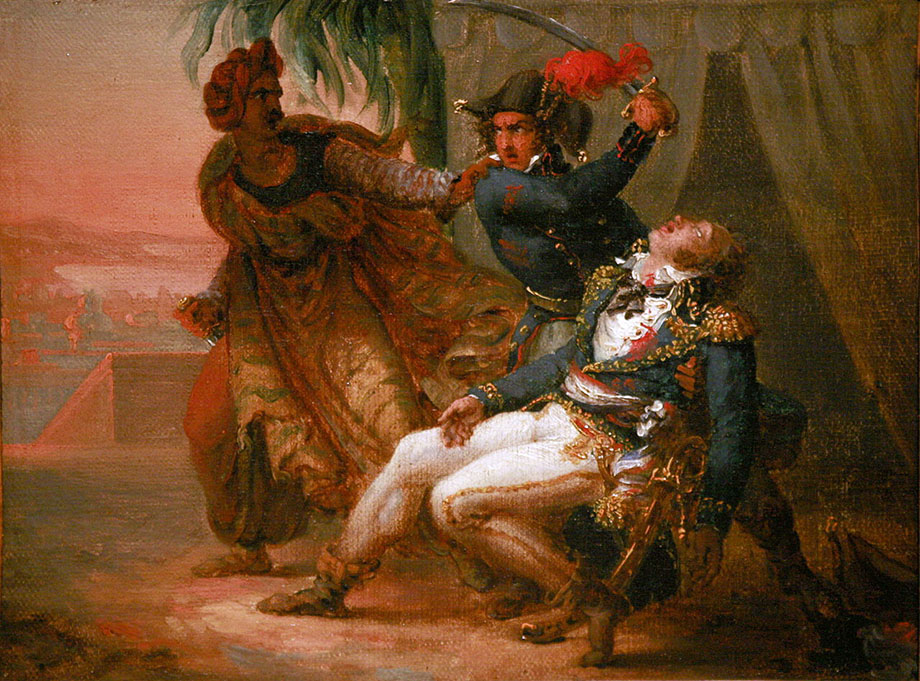
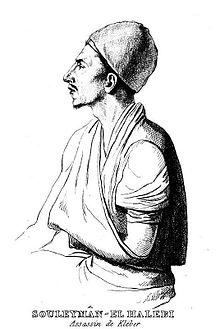
On this date in 1800 — which was the same date they buried his victim — the 23-year-old student Suleiman al-Halabi was put to death in Cairo for assassinating French General Jean Baptiste Kleber.

Casualty of the brief Napoleonic adventure in Egypt, Kleber had received supreme command of the expedition when Napoleon himself returned to France the previous year — a mission which involved running the English naval blockade that trapped the Armee d’Orient.

Kleber, a product of the French Revolution’s military meritocracy who had attained his rank capably suppressing the Vendee royalists, was certainly up to the martial tasks at hand. He routed a larger Ottoman-English-Mamluk force in March of 1800, and then smashed a revolt in Cairo.

But the Napoleonic invasion often figures as a periodization marker for this region: the germ of liberalism and nationalism that would tear apart the Ottoman Empire and set the scene for a recognizably modern Middle East. So it’s somewhat fitting that Kleber would be undone by a figure who could be lifted from the evening news,* the anti-occupation insurgent.

Suleiman al-Halabi (English Wikipedia entry | French) was a Syrian Kurd hailing from Aleppo. (“al-Halabi” means “of Aleppo”)

He had been in Cairo to study, but after a return visit home was induced by the Turks to attend himself to punishing the invader instead. He then made his way back to to Egypt where, disguising himself as a beggar, where he was able to approach the general innocuously and dagger him to death.

The French, of course, had just a few years before this point introduced its most distinctive execution device in place of the ghastly old methods, and employed it with egalite for commoner and king alike. Nor was France, as an imperial power, reluctant about exporting its invention to the every corner of earth.

But in this particular instance, the French decided to prioritize, er, cultural sensitivity.

The committee, after carrying through the trial with all due solemnity and process, thought it necessary to follow Egyptian customs in its application of punishment; it condemned the assassin to be impaled after having his right hand burned; and three of the guilty sheikhs to be beheaded and their bodies burned.

The “guilty sheikhs” in question were men to whom the killer had confided — not his plan, exactly, but the fact that he was on a jihad mission. Hey, close enough.

As for Suleiman al-Halabi himself,

The executioner Barthèlemy sat down on Suleiman’s belly, drew a knife from his pocket, and made a large incision to widen the rectum, then hammered the point of the stake into it with his mallet. Then he bound the patient’s arms and legs, raised the stake the air and mounted it in a prepared hole. Suleiman lived for four hours, and he had lived longer save that, during the absence of Barthèlemy, a soldier gave him a drink which caused his immediate death.

(Impaling victims could live for agonizing days, but the water caused Suleiman, mercifully, to quickly bleed out.)

Not content with going all Vlad the Impaler, the French then paid homage to the invasion’s scientific sub-theme** by shipping Suleiman’s remains back to France for use as an anthropological exhibit.† His skull still remains at the Musee de l’Homme to this day. What’s left in his homeland(s) is a martyr’s memory.

According to the scholar al-Jabarti, whose chronicle is one of the principal sources on this episode, the investigation indicated that Suleiman undertook his mission for no ideology save his family’s desperate need of the purse the Porte was willing to offer. But in the ensuing decades’ growth of nationalism and, eventually, anti-colonialism, the brave young Muslim dying on a spike to slay the French commander could not help but be viewed in an exalted light. (Notably, at the acme of Arab nationalism, the Egyptian writer Alfred Farag celebrated Suleiman as an avatar of resistance in a 1965 play. “I do not kill for revenge,” Farag’s Suleiman avers — and when pressed for the reason, he has a one-word reply: “Justice.”)

* Indeed, the name has been in the news: there’s a Suleiman al-Halabi neighborhood in Aleppo that has seen fighting during the ongoing Syrian civil war. Since it’s even a Kurdish neighborhood one can’t but suspect that it’s named for the man featured in this post; however, I haven’t been able to establish that with certainty. If any reader knows, a comment would be most welcome.

** Napoleon brought a corps of scientists and intellectuals along on his invasion, kicking off the modern Egyptology craze. His mission also uncovered the Rosetta Stone — although that artifact now resides in the British Museum because of the aforementioned naval blockade.

† According to Dark Trophies: Hunting and the Enemy Body in Modern War, phrenologists hailed Suleiman’s skull as an outstanding exemplar of criminality and fanaticism.

On this day..

1902: Hirsh Lekert, Jewish assassin

On this date in 1902, the Jewish socialist Hirsh Lekert was hanged in Vilna (Vilnius) for his attempt on that city’s governor.

The 22-year-old shoemaker, active in the Bund since childhood, was aggrieved along with many others by repressive measures taken against that leftist council by Vilna governor Victor von Wahl — culminating with the calculated humiliation he inflicted by personally overseeing the flogging of 20 Jews and 6 Poles arrested at a May Day demonstration.

As was the style at the time, Lekert took some retaliatory potshots at the municipal dictator on May 18, 1902. He scored a couple of flesh wounds before the police on hand beat him all to hell.

And that was pretty well that. Lekert got sent to face a military tribunal with a foreordained result. But he made his bones with posterity by refusing to apologize and instead fearlessly vindicating his action as a defense of the Jewish worker’s dignity.

This carried his legend in the early 20th century Jewish community much further than one might assume.

For Jewish Workers Bund, “the first great attempt at the organization of the Jewish masses for secular and independent political activity,”* Lekert’s uncompromising embrace of revolutionary violence created an internal controversy: radical workers saw a martyred hero; elites, and the Bund officially, were much more wary of terrorism provoking official backlash in an empire where Jewish communities were still liable to be targeted by pogroms at any time. All this during a renaissance of cultural and political thought among Eastern European Jewry.

Even decades later, the esteem remaining Lekert from his sacrifice gave his name power. Another generation of Jewish terrorists — in Mandate Palestine — was incensed at the British for flogging some Irgun members, leading Menachem Begin to invoke Lekert as his justification for kidnapping several British soldiers and flogging them. (Source) The British had no stomach for this, and desisted with floggings.

Artistic tributes followed as well — folk songs; plays by Arn Kushnirov and H. Leyvik; the bust that illustrates this post; a monument in Soviet Minsk; even this appearance in a 1927 silent film called His Excellency:

And from the hellish Vilna Ghetto under Nazi occupation, the great poet of the Holocaust Abraham Sutzkever depicted his “Teacher Mira” trying to keep her students’ heads up by reminding them of the Vilna cobbler who fought back.

Her skin, a windowpane in stains of dusk,
Mira must not reveal the darkness thus.
She bites her lip, of courage she will tell:
About Hirsh Lekert, how he fought and fell.

* Koppel Pinson, “Arkady Kremer, Vladimir Medem, and the Ideology of the Jewish ‘Bund'”, Jewish Social Studies July 1945.

On this day..

1820: Louis Pierre Louvel, anti-Bourbon assassin

On this date in 1820, Louis Pierre Louvel was guillotined at Paris’s Place de Greve for murdering the heir to the French throne.

Louvel (French link) was a Bonapartist saddler, so embittered by the return of the ancien regime that he vowed on the day of the Restoration to exterminate all the Bourbons.

While his attempt to greet the returning Louis XVIII in April 1814 with a dagger came to naught, Louvel’s patience paid off six years later.

On February 13, 1820, he surprised the Duke of Berry outside the opera and plunged a knife into his chest.

The Duke, who expired the next morning, was not the heir to the throne: he was the younger of two sons of the Comte d’Artois, who was the brother of the still-reigning Louis XVIII. These Bourbons, however, seemed congenitally unable to reproduce: Louis XVIII would die childless, leaving the aforesaid Comte d’Artois to inherit as Charles X; the oldest of Artois’s children also had a childless marriage.

So the potential future of the dynasty looked a murky thing in 1820. The Duke of Berry had an infant daughter, and the guy looked like maybe the only male in the royal family’s younger generation who might be capable of fathering a son. Louvel’s blow potentially set the stage for an eventual succession crisis.*

The killer was promptly arrested and made no bones about his action, avowing that he acted without aid or accomplice. He had, he said, no particular personal beef with the Duke: it’s just that he considered the guy’s entire family traitors whose presence dishonored the nation. (Here’s a complete French account of his trial.)

Because Louvel had his head cut off by the guillotine, he was not around to experience the miraculous September delivery by Louvel’s widow of a posthumous son and heir. In time, this son would become the Legitimist pretender to the French throne.

As a matter of fact, the prideful Count of Chambord could have become king after the Franco-Prussian War and the Paris Commune wiped away the Second Empire. But to the grief of practical-minded monarchists, he publicly refused to accept the offered throne that he’d been waiting all his life for unless the nation also gave up the beloved tricolore flag associated with the regicidal Revolution. France said no thanks, and hasn’t had a monarch since.

* One more immediate consequence of Louvel’s strike: the liberal monarchist prime minister Elie Decazes came under opportunistic attack by ultra-royalists for giving aid and comfort to the terrorists with his moderate policies. Decazes was forced to resign and briefly went into exile in England due to the Ultras’ fulminations.

On this day..

1901: Filipino insurgents on Luzon

The American occupation of the Philippines from 1899 spawned a widespread indigenous resistance whose “hatred of our people is as bitter as it is groundless,” one American general puzzled.

Not all Americans saw it that way. William Jennings Bryan‘s populist magazine The Commoner slagged the U.S. Army for its liberal use of “the methods best calculated to give them new reasons for hating us.”


Cartoon on the cover of Life magazine’s May 22, 1902 issue (click for larger image) shows colonial European powers chortling, ‘Those pious Yankees can’t throw stones at us any more’ as they watch Americans apply the water cure to a Filipino captive. Torture by water cure was widespread during the Philippines-American War.

“The native is tied down flat on the ground and his mouth forced open with sticks or a string,” one soldier described it (pdf source; it’s on page 23). “Water is poured down his throat through a bamboo tube, which is nearly always handy. The native must drink the stuff, and it is poured down him until he can hold no more. As much as a gallon can be forced into a man that way. Then the water is pumped out of him by stamping on his stomach or rolling him over. When he comes to the native is always ready to talk.”

Apart from guerrillas in the field, Filipino insurgents opposed the occupiers’ superior firepower with the nasty asymmetrical tactics of assassination and terrorism, and that’s what brings us to today’s post.

Filipino terrorists known as Ducots, Mandoducots, or Sandathan on August 28, 1900 murdered a wealthy Los Banos landowner named Honorato Quisumbing who served as a town “presidente” under the American occupation.

A U.S. military court found that nine prisoners at the bar (in combination with “other natives whose names are unknown”) made “an assault upon the said Honorato Quisumbing with clubs, knives, bolos, and daggers, and did then and there wilfully, feloniously, and with malice aforethought kill and murder the said Honorato Quisumbing by striking, cutting, and stabbing the said Honorato Quisumbing with the said clubs, knives, bolos, and daggers.”

The decedent was a Visayan doing business as a merchant at Santa Cruz and Los Banos … formerly loyal to the Spanish Government and transferred his loyalty, active assistance, and cordial good will to the succeeding Government of the United States … Because of his friendshipfor, and willingness to aid, the forces of the United States, he was made a marked man, and the order went forth from the insurgent chiefs that he should be secured, dead or alive; and, as the sequel shows, a money reward was offered for his life.

General Arthur MacArthur — father of World War II General Douglas MacArthur — commuted four of the sentences to prison terms, and approved the remaining five executions for April 5, 1901.

Honorato Quisumbing’s widow was compensated by American authorities to the tune of $1,500. One of the victim’s seven sons, Eduardo, grew up to become his country’s leading botanist.


Further north on Luzon that same date, the pueblo of Mexico witnessed the hanging of insurgent captain Isabello del Rosario, also by authority of the American military government.

He’d been convicted of various depredations as what his prosecutors called “a notorious outlaw,” the most shocking of which was buring alive a man who had been reported to have made suspicious inquiries as to the whereabouts of the guerrillas. (He was also convicted of rape, extortion, and the most egregious war crime, fighting out of uniform.)

On this day..

1857: Jean-Louis Verger, doctrinaire

On Saturday, January 3, 1857, the Archbishop of Paris Marie-Dominique-Auguste Sibour had just reached the church of Saint-Etienne-du-Mont when Jean-Loiuis Verger stepped out of a crowd — out of obscurity — and plunged a long Catalan knife fatally into Sibour’s chest.

The assassin Verger (English Wikipedia entry | French) was a 30-year-old ordained priest who had accumulated a quarrelsome reputation among his ecclesiastical peers. The previous year, he had been laid under an official interdiction for preaching against the Catholic Church’s controversial new doctrine of the Virgin Mary’s Immaculate Conception.

Some reports had Verger crying out “No goddesses!” as he daggered the archbishop. “It is nowise the person of the Archbishop of Paris whom I wished to strike, but, in his person, the dogma of the Immaculate Conception,” Verger told the magistrates who judged him within days. There wasn’t a whole lot of doubt about the trial, so why wait around? But Verger’s vendetta wasn’t only theological; his suspension meant he wasn’t getting paid, and as his fury mounted over it he went so far as to post himself at the door of a church with a placard proclaiming that he was starving.

Archbishop of Paris was a surprisingly dangerous job in the mid-19th century. Sibour got the post because his predecessor was shot dead negotiating at a barricade during the 1848 revolution; in 1871, Archbishop Georges Darboy was taken hostage by the Paris Commune and executed by his captors when the national government invaded the city.

On this day..

1963: Lazhar Chraiti and nine other Tunisian conspirators

Ten men were executed at dawn on this date in 1963 in Tunis for an assassination plot against President Habib Bourguiba.

Lazhar Chraiti. His daughter has founded a center dedicated to rehabilitating his memory.

Bourguiba was first president of the independent Republic of Tunisia, having led that country out of French domination in the 1950s … and this plot was the first major threat to his rule. “It is a miracle that I am still alive,” he told a women’s conference at the western city of El Kef after it was discovered on December 19. Kebair Meherzi, an officer of President’s Guard (who was among those executed this date) had been privy to the plot, and intended to admit the assassins to Bourguiba’s own bedside. (London Times, Dec. 27, 1962)

Twenty-six people faced a military trial for this attempted coup in early January with thirteen death sentences handed down — most notably including legendary Arab independence guerrilla Lazhar Chraiti (by now a respected official in the ruling Neo Destour party).

One of those 13 was condemned in absentia, having already fled the country to Algeria — the plotters’ Algerian ties caused Tunisia to withdraw its embassy — while two other army officers were reprieved to life and hard labor.

On this day..

1536: Sebastiano de Montecuccoli, poisoner of the heir?

On this date in 1536, Italian nobleman Sebastiano de Montecuccoli was torn apart at the Place de la Grenette in Lyons for poisoning the dauphin Francis, heir to the French throne.

Sebastiano de Montecuccoli was a knight from Ferrara who had arrived in France in the train of the Catherine de’ Medici when she was married off to the no. 2 French prince Henri. He was fast friends with the royal princes, but his proximity to the family horribly turned against him when the 18-year-old Francis played a game of tennis, then caught ill and dropped dead. The last thing poor Francis had done was ask Montecuccoli for a glass of water.

In an era of forensics-by-guesswork, a sudden and unexplained death inevitably drew suspicions of poison — all the more so in a France gone security bonkers in the wake of the Affair of the Placards.

So just was in that glass of “water,” eh?

Sebastiano, upon his arrest, was found to possess a tome of poisons. This was a common enough interest among his class. (Catherine de’ Medici also had an interest in poison.) Nevertheless, it was great material for tunnel-vision investigators, and the young Italian soon provided a corroborating self-incrimination under torture: Sebastiano had offed the crown prince on orders from France’s longtime rival Charles V, who also just happened to be fighting a war with France over the duchy of Milan at that very moment.

Sebastiano attempted to recant this confession once he was off the rack, but to no avail. Many 16th century contemporaries could descry the eventual consensus of posterity that Sebastiano was a naif, and not an assassin. (Francis likely died from a disease.) Less generous by far was the judgment of the Lyonnaise citizenry who fell upon and ravaged Sebastiano’s body after it had been torn apart by horses.

Thanks to the unexpected death of the heir that triggered this horrible punishment, Francis’s brother Henri advanced to the crown prince seat and eventually became Henri II of France (until Henri’s own unfortunate sporting mishap) … and that Italian bride Catherine de’ Medici became Queen of France.

On this day..