995: Tormod Kark

On an unrecorded date in 995, Norwegian slave Tormod Kark became the first person beheaded under King Olaf I of Norway.

A subsidiary character in a long and brutal struggle for supremacy in Norway and its neighbors to the east and west, Kark had betrayed his lord, the de facto Norweigan ruler Haakon Jarl (“Earl Haakon”), as Olaf Tryggvason’s army searched for him. Haakon had holed up on a farm with Kark and at least one other trusted associate, but when Kark heard of the reward for Haakon’s, he thought it more opportune to kill his lord than to wait to be found.

Kark expected cake. Instead, King Olaf I abhorred his disloyalty and delivered him death.

Olaf grew up a refugee in the court of Kiev Rus’ ruler Vladimir the Great, who, according to some early sagas, had a Norse wife. Regardless of the circumstances, Olaf’s military prowess was such that Vladimir eventually became distrustful of a potentially dangerous guest and Olaf decided to take his leave.

Making his way back to Norway, Olaf married for the first time. When his wife died, he took sail down to the Scilly Isles (south of England), where he converted to Christianity. He then moved to England (Norsemen held sway there at this time). During his time there, he caught wind of Haakon Jarl waning hold on the affections of Norwegians high and low.

Olaf jumped at the chance. He quickly formed an alliance with several local leaders and sallied forth, and practically from the time he hit the fjords, Haakon was a fugitive.

Haakon Jarl — a.k.a. Haakon Sigurdsson — was an old friend of Harald Bluetooth,* the man credited with uniting Norway and Denmark. Haakon’s father was killed by Harald Greycloak, and Bluetooth enlisted Haakon to avenge that death. (He did so, with aplomb.)

With Greycloak out of the way, Bluetooth had solidified his position as effective ruler of Norway, where he installed Haakon — now elevated to Earl Haakon — as his vassal king. Haakon Jarl had wide latitude to subjugate the lands around him. As vassal, though, Haakon was called on by Bluetooth to fight the Holy Roman Emperor Otto II, who had made an alliance with Olaf’s father-in-law in an effort to overrun the still-pagan Norse.

Bluetooth et al fought them off initially, but Otto II sent a fleet around to Jutland and bested the Danes and Norwegians. As a result, Haakon, Harald, and their armies were forcibly converted to Christianity.

Unwillingly as he had adopted it, Bluetooth maintained his new Christianity; Haakon Jarl didn’t really go in for that Jesus stuff and stubbornly held to his paganism. When Bluetooth** approached Haakon about really really converting around 977, the Jarl refused to accept the Christian faith, instead taking his Norway and going home. Haakon thereafter ruled on his own for almost 20 years.

Ultimately, it may have partially been paganism that defeated the Jarl, who was never crowned king: Haakon’s enemies cited his distrust of Christianity as a motivator in the initial agitations against him. That may just be spin, too, since Olaf was so adamantly Christian that he insisted those under his rule convert.† And heavenly imprimaturs tend to be a hot commodity for usurpers.

Regardless of the cause, by 995 Haakon Jarl was beheaded by his slave, his slave was beheaded by the king, and King Olaf I sat on the throne of Norway.

And then five years later, Haakon Jarl’s sons deposed King Olaf.

Olaf summoned the people together out in the yard, and standing on the rock which was beside the swine-sty spake unto them, and the words that he uttered were that he would reward with riches and honour the man who would work mischief to Earl Hakon. This speech was heard both by the Earl and Kark. Now by them in the sty had they a light there with them, and the Earl said: ‘Why art thou so pale, yet withal as black as earth? Is it in thy heart, Kark, that thou shouldst betray me?’ ‘Nay,’ said Kark, ‘we two were born on the self-same night, and long space will there not be twixt the hour of our deaths.’ Towards evening went King Olaf away, & when it was night Kark slept, and the Earl kept watch, but Kark was troubled in his sleep. Then the Earl awakened him & asked him whereof he dreamt, and he said: ‘I was now even at Ladir, and Olaf Tryggvason placed a gold ornament about my neck.’ The Earl answered: ‘A blood-red ring will it be that Olaf Tryggvason will lay about thy neck, shouldst thou meet with him. Beware now, and betray me not, & thou shalt be treated well by me as heretofore.’ Then stay they both sleepless each watching the other, as it might be, but nigh daybreak fell the Earl asleep and was troubled at once, so troubled that he drew his heels up under him & his head likewise under him, and made as though he would rise up, calling aloud and in a fearsome way. Then grew Kark afeard & filled with horror, so it came to pass that he drew a large knife from his belt and plunged it into the throat of the Earl cutting him from ear to ear. Thus was encompassed the death of Earl Hakon. Then cut Kark off the head of the Earl and hasted him away with it, and the day following came he with it to Ladir unto King Olaf, and there told he him all that had befallen them on their flight, as hath already been set forth. Afterwards King Olaf let Kark be taken away thence, & his head be sundered from his trunk.

Thereafter to Nidarholm went King Olaf and likewise went many of the peasantry, and with them bare they the heads of Earl Hakon and Kark. In those days it was the custom to use this island as a place whereon might be slain thieves & criminals, and on it stood a gallows. And the King caused that on this gallows should be exposed the heads of Earl Hakon and Kark. Then went thither the whole of the host, and shouted up at them and cast stones, and said that they went to hell each in goodly company, ever one rascal with another. Thereafter did they send men up to Gaulardal, & after they had dragged thence the body of Earl Hakon did they burn it. So great strength was there now in the enmity that was borne against Earl Hakon by the folk that were of Throndhjem that no one durst breathe his name save as the ‘bad Earl,’ and for long afterwards was he called after this fashion. Nevertheless it is but justice to bear testimony of Earl Hakon that he was well worthy to be a chief, firstly by the lineage whereof he was descended, then for his wisdom and the insight with which he used the power that pertained to him, his boldness in battle, and withal his goodhap in gaining victories and slaying his foemen. Thus saith Thorleif Raudfelldarson:

Hakon! no Earl more glorious ‘neath the moon’s highway:
In strife and battle hath the warrior honour won,
Chieftains mine to Odin hast thou sent,
(Food for ravens were their corses)
Therefore wide be thy rule!’

The Saga of Olaf Tryggvason


* Bluetooth is, indeed, the namesake of the protocol that wirelessly unites mobile devices and computers. Scandanavian companies made it, so they gave it both a historically interesting name and a historically symbolic ligature logo (representing the “H” and “B”).

** Bluetooth’s daughter, Thyra or Tyra or Thyri, eventually became a consort to King Olaf I.

† Olaf I became known for his … er … creative executions for heathens.

On this day..

1865: Okada Izo, barbarian-expeller

On this date in 1865, the Japanese samurai Okada Izo was dispatched by crucifixion.

He was one of* the “Four Hitokirimanslayers — whose legendary blades coruscated in the Bakumatsu era that marked Japan’s pivot from an isolationist feudal state, one where samurai were big men on prefectures, to a burgeoning modern power ruled by industry and mass conscription.

The irony was that dinosaurs like the Hitokiri helped bring the asteroid down on their own heads.

During the chaotic Bakumatsu period, triggered by Japan’s becoming involuntarily opened to the outside world, the emperor — long a figurehead marginalized by the shogun — entered the political fray under the xenophobic banner “revere the emperor, expel the barbarians.”

Warriors/assassins like the Hitokiri were wooed by the imperial camp and the promise of a policy that would maintain the purpose and privilege of elite swordsmen. But once power was conquered, the Meiji emperor repaid those knights’ exertions by doing the modernization thing that Hitokiri types had hoped to avoid.

Okada Izo was among the first barbarian-expellers to be caught up by the policy swing. After a couple of years running amok in Kyoto, the anti-foreigner movement was suppressed and its leader forced to commit seppuku, which was still more deference than Izo received.

The execution, usually conceived as the end, is the jumping-off point for the surreal time-and-space-hopping 2004 Takasha Miike bloodbath Izo, “one of the most difficult works of art to be made in recent times.”

* Along with fellow-execution victim Kawakami Gensai, and two other guys who met violent deaths that were not (more’s the pity for this site) executions.

On this day..

1879: Alexander Soloviev, bad shot

On this date* in 1879, would-be regicide Alexander Soloviev was hanged

Soloviev (English Wikipedia entry | Russian), a Narodnik revolutionary, was one of the less competent assassins to have a go at Tsar Alexander II.

Surprising the undefended sovereign on the latter’s morning constitutional near Winter Palace, Soloviev couldn’t connect with his revolver from four meters’ distance. As Alexander fled, Soloviev gave chase, firing four more times in the process to no effect before the gathering crowd wrestled him to the cobblestones.

Soloviev admitted the crime — the admission was hardly necessary — and hanged before a crowd of 70,000 souls. Despite the ensuing police crackdown on subversives (resulting in still more executions), many of those 70,000 surely numbered among the gawkers two years later for the hanging of the Narodnaya Volya terrorists who at last successfully assassinated Alexander.

* May 28 was the local (Julian calendar) date for the execution; by the Gregorian calendar prevailing outside Russia, it was June 9.

Part of the Themed Set: Terrorism.

On this day..

1915: Basanta Kumar Biswas, bomber

Today is the centennial of Basanta Kumar Biswas‘s execution for the Delhi-Lahore conspiracy.

Said conspiracy was a project several years running by a circle of Bengalis and Punjabis to murder officials of the British occupation — “necessary,” as one of the accused explained at trial in 1914, “to awaken the masses, who are wrapped in sleep and under a foreign yoke.” (London Times, June 24, 1914)

Indeed, from a worse-is-better standpoint, the current Viceroy Lord Hardinge was a real pain since he had implemented reforms to make British authority a little more responsive to the subcontinent’s inhabiants.*

One of the conspirators’ signal blows was tossing a bomb into Hardinge’s elephant-mounted howdah.

This explosive lacerated Lord Hardinge with shrapnel, but it did not slay him — neither him, nor the Raj. (The poor elephant-driver was not so lucky.) But the authors of the deed remained obscure for many months despite the state’s intense investigation, and lucrative reward.

While the British hunted, the terrorists/freedom fighters authored a second bomb attack — one that would eventually form the basis of their prosecution. Biswas was tasked with assassinating another colonial official with another bomb, but finding that sentries prevented his approaching his target, he lodged the device on a carriageway, hoping it would detonate under the wheels of some passing viceregal envoy.

Instead, the roadside bomb was struck by a messenger on a bicycle — with lethal effect.

Three other men were condemned to death at the same trial: Amir Charid, Abadh Behari, and Balmokand. Biswas himself received only a prison sentence, but it was upgraded to hanging on appeal.

Several plaques in India — and one in Tokyo, placed by an expatriate — commemorate the young man as a national martyr.

* The measure of Hardinge’s success was London’s ability during World War I to deplo most of its occupation troops plus over a million Indian soldiers to other theaters without losing control of India — despite the best efforts of the Central Powers to foment a wartime mutiny on the subcontinent.

On this day..

4 BCE: Antipater, disinherited Herodian

The names of the Roman Empire’s various client kings are, when not utterly lost to history, deeply obscure to a present-day general audience. The best exception bar Cleopatra is surely the Judean ruler King Herod of Biblical villainy.

Christ‘s antagonists were actually two* different men of the same name: the tyrannical Herod the Great, the one whom the Gospel of Matthew accuses of massacring Bethlehem infants in a vain attempt to kill the baby Jesus; and, his son Herod Antipas, the successor credited with beheading John the Baptist and with taking a pass on Jesus’s own case when Pontius Pilate tried to drop it on him.

But for fickle fortune, Herod Antipas’s annual Advent vilifications might belong instead to Antipater, who was put to death around this time in 4 BCE by command of his dying father Herod the Great.

Named for his grandfather who founded the Herodian dynasty, Antipater was Herod the Great’s first-born son and for most of the decade preceding his death had been in Herod’s succession plans.

Like many princes, Herod was cursed with scheming, rivalrous offspring, and the father was forever revising his last will as their fortunes ebbed and flowed. In 7 BCE he had even executed two of Antipater’s half-brothers, Alexander and Aristobulos. Nearly 70 years old, Herod the Great now designated Antipater as his sole successor. The young man’s prospects for lasting Biblical infamy seemed excellent.

But for Antipater, himself already entering his fifth decade, patience did not appear a virtue.

Josephus describes Antipater complaining to his mother that “he had already gray hairs upon his head, and that his father grew younger again every day, and that perhaps death would overtake him before he should begin to be a king in earnest; and that in case Herod should die, which yet nobody knew when it would be, the enjoyment of the succession could certainly be but for a little time; for that those heads of Hydra, the sons of Alexander and Aristobulos, were growing up.”

Upon learning of Antipater’s consequent plot to speed his inheritance, Herod reportedly went on a paranoid security bender “and had many innocent persons led to the torture, out of his fear lest he should leave any guilty person untortured.” Herod lured Antipater back to Jerusalem and had him handed over to the Roman governor of Syria, Varus,** for trial.

The evidence against the heir — including a captured potion that was given to a condemned prisoner and proved thereby to be a lethal poison — was quite extensive, and Antipater was imprisoned and disinherited in 5 BCE.

Just one year later, the inexorable march of time delivered Herod to his deathbed. Had Antipater but waited …

But the would-be king was still alive and in custody, so perhaps he still stood a chance. Impatient as ever, Antipater jumped the gun when he caught premature word that Herod, who was actually still clinging to life, had finally kicked off.

As soon as Antipater heard that, he took courage, and with joy in his looks besought his keepers, for a sum of money, to loose him and let him go; but the principal keeper of the prison did not only obstruct him in that his intention, but ran and told the king what his design was, hereupon the king cried out louder than his distemper would well bear, and immediately sent some of his guards and slew Antipater; he also gave order to have him buried at Hyrcanium, and altered his testament again, and therein made Archelaus,† his eldest son, and the brother of Antipas, his successor, and made Antipas tetrarch.

So Herod, having survived the slaughter of his son five days, died, having reigned thirty-four years.

* There’s also a Herod Agrippa who appears in the Acts of the Apostles, executing St. James the Great. He is still another king of the same line.

** Varus, who seems to have been hated by the Jews for his cruelty, was destined for a specifically Roman notoriety of his own: he led the huge Roman force destroyed by Germanic tribes at the Battle of Teutoburg Forest. “Varus, give me back my legions!” Augustus cried upon hearing that three whole legions had been annihilated.

Archelaus‘s succession did not last long; the emperor Augustus deposed him in 6 AD, leaving Herod Antipas to govern Judea.

On this day..

1801: Four entrapped Jacobins

On this date in 1801, four Jacobins were executed in Paris after Napoleon’s secret police entrapped them into a plot against the First Consul.

After seizing power on the 18th Brumaire (November 9, 1799) the new man on horseback needed to consolidate power against the opposition of both royalist and Jacobin opposition. It would prove to be the case that the latter were the declining force and the royalists were the ones in it for the long haul.

But it had not been many years since the Jacobins were the power in Paris, and Napoleon was a proactive type; his 18th Brumaire coup had been effected on the pretext of a phony Jacobin conspiracy. So instead of just waiting around for the attentats aimed at his person, Napoleon set his police chief — Joseph Fouche, the onetime “Executioner of Lyons” — to spin them up himself by the offices of agents provocateur.

The so-called Conspiration des poignardsConspiracy of Daggers — was one of Fouche’s triumphs.

Here, a police plant named Harel goaded several radicals into kind of supporting (or at least not resisting) his plot to dagger the Corsican at the opera in October 1800. “It was agreed to exaggerate the danger to which it was appropriate to the First Consul to have been exposed,” wrote the French diplomat Bourienne in his memoirs. Harel himself had to distribute the weapons.

Though the daggers conspirators would probably have been happy to see Napoleon dead, they were so little inspired to achieve that death by their own hands that most of them quailed to appear at the scene where the trap would be sprung. They ended up being arrested in their homes.

Four of the seven Jacobins were guillotined on January 30, 1801 (all these links are to French Wikipedia pages):


The Death of Caius Gracchus, by Jacobin artist Francois Topino-Lebrun (1798). The painting’s contemporary allusion was to Gracchus Babeuf, recently executed (after an unsuccessful suicide attempt in the courtroom) for the Conspiracy of Equals.

The artists implicated were both associates of Jacques-Louis David (and the opera being staged was one inspired by David’s The Oath of the Horatii). David had already by this time proved himself a willing lackey of the new regime, but the resulting brush with police scrutiny (David had to testify at the trial) surely underscored to the opportunistic painter that his own revolutionary past could be dropped on his head like Damocles’ sword at any moment Napoleon should choose.

On this day..

1809: Seven Valladolid ruffians, by Napoleon

Upon this a question arises: whether it be better to be loved than feared or feared than loved? It may be answered that one should wish to be both, but, because it is difficult to unite them in one person, is much safer to be feared than loved, when, of the two, either must be dispensed with. Because this is to be asserted in general of men, that they are ungrateful, fickle, false, cowardly, covetous, and as long as you succeed they are yours entirely; they will offer you their blood, property, life and children, as is said above, when the need is far distant; but when it approaches they turn against you. And that prince who, relying entirely on their promises, has neglected other precautions, is ruined; because friendships that are obtained by payments, and not by greatness or nobility of mind, may indeed be earned, but they are not secured, and in time of need cannot be relied upon; and men have less scruple in offending one who is beloved than one who is feared, for love is preserved by the link of obligation which, owing to the baseness of men, is broken at every opportunity for their advantage; but fear preserves you by a dread of punishment which never fails.

Machiavelli, The Prince

This date in 1809, Napoleon gave that dread of punishment to the Spanish with the execution of seven insurgents at Valladolid, where he had come to collect grudging oaths of loyalty from that conquered nation’s grandees to his brother and puppet king Joseph.

We get this entry from Adolphe ThiersHistory of the consulate and the empire of France under Napoleon. We’ve added some paragraph breaks for readability.

Napoleon very distinctly discerned in the alleged devotion of the Spanish people for the house of Bourbon the demagogue passions that stirred them, and which took that strange way to manifest themselves; for it was the most violent democracy under the appearance of the purest royalism.

This people, extreme in all things, had in fact begun again the work of assassination in revenge for the disasters of the Spanish armies. Since the murders of the unfortunate marquis de Parales in Madrid, and of Don Juan Benito at Talavera, they had massacred in Ciudad Real Don Juan Duro, canon of Toledo, and a friend of the prince of the Peace; and at Malagon, the ex-minister of finance, Don Soler. Wherever there were no French armies, honest men trembled for their property and their lives.

Napoleon, resolving to make a severe example of the assassins, ordered the arrest in Valladolid of a dozen of ruffians known to have been concerned in all the massacres, particularly in that of the unfortunate governor of Segovia, Don Miguel Cevallos; and he had them executed, notwithstanding the apparent entreaties of the principal inhabitants of Valladolid.

“You must make yourself feared first, and loved afterwards,” was his frequent remark in his letters to his brother. “They have been soliciting me here for the pardon of some bandits who have committed murder and robbery, but they have been delighted not to obtain it, and subsequently everything has returned to its proper course.”

Our historian encloses as a footnote the text of a Napoleonic correspondence, documenting not only this date’s particular entry into the annals of execution but the Corsican’s methods generally.

The historian Thiers, it transpired, would soon be called upon to implement the sanguinary lessons of his study.

To the king of Spain

Valladolid, January 12, 1809 — noon.

The operation effected by Belliard is excellent. You must have a score of rascals hanged. To-morrow I hang seven here, notorious for having committed all sorts of atrocities, and whose presence was an affliction for the honest folks who secretly denounced them, and who are recovering courage since they are quit of them. You must do the same in Madrid. If a hundred incendiaries and brigands are not got rid of there, nothing is done. Of these hundred have a dozen or fifteen shot or hanged, and send the rest to France to the galleys. I have had quiet in France only in consequence of arresting 200 incendiaries, September murderers, and brigands, whom I sent off to the colonies. Since that time the tone of the capital changed as if at a whistle.

On this day..

1477: Gerolamo Olgiati, ducal assassin


Dramatization of events in this post for the video game-derived film Assassin’s Creed: Lineage.

On this date in 1477, the assassins of the Duke of Milan suffered bitter death for fame eternal.

Famous for both his astute political machinations and for cruelty verging on the sadistic, Galeazzo Maria Sforza inherited leadership of Milan in at the age of 22 with the passing of his father, the great condottiero Francesco Sforza.

Francesco, the founder of the Sforza dynasty, had dynastically married himself to one Bianca Maria Visconti, a daughter of Milan’s previous ruling house.* But not all of the Visconti were at home with the Sforza.

A brash young man of that noble family, Carlo Visconti, as full of humanistic idealism as he was of bile for the licentious Duke’s alleged violation of his sister, joined a conspiracy also compassing two other gentlemen, Giovanni Andrea Lampugnani and Gerolamo Olgiati, to do Galeazzo Sforza to death.

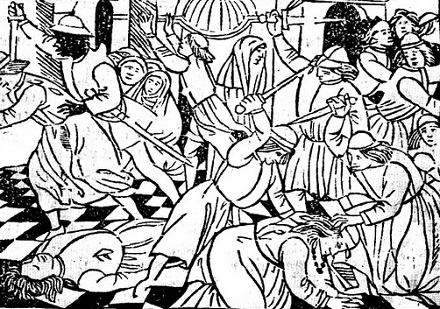
At a St. Stephen’s Day service in a basilica christened to Stephen Lampugnani approached the prince feigning supplication for some audience, then produced a hidden blade and stabbed Galeazzo Sforza. Visconti and Olgiati then rushed on Sforza as well and before anyone realized what was happening the Duke, croaking some half-heard invocation of Mary, was falling dead on the church floor.


Illustration of Galeazzo Sforza’s murder on the title page of a 1476 Lament for the Duke decrying the assassination.

Pandemonium ensued, and in the ensuing helter-skelter, Sforza’s bodyguards fell on Lampugnani and killed him on the spot, while Olgiati managed to escape.**

“It now only remains for us to consider those dangers which follow after the execution of a plot,” Machiavelli mused in his “Of Conspiracies” typology of his Discourses. “These in fact resolve themselves into one, namely, that some should survive who will avenge the death of the murdered prince. The part of avenger is likely to be assumed by a son, a brother, or other kinsman of the deceased.”

Well, yeah.

The assassins of the Duke of Milan appear not to have burdened themselves overmuch with advance consideration of this danger, possibly indulging the dream of Brutus that by a dagger’s stroke alone they could restore the lost republic.

Needless to say, this beautiful hope vanished in the bloody revenge carnival that actually ensued the murder. Just a few days after the assassination, having taken refuge with a priest — his justly frightened family had closed its door on him and needed to make theatrical denunciations of his treason for their own safety — Olgiati was captured, put to a torturous interrogation, and publicly butchered. He had outlived the Duke by only a week, and his gashed carcass was hung up in sections around town by way of warning. The rotting heads of the conspirators remained impaled on lances on the city’s bell tower well into the 1490s.

According once again to Machiavelli, Olgiati “exhibited no less composure at his death than resolution in his previous conduct, for being stripped of his apparel, and in the hands of the executioner, who stood by with the sword unsheathed, ready to deprive him of life, he repeated the following words, in the Latin tongue, in which he was well versed

“‘Mors acerba, fama perpetua, stabit vetus memoria facti.'”

That is,

‘Death is bitter but fame is eternal, and the memory of the deed will endure.’

This attempt, quixotic and doomed, to depose an Italian tyrant by murdering him in church might well have formed the blueprint for a similar plot in Florence in 1478, the Pazzi conspiracy. That version was even less successful than its Milanese predecessor: at least Olgiati and company could say that they actually managed to kill their target before everything else hit the fan.

And republic or not, Sforza’s murder did shake up the polity. It put the Duchy of Milan in the hands of his wife, as the unsteady regent of a seven-year-old heir. A few years later, the late duke’s brother Ludovico displaced the regent and effectively bossed Milan until the French imprisoned him in 1500 during the Italian Wars.

While he had the run of the place, Ludovico Sforza commissioned of Leonardo da Vinci a monumental equestrian statue in memory of his brother that da Vinci never finished.† Quite strangely, the master’s notes were plumbed by a 20th century Pennsylvania airline pilot who dedicated the latter part of his life to actually casting “Leonardo’s Horse”.

* The names Visconti and Sforza are also associated with some of the earliest tarot decks and among the first to introduce to playing cards the use of trionfi, or “triumph” cards — that is, “trumps”. One can readily purchase present-day reprints of this historic pack.

** There is a positively maddening inconsistency, thus far irresolvable for this author, between accounts (here’s one example | and another) asserting that Carlo Visconti was slain by Sforza’s bodyguards directly after the assassination, and other accounts (like Gregory Lubkin’s 1994 history of Sforza’s Milan) that put Visconti on the scaffold beside Olgiati.

† Da Vinci’s ponderously slow progress on this high-profile project led Michelangelo to cattily impugn the rival artist’s bronze-casting aptitude.

On this day..

1932: Lee Bong-chang, would-be Hirohito assassin

On this date in 1932, Korean nationalist Lee Bong-chang was hanged at Ichigaya Prison for attempting to assassinate Japanese Emperor Hirohito.


The would-be assassin under arrest.

Remembered now as a patriotic hero, Lee on January 9, 1932 chucked a grenade at an imperial procession in Japan as it passed the imperial palace’s Sakuradamon Gate — the aptly-named Sakuradamon Incident. Korea at that point had been directly ruled by Japan since 1910.*

Lee’s hand grenade targeted the wrong carriage, and didn’t even kill the occupants of that conveyance — it just injured a guard. A second grenade failed to explode altogether.

Three months after Lee’s attempt, another Korean, Yoon Bong-gil, also tried to murder Hirohito with a bomb. Both men are interred with garlands at Seoul’s Hyochang Park. A statue of our man Lee, poised with a grenade in hand, stands in the park.

* Newspapers in China — also under Japanese occupation — expressed regret that Lee’s attempt had missed its mark; this impolite language helped to catalyze a Japanese show of force later that month known as the January 28 Incident or the Shanghai Incident.

On this day..

1911: Dmitry Bogrov, Stolypin’s assassin

On this date in 1911,* Dmitry Bogrov was hanged in Kiev for assassinating Russian Prime Minister Pyotr Stolypin.

Many could diagnose the long-advancing rot of the Russian state, but few had the physic to abate it. Stolypin, a resolute conservative landowner, might have been tsarism’s last, best hope.

During the cataclysmic 1905 revolution, Stolypin was governor of Saratov and kept his province notably free from disturbances.

That earned him a kick upstairs in 1906 in hopes that he could work the same magic on the turbulent country. To a greater extent than most, he did: Stolypin was tsarist Russia’s last great statesman, notably introducing capitalistic land reforms in an effort to germinate a new rural middle class of small, freeholding landowners with skin in the Romanov dynasty. To break liberal obstruction, he also mounted a coup to weight the Duma in favor of propertied classes. “Give me 20 years of peace,” he vowed, “and you won’t recognize Russia.”

It’s left to the speculation of posterity whether he could have pulled the trick: in the event, Stolypin did not get 20 years and Russia did not get peace.

For some, like Solzhenitsyn, Stolypin is the lost chance for a Russia without either despotism or revolution: “He brought light to the world and the world rejected him.” For many others, that Great Man theory is a bit much. Russia’s issues with class and governance were a pretty long-term concern.

One of its long-term products was Russia’s energetic radical underground, and this Stolypin harried Russia’s revolutionaries from pillar to post, greatly intensifying police surveillance and infiltration of agitators’ circles to prevent a repeat of 1905. His secret courts meted out punishment with a greater regard for swiftness than certainty; a staggering 3,000 radicals were hanged for alleged involvement in terrorism from 1906 to 1909, generating worldwide condemnation and causing the phrase “Stolypin’s necktie” to enter the lexicon as a synonym for the noose.

Of course, there was plenty of real terrorism, no small part of it directed at Stolypin himself. He survived or avoided several assassination attempts, including a bomb that took the life of his daughter. In turn-of-the-century Russia, though, there was always a next man or woman up when it came to the propaganda of the deed.

In September 1911, at festivities marking the quinquagenary of the liberation of the serfs, Stolypin attended the Kiev opera’s performance of The Tale of Tsar Saltan.


The (obviously non-operatic) cartoon adaptation of The Tale of Tsar Saltan; the source material for both opera and cartoon is a Pushkin poem.

As the third intermission drew to a close, a young bourgeois approached Stolypin, drew a Browning pistol, and shot the Prime Minister. Legend has it that Stolypin opened his bloodied waistcoat and addressed the close-enough-to-witness-it sovereign with the words, “I am happy to die for the tsar.” The prime minister would linger on and die a few days later; his murderer did not long outlive him.

Despite Stolypin’s reputation as public enemy no. 1 for revolutionaries, the reason for Dmitry Bogrov to commit this particular murder has long remained murky. (pdf)

Bogrov (English Wikipedia entry | Russian) was a revolutionary, but he was also an informer for the Okhrana, the tsarist secret police whose augmentation had been a key Stolypin priority. Just where Bogrov stood at any given time in the vast foggy marches between compromised true believer and agent provocateur is difficult to pinpoint.

The Kiev opera on the night Bogrov shot Stolypin was thick with military personnel, but nobody at all stood watch on the oft-targeted politician — even though there was specific intelligence of a possible threat, issued in his capacity as an informer by the Janus-faced Bogrov himself. The eventual assassin was admitted to the theater that night on a ticket provided by his police handlers.

Considering Bogrov’s very swift execution, and the fact that the tsar suspiciously shut down the investigation (Russian link), many believe that elements of the state security apparatus were the true authors of Stolypin’s death, whether or not Bogrov himself realized it. Russia’s great landholders, never noted for farsightedness, widely opposed the reductions of their estates demanded by Stolypin’s agricultural reforms and rightly saw him as about the only man with the clout to move policy against their considerable opposition. They weren’t sorry to see him go.

As for Bogrov, his departure was a mere footnote. He asked for a rabbi before his hanging, but when he found out that this presumably confessional meeting would be monitored by the public prosecutor, he withdrew the request. (London Times, September 26, 1911) He reportedly died almost indifferently, his last words a disarmingly casual inquiry to the executioner about how best to position his head within his Stolypin’s necktie.

* September 12 by the local Julian calendar; September 25 by the Gregorian calendar.

On this day..