1939: Joe Arridy, on Woodpecker Hill

Update: Embargoed as of this post’s publication, Joe Arridy’s growing ranks of supporters had submitted to Colorado Gov. Bill Ritter an application for a posthumous pardon. On January 7, 2011, Gov. Ritter granted that pardon — a fitting conclusion to a cinematically heart-rending story.

“Granting a posthumous pardon is an extraordinary remedy. But the tragic conviction of Mr. Arridy and his subsequent execution on Jan. 6, 1939, merit such relief based on the great likelihood that Mr. Arridy was, in fact, innocent of the crime for which he was executed, and his severe mental disability at the time of his trial and execution. Pardoning Mr. Arridy cannot undo this tragic event in Colorado history. It is in the interests of justice and simple decency, however, to restore his good name.”

-Gov. Bill Ritter


On this date in 1939, Joe Arridy “walked to his death with the faith of a child” (Los Angeles times, Jan. 7, 1939) up “Woodpecker Hill” — where the victims of Canon City, Colorado’s gas chamber (since retired) were buried.

Shortly before execution, Joe Arridy gives away the toy train he received from warden Roy Best to a fellow prisoner.

A young Syrian-American with the mental age of a six-year-old riding the rails during the Depression, Arridy was picked up for a teenage girl’s rape-murder in a literal lynch-mob environment: he was nearly pulled from his cell for summary punishment.

Instead, the good citizens let justice run its course to the same conclusion.

The damnable thing — well, the other damnable thing — is that we have about as much reason to believe Joe Arridy committed the crime as we do you or I.

He was linked to the murder by nothing but an evolving series of unreliable confessions fed by the sheriff to his suggestible prisoner (and, later, a single “matched” hair with a suspicious chain of custody; matching hair without DNA is still an unreliable forensic technique today). The real murderer was even in custody, and was executed for the same crime while Joe Arridy’s appeals ran their futile course.

“Believe me when I say that if he is gassed, it will take a long time for the state of Colorado to live down the disgrace,” Arridy’s appellate lawyer pleaded to a deaf court.

Robert Perske’s Deadly Innocence, about Joe Arridy.

Executed Today is honored to welcome Robert Perske, a pioneering pastor to the intellectually and developmentally disabled whose book Deadly Innocence helped pull the Arridy case out of obscurity.

This post is an edited version of Perske’s affidavit to the governor’s office in support of the pardon.


On March 28, 1992, Sociologist Richard Voorhees sent me a poem from an out-of-print book that described a warden weeping as he watched a man in a death row cell playing with a toy train before being walked to a gas chamber (“The Clinic” (.doc) by Margeurite Young in Moderate Fables, 1944).

“The man you kill tonight is six years old,
He has no idea why he dies,”
Yet he must die in the room the state has walled
Transparent to its glassy eyes.

I sent a copy of the poem to Watt Espy, Director of the Capital Punishment Archives, in Headland, AL. Espy researched and responded with information that tied the poem to the life and trials of Joe Arridy who at age 23 was executed on January 6, 1939.

During the next two years after receiving the poem, I traveled up and down the Eastern Slope of the Rocky Mountains from Cheyenne to Pueblo, and to Grand Junction on the Western Slope. News stories were discovered from the reading of old microfilm rolls in The Pueblo Chieftain, The Denver Post, The Rocky Mountain News (Denver), The Daily Sentinel (Grand Junction) and Wyoming Tribune (Cheyenne). Archivists and historians were interviewed at The Regional History Division of Western Colorado (Grand Junction), Wyoming State Archives (Cheyenne), District Archives of the Pueblo Public Library, Local History Center of the Cañon City Public Library, and the Colorado State Archives (Denver).

Joe Arridy’s Earliest Years

Joe Arridy was born to non-English speaking Syrian immigrants in Pueblo, Colorado on April 29, 1915. He attended the first grade in Bessemer Elementary School. At the beginning of his second year, the principal called on the Arridy family and told them that their son could not learn and asked them to keep him at home. The parents reported that for the next four years, Joe stayed around the house. He was a passive but happy child. According to his parents he was the happiest when he was alone playing all by himself. His favorite pastime was making mud pies.

Intelligence Testing and Institutionalization

At age 10, Joe was committed to the Colorado State Home and Training School for Mental Defectives, in Grand Junction. He was administered the Binet-Simon Test. The results showed that he was unable to repeat four digits (4-3-7-9). When shown the color red, he said it was black and that green was blue. He usually spoke in incompete two or three word sentences. As the questions became harder to answer, he remained silent. The examiner listed him as “an imbecile with an IQ of 46.” Later his institutional records showed no critical incident reports. For the most part he was a shy and quiet loner.

Nine months later, Joe’s father missed his son. He asked for his son to be returned home. The request was granted. Upon his return, he tended to take lonely walks all over town. These walks continued for three years.

At age 14, the walks came to an end when a probation officer caught a gang of boys performing sexual acts on him. The officer wrote an angry letter to the court, labeling Joe as “one of the worst mental defective cases that I have ever seen.” The court ordered his immediate return to the institution in Grand Junction.

During the next seven years at the institution, his records show that he was incapable of working on the farm crews or sitting in classrooms. Therefore, he was given a “day activity,” working side by side with a kindly kitchen worker, “Mrs. Bowers.” The worker reported that Joe was only capable of “Tasks of not too long duration, can wash dishes, do mopping of floors, can do small chores and errands. He depends on others for leadership and suggestions.”

Railroad Boxcar Riding

At age 22, he and a few other inmates watched men riding on top of railroad boxcars that passed the institution. So together they wandered off the institution grounds and also jumped on boxcars. They took the 24-hour ride through the mountains to Pueblo. Later they took the trip back. Joe was last seen in Grand Junction on the evening of August 13, 1936. He was believed to have jumped onto a boxcar either that night or on the next morning.

After that, Arridy disappeared from sight until he walked up to the kitchen car of a railroad work gang on August 20, in the East Railroad Yards of Cheyenne, Wyoming, dirty and hungry.

Rape and Murder in Pueblo

On Saturday evening, August 15, 1936, slightly before or after midnight, Dorothy Drain, 15, and Barbara Drain, 12, were bludgeoned about their heads while sleeping together in the same bed, at 1536 Stone Avenue in Pueblo. Dorothy was raped and beaten to death. Barbara was near death, but survived. Later, she identified Frank Aguilar as the attacker at his trial. She was not present at Joe Arridy’s trial. She did not even identify Joe Arridy as a co-attacker.

Sheriff Gets a Confession from Arridy Even Though the Real Killer is Already in Custody

On August 26, 1936, Joe Arridy was arrested by two railroad detectives and turned over to Sheriff George Carroll. Carroll, like all law officers in all of the towns up and down Colorado’s Eastern Slope, was actively picking up suspects and interrogating them regarding the attacks on the Drain girls in Pueblo.

After an hour and a half of questioning, Carroll called a reporter and told him that he had just received a complete confession for the Pueblo crime from Arridy. He recited to at least one reporter a long series of wordy, complete sentences that Arridy purportedly uttered. According to Carroll, Arridy was the lone killer and he committed the crime with a club.

At first, when Pueblo Police Chief J. Arthur Grady received news of the confession, he was shocked. The real killer, Frank Aguilar, a former WPA worker who had been supervised by the Drain girls’ father, had already been arrested for the crime.

Aguilar had been arrested during the funeral of Dorothy Drain. The Pueblo police had even recovered the weapon used in the crime. It was the head of a hatchet with nicks that matched the wounds on the girls. The Pueblo police kept all this evidence in silence because Aguilar vehemently denied committing the crime.

Following that, Sheriff Carroll changed his story. After conducting another interrogation, he then reported to the press that a hatchet—not a club—was used in the crime. He also claimed that Arridy did not do the crime alone. According to Carroll, Arridy said he did it “with Frank.”

Sheriff Carroll was a famous but loquacious individual who was known to talk long and loud about being in the posse that finally caught up with and finished off the notorious Barker gang.

Now with his regular announcements to the press he remained at his long-worded best. Carroll had been so totally verbal in his interrogations of Arridy, nothing was written down on paper. Nor was any confession signed. Consequently the confessions and changes in them were dictated daily to reporters.

Later, in the trial of Arridy, Sheriff Carroll became the star of the case. He spoke in his heroic, over-wordy style. According to the press, he did not speak from a single note. He simply testified from memory.

Frank Aguilar is Quickly Convicted

Aguilar’s trial came quickly, starting on December 15, exactly four months after the crime. It ended seven days later. His executed came quickly, too: on August 15, 1937, just two days short of the anniversary of Dorothy Drain’s murder.

Aguilar Identified as Lone Murderer in an Identical Crime in the Same Neighborhood

After the death sentence, Aguilar was brought face to face with Mrs. R. O. McMurtree, 58, who identified Aguilar as the lone attacker in a similar crime that happened two weeks earlier and just three blocks away from the Drain crime. She and her aunt, Sally Crumply, 72, were sleeping in the same bed when Aguilar attacked. He beat them on the heads as he had done in the Drain home. Like Dorothy Drain, Sally Crumply was bludgeoned to death.

Sheriff Carroll Assumes Leadership in all Aspects of the Arridy Investigation

After announcing Arridy’s first confessions to reporters and Chief Grady, two Pueblo detectives sped through the night to Cheyenne. The next morning, they joined in an added interrogation with Carroll leading it. Then they drove back to Pueblo.

Later that day, Carroll drove Arridy to Pueblo. He was present at the Pueblo Police Station when Arridy and Augilar may have been brought together. He took leadership when Arridy was taken to the Drain home and the crime was reenacted. He was present at the prison in Cañon City when Aguilar gave a signed confession that marginally included Arridy’s initials in a lower left column. That confession was printed in its entirety in the Pueblo Chieftain but was withdrawn and was never heard in a court.

Sheriff Carroll Became Chief Presenter of Evidence Against Arridy

During the prosecutor’s evidentiary presentations, Sheriff Carroll took the stand five different times. The transcript shows how Carroll was allowed to launch forth as a riveting story teller. He testified that Arridy was in complete control of his thoughts, and speaking in clear sentences that described the colors on the walls in the bedroom and the colors of nightgowns that the girls wore, and even the colors of the dresses the girls would be wearing when they went to the Sunday church services.

The Joe Arridy that Carroll described was a far cry from the Arridy who often spoke in unfinished sentences and did not know who Franklin Delano Roosevelt was. Nor did he know what a hatchet was or that his own father was present in the courtroom.

The Defense Loses in a Sanity Hearing, and Eschews an Evidentiary Defense

The defense argued at a pre-trial sanity hearing that Arridy was “Not Guilty by Reason of Insanity”. The question before the court: “Does Joe Arridy have the capacity to tell good from evil and right from wrong?” If not, he should be found to be insane and not guilty. Three psychiatrists testified that Arridy did not know right from wrong, but they hedged by saying that he was not insane. According to them, one needed to be normal first before ever being insane, and they claimed that Arridy had never been normal.

The jury deadlocked at six to six, but an hour later, voted that Arridy would have to go on trial for murder.

As strange as it may seem today, the defense attorney had conducted no investigation in the case. At the beginning of the trial he announced that he would not present an evidentiary defense and would only cross-examine witnesses for the prosecution.

He then requested that the judge set aside the earlier sanity trial verdict and that he be given permission to argue a sanity case one more time. He furthermore requested permission to make his opening argument only after the prosecution had completed with its evidentiary case. The judge agreed to all of these conditions.

The same three psychiatrists (joined by a fourth) gave the same testimony once again.

But Sheriff Carroll voiced his views unchallenged. After touting his 30 years of experience and claiming that he interrogated Arridy for “six or seven hours,” the prosecutor asked him, “Based on your experience [is] Joe Arridy capable of distinquishing right and wrong?” Carroll responded, “I think there is no doubt, whatever, but what he is”.

A verdict of “guilty” was rendered on April 17, 1937, and Arridy was sentenced to death.

On August 13, 1937, Frank Aguilar was executed, and on the same day, Sheriff Carroll and two railroad detectives received a $1000 reward for making the arrest of Joe Arridy in Cheyenne.

For a year and a half, a pro bono “Citizen Lawyer” Gail Ireland fought valiantly to save the life of Joe Arridy. During that period, Ireland managed to win at least six stays.

On January 6, 1939 at 6:15 p.m., the Colorado Supreme Court voted 4-3 to deny the last petition. Governor Teller Ammons called the warden at 6:30 p.m. and ordered that the execution be carried out.

The chaplain administered the Roman Catholic Church’s “Last Rites for a Child.” It called for the Chaplain to recite each phrase of “The Lord’s Prayer,” one at a time with Arridy repeating it, all the way to the “Amen.”


Joe Arridy’s rusty motorcycle plate served as his grave marker for 71 years, until it was replaced with a headstone reading Here Lies an Innocent Man

This volume by Perske addresses the criminal justice system’s (mis)handling of the developmentally disabled. He’s written a number of other books, fiction and nonfiction, humanizing this.

Robert Perske also graciously agreed to address a few additional questions that we had for him.

ET: How did you come to this case?

RP: It’s almost a magical thing to me. Back in 1991, I got a poem from a valued colleague of mine who is a professor, a sociologist. He was digging through some old books in Greenwich Village, and he found a poem about a warden weeping before the pellets were dropped and all of that, and how the warden cried, and how he complained about how this man playing with a toy train would die.

And I got ahold of it and went down to my buddy Watt Espy [of the Espy file -ed.], and he found it. He really dug for me, what a guy, and he found it and I headed for Pueblo and dug and dug and dug from 1991 to 1995.

What motivated me was that after coming out of World War II, I went to school and became a chaplain at an institution for mentally disabled people in Kansas. I worked my ass off to be a good pastor to them, and so when I found this much, I really started digging.

Did they lead him into the confession?

Oh, yes. He was arrested in the railyard by Sheriff George Carroll. And Carroll was a swashbuckler. He was a hero, and he was a mouthy sonofagun, and he pretty well set up the case.

As soon as he got the so-called confession, he [Carroll] didn’t call the police chief first — he called the press. He said he had the guy who did it.

But they already had the guy in Pueblo, Frank Aguilar.

Was there outright misconduct by the investigators here? Did they realize, or should they have, that they might be railroading someone?

Here’s the deal. People with so-called mental retardation were seen as nobodies in those days. They didn’t have community services, so they all went like Joe, to the institution.

In the year I was born, 1927, Oliver Wendell Holmes issued his ruling that all such people could be sterilized.

Carroll knew he had somebody like that in Joe. There was a lynch mob starting to form in Pueblo, because this head of the WPA was a good solid citizen, and when his daughters were hit, and one killed and raped, there was a lot of hiding of people.

I’ve known a lot of Joes. And he’s lovable, and he’s trusting, and he’s naive, and he’s concrete-thinking, so half of the things he says, he doesn’t really understand. But on the other hand, very dependable, and very lovable. Nobody in Pueblo saw that, but [Warden Roy] Best picked it up, and then the inmates in prison picked it up too.

In their hearts of hearts, yeah, they knew. But they figured he wasn’t worth anything. He was retarded, mentally defective was the word they used. They knew they had the real killer, but they go back and get Joe to amend the confession and now he was there “with Frank”.

If you’ve got a serious mental limitation and you’re facing a capital charge in the criminal justice system today, what’s going to happen to you?

In the year 2002, Atkins v. Virginia, they banned the death penalty in those cases. And they played around with the IQ number, but in some states they’re going farther than that because you have all kinds of other disabilities. I’d say by and large, except for Texas, people are looking at these people — not more kindly, but not looking at them as people who should be executed.

If we would have had that for Joe, he would not have been executed.

Can you give us a lay definition of developmental disability?

The most prominent one I’ve seen when I worked in the institution, and yet today when I work the streets and agencies and group homes and that sort of thing, is the inability to abstract from concrete things. For example, I’ve had guys say to me, I’d say, “why did you waive the right?” and they say, “you’ve got to waive it the right, you can’t waive it the wrong.”

Barry Fairchild, down in Arkansas — Barry thought that the reading of the rights was some kind of opening prayer.

These people survive on the basis of having abstract thinkers as their friends and protectors, so consequently guys like Richard LaPointe had cops as their friends, because they leaned on authority figures. And of course the police department are committed to secure the safety of the neighborhood, but then if there’s a terrible murder and somebody starts to blame them, they’re going to cooperate with that.

I’ve got one where, on a tape recorder, they’re saying, “if you tell us, we’ll all go home”. So that’s concrete thinking that my guys usually have.

Richard Lapointe is still in prison, not on death row. He has hydrocephalus, it’s called Dandy-Walker syndrome, so he’s a guy with all kinds of disabilities. He’s not athletic at all and gets dizzy when he stands up or stops suddenly, and yet they got him to confess to a highly athletic murder of a woman with multiple violent stab wounds and moving the body.

On this day..

317 B.C.E.: Philip III Arrhidaeus, who succeeded Alexander the Great

It was perhaps on this date in 317 that the half-brother and successor of Alexander the Great was put to death, just another casualty as the conqueror’s vast empire fragmented.

The half-witted Philip III Arrhidaeus (or Arridaeus) didn’t exactly seem like he was born to rule — or maybe he was and that was just the problem. Plutarch juicily speculated that the boy was muddled intentionally by the snake-worshiping wife of Macedonian conqueror Philip II, Olympias. Olympias was the mother of a kid named Alexander whom she was trying to advance to the throne ahead of his half-siblings; Angelina Jolie made an apt choice to depict her at her ruthless harem-politicking best.

Arrhidaeus was the son of Philip by a courtesan named Philinna, a woman of low birth. His deficiency in understanding was the consequence of a distemper, in which neither nature nor accident had any share. For it is said, there was something amiable and great in him, when a boy; which Olympias perceiving, gave him potions that disturbed his brain.

Plutarch

Philip III Arrhidaeus is one of the main characters of this historical novel.

Whatever potions Olympias did or did not administer, she did in fact put her kid in line to follow Philip; that boy vindicated the succession by rolling his phalanxes over vulnerable potentates from Hellas to India. You might have heard of the guy.

The problem for Macedon as for Arrhidaeus came after Alexander the Great’s brilliant career closed with his unexpected, youthful death.

The stupendous empire had no obvious heir, and different factions of Alexander’s military backed different candidates. Long story short, the Arrhidaeus succeeded as the titular, but powerless, king, under a succession of regents who were prone to untimely deaths.

“Merely” titular kingship is a pretty powerful post in itself, though, and Arrhidaeus’s wife Eurydice began maneuvering to gain a wider sphere of action from her now-allied, now-enemy regents, who were themselves fighting one another. In 317, Eurydice backed the wrong horse, and she and the hubby were put to death after capture by his rival, who was at the time allied with Olympias.

Alexander’s empire was fracturing, and would soon come completely apart (one of Alexander’s generals founded the Ptolemaic dynasty of Egypt, which ended with Cleopatra‘s asp). It was a dangerous environment for everyone within a pikestaff of power, which meant that at least Arrhidaeus and Eurydice could take solace from the next world when the very same fate befell Olympias herself.

(More posthumous consolation: the Rimae Ariadaeus lunar crater is named for this short-lived figurehead.)


The funerary tumulus at Vergina, one of Greece’s most spellbinding archaeological treasures, features an in situ tomb whose occupant — though grandly claimed to be the more impressive Philip II — might, in fact, be Philip III. The contents of this tomb have been the subjected of spirited academic, and even nationalist, disputation, on which topics this blog is blessedly destitute of authority.


Royal Macedonian Tomb, Vergina. (cc) image from Templar1307 (whose user ID alludes to another blog-worthy incident).

On this day..

2009: Danielle Simpson, “If I can’t be free – Kill me!!”

Last year on this date, Danielle Simpson was executed in Texas for murder.

Simpson, his wife, his brother, and another accomplice kidnapped an octogenarian church organist from her home, trussing her up and throwing her into the Nueces River to drown.

Though it would be another decade before his execution, the brutality of life on death row (and the usual appellate losing streak where the Fifth Circuit reigns) eventually ground him down into volunteering to expedite his execution.

I’m tired of being in an institution that’s unjust, degrading, and corrupted … I’m ready to die!! If I can’t be free – Kill Me!!

Simpson reversed himself shortly before the execution actually went down, but the further appeals on the matter of his “debilitating mental illness” and “diminished intellectual functioning” were equally unavailing.

It may not rise to a legal threshold, but the high school dropout’s thinking was clearly a bit scrambled. Death row has been known to have that effect.

One of Simpson’s attorneys at the Texas Defender Service, David R. Dow, recently wrote a well-received meditation on his life of representing defendants like Simpson who have virtually no prospect of success in the courts. The Autobiography of an Execution, blessedly un-tendentious despite the author’s unabashed death penalty opposition, makes a compelling stocking stuffer for the family member whose tastes run a bit grim.

On this day..

1913: Ernest Austin, the last hanged in Queensland

On this date in 1913, Ernest Austin was hanged at Brisbane’s Boggo Road Gaol — the last person to suffer that fate in Queensland.

Austin stalked an 11-year-old girl down a dirt road — one that inconveniently recorded the distinctive prints of his heel-less boot — and raped and murdered her.
This “mental deficient” (“The State Slays Its Own Creation,” headlined an anti-death penalty newspaper, alluding to Austin’s institutionalized upbringing) was resigned to his fate even prior to conviction. Resigned enough to hurry it along.

Witness opened the cell door, and found accused standing with an upturned cell bucket by his side. O’Callaghan shook out all the blankets, and found a rope plaited of three strips torn off a blanket. Witness said to accused:—”You should not do anything rash.” Accused replied:—”I will be hanged anyhow.” Witness then said:—”You are not found guilty yet.” Accused said:—”I admit I murdered the girl.”

Little wonder the government wasn’t interested in clemency.

Nine years later, Queensland became the first Australian state to abolish the death penalty.

Austin’s ghost is supposed to haunt Boggo Road Gaol to this day, even though the section of the prison where he died has long since been demolished. The haunting story seemingly rests on an urban legend that Austin was some outsizedly diabolical creature and not the run-of-the-mill pathetic malefactor that a century’s perspective might suggest.

On this day..

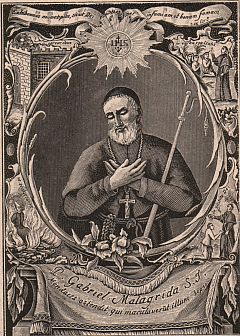
1761: Gabriel Malagrida, Jesuit nutter

On this date in 1761,* the Jesuit Gabriel Malagrida became a late casualty of the Tavora Affair and the Lisbon earthquake when he was garroted for heresy.

Malagrida (English Wikipedia entry | Portuguese) was a 72-year-old Italian with decades of missionary service to the Portuguese New World colonies under his belt.

He had, in his time, been a prominent exponent of the Jesuits missions’ policy in the Amazon, which amounted to asserting their own jurisdiction against the secular government’s attempt to order its overseas territories. (There’s more on that conflict here.)

And this only exacerbated his principal sin of being a Jesuit — an order whose diminution was eagerly sought by the rising statesman of Enlightenment Portugal, the Marquis of Pombal.

The shock of the 1755 Lisbon earthquake would deal Pombal the trump hand he needed to start reshaping both city and society to his liking.

Malagrida, meanwhile, carped that the earthquake’s causes

“are not comets, are not stars, are not vapors or exhalations,** are not phenomena, they are not natural contingencies or causes; but they are solely our intolerable sins … I do not know how a Catholic subject dares to attribute the present calamity of this tragic earthquake to causes and natural contingencies. Do not these Catholics understand this world is not a house without an owner?”

This published pamphlet merely echoed what many of the order were saying in the pulpits, and Pombal was not about to let the backwards, superstitious crowd** own the catastrophe.

Malagrida was banished from Lisbon: and, when the Tavora family was implicated in an attempt to assassinate the Portuguese king, Malagrida, their confessor, found himself clapped in prison.

Though the now-septuagenarian priest did not share the Tavoras’ grisly public butchery, he was left to molder. A couple years in a dungeon saw him go a bit strange, and supposedly he published treatises with such eccentric features as God’s personal instructions to Malagrida, and Malagrida’s fascination with St. Anne’s uterus. Catholic sources, which consider Malagrida a martyr, doubt that he ever published any such thing; if he did, it seems apparent that it was dementia rather than heresy that afflicted the old man.

But Pombal had installed his own brother as judge of the tribunal, so the matter was prearranged. The execution itself was

staged in a dramatic way, even to the point of Malagrida’s appearing on the scaffold in Jesuit habit, to impress upon the Portuguese and the world at large that an old order had come to an end and a new one was to be established … one might say that … symbolism at the cost of one human life was a relatively humane procedure in comparison with the symbolic elimination of whole classes of society in the twentieth century.


Detail view (click for the full image) of Malagrida executed at a Lisbon auto de fe. CC image from Ricardo Mealha, original provenance unknown.

Pitying the superstitious Jesuit at the stake, Enlightenment secularist Voltaire inveighed against Enlightenment secularist Pombal for conducting the execution … just part of Voltaire’s queer ideas about not killing people over their religious beliefs.

“It is all pity and horror,” Voltaire wrote in a private correspondence. “The Inquisition has found the secret to inspire compassion for the Jesuits.”

Voltaire’s appraisal in Candide (already published by this time) of a country in the grip of religious superstition unjustly stands as one of the lasting literary monuments to an event that actually rolled back clerical influence: “the sages of [Portugal] could think of no means more effectual to prevent utter ruin than to give the people a beautiful auto-da-fé; for … the burning of a few people alive by a slow fire, and with great ceremony, is an infallible secret to hinder the earth from quaking.” That the philosophe who penned those words waxed so immoderately outraged at the demonstrative chastisement of a man who preached precisely all that hocus-pocus — that Voltaire ascribed his execution to “the Inquisition” — plants the cherry on the irony sundae.‡

But Pombal’s expedient use of the Inquisition’s medieval machinery to make an example of Father Malagrida would not be the start of a pattern; the Pombaline reforms of the years to come brought the Inquisition sharply to heel, and it was Malagrida himself who was its last victim (pdf) in Portugal in its classical ecclesiastic form.


The house where Malagrida was born in Menaggio, Italy is marked with a plaque. Image (c) kallipyg and used with permission.

* Some sources give September 20 as the date.

** The “God is pissed” hypothesis was posited against theories of earth’s vapors promulgated by the Pombal-sponsored scientist Ribeiro Sanches.

† Anti-Jesuit sentiment was widely abroad in Europe at this time; increasingly resented as political manipulators, the Society would be suppressed by papal order in 1773, only to revive during the post-Napoleonic reaction.

‡ Malagrida was well-known to contemporaries in Europe, but that does not mean sympathy for him was universal. The British pol Lord Shelburne was satirized as “Malagrida” for his putative duplicity.

On this day..

1736: Both John Vernham and Joshua Harding survive a hanging

Bristol, September 4.

Yesterday at 12 o’Clock, Vernham and Harding, were carry’d from Newgate to the Place of Execution on St. Michael’s hill, attended by the Under-Sheriff, and his Officers, and the Constables of the City, (in a Cart, with Halters about their Necks;) the Divine who attended them, having finish’d his last Office, the Cart drew away: But to the Surprize of every one, after hanging the usual Time, and being cut down, Vernham was perceived to have Life in him, when put into the Coffin; and some Lightermen and others, who promis’d to save his Body from the Surgeons, carried him away to a House; and a Surgeon being sent for, immediately open’d a Vein, which to recovered his Senses, that he had the Use of Speech, far up, robb’d his knees, shook Hands with divers persons that he knew, and to all seeming Appearance, a perfect Recovery was expected.


Appropriately metaphorical image of a gateway on St. Michael’s Hill in Bristol, (cc) Daniele Sartori.

The Rumour of this, soon came to the Under-Sherif’s Ears, who, with Mr. Legg, and several Officers armed, went to know the Truth, and finding it certain, were about to remove him to a proper Place, in order to have him again under their Care for a second Execution,and finishing the Law; which we hear would have been done in a private Manner, without any Ceremony: But whether any secret Method was used to dispatch him, or not, he died about Eleven o’ Clock, in great Agony of Pain, his Bowels being very much convls’d, as appeared by his rolling from one Side to the other, and often on his Belly.

{He was bout 20 Years of Age; while [under] Sentence of Death he behaved very penitent, laying the whole of his Misfortune upon a fatal Companion,* particularly as to the breaking open Mrs. Atherton’s House. Harding behaved very unconcerned, charging his Wife with being the chief Inset to his Misfortunes, and even curs’d her just before he received the Sacrament that Morning.}

And to our second Surprize, Joshua Harding is also come to Life again, and is actually now in Bride-well, where great Numbers of People resort to see him, Particularly Surgeons, curious of Observations. He lies in his Coffin, covered with a Rug, has Pulsation, breathes freely, and has a regular Look with his Eyes; but he has not been heard to speak, only motions with his Hand where his Pain lies. ‘Twas thought he would be executed a second Time {to the finishing his unhappy Fate by a private Execution, at the same Tree he was cut down from}; but we are now told, he is to be provided for in some convenient House of Charity, with Restraint, he being to all Appearance defective in his Intellects. Two such Resurrections happening at one Instant in the World, was never heard of in the Memory of man.**

The Virginia Gazette, Dec. 24, 1736. {Curly-braces portions from an otherwise largely identical report in The South Carolina Gazette, Jan. 15, 1737.}

Coverage from The Daily Gazetteer is available here. The London Magazine adds the detail that all those curiosity-seekers visiting Harding “give him Money” and “are very inquisitive whether he remembers the Manner of his Execution: to which he says, he only can remember his being at the Gallows, and knows nothing of Vernham’s being with him.”

* This Annals of Bristol says that Vernham nearly refused to plead until the prospect of judicial pressing caused him to chicken out. (And ironically, to the extent it forwarded his execution date to this evidently felicitous occasion, almost saved his life.)

** Two hanged men reviving at once is remarkable indeed, but it was not so strange at this time for individual prisoners to survive their executions.

On this day..

1795: Pomp, a Negro

On this date in 1795, an African-American near-slave (slavery’s official 1783 abolition in the state seems not to have constituted a completely bright line) was hanged in Ipswich, Mass. for murdering his master-slash-employer.

Thanks to Laura James at CLEWS, we are drawn to this story reproduced here at the University of North Carolina-Chapel Hill’s Documenting the American South site. Pomp was perhaps mentally “touched”; he was certainly physically “touched” for any perceived inadequacy at his labors, and eventually chopped off his master’s head while the latter slept beside his wife. (The wife summoned the police, without molestation from Pomp.)

The victim, Captain Charles Furbush, was a minuteman who fought at Lexington, one of the opening skirmishes of the Revolutionary War.

Reprinted in full below (complete with breaks in the text where the original document is damaged) is the “Dying Confession of Pomp,” a broadsheet produced by a local merchant — who does not scruple to append some classified ads to the end of the text.*


I POMP now under sentence of death in Ipswich Jail, was born in [illegible], and brought from that place, so soon after I began my existence, that together with my Parents, I arrived at Boston when I was about three months old. My Father died soon after and my Mother has since had two husbands, and is now a widow. I have three sisters and three brothers now living in Boston, for whom a well as for my Mother I have a great regard.

My Mother soon after our arrival in this Country gave me away to Mr. Abbot of Andover. With this Gentleman I lived till I was sixteen years of age, but he being then on the point of moving back into the country some distance, told me if I chose it that I might then live with one of his sons, who was still to reside in Andover. I took up with his offer: choosing rather to continue in Andover, than to accompany my old master, to his new abode.

With young Mr. Abbot I lived not long, before I grew uneasy with the place. I told him that I meant to leave him soon, but he informed me that I was not free. About this time I was seized with convulsion fits which continued to oppress me at times ever after, to the fatal night that I murdered Capt. Furbush. Continuing still unreconciled to the new place, I went to the Select men of Andover to know whether I had not a right to leave it, and by their advice continued there a considerable time longer. But after a while it came to pass that Capt. Furbush took a notion to have a black man; and applying to the Select men, obtained their consent that I should be his servant. In compliance with the wishes [illegible] him; but soon found that I did not like him any better than the man with whom I had last lived. Furbush had a considerable farm and when I first began to live with him did some work himself, but I did not like the way he carried on his business, and after a while he left off work entirely, and by my desire left the whole management of the farm to me. I performed nearly all the work that was done on the place, cut all the hay, and with a trifle of help from the boy, whom my master desired to asist me a few days in a season, raised an hundred and seventy bushels of corn in a year. But my master still continued unkind to me, never letting me go to meeting on Sundays, and forcing me to clear out the cattle on those sacred days. When I asked him for money, he commonly gave me no more than four pence half peny, at a time: and even on Election day he gave me no more, nor would he suffer me on those days to go to frolicing till after one o’clock in the afternoon.

Though I did the best that I was able to do on the farm, my master was so far from seconding my endeavors, that he often brought whole droves of horses home with him in the night, and turned them in among the standing corn, that I had taken so much pains to plant, and hoe, and on the succeeding mornings he would charge me with the guilt of turning these horses into the corn field. In this way he often caused corn enough to be broken down in one night to fat a hog, and keep him fat a whole winter. I thought I found that he was a bad man, and a cheating horse jockey, and finally being unable to like him, I ran away from him, but was pursued, found, brought back, and severely flogged, by him for my pains. I afterwards ran off again but again met with the same fate. In this manner I went on ten or a dozen years, not liking my place, and not able to get away from it. I was frequently troubled with convulsion fits and sometimes crazy in such a degree, that I was generally bolted in to a chamber every night, in order to hinder me from getting into the chamber where my masters daughters slept. I worked very hard all the time. My master had one weakle son who was unable to work, and who often shed tears while he saw me labor and told me that he wished he was able to help me. I told him that perhaps I should contrive something after a while but did not explain myself. Continuing still uneasy I thought I would try once more the benefit of my legs. I accordingly ran off, but after a weeks absence, I was again brought back by my master, stripped naked, tied up by both hands, and unmercifully flogged. This was in the evening, and though it was late in the fall, and cold, frosty, icy weather, my master left me thus naked, and tied up, till the morning. My sufferings during the tedious hours of this lengthy night, by reason of cold and nakedness, a sore back and wounded spirits, were extremely great, and while under this torture, I thought it likely that my master would sometime or other feell the effect of his cruelty. My conjectures were so far right that it was the last time, that Furbush ever struck me.

My master used to tell me I might stay as long as I pleased at his house, adding that he should not stay in the world forever. From this I entertained an idea that Mrs. Furbush and the farm would be mine, after the death of my master. The hopes of being master, husband and owner, on one hand, and the cruel treatment I had received from Furbush on the other, prompted me to wish for his death and produced an idea of hastening [illegible] by [illegible] him myself.

In this state of mind the morning of the fatal day arrived. I arose considerably disordered having a great singing noise in the ears, and something whispering strange things to me I however went about my work as usual, cut up bushes all the day, near where there was another man to work but revealed nothing concerning my designs to him, at night went home, eat a beef steak for supper, and went to bed. Soon after I was seized with a fit, bit my tongue almost through, and after coming out of the fit, was delirious. I continued not long after this in bed, being impressed with an idea that I must get up and kill Capt. Furbush. The Lord a massy! said I to myself what is a going to take place now! The door of my chamber not being bolted as usual, I left my apartment and went down to the fire place. I was struck with horror by my reflections; but something still kept whispering in my ear, that now is your time! kill him now! now or never! now! now! I took an axe and went softly into the bed room of my master, and the moon shining bright, distinguished him from my mistress, I raised the ax before he awaked and at two blows, I so effectually did the job for him, that he never after even stretched himself.

My mistress being roused from sleep by the sound of the blows, said are you dead you? But receiving no answer she immediately left the bed, and called in a near neighbor. I did not try to escape not knowing that there was any necessity of it. I was told that I had but to go up to my chamber, I went there and perceived that somebody had bolted the door after me. Company soon began to croud into the house, and I was soon told that I should certainly be hanged. I was now very much frighted, nnd expected to be hung immediately, but my grief wore off considerably w [illegible] found that I was not to be hung there. I [illegible] soon brought to this Jail, and here enjoy mys [illegible] considerable well, though at Court time I [illegible] ry unhappy, and now some times, the idea [illegible] I have no friends, makes me dull.

The Ministers have been kind to me here, and I believe they are clever people: Mr. Stanniford too the Ja [illegible] keeper is kind and humane, and his wife and daughters clever people and pretty women. ([illegible] ndantly amiable ladies he ought to have said [illegible] whole family are clever folks.) The Ministers have told me to pray to God, and to the blood of Christ, for a new heart. I approve of [illegible] advice, and spend great part of my time in prayer, even ten or twenty times in a day I pray though I find it hard work, I do not however find fault with the hardness of the task, for [illegible] ieve it has been attended with great success. I have good hopes that I have got a new hear [illegible] the one that I used to have, used to ache [illegible] d, but the one I now have feels easy. I never [illegible] so well and hearty in my life as I now am, [illegible] fits and lunacy have left me entirely [illegible] hope to behave cleverly and graciously in this world.

I have prayed so much, that I have got all the minister’s [illegible] of praying and am not afraid to pray with [illegible] black coated man on the Continent. I [illegible] d make a very extraordinary priest, and inde [illegible] am turning very fast into one. When I [illegible] here, I was as black as any negro in the country, but now I have scarcely a drop of negro blood left in me, my blood having so far [illegible] ed into the blood of a Minister, that I am a [illegible] y nearly as white as a Mulatto. Minist [illegible] people and they can turn [illegible]

Some acc [illegible] the hapless POMP with some reflections [illegible] fate by J. PLUMMER, Jun.

Illustration of Pomp's hanging from the broadsheet

POOR POMP was a well made, considerable large, likely looking Negro. [illegible] e was very capable of contriving business on a farm, and such was his strength and industry, that besides the [illegible] which he received for his labour, Capt. Furbush could very well have afforded him 50 dollars per year–With such wages, or even with half that salary he might soon have acquired money enough to purchase 50 acres of excellent [illegible] land, and to have enabled him to clear and improve the same–In that situation some unfortunate white woman might possibly have sought [illegible] assylum in his arms, or at least the likelie [illegible] to girl that fell within the line of his ac [illegible] nce would have sprung like nimble doe [illegible] his marriage bed–The animating sweets of freedom, and of domestic life, had then been all his own–He would neither have sullied his hands with innocent blood, nor have been forced with unutterable woe, to breathe his last in a h [illegible] . But alas! instead of running this happy course, for want of understanding, and skill [illegible] him, to wife and laudable pursuits, we have seen him experience the sad reverse.

I ha [illegible] endeavored to preserve the ideas of poor Pomp, in the above speech, though I have taken the liberty to arrange the matter in my own way, [illegible] to word his thoughts more elegantly and [illegible] than he was able to express them. As to [illegible] said of something telling him to kill his [illegible] er, I believe it to be a falsehood of his ow [illegible] hing contrived by him to excuse his conduct, but as to the rest of his speech, I fancy that he believed it himself; though in several particulars he was pretty much mistaken. His [illegible] capacity was below the common pitch, and his understanding was undoubtedly considerably injured by convulsion fits, though his parts were vastly superior to those of an ideot. But for a rational being his mental improvements were extremely small; though when we consider the situation that he has lived in, this is not so very strange as we at first should think it. He lived either alone in the field, in bed, or in the kitchen of some people, who were too much above him to be his associates: and probably was never learned to read–There were few Negroes in Andover or any where near him, and all there was were unlearned people. From whom then or in what manner was it in his power to gain knowledge? ‘Tis true that he had some intercourse with his white neighbours, but very little that was profitable for instruction;– the discourse generally turning on domestic business, the raising country produce, the age, and strength, of oxen, and horses, the bulling of cows, or the lambing of sheep.– Of knowledge like this Pomp had a large stock. He knew all his master’s cattle, sheep, and hogs, and pretty exactly the age of each creature: and likewise the horses and oxen of many of his neighbours: could tell when such a particular cow of a certain neighbour had been bulled, and when his sow had pigged; but no man thought it worth his while to talk much upon other matters with him, nor would he have been much pleased with the discourse had it been otherwise. He knew not the names of the Seven Sciences, nor even that there were such things or names–knew nothing of ancient or modern history, nor even the late revolution in France, or the consequences of it so often rung through the universe–So little [illegible] ears–Of philosophy [illegible] , geography, good breeding, honor, politics, [illegible] he never heard, or heard with little attention, and less improvement– To crown his ignorance he lost his life by not knowing that murder was a sin: he expecting that he should immediately rise to a good estate and great felicity whenever he should be fortunate enough to kill his master. He knew nothing of the Laws of the United States or of this Commonwealth; and after the murder when he was told that he would be hung, he dreamed nothing of any previous imprisonment or trial: when he heard the sentence of death in Court, he expected to be hung the same hour but finding he was not to be executed that day, he conceived hopes that he never should be. He had seen others and been himself corrected in anger. He had observed that whenever his master was angry with him he either flogged immediately, or he for that time escaped correction, and that after the wrath of his master had subsided there was no danger. He thought the People of Andover and the Court at Ipswich would hang him in the same angry frame of mind, that his master used to flog him in, or that they would not hang him at all: he having no idea of the calm, but irrefutable ire, the deliberate, but vindictive, vengeance of the offended Justice, and of Heaven.

N. B. The reader will take notice that I do not attest to the truth of Pomp’s dying speech, but I affirm that he related to me as matters of fact the particulars [illegible] ted in this speech– Unfortunately for me [illegible] Jail keeper was absent when I visited the prisoner, [illegible] on his name does not appear a [illegible] tness: his lady was present, but perceiving that she was rather timorous, I did not trouble her with a request to be a witness; though I believe she will readly, orally attest to the truth of it.

Printed for and sold by JONATHAN PLUMMER, JUN. price 6d, who still continues to [illegible] various branches of trifling business–Underbeds filled with straw and wheeled to the ladies doors — Any person wanting a few dollars at any time may be supplied by leaving a proper adequate in pawn–Wanted 1000 junk bottles.

A certain secret disorder cured privately and expeditiously– Love-letters in prose and verse furnished on the shortest notice–The art of gaining the object beloved reasonably taught–

Nymphs and swains bow’d down with care
By cupid wounded to the heart,
Quick, O quick to me repair
For soon I ease the dreadful smart.


To Tell a Free Story: The First Century of Afro-American Autobiography, 1760-1865 characterizes the dueling interpretations of Pomp and his white interlocutor as “[pitting] two explanations of black criminal behavior against each other for the first time in Afro-American autobiography. Plummer’s argument is based on the notion of the Negro as absence. His lack of remorse for murder shows that he has no moral sense, and in justifying his crime with the “whispering” voices, he proves that he lacks truthfulness. Pomp’s narrative, on the other hand, insists that there was something at work in the black man’s psyche, a dynamic whose manifestations in the actions and language of Pomp resisted Furbush’s methods of control and Plummer’s system of reference.”

* By the way, click on my sidebar ads, why don’t you?

On this day..

1990: Dalton Prejean, cop-killing child

Just after midnight this date in 1990, Dalton Prejean was electrocuted in Louisiana for murdering state trooper Donald Cleveland.

A 17-year-old (at the time of the crime) black youth who tested just this side of mentally disabled, Prejean shot Cleveland during a traffic stop. (He was, at the time, just seven months out of a reform school stint he had served for murdering a taxi driver at the tender age of 14.)

It was a three-day trial with an all-white jury, and not much question as to Prejean’s culpability.

But as he neared the execution of that sentence, his youth and his limited candlepower loomed ever larger. They would generate worldwide attention with some heated rhetoric like this one from Amnesty International’s southern regional director:

“I doubt that in documented recent world history there is an execution” with “such a pile of reasons not to do it.”

The Louisiana board of pardons agreed — it recommended commutation — but Gov. Buddy Roemer did not.

Dalton Prejean’s was the first execution of a juvenile offender in the United States since the Supreme Court upheld the constitutionality of that practice in the 1989 decision Stanford v. Kentucky. That decision was reversed in 2005, and minors are no longer eligible for death-sentencing in the U.S.

On this day..

2005: Michael Ross, the Roadside Strangler

As of this writing, New England has seen only one solitary execution in the past half-century.*

That one execution happened five years ago today: the lethal injection of serial murderer/rapist Michael Ross in Connecticut.

The “farm boy from Brooklyn, Conn.”, sexual sadist, and Cornell University graduate** went no a rape-and-murder spree in the early 1980s. He would confess to eight homicides.

Condemned in 1987, Ross spent 17 years fighting execution before a 2004 volte face had him waiving his appeals in the interests of sparing victims’ families any further agony.

This precipitated an intense last-minute legal melee over whether the admittedly disturbed Ross possessed legally sufficient competency to pursue his own death. A scheduled execution in January was scratched at the last moment when a federal judge insisted on a competency determination.

A serial killer who consents to his own execution wouldn’t typically be the sort to attract a lot of sympathy, but in true-blue New England, any brush with the executioner is cause for public hand-wringing.

Ross, of course, was adjudged competent to drop his appeals, and that was that.

After the execution, one of the psychiatrists who disputed Ross’s competency to choose execution received a mailed taunt from the killer, dated May 10:

Check, and mate. You never had a chance!

And it seems our date’s principal reserved an even gnarlier gambit for the judge who once blocked his execution.

District Court jurist Robert Chatigny has found himself much in the news with Michael Ross since he was nominated by President Barack Obama for a seat on the Second Circuit Court of Appeals. That nomination has been held up thus far largely because Chatigny berated and threatened Ross’s attorney (the one who was trying to get his client executed) with disbarment.

* The last one before Michael Ross? Joseph Taborsky, electrocuted in Connecticut on May 17, 1960.

** His criminal career began in Ithaca, N.Y. Cornell is famous for its suicides, but Ross apparently couldn’t go through with his after he contemplated taking his own life.

Ross was also a graduate of something called Killingly High School. True story.

On this day..

1222: An apostate deacon

Thirteenth century England was a dicey place for theological heterodoxy.

On this date in 1222, Archbishop of Canterbury Stephen Langton held at Oxford a provincial council that ordered for immediate execution

an apostate deacon, who for the love of a Jewess had circumcised himself. When he had been degraded he was burnt by the servants of the lord Fawkes.

The story of this nameless and foreskinless deacon — and the link includes several congruent descriptions from primary sources — is sometimes conflated with that of Robert of Reading, another Christian divine who converted in the late 13th century.

Robert’s fate — or Haggai’s, to use the new name he took — seems to be officially unknown, and might have unfolded overseas: Edward I expelled Jews from England in 1290. Nevertheless, the mixed Robert-anonymous deacon story was commemorated with a plaque at Osney Abbey.

Whomever this date’s deacon really was, he wasn’t the only one for whom this council ordained a dreadful end for having the wrong idea about the Almighty.

And there was brought thither into the council an unbelieving youth along with two women, whom the archdeacon of the district accused of the most criminal unbelief, namely that the youth would not enter a church nor be present at the blessed sacraments, nor obey the injunctions of the Catholic Father, but had suffered himself to be crucified, and still bearing in his body the marks of the wounds had been pleased to have himself called Jesus by the aforesaid women. And one of the women, an old woman, was accused of having long been given to incantations and having by her magic arts brought the aforesaid youth to this height of madness. So both being convicted of this gross crime, were condemned to be imprisoned between two walls until they died. But the other woman, who was the youth’s sister, was let go free, for she had revealed the impious deed.

Our source thinks this means life imprisonment rather than being bricked up behind the amontillado. Whatever. It’s not every day we get to use the “immured” tag.

On this day..