This date in 1965 saw the end of the road (and the end of the rope) for Dick Hickock and Perry Smith, the drifters who slaughtered the Clutter family in Holcomb, Kansas, and inspired Truman Capote’s magnum opus In Cold Blood.
Hickock (left) and Smith.
These ex-cons — Smith, the smart Korean War veteran; Hickock, the fallen high school jock turned small-time hood — got a tip from a fellow jailbird that Herbert Clutter’s farm had a well-stocked safe.
On November 15, 1959, they raided the farm, tied up and shotgunned the family of four, and made off with … 40 bucks. Alas: no safe.
The horrific, out-of-nowhere brutality of the crime — “apparently the work of a psychopathic killer” — made national headlines and drew Manhattanite Truman Capote out to small town Kansas (along with novelist Harper Lee, whom Capote used to gain the confidence of locals).
The killers were caught on the lam in Nevada, and as the case unfolded,* Capote’s sympathy for Smith unlocked a spellbinding book that put this day’s murderers in the literary canon.
I really admired Mr. Clutter, right up until the moment I slit his throat.”
– Perry Smith
(Perry Smith was first protrayed on celluloid by actor Robert Blake, who would one day stand trial himself for arranging the 2001 murder of his wife. Blake was acquitted.)
On this date in 1951, Charlie Gifford was electrocuted in Florida’s Raiford Prison for murder.
The murder victim was popular young Florida legislator/war hero Charles Schuh, whose promising political career ended abruptly on April 24, 1950, when the 71-year-old Gifford strode into his St. Petersburg offices and shot him dead over some head-scratching private grievance relating to Schuh’s legal practice. (Schuh represented Gifford’s ex-wife in a divorce proceeding.)
An insanity defense didn’t fly, though Gifford’s purchase on reality seems to have been … hit and miss. The septuagenarian perp didn’t seem to mind the death sentence.
The murdered legislator’s son, Charles E. Schuh, grew up into a political career of his own, eventually becoming mayor of St. Petersburg. Charles E. Schuh’s recent passing brought out this fascinating story by a former reporter who witnessed Gifford’s execution.
The electric chair was in the center, but the controls were behind a glass-enclosed area. I was repelled by the sight of “Old Sparky,” the electric chair. I was even more horrified to see that the executioner, a local electrician, wore a black hood reminiscent of the Inquisition. …
Today I am a decade older than Gifford was then, but to a 22-year-old reporter he seemed to be just a frail old man with a shaved head.
The wise were forced to live as the mad were accustomed, in order to shun death, such that the greatest lunatic now possesses the royal burdens. The wise now lived alone with their wisdom, behind closed doors, applauding only in public the others’ mad and twisted caprices.
-Tommaso Campanella
On this date in 1603, freaky-deaky Dominican philosopher Tommaso Campanella drew a life sentence — avoiding execution by dint of a painfully convincing performance of insanity.
Campanella had some problematically heterodox notions about the sun (namely, that it was going to consume the earth) and everything under it, and had had a recent scrape with the Inquisition.
What really got him in trouble was trucking with a Calabrian conspiracy to overthrow Spanish domination, apparently a product of the monk’s millenarian anticipation of a sort of proto-communist revolution.
Campanella was a strange guy, but this was quite a far-out plot.
This took place, let it be noted, after he had written two works advocating a Papal monarchy for Italy and the world and two works promoting the interests of the Spanish Empire also in Italy and throughout the world.
Past performance is no guarantee of future returns. Once the conspiracy was betrayed,
Campanella was imprisoned … in the Castel Nuovo, one of the principal fortresses in which the Spaniards maintained a military garrison. He was arraigned before the civil tribunal for rebellion and before the ecclesiastical tribunal for heresy. His “examination” which began in January 1600 was gruesome. He claimed innocence in his first interrogation before the civil tribunal, was thrown into a dungeon, actually a cleft in the bedrock of the Castle, to remain there for seven days. Then followed torture. He “confessed,” admitting that he preached about the coming political upheaval but denying that he was part of a conspiracy to bring it about …
His desperation at this point can be gauged by the fact that by April of 1600 he began to feign madness. The ecclesiastical action against him began now, and he persisted in this attitude of insanity through three interrogations, including an hour of torture … On the fourth and fifth of June 1601, he was subjected to the cruel torture of “the vigil” to test whether his insanity was genuine. This was the usual torture of the rope, suspending the body of the victim by his tied hands over a blade which cut into his flesh whenever he yielded to the strain of holding himself in the air; but the vigil refined this cruelty by continuing it for forty hours. Campanella endured the ordeal without breaking.
And it wasn’t just a feat of toughness to beat the torturer at his own game, impressive as it is on those terms alone: Campanella pulled off a genius gambit exploiting the Inquisition’s own legal machinery to duck the separate capital charges he faced in civil and ecclesiastical court.
Joseph Scalzo’s “Campanella, Foucault, and Madness in Late-Sixteenth Century Italy”,* an academic paper that reads like a thriller, narrates Campanella’s “dangerous competition” with his persecutors.
In fine: on Easter Sunday 1600,** as he was approaching conviction and condemnation in his state trial for treason, Campanella began his insanity ploy, successfully forcing a delay in that case and initiating his separate church trial for heresy.
Then, by remaining stubbornly committed to what most of his examiners believed was a charade, Campanella won … by forcing them to inflict that juridically determinative 40-hour “vigil” torture.
the jurisprudence of the time accorded torture so much force, such as to annul all other proofs and “to purge circumstantial evidence”; if the torture had been vigorous and unusual. The accused came, all the more to avail himself of the result obtained, according to the scholarship of the criminologists most in vogue. Thus, Campanella had judicially to be regarded as insane, although everyone was persuaded that he probably simulated insanity. The consequence, in the tribunal of the Holy Office, was not indifferent: He was a “relapsed heretic,” and even if repentant, he would have been disgraced and consigned to the secular court of justice, which would have executed him; being mad, he could no longer suffer condemnation, and in the circumstance in which he might already have been condemned, he would have been spared the death penalty, to reason and repent.
(this is Scalzo’s quotation of Luigi Amabile, an Italian who wrote the book on Campanella; I have been unable to find the Amabile original online.)
Home free.
Having reached this judicial safe haven, Campanella soon — in fact, according to the man who tortured him, literally on the walk from the vigil back to his cell — resumed a recognizable rationality.
He’d languish in prison until 1626 (a few years after he got out, he had to flee to France), but he made the most of it. Campanella wrote his magnum opus, the utopian City of the Sun, while awaiting his sentence in 1602. A number of other works on a wide array of subjects — science, philosophy, theology, political governance (he returned to giving the Spanish empire supportive advice), a vigorous defense of Galileo — were also composed during his 27 years under lock and key.
Campanella’s visionary anticipation of radical egalitarianism would, like Thomas More‘s, help shape the utopian literary genre. But Campanella’s take, while still a theocratic one, lent itself to distinctly more subversive interpretation.†
For example, this Brezhnev-era Soviet essay‡ (unearthed and translated by Executed Today friend and sometime guest-blogger Sonechka) decants the Dominican’s heretical notions into Marxist orthodoxy.
How many times were the communists denounced by their enemies for this “commonality of wives”! Scientific communism, certainly, is not responsible for the figments of a monk like Campanella. But it is instructive to penetrate his logic. It is not commodification or dehumanization that hides behind Campanella’s “commonality of wives”. The women of the “City of Sun” have the same rights as men … The “commonality of women” is equivalent to the “commonality of men” on the basis of mutual equality. That is why, though [we are] decisively rejecting this type of family-free communism, it is necessary to consider who stands on the higher moral grounds — Campanella’s woman, alien to deceit and pretense, or a false bourgeois woman, whose lot in life is adultery and legalized prostitution.
Ultimately, this wild man not only got the high moral ground: he got to die in bed. Once in a while, we get a happy(ish) ending.
So although it actually has nothing to do with Tommaso, “La Campanella” — “Little Bell”, a Paganini violin concerto — allows us here at this blog (in common with our day’s hero) an atypically soothing* denouement.
* Joseph Scalzo, “Campanella, Foucault, and Madness in Late-Sixteenth Century Italy”, The Sixteenth Century Journal, Vol. 21, No. 3 (Autumn, 1990)
** Campanella’s Easter 1600 madness was initiated only a few weeks after fellow intellectual omnivore Giordano Bruno was burned for heresy up the road in Rome. Strictly coincidence.
† Since so much of Campanella’s work was produced while the author was under duress — fighting capital charges, applying for clemency and release — it remains disputable just which parts of it can be taken to represent his real beliefs.
‡ L. Vorob’ev. “Utopija i dejstvitelnost”. (“Utopia and Reality”) in Utopicheskij roman XVI-XVII vekov (Utopian Novel of XVI-XVII century); Series “Biblioteka vsemirnoj literatury”, Khudozhestevnnaja literature, Moscow, 1971, p. 19.
This morning, China confirmed (to London’s fury) the dawn execution of British national Akmal Shaikh.
As tweeted @executedtoday, Shaikh has been at the eye of a media firestorm the past week, though without himself being aware of his impending (and publicly announced) execution until family members who had raced to China to plead for mercy met with him within the past day.
“He was obviously very upset on hearing from us of the sentence,” said the clan’s post-meeting (under)statement.
The 53-year-old Shaikh had been homeless in Poland and apparently duped into schlepping some cargo to China as part of a wild goose chase to become a pop star and bring world peace.
In any case like this (and certainly on any blog like this), the mystery parcel invariably contains drugs, doesn’t it? In this instance, our courier was busted at Ürümqi airport with 4 kg of heroin, some 80 times China’s death-sentencing threshold. He swore he knew nothing about it.
So this morning, Akmal Shaikh became the first European executed in China in some 50-plus years … and the lone casualty of a lonely quest to somehow save the world.
Update: China flexes its muscle in the diplomatic row: “We hope that the British side can view this matter rationally and not create new obstacles in bilateral relations.”
On this date in 1666, a hapless French watchmaker was hanged at Tyburn for starting the Great Fire of London — his obstinate confession in the face of all other evidence making him the convenient fall guy for an accidental cataclysm.
though the Chief Justice told the King, ‘that all his discourse was so disjointed that he did not believe him guilty;’ nor was there one man who prosecuted or accused him: yet upon his own confession … the jury found him guilty, and he was executed accordingly. And though no man could imagine any reason why a man should so desperately throw away his life, which he might have saved, though he had been guilty, since he was only accused upon his own confession; yet neither the judges, nor any present at the trial, did believe him guilty, but that he was a poor distracted wretch weary of his life, and chose to part with it this way. Certain it is, that upon the strictest examination that could be afterwards made by the King’s command, and then by the diligence of Parliament, that upon the jealousy and rumour made a Committee, who were very diligent and solicitous to make that discovery, there was never any probable evidence, (that poor creature’s only excepted,) that there was any other cause of that woeful Fire, than the displeasure of God Almighty.
More Great Fire images, including a map of the destroyed area, here.
Was London lucky to have the Great Fire?
Yes, I suppose so. Lots of people have sort of argued that London missed an opportunity to make more changes, but they just didn’t have the money to do them at the time.
There were a lot of improvements made. They widened the streets. The city was rebuilt in brick instead of wood, although that rule was in place from before 1666. The regulations were restated and extra ones were added in; a lot of people think that it was because of the Great Fire that people started building in brick, but that regulation already existed from earlier in the 17th century.
You’ve got acres and acres and acres of land that have been reduced to rubble during the Great Fire, and en masse, all these new buildings are going up. But yes, it made life more healthy & more pleasant in the city. You had pavement put in for the first time. All these little things you wouldn’t think of, like the houses had to have gassers for the first time, as opposed to just spouts that would spray water on you if you walked down the street. The Great Fire gave people the opportunity to get rid of all those inconveniences.
And they were able to do other things, like the slope down to the River Thames was quite steep, and they were able because of all the rubble to ease the slope.
How did it reshape London? What might have been different about the subsequent life of the city if it had never occurred?
Within days of the fire going out, various architects like Christopher Wren were supplying architectural plans to rebuild London, perhaps around an American grid plan, or European-looking piazzas.
What they really wanted to do was get people moving back into London and rebuilding their houses as quickly as possible, so they kept the medieval street plan and instituted new regulations, like the streets had to be widened, and they could no longer build the houses hanging into the street. The size of the house you could build was proportional to the size of the street you were on, so if you lived on a main boulevard instead of a small lane
Where’s the best place in London to catch a glimpse of that world, as it looked then?
It’s kind of a hidden thing because of course we were bombed in the Second World War, but there are places, like behind St. Paul’s Cathedral, in Amen Court.
So who is Robert Hubert?
He’s a French watchmaker from Rouen, and he was seized in Essex apparently attempting to flee the country. There were various other foreign people who were seized as well, but Hubert confessed to starting the fire.
But his evidence* was very conflicting; he kept changing his mind of what he’d done. He said he’d been part of 23 conspirators and put a fireball through the window of the bakery where the fire started. The baker himself said there wasn’t a window there.
The jury really thought that Robert Hubert was mad, but he was so insistent that he’d done it.
The following year, they discovered that he hadn’t actually arrived in London until two days after the fire started.
Lucky for the baker! He didn’t end up catching any blame for burning down the city?
Hubert was a very convenient scapegoat, and Thomas Farynor** of the bakery was incredibly relieved. Right from the start, Farynor had said “I put my oven out that night, it can’t possibly be me, it must be arson.”
I’ve had a little look at the records of Pudding Lane to see whether he rebuilt his house, and he did.
One of the interesting resources on your site deals with the going fear of “Catholic incendiarism” (pdf), and the use of the Great Fire as a touchstone for the succession conflicts of the 1680’s. Would it have been conventional wisdom by that time, a generation or so after the event, that the Great Fire was a Catholic plot?
It becomes all caught up in the contemporary politics of the time, so it’s really got nothing to do with the fire. It’s people not liking James II for being a Catholic. It’s the fictional Popish Plot, completely fabricated. It’s probably not a coincidence that at the height of the Popish plot that they put up the plaque on the side of the bakery saying that the Fire came from “the malicious hearts of barbarous Papists.”†
Given the combustible material all about, why wasn’t something like the Great Fire a more regular occurrence?
There were six serious fires in the 17th century before the Great Fire happened; one of them was a great explosion of gunpowder.
Fires were sort of a common hazard. The thing about the Great Fire was that there was sort of a whole load of circumstances. There was a drought, so it was dry; there were storm winds coming in from the east, so it blew the fire on faster than it would have; it started at 1 o’clock in the morning, so people were in bed. I think the problem is that it’s all these circumstances combining together. Maybe if it happened at 3 o’clock on Monday when it was raining, it wouldn’t have gone beyond the block.
Logistically, how did the society and the state handle the mass homelessness and unemployment that followed? Where did all these people live right after the fire, and how smoothly were they reintegrated?
People were camping out in the fields outside of London; others were moving into areas that were unburnt but having to pay hugely inflated rents. Some people had to move into other towns. There was evidence that people were still living in shantytown tented accommodations up to eight years after the fire, because there’s another rebuilding regulation in the 1670s that addresses that.
In the first year after the fire, only 150 houses are rebuilt; the rebuilding happens over 10 years, though some houses took up to 30 years. Some people were in very desperate circumstances, so formerly very wealthy people who had lived off their rents might now be working as servants. People coped, a lot of times in reduced circumstances from what they were used to.
There was a particular man you can read about in Samuel Pepys’ diary, and he threw himself into a pond in an attempt to commit suicide because he was so indebted.‡
As curator of an exhibit, what do you hope visitors take away from London’s Burning?
One thing that I really wanted people to understand as they go around the exhibition is the effect on people. You learn about it at school, but you don’t really focus on how people cope and how they rebuild.
There’s also a lot of urban myths about the Great Fire, like the ‘fact’ that the fire is supposed to have ended the Great Plague, which is not the case (pdf); those are things we wanted to dispel.
* There’s some original documentation from the examination of Hubert and others after the Fire here.
** Also spelled Thomas Farriner — or Faryner, or Farryner.
Christopher Wren’s monument to the Great Fire of London.
† An inscription on the base of the Great Fire monument itself (only chiseled out in 1830), once read:
This pillar was set up in perpetual remembrance of the most dreadful burning of this protestant city, begun and carried on by the treachery and malice of the popish faction, in the beginning of September, in the year of our Lord, 1666, in order to the carrying on their horrid plot for extirpating the protestant religion, and old English liberty, and introducing popery and slavery. (Source)
Alexander Pope savaged this civic pamphleteering with the couplet,
Where London’s column, pointing at the skies,
Like a tall bully, lifts the head and lies.
Poets and elites might think what they like, but Lord Clarendon recorded a popular anti-foreigner freakout as England reached
a universal conclusion, that this Fire came not by chance … the wicked authors … were concluded to be all the Dutch and all the French in the town, though they had inhabited the same places above twenty years. All of that kind, or, if they were strangers, of what nation soever, were laid hold of; and after all the ill usage that can consist in words, and some blows and kicks, they were thrown into prison. And shortly after, the same conclusion comprehended all the Roman Catholics, who were in the same predicament of guilt and danger … In the mean time, even they [the King’s Privy Councilors], or any other person, thought it not safe to declare ‘that they believed that the Fire came by accident, or that it was not a plot of the Dutch and the French and Papists, to burn the City;’ which was so generally believed, and in the best company, that he who said the contrary was suspected for a conspirator, or at best a favourer of them. (Source)
the story is that it seems on Thursday last he went sober and quiet out of doors in the morning to Islington, and behind one of the inns, the White Lion, did fling himself into a pond, was spied by a poor woman and got out by some people binding up hay in a barn there, and set on his head and got to life, and known by a woman coming that way; and so his wife and friends sent for. He confessed his doing the thing, being led by the Devil; and do declare his reason to be, his trouble that he found in having forgot to serve God as he ought, since he come to this new employment: and I believe that, and the sense of his great loss by the fire, did bring him to it, and so everybody concludes.
Although the man survived the drowning, he caught his death from the attempt and died in bed; Pepys intervened to see that the desperate suicide’s remaining estate would not be confiscated from his widow for his “self-murder.”
“Thanks a lot, society, for railroading my ass!”
-Aileen Wuornos
On this date in 2002, the tragically, horrifically iconic serial killer Aileen Wuornos checked out at Florida’s Starke Prison (and into an afterlife as an Academy Award-winning role) with the appropriately bizarre last words,
“I’d just like to say I’m sailing with the rock, and I’ll be back like Independence Day, with Jesus June 6. Like the movie, big mother ship and all, I’ll be back.”
Her sensational FBI-bestowed reputation as America’s “first” female serial killer rests on exaggeration,* but there’s something of the larger-than-life about prostitute/manslayer Aileen Carol Wuornos.
Heck, Aileen herself sold rights to her story within weeks of her arrest. So did investigators who worked the case. A year before our day’s perp faced lethal injection, her surname titled “the world’s first opera about a lesbian prostitute serial killer survivor of child abuse who is now on death row.” (Here’s the opera’s home page.)
That’s not the sort of legacy usual for a seven-time murderer. But there wasn’t much usual about Aileen Wuornos.
Wuornos — “Lee,” to her friends — projects for all her trail of bodies an irrepressibly humanity; Charlize Theron played her in Monster as the most sympathetic serial killer ever put to celluloid, her crime spree a desperate and impossible cry after human love that her life’s many travails had warped but never drained.
Still professing love for the lover who had sold her out and thereby ducked prosecution, Wuornos resigned her appeals and went her own way out this date in 2002.
Books and Films about Aileen Wuornos
* Or, if you like, a precision of definition not likely shared by the majority of her headline-reading public. What made Wuornos distinctive was killing strangers in a pattern over time; the stereotypical female multiple-murderer kills in a single spree, and/or for distinct pecuniary motives, and/or kills family members or other intimates.
On this date in 1932, deranged Russian emigre Paul Gorguloff was guillotined for murdering President Paul Doumer four months before.
The forgettable Paul Doumer — distinguished for reasons quite beyond his control as the penultimate President of the Third Republic — was a week short of his one-year anniversary in office when the nutbar gunned him down at a Parisian book fair.
Disturbed 37-year-old Gorguloff had some impenetrably incoherent justification for the murder having to do with some “Idea” formed in a trance-like state.
From the moment of my arrival in Paris, and even in the train, I had a sort of hypnotic obsession that I must kill the President. I went and prayed in Notre Dame; then I drank heavily, and gradually decided to kill myself, the idea almost supplanting that of assassination. After drinking I conceived the idea of getting arrested to prevent me from committing the crime, so I asked a policeman on the Boulevard Saint-Michel a lot of stupid questions, hoping that he would ask for my papers and, finding them not to be in order, arrest me. All the time the Devil was saying: “Kill yourself, if you like, but only after you have killed the President.” Until 2 o’clock in the afternoon on the day of the crime I drank in a bar, emptying a bottle of cognac in the hope that I would get too drunk to do anything. Nevertheless I finally went to the book exhibition in the Rue Berryer, where the President was expected. After I had spoken with M. Farrere [he was later shot in the arm by Gorguloff] and looked at a few books, the President arrived. I was in a kind of hypnotic sleep, and fired without really knowing what I was doing. (The Times of London, May 18, 1932)
Whatever this daemon may have amounted to in Gorguloff’s mind, he cherished it; the brief trial was punctuated by repeated invocation of the never-explicated “Idea”:
France, listen to me! I am the apostle of my Idea. My crime was a great protest in the name of the miserable ones who wait ‘over there’ [in Russia] … My Idea is more precious than my life. Take my life, but save my Idea. (The Times of London, July 26, 1932)
The “idea” may have been fame. Gorguloff’s defense counsel — understandably pinning its hopes on an insanity defense (French link) — entered into the record a request the assassin had forwarded Czech authorities to be launched in a rocket to the moon; a correspondent for Le Matindiscovered that the killer had nursed similarly half-baked plots to do in Hindenburg, Lenin, and Czech President Thomas Masaryk instead/as well.
Gorguloff was beheaded just before 6 a.m. outside La Sante Prison in Paris.
On May 9, 1947, Willie Francis was executed in the same electric chair that he had walked away from a year and a week earlier, when a drunken prison guard and trustee bungled the wiring. Willie’s story had made front-page headlines around the country as the United States Supreme Court grappled with questions about what the State of Louisiana was permitted to do with regard to double jeopardy and cruel and unusual punishments.
One of the things that drew me to this story as I was working on my book, The Execution of Willie Francis, was the shroud of secrecy that surrounded the Willie Francis case.
Willie was accused and convicted of killing 53-year-old Andrew Thomas, a Cajun pharmacist who was something of a mystery to the people in the small town of St. Martinville, Louisiana. Thomas’ brother Claude was the town’s chief of police, and Willie was convicted by twelve Cajun jurors and sentenced to death by a Cajun judge. His court-appointed attorneys neither called nor cross examined any witnesses, and did not even make a case in defense of their 16-year-old client.
The prosecution based its entire case on a confession obtained while Willie was in police custody without the aid of a lawyer. In this confession, Willie wrote, “it was a secret about me and him,” which was never explained. It was obvious to me that there was more to Willie’s story than the version presented in trial and to the public.
In my research, I came across a photograph taken on the evening Willie had survived his own execution. He’d been brought back to his cell, and the sheriff allowed reporters and a photographer to visit with Willie, where he told them that death tasted “like peanut butter” and looked a lot “like shines in a rooster’s tail.” The photographer asked for a few pictures, and Willie, holding his dog-eared Bible, stood in front of a dull pink wall. The flash fired.
This picture was never used by any of the newspapers. There was a lot of glare on the wall, and the photographer had gotten a much better one of Willie smiling — the picture that ended up on the front page of many newspapers the next day. But there was some writing on the wall image that was barely legible. I scanned it onto my computer and ran it through Photoshop, adding contrast and burning and dodging until the words could be read. The handwriting matched Willie’s.
Detail of the enhanced photograph. Click for the full image.
Not surprisingly, the sheriff had testified under oath that Willie had confessed to killing Andrew Thomas in writing on the wall of his cell a month before he was scheduled to die in the chair. But the Sheriff had also taken Willie’s words out of context, reading only select portions of the writing, and mischaracterizing others. In fact, Willie Francis, just as he had when he wrote in his confession that “it was a secret about me and him,” alluded to something different than the robbery-turned killing prosecutors accused him of. Willie wrote, “Practically I killed Andrew by accident. It will happen once in a life time”
Only two people know the truth about that fateful confrontation at the house of the Cajun bachelor and the black teenager who once worked for him. Both are dead, and the official story does not ring true. Willie Francis never denied killing Andrew Thomas. But he disputed the prosecution’s accusation that he was trying to rob the pharmacist. “I wasn’t after money,” Willie insisted to a reporter before he went to the chair a second time. Yet he would never elaborate, and took whatever “secret” there was between him and Thomas to his grave.
The truck was a 1941 International Harvester K–3 two-ton cornbinder, from the manufacturer known at the time for its production of heavy-duty farm equipment. Painted red, it was mounted with a large, gray sheet-metal trailer, unmarked and nondescript. In fact, the only thing odd about this truck was the additional muffler and exhaust pipe that extended from the roof of the van. It would not have turned heads, at least not until it pulled up to park behind a Louisiana parish jail. Then, as photographs show, people would stop dead in their tracks and stare, as if some ancient beast of classical mythology was lurking behind the thick, metal doors. And when Captain Ephie Foster, the Angola prison guard who, on May 3, 1946 had arrived to execute Willie Francis emerged from the truck, they stared at him, too — their somber eyes carefully registering the face of a killer.
May 3rd was supposed to be Willie’s last day on earth. His head had been shaved and his pant leg had been torn so that current could cleanly surge through the body of the 17-year-old Louisiana youth as he sat strapped into the electric chair known as “Gruesome Gertie.” But things did not proceed as planned in the small town of St. Martinville. Foster and his assistant had been drinking and did not wire the chair properly on that hot morning, and when the switch was thrown, Willie convulsed and screamed for more than a minute, until it became obvious to everyone in the death room that something was wrong. “I am not dying,” Willie shouted, until finally, the sheriff ordered the electricity shut off.
Deputies put Willie back in his cell and Louisiana Governor Jimmie Davis was called as town officials were unsure what to do with the boy who walked away from the electric chair. About an hour later, Davis had made up his mind. Foster was to load the chair back into the truck and drive it home to Angola where it would be fixed. Then they’d send it back to St. Martinville a week later where Willie Francis was to be re-executed.
Gruesome Gertie had haunted the dreams of many a condemned man in Louisiana. Willie was the twenty-third person to take the deadly current, but the first to survive an electrocution. By the 1940s, executions were private affairs. They took place behind the walls of prison complexes, and the most anyone might see of them would be a hearse driving out with a coffin loaded in the back.
But Louisiana had a traveling electric chair that turned an execution into a bizarre, macabre road show.
A crowd would often gather to watch prison officials unload Gruesome Gertie and bring her into a parish jail. The chair would then be attached to two long, black, snake-like cables that would lead back to the truck, plugged into a powerful gasoline engine in the back that gave Gertie her juice. The engine was loud, and people were drawn to the noise from blocks away. On May 3rd, one of the people in the crowd in St. Martinville, Louisiana was Frederick Francis, Willie’s father. He’d arrived with a coffin and was seen pacing back and forth beneath a live oak tree, waiting to claim the body of his youngest son.
I’d been working on my book, The Execution of Willie Francis for nearly two years, but had never seen a picture of the truck that had delivered death to so many condemned men (and one woman, Tony Jo Henry) in Louisiana. I’d read about it in countless newspaper stories, as well as in Ernest Gaines’ book, A Lesson Before Dying, which was loosely based on Willie’s story. But it wasn’t until I had the opportunity to go through the legal files of Bertrand DeBlanc, the lawyer who took Willie’s case after the botched execution, that I ever got a glimpse of the truck. DeBlanc lived across the street from the St. Martinville jail, and when the truck parked in front of his house, he was just another curious onlooker who went outside with his Brownie camera to take pictures.
The photographs DeBlanc took on that fateful day not only provide a record of one of the most famous execution attempts in this country’s history, but they also serve to illustrate the inequity of the death penalty in the south at the time. Lynchings were becoming less common, but the implied bargain of swift justice pacified the vigilante cry for death. This innocuous looking truck rolled through small Louisiana towns to execute mostly black men at the hands of white law enforcement officials. But when townspeople gathered around, and the doors swung open and Gertie was taken up the back steps and fired up, the spectacle of this traveling show of death sent as strong a message to blacks as any public mob lynching.
On this date in 1868, the first Australian known to have attempted a political assassination received the short drop and sudden stop that often constitutes the wages of that distinguished profession.
Someone was smiling down on Alfred that day, because the shot was deflected by a metal buckle and inflicted only a flesh wound. Onlookers tackled the assailant before he could finish the job.
O’Farrell claimed affiliation with the Irish nationalist Fenian brotherhood, which inflamed anti-Irish passions (some cynically whipped up by New South Wales Prime Minister Henry Parkes). Paranoia redoubled when a Fenian assassin killed a Canadian politician a few weeks later.*
Under the circumstances, it was a hopeless struggle for O’Farrell’s attorney, who strove to demonstrate (probably accurately) that his charge was not so much a terrorist as a madman. Even the Duke of Edinburgh’s own intercession for clemency did not secure it, eager as the populace was to make an offering of its loyalty.**
* Irish convicts transported to Australia, especially after the 1798 uprising, formed a significant demographic among early New South Wales settlers. (Source)


 The murder victim was popular young Florida legislator/war hero Charles Schuh, whose promising political career
 As tweeted
 So who is Robert Hubert?
 On this date in 2002, the tragically, horrifically iconic serial killer Aileen Wuornos checked out at Florida’s Starke Prison (and into an afterlife as an Academy Award-winning role) with the appropriately bizarre last words,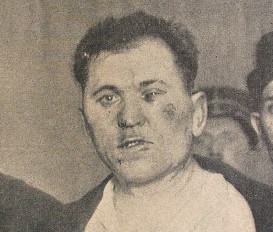


 It was March 12 — less than six weeks before — that