1741: Caesar and Prince, leaders of a plot to burn New York?

The first executions for New York’s 1741 fires took place on this date in 1741, several weeks before any others. They were two slaves of regal name: Caesar, the property of a baker named John Vaarck, and Prince, who was owned by the merchant John Auboyneau.

The first thing to know about these two men is that they were arrested in the first days of March … more than two weeks before fire consumed Fort George and initiated Gotham’s burning season. Though Prince was out on bail (as were the tavern owners John and Sarah Hughson, also arrested at the same time), Caesar and his white lover Peggy Kerry had been under lock and key throughout the supposed arson spree, awaiting trial for burglary.

Days prior to their arrest, they had contrived to unlock a window and steal coins plus £60 of linen merchandise from the shop of Rebecca Hogg. These men were indeed thieves, and they had a reputation in a town still intimately small (12,000 or so). Back in 1738, Caesar and Prince — along with Cuffee, who in 1741 would again be esteemed their third triumvir — had been carted shirtless through a Manhattan winter’s day, “attended by a Number of Spectators of all Degrees Ages and Sizes, and were continually complimented with Snow Balls and Dirt, and at every Corner had five Lashes with a Cowskin well laid on each of their naked black Backs.” (New York Gazette) The reason was that, in a celebratory mood, the three had broken into a pub and stolen its gin, thereafter toasting themselves the Geneva Club in celebration. They used the liquor as part of a mock initiation ceremony, travestying for their own fraternity the outlandish rites of New York’s white Freemasons. This in turn had led to them christening themselves as Black Masons.

As Jill Lepore notes in New York Burning: Liberty, Slavery, and Conspiracy in Eighteenth-Century Manhattan, the existence of this mock secret society would be conflated for the prosecutors of the 1741 burnings with a three-year plot to destroy New York.

This alliance of minor crooks was so obvious a target that the bailed-out Prince was re-arrested two days after Fort George burned, at the order of New York’s mayor. Round up the usual suspects!

They are also, collectively, the Patient Zero for that city’s epidemic of incendiary accusations. We can even date the first onset: April 22, 1741. That’s the day the Hughsons’ servant Mary Burton provided to Daniel Horsmanden‘s grand jury the crucial testimony that would cast their society as not merely deviant, but menacing. After making a great show of refusing to give evidence, Burton sang when threatened with the prospect of joining Caesar, Prince, Peggy Kerry, and the Hughsons in city hall’s cellar jail. Mary was no fool: far better the star witness in court than the undercard attraction at the gallows.

And when she started talking, she had a shocking story to tell them — one that would firmly fix upon the accused the city’s rampant rumors and speculations about a black plot.

Accordingly, she being sworn, came before the grand jury; but as they were proceeding to her examination, and before they asked her any questions, she told them she would acquaint them with what she knew relating to the goods stolen from Mr. Hogg’s, but would say nothing about the fires.

This expression thus, as it were providentially, slipping from the evidence, much alarmed the grand jury; for, as they naturally concluded, it did by construction amount to an affirmative, that she could give an account of the occasion of the several fires; and therefore, as it highly became those gentlemen in the discharge of their trust, they determined to use their utmost diligence to sift out the discovery, but still she remained inflexible, till at length, having recourse to religious topics, representing to her the heinousness of the crime which she would be guilty of, if she was privy to, and could discover so wicked a design, as the firing houses about our ears; whereby not only people’s estates would be destroyed, but many persons might lose their lives in the flames: this she would have to answer for at the day of judgment, as much as any person immediately concerned, because she might have prevented this destruction, and would not; so that a most damnable sin would lie at her door; and what need she fear from her divulging it; she was sure of the protection of the magistrates? or the grand jury expressed themselves in words to the same purpose; which arguments at last prevailed, and she gave the following evidence, which however, notwithstanding what had been said, came from her, as if still under some terrible apprehensions or restraints.

Deposition, No. 1. — Mary Burton, being sworn, deposeth,

1. “That Prince and Caesar brought the things of which they had robbed Mr. Hogg, to her master, John Hughson’s house, and that they were handed in through the window, Hughson, his wife, and Peggy receiving them, about two or three o’clock on a Sunday morning.

2. “That Caesar, Prince, and Mr. Philipse’s* negro man (Cuffee) used to meet frequently at her master’s house, and that she had heard them (the negroes) talk frequently of burning the fort; and that they would go down to the fly and burn the whole town; and that her master and mistress said, they would aid and assist them as much as they could.

3. “That in their common conversation they used to say, that when all this was done, Caesar should be governor, and Hughson, her master, should be king.

4. “That Cuffee used to say, that a great many people had too much, and others too little; that his old master had a great deal of money, but that, in a short time, he should have less, and that he (Cuffee) should have more.

5. “That at the same time when the things of which Mr. Hogg was robbed, were brought to her master’s house, they brought some indigo and bees wax, which was likewise received by her master and mistress.

6. “That at the meetings of the three aforesaid negroes, Caesar, Prince, and Cuffee, at her master’s house, they used to say, in their conversations, that when they set fire to the town, they would do it in the night, and as the white people came to extinguish it, they would kill and destroy them.

7. “That she has known at times, seven or eight guns in her master’s house, and some swords, and that she has seen twenty or thirty negroes at one time in her master’s house; and that at such large meetings, the three aforesaid negroes, Cuffee, Prince, and Caesar, were generally present, and most active, and that they used to say, that the other negroes durst not refuse to do what they commanded them, and they were sure that they had a number sufficient to stand by them.

8. “That Hughson (her master) and her mistress used to threaten, that if she, the deponent, ever made mention of the goods stolen from Mr. Hogg, they would poison her; and the negroes swore, if ever she published, or discovered the design of burning the town, they would burn her whenever they met her.

9. “That she never saw any white person in company when they talked of burning the town, but her master, her mistress, and Peggy.”

This evidence of a conspiracy, not only to burn the city, but also destroy and murder the people, was most astonishing to the grand jury, and that any white people should become so abandoned as to confederate with slaves in such an execrable and detestable purpose, could not but be very amazing to everyone that heard it; what could scarce be credited; but that the several fires had been occasioned by some combination of villains, was, at the time of them, naturally to be collected from the manner and circumstances attending them.

By the summer, Mary Burton’s credibility was shot. But for months before her fall from public confidence, the town fence’s 16-year-old servant sent many slaves and some whites too scrambling to protect themselves, unfolding a warren of defensive silences, opportunistic denials, and pay-it-forward name-naming that would flesh out the “twenty or thirty negroes” and more.

Caesar and Prince were just the low-hanging fruit. Languishing in jail and already charged with a theft that could be constructed as a capital crime, their now-certain doom became the leverage used against their white co-accused. Before they died, they would see Caesar’s lover Peggy Kerry, the mother of his son,** “admit” the plot — desperate gambit that would not in the end save her, either.

The court did not bother to keep them around for the arson trials that would come, but it was clear at Caesar and Prince’s sentencing (May 8, 1741) that it wasn’t the stolen linens that were on Judge Philipse’s mind.

I have great reason to believe, that the crimes you now stand convicted of, are not the least of those you have been concerned in; for by your general characters you have been very wicked fellows, hardened sinners, and ripe, as well as ready, for the most enormous and daring enterprises especially you, Caesar: and as the time you have yet to live is to be but very short, I earnestly advise and exhort both of you to employ it in the most diligent and best manner you can, by confessing your sins, repenting sincerely of them, and praying God of his infinite goodness to have mercy on your souls: and as God knows the secrets of your hearts, and cannot be cheated or imposed upon, so you must shortly give an account to him, and answer for all your actions; and depend upon it, if you do not truly repent before you die, there is a hell to punish the wicked eternally.

And as it is not in your powers to make full restitution for the many injuries you have done the public; so I advise both of you to do all that in you is, to prevent further mischief’s, by discovering such persons as have been concerned with you, in designing or endeavouring to burn this city, and to destroy its inhabitants. This I am fully persuaded is in your power to do if you will; if so, and you do not make such discovery, be assured God Almighty will punish you for it, though we do not:† therefore I advise you to consider this well, and I hope both of you will tell the truth.

The condemned slaves did not gratify their persecutors with any such discoveries.

MONDAY, MAY 11

Caesar and Prince were executed this day at the gallows, according to sentence. They died very stubbornly, without confessing any thing about the conspiracy; and denied they knew any thing of it to the last. The body of Caesar was accordingly hung in chains.

These two negroes bore the characters of very wicked idle fellows; had before been detected in some robberies, for which they had been publicly chastised at the whipping-post, and were persons of most obstinate and untractable tempers; so that there was no expectation of drawing any thing from them which would make for the discovery of the conspiracy, though there seemed good reason to conclude, as well from their characters as what had been charged upon them by information from others, that they were two principal ringleaders in it amongst the blacks. It was thought proper to execute them for the robbery, and not wait for the bringing them to a trial for the conspiracy, though the proof against them was strong and clear concerning their guilt as to that also; and it was imagined, that as stealing and plundering was a principal part of the he1lish scheme in agitation, amongst the inferior sort of these infernal confederates, this earnest of example and punishment might break the knot, and induce some of them to unfold this mystery of iniquity, in hopes thereby to recommend themselves to mercy, and it is probable, that with some it had this effect.

* Frederick Philipse, also one of the judges in this case. As already noted, the city was intimately small.

** An infant at the time events unfold here, the child presumably died as it disappears from the record about the time Peggy Kerry was arrested.

† Many other slaves burned for the purported conspiracy instead of “merely” hanging; this surely would have been the fate of Caesar and Prince had they been formally convicted of leading a plot to fire the city. But it’s still not quite the case that they weren’t punished for the fires: slaves being valuable property, it’s rather doubtful that they would have been executed for the linen thefts absent the subsequent security panic.

Part of the set Corpses Strewn: New York’s Slave Conspiracy of 1741.

On this day..

1756: Owen Syllavan

Colonial counterfeiter Owen Syllavan (Sullivan) was executed in New York on this date in 1756.

An Irish runaway, Syllavan followed an indenture to the North American colonies and wound up enlisted in the army during the French and Indian War. As a militia armorer, he picked up the smithing skills with which he would later turn out plates to to clone the colonies’ bills of exchange.

Anthony Vaver, author of Bound With An Iron Chain: The Untold Story of How the British Transported 50,000 Convicts to Colonial America, tells the charming crook’s story on Vaver’s blog Early American Crime; click onward to find out whether Syllavan’s gallows appeal for his 29 confederates to get out of the currency fraud game saved their necks.*

* Anthony Vaver has also guest-blogged for Executed Today.

On this day..

1612: The slave rebels of Mexico City

On this date in 1612, Spanish colonial authorities smashed an alleged plot among Mexico City’s black slaves with a grisly mass execution.*

In Mexico as elsewhere in the Americas, African labor had been imported en masse in the 16th and 17th centuries; David Davidson estimated** that Mexico City had a black population ranging from 20,000 to 50,000. And as elsewhere in the Americas, they frequently resisted: Mexico City slave risings dating back to the 1540s had badly shaken the city, and led the viceroy Luis de Velasco to worry in 1553 that “this land is so full of Negroes and mestizos who exceed the Spaniards in great quantity, and all desire to purchase their liberty with the lives of their masters.”

The most illustrious name of this era was Gaspar Yanga, who was kidnapped into bondage from the Gold Coast, and escaped bondage by leading a large band of fugitive slaves into the highlands of Veracruz and founded an outlaw colony that still bears his name today.

Yanga’s palenque — known in his time as San Lorenzo de los Negros de Cerralvo — had to fend off military action by the Spanish authorities from 1609 until a truce in 1618.

Still, a truce was possible: a refuge like San Lorenzo offered slaves the unwelcome-to-their-masters prospect of escape from the scourge economy, but the real threat to New Spain was that purchasing liberty with lives bit.

As we have seen in the American South, the situation on the ground begat paranoia that makes it nigh impossible for later interlocutors to disentangle fact from fantasy: was there really a phenomenal slave rebellion nipped in the bud? Or just informers and torturers refracting the terrors of those outnumbered Spaniards?

The slaves in this case were said by a Portuguese merchant who overheard them to be readying themselves to exploit Spanish inattention during Holy Week celebrations, and to bloody those days by falling upon their masters and taking possession of the colony. In the inevitable rounds of arrests and torture that ensue, the alleged plot as recorded by the annalist Chimalpahin (Spanish link) sounds suspiciously like a psychosexual projection, for it

involved castrating any surviving Spanish males, making sexual slaves of white women, and gradually “blackening” the latter’s descendants.**

Certainly the punishment blackened Mexico City; our correspondent uses this same word to describe the condition of the gibbeted corpses when they were finally let down from their gallows on the feast of the Holy Cross. Even then, the flesh of the would-be slave kings could not rest: most were beheaded posthumously and mounted on pikes while six others were quartered for display on all the roads entering the capital. This in itself was a small moderation for the public good. Chimalpahin reports that doctors advised the state that “if all the dead were to be quartered and hung up in the main streets to rot, their stench will blow a sickness across the city.”

* Thirty-five is the execution count supplied by Chimalpahin; some sources give 33.

** “Negro Slave Control and Resistance in Colonial Mexico, 1519-1650,” The Hispanic American Historial Review, Aug. 1966.

† Maria Elena Martinez, “The Black Blood of New Spain: Limpieza de Sangre, Racial Violence, and Gendered Power in Early Colonial Mexico,” The William and Mary Quarterly, Jul. 2004.

On this day..

1803: Cato, slave of Elijah Mount

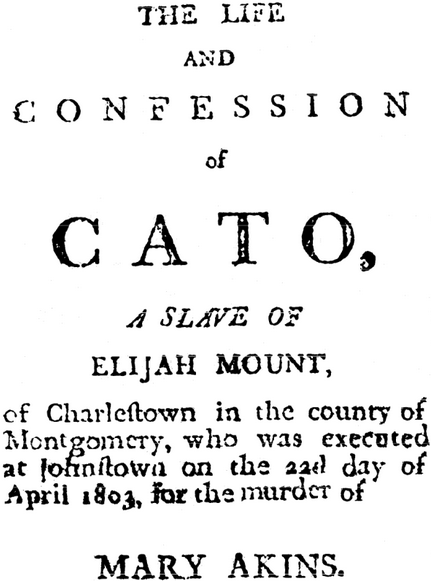
The following confessional and its exhausting run-on sentence arrive courtesy of a pamphlet published at the time and reprinted in Free Blacks, Slaves, and Slaveowners in Civil and Criminal Courts: The Pamphlet Literature.

The Life and Confession of Cato, a Slave of Elijah Mount, or Charlestown in the county of Montgomery, who was executed at Johnstown on the 22d day of April 1803, for the murder of Mary Akins.

Containing many incidents of his life and conduct not before made public. Faithfully written from his own words, while under sentence of death in prison.

LIFE and CONFESSION &c.

In offering to the public the following narrative I feel no other interest than the good of mankind, nor have I any other object in view than to caution the careless and unwary against pursuing that vicious course which has been the means of plunging me at this early period of life into that dreadful dilemma in which I am now involved.

Altho nature had doomed me to a state of obscurity and degradation, I might have remained happy in this unenviable situation, had not the vicious habits I had contracted in the earlier stages of my youth driven me into excesses which have proved my ruin. Pursued by the hand of justice, I have thus early been arrested in my vicious career: drawn from the deep & solitary recesses of obscurity and debasement, to the bar of justice, I am condemned to recieve [sic] the punishment which my guilt has so justly merited, as a warning and example to those I leave behind. It may be somewhat interesting to those I am about to leave to be informed of the causes which have produced those (to me) dreadful effects.

The following pages contain a brief history of my short and wicked life, and such reflections as have been produced in my mind by a retrospective view of my conduct; they are submitted to the public as the last words of a dying sinner.

I am this day seventeen years and five weeks old. I was born of African parents; slaves to Mr. Benjamin Ward of Middlesex county State of New-Jersey, in whose family I lived until about four years ago, previous to which my parents purchased their freedom, and left my master’s family.

My master was a man of very corrupt and immoral habits, subject to habitual intoxication, and most of the vices which flow from that fertile scource [sic] of human depravity. Among other things he almost totally neglected his family concerns, the consequence was that I and my brothers and sisters were left to govern ourselves, and form such habits and principles as our inclinations led us to pursue.

We were not only neglected as to our morals and habits, but were badly provided for with the necessaries of life, our table was but illy supplyed [sic], our cloathing [sic] would scarcely cover our nakedness, much less protect us against the inclemency of the seasons. Thus were we permitted to spend our time in idleness and want, which produced in us an inclination, and afforded us liesure [sic] and opportunities to practise almost all kinds of evil.

I was thus in a manner abandoned by my master and only guardian, in a hopeless state of slavery, with no prospect before me to stimulate my ambition, or direct the youthful ardor that glowed in my breast to the pursuit of any laudable object, I sunk even below the degraded station which nature had assigned me.

I formed connection with such as were willing to associate with me, those were of course a motly tribe of the most abandoned of the human race, among whom it was my chief ambition to become famous, and it may readily be conjectured what was the measure of fame in a society where wickedness was the standard of merit, and lewdness and profanity esteemed the higest [sic] accomplishments of its members.

Hence I became extremely wicked, and subject to almost every vice my tender years were susceptable [sic] of, such as cursing, profane swearing, lying and sabath-breaking [sic; he will repeat this word several times more with the same spelling], with a number of other lewd practice, all which I indulged without restraint, and all my vicious habits increased with my age. My master occasionally chastised me, but this was generally so indiscreetly done, that, instead of a reformation it produced the contrary effect, and I became obstinate and headstrong.

In this situation I lived until I was about thirteen years of age, during which time tho’ I indulged in almost all kinds of wickedness which my tender age was capable of, I do not recollect of having committed any thing legally criminal, except, that I once stole a shilling out of a bakers drawer, with which I bought some cake and shared it with my companions, but being detected, I confessed the fact, and was severely chastised for it.

At length my master dying, his estate fell into the hands of his heirs, who found it so involved that they were under the necessity of selling the personal property. Among the rest I was sold to Mr. Elijah Mount, who then lived in New-Jersey, but afterwards moved to Charlestown, Montgomery county, state of New-York.

I now found my situation entirely changed, my new master was quite the reverse from my old one, he was moral, sober, industrious and frugal, paid great attention to the comfortable support and instruction of his family, nor did he neglect to extend his benevolence to me. He soon laid me under such restraints as in a great measure reformed my external deportment. He totally prohibited my profaneness and instructed me in the principles of christianity, [sic] but, alas! the inbred vicious habits I had contracted in the earlier part of my life, had made such a deep impression on my mind that, altho I found myself under the necessity of complying with his regulations in my conduct, they were far from producing a radical reformation in my principles. On the contrary, I found, that, tho I was constrained to abandon the vicious habits of cursing, profane swearing and sabath=breaking at least publicy, the corrupt principles I had imbibed daily acquired strength as I grew up and became capable of carrying them into effect.

I became lewd to that degree that my lasciviousness overleaped all bounds of discretion, and I indulged it in the most wanton and abominable excesses, so that not even the brutal part of the creation escaped the rage of my unruly passions, the innocent lamb and the loathsome swine indiscriminately became its victims.

I also extended my lewd desires, to those whom nature had placed above me, I however found the gratification of those desires so obstructed by my debased situation, that I could not flatter myself with a hope of indulging them as a favour. I was therefore impelled by their impetuosity to endeavour to obtain by violence what I could not effect by solicitation, I was rash and inconsiderate, destitute of fortitude and circumspection by which I was soon led into the error that now terminates my existence.

The first attempt I made to gratify these lewd desires, was on the body of a young woman in the town of Charlestown whose name for her sake I chuse to with-hold from the public. The circumstances of this nefarious attempt were as follows. It was on a sabath day. I together with some young men of the neighbourhood, who I likewise do not chuse to expose at this time, by publishing their names to the world, were together in an orchard, when this young woman came in. She had by some means or other become obnoxious to them, and soon after she appeared they proposed to me to make an attempt on her chastity, they offering me a small pecuniary compensation, and promised to withdraw to afford me an opportunity, which they accordingly did, while I made the attempt, but I did not succeed, for before I could effect my purpose two of her brothers (small boys) came in sight, and I fled.

This transaction was not disclosed, it is probable the young woman who was the subject of it, from motives of modestly declined complaining, or pursuing measures to bring me to justice; and those who were concerned with me and who ought rather to have protected her agianst any violence offered by me, than to have encouraged me in such an abominable attempt,) could have no motive in divulging a crime in which they themselves were so deeply implicated, and by these means I evaded the punishment which I so justly deserved.

Having thus escaped with impunity, I felt encouraged to pursue my wicked inclinations, my obscurity however prevented my having many opportunities of indulging my passions.

At length however, my attention was attracted by that unfortunate victim of my inordinate passion, who fell a sacrifice to my wantoness, [sic] and ferocity, for which I am now to suffer the just punishment of the law.

Her name was Mary Akins, daughter of Mr. Samuel Akins, of Charlestown, in the county of Montgomery. She was a girl of about twelve years of age, her father lived on a part of my master’s farm, she came to my master’s house on the morning of Sunday the thirteenth day of February last, for the purpose of attending public worship, having heard that a minister was to preach there that day, but being disappointed in her object, and the weather stormy, she remained there til the sun about half an hour high in the afternoon, her father lived about half a mile from my master’s, the road leading across the fields, I had formed a design of making an attempt on her chastity and watched an opportunity to follow her undiscovered, which soon offered, and I as readily embraced, I soon overtook her in an obscure place, where we could not be discovered from either house, with a determination of carrying my nefarious purpose into effect, I passed by her, she appearing offended at my presence, accosted me saying “who wants to keep your company you black devil” I replied I was not going to keep her company, upon which she again accosted me in the same manner adding “you black son of a bitch” to which I made the same reply as before and immediately assaulted her, threw her down, and attempted a violation of her chastity but not effecting it I permitted her to rise, as soon as she found herself disengaged she attempted to escape towards my master’s, threatening to have me brought to justice, upon which my guilt beginning to operate on my mind, and dreading the consequences of a discovery, I determined to prevent it by committing a crime still more heinous, and in an instant determined to deprive her of the power of exposing me, by depriving her of her life I had no sooner come to this resolution than I siezed [sic] a small stone which lay in my way, and I could conveniently hold in one hand, by this time she had advanced about ten or twelve yards from the place where I had made the first attempt upon her towards my master’s, I again assaulted and threw her down, struck her with the stone I held in my hand, on the crown of her head with such force as stunned her and blood issued from her mouth and [obscure], in this situation I again attempted to carry my first design into effect, but was again baffled by her incompetency, I then disengaged from her, blood on my feet and threw the same stone with which I had before struck her on the head, this I repeated twice, and then left her in the agonies of death, and expiring, finding some blood on my hands, I washed them and retired towards home, my conscience had however by this time awakened, and the horrors of my guilt began to agitate my mind, but I endeavoured to sooth my waring [sic] conscience with reflections that I had not been discovered, and that the only one privy to this horrid scene had been deprived of the power of discovering it by the very act that now filled my mind with remorse, under those reflections I had [obscure] some distance, when I began to apprehend, that she might perhaps recover, and have strength enough to reach home, or at least to communicate the transaction and discover its agent, to some one who might pass that way, I therefore returned to the place where I had been engaged in this sanguinary scene, and where its subject lay breathing her last (for she yet breathed.) to remove the apprehensions I had entertained of her revival, I placed two rails crosswise on her neck, and the one end of each under the fence by the side of which she lay, having thus secured her against all possibility of recovering, I retired a second time.

I now returned home, it being about sunset, and no one having noticed my absence, I went about my work as usual, and in about fifteen minutes her brother came in search of her, I heard him making enquiry for her, and passing by him into the house I familiarly asked him what he would think if he should find her dead? to which he replied that he would be much frightened, little thinking that those words carelessly spoken were to be the means of betraying me, they however made a deeper impression on the mind of the young man than I expected; & in searching for the author of this melancholy event, afforded a clue to discover its author, and fixed the suspicion on me.

Soon after the departure of the young man his mother came to my master’s, and informed him that she feared some misfortune had befallen her daughter as her bonnet had been found and she was missing; this excited great consternation, and my master and others went with her in search of her daughter; whom they soon found & carried home. The next morning Mr. Akins came to my master’s and charged me with the crime, informing my master of the grounds of his suspicion: I denied it, but by threats and promises was prevailed upon to confess it at last.

I was immediately bound and carried before Benjamin Van Veghten Esq. for examination, where I made the like confession; as I also did before the Coroner’s inquest. I was then committed to jail for my trial which I had on the 24th of March last, a conviction was a matter of course, my sentence was pathetically delivered by the presiding judge, during which awful scene I remained insensible.

I have since been benevolently attended by the reverend clergy of different denominations, who merit my warmest acknowledgments for their solicitude for my future happiness, I cannot however flatter myself with a hope of mercy; my approaching dissolution exites dreadful sensations in my mind, which I am unable to suppress; my sentence is just but [obscure] reconcile myself to my fate.

The foregoing narrative contains a faithful history of the chief incidents and material transactions of my life, as far as I recollect them; I have no motives to conceal anything; whatever else has been laid to my charge I deny.

Hence let masters learn the necessity of paying due attention to the instruction of their servants, had I not been neglected in my youth, I might have escaped this tragical end.

Let servants learn obedience and resignation, for had I paid due respect to the admonitions of my late master, and contented myself in my late situation, I might yet have been happy; let them also learn to shun the company of that worthless class of citizens, who being despised by their own society seek that of slaves, these are sure guides to destruction, such were those who offered me a reward to commit a rape.

Hence also let parents who profess christianity, (as the parents of these young men did) learn the danger of letting their children stroll about in idleness in such company, especially on sabbath days; and let profaners of that day remark that my worst crimes have been the effects of that sin.

In short let every description of sinners learn the danger of deferring repentance to the cross, if they have one favourable instance, they have a cloud of melancholy examples. I feel the necessity of a Saviour, but my heart is a rock at the door of the sepulcher which I am not able to remove, and I stand on the brink of eternity under the gloomy apprehensions of everlasting misery and despair.

Johnston Jail, April 22d 1803.


Although it sounds as if Cato (or the confessor who obviously composed his testimonial) was pessimistic about the prospects for his everlasting soul, we have firmer information on the unedifying disposition of the youth’s mortal flesh: a Dr. John Ball of Franklinton, Ohio (a settlement today absorbed into the city of Columbus) secured it and kept it in his closet “in order to keep his personal effects secure from the prying eyes of servants. The skeleton was so suspended that should the closet door be opened by one not acquainted with the secret, Cato’s jaws would gnash together and his head would wag in a manner calculated to strike terror into inquisitive female hearts.”

On this day..

1895: A quintuple lynching in Greenville, Alabama

(Thanks to Meaghan Good of the Charley Project for the guest post. -ed.)

On this date in 1895, three black women and two black men were lynched in Greenville, Alabama for the murder of Watts Murphy, white.

Watts was a “young man of great prominence” who was said to be the nephew of Alabama’s former governor, Thomas H. Watts. He was killed on April 17, aged about thirty. When he failed to arrive home, his family began looking for him. Finally, one of the family servants confessed to what he knew: Watts had been working in the field with six black people, three men and three women, and one of the men hit him on the head with a tree limb. The others beat him unconscious and carried his body to a secluded area, where the women gathered loose brush, piled it on top of Watts’s body, and set the heap ablaze.

Newspapers reported grisly details about the crime, saying that the murderers kept piling wood on the fire until there was nothing left but the victim’s teeth, his heart and his liver, which “for some unknown reason failed to burn.”

Just why the murder happened has been lost to history, and various contradictory rumors floated around. According to one story, one of the men planned to kill him in revenge for “an imaginary wrong of a trivial nature.” In another account, it was an impulsive act of violence, the result of an argument.

Daily Inter Ocean (Chicago, Ill.), April 22, 1895

Zeb Caley or Calley, Martha Greene, Alice Greene, Mary Deane, and John Rattler were arrested on April 20 near Butler Springs, Alabama, and charged with murder. (The third man who was implicated, left unnamed in press reports, got away.) A group of men was charged with transporting the five prisoners sixteen miles to the security of jail in Greenville. They set off at 11:00 p.m. At 3:00 a.m., while the party was en route, a mob of approximately 100 men brandishing Winchester rifles surprised the party on the road, surrounded them and took the prisoners away.

The members of the mob tied each person’s hands, lead them one by one to the side of the road, and hanged them from trees. Later that day the bodies were seen by people passing by on their way to church.

On April 29, the sixth suspect in the crimes, who has never been identified, was found hanging from a tree in the same general area as the other ones. He had been dead for about a day.

On this day..

1895: Richard Burleson, Crab Shack controversy

A few months ago as of this writing, Joe’s Crab Shack in Roseville, Minnesota made unfortunate news for its indecorous decision to include a black-and-white photograph of an old Texas hanging in its zany family dining table collage: that of the April 12, 1895 execution of Richard Burleson in Groesbeck, Texas. (Not a lynching, as it was widely characterized: it was a legal public execution.)


The hanging of Richard Burleson as interpreted by oe’s Crab Shack.

The image was adorned by a dreadful word bubble in which the doomed man exclaims, “All I said was, ‘I don’t like the gumbo!'” perhaps suggesting that uninspired dishes are best not returned at this establishment.

Here’s now the New Orleans Daily Picayune of April 13, 1895 described the actual, gumbo-less event.

Burleson Executed

For the Murder of J.G. McKinnon.

Groesbeck, Tex., April 12. — (Special.) — Richard Burleson slept all night, arose this morning, ate a hearty breakfast and was quite cheerful. At 10:30 Sheriff Gresham read the death warrant to him and told him to prepare for death. His spiritual advisers, J.H. Linn, of Mexia, and J. Beckham and J.M. Jackson, of Groesbeck, were with him several hours, but he refused to accept Christ or acknowledge his guilt. At 11:50 a.m. he ate a light dinner and prepared to arrange his toilet. At 2 o’clock he bade his brother good-by, who was in an adjoining cell, charged with aggravated assault. He walked up the steps leading to the gallows as though the end was not so near. The trap did not work at first and necessitated some three minutes’ delay. He became impatient, and told the officers that he could hang three or four niggers in that length of time himself. He never shed a tear or seemed to dread death in the least. At 2:05 he shot through the trap. His neck was broken; he never quivered nor moved a muscle. At 2:20 he was pronounced dead. When his body was sent down such a crowd had gathered on the platform to see him that the platform fell with a crash, but, fortunately, no one was hurt. He sold his body to Dr. W. M. Brown for $5. He was 21 years old at the time of his death, and lived in Limestone county, at Tehuacana, where his mother and wife, whom he married three months before hw as arrested for this crime, reside. He spoke in high terms of the officers. The crowd was estimated at 4000, and everything passed off very quietly.

The crime for which Burleson was sentenced to be hanged was a most horrible one, and one which stirred the community as it had not been stirred in many years.

The evidence was circumstantial, but no evidence could be found more closely linked together than was that on which he was convicted.

May 2, 1894, the murderer followed the venerable Mr. J.G. McKinnon out of Mexia and asked permission to ride in his wagon, which was readily granted him; he assaulted the helpless old man shortly after he had gotten into the wagon and with some heavy object tied up in a jacket beat him over the head until life had been crushed out of his victim. He then robbed the dead body and leaving the scene of the crime fled to Tehuacana, where he was living.

A few hours later he was arrested at his home. In order to give him a legal trial the sheriff slipped across country and put him in jail at Corsicana, where he has been kept ever since, with the exception of the time when he was on trial at this place.

This was the first legal hanging in Limestone county in seventeen years.

After news of the Crab Shack’s tasteless appropriation of this picture got all over the Internet and triggered public protests, the restaurant found a less risible inanity upon which to plate crustaceans.

On this day..

1809: Four by William Brunskill at Horsemonger Lane

Jackson’s Oxford Journal, April 1, 1809:

ASSIZES. — At Surry [sic] assizes, the following capital convicts received sentence of death: — J.A. Davison, J. Mason, J. Wood, and S. Hilton, for burglary; W. Leech, for highway robbery; J. Bartlet, [sic] for an unnatural offence; T. Hall, for extorting money under a threat of charging J. Clarke with an unnatural offence; H. Edwards, for shooting at W. Smith; J. Stenning, for forging a note; C. March, for cattle-stealing; S. Turner, for privately stealing; and Mary Ann Ellis, J. Hopkins, and J. Cobb, for stealing in dwelling-house. The Judges reprieved all except Bartlett, Edwards, Mason, and Wood.

Robert Skinner was indicted for attempting to ravish Mary Ann Hill, on the 16th of February last, at Wandsworth. The prosecutrix, who stated herself to be only 16 years of age, deposed that her father was a market-gardener at Wandsworth, and the prisoner worked in his service. On the 16th of February last they were at work together in a shed. He was binding coleworts, and she was trimming them.


A field of colewort. (cc) image by patchara yu.

After he had finished, he came to where she was sitting and threw her down. He was, however, interrupted by the coming of a cart, or she believed he would then have committed the offence charged. On cross-examination, she said her father had a cottage in his garden in Garret-lane, and she, her sister, and another girl slept there alone. On the 14th of January the prisoner was there in the evening; they gave him some beef-steaks for his supper, and he would not go home. She gave him the mattress to lie upon without side her chamber door. — In the night she heard a noise, and got up to see what it was; they were both naked. She did not tell her father of this. A few nights afterwards they had him to supper again, and got him some sausages; he would stay all that night, and she then let him lie in the same bed, but she did not let him lie next to her. The Learned Judge here interrupted, and observed it was ridiculous to talk of any attempt at a rape after this. The prisoner was of course acquitted.


Jackson’s Oxford Journal, April 8, 1809:

EXECUTION. — James Bartlett, for an unnatural crime; Henry Edwards, for highway robbery; and John Biggs and Samuel Wood, for burglary, were executed yesterday morning, [April 4, 1809] at the usual hour, on the top of the New Prison, Horsemonger-lane, in pursuance of their sentence. The crowd assembled on the melancholy occasion was excessive. The unfortunate men met their fate with great fortitude, and died acknowledging the justice of their punishment. Biggs sarcastically observed to the Executioneer, [sic] when he was pinioning him in the usual way — “I wish you had a better office.”* — He with the rest died extremely penitent. A hearse conveyed the body of Bartlett to Limehouse, where he is to be interred. — He is stated to have conveyed before his trial upwards of 1500l. to his daughters.

* The hangman so busted upon was William Brunskill, who already had near a quarter-century in his poor office by that time. It’s a bit hard to tell from the printed account, but since Brunskill had some notable ten-thumbed hangings to his credit — like that of Joseph Wall seven years before — the “better office” remark might have been a Monmouth-esque professional rebuke.

On this day..

1560: Baron de Castelnau, for the Amboise Conspiracy

On this date in 1560 the second Baron de Castelnau, Jean Boileau, was beheaded as a Huguenot traitor. His was one of the opening casualties of France’s devastating Wars of Religion.

We find Castelnau’s end before war began, when the Huguenot party — although it had been pressed sorely enough for martyrmaking in the years of the Reformation — was perhaps not yet quite steeled for the measure of purposeful violence it would require to conquer state power. After the events in this post, the great Huguenot leader Gaspard de Coligny would remonstrate at a royal Council of Notables protesting the loyalty of the realm’s Protestant subjects. Two years later, he was commanding rebels in the field; a decade later, he would be murdered in the St. Bartholomew’s Day Massacre.

“Rashly designed and feebly executed,”* the plan of these 1560 pre-rebellion Huguenots was to tilt France’s religious policy by muscling out the top Catholic.

If it were possible to imagine such a gambit it was amidst the flux following King Henri II‘s sudden death at the jousts in 1559. his sickly 15-year-old heir Francis was dominated by the staunchly Catholic Duke of Guise; policy accordingly trended away from religious accommodation for the Calvinist Huguenot minority.

Considering the new king’s youth and Guise’s prestige, here was the potential to lock in for decades to come a situation intolerable to France’s Protestants. (In actual fact, Francis had not long to live himself and the country soon fell into civil war … but the characters in this post did not have the benefit of hindsight.)

So the muscling-out plan was born: the Amboise conspiracy. Named for the castle where the attempt was unsuccessfully executed, this plot aimed to seize the Duke of Guise by main force and begin forcing a more satisfactory policy direction on the malleable sovereign.

This scheme became very widely known among Protestant nobles and even bourgeois, who variously signed on or demurred; no surprise, someone in the ever-widening circle of confidantes eventually leaked it to the court. Guise quietly made ready the castle at Amboise to repel the putsch, and when the attempt was made in mid-March it was not the Catholics but the attacking Huguenots who were surprised and routed. Over 1,000 men involved in the attempt were slaughtered in the ensuing days — by the rope, the sword, or the waters of the Loire. Its chief architect, La Renaudie, was killed in the skirmishes but his corpse was still posthumously mutilated.


Castelnau’s beheading is foregrounded

The Lord Castelnau’s detail for the conspiracy was to seize the nearby Chateau Noizay. He did so only to discover himself in a most embarrassing position when his comrades were crushed. The Guise-allied young Duke of Nemours persuaded Castelnau to surrender under safe conduct:

“Lay down your arms then,” said Nemours, “and if you wish to address the king as becomes a faithful subject, I promise you, upon my faith, to enable you to speak to the king and to bring you back in safety.”

Castelnau, in consequence, surrendered the castle of Noizai to the Duke of Nemours, who took an oath and signed it, that no harm should happen to him or his followers. They went together to Amboise, where the unfortunate baron found that the promise which had been made him was not binding, for the Duke of Nemours had exceeded his orders.

Castelnau’s bravery did not forsake him on the scaffold, where he died a martyr to his religion; the Duke of Nemours felt very indignant at the circumstance, as he had given his signature, which tormented him probably much more than it would have done if his word alone had been passed. (Source)

This traitorous conspiracy — and the ferocity of its destruction — helped to initiate the ensuing years‘ tit-for-tat confessional violence that plunged France headlong into the Wars of Religion (and got Guise himself assassinated in 1563). “A morbid desire to witness the shedding of blood seized upon society,” one historian wrote. “D’Aubigne the eminent historian of the French Reformation, was an eye-witness of such incidents, and though but ten years of age, swore like young Hannibal before his father, to devote his life to vengeance of such atrocities.”

A century-plus after events in this post, when France revoked the Edict of Nantes and resumed official harassment of Huguenots, the Baron Castelnau of that time (our Jean Boileau’s great-grandson) was clapped in a dungeon. His son and heir Charles escaped to England where the family continues to this day — the Boileau Baronets.

* Cambridge Modern History, vol. 14.

On this day..

1558: Cuthbert Simson

On this date in 1558, Protestant Cuthbert Simson or Simpson was burned at Smithfield — having withstood harrowing torture in the Tower of London.

As deacon of a secret congregation during the reign of the Catholic Queen Mary, Simson bore the dangerous responsibility of keeping membership rolls. When he was arrested as a heretic and a traitor, he was subjected to “enhanced interrogation” in an effort to obtain the identities of the whole coterie.

He resisted.

Protestant hagiographer John Foxe recorded an alleged last letter that Simson sent to his friends from captivity (updated to present-day English from the glorious original), describing what happened after he, Simson, refused interrogators’ demand that he begin naming names.

I was set in an engine of iron, for the space of three hours as I judged. After that, they asked me if I would tell them. I answered as before. Then I was loosed, and carried to my lodging again. On the Sunday after, I was brought into the same place again before the lieutenant, being also constable, and the recorder of London, and they examined me. As before I had said I answered. Then the lieutenant sware by God, I should tell. Then did they bind my two forefingers together, and put a small arrow betwixt them, and drew it through so fast that the blood followed, and the arrow brake.


1563 woodcut of Cuthbert Simson’s torture. (Source)

Then they racked me twice. After that was I carried to my lodging again; and ten days after, the lieutenant asked me if I would not confess that which before they had asked me. I said I had said as much as I would. Then five weeks after, he sent me unto the high priest, where I was greatly assaulted; and at whose hand I received the pope’s curse, for bearing witness of the resurrection of Jesus Christ.

And thus I commend you unto God, and to the word of His grace with all them that unfeignedly call upon the name of Jesus; desiring God, or His endless mercy, through the merits of His dear Son Jesus Christ, to bring us all to His everylasting kingdom. Amen. I praise God for His great mercy shewed upon us. Sing Hosanna unto the Highest, with me Cuthbert Simson. God forgive me my sins. I ask all the world forgiveness, and I do forgive all the world; and thus I leave this world, in hope of a joyful resurrection.

Two associates, Hugh Fox and John Davenish, suffered at Smithfield with Simson.

On this day..

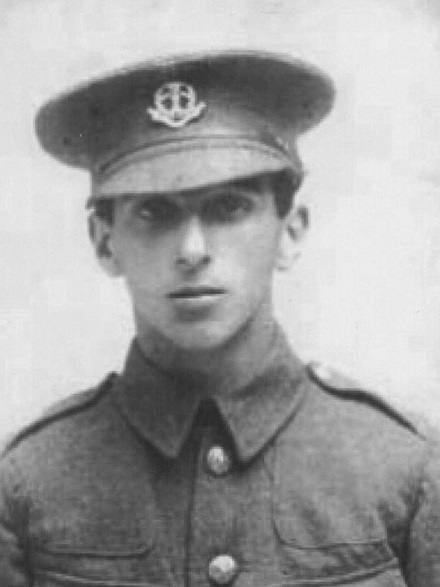
1916: Abraham Bevistein, child soldier

One century ago today, a Polish Jew from east London named Aby Bevistein was shot for cowardice in Calais — four weeks shy of his 18th birthday.

Abraham Bevistein was among an estimated quarter-million Brits who bore arms as minors in World War I. Fired by patriotism, these boys dodged the military’s 18-year-old minimum by … telling their recruiters they were 18. No documentation necessary.

Bevistein, whose family had moved to London from Warsaw when he was a small child, was British through and through enough to surge into the army with the first wave of pie-eyed volunteers in September 1914. He had 16 years and four months, and if he was like many of his new comrades in arms he probably reckoned on being back home by 17 — a bonny hero of a speedy war.

Instead, he spent most of 1915 navigating the labyrinth of trenches in France, and all their attendant horrors. He was wounded in December of that year but soon passed fit for duty again. On February 12-13, 1916, shellshocked and deafened by German grenades, he again sought medical help but was directed back to the lines by a harried medical officer. Instead, Bevistein wandered away to the rear, and took temporary refuge at a French farm.*

“We were in the trenches and I was ill so I went out,” he wrote to his mother by way of all-too-nonchalant explanation. “They’ve taken me to prison and I’m in a bit of trouble now.”

Anti-war suffragette Sylvia Pankhurst took up Bevistein’s cause when she learned about his execution, prominently publishing a sympathetic feature story in her newspaper, Women’s Dreadnought. Like 305 other British and Commonwealth soldiers shot at dawn during the Great War, Bevistein was posthumously pardoned and added to war memorials in the 21st century.

* The farm owner’s later testimony to Bevistein’s court-martial that the young tommy had expressed an intent to return to England sealed his fate as a deserter.

On this day..