1763: Hannah Dagoe, violently

On this date in 1763, Hannah Dagoe did it her way in “an extraordinary and unprecedented scene” at Tyburn.

A “strong, lusty”* Irish woman, her crime of theft does not much enthrall us, but her behavior on the way to the gallows would have done many a condemned wretch proud:

On the road to Tyburn she showed little concern at her miserable state, and paid no attention to the exhortations of the Romish priest who attended her. When the cart, in which she was bound, was drawn under the gallows, she got her hands and arms loose, seized the executioner, struggled with him, and gave him so violent a blow on the breast that she nearly knocked him down. She dared him to hang her; and in order to revenge herself upon him, and cheat him of his dues,** she took off her hat, cloak and other parts of her dress, and disposed of them among the crowd. After much resistance he got the rope about her neck, which she had no sooner found accomplished than, pulling out a hand kerchief, she bound it round her head and over her face, and threw herself out of the cart, before the signal was given, with such violence that she broke her neck and died instantly.

(Updated with a fortuitous connection not noted in first passing.)

Somewhere amid that ample throng cheering on the unexpected fisticuffs under the scaffold was notable scribbler James Boswell, he of The Life of Johnson.

Boswell had come along to the spectacle to see another, less pugilistic victim of the hanging party, Paul Lewis, a respectable clergyman’s son and former Navy officer taken to highway robbery. (The third member of the doomed party was stockbroker and forger John Rice.) Boswell’s diary records the happenstance encounter with Lewis and Hannah “Deigo” that led him to Tyburn’s shadow.

TUESDAY 3 MAY.

I walked up to the Tower in order to see Mr. Wilkes† come out. But he was gone. I then thought I should see prisoners of one kind or other, so went to Newgate. I stepped into a sort of court before the cells. They are surely most dismal places. There are three rows of ’em, four in a row, all above each other. They have double iron windows, and within these, strong iron rails; and in these dark mansions are the unhappy criminals confined. I did not go in, but stood in the court, where were a number of strange blackguard beings with sad countenances, most of them being friends and acquaintances of those under sentence of death. Mr. Rice the broker was confined in another part of the house. In the cells were Paul Lewis for robbery and Hannah Diego for theft. I saw them pass by to chapel. The woman was a big unconcerned being. Paul, who had been in the sea-service and was called Captain, was a genteel, spirited young fellow. He was just a Macheath. He was dressed in a white coat and blue silk vest and silver, with his hair neatly queued and a silver-laced hat, smartly cocked. An acquaintance asked him how he was. He said, “Very well”; quite resigned. Poor fellow! I really took a great concern for him, and wished to relieve him. He walked firmly and with a good air, with his chains rattling upon him, to the chapel.

Erskine and I dined at the renowned Donaldson’s, where we were heartily entertained. All this afternoon I felt myself still more melancholy, Newgate being upon my mind like a black cloud. Poor Lewis was always coming across me. I felt myself dreary at night, and made my barber try to read me asleep with Hume’s History, of which he made very sad work. I lay in sad concern.

WEDNESDAY 4 MAY.

My curiosity to see the melancholy spectacle of the executions was so strong that I could not resist it, although I was sensible that I would suffer much from it. In my younger years I had read in the Lives of the Convicts so much about Tyburn that I had a sort of horrid eagerness to be there. I also wished to see the last behaviour of Paul Lewis, the handsome fellow whom I had seen the day before. Accordingly I took Captain Temple with me, and he and I got upon a scaffold very near the fatal tree, so that we could clearly see all the dismal scene. There was a most prodigious crowd of spectators. I was most terribly shocked, and thrown into a very deep melancholy.

The Macheath imagery, if not the melancholy, evidently stuck with the dutiful scribe, who found himself still minded of the Beggar’s Opera hero two weeks later while out on the pull.

I then sallied forth to the Piazzas in rich flow of animal spirits and burning with fierce desire. I met two very pretty little girls who asked me to take them with me. “My dear girls,” said I, “I am a poor fellow. I can give you no money. But if you choose to have a glass of wine and my company and let us be gay and obliging to each other without money, I am your man.” They agreed with great good humour. … We were shown into a good room and had a bottle of sherry before us in a minute. I surveyed my seraglio and found them both good subjects for amorous play. I toyed with them and drank about and sung “Youth’s the Season” and thought myself Captain Macheath; and then I solaced my existence with them, one after the other, according to their seniority. I was quite raised, as the phrase is: thought I was in a London tavern, the Shakespeare’s Head, enjoying high debauchery after my sober winter. I parted with my ladies politely and came home in a glow of spirits.

* London Evening Post, May 3-5 1763.

** The executioner was entitled to claim his clients’ clothing.

† Distantly related to namesake and Lincoln assassin John Wilkes Booth.

On this day..

1980: Thirteen deposed Americo-Liberian officials

On this date in 1980, days after the coup d’etat that overthrew the Liberian government, thirteen of its former officials were shot on the beach near an army barracks in Monrovia.

This day’s scene — messily conducted, according to journalist witnesses, and with four forced to watch the first nine shot owing to a shortage of stakes — got its start in antebellum America, where a weird coalition of slaveholders, abolitionists and slaves themselves conceived ex-slave colonies in Africa as the way to let off the domestic pressure of the “peculiar institution.”

And thus was born Liberia, where African-American settlers promptly assumed the role of privileged elite vis-a-vis the natives that white colonists had elsewhere in the colonial world. The tiny “Americo-Liberian” population ran the country for over a century through the True Whig Party — an aptly retro title.

This was a better deal for the Americo-Liberians than for the other 15 or so ethnic groups, and resentment over economic disparities started gathering head through the 1970’s.

On April 12, 1980, an ethnically Krahn officer named Samuel Doe overthrew — and personally murdered — the last Americo-Liberian president, William Tolbert.

Ten days later, Tolbert’s older brother and an assortment of cabinet officers and other ministers of the True Whig government followed the ex-president into the hereafter* — setting the stage for Doe’s brutal turn in power and the almost continual civil war that has become Liberia’s watchword over the past generation.

* Only four had actually been death-sentenced by their military tribunals, but Doe had the more lenient sentences overruled.

On this day..

1936: Bruno Richard Hauptmann, The Most Hated Man in the World

On this date in 1936, a German immigrant went to New Jersey’s electric chair for kidnapping and murdering the infant son of famed aviator Charles Lindbergh.

Snatched

The kidnapping of the Lindbergh boy in 1932 had touched off an outpouring of public compassion matched only by the clumsiness of the investigation. The circus that formed around a father desperate to retrieve his boy — and prone to rash decision-making thereto — pulled in underworld figures, military intelligence officers (including the founder of the CIA’s forerunner and the father of Gulf War General Norman Schwartzkopf), a meddlesome schoolteacher, and queer characters like “Cemetery John,” who somehow managed two meetings with Lindbergh’s intermediaries, making off with a box full of ransom cash without anyone so much as tailing him, much less having to fork over the hostage.

The boy, in fact, was dead, and would be discovered weeks later, a few miles from the Lindbergh house, in such a state of decomposition as to suggest that, by accident or intention, he had suffered a fatal head injury almost at the moment of his abduction.

Two years’ fruitless investigation ensued, with leads that frustratingly faded away and at least two suspects who committed suicide. The police job had been a hash from the start, between amateurish cock-ups like failing to measure footprints found on the scene and security breaches in the chaotic weeks following the kidnapping. Most damagingly, a newspaper laid hands on an early ransom note and printed it, making it impossible subsequently to positively discern the kidnapper’s real notes from hoaxes.

But John Law had done one thing right: paid the ransom in soon-to-be-obsolete gold certificate. As they’d hoped, someone was finally caught spending this distinctive currency: Bruno Hauptmann.

Hauptmann actually went by “Richard”, but with its unerring sense of the Zeitgeist, the press played up his menacing alien moniker. After two and a half years, the public was ready to hate someone, and an illegal immigrant with a criminal record* from the late war’s great enemy was pretty much made to order.

Trial of the Century

The one thing Hauptmann didn’t do was confess — and that necessitated the “Trial of the Century,” or in Mencken’s coinage, “the greatest story since the Resurrection.”

It was O.J. before 24-hour cable. Journalists packed the small-town courtroom of Flemington, N.J.; for six weeks early in 1935, an aggressive prosecutor vied with a flamboyant (but cripplingly dissolute) defense attorney hired for the penurious defendant by the Hearst newspaper empire in exchange for inside information.

This newsreel footage of the trial consists mostly of Hauptmann’s own testimony, and even at seventy-plus years’ distance it crackles with drama — and with the persecutorial atmosphere that sealed Hauptmann’s fate, guilty or not. (The defendant often sounds uncertain and evasive in these clips — it cannot have helped his standing with the jury, but it is worth recalling that English was not his native language.)

History’s Verdict

The case was circumstantial, the most powerful circumstance, of course, being Hauptmann’s possession of ransom money — thousands of dollars worth, as it turned out, stashed in his garage. Hauptmann said a friend had left it when returning to Germany; the alibi didn’t convince many, but Hauptmann stuck to it to the end, even refusing to accept a commutation in exchange for a confession. This audio of a convicted Hauptmann still maintaining his innocence comes from the New Jersey Star-Ledger blog.

[audio:Bruno_Hauptmann.mp3]

Much other evidence against him — shaky eyewitness testimony, doubtful courtroom forensics — seems less damning, especially from the perspective of time. Unexplored problems — why would a professional carpenter build such a shoddy ladder? How could he have known the (rare) night the Lindberghs would actually be home? — gesture emptily towards other suspects never pursued, though they are very far from authoritatively exonerating Hauptmann. Ultimately, it’s a case with many unclear data points, whose importance and configuration invite dispute. (Here‘s a site dedicated to Hauptmann’s innocence, including this article (.pdf) outlining the main arguments his partisans make.)

Even the verdict’s defenders, and there are many, concede that portions at trial were exaggerated or outright perjured in an atmosphere hardly conducive to dispassionate review. Whether that makes Hauptmann “guilty but framed” or plausibly innocent (of the kidnapping, if not of opportunistic extortion) has been the subject of far more rumination than this blog can hope to assay.

A few of the many books about the Lindbergh case

An enigmatic criminal tied to an enigmatic icon in a painfully public four-year drama that transfixed the nation and still inspires debate: that “Trial of the Century” marquee holds up pretty well.

* In Germany; Hauptmann’s record was clean stateside — apart, that is, from Charles Lindbergh, Jr.

On this day..

1947: Qazi Muhammed, father of Kurdistan

On this date* in 1947, the only president of the world’s only Kurdish state was hanged with two aides in Mahabad, the Iranian city that had been the capital of his nascent country.

Ground between the maneuvers of much more powerful states — the stereotypical fate of the Kurds — Qazi Muhammed‘s endgame begins not in mountainous northwest Iran where he declared the short-lived Republic of Mahabad (alternatively, Mehabad), but in Berlin, where a distant dictator had hurled Europe’s great powers into war.

The contest for influence in Middle East and its lifeblood of oil for the modern mechanized army forms a crucial sidebar to World War II’s European chessboard, and the unpredictable collisions between rival empires and competing anticolonial interests made many strange bedfellows.

Two months after Germany invaded the Soviet Union, British and Soviet troops jointly seized Iran from its potentially pro-German ruler — securing both oil resources** and a precious route for sending American supplies to Russia’s desperately pressed defenders.

Kurds were very far from Stalin or Churchill’s calculation, but the moment also offered a power vacuum permitting de facto Kurdish self-rule in a narrow band straddling Soviet and British occupation zones.

As the war drew to a close, erstwhile allies began girding for the Cold War — and the disposition of Iran was a dress rehearsal. Moscow was keen to maintain influence in that country’s north, and to that end encouraged Iran’s Azerbaijani region to break away as an independent state — which it did in December 1945. The Kurdish Republic of Mahabad followed suit on January 22, 1946 (a date still commemorated by Kurdish activists) with Qazi Muhammed as president. Although the Mahabad Republic is sometimes characterized as “Soviet-backed,” or even a Soviet puppet, that might be a better description of its hopes than its reality.

Mahabad may have represented the national dream for Kurds, but it was a small pawn to the Soviets, easily sacrificed when its position became untenable. Moscow’s priorities were elsewhere, and this was the brief window when America was the only nuclear power: the Red Army was (diplomatically) forced out of Iran and the breakaway Republics reoccupied by the western-backed Iranian government. And Mahabad, a statelet founded by a middle class party with only limited backing from tribal chiefs, required Soviet support to have any hope of holding up.

Seeing where the wind was blowing, the Kurds submitted in December 1946 to the advancing Iranian army without a hopeless fight, but Muhammed refused on his honor to flee, hoping to placate the Iranians.

For all its inadequacies, Mahabad was the only Kurdish state of the 20th century, and Qazi Muhammed its founder and only president. That has earned him a place of honor in the crowded pantheon of Kurdish martyrs.

After a military court had him hanged, leadership of the Kurdish struggle passed to Mustafa Barzani, whose refugee guerrillas had made declaration of the Kurdish state a possibility in the first place.

In a biography of Barzani written by Barzani’s son, the Kurdish captain describes his last meeting with the president — and if the manifest interest of the reporting parties colors our presumption of its literal authenticity (journalist Jonathan Randal, for instance, reports that Barzani never held Mohammed in high regard), it likewise underscores the place of this day’s victim in the Kurdish mythology.

I went to Qazi Mohammed and asked him what he personally intended to do. He said that he intended to sacrifice his life to prevent bloodshed in Mahabad, that he would surrender to the Iranian forces, and that he had sent an emissary to General Hamayoni in Miyandoab informing him of his decision. He broke down in tears as he continued: “Never rely on anyone but your own group. All those who took the oath of allegiance have betrayed us and are rushing to prove their loyalty to the Iranian forces. Beware of the tribal chiefs who would target you if they could. I hope that you will leave Mahabad as soon as youc an to avoid confronting the Iranian forces.”

I insisted that he go with us [to Iraq], and pledged my word of honor that I would sacrifice my life and the lives of all who were with me to defend him, because he was the symbol of our nation. I told him that my advice to him was not to trust Iranian promises. It would be painful to see the first president of the Republic of Kurdistan fall into enemy hands.

In tears, Qazi Mohammed rose and hugged me, saying, “I pray God will give you strength and protect you. May my sacrifice spare the citizens some of their affliction and mitigate the terror and vengeance.” Then, he pulled a flag of Kurdistan from his pocket and gave it to me and said: “This is the symbol of Kurdistan. I give it to you as a token of trust in your honor, for I think you are the bes man to keep it.”

The Encyclopedia of Kurdistan has an excellent entry on Mahabad’s straitened political situation, as well as a good article on the background of tribal politics in the years prior to World War II.

* Some sources report March 30; the small hours in the morning of the 31st seems to have the plurality of scholarship.

** Although Baku was a much more important source of oil for the USSR.

On this day..

1933: Giuseppe Zangara, who is not on Sons of Italy posters

On this date in 1933, Giuseppe Zangara went to Florida’s electric chair for the murder of Chicago mayor Anton Cermak — the man he had accidentally shot while attempting to assassinate President-elect Franklin Delano Roosevelt.

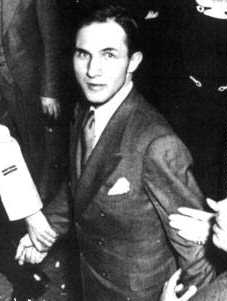
Zangara had to stand on a chair to take the shot: he was only five feet tall. This image is from Miami Police of Yesterday, a site by a descendant of one of the officers who arrested Zangara.

A strange and strangely forgotten man, the Italian immigrant came within inches of dramatically altering American history.

On February 15, 1933, at a Roosevelt speech in Miami’s Bayfront Park, Zangara perched himself on a metal folding chair within ten meters of the man who was then President-elect, but somehow managed to miss him. A bystander, Lillian Cross, grabbed his arm, and others in the crowd wrestled him down.

Certainly Zangara would be better remembered if he had shot Roosevelt (and Roosevelt would be very much less remembered), but his head-scratching persona accounts for at least some of his obscurity.

He’s sometimes called an anarchist — the early 20th-century equivalent of calling him a terrorist — and he talked the talk. Here, his last words:

You give me electric chair. I no afraid of that chair! You one of capitalists. You is crook man too. Put me in electric chair. I no care! Get to hell out of here, you son of a bitch [said to the chaplain] … I go sit down all by myself… Viva Italia! Goodbye to all poor peoples everywhere!… Lousy capitalists! No picture! Capitalists! No one here to take my picture. All capitalists lousy bunch of crooks. Go ahead. Pusha da button!

Zangara was a working-class immigrant. But his specific motivation for murdering Roosevelt seems murky at best — there’s no clear subversive organization or cause with which Zangara seemed a dedicated fellow-traveler. The wikipedia page about him describes his lifelong stomach pains as the cause of his act, which seems a queer thing to make a fellow shoot a president.

The major conspiracy proposal, that the anti-mob mayor Cermak was the real target all along of a mafia-engineered hit (here (.doc) is a version) is highly speculative, to put it generously. (Update: More on this here, via Chicagoland) Certainly Zangara might have been, as he claimed and most believe, a lone nut — many have done worse for less cause.

The world didn’t have long to unravel this man’s mysteries; justice moved with a rapidity terrifying even by the standards of the time — as reflected in the title of one of the books about him, The Five Weeks of Giuseppe Zangara.

Zangara had already been sentenced to a long prison term for the several bystanders his errant shots had struck when Anton Cermak finally succumbed — after 19 painful days — to a gut shot. Two weeks after that, his killer was dead, too.

During his first trial, the judge pressed him on his motivation, as reported in a press clipping that became part of Zangara’s FBI file:

Q. Have you ever been in jail before? Ever been in any trouble?

A. No, this is the first time.

Q. Did you ever hurt anyone before?

A. No, me no hurt anyone.

Q. Did you plan this shooting?

A. No.

Q. When did you decide to do it?

A. I got it in my mind capitalist hurt people. They are to blame for my stomach hurting. My stomach was hurting bad. It was like I was on fire. It burns my mind, I act like a drunken man. It came in my mind when I was suffering.

At this trial — the one before Cermak died — he pled unsuccessfully for execution: “I am sorry only because I did not kill. I am sorry about nothing. Put me in the electric chair.” It reads like “suicide by cop”.

Zangara might not be a name of Oswaldesque dimensions among the assassinariat, but he comes in for a scene in Stephen Sondheim’s strange musical theater, Assassins.

Officially, Zangara was punished for the man he killed, not the soon-to-be-President he was (presumably) aiming at. But such a close scrape for such a transformative American leader, a man sometimes credited with saving capitalism from itself in an age of crisis, has made Zangara’s one famous act fodder for alternative history that asks the question “what might have been?”

On this day..

838: Babak Khorramdin

On this date in 838, Babak Khorramdin was chopped to pieces for his 20-year rebellion against the Abbasid Caliphate.

A Zoroastrian son of northwest Iran’s Azerbaijan region, Babak rose to head a movement at once political and religious rooted in cultural preservation against the Arab-dominated caliphate.

Captured at last — he had spurned a guarantee of safety with that timeless insurrectionary sentiment, “Better to live for just a single day as a ruler than to live for forty years as an abject slave” — he had his hands and legs struck off in the presence of the caliph. It is said that Babak washed his face in the blood of these wounds to deprive his royal observer the pleasure of seeing his face fall pallid.

Babak remains an iconic figure in his homeland for his resistance to Arab domination, as evidenced by this Farsi-language vignette …

… and this performance of the Persian Ballet.

But he is not an unproblematic character for contemporary Iran, and not so much because of the anti-Islamic character of his revolt. Babak, whose personal ethnic composition seems to be a bone of historical contention, is also hailed an Azeri nationalist hero vis-a-vis Iran. His fortress is mountainous northern Iran still stands … and has latterly become a meeting-ground for advocates of “greater Azerbaijan” on the occasion of Babak’s birthday in July, much to the displeasure of Iranian authorities.

On this day..

2006: Saddam Hussein

One year ago today, Saddam Hussein was hanged in “the hell that is Iraq” — his riposte to the mob scene at his gallows, transmitted worldwide by way of illicit footage shot with a cell phone.

Caution: This video contains graphic footage. You knew that already.

How it was then:

Who could follow in his footsteps?

On this day..

1862: 38 Sioux

On this date in 1862, 38 rebellious Sioux were hanged in Mankato, Minnesota, in the largest mass execution in U.S. history.

Fully 303 had been condemned to die in drumhead trials after the five-week Dakota War, one of the numerous native conflicts sparked by the march of European settlers across North America.

Abraham Lincoln — in a political risk — commuted all but 39 sentences* adjudged “to have participated in massacres, as distinguished from participation in battles,” essentially defining a special category for what today might be considered “war crimes.”

Lincoln had more pressing business on his hands, to be sure, but seems to have been affected by the plight of the natives that drove them to wage hopeless war on encroaching settlers:

“[Bishop Henry Whipple] came here the other day and talked with me about the rascality of this Indian business until I felt it down to my boots. If we get through this war, and I live, this Indian system shall be reformed!”

Fateful “if” — but politicians say many things, after all, and it was long before Lincoln went to Ford’s Theater that the tribes had been forced out of Minnesota, scattered to wasteland reservations and subsequent clashes with the American army.

On this day, all that doleful future was prefigured in the 38 who hanged together in what is now Mankato’s Reconciliation Park, an event that after a century’s time has become a moment for commemoration.

Two academics’ pages on the Dakota War and its aftermath are here and here.

*One of those was subsequently spared over uncertainty of the evidence against him.

Part of the Themed Set: The Spectacle of Public Hanging in America.

On this day..

1962: Arthur Lucas and Ronald Turpin

Forty-five years ago today, two men linked by nothing but fate stood back to back on the gallows of Toronto’s Don Jail and became the last hanged in Canada.

Book CoverToday, Executed Today interviews author Robert Hoshowsky, whose new book The Last to Die explores how this day’s events came to pass.

The doomed men were far from Canada’s greatest criminals. The 29-year-old Turpin was a small-time thief who shot a policeman while fleeing a restaurant robbery; the 54-year-old Lucas was convicted of killing an FBI informant despite lingering questions over his guilt and his mental impairment. Both were petty criminals with little previous violence to their history, seemingly almost too small for the historical role that even on the night of their hanging they seemed probable to play.

The Last to Die is the first book about Canada’s last execution, and has been met with general acclaim. CourtTV Canada recently profiled the story:

Executed Today: Why you, why now, why this book? What brought you to it?

Robert Horshowsky: I’ve worked as a freelance writer for almost 20 years now, and in that time, some stories were assigned to me, while others were the product of my own imagination. This book, like many before it, got its start as an article.

In 2001, I was in the library at Maclean’s magazine, where I worked as a Researcher-Reporter. They have a large section on Canadian history, and I saw a book by John Robert Colombo, who is very well known for his works on history and trivia. I believe the book was 1001 Questions About Canada. Picking up Colombo’s paperback, the first page I turned to asked, “When was the last execution in Canada?” The brief paragraph mentioned Ronald Turpin, a Canadian criminal, and Arthur Lucas, a Black man from Detroit. Both men were hanged on Dec. 11, 1962. Since it was a book of trivia, there wasn’t much more information than that, which got me thinking, “I wonder if I can pitch a story on the 40th anniversary for the December 2002 issue of Maclean’s?” Although it is a weekly news magazine, Maclean’s often ran articles on subjects of historic note, and the story I submitted on Turpin and Lucas was very well-received by the editors.

The one thing I have been accused of my entire working life is over-researching a subject, and the piece entitled “The Last Night of the Condemned” was no exception. My editor at the time said, “You’re not writing a book” in regard to the amount of research I had conducted, and I took this, perhaps subconsciously, as a challenge.

I was hooked by the stories of Turpin and Lucas for a number of reasons. There had never been a book about them, a fact that still boggles my mind. The end of the death penalty in different countries is a subject that is widely covered. The last two men to hang in England, for example, were Peter Anthony Allen and Gwynne Owen Evans. They were executed in 1964, and a book was published about them a year later. Turpin and Lucas were hanged in 1962, and my book was published in 2007, 45 years after the fact. Of course, there were newspaper and articles about them, a chapter here and there, or a mention in a law textbook, but not much else, certainly not a book. Through my research I soon discovered that others had attempted plays and documentaries about the two, with little success. This made me wonder if the subject was cursed, which is certainly how I felt sometimes.

ET: What effect did writing the book have on you?

The book took a toll on me physically and mentally. Research at times was slow and painful, and obtaining documents – especially from the Canadian government – was a tedious and frustrating process. In Canada, we have something called the Freedom of Information and Access to Privacy Act, which I used over and over again to obtain jail records, court documents and the like on Turpin and Lucas. In the United States, I used the Freedom of Information Law to access documents on Arthur Lucas; since he was an American from Detroit, I figured there would be rap sheets and the like on him, which there were. All these documents were very useful, but getting hold of them was a real challenge, since you have to prove the person you’re inquiring about is dead, that no other persons will be incriminated or named in the documents, etc.

The hardest thing for me to deal with was the cancer that took my mother’s life in March of this year. Her last wish was that I finish this book, and I struggled against two deadlines: the publisher’s, and my mother’s. As soon as I finished a chapter, I gave it to mom to read, followed by the next. Completing the book was a bittersweet experience: although she read the entire thing, mom didn’t live long enough to see it published, passing away six weeks before it was printed. In hindsight, I’m shocked I didn’t fall to pieces. The most difficult section for me to write was the funeral of Frederick Nash, the policeman shot to death by Turpin. I wrote this after interviewing his widow, and three of his four daughters – the eldest was 11, and one of them, Karen, was only two months old when he died. That was tough, the mental image of these little kids holding flowers outside the church, not quite realizing that their father was never coming home again. That was one of the reasons I wanted to write an entire chapter about those people left behind, like officer Nash’s children, the Salvation Army chaplain who was with Turpin and Lucas when they died, and many others involved in the cases. Far too often, true crime books focus almost entirely on the killers, and not enough on the families of the victims.

ET: Canada was trending towards abolition, and Lucas and Turpin knew themselves that they might be the last ones hanged. Was it just happenstance, or was there some intentionality in pushing these cases in particular? What was the fallout in Canada?

RH: In the early 1960s, there was a push in many countries to eliminate capital punishment, and Canada was no exception. As early as 1914, a Canadian Member of Parliament named Robert Bickerdike introduced a private members’ bill for the abolition of the death penalty. Although it was defeated, there were other members’ bills over the years. In 1935, a woman named Thomasina Sarao was unintentionally decapitated during her hanging in Montreal, which led to more and more executions in Canada taking place behind closed doors. Sarao’s beheading didn’t directly lead to the end of capital punishment, but the idea of a woman dying in such a gruesome fashion certainly didn’t help the pro-death penalty camp!

Ronald Turpin

By the 1950s, more changes were made to Canada’s Criminal Code, limiting the reasons a person could be executed. By 1961, changes were made which divided murder into a capital and a non-capital crime. One of the reasons you would die was for the murder of a police officer, a crime committed by Roland Turpin when he shot Fred Nash in February of 1962. There was always the possibility that even though you were found guilty of murder, the jury could recommend mercy, sparing your life. This didn’t happen in either Turpin or Lucas’s case.

Prior to the executions of Turpin and Lucas, there were a number of appeals for both men. The Salvation Army chaplain who was spiritual advisor to both men, Cyril Everitt, even appealed to the Prime Minister at the Time, John Diefenbaker. Law professors tried to fight the hangings, with no effect.

There was no doubt Ronald Turpin killed the police officer. I believe he suffered from some sort of mania or persecution complex. This certainly wouldn’t absolve him of shooting and killing a cop, but there is no doubt – to me at least – that Turpin was mentally unstable.

Arthur Lucas

As for Arthur Lucas, there was a lot of evidence against him, and all of it was circumstantial. Chaplain Everitt wasn’t to save both men body and soul, and he believed with all his heart that Arthur Lucas was innocent.

There wasn’t so much fallout after the hangings as there was serious doubt. Doubt about the guilt of either man, especially Lucas, who was convicted entirely on circumstantial evidence. Doubt about the competency of their legal representation, which was conducted by a brilliant but alcoholic lawyer named Ross MacKay, who acted for both Turpin and Lucas. Imagine it: MacKay was just 29 years old and inexperienced. Turpin and Lucas were his first and last capital cases, and he had no budget, compared to the estimated $40,000 spent by the government to prosecute Lucas alone. On top of that, Mackay had less than three weeks between the trial of Arthur Lucas, and the trial of Ronald Turpin. There is evidence that MacKay showed up to court hung over on some days. And the majority of the newspapers were against Turpin – who had a lengthy criminal record for break-ins and the like – and Lucas, who was slow (his IQ was just 63, borderline retarded), and happened to look like a killer. Read More

On this day..

1937: Teido Kunizaki

On this date in 1937, Japanese intellectual Teido Kunizaki was shot as a “spy of the Japanese army” in Moscow.

The reader is not deceived to infer from the date and place the dread hand of Stalin’s NKVD at the height of the Soviet purges. The fate of the Soviet Union’s tiny community of Japanese emigres, one of the hidden chambers in a house of horrors, only became fully understood after the Soviet Union collapsed.

The leader of the Japanese section of the German Communist Party in Weimar Germany, Kunizaki’s opposition to Japanese intervention in China and involvement in a publication as subversively titled as Revolutionary Asians had made him unwelcome in Germany shortly before Hitler took power.

But arriving in Russia in September 1932 with his German wife, he stepped into a struggle for power within the Japanese Communist Party’s Russian organs.

According to Tetsuro Kato, the professorial Kunizaki was among those denounced by another seminal Japanese communist, Kenzo Yamamoto — a working-class activist who distrusted intellectuals.

Kunizaki’s execution this day was only one of many wrought on the Japanese party by the Soviet secret police in the dangerous exchange of accusations and denunciations. On this date, Yamamoto himself was already in prison; early in 1939, he would swallow the same draught as Kunizaki — denounced, as it emerged after the Cold War, by yet another of Japan’s revered old Marxists.

In the 1920s and 1930s, there were about 100 Japanese who dreamed of living in “the paradise of the working class” and went to the USSR. These people were mainly communists, who were oppressed by the imperial police in Japan. There were also ordinary workers, intellectuals and artists who were not communist … Almost all Japanese living in the USSR [in the 1930’s] faced the same destiny. The exact number of victims is not yet known, but I now estimate there to have been about 80 Japanese [shot by the NKVD].

On this day..