1977: Hamida Djandoubi, Madame Guillotine’s last kiss

On this date in 1977, the guillotine claimed its last head.

The famous and infamous blade dropped for the last time at Les Baumettes prison in Marseilles on Hamida Djandoubi, a Tunisian immigrant convicted of the torture-murder of the naive young girlfriend he had forced into prostitution. Oddly, he had already had another appendage — a leg — amputated as a result of a work accident; it was while recuperating that he caught the fascination of his hospital roommate’s 19-year-old daughter, Elisabeth Bousquet.

Though the death penalty was grinding to a halt in 1970’s France, Djandoubi was not the last person condemned (the link is French); the guillotine was only abolished with the election of the Francois Mitterand government in 1981.

Today, Executed Today discusses the case with the man who wrote the book on Djandoubi:* expat Canadian writer Jeremy Mercer. Be sure to check his photo series on the Djandoubi case — including discomfiting shots of Djandoubi re-enacting his crime with a police secretary playing the victim, and the killer in happier times.
ET: Thanks for joining us.

JM: Thanks for the opportunity to speak with Executed Today. I moved to Marseille in 2003 and shortly after I stumbled upon the rather arcane fact that the last man guillotined in France was executed at the local prison on September 10, 1977. I thought it was interesting angle on capital punishment and I decided to try and write a book that mixed true crime and death penalty philosophy. As a result, I’ve been immersed in the death penalty debate for the better part of five years.

Let’s start with Hamida Djandoubi himself — 31 years on, he looks like a nasty but fairly run-of-the-mill criminal. Was it strictly coincidental that he became the last man executed?

It was absolutely random fate. It was really odd – during the 1970s, the death penalty debate was raging in France and most capital cases became national news. But the Djandoubi case went completely under the radar, partly because his lawyer didn’t drum up any attention and partly because his victim was a presumed prostitute and the media prefers ‘sexier’ victims – the elderly, little children, a dentist of good standing walking her dog at night.

Even odder, if you surveyed most French people today, they would tell you that Christian Ranucci was the last man guillotined. Ranucci was a young white man who was accused of killing a little girl. He claimed his innocence, but was nonetheless executed in June 1976 (14 months before Djandoubi). Afterward, a best-selling book and major film were released that argued Ranucci was innocent so his name really sticks in the minds of the French.

Obviously, there’s plenty of tension with North African communities in France still today. Djandoubi was Tunisian, and he was convicted of murdering a white woman. How significant was racial marking in the way his case was handled, inside the courts and out?

This is really curious. In the 1960s and 1970s, the French courts were tainted by racism and one of the national papers even ran an editorial saying that it is better to be named “Marius than Mohamed” when appearing before a French judge. But, in this case, it was Djandoubi’s own lawyer who was a member of a far-right party and staunchly anti-Arab so his case was undermined even before it went to court.

It is one of those frustrating moments. You assume that a death penalty case is of such importance that top professionals are involved. Instead, Djandoubi chose the civil lawyer who negotiated his accident benefits after he had an accident at work and ended up with a very poor defence.

As I said above, his murder victim had worked as a prostitute, which diminished some of the public outrage. As well, his three rape victims were all Algerian girls aged 14 – 16. I guarantee you the case would have been much more explosive if those three girls had been white.

Your book is partly about Djandoubi himself, and partly about the history of the death penalty and especially the guillotine in France. How had the guillotine shifted in France’s identity by the time of this execution?

At first, when the guillotine was introduced, it was public sensation and executioners became celebrities with special edition postcards in their honour and fan mail and all that. As late as the 1860s, tour groups like Thomas Cook were actually organizing execution trips so English tourists could see the guillotine at work. But, bit by bit, the French became a little embarrassed by the fame of the machine. First, they removed the scaffolding that raised the guillotine above the crowds so that it would be brought down to earth and spectators’ views would be impaired; then, they stopped holding executions in the afternoon and held them at the less fan-friendly time of dawn; then, instead of guillotining people right downtown, they did it outside a prison in an obscure neighborhood at the edge of Paris; and, finally, in the 1930s they moved the guillotine inside the prison walls and it was no longer a public event. By the 1970s, the guillotine held such a low profile that many people thought it was defunct and that the French government was using the electric chair.

Interestingly enough, the fall from glory of the guillotine mirrors the general attitude toward capital punishment. By the late 1800s, many countries were already abolishing the death penalty and by the 1970s France was the last country in Western Europe to resort to capital punishment. In the end, the guillotine became the country’s dirty little secret that they kept hidden in their closet.

What are the bits of guillotine folklore you found most interesting?

The most popular stories involve the life in the head after it is severed from the body. It all began with the guillotining of Charlotte Corday, who had stabbed Jean-Paul Marat to death as he soaked in his bathtub. After she was guillotined, the executioner held her head up to the crowd and slapped her on the cheek. But, according to newspaper accounts, both cheeks reddened, as if Corday was indignant by this treatment. Suddenly, everyone began to wonder what a severed head can feel or think.

This curiosity became even more intense a few weeks later when the chief executioner, Charles Henri Sanson, guillotined two political rivals one after the other. He told friends that when he looked in the basket where he kept the heads, one politician’s head was biting the other politician’s head!

So, all this got the scientists really excited and the experiments began. One doctor, Dassy de Ligières, was allowed to take a head back to his laboratory where he connected it to a living dog and pumped blood back into it. He kept hoping the head would speak, but alas, no.

The definitive experiment was conducted in 1905 when Dr. Beaurieux was given permission to wait beside the guillotine and examine the head the moment it was cut. Dr. Beaurieux interviewed the condemned man in prison and came up with a pre-arranged set of signals. The day of the execution, the doctor had incredible luck –the head did a little twist when falling and landed on the stump, slowing the loss of blood. Dr. Beaurieux then called the man’s name three times. At 5 seconds, the man was able to look at the doctor and his recognize him; at 15 seconds, the man was able to look at the doctor but his eyes were unfocussed; and at 25 seconds, the man could barely glance at the doctor. So, to the best of our knowledge, a guillotined head maintains some level of consciousness for more than 20 seconds.

You’re working with Robert Badinter — tell us about him, and his upcoming tour in the U.S.

Robert Badinter is simply the greatest man I’ve ever had the honor of working with. He became a dedicated abolitionist after one of his clients was unjustly guillotined in 1972 and dedicated the next decade of his life to fighting the death penalty. In the end, he saved six lives and ultimately wrote the legislation that abolished the death penalty in 1981 when François Mitterrand named him Minister of Justice.

I interviewed Badinter for my own book in 2005 and he asked me if I could look into translating one of his books into English. When I had time in 2007, I set about the task and now Abolition has been released by Northeastern University Press.

Badinter’s Abolition, in French and in Mercer’s translation

To mark the book’s release, Badinter will be holding three conferences in America on the death penalty and strategies to abolish it:

Why, in your judgment, did France abolish the death penalty? And even before abolition, why did its use abate so dramatically in the postwar era?

For many people, it was a tremendous humiliation for France, the birthplace of human rights and the Enlightenment, to be the last country in Western Europe to use the death penalty. The abolition movement began when Portugal abolished the death penalty for common crimes in 1867 and by the late 1970s, nobody was using it in Europe. Even in Spain, one of the first things they did after the death of Franco was abolish the death penalty.

So, the use of the guillotine simply had to abate because the world was becoming aware that the death penalty is a flawed punishment: the risk of executing innocents, the cost of capital trials, the predominance of poor and minorities on death row, the lack of deterrence value. But, as long as there was a right-wing government in power in France, they couldn’t abolish the death penalty because they wanted to appear tough on crime and polls showed a majority of the French people wanted to keep the guillotine.

Once Mitterrand and the Socialists were elected in May 1981, it was clear the death penalty would be abolished, and sure enough, five months later it was gone

Where do you think the death penalty is going in America? And can one really think of worldwide abolition as a legitimate possibility?

I am absolutely convinced we will see almost worldwide abolition by 2050. There will always be a few rogue states, but the death penalty is such an obviously flawed form of punishment it will inevitably be eliminated.

In terms of America, Badinter and I have discussed it at length. He believes the country is ready for abolition and that all is needed is one trigger case: a middle class white guy with a reasonable claim to innocence who is about to executed. This would really instigate a debate on the penalty and as soon as you bring in all stats — the 130 plus people who have been exonerated while on death row, the work of the Innocence Project, the race bias, the cost of capital trials, the overworked public defenders etc etc — I think it would be a slam dunk.

Personally, I think people are selling the abolition the wrong way. Every time I meet a die-hard death penalty supporter who wants a serial killer or a child rapist killed, I ask him or her “Why are you so merciful?” Because, I honestly believe life in prison is a far worse punishment than being executed.

* Here’s a review of Mercer’s book.

On this day..

1943: 186 prisoners at Plotzensee Prison

As dark fell on the evening of September 7, 1943, a mass execution of 186 death row prisoners — including six with unresolved clemency appeals — began at Berlin’s bomb-damaged Plotzensee Prison, continuing by candlelight until the following morning.

An Allied air raid the night of September 3-4 had struck the facility, allowing four prisoners to escape and damaging the guillotine and execution shed where sentences were normally carried out. Coincidentally, that had come hours after Hitler had (as was his wont, in common with many a politician to the present day) castigated the judiciary for the dilatory rigmarole that allowed the condemned to delay their fate with legal appeals.

Converging circumstances generated sensible elite consensus:

That is the last thing we need, that after the air raids a few hundred condemned to death would be let loose on the population in the Reich capital.
-Goebbels

Instead, at the order of Reich Minister of Justice Otto George Thierack, cases were quickly tied up for a night of mass hangings.

Protestant pastor Harold Poelchau described (pdf) what he witnessed.

As darkness fell on September 7 the mass murders began. The night was cold. Every now and then the darkness was lit up by exploding bombs. The beams of the searchlights danced across the sky. The men were assembled in several columns one behind the other. They stood there, at first uncertain about what was going to happen to them. Then they realized. Eight men at a time were called by name and led away. Those remaining hardly moved at all. Only an occasional whisper with my Catholic colleague and myself … Once the executioners interrupted their work because bombs thundered down nearby. The five rows of eight men already lined up had to be confined to their cells again for a while. Then the murdering continued. All these men were hanged. … The executions had to be carried out by candlelight because the electric light had failed. It was only in the early morning at about eight o’clock that the exhausted executioners paused in their work, only to continue with renewed strength in the evening.

And as Poelchau intimates, the fearful harvest of September 7-8 was not the end of the massacre. Dozens more followed over the ensuing days, for a total of more than 250 executions at Plotzensee September 7-12.

Notable among the victims was 27-year-old German-Dutch concert pianist Karlrobert Kreiten, memorialized at this German page. He’d been a little too loose with his distaste for Hitler and been arrested on the eve of a concert a few months before.

In 2003, Dutch composer Rudi Martinus van Dijk debuted his Kreiten’s Passion, an excerpt fo which can be enjoyed on the composer’s homepage.

On this day..

1993: Ruben Cantu, an innocent child?

On this date in 1993, Texas gave a lethal injection to a young man for murder — a crime many involved in the case no longer believe he committed, since the sole witness against him has recanted.

Ruben Cantu was only 17 years old at the time of the crime, and for that reason would not be eligible for execution today. But according to a Houston Chronicle investigation (the story is also mirrored here) 12 years after his death, he shouldn’t have been eligible then because he might not have done it. Cantu himself may have kept a street code of silence to his death.

Lise Olsen — interviewed by NPR here — blew up the case; Cantu’s jury forewoman and the district attorney who tried him for his life are among those who have publicly regretted their roles in what has emerged one of the most compelling cases of an executed innocent in the modern American death penalty era. Nobody could possibly have predicted that pitiable public defender resources and an extremely aggressive capital punishment regime could result in such a thing.

The subsequent (and still current) Bexar County District Attorney checked it out (threatening to prosecute the recanting witness) and declared everything proper. So don’t worry about it. What could she possibly have to gain from a whitewash?

On this day..

408: Stilicho, whose execution let in the barbarians

Sixteen hundred years ago today, the general whose talents were the last bulwark against barbarian conquest of the Western Roman Empire submitted for the sake of civil peace to execution at the hands of a callow boy-emperor.

The half-Vandal patrician Stilicho comes to the notice of posterity late in the reign of Theodosius the Great, the last Roman to rule both Eastern and Western Empires. At Theodosius’s death in 395, his two sons ascended the separate thrones.

Honorius, a 10-year-old child, took the purple in the west and somehow held it for 28 lackluster years that saw Rome’s long erosion finally set the realm on the slide into collapse.*

An apt commander, Stilicho had held Visigoth king Alaric at bay in two invasions of Italy (the crucial Battle of Pollentia stanched the first).


Stilicho and his wife Serena, with their child: two were executed, one was murdered.

Distrusted because of his part-barbarian parentage — and hated by the still-significant pagan community for burning the Sibylline Books — Stilicho’s service never made him popular. Because Alaric had escaped his battlefield defeats, it was whispered that Stilicho had connived with him … and Stilicho’s alliance of his legions with Alaric against other barbarians in Illyrium and Burgundy only heightened the suspicions.

We have little reliable basis to judge the possible truth of these accusations; the fundamental fact was that Rome no longer exercised its accustomed hegemony, and its principals needed to balance interests, cut deals and allocate scarce resources in ways that would have been unthinkable a century or two before.** The army itself was mostly barbarian; Alaric himself had once been a Roman officer.

In the story as related by Zosimus — a later Byzantine historian, a pagan famously abusive towards Christians and elsewhere critical of Stilicho, here softening his stance as he turns to savage his executioners — a wormtongued advisor got the ear of the still-youthful emperor and turned him against the general who was holding back the cataclysm.

Stilicho … was not conscious of any ill intention either against the emperor or the soldiers, [but] Olympius, a native of the vicinity of the Euxine sea, and an officer of rank in the court-guards, concealed under the disguise of the Christian religion the most atrocious designs in his heart. Being accustomed, because of his affected modesty and gentle demeanor, to converse frequently with the emperor, he used many bitter expressions against Stilicho, and stated that he was desirous to proceed into the east, from no other motive than to acquire an opportunity of … placing the empire in the hands of his own son, Eucherius. … Olympius, accustoming himself to visit the sick soldiers, which was the master-piece of his hypocrisy, dispersed among them, likewise, similar insinuations. … they were excited almost to madness … then dispersing themselves about the city, killed as many of the magistrates as they could lay hands on, tearing them out of the houses into which they had fled, and plundered all the town. … The tumult continued till late in the night, and the emperor fearing lest any violence should be committed against his own person also, for which reason he withdrew. … There likewise perished so great a number of promiscuous persons as is beyond all computation.

When intelligence of this reached Stilicho, who was then at Bononia, he was extremely disturbed by it. Summoning, therefore, all the commanders of his confederate Barbarians, who were with him, he proposed a consultation relative to what measures it would be most prudent to adopt. It was agreed with common consent, that if the emperor were killed, which was yet doubtful, all the confederated Barbarians should join together, and fall at once on the Roman soldiers, and by that means afford a warning to all others to use greater moderation and submissiveness. But if the emperor were safe, although the magistrates were cut off, the authors of the tumult were to be brought to condign punishment. Such was the result of the consultation held by Stilicho with his Barbarians. When they knew that no indignity had been offered to the person of the emperor, Stilicho resolved to proceed no further in punishing or correcting the soldiers, but to return to Ravenna. For he reflected both on the number of the soldiers, and that the emperor was not steadfastly his friend. Nor did he think it either honourable or safe to incite Barbarians against the Roman army.

It came to a bad end, Stilicho nobly refusing the prospect of his allies upholding his cause by arms:

Stilicho being therefore filled with anxiety concerning these circumstances, the Barbarians who were with him were very desirous of putting in force their former resolutions, and therefore endeavoured to dissuade him from the measures which he afterwards thought proper to be adopted. But being unable to prevail with him, they all determined to remain in some place until they should be better apprized of the emperor’s sentiments towards Stilicho, … In the meantime Olympius, who was now become master of the emperor’s inclination, sent the imperial mandate to the soldiers at Ravenna, ordering them immediately to apprehend Stilicho, and to detain him in prison without fetters. When Stilicho heard this, he took refuge in a Christian church that was near, while it was night. His Barbarians and his other familiars, who, with his servants, were all armed, upon seeing this expected what would ensue. When day appeared, the soldiers, entering the church, swore before the bishop that they were commanded by the emperor not to kill Stilicho, but to keep him in custody. Being brought out of the church, and in the custody of the soldiers, other letters were delivered by the person who brought the first, in which the punishment of death was denounced against Stilicho, for his crimes against the commonwealth. Thus, while Eucherius, his son, fled towards Rome, Stilicho was led to execution. The Barbarians who attended him, with his servants and other friends and relations, of whom there was a vast number, preparing and resolving to rescue him from the stroke, Stilicho deterred them from the attempt by all imaginable menaces, and calmly submitted his neck to the sword. He was the most moderate and just of all the men who possessed great authority in his time. … he never conferred military rank for money, or coverted the stipend of the soldiers to his own use. … In order that no studious person, or astrologers, may be ignorant of the time of his death, I shall relate that it happened in the consulship of Bassus and Philippus, during which the emperor Arcadius submitted to fate, on the twenty-second day of August.

This date is the end of the line for Stilicho, but hardly the end of the troubles that laid him low. A spasm of mob violence against barbarians on the peninsula ensued; the executed general’s son was among those murdered. Teutons, many of them Roman soldiers, in turn flocked to the banner of Alaric, who promptly swarmed into the enfeebled Italian lands and for the first time in 800 years sacked Rome.

Romans knew just who to blame: Stilicho’s widow, who was herself executed at the order of the Senate. In Gibbon’s relating:

The first emotions of the nobles, and of the people, were those of surprise and indignation, that a vile Barbarian should dare to insult the capital of the world: but their arrogance was soon humbled by misfortune; and their unmanly rage, instead of being directed against an enemy in arms, was meanly exercised on a defenceless and innocent victim. Perhaps in the person of Serena, the Romans might have respected the niece of Theodosius, the aunt, nay, even the adoptive mother, of the reigning emperor: but they abhorred the widow of Stilicho; and they listened with credulous passion to the tale of calumny, which accused her of maintaining a secret and criminal correspondence with the Gothic invader. Actuated, or overawed, by the same popular frenzy, the senate, without requiring any evidence of his guilt, pronounced the sentence of her death. Serena was ignominiously strangled; and the infatuated multitude were astonished to find, that this cruel act of injustice did not immediately produce the retreat of the Barbarians, and the deliverance of the city. That unfortunate city gradually experienced the distress of scarcity, and at length the horrid calamities of famine.

Alaric made out quite a lot better.

* Such, at least, is the conventional assessment of Honorius. For a take friendlier to the emperor (and less so to Stilicho), see here.

** Stilicho, incidentally, called home the second-last legion of Roman troops from Britain for use closer to home, and the island’s remaining Roman presence was cut off by barbarian incursions into Gaul during his lifetime … setting that island on its independent way (into, if you like, the Arthurian age); Honorius would later answer a plea for help from those lands with a note to the effect of, “good luck on your own.”

On this day..

1936: Rainey Bethea, America’s last public hanging

On this date in 1936, thousands thronged Owensboro, Kentucky, for a glimpse of what would prove to be the last public hanging in the United States.

The U.S. followed the trend of its onetime mother country, England, in moving the formerly iconic public hanging increasingly behind closed doors, but its federalist structure made that change uneven. In Kentucky itself at this time, the law displayed sedimentary layers of death penalty history.

Caught up for killing a 70-year-old woman — done in the midst of a drunken burglary, he had left a telltale ring at the scene; fingerprint analysis also helped establish his guilt — Rainey Bethea was on the hook for murder, robbery and rape. The former two indictments would have subjected him to (private) electrocution at the state penitentiary. The latter charge still carried the punishment of public hanging in the local county seat.

Bethea was charged only with rape.

While the explicit sentencing disparity between the crimes bears the clear marks of racism and patriarchy that made purported black-on-white sexual crimes such live fodder for lynch law, and the four-and-a-half-minute jury deliberation doesn’t have the look of solemnity, Bethea’s actual guilt seems fairly well-established.

But the case attracted a nationwide media swarm not for any exceptional quality of the crime or the anachronistic nature of the punishment, but for the involvement of a female sheriff. The “matronly” (virtually all descriptions of her gravitate to this adjective) Florence Thompson had inherited the top law enforcement post upon the death of her husband … and that meant she had inherited the responsibility of hanging Rainey Bethea, which would make her the first American woman to supervise an execution.

Would she or wouldn’t she? The press descended on Owensboro to cover the edifying spectacle of a plump mother stringing up a rapist, or else maneuvering her way out of the job. Thompson played cagey until the very last moment, when the ringers she had secretly hired appeared on the scaffold while she watched from a nearby vehicle.

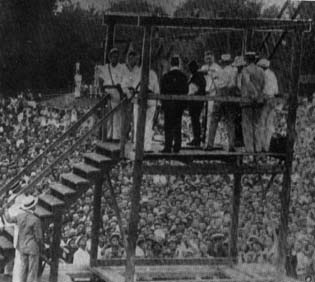
In this photo, Bethea — almost totally obscured between his escorts — has just begun ascending the gallows.

The man who threw the trap showed up drunk and performed appallingly, but press reports subsequently focused on the beastly behavior of the “jeering” crowd rushing the gallows to tear souvenirs from the corpse. (For instance, Time and the New York Times.)

But according to Perry T. Ryan’s 1992 review of the case — including interviews with surviving witnesses — little to nothing of the kind occurred. Ryan claims Bethea faced about the most dignified hanging mob imaginable.

Maybe hyped-up atrocities in the hinterlands were part of what distant editors demanded after H.L. Mencken at the Scopes trial. Certainly, the local Messenger-Inquirer painted a sharply different picture from more prominent outlets in this August 16 editorial (titled “Panderers Galore”) whose themes could have stepped fresh from a modern cable TV gabfest:

Ambitious and irresponsible reporters and photographers who swarmed into Owensboro for the Bethea hanging dipped their ready hands into the cloaca of evil designs and plastered over the name of this fair city the dirty results of their pandering.

Those who saw the dawn kindling in the east and ushering in the last sunrise of the despicable creature about to die, did not expect all of the watchers to be in reverent mood, but a calm, quiet demeanor characterized their behavior, as a group, throughout their long wait, surprisingly moderate for an occasion on which the law was exacting the supreme penalty.

Considering the size of the throng that witnessed the hanging Friday morning and that it was composed largely of people, who journeyed to Owensboro from distant places, the wonder is that there was no demonstration, no emotional outburst. There was not the semblance of ‘mob impulse’ or ‘eagerness for the kill.’ For the sensation seeking star scribes of quacks of American journalism, it was entirely too tame an affair. This is the reason that some of them reported it as they wanted it to be — not as it was.

They heard a very few people on the outskirts of the crowd call out at different times: ‘Hurry up,’ ‘Get it over’ or ‘hang him.’ To give screaming bulletins to the yellow press and to ruthless radio commentators, they magnified and colored it into a scene of ‘great disorder’ though there was never a general outcry of any kind.

When a priest held up his hand from the scaffold for silence, as Bethea was about to go to his death, there was no ‘blood thirst’ mob ‘shouting and yelling.’ Present were several thousand, who came from near and far to see a man legally hanged for the most heinous crime ever committed in Daviess county, and several thousand more, who turned out to see how the rest would act. When that hand went up in a gesture for silence, the buzz of the multitude’s conversations died down till the fall of the proverbial pin could have been heard.

The smart scribes and sob sisters looked on. All they saw was a black man standing on a scaffold with a rope around his neck and a mass of people peering up at him. That was too tame, they would call it a ‘jeering’ throng. All they heard was the click of the trap door. That would not do. There would have to be ‘cheering.’ So they said there was. Then they heard cameramen from cities where nothing is cared about the horrible crime Bethea committed. They were bawling at officials to ‘move out of the way,’ to ‘give us a break.’ They had to have their souvenirs to show the half civilized readers of their yellow sheets. The boys and girls who had to tell the story needed more color to regale them with atrocious accounts of how the people behaved. They found a few individuals who had gone in the bizarre which inspired thundering headlines about ‘gayety’ and ‘carnival’ spirit.

In administering the last sacrament, the Rev. H. J. Lammers, of Louisville, made an opening in the hood. When the doctors pronounced Bethea dead, one of the attendants at the scaffold took a tag off the hood. Another then took a fragment and others, who were at arms length from the dead man, followed suit. The blunder of tearing off that tag gave the high powered thrill-writers their big opening. They pictured the crowd as tearing Bethea’s clothes from his body. The crowd was never in disorder and Bethea’s clothes were never torn.

The ‘souvenir hunting mob’ did not even pick up the sox [sic] and shoes the doomed man left at the foot of the gallows. It did not so much as touch the basket in which Agnew and Wheatley, colored undertakers, placed the body, clothes and all, or molest it or them in the slightest as they bore it away.

The scavenger writers who came to depict a ‘jolly holiday’ and ‘gala occasion’ had both, but they never saw a more orderly throng at a baseball game.

The public hanging of Bethea was not a disgrace to Kentucky. But, a disgrace to Illinois, Missouri, Tennessee, and some other states, was the spectacle made of it in their scandal monger press. Owensboro should not be surprised at the scurrilous attack upon it by lurid writers and glib tongued talkers in northern and eastern states for they delight to distort any news from Kentucky into weird barbaric tales. We have learned how best to protect our women from rapists-murderers, white or colored. The only way, it seems, that we will ever be able to protect them from the cruelties of a sordid section of the press, will be by softening the state’s anti-rape law, which makes public hanging mandatory. So many as favor that will please tell the legislature.

Vendors of news occupy an important place in the nation, and their purpose should always be to maintain unquestioned exactness of facts. Where the subject matter is susceptible to coloring there should be no sacrifice of truth. To pervert the high honor of the profession for the paltry reward of more readers is a dangerous venture and one that should be curbed.

Owensboro’s citizenry, than which no finer representatives of high-bred Americans can be found anywhere, regrets that it was necessary to invoke the Mosaic law, but a sobered regret and a more solemn memory is that the hanging was eagerly seized upon and transformed into a picturization of the exhibition of low passions loosed.

We are proud of our city, and justly so, for no people are of finer fiber. The putrid pens of those who wore the garb of the news profession painted in lurid colors purported happenings, and it is sad but true that such distorted reports are accepted while the plain statement of facts is discarded as an attempted apology.

Thousands of those who witnessed the Bethea hanging came from outside the county. They belonged to good families in their communities, temporarily bereft of their better judgment and bent on viewing a scene which ordinarily would be extremely repugnant to them. And the out-of-town reporters found in the visitors elements to embody in their sordid stories.

A thoughtless word here and there, expressed without cognizance of its probability of misuse, and the staid citizen away from home becomes to the wild-eyed correspondent a Kentuckian gunning for human game. There should be available means of calling to account the writer who for a few filthy shekels diverts his sense of justice into the recording of things that never were.

As the editorial intimates, regardless of what actually happened in Owensboro, the circus atmosphere quickly brought the matter of public hangings into question. In 1938, the Kentucky legislature moved all executions behind prison walls … and Bethea secured an indefinite claim to the status of last person publicly executed in the United States.

Part of the Themed Set: At the End of the Rope.

On this day..

1862: Nueces Massacre

On this date in 1862, German immigrants fleeing Confederate conscription were caught near Texas’ Nueces River and slain to a man.

The nomenclature of the “Nueces Massacre” is controversial since this party of Union loyalists making a leisurely pace* for Mexico got its shots off as it was gunned down in a gully by Texas Partisan Rangers in the predawn hours.

But the incident becomes a clear candidate for these pages with the summary execution of the surviving captured and wounded men later this day. Here’s the account of an obviously upset member of the Confederate party:

[S]ome of the more humane of us did what we could to ease the sufferings of the wounded Germans. They had fought a good fight, and bore themselves so pluckily I felt sorry I had taken my part against them. We bound up their wounds, and gave them water, and laid them as comfortably as we could in the shade. Poor creatures, how grateful they were!

He then pauses for breakfast and helps gather up the scattered German horses; we rejoin the narration after 4 o’clock in the afternoon.

I hurried over to where we had left the German wounded to see how they were getting on, and was surprised to find them gone. Asking what had become of them, I was told they had been moved to a better shade a short distance away. With this answer I was quite satisfied, and never dreamed the brutes with whom I served would be guilty of foul play, especially after the gallant fight the enemy had made.

Just then one of our wounded called for water, and I brought him some from the cool spring. As I was giving it to him, the sound of firing was heard a little way off. I thought at first they were burying some of the dead with the honors of war; but it didn’t sound like that either. Then, possibly it might be an attack on the camp; so I seized my rifle and ran in the direction of the firing. Presently I met a man coming from it who, when he saw me running, said, “You needn’t be in a hurry, it’s all done; they shot the poor devils, and finished them off.”

“It can’t possibly be they have murdered the prisoners in cold blood!” I said, not believing that even Luck [a villainous — to the diarist’s mind — lieutenant] would be guilty of such an atrocious crime. “Oh, yes; they’re all dead, sure enough — and a good job too!” Feeling sick at heart, though I hardly even then credited his report, I ran on, and found it only too true.

It seems they were asked if they wouldn’t like to be moved a little way off into better shade. The poor creatures willingly agreed, thanking their murderers for their kindness. They were carried away, but it was to the shade and shadow of death, for a party of cowardly wretches went over and shot them in cold blood.

More summary justice followed in the weeks ahead against members of the party who had escaped** and others, and Confederate Haengerbande would plague Texas Germans of insufficient southern enthusiasm for the remainder of the war.

Fred Shon Powers offers this detailed account of the affair; there’s another here.

This day’s victims are honored by the Treue der Union obelisk, the only Union monument in Confederate territory, a prominent distinction that (as with all things in the Civil War) invites political football. This conservative article throws cold water on the “Germans-as-antislavery-Unionists” trope, and academic papers from a 1990’s conference gathered in this volume treat Nueces among other topics of “disloyalty” in the Confederacy.


The photo is taken by Steve & Marion Daughtry In Comfort, Texas. Image used with permission.

* An escapee recounted decades later by way of explanation for the party’s fatal inattention to either haste or defense, “Having read a proclamation from the Confederate government announcing that all persons not friendly to it might leave the country, we believed we had a right to do so in large or small bodies, as best suited our convenience, to the border and there cross over into Mexico.”

** About half the group had separated from the main body just before the Confederates engaged them. From this number come the “escapees,” many of them later killed in the hills or while crossing into Mexico. Those who stayed put all died this day.

On this day..

1822: The audacious Denmark Vesey

On this date in 1822, white South Carolinians hanged the most terrifying slave insurrectionary who never rose — and breathed a sigh of relief as they clamped the shackles ever tighter upon their groaning servile class.

Inspired by slave revolts shaking the Caribbean, the Denmark Vesey plot was the South’s worst nightmare: Nat Turner, multiplied by about nine thousand.

That’s the size of the slave and free black network Vesey is said to have recruited — ready to undertake a coordinated uprising to seize Charleston, slaughter the white populace, and possibly then to sail for a Haiti whose own slave revolt had recently established it a black-governed republic. The mind boggles at such a scheme’s bravado … but in an age when horseshoes and mizzenmasts could outrun information, Vesey’s plot could have been past any prospect of obstruction before anyone in a position to obstruct it even knew what happened. Had they not flown but defended Charleston, the event would have ignited a conflagration to outshine every other slave uprising.

The weak point, of course, were those 9,000 — or however many — slaves who had to act ruthlessly and in unison, and keep their peace until they struck. It is incredible enough that such a secret kept among so many for up to four years.

The plot finally leaked mere days before it was to have been attempted when a middling player attempted the unnecessary freelance recruitment of a house slave — a class Vesey had intentionally (and rightly, events would prove) excluded for dangerously excessive personal loyalty to their masters’ families.*

Melancholy Dane

A well-educated and well-traveled man on account of his years as the personal property of a slaver — Joseph Vesey, who bequeathed his purchase both a surname and the given name Telemaque, subsequently corrupted into “Denmark” by Charlestonians — the plot’s signature hero/villain had managed to purchase his freedom and establish himself in the anomalous position of free black artisan/entrepreneur in the slaveholding South.

His successful carpentry business (apt choice, for a martyr) had given him the prestige and the werewithal to start an independent African Methodist Episcopal church where he poured out a hatred of chattel slavery undiminished by his own liberty.

For several years before he disclosed his intentions to any one, he appears to have been constantly and assiduously engaged in endeavoring to imbitter [sic] the minds of the colored population against the whites. He rendered himself perfectly familiar with those parts of the Scriptures which he could use to show that slavery was contrary to the laws of God; that slaves were bound to attempt their emancipation, however shocking and bloody might be the consequences … (Source)

His judges were later incredulous that he’d be so hung up about it:

It is difficult to imagine, what infatuation could have prompted you to attempt an enterprise so wild and visionary. You were a free man, comely, wealthy, and enjoyed every comfort compatible with your situation. You had, therefore, much to risk and little to gain.

An American Spartacus?

Denmark Vesey blurs into myth as he approaches his end, together with lieutenants: among them, Peter Poyas, the organizational maven of the operation who was hanged along with Vesey and four others; and Gullah Jack, an African priest among the 29 more who would die in the weeks ahead.

Most of the principals held their tongues before interrogators; the tribunals were held secretly; their records were censored against the apprehension by other slaves of the potential for such designs as “a bottle with poison to put into my master’s pump & into as many pumps he could about town.”

But there was enough known to shatter forever any illusion of paternal congeniality more liberal masters might have fancied. One planter was incredulous that his agreeable charge might be involved in such nefarious doings until he asked the man directly and was astonished to hear from his trusted coachman’s lips the frank intention “to kill you, rip open your belly and throw your guts in your face.” (Both quotes are from this book review.)

Whites were scared. “I have never heard in my life, of more deep laid plots or plots more likely to succeed,” wrote Anna Haynes Johnson, niece to Gov. Thomas Bennett. (Source) Another concluded that “our NEGROES are truly the Jacobins of the country.” (Source)

But as initial panic (and federal troop deployments) gave way to a more pervasive undertow of security paranoia, the affair was self-consciously downplayed and records intentionally destroyed for fear that too-careful documentation of its particulars could map the way for a revival. An 1861 piece in The Atlantic — an excellent read on the progress of the conspiracy — grapples with what was even then a gaping evidentiary vacuum.

The intense avidity which at first grasped at every incident of the great insurrectionary plot was succeeded by a distaste for the memory of the tale; and the official reports which told what slaves had once planned and dared have now come to be among the rarest of American historical documents. In 1841, a friend of the writer, then visiting South Carolina, heard from her hostess for the first time the events which are recounted here. On asking to see the reports of the trials, she was cautiously told that the only copy in the house, after being carefully kept for years under lock and key, had been burnt at last, lest it should reach the dangerous eyes of the slaves. The same thing had happened, it was added, in many other families. This partially accounts for the great difficulty now to be found in obtaining a single copy of either publication; and this is why, to the readers of American history, Denmark Vesey and Peter Poyas have been heretofore but the shadows of names.

Antebellum September 11

Even as a nonstarter, the insurrection was an antebellum 9/11 that spurred a reactionary crackdown on perceived liberalities in the system — most vividly symbolized by the construction of the fortress that became the still-extant military academy The Citadel, but more systematically impinging blacks’ everyday freedom to assemble and worship, and even requiring (until the Supreme Court overruled the law) free black sailors be detained whenever a northern ship called at port. Pro-slavery southerners blamed open disapprobation for slavery voiced in Congress during the recent Missouri Compromise wrangling, and even similar sentiments expressed in the British parliament, for emboldening the terrorists.

All this yielded a rich political harvest from the fruit of the gallows — like Charleston mayor James “there is nothing they are bad enough to do, that we are not powerful enough to punish” Hamilton, who rode his timely suppression of the plot to Congress later that year.

Such political profiteering, combined with the sketchiness of primary sources, has licensed a revisionist take on the orthodox history — that there was never any conspiracy, but that reactionary white elites concocted the plot from a tissue of loose liberation talk, false confessions, and latent white fear in order to win political power. This contested minority interpretation has been a recent topic of academic dispute, since Michael P. Johnson floated it in 2001 (an account is required to read Johnson’s original essay; here’s a synoptic article that appeared subsequently in The Nation).

Markers of historiography around these competing versions of Vesey, bearing directly on the question current in today’s Charleston of whether and how to memorialize this episode, are ripe with controversial modern-day implications.

Consider: if Vesey is a rebel indeed, the silence of (most of) the plotters is a noble acceptance of torture to protect their confederates; if they’re framed, they’re silent because there’s nothing to confess. Either way, the modern reader’s sympathies are likely to lie with the blacks, but Johnson’s interpretation removes the locus of action from them to white elites. If he’s right, would that derogate an entire narrative of black resistance to slavery, drain the martyrdom from their deaths? Or would it correct an overstated romantic mythology of armed resistance, and color this day’s hanging with a different heroism: refusing to purchase their lives with a false accusation?

* For his timely betrayal, Peter Desverneys received his liberty and a state pension; he later became a slaveholder himself. See Black Slaveowners.

On this day..

1864: William Johnson, a bad example

On this date in 1864, the Union army in the American Civil War hanged a black deserter outside Petersburg, Va., for — in the delicate words of the army dispatch — “an attempt to outrage the person of a young lady at the New-Kent Court-house.”

The Union army was just taking up position for the coming monthslong siege of the Confederate capital, Richmond. Johnson, who confessed to deserting another unit, offered savvy blue commanders a win-hearts-and-minds opportunity: a public reassurance that the Old Dominion’s dim view of Negro outrages upon young ladies would be honored by its soon-to-be occupiers.

Not bad in theory. The execution left something to be desired.

The field of public relations being very much in its infancy, the upshot of this salutary demonstration seems not to have been conveyed to its target audience; so, when a defending Confederate battery caught sight of the gallows being thrown up in brazen view of its own lines, it jumped to the not-unreasonable conclusion that the Yanks were about to make an example of a southern spy. Rebel guns promptly made the Union detachment their “target audience.” An artillery shot struck one Sgt. Maj. G. F. Polley (or Polly) and “tore him all to pieces” before

[a] flag of truce was sent out to inform the enemy that a negro was to be hung who had insulted a white woman the day before; they stopped firing. We then marched back and saw the negro hung.

The return on investment for the souls of Johnson and the misfortunate NCO was altogether unsatisfactory:

The incident was cleverly turned to advantage by the Confederates, who had been losing hundreds of Negro laborers by desertion. The Rebels marched Negroes past the spot, pointing out to them the perils of fleeing their lines, saying that the Yankees hanged all ‘Contrabands.’ For weeks nocturnal escapes of Negroes ceased on that front. (Source)

It wasn’t a total loss, however. The Library of Congress ended up with some striking archival photos.

(There’s a better touch-up of this last photograph of Johnson’s body being cut down here.)

On this day..

1833: Midgegooroo, Noongar rebel

On this date in 1833, an aged aboriginal Noongar (or Nyungar) was sentenced to execution and summarily shot in southwest Australia.

Midgegooroo was one of the many indigenous casualties of European settlement — Perth, in this case.

Little is documented of his life but the end and that, of course, by his enemies; he helped raise resistance to the arriving whites in 1831 after a native was killed trying to raid a potato patch. As tensions heightened over the ensuing months, he was outlawed with a £20 reward on his head. He was sentenced — possibly without any sort of formal trial — and summarily shot a few days after capture.

Midgegooroo’s son Yagan outlived his father two more months, and in that scanty condescension of destiny carved a place as one of Australia’s most illustrious native rebels. (pdf)

In the end, inevitably, Yagan’s fate was the same — not so precisely as to qualify him directly for these pages but ambush by settlers amounted to much the same as the rickety assemblage of formal semi-legalisms that thrust his father into the ground: the law of conquest without apology. It would be years yet before any white would face the law’s lethal sanction for killing Australian natives.

Yagan’s head was hewn off and packed for England as a grisly trophy-cum-souvenir-cum-“anthropological curiosity”. Not until the recent trend towards repatriating such remains was it was finally exhumed and returned to the Noongar nation — in 1997.

On this day..

1916: Jesse Washington lynched after conviction

Lynching is such a vile word. Likely taken from the name of Captain William Lynch of Virginia (circa 1780), the term for administering justice while dispensing with a trial had, by 1916, long since taken on its more common meaning of a white-on-black public killing.

But Jesse Washington‘s case defies this simple definition, straddling the line between state execution and an unrestrained populace. Washington’s brutal lynching at the hands of a white mob in Waco, Texas, on May 15, 1916, clearly fits the definition, and the particularly grisly details of his demise conjure all-too-familiar images of violent racism in the pre-Civil Rights South; but in another more disturbing way, Washington was effectively executed, his punishment carried out not by the state of Texas, but by the people themselves.

Jesse Washington’s charred corpse after the lynching.

Washington was born in 1899, a black farmhand who may or may not have been mentally retarded.* While his life is not well-documented, his death most certainly is. Washington was arrested on May 8 of that year for the rape and murder of Lucy Fryer, the 53-year old wife of a well-to-do cotton farmer. Fryer was found bludgeoned to death. Washington was spared for a week by the Waco sheriff, who successfully took him into custody before a pre-trial mob got their hands on him; Washington was then sent to Dallas for holding to prevent a local incident. To appease the mob, he was transferred back to Waco and tried for the crime just one week later.

It’s unclear whether Washington was guilty — evidence is scant and the trial lasted just one hour, but Washington appears to have had ample opportunity to perpetrate the act and is purported to have confessed — but his guilt or innocence in the matter was not on the mob’s mind. On May 15, the well-attended trial ended, and in four minutes, the jury reached its guilty verdict. Before the 17-year old could be sentenced, and with little or no resistance offered by any of the various legal entities in the courthouse, several hundred of the onlookers (some brandishing weapons) rushed Washington and carried him out the doors. Outside, a larger crowd waited to beat and castrate him. A chain was thrown around Washington’s neck, and he was dragged to the town square, where he met an immense crowd as well as the pile of dry goods boxes that was to be his end.

A Fred Gildersleeve image of the lynching of Jesse Washington.

By some estimates, up to 15,000 (mostly white, though not exclusively white) people watched the horrible events unfold; without question, Waco’s mayor as well as several other public officials watched from their second-story perch at town hall on one side of the square. Washington was tossed onto the boxes and coal oil was poured over him. The other end of the chain was thrown over what has become known as the Hanging Tree, and the fuel below Washington’s feet was set ablaze. Immersed in the flames, he attempted to climb the blisteringly hot chain multiple times, each time to be lowered back into the cauldron. It’s unclear how long Washington was alive, but the event lasted more than an hour, after which his fingers and teeth were claimed as souvenirs, his body parts were separated from the torso, and the remains of Washington were dumped in a bag so they might be dragged once more through the Waco streets.

Also watching from the mayor’s position was a cameraman who wanted to sell photographs of Washington’s charred corpse as postcards. Fred Gildersleeve snapped a series of images which would briefly make Waco the most shamefully famous city in the nation. Gildersleeve’s work paints a portrait of a town possessed by spite and uncontrolled rage: thousands of white spectators standing about the burning body of Washington from above, then hundreds of blacks gathered around his burned and brutalized remains from ground level. Others took pictures as well,
some more disturbing than others.

A complete and startlingly brutal account of this murder is given by Patricia Bernstein in her 2005 book The First Waco Horror: The Lynching of Jesse Washington and the Rise of the NAACP, which also tracks the increased viability of the NAACP in the wake of the slaying. What makes this case noteworthy for this column, though, is that Washington was found guilty prior to his lynching, and he would doubtless have received a state-supported death sentence. At the time, Texas law would have allowed for a public hanging; presumably, the spectacle surrounding Washington’s execution would have been just as significant (though not nearly as gruesome). Instead, vigilante justice was administered on the young farmhand, and his case because a linchpin for the Civil Rights movement. As with other lynchings of the time, no persons were charged in the incident, though it was obvious that there was significant planning involved and, from some of the images, that some form of self-appointed executioner actively participated in the deed.

Unlike a state-sponsored execution, though, Washington’s death raised the ire of the jury foreman, who harshly criticized the court for not protecting him. And because he was lynched, his cause was also taken up by several Northern papers, pushed into the national spotlight by NAACP secretary Royal Freeman Nash and Elisabeth Freeman.** Over 90 years later, the town of Waco is still dealing with the Waco Horror. The lynching has reared its head multiple times as many residents have pushed for a plaque to be erected on the site of the lynching, as one was for a distressingly large number of prior lynchings in Waco. Some in the town continue to resist, asserting that Washington’s guilt absolved the mob of responsibility for its act.

A postcard commemorating the lynching; written on the back: “This is the barbecue we had last night. My picture is to the left with a cross over it. Your son, Joe [Myers].”

Washington’s case raises two of the critical issues in the modern death penalty debate: culpability of the executioner (and witnesses), and cruelty of punishment. Nobody in the mob was prosecuted for the crime, and in the Waco of that day, it would have been unusual if someone had; today, we take little interest in the state executioner but would vociferously condemn such mob action. On a similar note, Washington’s death was barbaric and brutal, and few would argue that such an execution should be undertaken through legal channels, but recent Supreme Court cases have found it difficult to identify the meaning of “cruel and unusual punishment”. The debate continues in the United States, but these are two arguments, posed by Cesare Beccaria, that caused Leopold II to outlaw capital punishment in the Grand Duchy of Tuscany in 1789, and cases like Washington’s suggest they should continue at the very least to give us pause today.

* Some accounts state simply that he was illiterate, and if this is the litmus test for mental retardation in the early 1900s, around 6 percent of the population fell into that category.

** Freeman worked tirelessly to drag information from Waco’s inhabitants, her actions likely sparking papers like the local Waco Times-Herald to quickly shut the door on the case; that paper officially apologized 90 years later for its and other newspapers’ roles in venerating the lynch mob.

On this day..