1612: The Pendle Witches

You have heard of mother Nottingham, who for her time was pretty well skilled in casting of waters: and after her, Mother Bombye; and there is one Hatfield in Pepper-Alley, hee doth prettie well for a thing that’s lost. There’s another in Coleharbour, that’s skilled in the Planets. Mother Sturton in Goulden-lane, is Fore-speaking: Mother Phillips of the Banke-side is for the weaknesse of the backe: and then there’s a very reverent Matron on Clarkenwell-Green, good at many things: Mistris Mary on the Banke-side is for recting a Figure: and one (what doe you call her) in Westminster, that practiseth the Booke and the Key, and the Sive and the Shears: and all doe well, according to their talent. For myselfe, let he world speake.

-Title character in Thomas Heywood’s The Wise Woman of Hogsdon (1638)

This date marks the 400th anniversary of the Pendle witches‘ hanging — perhaps the most notorious witchcraft execution in English history.

Eight women and two men — Alizon Device, her brother James Device, and their mother Elizabeth Device of the Demdike family; Anne Whittle and her daughter Anne Redferne of the Chattox family; Jane Bulcock and her son John Bulcock; Alice Nutter; Katherine Hewitt; and Isabel Robey* — hanged together this date at Lancaster’s Gallows Hill after being tried over the preceding 48 hours; they, along with a woman named Jennet Preston hanged at York on July 29, comprise the Pendle Witches.

It’s an extraordinarily sad case.

The prosecution of the Pendle witches bubbled out of a witches’ brew of circumstances particular to early-17th century England. There was, to begin with, a new(ish) English king, James I and the guy had a major jones for hunting those early modern supernatural terrorists, witches.** The guy even wrote his own book, Daemonologie, to establish “that such divelish artes have bene and are … [and] what exact trial and severe punishment they merite.” A 1604 law had accordingly broadened the reach of the death penalty for supposed instances of sorcery.

Coming as this did in the aftermath of the Tudor Reformation, the nebulous concept of “witchcraft” was handy as well for clamping down on any excessively Catholic practices that might strike the right authorities as subversive, intransigent, or impious. Lancashire where we lay our scene was just such a Catholic-leaning zone.

Lancashire also had, as almost everywhere in the Isles, its share of “cunning folk” — workers of everyday folk magic whose widely tolerated practices could also be taken by a hostile viewer as Catholic superstition and/or hard-core infernal trafficking.

So, these are the brew’s ingredients. Add wool of bat and tongue of dog, stir vigorously … and serve with a length of hemp.

Curses

The Pendle witches brew started bubbling with a freak incident: a cunning woman named Alizon Device (you’ll recognize her name from the list of the hanged, above) tried to beg some needles from a passing peddler. The latter refusing her, Alizon cursed him, just like you do when you’re cut off in traffic.

Except in this case, the peddler promptly suffered a stroke.

Everyone was spooked at this apparent effusion of transmundane malevolence, nobody more so than Alizon herself. She became the first arrestee, and in the end would go the gallows convinced of her own sorcery.

She also started accusing others of occult involvement, either from a sense of panicked guilt or a blithe ignorance that the new legal regime would be interpreting folk spells as capital crimes. This led her bizarre instance of passing-peddler-popping to become a full-on witch hunt.

Alizon Device came from a whole family, the Demdykes or Demdikes, of cunning-women, and she implicated her own grandmother for having taught her the witchy ways. (Grandma would be spared the ignominy of hanging because she suffered the ignominy of dying in the filthy dungeon.) Alizon also accused a rival family, the Chattoxes, themselves well-known as “witches”, and she also implicated the matriarch of that family, Anne Whittle. The dreadful progress of the ensuing investigation, in which the feuding locals hanged each other with the aid of an ambitious local magistrate, is widely available — thanks to the record one lawyer witness to the proceedings set down in his credulous 1613 chapbook The Wonderfull Discoverie of Witches in the Countie of Lancaster.

Foiled Again

Once these initial arrests were in the books, Alizon’s mother Elizabeth apparently convened a solidarity meeting at a hut with the diabolically menacing name of Malkin† Tower. Dining on stolen mutton, and on Good Friday no less, they may have worked out a plan to liberate the prisoners from Lancaster Castle (at least, the Demdike prisoners). But the magistrate got wind of this confabulation and burst in to arrest those participants, too. As these secondary circles were pulled into the investigation, so too were past years of community gossip about these “witches”, of various folk who had died unexplained and various mishaps that befell people whom the witches didn’t like.

These superstitions seem to have been shared by the witches themselves, at least many of them. The Demdikes and Chattoxes used clay figures, human remains, and little effigies of victims with the intent of hurling evil at their enemies. Causality aside, Alizon Demdike did curse the peddler. “Witches think sometimes that they kill, when they do not, and are therefore as culpable, as if they did,” said their contemporary, pastor John Donne.

To augment the assorted confessions and counter-accusations among the accused, Elizabeth Device’s nine-year-old daughter Jennet Device (little sister of the original peddler-curser Alizon) was summoned up to provide coached testimony against her siblings Alizon and James, against her mother, and against those at the Malkin Tower meeting. Several of these latter would be convicted of non-capital crimes or even acquitted outright, but little Jennet’s testimony doomed her own family.

Although not the first time a child had provided evidence, it was a landmark in normalizing minors’ accusations — jurisprudence advocated by James’s Daemonologie. “Children, women and liars,” the sovereign announced, “can be witnesses over high treason against God.”

These witnesses would cast an evil pall well after Pendle.

In later life, Jennet appears to have been caught up in the same trap, when she was accused of witchcraft by a 10-year-old boy. A judiciary grown more cautious by then did not put her to death … but she (unless it was a different person also named Jennet Device) died in prison.

And the acceptability of this sort of children’s testimony, duly documented for country JP’s in Michael Dalton’s Country Justice, containing the Practice, Duty, and Power of Justices of the Peace, would be the lethal linchpin of the witch trials 80 years later across the Atlantic — in Salem, Massachusetts.

This miserable event has informed any number of artistic productions from the 17th century stage to the present-day Pendle Sculpture Trail. Pendle and Lancashire, as bywords for witch superstitions, now trade handsomely on the unfortunate fame.

Many there have also pushed (thus far unsuccessfully) for an official posthumous pardon of the hanged witches.

And the nearby village of Roughlee even erected a statue in 2012 to the hanged Alice Nutter … a gentlewoman (i.e., of considerably higher class standing than her fellow condemned) whose reason for attending the Malkin Tower meeting remains mysterious.


Alice Nutter statue at Roughlee. Image (c) Burnley & Pendle Ramblers and used with permission.

* Isabel Robey is an outlier case; as of this writing, she’s not even named as one of the Pendle witches on the Wikipedia page as it seems she was not associated directly with the Malkin Tower crowd — merely a bystander who got caught up in the storm of denunciations. She was, however, hanged on Gallows Hill for witchcraft on August 20. There’s a lengthy attempt at reconstructing her story in the face of scant documentation here (pdf).

** All well and good for us moderns to pooh-pooh James’s supernatural obsessions, but the man’s security concerns were very real.

† The BBC documentary has Malkin as slang for “shit”; this page proposes that the word can signify a cat, a bindle, a scarecrow, or “an awkward woman.”

On this day..

1347: Not the Six Burghers of Calais

On this date in 1347, the city of Calais yielded to an English siege.


The siege of Calais, from Jean de Wavrin‘s Chroniques d’Angleterre. (More images)

Edward III had proceeded to invest Calais directly after the previous year’s staggering win at Crecy. The crippled French leadership could not relieve the city, and after fruitlessly probing for an opening, the relief army marched away at the start of August 1347.

By this time reduced to eating vermin and ordure, the starved city had little choice but to capitulate. According to Froissart’s account, the king declared that “the Calesians have done him so much mischief, and have, by their obstinate defence, cost him so many lives and so much money, that he is mightily enraged.” He wasn’t only sore about the city’s holding out over the preceding year: Calais was notorious as a refuge for English Channel pirates who had long bedeviled the commerce of Edward’s realm.

As a condition for sparing the rest of the town, Edward demanded that six of its leading citizens present themselves to him, “with bare heads and feet, with ropes round their necks, and the keys of the town and castle in their hands.” Edward seems truly to have meant (much against the conscience of his own nobles) to put these men to death “for that the Calesians had done him so much damage, it was proper they should suffer for it.”

This information caused the greatest lamentations and despair [in Calais]; so that the hardest heart would have had compassion on them; even the lord de Vienne wept bitterly.

After a short time, the most wealthy citizen of the town, by name Eustace de St. Pierre, rose up and said: “Gentlemen, both high and low, it would be a very great pity to suffer so many people to die through famine, if any means could be found to prevent it; and it would be highly meritorious in the eyes of our Saviour, if such misery could be averted. I have such faith and trust in finding grace before God, if I die to save my townsmen, that I name myself as first of the six.” When Eustace had done speaking, they all rose up and almost worshipped him: many cast themselves at his feet with tears and groans Another citizen, very rich and respected, rose up and said, he would be the second to his companion, Eustace; his name was John Daire. After him, James Wisant, who was very rich in merchandise and lands, offered himself, as companion to his two cousins; as did Peter Wisant, his brother. Two others then named themselves, which completed the number demanded by the king of England.

Wealthy elites sacrificing themselves for the greater good? The past really is a different country.

These six duly presented themselves, nearly naked and haltered and braced to bear the brunt of Edward’s vengeance. The English king had the executioner summoned … and then, Edward’s (very pregnant) queen Philippa dramatically fell to her knees

and with tears said, “Ah, gentle sir, since I have crossed the sea with great danger to see you, I have never asked you one favour: now, I most humbly ask as a gift, for the sake of the Son of the blessed Mary, and for your love to me, that you will be merciful to these six men.”

The king looked at her for some time in silence, and then said; “Ah, lady, I wish you had been anywhere else than here: you have entreated in such a manner that I cannot refuse you; I therefore give them to you, to do as you please with them.” The queen conducted the six citizens to her apartments, and had the halters taken from round their necks, after which she new clothed them, and served them with a plentiful dinner: she then presented each with six nobles, and had them escorted out of the camp in safety.

Edward still had the last laugh when it came to Calesian carnage.

This nigh-unconquerable foothold on the French coast would persist in English hands for two centuries: the first century spanned the Hundred Years’ War, which England was licensed to protract by dint of (and France would not settle because of) the menacing northern base England won this day. “Each will have to take up his shield,” ran a French verse cited in Barbara Tuchman’s A Distant Mirror: The Calamitous 14th Century, “For we’ll have no peace till they give back Calais.”


The Six Burghers persisted even longer than that.

George Bernard Shaw wrote a one-act play standing the story on its head, in which a henpecked Edward exasperatedly yields to his nagging wife’s merciful caprice, to the open derision of the burghers themselves.

A bit more exalted of spirited is Rodin‘s sculpture group Les Bourgeois de Calais — rendering six emaciated, suffering, and courageous figures.

I have, as it were, threaded them one behind the other, because in the indecision of the last inner combat which ensues, between their devotion to their cause and their fear of dying, each of them is isolated in front of his conscience. They are still questioning themselves to know if they have the strength to accomplish the supreme sacrifice–their soul pushes them onward, but their feet refuse to walk.

They drag themselves along painfully, as much because of the feebleness to which famine has reduced them as because of the terrifying nature of the sacrifice … And certainly, if I have succeeded in showing how much the body, weakened by the most cruel sufferings, still holds on to life, how much power it still has over the spirit that is consumed with bravery, I can congratulate myself on not having remained beneath the noble theme I dealt with.

Rodin

The discriminating connoisseur of Middle English may also enjoy Laurence Minot‘s poetic celebration of the siege of Calais. (Helpful explanatory annotations.)

Part of the Themed Set: Scary Escapes.

On this day..

1994: Not Arthur Judah Angel, death row artist

On this date in 1994, 38 people were executed at Nigeria’s Enugu Prison … but artist Arthur Judah Angel somehow was not among them.

Angel was convicted of armed robbery and murder: tortured and framed, he says, by corrupt police under the military dictatorship of Gen. Ibrahim Babangida.

At the time, Nigeria was liable to put to death condemned prisoners without warning at any time, like Japan does today … except that Nigeria carried out such executions by the dozens. In one instance Angel witnessed, there were 58 executions in a single day.

On August 2, 1994, a Tuesday, that occasion finally arrived for Arthur Judah Angel — or so it seemed.

“I was chained; I was given my last meal that was August 2, 1994,” Angel said in an interview. “38 others were executed that very day. Only God knew how I was spared. He was the one that made my name disappeared in the book. I did not know how it happened. But it happened. I died, in fact, every person on the death row dies every day.”

Who exactly it was that saved Angel on that date I have not seen conclusively documented, but they say that God helps those who help themselves. In this case, Angel helped himself with his charcoal sketches on death row, which soon brought him to the attention of some well-placed people in the prison bureaucracy, a Catholic bishop — even a British arts organization which organized exhibitions of his work in 1993 and 1994.

Angel’s death sentence was commuted in 1995, and he was released outright in 2000. He well knows that, like those other 38 people who hanged this date, he’d be forgotten if not for his fortuitous escape. Life is just too damn cheap for exonerating the dead.

“I am able to clear my name because I am alive,” Angel said. “If I had been executed, nobody would believe that I was innocent. If I didn’t make it, no one would know. I knew many people who were innocent in prison. Yet they died in prison. Only people like me, who were close to them until their death, knew they were innocent. The rest of the world learnt that armed robbers were executed on so and so day; nobody knew they were innocent.”

But Angel did survive, and is remembered — not only for his exoneration, but for the 51 startling sketches he made of Nigeria’s death row. They (and other anti-death penalty art Angel has created since) have been exhibited worldwide by human rights NGOs.

Angel, who’ll turn 50 this November, continues to work as an artist from a studio outside Lagos — and uses his art to campaign against the death penalty, as one might imagine. He has written a book, I Refused to Die; unfortunately for its prospective international readership, the book requires expensive shipping from Nigeria.

(There’s also a bit of video from a news report here.)

Part of the Themed Set: Scary Escapes.

On this day..

1945: Dr. Achmad Mochtar, quiet hero

On this date in 1945, Japanese forces occupying Indonesia cut off Dr. Achmad Mochtar’s head for a medical experiment gone horribly awry.

Officially, Dr. Mochtar had been responsible for a supposed vaccine whose administration killed hundreds of Indonesian forced laborers.

Latter-day research, however, indicates that it was the Japanese military who administered the vaccine (Indonesian link), an experimental tetanus-cholera-typhoid-dysentery combination shot, getting a trial run before it was administered to Japan’s own soldiers. When this drug proved lethal to most of its recipients, Mochtar and his staff at the Eijkman Institute were arrested in 1944 and subjected to harrowing torture.

According to Jakarta-based British researcher Kevin Baird, Mochtar agreed to take the fall for the experiment in exchange for the release of his colleagues.

“We think of this sort of heroism as the reserve of military men and not learned intellectuals,” Baird told the Guardian. “Achmad Mochtar was not only a hero of Indonesia, but a hero of science and humanity.”


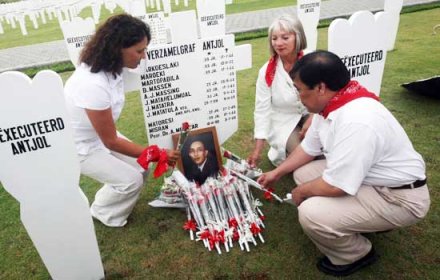
Present-day Eijkman Institute director Sangkot Marzuki (right), and two descendants of the executed man, Monique Mochtar (left) and Jolanda Mochtar (center) lay flowers at a 2010 memorial event after the doctor’s location in a mass grave was discovered. Achmad Mochtar’s name also graces a Sumatran hospital.

On this day..

1842: Charles Stoddart and Arthur Conolly, Great Game diplomats

On this date in 1842,* British diplomats Charles Stoddart and Arthur Conolly were summarily beheaded by a Central Asian potentate as London’s ill-chosen intervention in Afganistan came to a disastrous conclusion.

The backdrop is “the Great Game”,** the long-running chess match for supremacy in Central Asia between an expanding Russian Empire and Great Britain, with its imperial position in India.

Seeking to pre-empt a Russian move into Afghanistan, Britain invaded in 1839. This was the First Anglo-Afghan War: it would have, for the Brits, an inglorious end.

Our day’s featured principals were among the postscript casualties of that catastrophe, never-avenged losses for an empire that had overreached itself.

Stoddart, an intelligence officer, had been dispatched northward to the ancient silk road city of Bokhara intending enlist the allegiance, or at least the benign neutrality, of its emir, Nasrullah Khan. Today Uzbekistan’s fifth-largest city, Bokhara was then an independent state .

[I]n the nineteenth century, the executions carried out there with genuine cruelty, as well as the tales told by travelers gave the city a reputation of being a forbidden, closed, and hostile place. It was “despotic” Bukhara, and the Europeans projected onto it their own oriental fantasies: with citadel, dungeons, palaces, and city walls bolted shut at night, all helping to set the scene.

(Vibe on some the oriental fantasy in the 1911 volume The Emir of Bokhara and His Country, or this volume on Russian Central Asia, which by then included Bokhara.)


Scenic! Bukhara’s historic citadel, the Ark, where Stoddart (and later Conolly) were imprisoned (and later executed). (cc) image from elif ayse.

Into this scene, our Brit entered clumsily, immediately irritating the ruler he intended to supplicate. Reportedly (though the fact has been disputed), he was on the brink of execution when he acceded to save his life to Nasrullah’s formulaic offer of clemency in exchange for conversion to Islam.

In any event, Stoddart languished for years, alternately imprisoned and in the custody of the (better-received) Russian mission. Though the latter had also been charged by its sovereign to retrieve the ill-favored English emissary as a gesture of Great Powers goodwill (and to deprive England of any rationale for intervention that his captivity might offer), Stoddart seems to have been too stubbornly prideful to get out via St. Petersburg while the getting was good.

Instead, he waited on the arrival of countryman Arthur Conolly, who showed up in late 1841 on a mission to secure Stoddart’s release. But Stoddart’s situation little improved, considering Nasrullah Khan’s wary reaction to this second British interloper.

Word has it that the Bukharan prince was piqued that correspondence to him did not arrive over the signature of the British monarch herself, but merely some subcontinental subaltern — as well as, we might think understandably, suspicious at his guests’ motivations and mission.

The captor’s uncertain attitude towards his prisoners was resolved by Britain’s catastrophic loss of Kabul and the subsequent massacre of an entire 16,000-strong army as it attempted to retreat.

Seriously, the whole army. To a man. Except for one guy.


Remnants of an Army, by Elizabeth Butler, depicts the only British subject on retreat from Kabul to reach Jalalabad, William Brydon.

Battles don’t get much more decisive than that.†

Reasoning‡ that the routed British were now of no conceivable threat, nor his prisoners of any conceivable benefit, Nasrullah Khan now accused them of espionage and abused them with impunity.

The two were cast into an Indiana Jones-esque “bug pit,” an oubliette infested with … well, you know.§

Later, finding illicit writing materials secreted on his captives’ persons, the mercurial Nasrullah disposed of them outright.

their quarters were entered by several men, who stripped them, and carried them off to prison … In stripping Colonel Stoddart a lead pencil was found in the lining of his coat, and some papers in his waist. These were taken to the Ameer, who gave orders that Colonel Stoddart should be beaten with heavy sticks until he disclosed who brought the papers, and to whom he wrote. He was most violently beaten, but he revealed nothing; he was beaten repeatedly for two or three days. On Friday, the 8th or 9th (the 7th) of Jemmadee-ool-Eovel (17th of June), the Ameer gave orders that Colonel Stoddart should be killed in the presence of Captain Conolly, who was to be offered life if he would become a Mahomedan. In the afternoon they were taken outside the prison into the street, which is a kind of small square. Their hands were tied across in front. Many people assembled to behold the spectacle. Their graves were dug before their eyes. Colonel Stoddart exclaimed aloud at the cruelty and tyranny of the Ameer. His head was then cut off with a knife.

The chief executioner then turned to Captain Conolly, and said — “The Ameer spares your life if you will become a Mussulman.” Captain Conolly answered, “Colonel Stoddart has been a Mussulman for three years, and you have killed him, you killed Yoosoof too; I will not be a Mussulman, and I am ready to die.” Saying which he stretched forth his neck. His head was then cut off.

London Times, Aug. 22, 1843, reporting the testimony of a dubious local semi-ally

The veracity of this faint bulletin from a distant and inaccessible realm nevertheless remained in some doubt. Friends of the lost men, despairing of obtaining definitive word of their fate, commissioned a strange but courageous missionary named Joseph Wolff to brave his own sojourn to Bokhara to investigate.

Wolff barely escaped with his own life, but seemingly confirmed the sad story and published a Narrative of his travels in 1845 (Part 1, Part 2).

* The initially reported June 17 execution date was subsequently contested by Joseph Pierre Ferrier, who argued that the chronology instead pointed to the next Friday, June 24. The matter appears to me permanently unresolvable.

** Ironically, the sportive phrase “the Great Game” was itself attributed to Arthur Conolly for whom, in the end, events turned out to be quite other than playful.

† Britain recaptured Kabul in reprisal later in 1842, upon which pretext it was able to declare its honor vindicated and depart Kabul (sans massacre), ending the war. Certain latter-day occupations of that “graveyard of empires” might envy their forebear’s talent for declaring victory and leaving.

‡ Correctly. Nasrullah Khan faced no British reprisal for his treatment of Stoddart and Conolly, notwithstanding the attempt by some friends to use their sad fate as some sort of casus belli. This public domain book from 1845 bears a dedication to Queen Victoria in “hope of directing your Majesty’s attention to the cruel sufferings and alleged murder of two British officers … abandoned in an unaccountable manner, by your Majesty’s Government … [in circumstances] degrading to the British nation;” the same man had previously published an “Appeal to the British Nation” in an “endeavour to excite the public sympathy.” Sympathy or no, the two British officers stayed abandoned.

§ Bug tortureenhanced interrogation was actually authorized during the Bush administration for the insect-averse Abu Zubaydah. The gentleman approving that technique, Jay Bybee, is now a federal circuit judge.

On this day..

1897: Five Barcelona anarchists

THE BARCELONA ANARCHISTS.

(Through Reuter’s Agency.)

BARCELONA, May 4.

The five Anarchists sentenced to death for complicity in the dynamite outrages here during the Corpus Christi procession last year were shot at 5 o’clock this morning in the moat of Monjuich Castle. The troops intrusted with the carrying out of the sentence fired repeated volleys at the criminals, who all met their doom calmly, their eyes fixed on the public, who were kept at a distance by a large force of soldiers. The condemned men, who all had their hands tied behind them, bowed to the public as they arrived at the scene of execution. Mas asked the firing party to come nearer. Nogues, Molas, and Alsina exclaimed: — “We are innocent! This is murder!” Just before the first volley was fired all cried together: — “Long live Anarchy! Long live Revolution!” Molas then gave the word for the soldiers to fire. Four of the prisoners fell dead immediately, but Alsina remained on his knees not even wounded. At the second volley he fell, but was not killed outright, and it was not till a third volley had been fired that he was pronounced to be dead. (London Times, May 5, 1897)

The “outrage” that occasioned the executions this date in 1897 was the previous June’s bombing of a Catholic processional, attributed by police to an unidentified anarchist and by anarchists to a police agent provocateur.*

Whoever chucked that egalitarian explosive triggered an outrage of the law, els procesos de Montjuic — wherein the wholesale arrest of hundreds of accused “terrorists” under a general suspension of civil liberties resulted not only in this day’s five executions but in countless tortures courtesy of the Inquisitorial equipment still on hand in the venerable Montjuic dungeons.

It was not only anarchists but liberals and republicans who felt the effects of this right-wing crackdown; 87 people were tried in camera by drumhead military tribunals under emergency antiterrorist legislation. Notary Salvador Dali Cusi, father of the famous painter, appeared as a defense witness in one trial, successfully persuading the court that one of his lefty friends nevertheless sported impeccable patriotic credentials and required “merely” exile.

The upshot of it all was to smash up the militant Catalan working class.

Said smashing notably failed to settle the small matter of who actually threw the bomb. As per their dying proclamations, it almost certainly had nothing to do with LluĂ­s Mas, Josep Molas, Antoni NoguĂ©s and Joan Alsina — men who were alleged by the state to have been party to an ambitious bombing campaign all over the city. This campaign never went off and the only evidence supplied for its existence came from men tortured to describe it.

Tomas Ascheri, a militant anarchist whose confession helped get the others shot, has long been suspected a police plant, a hypothesis at odds with Ascheri’s shared presence at the wrong end of the firing squad this date. Occam’s Razor — and somebody probably used an Occam’s Razor on Ascheri in between the thumbscrews and the strappado — suggests that the guy’s betrayal was likewise nothing but an inability to withstand “enhanced interrogation.” (Nogues and Mas also signed “confessions” under torture. This public-domain Spanish text by another post-Corpus Christi torture victim denounces that nation’s methods both in Montjuic and in the Philippines.)

Torture in Spain, torture in Russia … the danse macabre proceeds in the dungeons of Mont-juich and St. Petersburg.

-Kropotkin, April 1897

Ongoing state violence in turn invited reciprocation.

Over in England, the Italian anarchist Michele Angiolillo was incensed by the executions, and the tortures suffered by Spanish refugees who had fled to England. “Angiolillo saw, and the effect surpassed a thousand theories,” wrote Emma Goldman. “The impetus was beyond words, beyond arguments, beyond himself even.”

Angiolillo made his way to Spain. On August 8, he joined the great tradition of anarchist avengers by assassinating the torture-happy Prime Minister, Antonio Canovas del Castillo.

* The argument for a false flag operation is a circumstantial one: the parade included a number of high muckity-mucks, like a right-wing general and the Bishop of Barcelona, detested by anarchists … and yet the bomber managed to let all the VIPs pass and attack only a knot of common people at the tail end of the train.

According to this book, a French journalist later reported that one of his countrymen by the name of Jean Girault, a genuine albeit “misguided” anarchist, did the deed. Girault fled to France and eventually to Argentina.

On this day..

1945: Dachau Massacre

On this date in 1945, American troops liberated the Dachau concentration camp in Upper Bavaria — and then proceeded to summarily execute a number of its SS personnel.

The “Dachau massacre” involves several distinct incidents of wantonly killing defenseless POWs by American troops, who may have been set on edge by warnings of potential fake-surrender gambits, and then evidently went right off the rails with discovery of emaciated dead bodies around the place. In particular, a stranded transport that had been sent from Buchenwald, christened the “death train”, greeted the liberators with a 40-car phantasmagoria of horror.


“We had seen men in battle blown apart, burnt to death, and die many different ways, but we were never prepared for this. Several of the dead lay there with their eyes open, a picture I will never get out of my mind. It seems they were looking at us and saying, ‘What took you so long?'” -Private John Lee

“It made us sick at our stomach and so mad we could do nothing but clinch our fists. I couldn’t even talk.” -Lt. William Cowling

These stunned, outraged soldiers, some of them still teenagers, would soon have a bunch of disarmed German troops from the camp under their power. Uh-oh.

As the dry but shocking (and also marked “Secret”: nobody ever faced a court-martial for the incident*) U.S. Army investigation remarked, “The sight of these numerous victims would naturally produce strong mental reaction on the part of both officers and men. Such circumstances are extenuating, but are the only extenuating facts found.” (Read the entire report in this forum thread.)

The behaviors these facts propose to extenuate may also produce a strong mental reaction. “‘After what we saw, we shot any German guards we saw on sight,” one of the Dachau liberators admitted in the 1990s.

  • A Lt. William Walsh took the surrender of four SS men near one of these train cars, then forced his prisoners inside the car and shot them on the spot.
  • About seven Germans taken prisoner at the camp’s Tower B were lined up a few steps away from the tower preparatory to marching them elsewhere, when for sketchy reasons one of their American guards started shooting, and then others followed suit.
  • And the most notorious of the incidents, about 50 captured SS men were segregated from other POWs — again, by Lt. Walsh — and lined up in the camp coalyard by the wall of the hospital. There they were machine-gunned, resulting in 17 deaths before a superior officer interceded.

Another 25 to 50 guards were killed by prisoners themselves, many with the implicit blessing of American infantrymen who stood by and watched, and or the explicit blessing of Americans’ weapons on loan from sympathetic troopers.

The irony in all this was that most of the camp’s regular guards had already fled the place. The SS men whom outraged Americans were shooting down in the Dachau charnel house were Waffen-SS who had been transferred from the eastern front just days before and whose specific purpose in the camp was to surrender it to the western Allies. They probably considered this assignment far away from the vengeful Red Army a very lucky break.

It wasn’t so lucky: this is the mischance of war. But they didn’t have anything to do with Dachau’s horrors, and their deaths in a unthinking bloodlust disgraced only their executioners.

“German soldiers after their surrender as prisoners of war to American troops were summarily shot and killed by such troops.”

-Conclusion of the Army Inspector General’s report

* Court-martial charges were filed, but quashed. The whole affair remained unknown to the public until the 1980s.

On this day..

1945: Massacres of Treuenbrietzen

On this date in 1945 — the same date when, in Berlin, a last mopping-up terminated the remaining participants in the Valkyrie assassination plot, such as Albrecht Haushofer — successive war crimes by the German and Soviet armies slew hundreds at the nearby village of Treuenbrietzen.

In the German installment of the Massaker von Treuenbrietzen, the army led 131 Italian internees taken prisoner after that erstwhile ally had gone over to the Allies in 1943 out to a gravel pit, and gunned them all down. (Stone markers now label the site.)

Only four men survived the mass execution.

“I can not explain this miracle,” said Edo Magnalardo, an Italian who played dead until the heap of corpses was buried, and then climbed out and found some Russians to surrender to/be liberated by. This German article records Magnalardo’s recollections of events, and the long and fruitless struggle for an official investigation.

For Germans in Treuenbrietzen, surrendering to the Red Army was a much less liberating experience … not that anybody had a choice in the matter.

Beginning on this date, Soviet soldiers carried out a horrifying rampage that left upwards of a thousand Treuenbrietzen men dead.

Apparently provoked when a Russian officer celebrating the village’s capture had been shot dead during a brief German reconquest, Soviet troops shot an estimated 270 or so civilians at the edge of the nearby forest on April 23. Over the next two weeks, they kept shooting: some 800 to 1,000 men (mostly) are believed to have been killed in this way by the end of the war. As for the women … there would soon be a need to set up a gynecological station in a local office, and require that all report for VD testing.

Since Treuenbrietzen ended up in communist East Germany after the war, this part of the massacre was seriously downplayed for a long time.

But no matter how officially favored the winning side in the war, the grim fate of so many noncombatants in Treuenbrietzen surely shames those who participated in it. As one survivor put it in the German press, “He who takes revenge can not be celebrated as a liberator, even though he has helped to end this disastrous war.”

This date is locally commemorated in Treuenbrietzen for both massacres, and both Italian and Russian diplomats have participated in memorial ceremonies.

From the Themed Set: The Death Rattle of the Third Reich.

On this day..

1945: Wilhelm Cauer, but not Helmuth Weidling

On this date in 1945, the brilliant scientist Wilhelm Cauer was summarily executed by Red Army soldiers advancing into besieged Berlin.

Cauer hailed from a rich lineage of academics.

Although his career prospects in Nazi Germany were ultimately limited owing to that lineage’s kinship to Frederick the Great’s Jewish banker, they were not so limited that he was not able to become a university professor and one of the founding figures in the field of engineering network synthesis filters. The elliptical filter is known as the “Cauer filter” in his honor.*

By the end of World War II, he was, like millions of less-distinguished countrymen and -women, merely a person in the way of a terrible conflagration.

Cauer succeeded in evacuating his family west, where the American and not the Soviet army would overtake it — but for reasons unclear he then returned himself to Berlin. His son Emil remembered (pdf) the sad result.

The last time I saw my father was two days before the American Forces occupied the small town of Witzenhausen in Hesse, about 30 km from Gottingen. We children were staying there with relatives in order to protect us from air raids. Because rail travel was already impossible, my father was using a bicycle. Military Police was patrolling the streets stopping people and checking their documents. By that time, all men over 16 were forbidden to leave towns without a permit, and on the mere suspicion of being deserters, many were hung summarily in the market places. Given this atmosphere of terror and the terrible outrages which Germans had inflicted on the peoples of the Soviet Union, I passionately tried to persuade my father to hide rather than return to Berlin, since it was understandable that the Red Army would take its revenge. But he decided to go back, perhaps out of solidarity with his colleagues still in Berlin, or just due to his sense of duty, or out of sheer determination to carry out what he had decided to do.

Seven months after the ending of that war, my mother succeeded in reaching Berlin and found the ruins of our house in a southern suburb of the city. None of the neighbors knew about my father’s fate. But someone gave identification papers to my mother which were found in a garden of the neighborhood. The track led to a mass grave with eight bodies where my mother could identify her husband and another man who used to live in our house. By April 22, 1945, the Red Army had crossed the city limits of Berlin at several points. Although he was a civilian and not a member of the Nazi Party, my father and other civilians were executed by soldiers of the Red Army. The people who witnessed the executions were taken into Soviet captivity, and it was not possible to obtain details of the exact circumstances of my father’s death.

Cauer’s name was actually on a list of scientists the Soviets were looking to recruit, not eliminate. Presumably he and those other civilians who shared his nameless grave fell foul of the occupying army in some incidental way and were shot out of hand in the fog of war.


By contrast, April 22 was the lucky day for Wehrmacht General Helmuth Weidling.
Weidling had been forced by overwhelming Russian power to withdraw from a position and an enraged Hitler ordered him summarily shot.**

Fortunately, it was not effected so “summarily” that Weidling wasn’t able to get his side of the story in and have the execution order revoked. Lucky Helmuth was within hours, uh, “promoted” to commander of the Berlin Defence Area, which is supposed to have led him to remark, “I’d rather be shot than have this honour.”

This was not to be his fate.

Instead, after a week’s overseeing the suicidal exertions of his underaged, underarmed Volkssturm militia, it fell to Weidling on May 2 to issue the order directing remaining garrisons in Berlin to lay down their arms.

On April 30, 1945, the FĂĽhrer committed suicide, and thus abandoned those who had sworn loyalty to him. According to the FĂĽhrer’s order, you German soldiers would have had to go on fighting for Berlin despite the fact that our ammunition has run out and despite the general situation which makes our further resistance meaningless. I order the immediate cessation of resistance.

The devastated Berlin of the Soviet encirclement was Weidling’s last glimpse of his homeland: he was flown to the USSR as a prisoner of war and died there in captivity in 1955.

* Also working against the big brain’s career path in academia: “few people could appreciate the vast potential of Cauer’s special field of work … for mathematicians, he seemed too involved in applied sciences, and for electrical engineers his contributions included too much mathematics.” These days, Cauer’s disciplined application of mathematical principles to the field of network filtering is precisely what he’s remembered for.

** This was a notably bad day for der Fuhrer: it was also on April 22 when the impotence of the German army’s remaining shreds caused him to launch into that bunker tirade that has spawned a thousand Internet parodies.

From the Themed Set: The Death Rattle of the Third Reich.

On this day..

1942: Jakub Lemberg and family

(Thanks to Meaghan Good of the Charley Project for the guest post. -ed.)

On this date in 1942, on the first day of Purim, Jakub Lemberg was executed together with his family in the Nazi ghetto in Zdunska Wola, Poland.

Lemburg, a 43-year-old internist and pediatrician, was head of the Judenrat in Zdunska Wola and thus it was his task to do the Nazis’ dirty work, such as putting together lists of his fellow-Jews for deportation.

He revealed himself to be a man of exceptional character and courage, and the circumstances of his death, as recorded in Louis Falstein’s The Martyrdom of Jewish Physicians in Poland, should not be forgotten:

The Gestapo chief ordered Dr. Lemberg to deliver ten Jews to be hanged for the ten hanged sons of Haman. Dr. Lemberg replied that he could deliver only four Jews: himself, his wife and their two children. Hans Biebow, “the Butcher of Lodz,” seized Dr. Lemberg and turned him over to the executioners, who killed him in the cemetery.

The Zdunska Wola ghetto was liquidated five months later. And in 1947, Biebow got his.

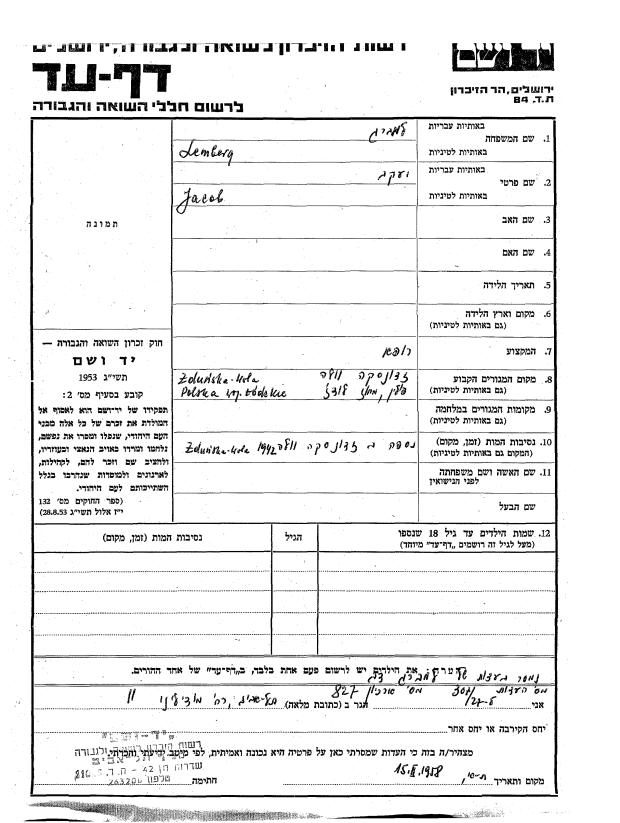
Here’s an image of Lemberg testimony (in Hebrew) from the Yad Vashem database.

On this day..