1999: Recak Massacre

(Thanks to Meaghan Good of the Charley Project for the guest post. -ed.)

On this day in 1999, Serbian militants killed approximately 40 to 45 Kosovo Albanians near the village of Reçak in Kosovo. The victims allegedly included a twelve-year-old boy and at least one woman.

Depending on who you listened to, it was either a massacre against innocent civilians, or a military action against guerillas.

The New Kosova Report, adopting the former point of view, summarizes in a 2008 article:

In the early morning of 15 January, 1999, forces from Serbian Interior Ministry (MUP) and Yugoslav Army (VJ) moved into the village with tanks and began to shoot at houses sheltering civilians. After ransacking all the houses, they gathered 28 Albanian men and boys and ordered them to head towards a hill outside the village for questioning. There they were sprayed with machine guns and 23 of them died. Only five survived by pretending they were dead. Another 22 people were shot and/or decapitated at different places in the village. Some in a ravine behind the village, while others in front of their houses.

A local villager named Shefqet Avida gave photographer and BBC Radio reporter Melanie Friend an account which was later quoted in Friend’s book No Place Like Home: Echoes from Kosovo.

Policemen — Serbs — were hiding here, expecting them. I heard the Serbs saying, “Anyone under fifteen years old, don’t touch, but upwards of sixteen or seventeen years old, just kill them …” The people, when they were captured here, were made to stay in line, and every one of them was shot, and after that with a … very nice knife … they took eyes from the faces and hearts from the chest, and the Serbs later said, “That’s not true, we didn’t do that,” the mice, they’d eaten them. […]

Serbian police were shooting until four or five in the afternoon. When the observers arrived in the morning, we went with them to see the place where the people were murdered. Three of us stayed here all night to guard the bodies. […] Thirteen members of my family were killed there.

The Serbs denied having murdered civilians and claimed all those killed were all Kosovo Liberation Army fighters, shot during a skirmish with Serbian forces. To this day, many maintain the entire thing was staged, a hoax set up by the KLA in order to get support for their side.

Trying to sort the matter out, the European Union dispatched forensic experts to the scene from Finland. Helena Ranta, one of the experts, concluded that “There were no indications of the people being other than unarmed civilians.” When her opinion was broadcast in a press release, many mistook it for being the opinion of the entire group of scientists.

The Finns’ official report, however, has never been released. Dr. Ranta, a forensic dentist, later accused officials from the Ministry for Foreign Affairs of pressuring her to go against the Serbs.

Yugoslav and Belarusian scientists also examined the bodies and said they believed all the dead were KLA combatants. In response, critics blasted them for using allegedly out-of-date and unscientific testing methods.

News of the killings made headlines all over the world and incited NATO to finally get involved in the war. A couple of years later, Yugoslav dictator Slobodan Miloševic was brought up on war crimes charges; ordering the Reçak killings was one of them. It was later removed from the indictment for lack of evidence, however. (Miloševic died before his trial was concluded.)

In 2001, a Kosovo Serb police officer was sentenced to fifteen years in prison for participating in the killings. Outside observers, including the United Nations and Amnesty International, criticized the trial proceedings, accusing the Kosovo war crimes tribunal of ethnic bias and politically motivated decision-making. As of this writing, no one else has been called to account for what happened in Reçak.

On this day..

2011: Two leaflet-readers

South Korean activists have in recent years taken to balloon-lifting propaganda leaflets over the DMZ into North Korea — including on the occasion of the recent leadership succession.

North Korea is not amused by this tactic and has pressured — and even militarily threatened — South Korea to clamp down on it. But that’s nothing next to the clampdown within North Korea.

On this date in 2011, according to an activist whose father is a North Korea abductee, two were publicly shot for the crime of handling these leaflets.

An army officer who pocketed dollar bills enclosed with the leaflets was shot along with a 45-year-old woman who concealed one of the flyers, said Choi Sung-Yong.

He said the executions were carried out on January 3 at Sariwon, 45 kilometres (27 miles) south of Pyongyang, in front of 500 spectators following a special ideological session on the leaflets.

Choi, citing a source in Sariwon, told AFP that six members of the victims’ families had been sent to a camp for political prisoners.

“North Korea apparently carried out the executions to teach a lesson to its people,” Choi said.

He said the regime appeared to have tightened ideological control as it grooms the youngest son of leader Kim Jong-Il as eventual successor to his father.

Those dollar bills that cost the army officer his life are, very sadly, enclosed with some leaflets to induce North Koreans to pick them up despite the risk to life and limb.

On this day..

1529: Desle la Mansenee in the Luxeuil Trial

“In 1529, the Inquisitor General of Besancori, a Dominican friar named Jean Boin, visited incognito the village of Anjeux in the bailiwick of Luxeuil, Franche-Comte, and noted down the gossip of the villagers, which centered on 27-year-old Desle la Mansenee,” begins this vignette in the only part of Nigel Cawthorne’s Witches: History of Persecution that Google books preview will cough up.

You know this isn’t going to end well.

Our incognito Inquisitor swiftly decloaked and transformed Desle la Mansenee from grist for the neighbors’ grapevine into ash for their garden plots by torturing her into confessing to — oh, you know, the usual stuff. Dancing at witches’ sabbats and flying on broomsticks and banging the devil. That sort of thing.

People, these are infernal agents. It doesn’t get any worse than that. You’ve got to use tough tactics to get information, not just start salacious rumors and hope they’ll come clean.

On this day..

1802: Jacques Maurepas and his entire family

On this date in 1802, a Haitian general, his family, and his men, were butchered by French forces fighting to retain control of Saint-Domingue.

Haing recently mastered the French Revolution, Napoleon Bonaparte — ever one for keeping it in the family — late in 1801 dispatched his brother-in-law* and brother-in-arms Leclerc to suppress the Haitian Revolution.

Over the course of 1802, Leclerc made headway towards accomplishing just that, as much with carrots as with sticks.

Maurepas was one of the Haitian commanders tasked by Toussaint L’Ouverture with defending Saint-Domingue, in his case, Port-de-Paix. Faced with a French landing, Maurepas burned the town to the ground and withdrew for an effective guerrilla resistance in the mountains.

But he eventually came to terms with the French, as did other Haitian officers, L’Ouverture included — reintegrating forces back with the French on the understanding that all that liberte, egalite, fraternite stuff would at least extend as far as not reintroducing slavery.

The French had other plans for their lucrative once-and-future colony, and when the Haitians caught wind of them, trouble resumed — now under the leadership (since the French had sagely deported L’Ouverture) of Jean-Jacques Dessalines.**

Leclerc had the, er, “fortune” of succumbing to yellow fever shortly after Dessalines’ promising revolt got underway; he was succeeded by the brutal Rochambeau, who threw away the carrots and relied on naked violence to control the island. (Again, not uncharacteristic of Napoleonic conquests.)

Maurepas had not actually gone over to Dessalines, but the fact that he was a black Haitian general was reason enough for his white French superior officer to arrest him preventively. Immediately upon assuming command, Rochambeau made an example of Maurepas.

The sea off the Cape was chosen to be the theatre of an execution, unparalleled in what is called civilized life. For fear that Maurepas, who had gained distinction under Toussaint L’Ouverture, after having embraced the side of France, should join the insurgents, Leclerc had written to him to come by sea, with his family and his troop, to take the command of the Cape, which he destined for him as a reward for his services. No sooner had he arrived than he and his soldiers were seized and disarmed. Rochambeau ordered preparations to be made for a barbarous punishment in order to put the negro general to death, with his troop, consisting of 400 blacks. It was also put in deliberation whether death should be inflicted on his children, in order to prevent them from rising up to avenge their father.

After having been bound to the mast of a vessel, Maurepas was frightfully insulted. His wife, his children, and his soldiers were brought to be drowned under his eyes. The executioners were astounded when they beheld a father fix his dying eyes by turns on his children, his wife, and his companions in arms, undergoing a violent death; while they, on their part, turned their eyes away from a father, a husband, a general, whose countenance was disfigured by the tortures he was enduring. After being made to contemplate each other’s sufferings, they were all tossed into the ocean. They died without complaining in a manner worthy the champions of liberty. With a reversal of the order of nature, the father died last; he also suffered most.

Thus died Maurepas, whose character was a compound of frankness and severity. Thrice had he repulsed the French at the gorge of Trois-Rivières; he had at once the glory and the misfortune to go over to the French with victorious arms. The elevation of his soul equalled his valor. He preserved a tender feeling for the master whose slave he had been; he caused funeral honors to be paid to that master, and when his grave had been negligently prepared, he threw off his upper garment in order to perform the pious office properly. Among men of his own blood he was a powerful chief. A spirit of order and justice prevailed in his life. His riches, which were considerable, were given up to pillage. It would almost seem as if so much excellence were subjected to so much ignominy, expressly to show that while black men are capable of any virtue, white men are capable of any crime. Certainly, my narrative is replete with instances which, beyond a question, prove that moral as well as mental excellence is independent of the varieties of color.

This brutal punishment, preceded by vile perfidy, filled the camps of the insurgents with horror. That horror was augmented when Rochambeau, at the Cape, put to death five hundred prisoners. On the place of execution, and under the eyes of the victims, they dug a large hole for their grave, so that the poor wretches may be said to have been present at their own funeral.

Far from cowing the rebels into submission, this savagery fired more ferocious resistance from men, women, and children who now perceived that their race subjected them to wholesale and arbitrary cruelty that no display of loyalty could overcome.

A terrible retribution was determined upon. Dessalines erected 500 gibbets, and hanged half a regiment of French that he had captured by a bold countermarch. A war of extermination followed, and in December, 1803, aided by an English squadron, the French were compelled to evacuate the island.

January 1, 1804 is Haiti’s Independence Day.

* By way of marriage to Napoleon’s sister Pauline. Pauline enjoyed the Saint-Domingue adventure more than did her spouse; she sported with lovers and balked at returning to France. “Here,” she noted, “I reign like Josephine; I hold first place.”

This character is the subject of a recent biography.

** After expelling the French and becoming the first ruler of independent Haiti, Dessalines took a page from Napoleon’s own playbook and crowned himself Emperor.

On this day..

330 B.C.E.: Philotas, Alexander the Great Companion

Around this time — October, or at any rate autumn — of 330 B.C.E., Alexander the Great authored “one of the two greatest crimes of his life”* with the execution of his comrade-in-arms Philotas.

Philotas was one of Alexander’s “companions”, the elite cavalry who joined Alexander personally in battle. He had fought by Alexander’s side in the epic Battle of Gaugamela, which brought down the Achaemenid Empire and opened Persia to the legendary conqueror.

A year later, Alexander, and therefore also those companions, were winding down campaign season all the way on the other side of the late empire they had so stunningly dismantled. It’s the region of Drangiana on the present-day Iran-Afghanistan frontier. The Macedonians would name the city Prophthasia, Anticipation, in recognition of their chief’s narrow escape; we know it today as Farah, Afghanistan.

Unlike many of the “companions” who joined the young Macedonian king, Philotas wasn’t a bosom buddy of Alexander.

He was, instead, a bit of a political appointee who owed his position to the fact that his father Parmenion, a great Macedonian general, had backed the disputed succession of Alexander. Parmenion continued as one of Alexander’s generals; his kid — not particularly popular of himself but nevertheless a loyal and competent officer — got a plum gig in Alexander’s vanguard.

In this capacity so close to the royal person, Philotas was warned by a conscientious slave of an assassination plot going against Alexander. And rather incredibly, he didn’t bother to pass it on.

When the slave realized, a couple of days on, that the conspiracy hadn’t been busted, he proceeded to tell somebody else … and Philotas had some explaining to do.

For posterity, it’s as open a question as it was then: Philotas initially convinced Alexander that he had merely considered the whole thing so insubstantial as not to merit the king’s attention — but by the next day, Alexander had better inclined himself to the more damning reading, that Philotas was perfectly amenable to seeing Alexander eliminated.** If that were the truth, it would herald a conflict that would soon come to define the Macedonian’s coruscating and paradoxical career: the army’s rising discontent with its march so far from home, and its leader’s ever more visible habit of arraying himself in the alien habits of oriental despotism.

Philotas got a “proper” if farcically rigged trial before fellow-generals who were all too happy to be rid of him, and was tortured into confessing. He was executed either by stoning (actually the traditional Macedonian execution method, even for the likes of generals) or spearing.

(The scene is dramatized in the 2004 Oliver Stone film Alexander; the relevant bit can be viewed here.)

Parmenion, a greater character than his son, would also pay the forfeit of his son’s alleged misprision.

At the time of Philotas’s execution, Parmenion was commanding a large army several days’ ride from Alexander. Fearing that the torture and execution of his last remaining son (the other two had also died on campaign) might inspire the august general to do something rash, Alexander dispatched a few trusted officers to outrace the news: they murdered an uncomprehending Parmenion as soon as they reached him. Whatever one makes of the child, the father’s loyalty both to Alexander and his predecessor Philip II had never previously been impeached in a long and brilliant career. Alexander ought to have counted himself fortunate to have avoided any wider disturbance in the army from the rough handling of this beloved general.

The whole affair was sufficiently distasteful that it remained a sensitive matter of state security hundreds of years and hundreds of miles distant: An Elizabethan play about Philotas by Samuel Daniel earned its author some uncomfortable official scrutiny for its perceived commentary on the contemporaneous execution of the Earl of Essex … the fallen courtier whose prosecution of a Jewish doctor arguably informed Shakespeare’s Merchant of Venice.

* The other — later and greater — crime was Alexander’s drunken murder of his friend and loyal commander Cleitus. (He’s the guy shown stabbing Parmenion to death in the clip from Alexander, a circumstance that plays better as drama than history.)

** It doesn’t help anyone’s fact-finding that the main alleged plotter committed suicide when they came to arrest him.

On this day..

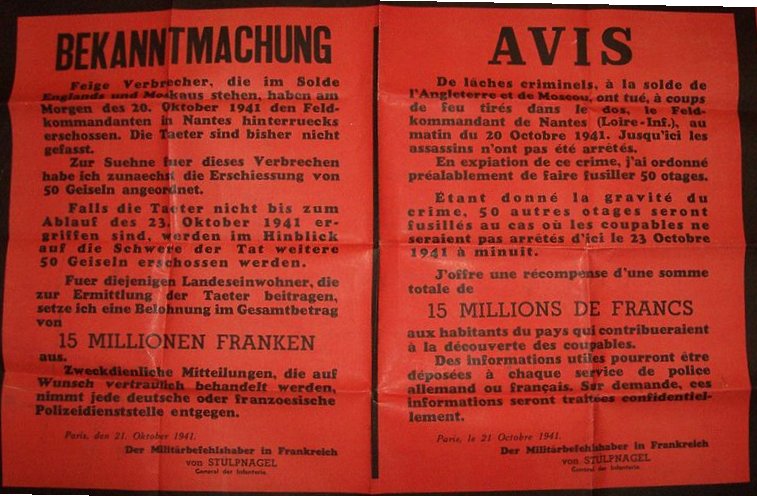
1941: Forty-eight French hostages

On “a beautiful autumn day” this date in 1941, four dozen French leftists were executed by that country’s occupiers as punishment for the murder of a German officer.

On October 20, 1941 — sixteen months into the German occupation — a pair of Communist commandos assassinated the Feldkommandant of Nantes, Lt. Col. Karl Hotz (French link).

News of this crime went straight to Adolf Hitler himself, who personally ordered a fearful reprisal.

The list of the executed hostages as published Oct. 23 in L’oeuvre

Accordingly, the collaborationist Petain government was induced to select 50 persons from among the ranks of detained German political prisoners. Pierre Pucheu, who would later be executed himself,* intentionally selected Communist types in an effort to confine the retaliation to fellow-travelers.

On this date, those 50 — well, 48, but who’s counting?; the numbering can get dodgy in these mass-execution scenarios — were put to death at three different locations: five at Fort Mont-Valerien; sixteen at Nantes; and most notoriously, 27 internees of Choisel (French link) at Chateaubriant.**

In three different batches of nine, the 27 reds and trade unionists were fusilladed into the ranks of Gallic martyrdom. They remain among the most emblematic French martyrs of the occupation; there’s a cours des 50-Otages named for them in Nantes, and various streets that bear individual victims’ names — such as Rue Jean-Pierre Timbaud in Paris. (Timbaud was a Communist steelworker.)


Monument to the martyrs of Chateaubriant. Image (c) Renaud Camus and used with permission.

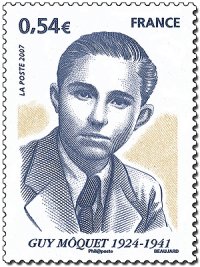
The youngest, 17-year-old Guy Moquet (you can find his name on the Paris Metro) was the son of an exiled Communist parliamentarian (French link).

He made headlines in 2009 when current French President Nicolas Sarkozy had added to the educational curriculum the reading of Moquet’s brave-but-sad last letter to his family: the decision drew some rather mean-tempered fire because of Moquet’s political persuasion. In the end, the text bore a fairly universal reading that could play inoffensively to posterity — like its postscript injunction,

“You who remain, be worthy of the 27 of us who are going to die!”

There’s a thorough roundup of the Oct. 22 executions (including poetic tribute) here.

* Vindicating Winston Churchill’s prophecy to the Times upon receiving news that “These cold-blooded executions of inocent people will only recoil upon the savages who order and execute them.” (Oct. 25, 1941, as cited in the The Churchill War Papers, vol. 3)

** Fifty more were supposed to be executed if the assassins weren’t promptly turned in, but that second batch never took place. (There was, however, a different batch of 50 executed on October 24 in retaliation for a different political assassination. Maybe they just all ran together.)

Part of the Themed Set: Illegitimate Power.

On this day..

1594: Ishikawa Goemon, bandit

On this date in 1594, legendary Japanese outlaw and folk hero Ishikawa Goemon was boiled to death in oil for attempting to assassinate Toyotomi Hideyoshi.

And he’s supposed to have had his son thrown into the kettle* with him, and, boiling to death himself, to have held the boy aloft out of harm’s way.

A 19th-century image painted by Toyokuni III of Goemon in one of the several kabuki plays he features in.

Ishikawa is a sort of Japanese Robin Hood figure, and the (very much) that isn’t offered by the documentary record is helpfully expanded in folklore.

Trained in forbidden ninja ways? Check.

Or maybe a samurai? Why not?

Henchman named “rat boy”? Oh, yes.

Just what his beef with national unifier Toyotomi Hideyoshi might have been is also subject to the exigencies of the story at hand. Let it be oppression or something, good enough for one of those classic outlaw-with-a-heart-of-gold retorts against condemnation for his thieving career.

It is you who are the robber who stole the whole country!

He gets to be the title character of the 2009 film Goemon:

Thanks to the inevitable marketing tie-ins, the world also has a Goemon action figure.

Personally, and especially because I would lose all these nifty accessories, I much prefer the adorable Goemon Cosbaby series.

* As a result of this famous exit, a Goeomon-buro (Goemon bath) in Japanese refers to a large iron kettle-shaped bathtub.

On this day..

1992: 42 Iraqi merchants

On this date in 1992, 42* Baghdad merchants who were among several hundred rounded up over the preceding 48 hours were executed at Saddam Hussein‘s command at Abu Ghraib prison and the Interior Ministry compound.

A year and change on from the close of the Gulf War, Iraq’s economy was groaning under a murderous program of economic sanctions.

The merchants were accused of profiteering by manipulating food prices — a chilling threat to businessmen, but one that had little power to arrest the wreck of Iraq’s economy. Prices for food, and everything else, were spiking under the blockade.

“Hardly any Iraqi trader sent anything to his country from our warehouse” after the executions, according to a Jordanian exporter quoted by Reuters.** “They tell us even if the goods are given to them for free, they are not ready to risk their lives.”

These executions have put some former Iraqi officials at risk of their lives in American-occupied Iraq.

The country’s longtime Deputy Prime Minister, Tariq Aziz, was tried for his life in 2008-2009 for ordering these executions; Aziz received a 15-year sentence.†

But at the same trial, two of the late dictator’s half-brothers, Watban Ibrahim al-Tikriti and Sabawi Ibrahim al-Tikriti, drew death sentences for the same affair.

Just days ago as of this writing, those two gentlemen were transferred from American to Iraqi custody, where they figure to be put to death very soon — though this is a matter of ongoing political wrangling.

* It’s not completely unambiguous to me that the “42 merchants” at issue in several post-Saddam trials were all executed on July 26 (though Amnesty International seems to think so); the roundup and execution process was less than orderly. But it’s certainly the case that at least many died this date.

Some testimony and trial documents related to the incident are available in pdf form here.

** Chicago Sun-Times, Aug. 3, 1992.

† Aziz has subsequently received a death sentence in a different and politicized case; that sentence was internationally condemned and Iraq’s president has stated that he will never implement it.

On this day..

1934: Night of the Long Knives

In the dark hours this date in 1934, a bargain with the devil was sealed in blood.

Months before, even mere hours before, it was still possible for longstanding adherents of the National Socialist Workers’ Party to demand the “Socialist” part of the program.

The SA and the SS will not tolerate the German revolution going to sleep and being betrayed at the half-way stage by non-combatants. … It is in fact high time the national revolution stopped and became the National Socialist one. Whether [the bourgeoisie] like it or not, we will continue our struggle — if they understand at last what it is about — with them; if they are unwilling — without them; and if necessary — against them.

Populist, not Bolshevik. (In fact, stridently anti-communist.) Nevertheless, a distinct menace by the have-nots against the haves.*

Especially so because they were the words not of some impotent scribbler but of Ernst Roehm, commander of the the Nazis’ paramilitary brownshirts. And threatening, too, for Adolf Hitler for this same reason: his ascension the previous year to the Chancellorship had entailed terms with a German elite who needed but mistrusted the man’s mass party. Something was going to have to give.

The Communist exile Leon Trotsky’s 1933 analysis of the infant Nazi Germany’s dynamics proved prescient.

The banner of National Socialism was raised by upstarts from the lower and middle commanding ranks of the old army. Decorated with medals for distinguished service, commissioned and noncommissioned officers could not believe that their heroism and sufferings for the Fatherland had not only come to naught, but also gave them no special claims to gratitude. Hence their hatred of the revolution and the proletariat. At the same time, they did not want to reconcile themselves to being sent by the bankers, industrialists, and ministers back to the modest posts of bookkeepers, engineers, postal clerks, and schoolteachers. Hence their “socialism.”

German fascism, like Italian fascism, raised itself to power on the backs of the petty bourgeoisie, which it turned into a battering ram against the organizations of the working class and the institutions of democracy. But fascism in power is least of all the rule of the petty bourgeoisie. On the contrary, it is the most ruthless dictatorship of monopoly capital. … The “socialist” revolution pictured by the petty-bourgeois masses as a necessary supplement to the national revolution is officially liquidated and condemned.

The Night of the Long Knives this date took those blades to the “socialists”, to the men like Roehm whose dreams of redistribution were reckless enough to picture his working-class militia supplanting the German army proper.

As its price of power, the Nazi leadership purged these dangerous elements.

At 2 a.m. this date, Hitler flew to Munich to personally arrest Roehm on the pretext of averting an imminent coup by Roehm’s SA.** Elsewhere in the Reich, coordinated arrests and summary executions destroyed the Nazi party’s “left”, and throughout this date, and continuing into the next, did not scruple to sweep up whatever other conservative elements Hitler considered unreliable.

It was a dangerous but ultimately decisive move. Albert Speer saw Hitler on July 1, and remembered him ebullient at the triumph.

Hitler was extremely excited and, as I believe to this day, inwardly convinced that he had come through a great danger. … Evidently he believed that his personal action had averted a disaster at the last minute: “I alone was able to solve this problem. No one else!”

The final death toll is uncertain. Hitler copped to 77 in a speech to the Reichstag two weeks later which chillingly claimed that “in this hour I was responsible for the fate of the German people, and thereby I became the supreme judge”; it is likely that the true number is much higher. But its effect went far beyond those immediately killed: it tamed the SA’s independence, and permanently subordinated it to the military; and, it brought Adolf Hitler the dictatorial power that would make the succeeding years so fruitful for this blog.

Among those known to have been seized and executed and/or murdered this date:

Roehm himself died on July 2, initially spared for his many good offices for the Nazi cause before Hitler realized he could not leave him alive.

The armed forces, apparently the day’s big winner, would pay a price of their own for the arrangement.

“In making common cause with” the murderous purge, observed William Shirer in The Rise and Fall of the Third Reich, “the generals were putting themselves in a position in which they could never oppose future acts of Nazi terrorism.” As the quid for the quo, soldiers were soon required to swear “unconditional obedience” to Adolf Hitler, and this oath would give countless Wehrmacht officers sufficient reason or excuse to eschew resistance to their leader until much too late.

Barely a month after the Night of the Long Knives, the ancient German President Hindenburg died in office. Hitler, who now commanded the clear allegiance of his nation’s elites and had savagely mastered his own party besides, succeeded the powers of Hindenburg’s vacant office along with those of his own Chancellorship and became the German Fuehrer.

* When the Nazis were knee high to the Weimar Republic, their party program sought such radical stuff as abolition of rentier income, generous old-age pensions, and nationalizing trusts.

** The historicity of any actual coup plot is generally dismissed, although the event is still known in German by the expedient sobriquet the Nazi leadership gave it, Roehm-putsch.

On this day..

1655: Massacre of Waldensians

On this date in 1655, Catholic forces under the Duke of Savoy carried out a notorious massacre of Waldensians* in the Piedmont.

This interesting, excommunicate sect had persisted for centuries in those hard-to-reach places in Alpine foothills, intermittently ignored and hunted. After Martin Luther, many Protestants inclined to see them as a proto-Reformation movement, or even a counter-papal apostolic succession reaching back to ancient Christianity.

At any rate, they sure weren’t Catholic.

And our friend the Duke decided — perhaps piqued by the murder of a missionary Catholic priest, or for whatever other reason — to mount one of those heresy-extirpating sorties and make them Catholic in 1655.

On April 17, the Marquis of Pianezza appeared with an overwhelming force of mixed Piedmontese, French, and Irish** troops. They conducted a few skirmishes, then made nice with the Waldensian civic leaders and induced them to quartering their troops temporarily further to some expedient pretext.

Alas! alas! these poor people were undone. They had received under their roof the executioners of themselves and their families. The first two days, the 22d and 23d of April, passed in peace, the soldiers sitting at the same table, sleeping under the same roof, and conversing freely with their destined victims …

At last the blow fell like a thunderbolt. At four of the clock on the morning of the 24th April the signal was given from the Castle of La Torre. But who shall describe the scenes that followed? On the instant a thousand assassins began the work of death …

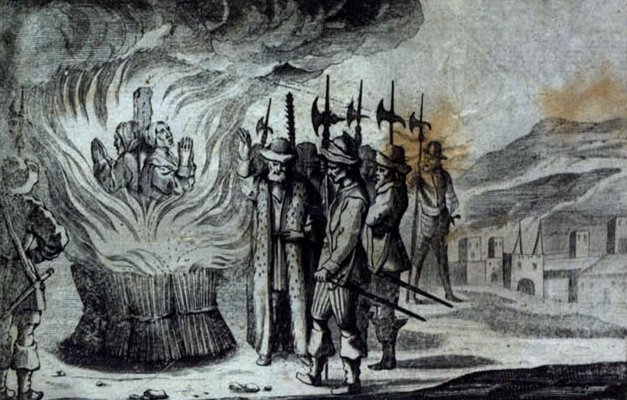
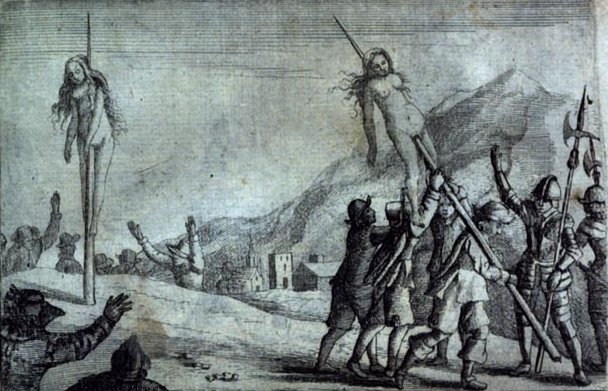
Little children were torn from the arms of their mothers, and dashed against the rocks; or, more horrible still, they were held betwixt two soldiers, who, unmoved by their piteous cries and the sight of their quivering limbs, tore them up into two halves. Their bodies were then thrown on the highways and the fields. Sick persons and old people, men and women, were burned alive in their own houses; some were hacked in pieces; some were bound up in the form of a ball, and precipitated over the rocks or rolled down the mountains … Some were slowly dismembered, and fire applied to the wounds to staunch the bleeding and prolong their sufferings; some were flayed alive; some roasted alive; others were disembowelled; some were horribly and shamefully mutilated, and of others the flesh and brains were boiled and actually eaten by these cannibals.

Source, whose atrocity accounts channel those in this French tome

Without doubting the capacity of man’s inhumanity to man, the cannibalism charge reminds that we’re dealing with propaganda alongside historiography. And what great propaganda — like, babies-torn-from-incubators great.

Thumbnails (click for a larger, disturbing view) of selected images of this date’s atrocities from Samuel Morland’s The History of the Evangelical Churches of the Valleys of Piedmont

And there’s little doubt as to the overall savagery of the affair, which could well have become the opening salvo in a full-scale sectarian cleansing campaign. (A later addendum to Foxe’s Book of Martyrs narrates the ensuing Piedmontese armed struggle, petering out before any definitive resolution in the field.)

Outrage at this hecatomb spread in Protestant Europe — which would also refer to the day’s doings as the “Bloody Easter,” since it corresponded with the eve of that celebration as reckoned by the Julian Calendar (source).

It was felt especially in Protectorate England, which intervened diplomatically.

A “day of solemn fasting and humiliation” was promulgated in Albion, along with collections for the relief of the survivors. Oliver Cromwell personally put £2,000 into the kitty.

More importantly, he dispatched diplomat Samuel Morland† to force the House of Savoy to lay off the persecution; in fact, he threatened to disrupt high statecraft between England and France unless the French twisted arms on behalf of the Waldensians.

Written correspondence for Morland’s diplomatic tour addressed to Louis XIV of France and various other continental potentates, as well as a fiery bit of oratory that Morland delivered to Savoy, all seem to have originated from the pen of Republican scribbler John Milton — the future author of Paradise Lost.‡

Milton, for whom the whole thing was more than just a day job, was further moved to put his umbrage at the slaughter into sonnet form:

Avenge O Lord thy slaughter’d Saints, whose bones
Lie scatter’d on the Alpine mountains cold,
Ev’n them who kept thy truth so pure of old
When all our Fathers worship’t Stocks and Stones,

Forget not: in thy book record their groanes
Who were thy Sheep and in their antient Fold
Slayn by the bloody Piemontese that roll’d
Mother with Infant down the Rocks. Their moans

The Vales redoubl’d to the Hills, and they
To Heav’n. Their martyr’d blood and ashes sow
O’re all th’ Italian fields where still doth sway

The triple Tyrant: that from these may grow
A hunder’d-fold, who having learnt thy way
Early may fly the Babylonian wo.

* The Waldensians in question here are interchangeably known as the Vaudois for their geographic region, actually above the Piedmont and abutting the Swiss region also known as Vaud. (These pages have visited the latter.)

** Fresh from being on the receiving end of another infamous massacre.

† Morland is more regarded for his post-Restoration labors as an inventor; he created an early calculator and internal combustion engine.

‡ The speech in particular is not definitively attributed; see Robert Fallon, “Milton in Government: Denmark and Savoy,” Milton Quarterly, May 1989.

On this day..