This date was Easter Sunday in 1457, which would make it the date associated with one of the more memorable displays of theatrical brutality by Wallachian proto-vampire Vlad Tepes, aka Vlad Dracula or Vlad the Impaler.
Having only just ascended the less-than-secure throne of Wallachia, a frontier principality pinched between the Hungarian and Ottoman Empires, the 25-ish prince and onetime Ottoman hostage had a bone-chilling inauguration plan to shore up his security both internal and external.
He asked the assembled noblemen:
“How many princes have you known?”
The latter answered
Each as much as he knew best.
One believed that there had been thirty,
Another twenty.
Even the youngest thought there had been seven.
After having answered this question
As I have just sung it,
Dracula said: “Tell me,
How do you explain the fact
That you have had so many princes
In your land?
The guilt is entirely due to your shameful intrigues.”
With ample proof of the boyars’ deceit and treacherous intents, Dracula decided it was timely to inflict upon them an exemplary punishment … mass impalement …
The oldest Romanian historical chronicle records the event two centuries later. It had taken place in the spring of 1457, during the Easter celebrations that the boyars were attending at the palace … “when Eastern Day came, while all the citizens were feasting and the young ones were dancing he [Dracula] surrounded them [the boyars] … led them together with their wives and children, just as they were dressed up for Easter, to Poenari, where they were put to work until their clothes were torn and they were left naked.” In actual fact, this episode, which is also recalled by the Greek historian Chalcondyles and firmly anchored in popular folklore, involved some two hundred boyars and their wives, as well as leading citizens of Tirgoviste … They were seized by Dracula’s men as they were finishing their meal in the main banqueting hall of the palace, following the elaborate Easter ritual at the Paraclete Chapel. In Dracula’s ingenious mind, one aspect of the punishment had a utilitarian purpose: the reconstruction of the famous castle high up on the Arges … On the way out of the chapel the old boyars and their wives were apprehended by Dracula’s henchmen and impaled beyond the city walls. The young and able-bodied were manacled and chained to each other and then marched northward under the vigilant eye of Dracula’s men.
But personal score-settling aside, Vlad’s sanguinary housekeeping had a statecraft dimension as well. It enabled him to centralize power in his own person, and had the happy side effect of speeding creation of a secure mountain fastness — Poenari Castle, which is one of several structures answering to the lucrative name of Castle Dracula.
While Vlad is (in)famous for his iron fist (and well-oiled spikes), it’s perhaps harder to say with confidence how much good this slaughter did him. Wallachia’s security situation was fundamentally defined by its neighbors no matter how cruel Vlad Tepes might be.
Vlad got some more impaling under his belt defending his country from Ottoman invaders (you’ll be shocked to learn that many boyars were more than happy to help the sultan get rid of this tyrant), but he was clapped in prison by the Hungarian ruler Matthias Hunyadi in 1462, lived most of the rest of his life in exile, and then died in battle attempting a Wallachian comeback in 1476. So basically, he got a few good years in … plus that whole latter-day afterlife he enjoys as tourist magnet, alleged literary inspiration, and nationalist icon.
And that’s more than one can say for most of the 15th century rulers who weren’t impaling their boyars.
On this date in 1705, another century’s supposed terrorist was hanged on Leith Sands with two of his “pirate” crew by a Scottish court “drunk with patriotic prejudice.”*
This execution took place in the feverish run-up to England and Scotland’s Acts of Union welding the neighboring realms into Great Britain in 1707.
Arising as it did from the same causes that animated that national marriage of convenience, Green’s execution also endangered it: Daniel Defoe, who was at this time a pro-Unionist mole (and prolific pamphleteer) for English pol Robert Harley, described this hanging as one of the six crises that had to be overcome en route to the Union.
A Man, A Plan, A Calamity
Panama.
That’s where it all started, for Green and Union alike.
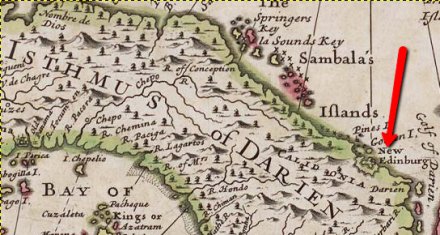
Mired in economic backwardness as neighboring European states carved up the world, Scotland made a bold, doomed bid for a chit in the empire game: the Darien scheme. One part visionary and (at least) two parts daft, this venture attempted to establish a Scottish colony on the Isthmus of Panama (aka the Isthmus of Darien) with a view to porting freight across the narrow strip of land separating Atlantic and Pacific, and dominating the dramatically more efficient east-west trade route that would result.
Students of the Panama Canal project will be aware that this malarial tropic would not be described as especially hospitable; to the natural disadvantages of the climate were added the political interpositions of England herself, whose hostility to the advent of her Caledonian neighbor as a New World rival was expressed in legislation choking the Darien adventure of foreign aid.
(Also a problem: Spain. The colony was abandoned at last under Spanish siege.)
So Scotland went it intrepidly, injudiciously alone in this last bid for real independent muscle in Europe. The hyperbole of the Isthmus’s publicists eventually sucked in 20 percent or more of the capital circulating in Scotland. And when Darien-dot-com went bust by 1700 at the cost of a couple thousand lives, it cratered the Scottish economy too. That set the stage for Edinburgh’s partnership in a different scheme: Great Britain.
Green with Envy
In the years following the Darien catastrophe, the Scottish corporation chartered to undertake it was still throwing stuff against the wall in the world trade game, trying to get something to stick to at least take the edge off the losses.
This company (theoretically a potential rival of England’s own East India Company) had suffered the further national indignity of having one of its ships, the Annandale, seized in the Thames for infringing the East India Company’s royal monopoly. Its appeals for redress falling on deaf ears, the Darien company apparently induced Scottish authorities to undertake the retaliatory seizure of an English merchant ship, the Worcester, that had the ill luck to weather a storm at the Firth of Forth.
Rumor soon connected this ship to another vanished Darien company vessel overdue from its return trip from the East Indies … and, as it quickly became understood by all right-thinking Scots, overtaken in the Indian Ocean by this same Worcester and its crew butchered.
Captain Thomas Green and his English crew were hailed before an Admiralty court** on piracy charges on this extremely fantastical connection in a virtual mob atmosphere.
It never was clearly established that an act of piracy had been committed as a distinct fact, but by putting certain circumstances together it was inferred that Green was guilty of piracy. The very shape in which the accusation is set forth, shows that the accusers could not point to the specific act of piracy which had been committed …
[There] was no specification as to the vessel taken, which might enable the accused to prove that it had not been taken; no names of parties murdered, who might be shown still to be alive; no ownership of cargo, which might admit of proof that the owner’s goods had arrived safe. As Green himself is made justly to say in the document published as his dying speech, “We are condemned as pirates and murderers on a coast far distant from this place — is there any of you who wants either a friend whom we have murdered, or whose goods we have taken?”
Worcester Sauce
The Worcester‘s Malabari cook provided a highly dubious charge — dubious, for he was not yet among the crew when it last called at the location he claimed the crime took place — of Green and crew hatchet-murdering approximately ten English-speaking mariners on an unnamed vessel off the Indian coast.
Upon this evidence, 14 or more members (the ready sources are a little loose on the total number) of the Worcester crew were condemned for piracy, and initially slated for three batches of hangings. Queen Anne‘s personal intervention managed a stay,
The Scottish Privy Council unto the very last hours debated what to do with the diplomatic appeals, with evidence forwarded from London to the effect that the crew these Worcester men had supposedly slaughtered were alive, their vessel having been hijacked in another place, by another man.
But a surging Scottish mob aggrieved by the preceding years’ misadventures and the impending shotgun marriage to Westminster rather than anything Green himself had really done was already engorged on the blood of the supposed English corsairs. Most of the Council thought better than to deny them their sacrifice.†
The Streets fill’d with Incredible Numbers of Men, Women and Children, calling for Justice upon those ENGLISH Murtherers. The Lord Chancellor Seafield‘s Coach happening to pass by, they stop’d it, broket he Sashes, haul’d him out, and oblig’d him to promise Execution should speedily be done before he could get from ’em … According to the Chancellors promise, soon after, on the same Day, being Wednesday, Captain Green, Madder [the mate], and Sympson [the gunner] were brought out, and convey’d to Execution, which was at Leith Road upon the Sands, and all the way was Huzza’d in Triumph as it were, and insulted with the sharpest and most bitter Invectives. Being come to the place of Execution, Good God! what a moving sight was it to see those Men stand upon the very Varge of Life, just launching in to Eternity, and at the same time see the whole Multitudet ransported with Joy!”
-From an anonymous Letter From Scotland To a Friend in London, quoted by James Kelly, “The Worcester Affair,” The Review of English Studies, Feb. 2000
In the event, these three were the only ones actually hanged; passions cooled enough for the other “pirates” to be quietly released.
But the wider, national passions unleashed by this date’s executions would long provide fodder for intemperate patriotic recrimination, and specifically anti-Unionist propaganda — on both sides of the border.
Competing propagandisticbroadsides framed and re-framed the events, as the affair of unscrupulous English buccaneers or perfidious highland barbarians. (Defoe, maneuvering for Union, wrote to chill such bad-for-business hostility: “Nothing could be more horrid, than that the Scots should Execute these Men on a meer Pique at the English Nation. Nothing can be more like it, than to conclude rashly, that it is so, and improve it on purpose to Exasperate our People against the Scots.” (Kelly))
And that, of course, is precisely the viewpoint that prevailed.
While the hemp neckties issued to Green et al this date threatened to (ahem) scotch the Union project, that very danger might have ultimately hastened its completion — as elites recognized, in Defoe’s words, that Union represented “the only way to preserve the publick Tranquillity, and prevent the certain Mischiefs that threatened the whole Body,” (Kelly, again) and rammed it through with dispatch.‡
‡ The ebb and flow of national resentment continued long after the Acts of Union, of course; continuing Scottish support for the restoration of the Stuart monarchy was one expression of Scottish nationalism and anti-Union sentiment.
“Four days” after an unspecified “early spring” date in George Orwell’s classic allegory of Soviet communism, Animal Farm, a show trial and mass execution of animals purporting to work for the book’s Trotsky figure signals the titular farm’s unmistakable collapse into dystopia.
The farm’s early cooperative elan soon shatters, with a pig bearing the unsubtle name of Napoleon becoming the revolution’s autocrat, and fostering a paranoid security climate against phantasmal plots by his fellow swine and onetime comrade, the exiled Snowball.
Napoleon ordered all the animals to assemble in the yard. When they were all gathered together, Napoleon emerged from the farmhouse, wearing both his medals (for he had recently awarded himself “Animal Hero, First Class”, and “Animal Hero, Second Class”), with his nine huge dogs frisking round him and uttering growls that sent shivers down all the animals’ spines. They all cowered silently in their places, seeming to know in advance that some terrible thing was about to happen.
Napoleon stood sternly surveying his audience; then he uttered a high-pitched whimper. Immediately the dogs bounded forward, seized four of the pigs by the ear and dragged them, squealing with pain and terror, to Napoleon’s feet.0 …
The four pigs waited, trembling, with guilt written on every line of their countenances. Napoleon now called upon them to confess their crimes. … Without any further prompting they confessed that they had been secretly in touch with Snowball ever since his expulsion, that they had collaborated with him in destroying the windmill, and that they had entered into an agreement with him to hand over Animal Farm to Mr. Frederick. They added that Snowball had privately admitted to them that he had been Jones’s secret agent for years past. When they had finished their confession, the dogs promptly tore their throats out, and in a terrible voice Napoleon demanded whether any other animal had anything to confess.
The three hens who had been the ringleaders in the attempted rebellion over the eggs now came forward and stated that Snowball had appeared to them in a dream and incited them to disobey Napoleon’s orders. They, too, were slaughtered. Then a goose came forward and confessed to having secreted six ears of corn during the last year’s harvest and eaten them in the night. Then a sheep confessed to having urinated in the drinking pool — urged to do this, so she said, by Snowball — and two other sheep confessed to having murdered an old ram, an especially devoted follower of Napoleon, by chasing him round and round a bonfire when he was suffering from a cough. They were all slain on the spot. And so the tale of confessions and executions went on, until there was a pile of corpses lying before Napoleon’s feet and the air was heavy with the smell of blood, which had been unknown there since the expulsion of Jones.
When it was all over, the remaining animals, except for the pigs and dogs, crept away in a body. They were shaken and miserable. They did not know which was more shocking — the treachery of the animals who had leagued themselves with Snowball, or the cruel retribution they had just witnessed. In the old days there had often been scenes of bloodshed equally terrible, but it seemed to all of them that it was far worse now that it was happening among themselves. Since Jones had left the farm, until today, no animal had killed another animal.
Animal Farm was published in 1945. In this 1954 British animated feature, the downer of an ending — with the corrupt pig rulers becoming literally indistinguishable from people — was dumped in favor of an ending where the animals revolt again.
On this date in 2006, a family of Iraqis was taken prisoner and shot by a group of American soldiers.
This date’s entry is, to be sure, well into and even across the zone of borderline executions: it was crime whose authors are serving long prison sentences (although they ducked execution themselves).
It has the barest trappings of execution, enough to give that name descriptively to the killings — but maybe a little more than that, too, for this is the story of an occupation army whose “bad eggs” are endowed with the power of life and death over their subject population
“We’ve all killed Hadjis, but I’ve been here twice and I still never fucked one of these bitches.”
Barker had already picked the target. There was a house, not far away, where there was only one male and three females during the day – a husband, wife and two daughters. One was young, but the other was pretty hot, at least for a Hadji chick. Witnesses were a problem, though; they knew they couldn’t leave anyone alive. Barker asked Green if he was willing to take care of that, even if women and kids were involved. “Absolutely,” Green said. “It don’t make any difference to me.”
Green — Steven Green — is the troubled private who would do the shooting, and the one over whose life a jury wrangled over for 10 hours before finally sparing him lethal injection.
Sneaking up on the house, the soldiers corralled the whole family into the bedroom. After they had recovered the family’s AK-47 and Green had confirmed it was locked and loaded, Barker and Cortez left, yanking Abeer behind them. Spielman set up guard in the doorway between the foyer and living room, while Cortez shoved Abeer into the living room, pushed her down, and Barker pinned her outstretched arms down with his knees.
…
As Green was executing the family, Cortez finished raping Abeer and switched positions with Barker. Green came out of the bedroom and announced to Barker and Cortez, “They’re all dead. I killed them all.” Cortez held Abeer down and Green raped her. Then Cortez pushed a pillow over her face, still pinning her arms with his knees. Green grabbed the AK, pointed the gun at the pillow, and fired one shot, killing Abeer.
The men were becoming extremely frenzied and agitated now. Barker brought a kerosene lamp he had found in the kitchen and dumped the contents on Abeer. Spielman handed a lighter to either Barker or Cortez, who lit the flame. Spielman went to the bedroom and found some blankets to throw on the body to stoke the fire.
The four men ran back the way they had come. When they arrived at the TCP, they were out of breath, manic, animated. They began talking rapid-fire about how great that was, how well done. They all agreed that was awesome, that was cool.
Only after Green was discharged did the crime come fully to light.
At Green’s sentencing in the anomalous confines of Kentucky — he was the first former soldier prosecuted in U.S. civilian court for crimes committed overseas under the Military Extraterritorial Jurisdiction Act — a cousin of Abeer’s murdered parents
spoke last, praising his slain family members and criticising the jury’s reluctance to execute Green. He concluded by turning to Green and saying, “Abeer will follow you and chase you in your nightmares. May God damn you.”
This incident is the subject of the 2007 film Redacted.
A century ago today, eleven Japanese anarchists were hanged for plotting the assassination of the Emperor.
Radical journalist Shusui Kotoku challenged Meiji Japan from the insurrectionary anarchist left.
A socialist early on — he helped translate The Communist Manifesto into Japanese — Kotoku turned towards anarchism when he read Kropotkin while serving time for opposing the Russo-Japanese War. He “had gone [to jail] as a Marxian Socialist,” he said, “and returned as a radical Anarchist.”
After his release, and a trip to America which had just birthed the anarcho-syndicalist Industrial Workers of the World, Kotoku returned to Japan as his nation’s patriarch of anarchism.*
So, when police uncovered an apparent plot by other radicals to off Emperor Meiji, and opportunistically used it to sweep up as fellow-travelers a nationwide “conspiracy” of twenty-plus alleged plotters, Kotoku was naturally one of the bad apples they were pleased to indict.**
The twelve ultimately doomed to death were slated to receive their judicially appointed sanctions on this occasion, just six days after conviction. (The rest of the anarchist movement was harshly suppressed in the years ahead.)
The first eleven (all men) took so long that the twelfth doomed soul, Suga Kanno — Kotoku’s lover and a genuine bomb-plot participant, who enjoys the distinction of being the only woman her country ever hanged for treason — had her execution put off to the 25th for want of daylight.
Though he’s never been officially [judicially] exonerated, Kotoku’s native Nakamura voted in 2000 to declare his rehabilitation. A secret letter that surfaced only in 2010 appears to support that position.
Some of Kotoku’s writing is available online in Japanese here.
** George Elison translated a Kotoku Shusui letter denying any interest in the anarchist assassination racket. It appears as “Discussion of Violent Revolution, From a Jail Cell,” in the Vol. 22, No. 3/4 (1967) Monumenta Nipponica.
How is the anarchist revolution to be brought about if not by bomb-throwing attempts upon the life of the sovereign? The Japanese word for “revolution” — kakumei — is Chinese in origin. In China, the term was used to describe the process in which the emperor of dynasty A, receiving the Mandate of Heaven, replaced the emperor of dynasty B; so it signified mainly the change of emperors, the change of sovereigns. Our “revolution” has quite a different meaning. We do not place much value upon the mere transfer of power between potentates; we do not use the word “revolution” except to mean a fundamental change in the governmental system and in the organization of society.
… they who for the sake of universal peace and liberty participate in this revolution must endeavor as best they can to avoid violence, to avoid producing victims to the revolution. For it seems that the great revolutions of the past were accompanied by much violence and required a great number of victims … I only hope for the disappearance of the misconception that the anarchist revolution has as its objective the assassination of the sovereign …
the prosecution and the examiners first put the title “Violent Revolution” to what I had said and contrived the stern-sounding phrase “death-defying band,” with other similar phrases. And I believe they condemned us under this syllogism: “The anarchist revolution is concerned with the destruction of the Imperial Family. But Kotoku’s plan was to carry out a revolution by violence. Therefore, all who were party to this plot planned to commit the crime of High Treason.” So the fact that these people used to discuss such things as direct action and the revolutionary movement has now served to get them into trouble! This I deeply regret.
Update: Embargoed as of this post’s publication, Joe Arridy’s growing ranks of supporters had submitted to Colorado Gov. Bill Ritter an application for a posthumous pardon. On January 7, 2011, Gov. Ritter granted that pardon — a fitting conclusion to a cinematically heart-rending story.
“Granting a posthumous pardon is an extraordinary remedy. But the tragic conviction of Mr. Arridy and his subsequent execution on Jan. 6, 1939, merit such relief based on the great likelihood that Mr. Arridy was, in fact, innocent of the crime for which he was executed, and his severe mental disability at the time of his trial and execution. Pardoning Mr. Arridy cannot undo this tragic event in Colorado history. It is in the interests of justice and simple decency, however, to restore his good name.”
-Gov. Bill Ritter
On this date in 1939, Joe Arridy “walked to his death with the faith of a child” (Los Angeles times, Jan. 7, 1939) up “Woodpecker Hill” — where the victims of Canon City, Colorado’s gas chamber (since retired) were buried.
Shortly before execution, Joe Arridy gives away the toy train he received from warden Roy Best to a fellow prisoner.
A young Syrian-American with the mental age of a six-year-old riding the rails during the Depression, Arridy was picked up for a teenage girl’s rape-murder in a literal lynch-mob environment: he was nearly pulled from his cell for summary punishment.
Instead, the good citizens let justice run its course to the same conclusion.
The damnable thing — well, the other damnable thing — is that we have about as much reason to believe Joe Arridy committed the crime as we do you or I.
He was linked to the murder by nothing but an evolving series of unreliable confessions fed by the sheriff to his suggestible prisoner (and, later, a single “matched” hair with a suspicious chain of custody; matching hair without DNA is still an unreliable forensic technique today). The real murderer was even in custody, and was executed for the same crime while Joe Arridy’s appeals ran their futile course.
“Believe me when I say that if he is gassed, it will take a long time for the state of Colorado to live down the disgrace,” Arridy’s appellate lawyer pleaded to a deaf court.
This post is an edited version of Perske’s affidavit to the governor’s office in support of the pardon.
On March 28, 1992, Sociologist Richard Voorhees sent me a poem from an out-of-print book that described a warden weeping as he watched a man in a death row cell playing with a toy train before being walked to a gas chamber (“The Clinic” (.doc) by Margeurite Young in Moderate Fables, 1944).
“The man you kill tonight is six years old,
He has no idea why he dies,”
Yet he must die in the room the state has walled
Transparent to its glassy eyes.
I sent a copy of the poem to Watt Espy, Director of the Capital Punishment Archives, in Headland, AL. Espy researched and responded with information that tied the poem to the life and trials of Joe Arridy who at age 23 was executed on January 6, 1939.
During the next two years after receiving the poem, I traveled up and down the Eastern Slope of the Rocky Mountains from Cheyenne to Pueblo, and to Grand Junction on the Western Slope. News stories were discovered from the reading of old microfilm rolls in The Pueblo Chieftain, The Denver Post, The Rocky Mountain News (Denver), The Daily Sentinel (Grand Junction) and Wyoming Tribune (Cheyenne). Archivists and historians were interviewed at The Regional History Division of Western Colorado (Grand Junction), Wyoming State Archives (Cheyenne), District Archives of the Pueblo Public Library, Local History Center of the Cañon City Public Library, and the Colorado State Archives (Denver).
Joe Arridy’s Earliest Years
Joe Arridy was born to non-English speaking Syrian immigrants in Pueblo, Colorado on April 29, 1915. He attended the first grade in Bessemer Elementary School. At the beginning of his second year, the principal called on the Arridy family and told them that their son could not learn and asked them to keep him at home. The parents reported that for the next four years, Joe stayed around the house. He was a passive but happy child. According to his parents he was the happiest when he was alone playing all by himself. His favorite pastime was making mud pies.
Intelligence Testing and Institutionalization
At age 10, Joe was committed to the Colorado State Home and Training School for Mental Defectives, in Grand Junction. He was administered the Binet-Simon Test. The results showed that he was unable to repeat four digits (4-3-7-9). When shown the color red, he said it was black and that green was blue. He usually spoke in incompete two or three word sentences. As the questions became harder to answer, he remained silent. The examiner listed him as “an imbecile with an IQ of 46.” Later his institutional records showed no critical incident reports. For the most part he was a shy and quiet loner.
Nine months later, Joe’s father missed his son. He asked for his son to be returned home. The request was granted. Upon his return, he tended to take lonely walks all over town. These walks continued for three years.
At age 14, the walks came to an end when a probation officer caught a gang of boys performing sexual acts on him. The officer wrote an angry letter to the court, labeling Joe as “one of the worst mental defective cases that I have ever seen.” The court ordered his immediate return to the institution in Grand Junction.
During the next seven years at the institution, his records show that he was incapable of working on the farm crews or sitting in classrooms. Therefore, he was given a “day activity,” working side by side with a kindly kitchen worker, “Mrs. Bowers.” The worker reported that Joe was only capable of “Tasks of not too long duration, can wash dishes, do mopping of floors, can do small chores and errands. He depends on others for leadership and suggestions.”
Railroad Boxcar Riding
At age 22, he and a few other inmates watched men riding on top of railroad boxcars that passed the institution. So together they wandered off the institution grounds and also jumped on boxcars. They took the 24-hour ride through the mountains to Pueblo. Later they took the trip back. Joe was last seen in Grand Junction on the evening of August 13, 1936. He was believed to have jumped onto a boxcar either that night or on the next morning.
After that, Arridy disappeared from sight until he walked up to the kitchen car of a railroad work gang on August 20, in the East Railroad Yards of Cheyenne, Wyoming, dirty and hungry.
Rape and Murder in Pueblo
On Saturday evening, August 15, 1936, slightly before or after midnight, Dorothy Drain, 15, and Barbara Drain, 12, were bludgeoned about their heads while sleeping together in the same bed, at 1536 Stone Avenue in Pueblo. Dorothy was raped and beaten to death. Barbara was near death, but survived. Later, she identified Frank Aguilar as the attacker at his trial. She was not present at Joe Arridy’s trial. She did not even identify Joe Arridy as a co-attacker.
Sheriff Gets a Confession from Arridy Even Though the Real Killer is Already in Custody
On August 26, 1936, Joe Arridy was arrested by two railroad detectives and turned over to Sheriff George Carroll. Carroll, like all law officers in all of the towns up and down Colorado’s Eastern Slope, was actively picking up suspects and interrogating them regarding the attacks on the Drain girls in Pueblo.
After an hour and a half of questioning, Carroll called a reporter and told him that he had just received a complete confession for the Pueblo crime from Arridy. He recited to at least one reporter a long series of wordy, complete sentences that Arridy purportedly uttered. According to Carroll, Arridy was the lone killer and he committed the crime with a club.
At first, when Pueblo Police Chief J. Arthur Grady received news of the confession, he was shocked. The real killer, Frank Aguilar, a former WPA worker who had been supervised by the Drain girls’ father, had already been arrested for the crime.
Aguilar had been arrested during the funeral of Dorothy Drain. The Pueblo police had even recovered the weapon used in the crime. It was the head of a hatchet with nicks that matched the wounds on the girls. The Pueblo police kept all this evidence in silence because Aguilar vehemently denied committing the crime.
Following that, Sheriff Carroll changed his story. After conducting another interrogation, he then reported to the press that a hatchet—not a club—was used in the crime. He also claimed that Arridy did not do the crime alone. According to Carroll, Arridy said he did it “with Frank.”
Sheriff Carroll was a famous but loquacious individual who was known to talk long and loud about being in the posse that finally caught up with and finished off the notorious Barker gang.
Now with his regular announcements to the press he remained at his long-worded best. Carroll had been so totally verbal in his interrogations of Arridy, nothing was written down on paper. Nor was any confession signed. Consequently the confessions and changes in them were dictated daily to reporters.
Later, in the trial of Arridy, Sheriff Carroll became the star of the case. He spoke in his heroic, over-wordy style. According to the press, he did not speak from a single note. He simply testified from memory.
Frank Aguilar is Quickly Convicted
Aguilar’s trial came quickly, starting on December 15, exactly four months after the crime. It ended seven days later. His executed came quickly, too: on August 15, 1937, just two days short of the anniversary of Dorothy Drain’s murder.
Aguilar Identified as Lone Murderer in an Identical Crime in the Same Neighborhood
After the death sentence, Aguilar was brought face to face with Mrs. R. O. McMurtree, 58, who identified Aguilar as the lone attacker in a similar crime that happened two weeks earlier and just three blocks away from the Drain crime. She and her aunt, Sally Crumply, 72, were sleeping in the same bed when Aguilar attacked. He beat them on the heads as he had done in the Drain home. Like Dorothy Drain, Sally Crumply was bludgeoned to death.
Sheriff Carroll Assumes Leadership in all Aspects of the Arridy Investigation
After announcing Arridy’s first confessions to reporters and Chief Grady, two Pueblo detectives sped through the night to Cheyenne. The next morning, they joined in an added interrogation with Carroll leading it. Then they drove back to Pueblo.
Later that day, Carroll drove Arridy to Pueblo. He was present at the Pueblo Police Station when Arridy and Augilar may have been brought together. He took leadership when Arridy was taken to the Drain home and the crime was reenacted. He was present at the prison in Cañon City when Aguilar gave a signed confession that marginally included Arridy’s initials in a lower left column. That confession was printed in its entirety in the Pueblo Chieftain but was withdrawn and was never heard in a court.
Sheriff Carroll Became Chief Presenter of Evidence Against Arridy
During the prosecutor’s evidentiary presentations, Sheriff Carroll took the stand five different times. The transcript shows how Carroll was allowed to launch forth as a riveting story teller. He testified that Arridy was in complete control of his thoughts, and speaking in clear sentences that described the colors on the walls in the bedroom and the colors of nightgowns that the girls wore, and even the colors of the dresses the girls would be wearing when they went to the Sunday church services.
The Joe Arridy that Carroll described was a far cry from the Arridy who often spoke in unfinished sentences and did not know who Franklin Delano Roosevelt was. Nor did he know what a hatchet was or that his own father was present in the courtroom.
The Defense Loses in a Sanity Hearing, and Eschews an Evidentiary Defense
The defense argued at a pre-trial sanity hearing that Arridy was “Not Guilty by Reason of Insanity”. The question before the court: “Does Joe Arridy have the capacity to tell good from evil and right from wrong?” If not, he should be found to be insane and not guilty. Three psychiatrists testified that Arridy did not know right from wrong, but they hedged by saying that he was not insane. According to them, one needed to be normal first before ever being insane, and they claimed that Arridy had never been normal.
The jury deadlocked at six to six, but an hour later, voted that Arridy would have to go on trial for murder.
As strange as it may seem today, the defense attorney had conducted no investigation in the case. At the beginning of the trial he announced that he would not present an evidentiary defense and would only cross-examine witnesses for the prosecution.
He then requested that the judge set aside the earlier sanity trial verdict and that he be given permission to argue a sanity case one more time. He furthermore requested permission to make his opening argument only after the prosecution had completed with its evidentiary case. The judge agreed to all of these conditions.
The same three psychiatrists (joined by a fourth) gave the same testimony once again.
But Sheriff Carroll voiced his views unchallenged. After touting his 30 years of experience and claiming that he interrogated Arridy for “six or seven hours,” the prosecutor asked him, “Based on your experience [is] Joe Arridy capable of distinquishing right and wrong?” Carroll responded, “I think there is no doubt, whatever, but what he is”.
A verdict of “guilty” was rendered on April 17, 1937, and Arridy was sentenced to death.
On August 13, 1937, Frank Aguilar was executed, and on the same day, Sheriff Carroll and two railroad detectives received a $1000 reward for making the arrest of Joe Arridy in Cheyenne.
For a year and a half, a pro bono “Citizen Lawyer” Gail Ireland fought valiantly to save the life of Joe Arridy. During that period, Ireland managed to win at least six stays.
On January 6, 1939 at 6:15 p.m., the Colorado Supreme Court voted 4-3 to deny the last petition. Governor Teller Ammons called the warden at 6:30 p.m. and ordered that the execution be carried out.
The chaplain administered the Roman Catholic Church’s “Last Rites for a Child.” It called for the Chaplain to recite each phrase of “The Lord’s Prayer,” one at a time with Arridy repeating it, all the way to the “Amen.”
Joe Arridy’s rusty motorcycle plate served as his grave marker for 71 years, until it was replaced with a headstone reading Here Lies an Innocent Man
This volume by Perske addresses the criminal justice system’s (mis)handling of the developmentally disabled. He’s written a number of other books, fiction and nonfiction, humanizing this.
Robert Perske also graciously agreed to address a few additional questions that we had for him.
ET: How did you come to this case?
RP: It’s almost a magical thing to me. Back in 1991, I got a poem from a valued colleague of mine who is a professor, a sociologist. He was digging through some old books in Greenwich Village, and he found a poem about a warden weeping before the pellets were dropped and all of that, and how the warden cried, and how he complained about how this man playing with a toy train would die.
And I got ahold of it and went down to my buddy Watt Espy [of the Espy file -ed.], and he found it. He really dug for me, what a guy, and he found it and I headed for Pueblo and dug and dug and dug from 1991 to 1995.
What motivated me was that after coming out of World War II, I went to school and became a chaplain at an institution for mentally disabled people in Kansas. I worked my ass off to be a good pastor to them, and so when I found this much, I really started digging.
Did they lead him into the confession?
Oh, yes. He was arrested in the railyard by Sheriff George Carroll. And Carroll was a swashbuckler. He was a hero, and he was a mouthy sonofagun, and he pretty well set up the case.
As soon as he got the so-called confession, he [Carroll] didn’t call the police chief first — he called the press. He said he had the guy who did it.
But they already had the guy in Pueblo, Frank Aguilar.
Was there outright misconduct by the investigators here? Did they realize, or should they have, that they might be railroading someone?
Here’s the deal. People with so-called mental retardation were seen as nobodies in those days. They didn’t have community services, so they all went like Joe, to the institution.
In the year I was born, 1927, Oliver Wendell Holmes issued his ruling that all such people could be sterilized.
Carroll knew he had somebody like that in Joe. There was a lynch mob starting to form in Pueblo, because this head of the WPA was a good solid citizen, and when his daughters were hit, and one killed and raped, there was a lot of hiding of people.
I’ve known a lot of Joes. And he’s lovable, and he’s trusting, and he’s naive, and he’s concrete-thinking, so half of the things he says, he doesn’t really understand. But on the other hand, very dependable, and very lovable. Nobody in Pueblo saw that, but [Warden Roy] Best picked it up, and then the inmates in prison picked it up too.
In their hearts of hearts, yeah, they knew. But they figured he wasn’t worth anything. He was retarded, mentally defective was the word they used. They knew they had the real killer, but they go back and get Joe to amend the confession and now he was there “with Frank”.
If you’ve got a serious mental limitation and you’re facing a capital charge in the criminal justice system today, what’s going to happen to you?
In the year 2002, Atkins v. Virginia, they banned the death penalty in those cases. And they played around with the IQ number, but in some states they’re going farther than that because you have all kinds of other disabilities. I’d say by and large, except for Texas, people are looking at these people — not more kindly, but not looking at them as people who should be executed.
If we would have had that for Joe, he would not have been executed.
Can you give us a lay definition of developmental disability?
The most prominent one I’ve seen when I worked in the institution, and yet today when I work the streets and agencies and group homes and that sort of thing, is the inability to abstract from concrete things. For example, I’ve had guys say to me, I’d say, “why did you waive the right?” and they say, “you’ve got to waive it the right, you can’t waive it the wrong.”
Barry Fairchild, down in Arkansas — Barry thought that the reading of the rights was some kind of opening prayer.
These people survive on the basis of having abstract thinkers as their friends and protectors, so consequently guys like Richard LaPointe had cops as their friends, because they leaned on authority figures. And of course the police department are committed to secure the safety of the neighborhood, but then if there’s a terrible murder and somebody starts to blame them, they’re going to cooperate with that.
I’ve got one where, on a tape recorder, they’re saying, “if you tell us, we’ll all go home”. So that’s concrete thinking that my guys usually have.
Richard Lapointe is still in prison, not on death row. He has hydrocephalus, it’s called Dandy-Walker syndrome, so he’s a guy with all kinds of disabilities. He’s not athletic at all and gets dizzy when he stands up or stops suddenly, and yet they got him to confess to a highly athletic murder of a woman with multiple violent stab wounds and moving the body.
On this date* in 1909, in the first novel of the hit French Fantomas crime serial, the title character escapes the guillotine by having a duped actor beheaded in his place.
Fantomas’s Wikipedia entry calls the character “a transition from Gothic novel villains of the 19th century to modern-day serial killers“: he’s a swashbuckling anti-hero who’s a master of disguise and perfectly okay with getting his hands bloody.
His own personal Javert, an inspector by the name of Juve who has stalked him for years,** has finally managed to have Fantomas convicted of a murder and sent to await execution. (Here’s a synopsis of the book.)
The widow of that crime’s victim — also Fantomas’s lover — subsequently contrives to arrange a tete-a-tete with an actor then portraying Fantomas’s lurid crime spree on the Parisian stage. She wants him to come in costume, which excites the actor as a seriously macabre kink: little does this Valgrand suspect that his own tete will be swapped for the murderer’s by next light.
That following day finds a drugged Valgrand infiltrated into Fantomas’s cell, in a sort of travesty of the noble Sydney Carton‘s guillotine switcheroo. Still suffering the effects of the potion his supposed inamorata has plied him with only hours before, and still made up to resemble the condemned man, he’s incapable of objecting as he’s hustled to the scaffold.
Juve was watching the unhappy wretch, and could not restrain a word of admiration.
“That man is a brave man! He has not even turned pale! Generally condemned men are livid!”
The executioner’s assistants had bound the man upon the plank; it tilted upwards. Deibler grasped the head by the two ears and pulled it into the lunette, despite one last convulsive struggle of the victim.
There was a click of a spring, the flash of the falling knife, a spurt of blood, a dull groan from ten thousand breasts, and the head rolled into the basket!
But Juve … sprang towards the scaffold. He thrust the assistants away, and plunging his hands into the bran that was all soaked with blood, he seized the severed head by the hair and stared at it.
…
“Good God!” he cried in tones of anguish.
“It isn’t [Fantomas] who has just been put to death!” Juve panted brokenly. “This face has not gone white because it is painted! It is made up — like an actor’s! Oh, curses on him! Fantomas has escaped! Fantomas has got away! He has had some innocent man executed in his stead! I tell you Fantomas is alive!”
And so he was … to the tune of a staggering 32 books over three years. Eat your heart out, J.K. Rowling.
Fantomas on the silver screen
This series has enjoyed a number of adaptations to the screen, and indeed it’s a media milestone as well since the books were cranked out at record pace by a team of writers working simultaneously on modular chapters to meet publication deadlines that fed immediately into cinema deals. There were also comic and radio spinoffs, though they’re not known to have been forward-thinking enough to have had a website.
In the classic first silent adaptation of Fantomas in 1913 (the book was published in 1911), poor Valgrand catches a break: he’s recognized and spared beheading at the last moment. There’s a very thorough guide for viewing that film here.
* The book situates the action where Valgrand is seduced and tricked on December 18, and the narrative makes it clear that the execution itself is at dawn the next morning.
It can be placed in 1909 because a guard mentions the execution of Henri Duchemin, a real historical figure guillotined earlier in 1909. (That year marked a resumption of executions in France; a death penalty opponent serving as President of the Third Republic systematically blocked executions from 1905 through 1908.)
Lady Beltham, whose feminine wiles spring the master criminal, subsequently commits suicide in 1910, which leaves only the one possibility.
** Juve is a big fan of the then-trendy, now-discredited system of Bertillonage; Fantomas consistently runs circles around this “scientific” crime-fighting. Academics, if you please?
Through the incorporation of Alphonse Bertillon’s anthropometrics — the dominant mode of criminal investigation at the time –, as both the narratological and criminological impetus for its exponentially serialized representations of criminality, Fantomas articulates resistance to the representational strategies of the numerical classification of criminals as a means of social and “scientific” control, while compelling the ongoing modern capitalist cycle of mass literary production and consumption.
-Nanette Fornabai, “Criminal Factors: ‘Fantômas’, Anthropometrics, and the Numerical Fictions of Modern Criminal Identity,” Yale French Studies, No. 108 (2005)
On an uncertain date speculatively identified with December 6, in either 1208 or (more usually attributed) 1209, the near-riotous townspeople of Oxford hanged two or three student “clerks” at that settlement’s famous university.
About this time, a certain clerk engaged in the liberal arts at Oxford killed a certain woman by accident and when he found that she was dead he decided to flee.
But when the mayor of the city and many others who had gathered found the dead woman they began to search for the killer in his house which he had rented together with three of his fellow clerks.
Not finding the man accused of the deed they seized his three fellow clerks who said they were wholly ignorant of the murder and threw them into prison; then a few days later they were, by order of the King of the English, in contempt of the rights of the church, taken outside the city and hanged.
When the deed had been done, both masters and pupils, to the number of three thousand clerks, left Oxford so that not one remained out of the whole university; they left Oxford empty, some engaging in liberal studies at Cambridge and some at Reading.
This ugly affair rooted in the ancient conflict between university and town caused much of the ancient academy‘s student population to flee town — some proceeding to found Oxford’s rival institution Cambridge. (This pdf short story on the Cambridge site dramatizes events.)
The conflict between the town and university at Oxford over this bloodletting persisted until 1214 when a Papal legate settled the dispute in favor of the university.
The authors of the hanging were required to carry the bodies to an honorable resting place, and the town was required to host a dinner for poor students once every year — on St. Nicholas‘s day, Dec. 6, which on that basis has become associated with the otherwise never-specified date of the unfortunate clerks’ demise.
On an unspecified date presumably around early December of 1327 — the timeframe is approximated by action’s story’s commencing on “a beautiful morning at the end of November” — the Inquisition burns the nameless peasant lover of the narrator in Umberto Eco’s novel The Name of the Rose.
Adso of Melk is apprenticed to the scientific-minded William of Baskerville — a deliberate allusion to Sherlock Holmes — when the monk is dispatched to an Italian monastery to sniff about for heresy.
The Name of the Rose unfolds a labyrinthine murder mystery around a literal labyrinth (a maze-like library) as William and Adso fight crime and the superstitious dogmatism of the Church. Well … William fights these things. Young Adso mostly comes along for the ride and keeps the action signposted for the reader with his cluelessness.
As a teenage boy, Adso has his own demons to confront.
During their short stay at the monastery, Adso has a chance, and scorching, sexual encounter with a peasant girl from the lands owned by the monks. This subplot intersects with a relentless Inquisitor — the real-life historical figure Bernard Gui* — in pursuit of refugee Dolcinians and other heretical types who were actually running around northern Italy at this time.
The long and short of it is that the girl is condemned to the stake as a sorceress on ridiculous circumstantial evidence that the reason-favoring duo is in no position to repel, and that Gui is eager to trump up further to politically muscling Dolcinian-friendly monks.
The very watchable 1986 cinematic adaptation of the novel, starring Sean Connery as Brother William and Christian Slater as Adso, takes some liberties with Eco’s text on the matter of the girl.
In the novel, her execution happens “off-camera” but with a numbing certitude; it’s an evil in the world that no protagonist can prevent, and Adso just has to get used to the idea.
I was tempted to follow her … William, grim, restrained me. “Be still, fool,” he said. “The girl is lost; she is burnt flesh.”
Directly after convicting the girl for witchcraft, and nabbing two heretical monks in the process, Gui departs the convent towards the papacy’s then-residence at Avignon for a gratifying show trial. The monks are the real prize; Brother William prophesies that the girl
will be burned beforehand, along the way, to the edification of some Catharist village along the coast. I have heard it said that Bernard is to meet his colleague Jacques Fournier (remember that name: for the present he is burning Albigensians, but he has higher ambitions), and a beautiful witch to throw on the fire will increase the prestige and the fame of both.
The smitten Adso is heartbroken over this cruelty.
“So the cellarer was right: the simple folk always pay for all, even for those who speak in their favor … who with their words of penance have driven the simple to rebel!”
…
The only sure thing was that the girl would be burned. And I felt responsible, because it was as if she would also expiate on the pyre the sin I had committed with her.
I burst shamefully into sobs and fled to my cell, where all through the night I chewed my pallet and moaned helplessly, for I was not even allowed — as they did in the romances of chivalry I had read with my companions at Melk — to lament and call out the beloved’s name.
This was the only earthly love of my life, and I could not, then or ever after, call that love by name.
The film indulges a happier and very implausible fate for Adso’s hot little number: in this version, the executions take place on-site at the monastery, and other peasants riot, murder the Inquisitor, and free our oblate’s muse. Hey, in a work that’s all about faith, why not a little deus ex machina?
Warning: SpoilersThe Name of the Rose is a detective story, and the clips below intercut the execution scene with the mystery’s big reveal. Don’t watch them if you want to approach the film or the book without knowing how it all plays out.
The movie’s softhearted approach has the benefit of allowing a more cinematic and literal presentation of Adso’s choice between the life of the mind/soul and the life of the flesh. The clip below is spoiler-safe, since you already know which one he chooses.
To geek out on this book’s complex tapestry of allusions, you could do worse than this archived study guide.
* Played by F. Murray Abraham in the film. Gui wrote a notable tract on examining heretics; dust off your Latin to read it on Google books here, or get the gist with this English-translated excerpt.
(Thanks to Michael Baney for the guest post. -ed.)
On this date in 1991, a Peruvian death squad showed up at the wrong party, and altered its country’s history.
In 1980 the Communist Party of Peru, better known as the Shining Path, launched its “People’s War,” which was never actually supported by the majority of Peruvians. Latin America had had its share of Marxist revolts, but this one was different from the others. There was nothing romantic about the revolutionaries, who wore plain clothes rather than uniforms, attacked the civilian population rather than invest significant capital to win them over to the Shining Path cause, and rose up in an effort to overthrow a democracy rather than a dictatorship.
The Shining Path was based mainly in Andean villages, but once they began to take serious losses in their own territory, they made a concerted effort to accelerate the war by pushing into the capital city, Lima. Both the Shining Path and the Peruvian military were committing deplorable human rights violations by the time Alberto Fujimori was elected president in 1990, although the vast majority of the violence had been confined to the hinterlands of the country up until then.
With Fujimori’s election, more urban-based death squad activities began. Perhaps the most famous was the November 3, 1991 massacre in the Barrios Altos neighborhood of Lima, a poor barrio only a few minutes’ drive away from the Congress and the Presidential Palace.
This date’s incident occurred when members of Grupo Colina (English Wikipedia entry | Spanish), a death squad that was part of the Army Intelligence Service, believed that they had identified a group of Shining Path militants having a pollada, which is a traditional fundraiser in Peru where a party is held so that chicken and beer can be sold to the neighbors. (Here’s a description, in Spanish)
A Grupo Colina squad drove to the building where this terrorist pollada was supposed to be taking place, lined the partygoers up, and extrajudicially executed them with submachine guns with silencers that the army had provided the group for the operation. Then the leader of the group, Santiago Martin Rivas, shot a young child who came running over to the body of his father. The troops got back into their vehicles, turned on their sirens to appear like they were the police in an effort to shift blame over the killings, and got drunk at the beach to celebrate.
Almost immediately it became clear that the death squad members had completely screwed up their hit.
The people who had been murdered were indeed having a pollada … not to fund the Shining Path’s Maoist agrarian war, but to fix the pipes in their building
And it transpired that that fateful night of Nov. 3, there was a differentpollada being held on a different floor in the very same building. The participants of that other party fled the building, never to return. There were reports that upon searching the rooms of those who fled, police uncovered many issues of El Dario, the Shining Path newspaper.
If Grupo Colina indeed crashed the wrong party, then it not only slaughtered a bunch of innocent people — it helpfully tipped the Shining Path to the fact that the army was onto them.
In any event, the executions became a media spectacle and the police had to at least go through the motions of investigating them. At first, the government suggested that the murders might have been actually carried out by the Shining Path, and as evidence of this theory they showed that one of the people who had been killed was previously a member of a Ronda, which is a peasant patrol group that fought against cattle rustling and, in some cases, the Shining Path. But it later turned out that the man had been a member of the Rondas many years before and hundred of miles away from the killings, and it seemed extremely improbable that the Shining Path would even bother to target him.
By December 4, 1991, the US embassy in Lima was informing the Secretary of State that the Peruvian government lacked the political will to investigate the murders, and had lied about whether or not the guns used in the extrajudicial executions were equipped with silencers in “an apparently deliberate attempt to obfuscate the situation.”
The Congress created a committee to investigate the crimes, which was a real threat to the Fujimori government because the Fujimoristas did not have a majority in Congress.
This ceased to be a problem on April 5, 1992, when Fujimori suspended the Congress, permanently disbanded the Senate, and fired a good number of the judges in the country, all in total violation of the Constitution. That ended the investigation.
Under pressure from the international community, a new Congress stacked with Fujimoristas was convened to write a new Constitution, and the investigation of the Barrios Altos killing nominally restarted. When the Congress called Nicolas Hermoza Rios de Bari, the Chairman of the Joint Command of the Armed Forces to testify, he took the oppotunity to remind the Congress that the military would never tolerate being “insulted.” When hearings continued, Hermoza Rios held an impromptu tank parade directly in front of the Congress. The few brave Congressmen and women who actually desired to expose the truth about the killings got the message loud and clear: the case would never go anywhere as long as Fujimori remained president.
When it finally looked like the perpetrators might be punished, for example, Fujimori rammed a law through the Congress that provided a general amnesty to everyone who had violated human rights “in defense of the fatherland.” When a judge ruled the amnesty law unconstitutional, Fujimori’s Congress stripped the power of judicial review from the courts in cases of amnesty laws.
In a very real sense, the Peruvian government had legalized illegality. Fujimori created a system in which there was no way to punish — or even investigate — murder so long as someone, somewhere considered the crime to have been committed for patriotic reasons.
All that changed in 2000, however, when Fujimori’s government collapsed amid scandal.
An opposition figure who vowed to create a Truth and Reconciliation Commission was sworn in as into office, and Peru reaffirmed its commitment to the American Convention on Human Rights. In 2001, in a groundbreaking decision, the Inter-American Court of Human Rights ruled in its Barrios Altos case that countries cannot issue an amnesty for “serious human rights violations.” The amnesty was thrown out and Grupo Colina members were arrested.
In 2007, Alberto Fujimori was extradited from Chile, where he had traveled, to Peru. In 2009, the Peruvian courts convicted Fujimori of a number of human rights abuses, including ordering the Barrios Altos murders. Just last month, justice was finally served when the members of Grupo Colina were convicted of murder, kidnapping, forced disappearance, and conspiracy, and were given various sentences ranging up to 25 years of prison. After 19 years, the Peruvian government has finally acknowledged that the extrajudicial executions that took place during that country’s cold war were crimes that must not go unpunished.

 Radical journalist


