June 13 is the feast of St. Cetteus, patron of the Adriatic port city of Pescara.
This saint’s legends smudges the line between just-so story and real historical events, illustrating the Church martyrology’s great strength as a ready-made memorial of Christians’ trials down the years. In this case the suffering was less a religious persecution per se than the shame of being trod over by conquerors who installed themselves almost without opposition in the hollowed husk of Roman greatness and did as they pleased.
The Lombard incursion beginning in 568 in some ways signals the permanent sundering of east from west in the Roman world, for the Germanic invaders — a mixture of pagans and Arian heretics, no less — in time ousted Byzantium from the latter’s Italian holdings and meanwhile underscored the Roman Empire’s near-impotence in its ancestral homelands. “From Italy the emperors were incessantly tormented by tales of misery and demands of succor, which extorted the humiliating confession of their own weakness,” writes Gibbon. “The expiring dignity of Rome was only marked by the freedom and energy of her complaints: ‘If you are incapable,’ she said, ‘of delivering us from the sword of the Lombards, save us at least from the calamity of famine.'”
For the near term, it was a violent and unstable period; Lombard rulers assassinated and warred with one another as their hegemony devolved into a patchwork of feuding duchies, helping set the scene for the fractured medieval peninsula.
The perils of internal strife manifest in our martyr’s story; despite his eventual association with Pescara, his bishopric was inland at Amiternum and it was there, the story goes, that he was ordered drowned in 597 by a tyrannous Lombard warlord who mistakenly thought him a crony of his rival.
Tossed into the drink, the bish floated downstream to Pescara where a fisherman, recognizing the corpse’s ecclesiastical raiments without knowing exactly who wore them, buried him under the whimsical name “Peregrino”.
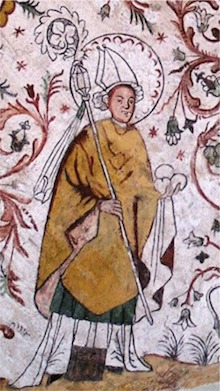
Ol’ “God-kettle” was one of several missionaries known to have been dispatched in the 11th and 12th century from England to Sweden, a traffic in religious conversion across the North Sea crossroads to invert the centuries-past course of Vikingers who put so many British sanctuaries to the sack.
The Northmen realms were ripe to join Christendom but sagas touching the time describe an uneven transitional period where the new and old faiths jostled for primacy.
“Ingi was king for a long time, well-liked and a good Christian; he put down [pagan] sacrificing in Sweden and ordered all the people of the land to become Christian,” runs The Saga of King Heidrek the Wise** (available in pdf translation here), about King Inge the Elder.
But the Swedes had too strong a belief in the heathen gods and held to their ancient ways … the Swedes thought that King Ingi had infringed their rights under the ancient law of the land, when he found fault with many things that Steinkel his [Christian] father had let be; and at a certain assembly which the Swedes held with King Ingi they gave him the choice of two things, either to observe the ancient laws or else to give up his throne. Then King Ingi spoke, and said that he would not leave the true faith; whereat the Swedes cried out, and pelted him with stones, and drove him from the law-assembly.
Svein, the king’s kinsman, remained behind at that assembly, and he offered to make sacrifice for the Swedes if they would grant him the kingdom; all agreed to Svein’s offer, and he was accepted as king over all the Swedish realm. Then a horse was led forth to the assembly, hewn in pieces, and divided up for eating, and the sacrificial tree was reddened with its blood. Thereafter all the Swedes cast off the Christian faith, and sacrifices were instituted, and they drove King Ingi away; he departed into western Gautland. For three years Svein the Sacrificer was king over the Swedes.
King Ingi went with his own bodyguard and some followers, though it was only a small force … into Sweden; he rode by day and night and came upon Svein unawares in the early morning. They seized the house over their heads and set it on fire, and burnt all the company who were inside … Svein came out and was cut down. And so Ingi took the kingship of the Swedes anew, and restored the Christian faith; he ruled the realm till the day of his death.
The “Svein” referred to here is a gentleman whom the historians recall as Blot-Sweyn — “Sweyn the Sacrificer” — and this Norse answer to Julian the Apostate apparently enjoyed his interregnum authority in about the 1080s thanks to Inge’s disrespect of the old rites still honored at the ancient Temple at Uppsala.
The timeline of high statecraft is extremely sketchy, and Saint Eskil’s relationship to events doubly so. Commonly recalled as a victim of the Blot-Sweyn period, Eskil is first marked in the 1120s annals of another Anglo-Saxon monk abroad in Scandinavia, Aelnoth from Canterbury — “Eschillus of sacred memory” who succumbed evangelizing to the “barbarorum feritate.” That’s the whole of it, with nothing like a year or a regnal era to hang one’s hat upon. In the 13th century, with Christianity truly triumphant, a hagiography of Eskil greatly embroidered the martyrdom story and tied it to the land’s most notorious rearguard ruling unbeliever, featuring a cast of heathens so nonplussed at the monk’s interruption of their feast that, notwithstanding his show of divine miracles, Blood-Sweyn has him sentenced to immediate stoning.
The town of Eskilstuna bears his name (it used to just be “Tuna”).
* Though it’s been bumped to June 12 everywhere else, the feast is still marked on its original June 11 date in the diocese Strängnäs, where the saint was supposed to have attained his martyr’s crown. (Strängnäs Cathedral is supposed to mark the very spot of his fatal confrontation with the Aesir followers.)
** This saga’s narrative stretches from an outright legendary prehistory to the Middle Ages. The Ingi-Svein affair is its last episode, but its first locates a more Wagnerian milieu: “Sigrlami was the name of a king who ruled over Gardariki; his daughter was Eyfura, most beautiful of all women. This king had obtained from dwarves the sword called Tyrfing, the keenest of all blades; every time it was drawn a light shone from it like a ray of the sun. It could never be held unsheathed without being the death of a man, and it had always to be sheathed with blood still warm upon it. There was no living thing, neither man nor beast, that could live to see another day if it were wounded by Tyrfing, whether the wound were big or little …”
June 11 is the feast date of St. Barnabas, St. Paul‘s New Testament wingman.
A Cypriot Jew named Joseph, “Barnabas” (“Son of Encouragement”) was so christened in the fourth chapter of the New Testament’s Acts of the Apostles because upon his conversion he sold his land for a donative to the Galileans.
After that, Barnabas reappears throughout Acts as one of the most important of the early Christian missionaries, usually joining St. Paul — whom Barnabas himself introduced to the Christians after Paul got religion — as emissary to the non-Jews, for which purpose the Holy Spirit itself demanded him by name. (Acts 13:2: “Set apart for me Barnabas and Saul for the work to which I have called them.”)
They’re frequently paired thereafter in the narrative although it’s invariably Saint Paul’s honeyed tongue that does the confounding before the companions flee this city or that ahead of a furious mob.* Evidently the Holy Spirit’s labor policies could have used some updating: Barnabas also features in a whinge by Paul in 1 Corinthians 9 against the excess sacrifices the Jesus sect is exacting from its most successful envoys, who get no wages and no sex and (so it seems) have to hustle side jobs to keep up their proselytizing.
Don’t we have the right to food and drink? Don’t we have the right to take a believing wife along with us, as do the other apostles and the Lord’s brothers and Cephas [St. Peter]? Or is it only I and Barnabas who lack the right to not work for a living?
Who serves as a soldier at his own expense? Who plants a vineyard and does not eat its grapes? Who tends a flock and does not drink the milk? … whoever plows and threshes should be able to do so in the hope of sharing in the harvest. If we have sown spiritual seed among you, is it too much if we reap a material harvest from you? If others have this right of support from you, shouldn’t we have it all the more?
But we did not use this right. On the contrary, we put up with anything rather than hinder the gospel of Christ.
Barnabas eventually parted ways with Paul, proceeding to Cyprus with the mysterious John Mark (possibly Mark the evangelist, author of the Gospel, or possibly a different guy) where hagiography holds that Jews angered by his preaching fell on Barnabas and stoned him to death, perhaps around the year 61.
Although obviously a consequential figure in early Christianity, Barnabas’s many Biblical appearances do not capture his voice. The apocrypha preserves at least two tracts** further animating this important character: the Epistle of Barnabas dating to the late first century or early second century; and, the Acts of Barnabas, a 5th century creation which purports to arise from the hand of John Mark and describes a martyrdom by fire, not stone:
And Barjesus, having arrived after two days, after not a few Jews had been instructed, was enraged, and brought together all the multitude of the Jews; and they having laid hold of Barnabas, wished to hand him over to Hypatius, the governor of Salamis. And having bound him to take him away to the governor, and a pious Jebusite, a kinsman of Nero, having count to Cyprus, the Jews, learning this, took Barnabas by night, and bound him with a rope by the neck; and having dragged him to the hippodrome from the synagogue, and having gone out of the city, standing round him, they burned him with fire, so that even his bones became dust. And straightway that night, having taken his dust, they cast it into a cloth; and having se cured it with lead. they intended to throw it into the sea. But I, finding an opportunity in the night, and being able along with Timon and Rhodon to carry it, we came to a certain place, and having found a cave, put it down there, where the nation of the Jebusites formerly dwelt. And having found a secret place in it, we put it away, with the documents which he had received from Matthew. And it was the fourth hour of the night of the second of the week.
Because June 11 formerly fell on/near Midsummer, ere the Gregorian reforms skipped the calendar 10-11 days forward, St. Barnabas’s Day has a festive agrarian history commemorated by the proverb, “Barnaby bright, Barnaby bright, the longest day and the shortest night.” The saint is also the patron of Cyprus, and may be invoked to protect against hailstorms or in service of peacemaking. Numerous schools, churches, and monasteries around the world bear his name.
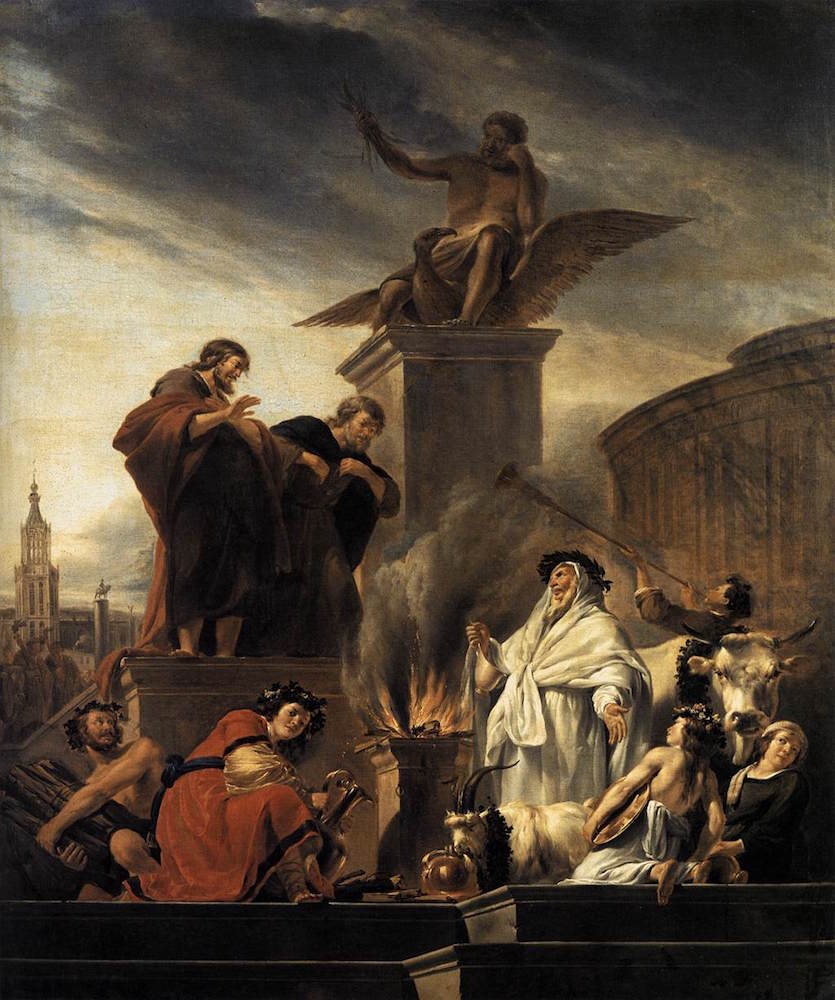
* There’s a comic touch to their preaching travails, too: in one exciting episode (Acts 14), Paul (of course) heals a cripple while the dynamic duo preaches in Lystra, leading excited witnesses to take them for Hermes and Zeus and start sacrificing to them.
No tips, please: Paul and Barnabas refusing the sacrifices of Lystrans in this detail (click for the full image) of a 1650 painting by Nicolaes Berchem.
** Beyond the Epistle and the Acts, there is also a very much later Gospel of Barnabas.
On this date in 1658, two royalist conspirators were beheaded at Tower Hill for plotting against Oliver Cromwell‘s Protectorate.
At this very late date, conflicts within the Lord Protector’s state raised the hopes of the exiled royal claimant Charles Stuart for a successful invasion. (Little did the imminent King Charles II suspect that Cromwell himself would die suddenly three months hence, collapsing the revolutionary government.) Plots and counterplots, spying and betrayal, were the order of the day; it was the bad luck of our men to set theirs in motion just a shade too early, but perhaps it was Charles Stuart’s good luck that Team Cromwell smashed it before it could ripen into a premature commitment of forces.
For the particulars, we turn to parliamentarian cavalryman and politician Edmund Ludlow, a regicide who had thirty-odd years cooling his spurs in continental exile during which to scribble his memoir of the grand experiment.
Another plot much more dangerous was about the same time carried on by the Royalists, and discovered to him by his spies. The persons concerned in it he used with more severity, because he accounted them to be of a more formidable party, and therefore referred them to be tried by those persons whom his last Assembly had nominated to be a High Court of Justice.
The prisoners were Dr. Hewet [John Hewett, onetime chaplain to King Charles I and an open royalist], Sir Henry Slingsby [a Yorkshire politician and Royalist veteran of the civil wars], and Mr. Mordaunt [eventually made a viscount by Charles II in recognition of his efforts on behalf of restoration], with some others of the meaner sort. The general charge against them was for endeavouring to levy war against the Government on the behalf of Charles Stuart.
The particular charge against Dr. Hewet was for dispersing commissions from the son of the late King, and perswading divers to raise forces by virtue of the same. That against Sir Henry Slingsby was for attempting to debauch some of the garison of Hull to the service of Charles Stuart, and delivering a commission from him to them. The prisoners of less note were charged with a design of firing the city in several places, at the time appointed for their party to be in arms.
Dr. Hewet being brought before the Court, moved that he might be tried by a jury, and demurred to the jurisdiction of the Court. But the Court over-ruled his demurrer, and told him, that unless he would plead to his charge, they would cause his refusal to be entred, and proceed against him as if the fact were confessed. This being twice said to him, he was required the third time to plead: to which he answered, that if the Judges would declare it to be according to law for him to plead, he would obey: but he was told that the gentlemen then present were his Judges, and that if he would not plead they would register his contempt the third time, and upon his refusal did so.
Mr. Mordaunt admonished by his example, pleaded not guilty; and after a full hearing of the witnesses on both sides, the Court acquitted him by one voice. Then Sir Henry Slingsby was called to the bar, and the witnesses on each side being heard, he was pronounced guilty, tho in the opinion of many men he had very hard measure. For it appeared that he was a prisoner at the time when he was charged to have practised against the Government; that he was a declared enemy, and therefore by the laws of war free to make any such attempt; besides it was alledged that the persons, whom he was accused to have endeavoured to corrupt, had trapan’d him by their promises to serve the king in delivering Hull, if he would give them a commission to act for him, which commission was an old one that had long lain by him. But all this being not thought sufficient to excuse him, he was adjudged to die.
The rest of the prisoners were also condemned, and sentence of death being pronounced, Sir Henry Slingsby and Dr. Hewet had the favour of being [June 8] 1658 beheaded; and the others, being men of a lesser figure, were hanged.
Cromwel’s daughter and favourite Mrs. Cleypole [Elizabeth Claypole, who was reputed to intercede frequently with her father on behalf of royalists], laboured earnestly with her father to save the life of Dr. Hewet, but without success: which denial so afflicted her, that it was reported to have been one cause of her death, which happened soon after with the concurrence Aug. 6. of an ulcer in her womb.
We have also an account of the dying behavior of both Slingsby and — much more detailed — Hewitt, each of whom slated the injustice of their sentence as having greatly exaggerated their “treasonable” designs.
Mary Dyer was hanged in Boston on this date in 1660 — the most famous of that city’s four “Quaker martyrs”.
Monument in Boston to Mary Dyer as “witness for religious freedom”. (cc) image by Andrea Schwartz.
By the time of her last ordeal, Dyer already had a quarter century-old reputation for religious misbehavior in the New World.
She’d ditched England with her husband in 1635, part of that decade’s great outmigration of Puritan dissidents — “A Comely Grave Woman, and of a goodly Personage, and one of a good Report, having a husband of an Estate, fearing the Lord, and a Mother of Children,” according to an admiring account. Opinions varied: the colony’s governor found her “very censorious and troublesome, (she being of a very proud spirit, and much addicted to revelations).”
She brought with her a proclivity for the heretical: in Massachusetts, where the Puritan majority delivered the persecuting, Mary quickly fell foul of right-thinking folk by backing Anne Hutchinson in a theological controversy.* When Hutchinson was convicted by a church trial and banished, Mary Dyer cinematically walked hand-in-hand with her out of church. On top of everything else, she was known to have stillborne a deformed monstrosity (“a woman, a fish, a bird, & a beast all woven together”) which was the kind of thing these people understood as deadly serious.
Mary and her husband went to exile with Hutchinson, and were among the first English settlers of Rhode Island, before returning to spend most of the 1650s back in England. There, Mary Dyer converted to one of the new entrants to the Commonwealth’s welter of novel sects, Quakerism.
This new faith’s emphasis on egalitarian personal religious experience ungoverned by ordained clergymen met an instant ban once Massachusetts caught wind of it, with a statute imposing mutilated tongues and trips to the pillory for expounding the outlaw doctrine. To these would be added the threat of the gallows for repeat offenders with the temerity to return from banishment … and Mary Dyer is only the most famous of four Quakers who actually suffered this penalty.
The Heart of N-England Rent at the Blasphemies of the Present Generation: Boston Rev. John Norton‘s 1659 anti-Quaker tract advocates their execution.
Dyer’s defiance of the law was straightforward, keeping with the bold tradition of martyrdom in witness. Jailed in Boston in 1657, her husband (who had not yet followed his wife’s conversion) managed to arrange her release; she returned in 1659 to visit other imprisoned Quakers and they were all banished for their trouble. Shortly after, she returned to Boston with William Robinson and Marmaduke Stevenson: these were the first two Quakers put to death by the Puritans, but Mary Dyer was spared at the foot of the gallows and again expelled, finding temporary refuge in Rhode Island.
“I came in Obedience to the Will of God the last General Court, desiring you to Repeal your unrighteous Lawes of Banishment upon pain of Death; and that same is my work now, and earnest Request,” she told the court that doomed her. “If ye refused to Repeal them, the Lord will send others of his Servants to Witness against them.”
The very next day, she was drummed — to prevent her preaching — on a mile-long walk a gallows on Boston Common. This time there was no reprieve waiting: only immortality.
* This controversy drove the short-term governor Henry Vane back to England, and martyrdom during the interregnum.
The last letter of French Resistance fighter Jacques Decour (an alias for Daniel Decourdemanche) to his family on the morning of his execution, May 30, 1942. (From here.)
Saturday, May 30, 1942 — 6:45 am
My dear parents,
You have been expecting a letter from me for a long time. You did not expect to receive this one. I, too, hoped I would not cause you this grief. Say that I have remained up to the very end worthy of you, of our country, which we love.
You see, I might very well have died in war, or even in the bombardment of that night. So I do not regret having given meaning to this end. You know very well that I have committed no crime, you have no reason to blush at me, I have done my duty as a Frenchman. I do not think that my death is a catastrophe; remember that at this moment thousands of soldiers from all countries die every day, swept along, in a great wind that carries me away too. You know that I had been expecting this morning for two months, so I had time to prepare myself, but since I have no religion, I did not fall into the Meditation of death; I consider myself a little like a leaf that falls from the tree to make potting soil. The quality of the soil will depend on the quality of the leaves. I speak of the French youth, in whom I place all my hope.
My beloved parents, I shall doubtless be at Suresnes; you can if you wish request my transfer to Montmartre. You must forgive me for this sorrow. My only concern for three months has been your anxiety. At this moment, it is to leave you thus without your son, who has caused you more sorrows than joys. You see he is content, however, with the life he has lived, which has been very beautiful.
And now here are some commissions. I would send word to the one I love. If you see her, soon I hope, give her your affection, it is my dearest wish. I would also like you to take care of her parents who are in trouble. Excuse me for leaving them thus; I console myself by thinking that you will want to replace their “guardian angel”. Give them things that belong to me and belong to their daughter: the Pleiades editions, the Fables of La Fontaine, Tristan, the 4 Seasons, the little chickens, the two watercolors (Vernon and Issoire) the map of the 4 Paves du Roy. I would like my friend Michel to have my personal belongings (pen, pencil, wallets, watch, lighter). Embrace them all for me.
I have imagined, lately, the good meals we would share when I was released. You will have them without me, as a family, but not sadly, I beg of you. I do not want your thoughts to dwell on the beautiful things that could have happened, but on all those we have experienced. I have been reborn during these two months of isolation, without reading, without all my travels, all my experiences, all my meals. I even planned a novel. Thoughts of you have not left me, and I wish you much patience and courage, and especially no rancor. Give all my affection to my sisters, to the indefatigable Denise, who has devoted herself so much to me, and to the pretty mother of Michael and Denis. I had a great dinner with Sylvain on February 17, I often thought of it with pleasure as well as the famous meal of New Year’s Eve with Pierre and Renée. It was because the question of food had become more important! Give Sylvain and Pierre all my affection and also to Jean Bailly, my best comrade, say that I thank him very much for all the good times I have spent with him. If I had gone home on the evening of the 17th, I would have ended up arriving here, so there is no regret. I will write a note for Brigitte at the end of this letter, you will copy it to her. God knows how I thought of her. She has not seen her dad for two years …
That I thank him very much for all the good times I have spent with him. If I had gone home on the evening of the 17th, I would have ended up arriving here, so there is no regret. I will write a note for Brigitte at the end of this letter, you will copy it to her. God knows if I thought of her. She has not seen her dad for two years … That I thank him very much for all the good times I have spent with him. If I had gone home on the evening of the 17th, I would have ended up arriving here, so there is no regret. I will write a note for Brigitte at the end of this letter, you will copy it to her. God knows if I thought of her. She has not seen her dad for two years …
If you have the opportunity, have my students in Première* tell my substitute that I thought of the last scene of Egmont and the letter of Th. Körner to his father under any reserve of modesty. .. All my friendships to my colleagues and friend for whom I translated Goethe without betraying.
It is eight o’clock, it will be time to leave. I ate, smoked, drank coffee. I do not see any business to settle. If there are objects belonging to Madame Politzer, 170 bis, rue de Grenelle, (books, especially those of the lycee, phono, etc.) try to recover them. There is also your Memorial of St. Helena.
My dear parents, I embrace you with all my heart. I am near you and thoughts of you do not leave me.
Your Daniel
My beloved little Brigitte
Your daddy has not seen you much for some time but he has thought of you. Tell your mom that I trust her to make you a good, firm, cheerful girl who stands strong on her own two legs. Work hard and try to become a good pianist. Often think of your father and friend and all the good times we have shared together.
I embrace you with all my heart as I love you and embrace your mother.
On this date in 1996 — his 19th birthday — Russian hostage Yevgeny Rodionov was beheaded by his captors outside a village in Chechnya.
The young conscript was seized by guerrillas/terrorists/rebels along with three other comrades* during the horrible Chechen War.
Whatever ransom was demanded, the young man’s family could not pay it and in the end the the kidnappers sawed off his head. Searching for his remains at great personal peril his mother met a Chechen who claimed to be Yevgeny’s executioner, and was told by him that “your son had a choice to stay alive. He could have converted to Islam, but he did not agree to take his cross off.”
If it was meant as a taunt it backfired, for the story was later picked up by Russian media and, championed by his mother, the young Rodionov has become elevated into a contemporary folk saint — icons and all.
From the standpoint of the Orthodox hierarchy, Rodionov’s cult is thoroughly unofficial, but when it comes to popular devotion people often vote with their feet. Rodionov’s martyrdom expresses themes of great importance to some Russians: the growing cultural currency of Orthodoxy after the fall of the irreligious Soviet Union; a muscular resistance to Islamic terrorism;** an intercessor for common people ground up in the tectonic shifts that have reshaped Russia.
Thy martyr, Yevgeny, O Lord, in his sufferings has received an incorruptible crown from thee, our God, for having thy strength he has brought down his torturers, has defeated the powerless insolence of demons. Through his prayers save our souls.
* The other three — Andrey Trusov, Igor Yakovlev and Alexander Zheleznov — were all likewise murdered by their kidnappers.
** Although the war that he died in ended for Moscow in humiliating futility, Rodionov only became widely visible in the early 2000s amid an upswing of Russian patriotism following the outrages of the Moscow apartment bombings. (And, a more successful re-run of Chechen hostilities.)
May 14 is the feast date of St. Victor, a Christian Roman soldier and his co-religionist and possible spouse Corona. Both the city and the century (and therefore the reality) of their passion are uncertain.
For the believer, what these martyrs lack in firm historicity they make up for in practical effect.
Corona chanced to become associated by medieval times with money — possibly the coincidence of her name, meaning crown,* with the sigils on coins — and thus she got wrapped up into a variety of pecuniary prayers and incantations. Strictly unofficial stuff from Rome’s standpoint, you understand: treasure-hunting, lotteries, wagering, and other fond fantasies of unearned windfalls.
Virgin and martyr Corona, I, a poor sinner, ask you to remember your great mercy and honour and your control over the treasures of the world and whoever asks you in the name of Jesus Christ your dear bridegroom, in his name you have power to give worldly goods to me, a poor and needy person, so I beg you with all of my humble heart, oh virgin and martyr Corona relief [sic] me from my needs and my poverty by giving me 50000 florins of good gold for the salvation of my soul through the redemption of my need body.
Because engaging such supernatural entities was a frightful venture for the petitioner, be he ever so humble, the prayer amusingly contains an equally elaborate chant for dismissing Saint Moneybags after she has paid up.
Now go away in the peace of God, which shall be between you and me, go back to the place where you came from, the eternal peace of God shall be and shall stay forever between you and me, and you will come again, when I wish to see you. Now go away and be blessed, through God and his holy five wounds, and go away in the peace of God, and the blessing be between you and me and the mine. Amen.
On this date in 1528, the Augsburg Anabaptist Eitelhans Langenmantel was executed as a heretic, along with a servant and a maid. Langenmantel had used his own fortune to print several dissident tracts.
His infant grandson, Daniel Hoechstetter, would eventually emigrate to Cumberland where he did honorable business for England’s Royal Mines as part of a community of German miners.
April 9 is the (Roman) feast date of the minor Cappadocian saint Eupsychius.
As martyr to the hated-of-Christians pagan throwback emperor Julian the Apostate, Eupsychius could perhaps be accounted an ironical late victim of the fratricidal family politics that consumed the heirs of the great Christianizer Constantine the Great.
When Constantine kicked off in 337, he left three sons of a disgraced empress whom he optimistically hoped would share rulership. What happened instead was that, inside of a generation, practically the entire Constantinian line laid one another in the earth by dint of bloodthirsty dynastic rivalries, leaving only two men standing.
And it so happened that those two kinsmen faced one another across late antiquity’s gaping spiritual chasm: one a Christian, the other a pagan.
Constantius was the surviving son of Constantine, and regardless his Christian affiliation had secured his initial control of his father’s new eastern capital by unsentimentally butchering the bulk of his extended family including his own uncle Julius Constantius, and Julius’s firstborn son. Two other sons of Julius Constantine, too young for the abbatoir, escaped their brother’s fate and so our future Julian the Apostate grew up under a perpetually dancing Damoclean sword, a bookish philosophizing type enchanted by classical learning — so enchanted that he would eventually, and at first very quietly, apostatize from his substantial Christian education and adhere instead to the old gods.
In the fullness of time, the remainder of Constantius’s family succumbed to various civil wars — including Julian’s only surviving brother, Gallus, executed for treachery in 354 in an incident that could very well have claimed Julian as well if for no other reason than proximity. A prolific writer, Julian would later recall that “if some God, to inure my safety, had not ingratiated me with his [Constantius’s] beautiful and excellent wife, Eusebia, I could not have escaped his resentment.” Perhaps the childless Constantius could foresee well enough that, resentment or no, his last relation would be required for imperial policy soon enough.
And indeed the very next year, having spent many months mulling over whether to kill him, Constantius instead elevated Julian as his junior co-emperor. The young scholar soon distinguished himself as a surprisingly competent leader and battlefield commander, pacifying Germania and Gaul before, almost inevitably, the two emperors turned on one another in civil war. Julian must have been well-favored of goddess Fortuna whom he will defend in this post, for he won that war before the first spear was chucked when Constantius took ill and died as the rivals steered their armies towards one another.
So suddenly, 40 years after the empire had officially gone Christian, it had a pagan ruler — the last pagan ruler it would ever know.
Julian was an intelligent and idealistic young man. Taking power before the age of 30, he set a bold course to massively remake the empire in the image of its most admirable anachronisms: living modestly, paring the bureaucracy, debating Senators as their equal instead of their overlord, and — the attempted rollback that would mark his nickname and his reputation — restoring a pre-Christian cosmology to philosophical preeminence.
A few books about Julian the Apostate
This could have been Julian the Apostate‘s life’s work, twenty or thirty of forty years dislodging Christianity from the official foothold it had only recently attained and creating the groundwork for a pagan-dominated middle ages: fine grist for speculative alternative history, since Julian actually died in 363 in war against the Persians.
Having learned from the failure of previous rulers’ persecutions, he deployed instead the devious and modern mechanic of liberal religious toleration, starving the “Galileans” of the galvanizing force of either state backing or state oppression while perhaps setting their orthodox edifice up to splinter over time as various heretical movements began freely venting their rival doctrines on one another.
Julian the Apostate presiding at a conference of sectarians, by Edward Armitage (1875).
His uniqueness and his erudition have made him an attractive character for modern interlocutors, especially those of the Christ-skeptic variety; Gore Vidal sympathetically centered Julian in an engrossing historical novel, and Gibbon warmly admired him:
The Christians, who had now possessed above forty years the civil and ecclesiastical government of the empire, had contracted the insolent vices of prosperity, and the habit of believing that the saints alone were entitled to reign over the earth. As soon as the enmity of Julian deprived the clergy of the privileges which had been conferred by the favour of Constantine, they complained of the most cruel oppression; and the free toleration of idolaters and heretics was a subject of grief and scandal to the orthodox party. The acts of violence, which were no longer countenanced by the magistrates, were still committed by the zeal of the people. At Pessinus the altar of Cybele was overturned almost in the presence of the emperor, and in the city of Caesarea, in Cappadocia, the temple of Fortune, the sole place of worship which had been left to the Pagans, was destroyed by the rage of a popular tumult. On these occasions, a Prince who felt for the honour of the gods was not disposed to interrupt the course of justice; and his mind was still more deeply exasperated when he found that the fanatics, who had deserved and suffered the punishment of incendiaries, were rewarded with the honours of martyrdom.
It is the last named of these incidents that finally brings us round to our date’s principal.
Like Julian himself, St. Eupsychius had no way of knowing that the new, old order would be a transient epoch. In his zeal to resist a rejuvenated paganism, Eupsychius led a riotous sack of a temple to Fortuna (Tyche). The church historian Sozomen gives us the primary-est historical record, and although it dates to several decades after Eupsychius’s martyrdom we can’t be picky when it comes to antiquity.
It is said that at this time were martyred Basilius, a presbyter of the church of Ancyra, and Eupsychius, a nobleman of Caesarea in Cappadocia, newly wed and in a manner of speaking still a bridegroom. As regards Eupsychius, I conjecture that he was executed because of the temple of Tyche, then destroyed, on account of which destruction, as has been said above, all citizens of Caesarea collectively experienced the emperor’s wrath, while those who personally took part in it were punished, some with death, some with banishment.
Later iterations would expand predictably on Eupsychius’s sufferings — tortures, miracle-making, blood and milk springing from his wound, and even eventually eliding the precipitating riot or arson — all of which conspires to pull a discernibly historical figure behind the dark glass of hagiography.*
Little more than a year later, Julian suffered a mortal wound in battle against the Sassanids. The Constantinian dynasty died with Julian, as did his signature project of Apostasy — a sudden volte-face of that fickle Fortuna whose memory and reputation would persist well beyond the twilight of paganism.
* See L.G. Westerink, “The Two Faces of St. Eupsychius,” Harvard Ukrainian Studies, Vol. 7, Okeanos: Essays presented to Ihor Shevchenko on his Sixtieth Birthday by his Colleagues and Students (1983).

 Ol’
Ol’ 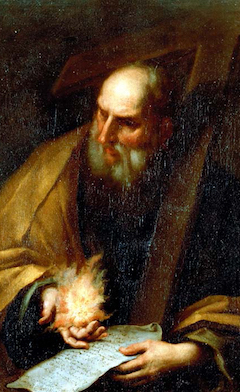 A Cypriot Jew named Joseph, “Barnabas” (“Son of Encouragement”) was so christened in the fourth chapter of the New Testament’s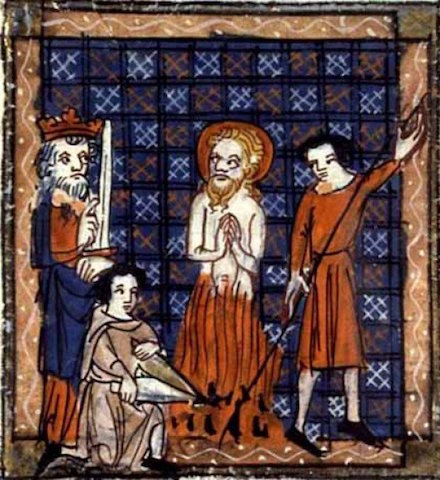


 For the believer, what
  His infant grandson,
 It is the last named of these incidents that finally brings us round to our date’s principal.