Feast Day of Pope Pontian and Antipope Hippolytus

August 13 is the shared feast date* of third century saint and antipope — two adjectives rarely held in tandem — Hippolytus of Rome, and also the feast of the official pope to whom he reconciled in the end, Pontian.

His legend, including his feast date, has been muddled with another ancient martyr of the same name, and even with the mythological son of Theseus — from which also derives the etymologically apt fancy that St. Hippolytus met his end by the straining of horses.**


The central panel (click for the full image) of the St. Hippolyte Triptych, from the Sint-Salvator Cathedral in Bruges, Belgium. (via the blog of Canadian Archbishop Terrence Prendergast) Attributed to Dieric Bouts and Hugo van der Goes, this image was commissioned by a courtier of Charles the Bold, Hippolyte de Berthoz — who also underwrote other depictions of his namesake’s martyrdom.

But Hippolytus the theologian and cleric was no fable.

Zealous after the correct doctrine in an age of heretical pitfalls like modalism and alogianism, Hippolytus clashed with Pope Zephyrinus and his successor Callixtus over their leniency — not only for heterodoxy but also for sinful conduct like adultery.

This timeless horn-locking between purists and pragmatists led Hippolytus to take his flock out of the Roman communion in opposition to Callixtus, and apparently to maintain himself as antipope for the best part of a generation — the very first recorded antipope, in fact.

Ironically it was the schismatic’s perspicacious quill that would bear to posterity much of our understanding of Christianity in the early third century. Apostolic Tradition, whose attribution to Hippolytus is contested, is a rare source on the early liturgy; Refutation of All Heresies helpfully catalogues dozens of beliefs disfavored of its author among pagan and Christian sects. He wrote a chronicle of the world since its creation, a compendium of ecclesiastical law, and numerous Biblical commentaries.

While world-shaping controversies gripped the sacerdotal space, the temporal world spiraled toward Rome’s Third Century Crisis, a periodization commonly dated to the rise of the cruel barracks-emperor Maximinus in the very year of our rival pontiffs’ martyrdoms, 235.

Maximinus’s years in the purple were short and sanguinary, harbinger of many like decades to come. “Italy and the whole empire were infested with innumerable spies and informers,” Gibbon wrote.

On the slightest accusation, the first of the Roman nobles, who had governed provinces, commanded armies, and been adorned with the consular and triumphal ornaments, were chained on the public carriages, and hurried away to the emperor’s presence. Confiscation, exile, or simple death, were esteemed uncommon instances of his lenity. Some of the unfortunate sufferers he ordered to be sewed up in the hides of slaughtered animals, others to be exposed to wild beasts, others again to be beaten to death with clubs.

Both Pontian and Hippolytus were arrested at Maximinus’s order, which was scarcely an act of pagan reverence on the latter’s part since he was also noted for stripping the traditional temples of valuables that could be melted into currency.

Banished to Sardinia for rough handling that was tantamount to a death sentence, the two men reconciled before attaining the crown of martyrdom.

Numerous cities in France (and one in Quebec) are named for St. Hippolytus.

* It’s the feast date in the Roman church. The Orthodox world honors Hippolytus on January 30.

** He’s the patron saint of horses, too.

† A reading of On Christ and the Antichrist is available free from Librivox.

On this day..

1849: Ernst Elsenhans, Rastatt revolutionary

Swabian revolutionary Ernst Elsenhans was shot at fortress Rastatt on this date in 1849 for his role in the revolutions of 1848-49.

Elsenhans — that’s a German link, which is the case for almost everything readily available about this gentleman — was a democratic journalist who was already serving a prison sentence for inciting treason in the Baden installation of Germany’s 1848 revolutions when he was liberated by the May 1849 republican recrudescence. He of course went right back to inciting treason, as secretary to the revolutionary government’s War Ministry for its short interim before Prussian boots stamped out the rebellion.

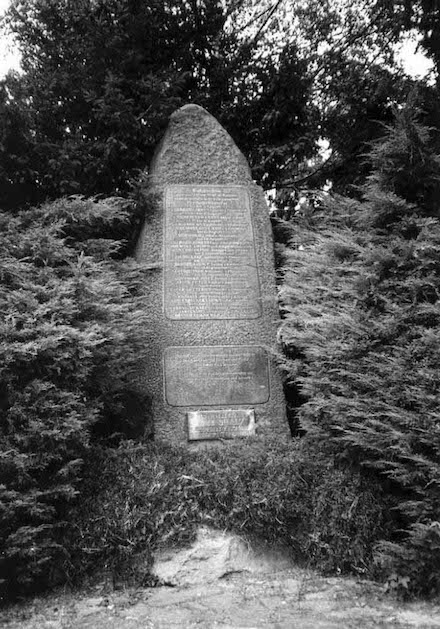
Elsenhans and other revolutionaries shot in the course of this suppression are honored at a memorial slab unveiled for the sesquicentennial of their martyrdoms.

German speakers can peruse editions of the Fortress Messenger published by Elsenhans in July 1849 here.

On this day..

1952: Johann Burianek, East German saboteur

On this date in 1952, Johann Burianek became the first person executed by East Germany.

A machinist and a World War II Wehrmacht soldier, Burianek (English Wikipedia entry | German) caught a one-year sentence in the postwar Communist East Germany for having the misbegotten initiative in the dying days of the war to go out of his way to arrest a deserter who was nearly executed as a result.

From about 1950 he became affiliated with the western-backed anti-communist resistance network Kampfgruppe gegen Unmenschlichkeit (KgU) — Strike Force Against Inhumanity. Crossing liberally between East and West Berlin, which easy movement East German authorities were fretting, Burianek had a two-year stint irritating the German Democratic Republic with graffiti, subversive posters, and eventually, sabotage.

He was arrested in March 1952 shortly ahead of what would have been his derringest do, the bombing of a rail bridge; a judge named Hilde Benjamin, who in the course of 1950s show trials made her name synonymous with politically motivated severity,* hammered him with a demonstrative sentence** — the very first judicial execution meted out by the DDR, in fact. It was administered in Dresden by beheading with a fallbeil.

* Benjamin, who died on the eve of the Berlin Wall‘s fall, enjoys a poor reputation in the post-Cold War state with a variety of uncomplimentary sobriquets to prove it — such as the “Red Guillotine” and “Red Freisler“.

** She would also impose the death sentence against a fellow KgU operative, Wolfgang Kaiser, who went under the fallbeil five weeks after Burianek.

On this day..

1934: Otto Planetta and Franz Holzweber, for the Juliputsch

German-Austria must return to the great German mother country, and not because of any economic considerations. No, and again no: even if such a union were unimportant from an economic point of view; yes, even if it were harmful, it must nevertheless take place. One blood demands one Reich. Never will the German nation possess the moral right to engage in colonial politics until, at least, it embraces its own sons within a single state …

The elemental cry of the German-Austrian people for union with the German mother country, that arose in the days when the Habsburg state was collapsing, was the result of a longing that slumbered in the heart of the entire people — a longing to return to the never-forgotten ancestral home. But this would be inexplicable if the historical education of the individual German-Austrian had not given rise to so general a longing. In it lies a well which never grows dry; which, especially in times of forgetfulness, transcends all momentary prosperity and by constant reminders of the past whispers softly of a new future

-Adolf Hitler, Mein Kampf

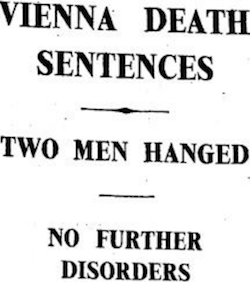
On this date in 1934, two Nazis were hanged for their part in a failed Austrian coup.

From his political ascent in 1933 — and well before, as the quote above indicates — the Reich’s unification with his native land of Austria had been a cherished goal for Adolf Hitler. To that end, Berlin had fostered a clandestine network of Austrian Nazis branded as “SS Standarte 89” and allowed exiles to broadcast seditious propaganda from German soil.

Their “July Putsch” (English Wikipedia entry | German) was a year or so in the making, and commenced when four truckloads of SS Standarte 89 men in military attire suddenly stormed the federal chancellery in Vienna, murdering chancellor Engelbert Dollfuss in the process.

“Hitler received the tidings while listening to a performance of Das Rheingold at the annal Wagner Festival at Bayreuth,” Shirer noted in The Rise And Fall Of The Third Reich — and Wagner’s granddaughter, also in attendance, could not help observing his “excitement” and “delight” and simultaneous anxiety to feign uninvolvement.

The last of these impulses showed the emerging tyrant’s wisdom, for the coup swiftly collapsed — exposing, to Hitler’s fury, the inept organization of the plot. Basically no other coordinated actions took place to complete the coup and the Austrian army remained loyal to the existing government, leaving to the lonely SS Standarte 89 nothing but a feeble surrender.

The first targets of the resulting courts-martial were Otto Planetta (cursory English Wikipedia entry | more detailed German), who actually pulled the trigger to kill the chancellor, and Franz Holzweber, the apparent leader of the attack on the chancellery. They would be tried and condemned in a two-day hearing July 30-31 and hanged within three hours of conviction. In time, both the Planetta and the Holzweber name would adorn many city streets in the Third Reich as patriot-martyrs.

Both prisoners, when asked whether they had anything to say before hearing their sentences, addressed the Court. Planetta said: —

I do not know how many hours I have to live. But one thing I would like to say, I am no cowardly murderer. It was not my intention to kill. One thing more. As a human being I am sorry for my deed, and I beg the wife of the late Chancellor to forgive me.

Holzweber said: —

I was assured that there would be no bloodshed. I was told also that I should find Herr Rintelen at the Chancery,, that the new Government was already formed. Not meeting the leader of the operation at the Chancery, I disclosed myself at once to Major Fey. I told him, here I stand, and I do not know what I should do. More or less spontaneously I took over the responsibility for our men because no one was there to take charge of the matter.

Holzweber, who was executed first, cried out on the gallows: “We die for Germany. Heil Hitler.” Planetta said simply, “Heil Hitler.”

London Times, Aug. 1, 1934

The time was not yet ripe — and Hitler, no matter how heiled by his would-be subjects, was required by the diplomatic blowback to forswear ambitions on unifying with Austria.

But the Fuhrer’s soft whispers of a new future would grow ever more insistent in the months to come, and not four years later the Reich accomplished the Anschluss.

That July 25, in 1938, in a Vienna now successfully absorbed to greater Germany,

the fourth anniversary [of the Juliputsch] was celebrated as an heroic act comparable with the Rathenau and Erzberger murders. The survivors of ‘SS Standarte 89’ marched to the federal Austrian Chancellery, which had been renamed the Reichstatthalterei. Here the bereaved families of thirteen men were addressed by Rudolf Hess. A tablet was unveiled which proclaimed that:

154 German men of the 89th SS Standarte stood up here for Germany on 25 July, 1934. Seven found death at the hands of the hangman.

On this day..

Feast Day of Rasyphus and Ravennus

July 23 is the feast date of fifth century Christian martyrs Rasyphus and Ravennus.

Supposed by Middle Ages legends to be British natives who fled to Gaul as Rome abandoned the island to onrushing Anglo-Saxons, they found martyrdom on the continent via some different horde — possibly the Goths.

Today, these historically unreliable characters have been deprecated to the Vatican’s minor league “local cult” circuit, but in their day they were the pride of Bayeux, whose cathedral held the honor of the saintly relics

Despite the repose of their bones, Rasyphus and Ravennus were not associated with Bayeux in life; they are said to have been decapitated at instead at the town of Mace.

This reliquary relocalization was consequence of a widespread shuffling of religious treasures during the Viking age — like the century-plus posthumous journey of St. Cuthbert as Danes put his various resting places to the sack. Bayeux’s native saint, the 4th-5th century bishop Exuperius (Exuperius of Bayeux is not to be confused with his contemporary and fellow-bishop, Exuperius of Toulouse), had had his bones moved for safekeeping from the Northmen to Corbeil, near Paris. Relics, especially very old ones, bestowed reverential prestige on their surroundings during the Middle Ages and having lucked into this bounty Corbeil afterwards refused to return Exuperius — which was a very common (mis)behavior. At one point Corbeil even humiliatingly shammed Bayeux by sending it the skeleton of some peasant after accepting a bribe for Exuperius.

So much for Bayeux’s homegrown holyman, but no problem: the Vikinger threat had also driven Rasyphus and Ravennus on from Mace to Bayeux, and two late antiquity corpses being even better than one, these British refugees now became patrons of a home they had never known.

(In later years the Rasyphus and Ravennus relics would be uprooted yet again, by the Wars of Religion; today, they’re not to be found in Mace or in Bayeux, but in Grancey.)

And thanks to their domicile, R+R perhaps make a cameo appearance on medieval Europe’s most famous narrative textile, the Bayeux Tapestry.

The tapestry pictures events leading up to the Norman conquest of England, culminating with the epochal 1066 Battle of Hastings. The Anglo-Saxon king who lost that battle, Harold, is a key character on the tapestry, and in the 23rd scene Harold swears an oath to his eventual foe at Hastings, William the Conqueror.

Although it’s not explicitly labeled as such in the threads, according to Trevor Rowley in An Archaeological Study of the Bayeux Tapestry: The Landscapes, Buildings and Places, we can plausibly identify the setting for that oath as the altar consecrated to Rasyphus and Ravennus in the Bayeux Cathedral. (The artifact was commissioned by William the Conqueror’s powerful half-brother Odo, who was also Bishop of Bayeux — hence both the tapestry’s name and its prospective interest in broadcasting the Bayeux cults. The 22nd scene preceding it appears to overtly situate the action at Bayeux (“Bagia”).)

Rasyphus and Ravennus provided a high-status devotional focus. Their feast day was celebrated in the cathedral and their altar was second only to the high altar, dedicated to the Virgin Mary. Bishop Odo’s centrepiece for the shrine was a new reliquary, which is described in an inventory of 1476 as a large architectural shrine, richly decorated with gilding and enamel work.

The back side [of the shrine] is of gilded silver or worked in beaten metal; and all the rest of it, that is to say the front side, the two ends, and the top is made of fine gold, with raised golden images, and decorated with large and expensive enamels and precious stones of various kinds.

The reliquary was installed on an especially dedicated altar in the apse of Bayeux Cathedral just behind the primary altar and was described by a sixteenth-century antiquarian as ‘a miniature version of Bayeux Cathedral that was taller than a ten-year-old girl’.

Although the cult of the brothers did not spread outside Bayeux, at the time Harold swore his oath their perceived sanctity would have been at its height and their fine new reliquary would have provided an appropriately holy shrine for the purpose. It is also clear from what we know of Odo in other contexts that he would not have hesitated to use the opportunity of the Tapestry to advertise the Bayeux cult to an audience outside his own diocese.

On this day..

1587: George Gaspar, an English heretic in the Inquisition

We have noted previously the progress of the Spanish Inquisition on the Canary Islands in the early 16th century. We turn here to another auto de fe it authored there in 1587 from the same source, The Inquisition in Spanish Dependencies, available free from Google books here.

By this time, the Canaries boasted a population of some 35,000* — half or so on Tenerife, where this auto took place — and had become an important entrepot in the growing traffic to the New World. For the same reason these isles became a theater in the running (albeit undeclared) Anglo-Spanish War, the conflict of which the Spanish Armada forms the most scintillating chapter. English privateer Sir Francis Drake raided the Canary Islands repeatedly in the 1580s. Between commerce and war, English, Irish, and Flemish sailors began to turn up in Spanish prisons on the Canary Islands where holy inquisitors could begin to take an interest in them.

There was another auto, celebrated July 22, 1587, in which there were burnt three effigies of a remnant of the Lanzarote fugitives.** There was also the more impressive relaxation of a living man — the first since that of the Judaizers in 1526. This was an Englishman named George Gaspar who, in the royal prison of Tenerife, had been seen praying with his back to a crucifix and, on being questioned, had said that prayer was to be addressed to God and not to images.

He was transferred to the tribunal, where he freely confessed to having been brought up as a Protestant.

Torture did not shake his faith and he was condemned, a confessor as usual being sent to his cell the night before the auto to effect his conversion. He asked to be alone for awhile and the confessor, on his return, found him lying on the floor, having thrust into his stomach a knife which he had picked up in prison and concealed for the purpose.

The official account piously tells us that it pleased God that the wound was not immediately mortal and that he survived until evening, so that the sentence could be executed; the dying man was carted to the quemadero and ended his misery in the flames.

It bears noting here that the beheading in February of that same 1587 of Mary, Queen of Scots might have inflamed continental Catholic sentiment against an Englishman at this moment; and, the aforementioned Drake had famously harried Spanish shipping during that spring. Nevertheless, the steely Gaspar presents an atypical case. More usually, an ounce of discretion could buy the life even of a heretic of a hostile power, and most preferred to pay the torturer in that coin.

Another Englishman was Edward Francis, who had been found wounded and abandoned on the shore of Tenerife. He saved his life, while under torture, by professing himself a fervent Catholic, who had been obliged to dissemble his religion, a fault which he expiated with two hundred lashes and six years of galley service.

Still another Englishman was John Reman (Raymond?) a sailor of the ship Falcon; he had asked for penance and, as there was nothing on which to support him in the prison, he was transferred to the public gaol. The governor released him and, in wandering around he fell into conversation with some women, in which he expressed Protestant opinions. A second trial ensued in which, under torture, he professed contrition and begged for mercy, which he obtained in the disguise of two hundred lashes and ten years of galleys.

In addition there were the crew of the bark Prima Rosa, twelve in number, all English but one Fleming. One of them, John Smith, had died in prison, and was reconciled in effigy; the rest, with or without torture, had professed conversion and were sent to the galleys, some of them with a hundred lashes in addition.

* Source

** In 1569, a Morisco merchant named Juan Felipe, catching wind that the Inquisition meant to arrest him, took to the seas with about thirty fellow Muslim converts and escaped to Morocco. These refugees were punished in auto de fe effigies in 1569, 1581, and the present case.

On this day..

1683: Andrew Guilline, Covenanter accessory

On this date in 1683, Andrew Guilline (several different spellings of his surname are possible) had his hands chopped off and then his head too, for his part in the Covenanter assassination of the hated Archbishop Sharp four years earlier.

To refresh the reader, Sharp was a former Presbyterian minister who accepted King Charles II’s appointment to be the face of Stuart religious policy in Scotland, thus earning himself a comfortable state pension and permanent lodgings in Hibernian galleries of villainy. The Covenanters who made so many martyrs in these years were so known for their demand that the king honor his pre-restoration “covenant” to promulgate Presbyterianism; that Sharp associated himself with the sovereign’s volte-face made him a traitorous figure in their eyes.

He’d been subject to assassination bids for years.

And our man Guilline was present on the afternoon of May 3, 1679 when one finally succeeded.

On that occasion, a party of Covenanters intercepted Sharp’s carriage near Magus Muir and — after suffering the prelate a last prayer — slashed and sabered him to death. Covenanter hagiographies of Guilline insist this man was a mere incidental to events, the bystander into whose hand the killers slapped their horses’ reins while they went about their business — that Guilline even objected as the assassination unfolded. (Evidence given by the Archbishop’s daughter, who witnessed the murder, confirmed that “one of the traitors standing some paces off called to the rest, Spare those gray hairs.”)


The Murder of Archbishop Sharpe on Magus Muir near St. Andrews, 1679, by William Allen (c. 1840).
A faithful martyr here doth lie,
A witness against perjury;
Who cruelly was put to death,
To gratify proud Prelate’s wrath;
They cut his hands ere he was dead,
And after that struck off his head.
To Magus-muir then did him bring,
His body on a pole did hing.
His blood under the altar cries,
For vengeance on Christ’s enemies.

-Guilline’s funerary inscription.

Be that as it may, Guilline was also immediately sought as a conspirator. He found it prudent to up stakes from Magus Muir and take his weaving business elsewhere.

In 1683, he caught the eye of a minister at Cockpen, near Edinburgh, on account of shirking his legal duty to attend the official church services. It was behavior characteristic of Covenanters, and during the years since Sharp’s murder the persecution of Covenanters had sharply intensified. The sniffing around that ensued uncovered his more infamous association, and it was this that Guilline was charged and condemned for, his sentence augmented with a demonstrative pre-execution severing of his heretical hands.

Guilline met his fate as befits a martyr, brandishing the spurting stump of his right hand after it had been clumsily severed and announcing to the multitude, “As my blessed Lord sealed my salvation with His blood, so I am honoured this day to seal His truths with my blood.”

There is a great confluence come here at this time; I wish with all my heart they would get good by their coming. I am come here to lay down my life. I declare I die not as a murderer, or as an evil doer; although this covenant-breaking, perjured, murdering generation lay it to my charge as though I were a murderer, on account of the justice that was executed on that Judas [i.e., Archbishop Sharp] that sold the Kirk of Scotland for 50,000 merks a year. And we being bound to extirpate Popery and Prelacy, and that to the utmost of our power, and we having no other that were appearing for God at that day, but such as took away his life; therefore, I was bound to join with them in defending the true religion. And all the land, every man, was bound in covenant, when he had sold the Church they were bound, I say, to meet him by the way, when he came down from London, and have put him presently to the edge of the sword for that heinous indignity done to the holy Son of God.

But it is (alas!) too apparent that men have never known God rightly, nor considered that He is a holy God. Oh! terrible backsliding, they will not believe that God will call them to an account for what they owed to God. But assure yourselves; as He is in heaven, He will call every one to an account, how they have stood to that Covenant and work of Reformation. I need say no more; but I would have you consider, that in breaking the Covenant, we have trampled under foot the precious truths of Jesus Christ.

Now, being straitened of time, I must leave off writing. Wherefore, farewell holy Scriptures, wherewith my soul hath been many a day refreshed. Farewell sweet societies with whom I have been, whose company was only refreshful to me. Farewell my mother, brethren, sisters, and all other relations. Farewell all earthly pleasures. Farewell sun, moon, and stars. Welcome spirits of just men made perfect. Welcome angels. Welcome Father, Son, and Holy Ghost into whose hands I commit my spirit!

Sic subscribitur,

ANDREW GUILLINE.

On this day..

1738: Baruch Leibov and Alexander Voznitsyn, Jew and convert

On this date in 1738, the Jewish proselytizer Baruch Leibov was publicly burned in St. Petersburg along with a convert, retired Russian naval officer Alexander Voznitsyn.

The nobleman Voznitsyn met the Smolensk merchant Leibov in Moscow and the two became friends and spiritual interlocutors. In 1737, Voznitsyn’s wife denounced him for Judaizing as she began to notice that he’d stopped wearing a cross, would pray facing the wall instead of Orthodox icons, and avoided eating certain foods. It emerged too that his Christian confessor had not heard from him in a very long time, and that he had ordered peasants on his estate to destroy some icons.

Both men denied the charges at first, but Voznitsyn’s genitalia confessed his apostasy and after an application of torture, so did Voznitsyn’s mouth.

The subsequent punishment was remarkably harsh even in contemporaries’ eyes — via the curious insistence of the Empress Anna upon severity.

A rarely-used edict from the pre-Petrine 17th century was invoked against Voznitsyn for blaspheming; in the case of Leibov, it was necessary in order to fit him into the statute to construe his having “seduced” Voznitsyn into the Abrahamic faith during the two men’s religious bull sessions. Since Voznitsyn was a seasoned and educated man with a known predilection for spiritual seeking, this finding negated the entire qualifier; if Voznitsyn was “lured” or “deceived” into Judaizing then it was officially impossible for anyone to Judaize absent deception.

But in practice, it was likely the convert’s exceptional qualities that attracted such a demonstrative punishment — “so that such ungodly deeds are discontinued, and such a blasphemer as Voznitsyn and converter to Judaism as Boruch do not dare to deceive others: for the sake of such blasphemous guilt … both to be executed and burned.”

They died together before a vast concourse of gawkers near St. Petersburg’s Admiralty building.

On this day..

1906: Four Egyptians for the Denshawai Incident

If her [England’s] empire means ruling the world as Denshawai has been ruled in 1906 — and that, I am afraid, is what the Empire does mean to the main body of our aristocratic-military caste and to our Jingo plutocrats — then there can be no more sacred and urgent political duty on earth than the disruption, defeat, and suppression of the Empire, and, incidentally, the humanization of its supporters.

-George Bernard Shaw

On this date in 1906, four Egyptian villagers were hanged by the British after a UK soldier died in riot begun by a pigeon hunt.

The Denshawai Incident — which is still to this day commemorated by its own museum — as an isolated event was one of those little local indignities that comprise a foreign military occupation. By the intersection of highhandedness on the one side and accumulated anger on the other it would become what George Bernard Shaw dubbed “the Denshawai Horror.”

On June 13, a mere 15 days before the executions in this post, a gaggle of bored Tommies* set out hunting pigeons in the Nile Delta. This was for the locals an irksome pastime inasmuch as the villagers raised these tame birds in brick towers for agrarian use — as Shaw noted:

Try to imagine the feelings of an English village if a party of Chinese officers suddenly appeared and began shooting the ducks, the geese, the hens and the turkeys, and carried them off, asserting that they were wild birds, as everybody in China knew, and that the pretended indignation of the farmers was a cloak for the hatred of the Chinese, and perhaps for a plot to overthrow the religion of Confucius and establish the Church of England in its place!

On this occasion, protesting villagers dared a little more resistance than was usual and before long a gun had discharged in the struggle, injuring several and felling a local woman (she survived, though onlookers took her wound for a mortal one in the moment). As if by metaphor, somewhere in the mayhem, somebody’s wheat caught fire.

Having clumsily escalated the disturbance that their presence had provoked, the Brits at length had to flee a small riot: one of their number died in the flight, the cause never clearly ascertained but attributed by a doctor to “heat apoplexy caused or aggravated by concussion of the brain.”** Several others were collared by the villagers, who abused them but did not kill them.

As Shaw notes, in a domestic English context it might have been the gendarmes who were punished for mismanaging the situation to the detriment of the public peace.

But the English occupation of Egypt disdained the hearts-and-minds approach, preferring bile and spleen. Fifty-two(!) villagers came up on charges of murder(!!) for the heatstroked officer, and the punishments meted out by a British-controlled court† seemingly aimed to maximize rancor with the understanding that cruelty was the only language the native could comprehend.

The husband of the woman shot by the hunting party, Shaw fulminated in an incandescent essay against imperialism,

in consideration of the injury to his wife, was only sentenced to penalty servitude for life … No such sentimentality was shewn to Hassan Mahfouz. An Egyptian pigeon farmer who objects to British sport; threatens British officers and gentlemen when they shoot his pigeons; and actually hits those officers with a substantial stick, is clearly a ruffian to be made an example of.

Penal servitude was not enough for a man of 60 who looked 70, and might not have lived to suffer five years of it. So Hassan was hanged; but as a special mark of consideration for his family, he was hanged in full view of his own house, with his wives and children and grandchildren enjoying the spectacle from the roof. And lest this privilege should excite jealousy in other households, three other Denshavians were hanged with him … ages of the four hanged men respectively, 60, 50, 22 and 20.

Hanging, however, is the least sensational form of public execution: it lacks those elements of blood and torture for which the military and bureaucratic imagination lusts. So, as they had room for only one man on the gallows, and had to leave him hanging half an hour to make sure work and give his family plenty of time to watch him swinging (“slowly turning round and round on himself,” as the local papers described it), thus having two hours to kill as well as four men, they kept the entertainment going by flogging eight men with fifty lashes each: eleven more than the utmost permitted by the law of Moses in times which our Army of Occupation no doubt considers barbarous. But they Moses conceived his law as being what he called the law of God, and not simply an instrument for the gratification of his own cruelty and terror.

It is unspeakably reassuring to learn from the British official reports laid before parliament that “due dignity was observed in carrying out the executions,” that “all possible humanity was shewn in carrying them out,” and that “the arrangements were admirable, and reflect great credit on all concerned.” As this last testimonial apparently does not refer to the victims, they are evidently officially considered not to have been concerned in the proceedings at all. Finally, Lord Cromer certifies that the Englishman in charge of the proceedings is “a singularly humane man, and is very popular amongst the natives of Egypt by reason of the great sympathy he has always shewn for them.” It will be seen that Parliamentary Papers, Nos. 3 and 4., Egypt, 1906, are not lacking in unconscious humor. The official walrus pledges himself in every case for the kindliness of the official carpenter.


Edinburgh Evening News, June 29, 1906

Shaw’s determination to humanize the “natives” by analogy to English country squires unsurprisingly stands in stark contrast to the dominant thrust of domestic reportage — which consistently describes the affair as an unprovoked attack or (still better) an outrage. Shaw, however, was far from alone in his sentiment: many British elites were discomfited by the harsh and arbitrary treatment meted out in the imperial hinterlands. Another writer, Wilfrid Scawen Blunt, bemoaned the “abominable case” and took up an editorial pen in the Egyptians’ defense — albeit more in hope than expectation, for as he confided to his diary, “English feeling on these matters has become absolutely callous, and I believe if Cromer ordered a dozen of the villagers to be crucified or impaled, no serious objection would be made to it here.” And he was right to despair.

Still, gentlemen of a liberal conscience have the luxury down the decades of forgetting the individual atrocities of empire.‡

Few in the West recognized the allusion when, following 2005 bombings in London by Islamic terrorists, Ayman al-Zawahiri “announced that Britain was one of Islam’s worst enemies; it had been responsible for the deaths of thousands of Muslims across the ages, from Palestine to Afghanistan, Delhi to Denshawai.” (Source)

But it had by that time been long since that the chickens of Denshawai had come home to roost. In his autobiography, Egyptian nationalist president Anwar Sadat mused on the formative influence worked upon his childhood by the sacrifice of one of the Denshawai martyrs.

[T]he ballad which affected me most deeply was probably that of Zahran, the hero of Denshway. I recall my mother reciting it to me as I lay stretched out on top of our huge rustic oven, half-asleep while my younger brothers (and our rabbits) had all fallen asleep. It appealed to me afresh every time I listened to it. Denshway was only three miles away and the ballad dealt with a real incident … Zahran was the hero of the battle against the British and the first to be hanged. The ballad dwells on Zahran’s courage and doggedness in the battle, how he walked with his head held high to the scaffold, feeling proud that he had stood up to the aggressors and killed one of them.

I listened to that ballad night after night, half-awake, half-asleep, which perhaps made the story sink into my subconscious. My imagination roamed free. I often saw Zahran and lived his heroism in dream and reverie — I wished I were Zahran.

His wish would come as near to fruition as wishes do. Sadat had the honor of announcing to the world the Egyptian Revolution of 1952 that would expel the British occupation … and thirty years later, of also giving his life for Egypt.

* Not Dickens nor Kubrick could not have bested the names of shooting party participants Captain Bull (the eventual fatality) or Brevet-Major Pine-Coffin.

** That is, running away from a bombardment of stones. It appears to be permanently obscure (and subject to partisan slanting) precisely how these factors weighed together at the moment of Bull’s death. The diagnosis is quoted in the London Times, June 25, 1906.

† The tribunal featured mixed Egyptian and British personnel, notably including Boutros Ghali, future Egyptian Prime Minister and grandfather of the eventual United Nations head Boutros Boutros-Ghali.

‡ At least, of their own empire. According to Aliens — Uneingeburgerte: German and Austrian Writers in Exile, the Third Reich produced a German-language play about the Denshawai incident by adapting Shaw’s account.

On this day..

Feast Day of Rufinus and Valerius

Rufinus and Valerius, Roman tax collectors who converted to Christianity and were martyred at Soissons during the Diocletian persecution in 287, are honored by the Roman martyrology on this date.

They’re saints of a lesser firmament, although Rufinus has a spot of archaeological distinction as the intercessor honored on the Darenth Bowl, a beautiful fifth-century glass artifact that somehow survived to us intact. (Note, however, that there are 11 saints Rufinus.)

They figure indirectly in one of the martyrology’s recurrent themes, the Saul-like conversion of Roman persecutors to the Christian faith: Rufinus and Valerius were held to have been martyred by the Roman prefect Rictius Varus,* who presents as a recurrent tormenter of Christians and in the martyrology arrives to dispatch our taxmen straightaway after doing the same to future Shakespeare monologue superstars Crispin and Crispinian.

In fact, Rictius Varus figures in no fewer than nine late third century martyrologies, compassing 20+ champions of the faith … the last of whom was the great Saint Lucy who is said to have induced Varus to embrace the same persecution and suffer martyrdom right along with her.

* Sometimes rendered Rictiovarus or Rixiovarus. He is no relation to the Varus from the Battle of Teutoburg Forest: that (in)famous man‘s cognomen was not Varus, but Quinctilius.

On this day..