1781: Benjamin Loveday and John Burke, “for the detestable Crime of Sodomy”

October 12, 1781 saw the hanging at Saint Michael’s Hill in Bristol of Benjamin Loveday and John Burke — “for the detestable Crime of Sodomy; they were both capitally convicted on the clearest Evidence, which is shocking to Human Nature to describe.”

The newspaper reporting, both slight and heartbreaking, can be perused at the website of gay history expert Rictor Norton, here. Between the lines, it suggests Loveday as the proprietor of a molly house or something very like it — an establishment catering to the underground market in same-sex desire, the like of which periodically surfaced in moral panic episodes in the 1700s and early 1800s. (See Norton’s topical Mother Claps Molly House: Gay Subculture in England 1700-1830.)

Loveday, “about 41 years of age … was formerly waiter at a principal inn in Bristol, but had lately kept a public-house in Tower Lane.” The younger Burke “had acted as a midshipman in the impress service, and he was the unlucky one. Three other men, Joseph Giles, James Lane, and William Ward, also faced potentially lethal charges of committing sodomy with Loveday at the same assizes; Giles and Lane got off with misdemeanor convictions and Ward was acquitted outright.

About Twelve o’Clock they were brought out of Newgate, and being placed in a Cart, moved in slow Procession to the fatal Tree, preceded by the Under-Sheriff on Horse-back, and other proper Offices; and attended in a Chariot by the Rev. Mr. Easterbrooke and two other Clergymen, who have frequently visited them since their Conviction, and earnestly laboured to bring them to a due Sense of their Crime, and a Confession of their Guilt. To and at the Place of Execution, their Behaviour was decent, and becoming their awful Situation; and though their Convicted was founded on clear and positive Evidence, yet with their last Breath, they both, in the most solemn Manner, protested their Innocence respecting the Crime for which they were doomed to suffer; but at the same Time acknowledged themselves to have been guilty of many heinous Offences. (Oxford Journal, Oct. 20, 1781)

On this day..

1867: Not Santa Anna

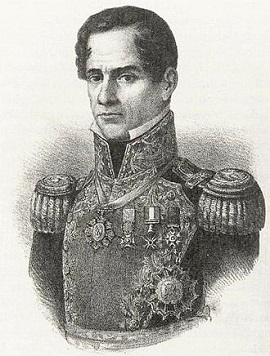
On this date in 1867, the Mexican general and onetime president Antonio Lopez de Santa Anna avoided execution at his court-martial.

Best recognized north of the Rio Grande for overrunning the Alamo, Santa Anna actually enjoyed an amazing career with a near half-century as Mexico’s definitive caudillo.

Antonio López de Santa Anna joined the military he would come to personify as a 16-year-old cadet in 1810 … except it was the Spanish colonial army, where he had hands-on training in the cold counterinsurgency tactics he would subsequently apply in his maturity.

Within barely a decade, the ambitious young officer was advanced to general — the last step by dint of his timely adherence to the incoming emperor of now-independent Mexico, Agustin de Iturbide.

Iturbide was destined for a firing squad, but Santa Anna had a better knack for tacking with his new country’s political gales — turning against his recent patron just in time to help depose the guy.

Santa Anna’s P.T. Barnum*-quality panache for shameless self-promotion — at one pont he repelled Spain’s last attempted reconquista and pronounced himself the “Napoleon of the West” — soon self-promoted himself right to the presidency. From 1833 to 1855, he held the office during 11 distinct stints.

His dictatorial exercise of power and abundant graft aroused resistance from more than just Texan Anglos, so he was often engaged in suppressing internal rebellions, and occasionally in being chased by them into exile. His last turn at president was aborted in 1855 by liberal reformers. Santa Anna fled to Cuba.

Considering the mad twists of fortune in his long career, it’s a miracle that none of his enemies ever actually executed Santa Anna. He was: both adoit and lucky to avoid purging during the tumultuous 1820s; captured by rebelling Texans, who preferred to avenge Alamo by forcing him to treaty terms; handed over to the U.S. government, which eventually sent him back to Mexico; captured again by rebelling Indians in Veracruz who sold him to the Mexican government which sent him to exile; and, tried by the liberals who finally toppled him, but in absentia since he had escaped once more. He had more lives than a cat; small wonder that here in his sixties and seventies he still wasn’t done plotting.

A full decade out of power, Santa Anna spent 1866-1867 in Staten Island, New York,** until the fall of Mexico’s French-backed Emperor Maximilian induced him once more — at the age of 73 — to sail for home with one last summons to his banner. Instead he was captured in a position that must have looked like curtains for sure.

The New York Times actually reported on July 5, 1867 that Santa Anna had been summarily executed; in fact, the restored liberal government of Benito Juarez clapped the nettlesome general in prison and subjected him to a court martial that ran Oct. 7-10. Juarez allegedly expected the old snake to be convicted of treason and finally executed, but like the Times, Juarez too was frustrated: the commission sentenced Santa Anna to exile and he was carried away to Havana once again.

It proved to be a waking death: cheated of the glory of a firing squad, the old general was pitiably forgotten.

“His schemes” — for still he schemed — “became increasingly the ravings of an old, deluded, sick man,” writes Robert Scheina in Santa Anna: A Curse Upon Mexico.

Permitted with Juarez’s death in 1874 to return to Mexico, Santa Anna now fought only for a pension. (He lost that fight.) So long his country’s first man, he “became increasingly depressed which was only relieved by his increasing senility. Santa Anna was suffering the worst possible punishment — obscurity and irrelevancy.” He died penniless of diarrhea in 1876.

* Santa Anna eventually came to hobble about on a cork leg, courtesy of a war wound. The leg was captured during the Mexican-American War, and Barnum put the artificial limb on exhibit.

That limb has never been returned to its native soil: Santa Anna’s prosthesis remains available to the Yankee gawker at the Illinois State Military Museum in Springfield.

** Santa Anna’s legacy in the United States (apart from that Alamo unpleasantness) was the importation of chicle, which the general liked to chew. Santa Anna’s American secretary, Thomas Adams, used it to create the chewing gum marketed as chiclets.

On this day..

1946: The Neuengamme camp war criminals

On this date in 1946, eleven men convicted by a British war crimes court of war crimes at the Neuengamme concentration camp hanged at Hamelin prison.

Neuengamme held about 106,000 prisoners from 1938 until the British overran it on May 3, 1945. (In a tragic coda, many of the last prisoners died when the ships to which they had been transferred were mistakenly strafed by the Royal Air Force that same day.)

Though its primary purpose was slave labor — Neuengamme inmates cranked out bricks and armaments — rather than extermination, close on half of its residents died of the maltreatment. Anne Frank’s elderly roommate-in-hiding “Albert Dussel” (his real name was Fritz Pfeffer) died there of enterocolitis in 1944; Suriname national hero Anton de Kom succumbed to tuberculosis at Neuengamme days before it was liberated.

Nor was Neuengamme above more direct methods — of course it wasn’t. As the Third Reich collapsed, Neuengamme was used to dispose of 71 leftists for no better reason than the Nazis begrudged their potential postwar life; meanwhile, Jewish children who had been subjected to medical experiments were hanged by their stonehearted SS doctor.

That gentleman, Alfred Trzebinski, was one of the men in the dock for Neuengamme, and ultimately, one of the men on the scaffold.*

Camp commandant Max Pauly and SS Schutzhaftlagerführer Anton Thumann were among the 10 others executed for Neuengamme, all together on October 8, 1946.

* Sigmund Freud’s grandson Walter worked for the War Crimes Investigation Unit on (among other cases) Trzebinski’s Bullenhuser Damm school hangings.

On this day..

1546: The Fourteen of Meaux

If the execution of the “Fourteen of Meaux” falls far short of the massacre of the Vaudois as regards the number of its victims, its strictly judicial character makes it more instructive as an example of the treatment of heretics.

In the year 1546 the Reformers of Meaux organised themselves into a Church after the pattern of that set up by the French refugees at Strassburg eight years before. They chose as their first pastor, a wool-carder, named Pierre Leclerc, a brother of the man who was burnt at Metz.

Their number increased under his ministry, and the matter soon came to the ear of the authorities. On September 8 a sudden descent was made on the congregation, and sixty persons were arrested and sent to Paris to be tried by the Parliament. Their greatest crime was that they had celebrated the Holy Communion.

On October 4 sentence was pronounced. Fourteen were sentenced to be tortured and burned, five to be flogged and banished; ten, all women, were set free, while the remainder were to undergo graduated forms of penance. The sentences were carried out at Meaux on October 7.*

Etienne Mangin, in whose house the services had always been held, and Leclerc, were carried to the stake on hurdles, the rest on tumbrils. They had all previously undergone what was known as “extraordinary” torture, and all had refused to reveal the names of other Reformers at Meaux. At the stake six yielded so far as to confess to a priest, thereby escaping the penalty of having their tongues cut out; the others who remained firm suffered this additional barbarity, which it was the custom to inflict on those who died impenitent. The congregation at Meaux was thus broken up, but the survivors carried the evangelical seeds to other towns in France.

The “Fourteen of Meaux” were not the only victims of the year 1546. Five others had already been burned at Paris, including the scholar and printer Etienne Dolet. Others were burned in the provinces. The next year, 1547, opened with fresh executions; and on January 14 the mutilation of a statue of the Virgin was expiated by a solemn procession at Paris.

Such was the policy which Francis I began definitely to adopt towards Protestantism after the affair of the placards, and which he put into active execution during the last seven years of his life. How far was it successful? As we have seen, it drove a large number of persons into exile; and these consisted chiefly of the better-born and better-educated among the Reformers.

It intimidated many into outward conformity with the Church. It prevented all public exercise of the Reformed religion, and all open propaganda. Religious meetings were held by night or in cellars; doctrines were spread by secret house-to-house teaching, or by treatises concealed amongst the wares of pretended pedlars.

On the other hand the frequent executions helped to spread the evil they were meant to repress. The firm courage with which the victims faced death did as much as the purity of their lives to convert others to their faith. Moreover, the influence of the exiles reacted on their old homes. From Geneva to the other Swiss centres of Protestantism missionaries came to evangelise France.

The Cambridge Modern History, vol. 2

* There are some sources that aver Oct. 6, and it appears that the primary documents are not explicit on the exact date of execution. This Proceedings of the Huguenot Society collects a great deal of information about the Fourteen of Meaux and settles on Thursday, Oct. 7 (see fn 54, page 101 and fn 64, page 103) — in part because the Parlement also demanded that the heretical house be razed, with Catholic services to be held there every Thursday.

On this day..

1918: Private Harry James Knight, deserter

“Owing to the state of my nerves, I find that I cannot carry on as I should. I’ve tried my best all through but four years has been a little too much.”

-British Private Harry James Knight of the The Queen’s (Royal West Surrey) Regiment 1st Battalion — shot as a deserter on October 6, 1918, five weeks before the armistice.

In honor of the 90th anniversary year of the war’s end back in 2008, the National Archives produced a podcast series titled “Voices of the Armistice”. The episode “Court Martial” dramatizes Knight’s fate via readings of archive records, and can be found here.

On this day..

1573: Maeykens Wens, Antwerp Anabaptist

On this date in 1573, Antwerp burned a clutch of Anabaptists, including the martr Maeykens Wens.

Thereupon on the next day, which was the 6th of October, this pious and God-fearing heroine of Jesus Christ, as also her other fellow believers, who in like manner had been condemned, were with their tongues screwed fast, like innocent sheep brought forward, and after each was tied to a stake in the market place, were robbed of life and body by a dreadful and horrible fire, and in a short time were burned to ashes. The oldest son of this aforementioned martyr, called Adrian Wens, about fifteen yars old, upon the day on which his dear mother was sacrificed, could not stay away from the place of execution, so he took his youngest brother, called Hans Matthias Wens, about three years old, on his arm, and stood on a bench not far from the burning-stake to witness his mother’s death. But when she was brought to the stake he fainted, fell down, and lay unconscious until his mother and the others were burned. Afterward, when the people had gone away and he came to himself, he went to the place where his mother was burnt, and hunted in the ashes until he found the screw with which her tongue had been screwed fast, and he kept it for a memento. There are now, 1659, still many descendants of this pious martyr living well known to us, who, after her name, are called Maeyken Wens.

On this day..

1736: Herry Moses, Jewish gangster

On this date in 1736, a Jewish gangster named Herry Moses was hanged as a highwayman at Vlaardingen, Netherlands.

Our source for Moses is Florike Egmond’s “Crime in Context: Jewish Involvement in Organized Crime in the Dutch Republic” from Jewish History, vol. 4, no. 1 (Spring 1989) — for whom Moses forms an window into the criminal life of Netherlands Jews. According to Egmond, Moses hailed from Frankfurt am Main, then an imperial Free City. He had no property or station, and spent the first decades of his life as a wandering beggar, a tinker, and one might guess a petty thief where the opportunity arose.

By 1723, when Moses was around 37 years old, he had washed up in the Dutch Republic — one of many Jews who had migrated to that more tolerant climate from Germany and points east.

In the Low Countries, these arrivistes filled many niches but one of the most noticeable was a burgeoning network of Jewish criminal gangs; per Egmond, in this period “between one-half and two-thirds of all Ashkenazim convicted of burglaries, theft, or robberies had been born outside the Dutch Republic.” The documentary record is far from thorough, but court cases suggest to Egmond the emergence of a small Jewish underground in the mid-17th century following the Thirty Years War, which was bolstered by subsequent immigration waves.

Jews filled plenty of more legitimate places too, of course — and we notice how diligently free of moral panic is the court that handles this minority outlaw. But the Dutch Republic endured in this period the decline of her former trading preeminence, and for the glut of new arrivals — who were sometimes legislated out of certain protected economic spheres — less legitimate occupations could not help but appeal.

Jewish gangs were accordingly quite prominent among the robbers and cutthroats prowling the roads; among other things, they were noteworthy for their willingness to raid churches, which Christian gangs tended to shy from attacking.

Similar “names, geographical background, occupation, travels, meeting places, and variable associations” populate the identifiable records of Jewish criminals, in Egmond’s words. They “were Ashkenazim, most of them poor, and a large majority were first-generation immigrants from Eastern and Central Europe.” Just as with Herry Moses.

So far as I have been able to tell, the annals do not supply us with the why in his strange story … which only deepens the intrigue of the what. Egmond:

In 1735 Herry Moses, alias Abraham Mordechai or Hessel Markus, confessed to a crime he did not commit. According to his version of the story, he murdered a Roman Catholic priest in his house in the Dutch town of Weesp and robbed him of aboug 3,000 guilders. The murder and theft were real enough, and a less scrupulous court than the schepenbank of Weesp (a high jurisdiction some twenty kilometers east of Amsterdam) might have sentenced Herry Moses to death on the strength of his confession alone. Adhering strictly to criminal procedure and confronted with some slight inconsistencies in Moses’ confession, the court tried to obtain more information. Could Moses have murdered the priest, as he declared, when standing behind the bedstead? (There was no room for a man to stand there.) Was he lying when he denounced several Jews and a Christian as his accomplices in both the murder and a burglary at The Hague? His descriptions proved accurate enough to track down some of these men and arrest them in different parts of the Netherlands, but they denied any involvement in the crimes and told the court that they did not even know their accuser. They were eventually released.

Herry Moses was interrogated a number of times during 1734 and most of 1735. Lengthy questioning yielded more detail and added more inconsistencies, but Moses continued to stand by his confession. The court, by now convinced of his innocence, saw no other solution than to torture him — not to obtain a confession but to have him retract it. Moses still did not oblige. The case was subsequently sent to a higher court (the Hof van Holland), which shared the doubts of the local court. Finally, at the end of 1735, Herry Moses was sentenced to whipping, branding, and banishment for life from the provinces of Holland and Zeeland, on account of his false accusations and his contempt for justice in general. Shortly before Herry’s sentencing — after he had been in prison for well over a year — the priest’s housekeeper and her husband confessed to having murdered the priest as well as the woman’s first husband. Both of them were sentenced to death.

As could be expected, Herry disappeared from sight after receiving his sentence, until September 1736, when he again stood trial in a Dutch criminal court. This time, there was no doubt about the indictment or the evidence. Passersby had caught him and his two accomplices in the act of attempting to strangle and rob a woman on a country road near Rotterdam. They arrived in time to save the woman’s life. Herry Moses was sentenced to death, and on 5 October 1736 was hanged at Vlaardingen.

On this day..

1872: John Barclay

On this date in 1872, John Barclay hanged in Ohio for murder — and was almost reanimated for science.

Barclay was a late-twenties knockabout of the area whom the Cincinnati Enquirer judged “does not look the diabolical murderer he is charged to be.” (“except his eyes”: from the May 23, 1872 edition, as are the subsequent quotes in this section)

Charles Garner, his victim, was a livestock merchant who specialized in supplying the Columbus butchers. On November 28, 1871, Garner headed out of Columbus rich with cash from a successful business trip. Barclay knew both Garner and the butcher with whom he was transacting business, one J.B. Rusk, and had hung about with them during the day — even holding open the bank door as Garner entered to cash Rusk’s check.

In the evening, hearing that Garner was about to depart, Barclay ducked into a nearby general store, inquired about buying a hatchet, and not being able to find a suitable one, settled for buying a yellow-handled hammer instead. Then he apparently hopped on the back of Garner’s wagon just as it set out, where a great heap of merchandise obscured him from the driver’s view.

Four miles out of town, at a bridge over Alum Creek, Barclay presented himself to his unknowing chauffeur and bludgeoned him with the hammer, “crushing in the skull so that the brain was exposed” — then fled on foot, having relieved the victim of several hundred dollars. The mortally wounded Garner somehow managed to drive the wagon to a house two miles further down the road, where he died five days later. A surgeon who attended him later testified that “brain, matter and blood [were] issuing from head and nose … a portion of forehead was an open wound; a portion of the brain was broken in and a portion lost.” Barclay would eventually confess the crime.


A most unusual postscript was appended to the execution of the hanging sentence.

Barclay willed his body to the benefit of the Starling Medical College in town, and there a local high school teacher named Thomas Corwin Mendenhall subjected it to the Frankensteinish jolts of a galvanic battery.

The dream, of course, was to reanimate the corpse altogether — although a history mused that the Supreme Court judges who also took enough interest to attend the experiment “might have to pass upon the uncanny question of Barclay’s legal status as a living person who had already suffered the death penalty.”*

Barclay hanged at 11:49 a.m.; by 12:23 p.m., his flesh was on the table under Mendenhall’s probes. Notwithstanding the dispatch of the scientists they did not accomplish his resuscitation, although the Cincinnati Commercial (Oct. 5, 1872) reported some ghoulish simulations of life:

The first test was on the spine. This caused the eyes to open, the left hand to become elevated, and the fingers to move, as if grasping for something. The hand finally fell, resting on the breast. The battery was then applied to the nerves on the face and neck, which caused the muscles of the face to move as in life. The test was next applied to the phrenic nerve of the left arm, and afterward to the sciatic nerve.

The next year, Mendenhall was hired as a physics instructor by the new Ohio Agricultural and Mechanical College in Columbus: while he would go on to a varied and widely-traveled career in the sciences, Mendenhall has the distinction of being the very first faculty member at the institution known today as Ohio State University, and the namesake of its Mendenhall Laboratory building. (Starling Medical College, site of the galvanic experiments, would also be absorbed into OSU’s college of medicine.)

* It ain’t like they’d be the only ones to ever confront that difficulty.

On this day..

1750: James Maclaine

Gentleman highwayman James MacLaine hanged at Tyburn on this date in 1750.

The debauched son of a Presbyterian minister, MacLaine wasted first an inheritance and later a dowry on expensive clothes, gambling, and ladies of easy virtue; want, however, was his ticket to the immortality of the gallows when he joined fellow penniless gentleman William Plunkett to seek his revenue on the roads. (Inspiring the 1999 film Plunkett & Macleane — which uses one of several alternate spellings available for our man’s surname.)

For several months in 1749-1750 they prowled the environs of a lawless London, and notably Hyde Park, with the exaggerated courtesy demanded by romance of their profession. They found noteworthy prey: once, they stole a blunderbuss from the Earl of Eglington, though Eglington survived to suffer a noteworthy murder years later; in November 1749, they robbed M.P. Horace Walpole, even skimming his face with a pistol-ball that was inches wide from depriving posterity of the gothic novel.*

When caught** by mischance, the mannered† Maclaine became the object of public celebration, much to the bemusement of Walpole — who professed no ill will for his assailant but wondered that “there are as many prints and pamphlets about him as about the earthquake.”

Three thousand people are reported to have turned up on a sweltering summer Sunday to pay their admiration to the rogue, not excluding the very cream of society. Walpole teased his friends, court beauty Lady Caroline Fitzroy (wife of the Earl of Harrington) and her sidekick Miss Elizabeth Ashe, for presenting themselves among these masses to starfuck this latter-day Duval. “I call them Polly and Lucy,” he wrote, alluding to female conquests of the outlaw Macheath in The Beggar’s Opera, “and asked them if he did not sing,”

Thus I stand like the Turk with his doxies around.

Maclaine did not have to borrow Macheath’s ballads, for he was celebrated with verse dedicated all to him — like this “Jemmie Maclaine”, to the tune of Derry Down:

Ye Smarts and ye Jemmies, ye Ramillie Beaux,
With golden cocked hats, and with silver laced clothes,
Who by wit and invention your pockets maintain,
Come pity the fate of poor Jemmy Maclaine,

Derry down derry, etc.

He robb’d folks genteely, he robb’d with an air,
He robb’d them so well that he always took care
My lord was not hurt and my Lady not frighted,
And instead of being hanged he deserved to be knighted!

Derry down derry, etc.

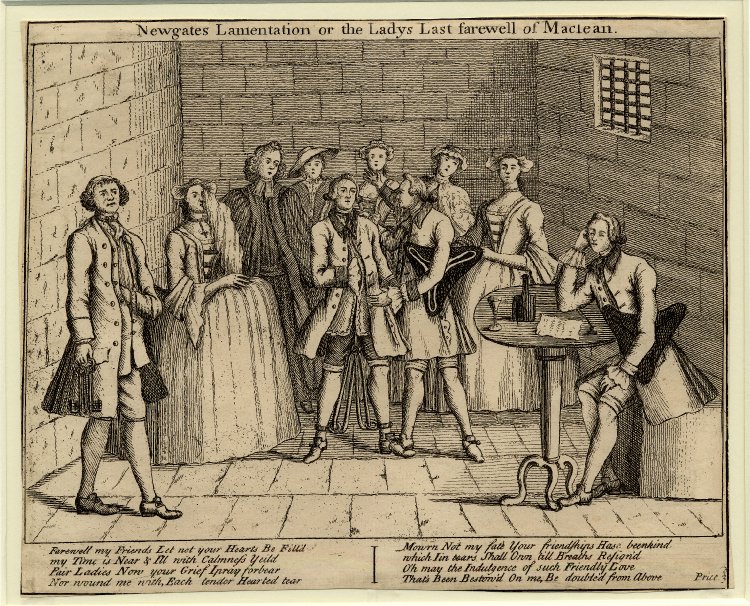
William Hogarth‘s 1751 print cycle The Four Stages of Cruelty, one skeleton overseeing the operating theater where a hanged criminal is dissected is subtly labeled — Macleane.

* Walpole once remarked of the ubiquity of violent crime in London that “one is forced to travel, even at noon, as if one was going to battle.”

** Plunkett was never apprehended; it’s alleged that he ultimately escaped to North America.

† Although our man “has been called the gentleman highwayman,” the player-hating Ordinary of Newgate wrote, “and his dress and equipage very much affected the fine gentleman, yet to a man acquainted with good breeding, that can distinguish it from impudence and affectation, there was little in his address or behaviour, that could entitle him to that character.”

On this day..

1850: Henry Leander Foote, sex crazed

On this date in 1850, Henry Leander Foote was hanged in Connecticut.

Foote was an educated man who used his time languishing in jail — there was nearly a full year between his conviction and his execution — to bestow upon the world an autobiographical narrative of his peregrinations, which the reader can peruse in its entirety at the bottom of this post. Affected with wanderlust, he struck out from home as a teenager and began a rambling career that would take him all over America.

One of his first stops was the bustling and burgeoning metropolis that will become the hub of his narrative and, as Foote conceived it, the source of his ruin — New York city. There he was introduced to the city’s vast sexual marketplace.

At the end of two or three weeks, I found myself in the city of New York. What a place for a stranger, a young man of seventeen or eighteen years of age to visit alone, without any guardian to conduct him or advise him, and warn him against evil company! I had no acquaintances except three or four young men, whom I met on board the boat, who were also from Connecticut. They were in company, all belonging to one town, and then invited me to stop at the same public house with them. I had been informed that one of them was the son of a minister of the gospel, consequently I concluded that the company was good and safe to be with. But I found, to my astonishment, that this young man was the ring leader, the rudest and wildest of the crowd. The first night I was led to the Theater, from there to the brothel, and from there to the gambling house and drinking saloon. Here we must be fashionable and have a game of cards and a bottle or two of champane. [sic] … We played and drank till sometime past midnight, when we concluded it was time to retire.

Foote is coy here and suggests that his virginal young self repelled the subsequent invitation to a brothel. Whether or not this is so, he soon became by furtive subsequent visits whose purpose he was careful to conceal from his family an intimate of the city’s many whores.

These youthsome frolics are only foreshadowing for the excuses that Foote would be obliged to make many years later in the pall of the gallows. He spent the 1830s and 1840s bouncing around the growing republic — upstate New York, westward to Cleveland and St. Louis, south to Charleston where he married but lost his wife within a year to childbirth. (The son died, too.) After that, he enlisted in the cavalry and fought in the Seminole Wars.

Foote does not give us much of his sexual adventures on these trips, but between the lines it appears that the concupiscient fornicator and the New England prude ever travel side by side with him. He ships to Rio de Janeiro and does not fail to notice that “the dress of most of the women was not much better than none, being merely a short gown, all open in the neck and breast, and reaching only half way to the knee, fastened round the waist with a belt. They would make any civilized man blush from head to foot, but they were not at all particular as to what position they happened to be in.” Nevertheless, he affects shock when “a mixed-blood, half Spanish and half Indian publican” offers him a girl for the night. (According to Foote, he did not take the girl.)

As for the army, well, it “is a most dangerous and destructive place to the morals of young men. It is a school of intemperance, profanity, licentiousness, obscene language, filthy communications, and all kinds of vile and lewd company” thanks to the degrading example of officers who “when at home, or where they are known, always assume the character of gentlemen, and presume to walk in respectable society, unite with the ‘upper ten,’ and [associate] with virtuous females, who, if they knew their true character, would turn from them with disgust.”

By 1849 we find the peripatetic Foote back in his native hamlet of Northford, Connecticut, 37 years old and again, or still, preoccupying himself with the diversions of the Tenderloin. To the best of my knowledge he is the subject of no biography save his own, and since we find that the diverse sojourns of the previous 20 years have ultimately changed neither his conduct nor even his locale, we might be excused for speculating how many adventures were contrived by the author’s hand.

Wherever it was that he had been, he was becoming a worldly denizen of the bagnio.

A few months before the murder, I spent one week in the city of crime and pollution, viz., New York. As usual on former occasions, I spent my evenings and nights in a theater, gambling house, or brothel. Also on a former visit I had attended an exhibition of nudes, or model artists, as they are termed. But at this time the company had gone to New Orleans; a few of them, however, remained in New York, with one of which I had the misfortune to become acquainted. She was an arrogant prostitute, residing in a house of the higher class. I found her at the Bowery Theater; she enticed me, and I consented to accompany her home. As we entered her room she locked the door, laid aside her upper garments, and invited me to take a glass of wine with her. She poured out two glasses, and took a phial from the drawer of her toilet, drew the cork, and pretended to drop some of the contents in her glass of wine, but not a drop did she let fall. She said it was Cream of the Valley, it would give the wine a delightful flavor, and then made a motion to drop some into my glass. But I was too wide awake for her. I knew it was some drug that might upset my ideas, so I told her to save her cream, I did not need any cream of that sort. She looked at me, and said, “you are not so green as you pretend. I gues syou understand a game or two.” I replied, “I understand enough to know the nature of your cream.” And said I, “what was your object in giving it to me?” “O,” she replied, “I was only going to give you a drop or two, to make you feel keen.” She was very proud of her perfect symmetry of form, and proceeded to make a model artist of herself again, that she might give me a clear view of her model, and also of the extra manoeuvres which she had learned in the model artist plays.

After passing the night with his model artist’s “extra manoeuvres,” Foote pinched the potion for himself thinking to deploy it for his own benefit. He first called on a prostitute who had previously robbed him, engaged her charms for the night, and administered the drug to her, thereby having leisure to rob back the lost funds (“with interest,” Foote admits) as well as to leave behind a taunting note. He also found that she, too, possessed a dose of this potent Cream of the Valley, and duly replenished his supply.

Our dissolute principal was much given to exploiting his moment of notoriety for moral grandstanding, and we again should treat his account with caution.* Another author who visited Foote and published his observations in a pamphlet titled Death Cell Scenes, Or, Notes, Sketches and Momorandums of the Last Sixteen Days and Last Night of Henry Leander Foote is by no means hostile to his subject but often notices his unbecoming worldly preoccupations when he ought to be attending his imminent death with due gravity: he “showed a singular disposition to make money even at the hazard of his soul” by cranking out paintings to sell to the gawkers come to gape at him through the prison-bars and on one occasion arrives only to be brushed off as Foote is “in the height of glory and ambition, vending pamphlets and pictures to persons surrounding his cell with as much gusto as though he had to live twenty years or more!”

He was a doomed man with a keen sense of his audience; Foote even took the trouble to pre-order his own inscribed marble tombstone. (The stone can still be seen at Northford Old Cemetery in New Haven.)

He had a gift for rationalizing and segmenting his hypocrisies, surely honed by his years alternating Puritan piety with opportunistic harlotry. At the end when it could no longer be denied, he surfaced the contradiction by way of attenuating his own guilt.

“By this and other means, the hags who keep brothels contrive to get many of their recruits,” Foote wrote of the drugs like Cream of the Valley — subtly conflating his own loss of self-control with white slavery. “And if an inexperienced young man allows himself to visit their houses once, perhaps for mere curiosity, when he is not aware of any danger, they will bewitch him in some way that will induce him to come again; and so he will continue to go until his ruin is completed. Beware, young man, and shun all such places! Once in, you insensibly lose self-command. It is not easy to resist such temptations when once poisoned. These female Satans use the very arts of old Satan himself, and some that he does not use. Once in their power, you are not your own keeper.”

Not your own keeper — even as he admits and bewails his own crime, Foote wants to convey to posterity the notion of a Jekyll-and-Hyde: that there is a Foote distinct from the murderer.

Back at Northford, “my thoughts were continually revolving upon the obscene views which I had witnessed in New York, particularly upon the model artist female … I seemed to have a bewitching anxiety to see the same again, or to see something of the same kind, and this base desire I could not overcome. A curiosity to see and examine some female in the same state of nudity was constantly haunting my mind.”

Although he’s taken the care to secret the prostitutes’ powerful draught in his trunk, it is not quite he who addresses himself to the “bewitching anxiety”: he gets drunk, and then “Satan himself was certainly busy with me, driving me on to ruin with all his power … [using] me as an instrument for the destruction of innocent life.” At length, “Satan” suggests him his young cousin Emily as the object to satisfy his base desire. Foote intercepted her on the way to school and, he said, lured her into the woods to snack on some tomatoes which he had dosed with the sleeping potion after which, you know, stuff happened. For a guy who carried out a premeditated plan to incapacitate and molest his underage kin, he sure expected to be given a lot of latitude.**

But with shame! shame! do I write it, I now proceeded to examine her person, which inflamed my baser passion to an unmanageable degree; and after my eyes were satisfied, I violated and robbed her of her virgin purity. She gave no signs of feeling except to draw one deep sigh. My brutish passion was now satisfied. I meditated upon what I had done, the criminal nature of the awfully wicked deed, the meanness of the act itself, and the base stratagem which I had employed to gratify my shameful curiosity. In the first place I had no intention of doing any thing more than to satisfy my eyes; but this created a passion so strong as to overrule all better feelings, honor, and decency. I stood over the wreck of beauty, innocence, and purity, and sincerely wished I had never seen the city of New York, or any of its bewitching female satans … my head was wild, and my heart felt as if it had turned into a great stone. I would have given half of the town had I possessed it, if I could have undone what I had done that morning. But that was impossible.

And having come this far, Foote realized if he should allow her to revive and be on her way, her story would send him to prison. “As if I almost heard an audible voice,” “something” suggested to him that he murder her. Foote floridly describes himself alternately resisting and impelled to the idea until “I acceeded [sic] to the horrible proposal, and Satan used me as an insensible instrument for his nefarious, bloody, and soul-destroying purpose.” Then Satan used him to slash Emily’s neck through the windpipe.

It’s a bit difficult to disentangle the actual or purported sequence of steps to the next murder; Foote writes of it as if he was hurled into despair by his crime and only paused from his intention of suicide to murder his mother when he reflected that the incestuous rape-murder imputed him might destroy her after he was gone. We get a somewhat different picture from the period’s newspaper accounts which suggest that he was no suspect at all when Emily first turned up missing and coolly played it as if shocked, before getting drunk and bashing mom’s head with a hammer. If you liked his story about how Satan made him rape Emily, you’ll love this.

I drank several times during the forepart of the afternoon, and about three o’clock I went to get another drunk, but the jug was missing — my mother had hid it, and it was not to be found by me. This enraged me … if she had let the liquor alone, it is possible, and not improbable, that I would have drank so much as to render me incapable of making any attempt upon her life; and thereby she might have escaped entirely. But she was often very unwise in provoking me, especially when I had liquor in my head. It was a wrong way to deal with me, to take liquor from me to prevent my drinking, for I was generally sure to go and get a larger quantity and drink so much the more. But she has many times done it, and thereby caused me to behave much worse than I should otherwise have done. Late years my mother has been very petulant towards me; whether I had been drinking or not, it seemed to be about the same. This I attributed to trouble, and the influence of opium, which induced her to pack the faults of others upon me, charge me with things of which I was entirely innocent, and find fault with me when I was not in the least to blame; and to complain of things which I knew were right.

Foote insists that he tells us all this not “for the purpose of defending or screening myself from any blame” from the matricide he committed for mom’s own benefit. Just wanted to contribute to the historical record. And then he has the chutzpah to accuse a neighbor who came running to the battered woman’s shrieks of being a big old pussy for backing away and yelling for help when threatened with the bloody hammer. This is a man who required a more forceful minister, a good psychiatrist, or a better P.R. team. Even to the last, the killer’s self-awareness only amounted to his own narcissism.

“The last act of Foote in his cell,” writes the hanged man’s companion in Death Cell Scenes, “was to make use of a quantity of mus on his hair, six cents worth of which he had ordered the night previous, besides ‘two pleasant Spanish cigars.'”

* As pertains the potion specifically, Foote cites (and perhaps may be suspected of borrowing from) the story of temperance moralizer John Bartholomew Gough, who disappeared in New York for a week in 1845 and was discovered in a whorehouse, floating in an opiate daze.

** There was a witness who heard a scream, presumably by Emily. Foote’s account essentially renders the attack “non-violent” (he says, as if to complete his travesty of Eden, that at one point she shrieked when she caught sight of a snake). It really is entirely possible that he simply perpetrated an uncomplicated wilderness rape and subsequently concocted every other convenient detail. (“No intention of doing any thing more than to satisfy my eyes” indeed.)

On this day..