1970: Hilmar “Henry Stutzbach” Swinka

East Germany executed sociopath Hilmar Swinka* on this date in 1970 for three murders in Berlin.

Swinka’s trial and execution were conducted in great secrecy — the Communist bloc being oft lothe to acknowledge such bourgeois monsters as serial sex-killers. Hans Girod describes him in his German-language study of DDR criminals, Blutspuren (Bloodstains), using the pseudonym Henry Stutzbach.

Swinka/Stutzbach wasn’t the type where you say nobody could have seen it coming.

A disaffected loner abandoned by his violent father, he dropped out of his apprenticeship and rotated unskilled jobs through his twenties while passing his time with pugilism of both the sweet science and the barroom brawl varieties.

His last job, as an assistant at a pathology institute, creepily set up his crimes — where he made a nauseating mockery of dissection by strangling and then carving open two ex-lovers on February 13, 1969. The next day, Swinka honored St. Valentine by doing the same thing to his lawfully wedded wife.

Swinka was shot at a secret execution facility in Leipzig, by Hermann Lorenz — East Germany’s last executioner.


There’s a truncated version of this documentary about the Leipzig death chambers here.

* The surname means pig in Slavic languages.

On this day..

1567: The Michelade of Nimes

On this date in 1567, Huguenots in revolt in Nimes put to death dozens of Catholics in a courtyard butchery to climax a massacre remembered as La Michelade (English Wikipedia entry | the much more detailed French)

This name of sinister memory derives from one of the church calendar’s great autumnal feast, Michaelmas — and the sword-arm of its titular archangel would have been required to keep the peace between the rival religionists in the Languedoc.

Nimes went heavily for the Protestants, with the region’s royal governors unable to restrain the conquest of Catholic neighborhoods and churches by the predominant Huguenots through the 1560s: “the very wind which blew upon Nimes breathed heresy,” in the words of Dumas.

The years running up to our events of 1567 feature one of the numerous rancorous truces pocking France’s intractable Wars of Religion: this one is known as the “Armed Peace”, which gives you an idea where everyone’s heads were at. And in Nimes, the heresy in the wind was not such as to prevent the restoration of Catholic authorities to control of the civic institutions — to the undoubted irritation of the Huguenot grandees who endured the indignity of displacement alongside the sure knowledge of the popular weight that supported them.

This ripening conflict appropriately came to fruition via a vegetable market at a city fair on Michaelmas — September 29, 1567 — where an altercation turned into a sectarian riot and soon transformed into a municipal Protestant insurrection.

Huguenots still maintaining the preponderance of force in Nimes, they perpetrated the expected outrages during the excitement: sacking the cathedral, murdering some particularly hated Catholics. But the overall organization of the Huguenots and the organized participation of the city’s Huguenot elites suggests a good deal of advance orchestration, and perhaps coordination with the Huguenot attempt to kidnap the king just days before.

In the disturbance, Nimes’s first consul Guy Rochette — Catholic, naturally — sought refuge in the palace of Bishop Bernard d’Elbene; a Huguenot captain forced the door and arrested them, confiscating from Rochette the keys to the city. Though the bishop managed to escape, other prominent Catholics were systematically detained, too. According to Allan Tulchin’s That Men Would Praise the Lord: The Triumph of Protestantism in Nimes, 1530-1570, “[i]t seems clear that the Protestant leadership intended to conduct a general roundup of Catholic lay and clerical leadership. Protestant forces targeted at least half of the sixteen men who had served as consul between 1564 and 1567 … of the nine Catholic members of the presidial, only two did not appear among the victims.”

Captive Catholics were detained in several buildings around the city, notably in the city hall. It is not known to what extent the kill lists to cull from these unfortunates were preordained and to what extent they were improvised in the moment, but on the night of September 30, summons for specific victims went out, and Protestant squads complied by dragging them out of the city hall basement or wherever else they were held to the courtyard of the bishop’s palace. This would be the makeshift abattoir.

In the narration of Dumas,

when night came the large number of prisoners so imprudently taken began to be felt as an encumbrance by the insurgent chiefs, who therefore resolved to take advantage of the darkness to get rid of them without causing too much excitement in the city. They were therefore gathered together from the various houses in which they had been confined, and were brought to a large hall in the Hotel de Ville, capable of containing from four to five hundred persons, and which was soon full. An irregular tribunal arrogating to itself powers of life and death was formed, and a clerk was appointed to register its decrees. A list of all the prisoners was given him, a cross placed before a name indicating that its bearer was condemned to death, and, list in hand, he went from group to group calling out the names distinguished by the fatal sign. Those thus sorted out were then conducted to a spot which had been chosen beforehand as the place of execution.

This was the palace courtyard in the middle of which yawned a well twenty-four feet in circumference and fifty deep. The fanatics thus found a grave ready-digged as it were to their hand, and to save time, made use of it.

The unfortunate Catholics, led thither in groups, were either stabbed with daggers or mutilated with axes, and the bodies thrown down the well. Guy-Rochette was one of the first to be dragged up. For himself he asked neither mercy nor favour, but he begged that the life of his young brother might be spared, whose only crime was the bond of blood which united them; but the assassins, paying no heed to his prayers, struck down both man and boy and flung them into the well. The corpse of the vicar-general, who had been killed the day before, was in its turn dragged thither by a rope and added to the others. All night the massacre went on, the crimsoned water rising in the well as corpse after corpse was thrown in, till, at break of day, it overflowed, one hundred and twenty bodies being then hidden in its depths.

Dumas is indulging poetic exaggeration of the scene, and later estimations of the number of victims range well below 120 — but Tulchin quotes a leather worker who saw the courtyard on the following day and described it as “all covered with blood and the water of the well all red.” Even “merely” twenty or thirty victims slashed to death would have been a gory work.

In the days following, Huguenots would cement their control of Nimes with the systematic pillage of churches and (after a six-week siege) the capture of the city’s royal garrison. There was no general massacre after the Michelade; in the main, Catholics were forced into submission or exile instead of the grave.

But the effusion, combined with Huguenot attacks further north, helped to trigger the (very brief) “Second War” within the Wars of Religion which gave way after a short truce to the much bloodier “Third War” of 1568-1570 … whose peace would be broken by a Catholic sectarian massacre much better remembered to history than the Michelade.

On this day..

1891: Ed Leeper and James Powell

The Ballad of Leeper and Powell

Come all my friends and near relations;
Come and listen unto me.
I will sing about two men,
About two men that’s to be hung.

‘Twas on the eighteenth night of December,
In eighteen hundred ninety-five,*
‘Twas the night they did the murder
For which they had to give their lives.

One says, “Father and dear mother,
Won’t you both remember me,
When I’m dead and gone forever,
And my face no more you’ll see?”

“We were held long in this prison —
No one came to go our bail** —
God will aid and assist us
Now to break the Gatesville jail.”

And when started from that prison
And the guards surrounded them —
“I must die and I’m not guilty,”†
‘Twas the answer Jim made then.

Ed was tall and fair complected;
Jim was low and very neat.
They were pale and very silent,
And their lips did seem to meet.

One says, “Lord, oh, do have mercy
On those who swore my life away.”
They tied their wrists and their ankles,
Placed black caps upon their heads.

The trapdoor fell and left them hanging,
Between the earth and the sky.
It was for a dreadful murder
These two men were made to die.

They’s cut down, placed in their coffins,
Delivered over to their friends,
Who were there for that purpose,
To receive them at their end.

Come all young men, now take warning;
Live, oh, live a sober life.

* The crime(s) for which Leeper and Powell hanged actually occurred on the evening of December 17, in 1889. Two armed outlaws waylaid some farmers returning to the country after they sold their cotton in Gatesville; a J.T. Mathis was mortally wounded in the resulting firefights, lingering until December 18 before he finally succumbed. (Another man named W.H.H. Harvey was wounded, but survived.)

** Actually, Ed Leeper’s mother was a prosperous Tennessee matron who spent liberally on her son’s defense; the men’s appeals, even challenging the legality of the entire Texas penal code, went all the way to the U.S. Supreme Court — quite unusual for the time. But it is correct that they did not have bail: the enormity of the crime, and the fear of inviting a lynch mob, saw them behind bars and under heavy guard from the time of their arrest hours after the robbery.

This is not to say that Mrs. Leeper’s efforts were wholly without effect:

Newspaper article describing the death of a prosecuting attorney who was injured returning by train from Austin 'on the Leeper and Powell business'.
From the Dallas Morning News, September 30, 1891.

† Since the attack took place under cover of darkness, nobody could positively identify the assailants. Leeper and Powell, well-known local ruffians, were suspected at once and the suspicion appeared circumstantially supported.

Both men did continue to assert their innocence on the scaffold: “I die innocent and I die game for the crime of some one else,” in Powell’s words. (Dallas Morning News, September 30, 1891)

On this day..

1620: Sidonia von Borcke, the sorceress

On this date in 1620, Sidonia von Borcke was beheaded and then immolated in Stettin (Szczecin) — one of the most notorious witch executions in German history.

The Pre-Raphaelites quite fancied the Sidonia story: this is Edward Burne-Jones‘s 1860 watercolor Sidonia von Bork.

This Pomeranian noblewoman (English Wikipedia entry | German), aging and penniless, resided from 1604 in a Lutheran Stift, a secular convent for unmarried ladies. There she busied herself and the courts of the Holy Roman Empire with numerous lawsuits against the convent’s prioresses, other women in the cloister, and inheritance disputes with members of her family.

According to Gerda Riedl’s “‘Alles von rechts wegen!’ Frühneuzeitliches Hexenprozeß-(un-)wesen am Beispiel des Falles der Sidonia von Borcke” in Hexen: Historische Faktizität und fiktive Bildlichkeit, the frayed nerves around Sidonia finally snapped at a church service where she and the sub-prioress got into an altercation and were both arrested.

It was July of 1619. Sidonia von Borcke was a cranky 71-year-old spinster with a knack for making enemies. And then the sub-prioress accused her of witchcraft.

The ordeals of the next year occupy over a thousand pages in the archives. A wandering fortune-teller named Wolde Albrechts was slated with channeling the infernal powers for Sidonia: when put to torture, that poor creature soon admitted all, complete with the obliging accusation of Sidonia.

Wolde Albrechts went to the stake on October 9, 1619. By December, 72 impressive charges were preferred against Sidonia von Borcke, by now transferred from confinement in her abbey (where she had attempted suicide) to the public prison. These included the murder by sorcery of every consequential person who had died in her vicinity in recent memory, from the previous prioress all the way up to the Duke of Pomerania, whose childless death at the tender age of 44 the previous year had thrown the political situation in Pomerania into confusion.* (Not to mention sexual contact with her loyal kitty Chim, in the latter’s guise as demonic familiar.)

Her ashes were barely cold when Sidonia passed into folklore and thence to legend, eventually to be seized and considerably embellished by Gothic poets in the 18th century. Her countryman Wilhelm Meinhold‘s Sidonia von Bork, die Klosterhexe situates her as a beautiful young woman balked of her dynastic marriages who goes on a midlife jag as a picaresque outlaw before repairing in her dotage to the abbey heavy with grievances. English translations of it were wildly popular, including one rendered by Oscar Wilde‘s mum.

* Succession started passing to the late duke’s brothers, and the Harry Potter-esque House of Griffin which had ruled Pomerania back to the 12th century was done by 1637. Their destruction juxtaposed to Sidonia’s own would help cement the latter’s immortality.

On this day..

Feast Day of Saints Cosmas and Damian


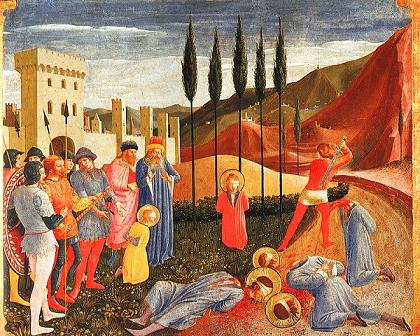
The Martyrdom of Saints Cosmas and Damian, by Fra Angelico.

September 27 is the traditional* feast date of early Christian saints Cosmas and Damian.

Martyred in Syria during the Diocletian persecution, these Arabian brothers were reputedly physicians who did not charge their patients, even for premium services like transplanting an entire leg.


Cosmas and Damian graft an Ethiopian’s leg onto a white patient.

This has made them patron saints to doctors, surgeons, pharmacists, and dentists but decidedly not to insurers.

They were once much more widely known and revered than today, back when the mysteries of medicine and of faith intertwined with one another. The two are named in the Canon of the Mass, and multiple churches in Europe dubiously claim the honor the ancient doctors’ relics; their skulls alone reside simultaneously in Bremen, Vienna, and Madrid, while a church in Venice allegedly holds their non-cranial remains. Visitors to the Roman Forum will behold the beautifully preserved pagan Temple of Romulus, which was rededicated in 527 as the basilica of Santi Cosma de Damiano and still hosts weddings beneath its impressive Cosmas and Damian mosaic.

The saints’ day is observed in Brazil, where children on September 27 receive candies (Cosmas and Damian also count confectioners and children among their devotees). St. Anthony’s Church in Utica, New York, also hosts an annual Cosmas and Damian pilgrimage attracting thousands of people from across North America.

As two men intimate with one another who traveled and ministered together, they are sometimes speculatively ventured as early gay exemplars. (They’re traditionally accounted as brothers.)

* The Vatican’s 1969 calendar revision moved the feast to September 26, leaving September 27 to St. Vincent de Paul.

On this day..

1965: Kenneth Roraback and Rocky Versace, Vietnam War POWs

According to a UPI wire story from Saigon which ran in American newspapers beginning Monday, September 27,

The Viet Cong said they executed two American prisoners Sunday … Although the broadcast did not say so, the executions apparently were in retaliation for the deaths Thursday of three anti-American demonstrators. The demonstrators were convicted by a military tribunal of engaging in terrorist activities and put before a firing squad in a soccer stadium at Da Nang.

An earlier execution of a Viet Cong terrorist by the government June 24 brought an announcement from the Communists that they had executed Sgt. Harold G. Bennet[t], a captive from Arkansas.

The two men shot on September 26 — whose names are garbled in the initial news report, since “the names were received phonetically” — were Sgt. Kenneth Mills Roraback and Capt. Humbert Roque “Rocky” Versace.

In 2002, Versace would be posthumously awarded the Congressional Medal of Honor — the first Vietnam War soldier so decorated on grounds of unwavering defiance as a POW.

On this day..

1794: Edmund Fortis, in the hands of God

On this date in 1794, Edmund Fortis was hanged in Dresden, Maine* — at the time still a part of the Commonwealth of Massachusetts.

Fortis was born a slave in Virginia but escaped and slipped into the wage economy by hiring out as a seaman on a ship bound from Alexandria, Va., to England. According to his dying confession he was a habitual petty thief; by the time he had made his way to Maine, “my life was dreadful — Drinking, stealing and gaming.”

Fortis admitted to, and even pleaded guilty to, the rape-murder of a young girl named Pamela Tilton whom he saw by chance and waylaid on a country road on May 18. This confession “the evidence of credible witnesses on oath … abundantly confirmed.” That’s from the sentencing oration of Justice Robert Treat Paine, via The Oracle of the Day (Portsmouth, N.H.), July 26, 1794, which continues with flourishes of hellfire —

This sentence, when executed, will remove you from this world, where you have proved yourself so unworthy an inhabitant, to a state of existence where you must reap the fruits of your past life; where you must appear before the awful tribunal of that holy Being, who cannot be deceived and who will not be mocked, and who will judge you for this and all the other sins in your life …

you have cast off the fear of God from your eyes, and all restraint of reverence to him from your thoughts, words, and actions, till your unbridled lust and malicious disposition had arrived to full ripeness, and urged you to the commission of crimes, at your own relation of which, nature revolts and the human heart is rent with agony. To what a pitch of brutal lust must you have arrived, that a person of your nation, your age, having a wife and children in the neighborhood, should so inhumanly assault and violate the chastity of that young girl in spight of her intreaties and remonstrances, and then with all the savage cruelty of a ruffian and an assassin, deaf to those cries and supplications which would have melted any heart but one lost to every humane feeling, you barbarously strangled to death the inoffensive victim of your lustful crime; thus in a short space of time destroying life, the first right of all mankind, and chastity, the second right of woman.

… repent and live … so, although your aggravated crimes must bring you to an untimely and disgraceful death, yet that you may escape that weeping, wailing and gnashing of teeth, that destruction from the face of the Lord, that bitterness of misery which cannot be discribed nor conceived, which will be inflicted on all the enemies of the holy Governour of the Universe, and that your soul may be happy forever in the heavenly world.

But Fortis did not need much convincing of his soul’s peril.

The bulk of his confession is taken up describing the transformative apparition of God’s grace as he awaited arraignment in prison — the appearance of which is precisely what induced him to plead guilty to the charge, lest he “lie against God.”

I could not rest, there was no comfort or peace for me: I tho’t no person was so bad as I, my whole life filled with sin, stealing, lying, whoring and drinking, and now murder. At length I got up, and endeavoured to pray, but my heart was hard as a stone, and it seemed bound up; still I thought I would keep praying to the Lord whether he had mercy on me or not.

On Saturday morning it seemed as if I had more desire to pray and plead with God than before; and in the afternoon it seemed as if my heart was in some degree melted, and there was some hope. I heard something like a voice, saying “verily, verily give him a new heart,” and it seemed as if a man was in me working downward, and clearing or cleaning my heart. I thought I could breathe out my heart to God, and could see a light shining from heaven, brighter than snow, and in the light it seemed as though a great many angels were singing, which drowned my groans and prayers; and I cried O Lord! and looked up, and I saw in a corner of the prison something red like fire, and thought it was the Devil. I found I had another feeling, and I cried to the Lord. I now felt relieved; but was doubtful whether it could be true that the Lord had mercy on me, and wanted to see the light again.

On Lord’s day morning I felt more contented; but could hardly believe what I saw, and felt. I looked out of the grates, and all things looked strange, as if in another place; the birds seemed to come near the Goal and sing. Putting myself in the same place where I first saw the light, I prayed, and said, O Lord, for thy dear Son Jesus’ sake, who died for sinners, have mercy on me! And immediately the same angels began to sing again; and I believed in the Lord, and loved every body. I felt cool and calm; all the dread and fear which I had suffered were gone.

When I was brought to the bar, a gentleman spoke to me, and advised me to plead not guilty: Oh! I thought he wanted me to lie against God; and I considered how dreadful it was for a man that could read to give such advice. When the indictment was read, and the judge asked me whether I was guilty or not guilty, I felt very calm, and answered, guilty. And when I was brought the next day to hear my sentence, I felt perfectly resigned and thankful to the court, God knows their sentence was just. I now wait for the last stroke of death. I can trust my soul in the hands of the Lord, and am willing to do, or suffer any thing God shall lay upon me; and if he should cast me off, it will be right for I deserve it.

However wondrous this gallows-foot conversion was for Edmund Fortis, it augured ill for some other residents of the Commonwealth.

A Henry McCausling (or McCaslane), whose own minister also tended to Fortis, took from this example the prospect of using the murder-repentance two-step as a back door into heaven.

It appears that M’Causling has lately become deluded in matters of religion. For some time he has principally associated himself with a party of baptists, living on a plantation back off Pittston, headed by one Stinson, and two or three others. In one of his paroxisms of religious insanity, he burnt an elegant church in the town of Pittston. He says that Stinson told him, that his brother Edmund Fortis, who was lately executed for the murder of Pamela Tilton, was certainly gone to heaven, and that the road to Heaven was marked with blood. M’Causling thought, that as Fortis had gone to heaven, he should go there too, provided he was to use the same means. (Boston Gazette and Weekly Republican Journal, Nov. 17, 1794)

Consequently, McCausling stalked a Mrs. Warren** “in a dark night, through woods and over rivers which were almost impassable by day” until he finally came upon her at her sick mother’s house, tending to her, and thereupon

he flung her back with his left hand, and with his right, drew a knife from his pocket, where he had concealed it, and instantly cut her throat, without her being able to say more than this — “M’Causling, are you going to murder me!” He immediately fled, but was soon arrested and committed to gaol, where he must remain for the sentence which awaits him.

Like his predecessor, McCausling also pleaded guilty to his crime; the court judging him quite mad, he was balked of his objective in this world at least: how he has fared in the next we dare not guess.

* The Pownalborough Court House, which doubled as a jail, can still be seen today. It’s where Fortis spent his last days, although he was not tried in that building.

** From the press accounts I have seen, she is identified only as “the wife of a Mr. Pelton Warren.”

On this day..

1482: Richard Puller von Hohenburg and Anthony Mätzler


The Alsatian knight Richard Puller von Hohenburg and his servant, Anthony Mätzler, burned for sodomy at Zurich. From illustration in Die Grosse Burgunderchronik by Diebold Schilling de Altere, c. 1483.

On this day..

1923: Jesus Saleta and Pascal Aguirre, Terrassa anarchists

On this date in 1923, two anarchists were garroted in the Catalan city of Terrassa.

Terrassa was unwillingly under new management, having been occupied by the Captain-General of Catalonia Miguel Primo de Rivera* upon the latter’s coup just days prior to the events in this post.

In historical periodization, Primo de Rivera’s six-year dictatorship marks a last stage of the Restoration, a decades-long social struggle bridging the span between Spain’s twilight years in the imperial-powers club and the onset of the Spanish Civil War.

Spain and especially the notoriously insurrectionary Catalonia had been riven by conflict in the first years of the 1920s. One of our principals for this day’s execution, Jesus Saleta, had been a leader of the intermittently outlawed anarchist trade union CNT,* whose gunmen fought ferocious street battles with police and company enforcers.

He was not averse to dirtying his own hands. In 1922, Saleta had stood trial (he was acquitted both times) for running a bomb factory and for orchestrating an attack on businessman Joan Bayes. After the murder of CNT executive Salvador Segui early in 1923, Saleta helped organize the reprisals. Tension and bloodshed rose throughout the year.

On September 18, he committed the crime for which he would die less than a week later: together with Pascual Aguirre and several other anarchists, he robbed a bank to finance his underground operations; a man was shot dead in the process. Saleta, Aguirre, and a third collaborator, Joaquin Marco, were arrested in the ensuing chase.

Marco was acquitted — he had not been identified clearly enough — but both Saleta and Aguirre were condemned to the firing squad, a sentence the military unilaterally amended to the garrote on the grounds that shooting was too honorable a death for these terrorists.

Both went boldly to the scaffold on this date. (There’s a full narration of proceedings in a Spanish newspaper (pdf) here, and a plain-text equivalent here) “This is the way anarchists die!” a proud Saleta exclaimed to the executioner as he was seated.**

The cry “Viva anarchy!” was the last thing each man uttered as the metal ring wrung the life from his throat.

* We’ve already met Primo de Rivera’s Falangist son in these pages.

** The two were garroted by longtime executioner Gregorio Mayoral Sendino, assisted by Rogelio Perez Vicario [or Cicario]. The latter was assassinated in revenge by Barcelona anarchists on May 7, 1924.

On this day..

1589: Franz Seuboldt, broken parricide

We have had occasion to profile the famous Nuremberg executioner (and diarist) Franz Schmidt, who is the subject of a recent book on his life and times.

This date in 1589 marked one of executioner Schmidt’s more high-profile appearances. The occasion was the execution of parricide Franz Seuboldt, who killed his own father by ambush while dad was setting bird traps.

For this transgression, Seuboldt was condemned to be drawn through Nuremberg and “nipped” by the executioner’s red-hot tongs. With these, Franz Schmidt ripped bloody chunks of the murderer’s flesh. When at last they reached the “raven stone” execution platform outside Nuremberg’s sturdy walls, Schmidt stretched out his patient and set about methodically smashing his limbs with a heavy wooden “Catherine wheel”: “only” two limbs in Seuboldt’s case, before administering the coup de grace.

This broadsheet illustration traces the case in a U shape from crime (upper left) to tongs (foreground) to execution (right) and finally the mounted wheel.

Although reserved for more exceptional crimes than the everyday thefts that merited hanging, breaking on the wheel was a fairly common form of execution in Germany, France, and elsewhere in continental Europe for many, many years. Indeed, while the wheel would fade from the Nuremberg scene during the 17th century, the horrible device remained in (increasingly rare) use in France right up to the French Revolution.

On this day..