1704: Roland Laporte, posthumously, and five aides, humously

On this date in 1704, the great Camisard commander Pierre Laporte was publicly burned. He was already two days dead, but the same could not be said by five comrades-in-rebellion who were quite alive as they were broken on the wheel.

Familiarly known by the nom de guerre “Roland”, Laporte (English Wikipedia entry | the far more detailed French) was a whelp of 22 when entrusted with command of about 400 Protestant guerrillas operating around Lassalle, and his native Mialet.

These were rebels in a very dirty regional civil war in France’s heavily Protestant southeast, following the crown’s revocation of tolerance for the heretics. Roland proved himself one of its ablest prosecutors, putting Catholics to fire and sword be they enemy troops or wrongthinking neighbors.

By 1704 the insurgency was circling the drain as Camisard officers were either killed off or bought off. Our self-proclaimed “general of the children of god” was not the type to be had for 30 pieces of silver plus an army commission,* and so only violence would do for him. On August 14, betrayed by an informer who was amenable to purchase, Roland was slain in a Catholic ambush at Castelnau-les-Valence. Five officers escorting him opted not to go down fighting and surrendered instead, which proved a regrettable decision.

But even death could not slake the vengeance of his foes. “On the 16th August, 1704, the body of Roland Laporte, general of the Camisards … was dragged into Nimes at the tail of a cart and burnt, while 5 of his companions were broken on the wheel around his funeral pyre.”

For the unusually interested reader, there’s a 1954 French biography by Henri Bosc — who also authored a multi-volume history of the Camisard war — titled Un Grand Chef Camisard Pierre Laporte dit Roland, 1680-1704. It’s long out of print and appears to be difficult to come by.

* Not long before Roland’s defeat, just such a deal had shockingly induced fellow Camisard commander Jean Cavalier to turn coat.

On this day..

1540: The Botolph Plotters of Calais, the last English Carthusian, and Thomas More’s son-in-law

The 4. of August, Thomas Empson sometime a monke of Westminster, which had beene prisoner in Newgate more than three yeares, was brought before the Justices of goale deliverie at Newgate, and for that he would not aske the king pardon for denying his supremacie, nor be sworne thereto, his monkes cowle was plucked from his backe, and his body repried till the king were informed of his obstinacie. The same 4. of August were brawen to Tiborne 6. persons, and one led betwixt twaine, to wit, Laurence Cooke, prior of Dancaster, William Horne a lay brother of the Charterhouse of London, Giles Horne gentleman, Clement Phillip gentleman of Caleis, and servant to the lord Lisle, Edmond Bromholme priest, chaplaine to the said lord Lisley, Darby Gening, Robert Bird, all hanged and quartered, and had beene attainted by parliament, for deniall of the kings supremacie.

John Stow, Annals of England to 1603 (see page 977 of this archive.org version)*

Tyburn hosted a mass execution on this date mingling several different offenders with a Catholic bent from Henrician England’s religion/politics bloodsport.

The most politically intriguing are Clement Phillip (or Philpott) and Edmund Brindholme, two members of the retinue of the Viscount Lisle. Lord Lisle governed Calais, Henry VIII’s vital French bridgehead.

Phillip and Brindholme were part of the “Botolph Plot”, so named for a fellow-servant called Gregory Botolf or Botolph.

Botolph was an energetic conspirator and/or trumped-up con man who represented to his mates that he was shuttling mash notes with the exiled Cardinal Reginald Pole, Henry VIII’s once-loved, now-despised nemesis noted for his noisy denunciations of the king’s break with Rome. Botolph’s declared objective was to “get the towne of Calais into the hands of the Pope and Cardynal Pole; this was the matter that I went to Rome for; and I have consulted with the Holy Father the Pope and with the Reverent Father Cardynall Pole.”

The implausibility of these fanciful pretensions — one chronicle calls this guy “Gregory Sweetlips” which gives you an idea of his credibility — stood in inverse relationship to the damage such a plot’s execution would inflict: Calais was a commercially and strategically important port that had been in English hands for nearly 200 years; for a dynasty perpetually nervous of its prestige, fumbling it away could have proven catastrophic.** So once a plan to betray it from the very governor’s household was exposed, the crown prosecuted it ferociously, although as best I can determine Botolph himself appears to have successfully escaped the royal vengeance.

Lord Lisle himself was also clapped in the Tower† for his servants’ misbehavior but no attainder was ever proceeded upon. In 1542, Henry cut him a break and released him; Lisle would already have been near or past the age of 70 by this point, which we mention as context in reporting that news of his intended release caused the poor ex-governor to keel over dead of a heart attack. “Henry VIII’s Mercy was as fatal as his Judgments,” one waggish historian would later remark.‡

Things might have gone less mercifully for Lisle had not his situation happened to overlap with the fall of Thomas Cromwell, which unfolded that same summer of 1540.

Cromwell was beheaded on July 28, significantly upstaging this August 4 coterie, and events in Calais might have played a part in that unhappy end. Politically weakened by his authorship of the failed Anne of Cleves marriage, Cromwell’s defeat is sometimes read in the light of excessive reformation zeal unleashed in Calais. (Like most theses about Tudor England, the Calais-reformers line has its detractors.) One possible way to read the Botolph Plot stuff is as one of Cromwell’s very last, desperate gambits: threatened by the conservative Duke of Norfolk, who had the whip hand during this brief interval thanks to his kinship to incoming queen Catherine Howard, Cromwell struck back against his persecutors “with the concentrated energy of a desperate gambler” (Source) … by going hard after the papist plot in Calais and implicating in the treason Howard’s ally, the aforementioned Lisle.


In William Horn(e) the crown completed the destruction of the Carthusian order, which had been violently suppressed several years previous — with 18 executions into the bargain. Eleven more Carthusians had avoided the scaffold only to be consigned to the dungeons where pestilence and neglect took their toll, until only Horn survived.

Nobody seems quite able to put a finger on why Horn was kept alive all that time: was he just hardier or “luckier” than the rest, or was he being intentionally saved as an accent upon an occasion such as this? With him went Friar Lawrence Cook, the last Carmelite executed in the king’s suppression of that order: he hailed from Yorkshire and had once countenanced that region’s subversive (in Henry’s eyes) Pilgrimage of Grace.

In a similar vein, we also find among this batch Giles Heron, a son-in-law of the first name in Catholic obstinacy, Sir/Saint Thomas More. Heron had kept his head about him and even sat on the Middlesex grand jury that recommended proceedings against Anne Boleyn, which is the sort of thing a Thomas More client wouldn’t mind doing at all.

Alas, he was in the judgment of a contemporary “wise in words, but foolish in deeds” during such dangerous times. Comfortably situated as a rentier landlord, Heron appears to have fallen into a ferocious tiff with a tenant who revenged an eviction by informing to Cromwell’s spies about Heron’s divergences from the new orthodoxy. The evidence of this tenant, one Lyons, eventually led Parliament to attaint Heron. The confiscated estates would be restored to Heron descendants under Queen Mary.

Darby Gynnyng — to use a more Gaelic rendering of his name — was a bit more forceful about his dissidence, for he came “late of Dublin,” where he “has maintained divers of the King’s enemies in Ireland, especially Fitz Garrard whom he succoured and accompanied.”

* A somewhat different roster for the same date is supplied by Wriothesley’s Chronicle (p. 121 of this archive.org version) which might be double-counting his “six persons more” to suggest so many as 13.

This yeare, the fowerth daie of Awgust, were drawen from the Tower of London to Tiburne, Giles Heron, gentleman, Clement Philpott, gentleman, late of Callis, and servant to the Lord Lile, Darbie Gynning, Edmonde Bryndholme, priest, William Horn, late a lay brother of the Charter Howse of London, and another, with six persons more, were there hanged drawn, and quartered, and one Charles Carow, gentleman, was that daie hanged for robbing of my Ladie Carowe, all which persons were attaynted by the whole Parliament for treason.

** The Tudors actually did lose Calais to French siege in 1558. These were the last months of the ailing Queen Mary’s rule; she’s reported to have wailed on her deathbed that “When I am dead and cut open, they will find Philip [her husband] and Calais inscribed on my heart.”

† Seized upon Lord Lisle’s arrest were seven years of correspondence comprising more than 3,000 distinct documents. This trove has survived to present times and become an invaluable resource for historians’ exploration of Tudor life. It’s known as the Lisle Papers; there are published collections and commentaries on them available by the late Muriel St. Clare Byrne.

‡ Still, this was a better fate than that enjoyed by the next Viscount Lisle, John Dudley, who briefly exercised de facto rulership of England only to have his head cut off after the fall of Lady Jane Grey.

On this day..

1681: Donald Cargill, Covenanter rebel

Scottish Covenanter Donald Cargill ascended his Edinburgh gallows on this date in 1681 with the undaunted last words, “The Lord knows I go on this ladder with less fear and perturbation of mind, than ever I entered the pulpit to preach.”

This Cameronian radical had been a fugitive for many years, ever since he darkened a thanksgiving service for King Charles II’s restoration by voicing from the pulpit of his Glasgow parish what many feared in their hearts: that Presbyterians were about to get the rough end of the restoration pineapple.

We are not come here to keep this day upon the account for which others keep it. We thought once to have blessed the day wherein the king came home again, but now we think we shall have reason to curse it; and if any of you come here in order to the solemnising of this day, we desire you to remove.

That was the end of Cargill’s career as a licensed preacher. His remaining years were illicit services, ducking arrests, and a flight to the Netherlands; he was wounded in service of the Covenanter cause at the 1679 Battle of Bothwell Bridge.

Back in Scotland by 1680, Cargill’s Queensferry Declaration* dared an open case for rebellion in pursuit of “the overthrow of the kingdom of darkness, and whatever is contrary to the kingdom of Christ,” for

now it cannot be called a government, but a lustful rage, exercised with as little right reason, and more cruelty than beasts; and they themselves can no more be called governors, but public grassators, and public judgements, which all ought to set themselves against, as they would do against pestilence, sword and famine raging among them.

The grassators finally got him the following year.

There’s a short biography of our man, The Life of Donald Cargill, available in the public domain which remarks (discount accordingly for hagiographical perspective), that Cargill was memorialized by an associate as

affectionate, affable, and tender-hearted to all such as he thought had anything of the image of God in them, sober and temperate in his diet, saying commonly, ‘It was well won that was won off the flesh,’ generous, liberal, and most charitable to the poor; a great hater of covetousness, a frequent visitor of the sick; much alone, loving to be retired, but when about his Master’s public work, laying hold of every opportunity to edify; in conversation still dropping what might minister grace to the hearers. His countenance was edifying to beholders; often sighing with deep groans; preaching in season and out of season upon all hazards; ever the same in judgment and practice. From his youth he was much given to the duty of secret prayer for whole nights together wherein it was observed that, both in secret and in families, he always sat straight upon his kneesk with his hands lifted up; and in the posturel as some took notice, he died with the rope about his neck.

* The thrust of this militant manifesto is similar to the Sanquhar Declaration issued by Cargill’s ally Richard Cameron, also in 1680.

On this day..

1661: Antonius Hambroek, defying Koxinga

Missionary Antonius Hambroek was put to death on this date in 1661 as the warlord Koxinga wrested control of Formosa (Taiwan) from the Dutch.

In the 1620s, the running Dutch-Spanish war as projected into both countries’ colonial extrusions had resulted in the two dividing that South China island: the Dutch in the south, based at Fort Zeelandia, and Spain in the north. In 1641 the Dutch conquered Spanish Formosa to establish themselves as the apex predators on a rough and lawless island.


Fort Zeelandia.

But that’s before they ran into Koxinga.

Simultaneous with the Dutch advance on Formosa, China’s Ming dynasty was in the process of collapsing. From the 1640s, civil wars between the advancing Manchus (eventually victorious as the incoming Qing dynasty) and the remnants of the Ming would tear at the mainland.

Koxinga was the last great Ming commander. He’d been born on a Nagasaki beach to a Japanese mother. His family ran a commercial concern stretching across the South China Sea as far as Vietnam and the Philippines; its dubious legality confers the romantic sobriquet “pirate” upon Koxinga but think corporate raider here. “Some people call him a pirate, but he was a businessman,” said present-day Taiwan historian Chu Cheng-yi.

And in both commerce and war, Koxinga could flex.

The author of this book about Koxinga’s victory over Dutch Formosa describes his book in this video.

Paradoxically the Ming’s collapse launched Koxinga; his very name as history knows it derives from a title (“Lord of the Imperial Surname”) conferred by the executed Longwu Emperor in gratitude for staying loyal when even Koxinga’s own dad had gone over to the Qing. In one cinematic moment, with the Ming looking toast, Koxinga torched the scholarly robes he had earned studying for a respectable court career and swore he would don nothing but armor until he’d expelled the Manchus from China.

This “Badass of the Week” post chronicles his scintillating military career; in the twilight of the Ming, Koxinga’s victories gave the foundering dynasty its last legitimate cause for hope and in the course of the 1650s his sword-arm established a Qing-defying state in the southerly province of Fujian. From this base in 1659 he launched a proposed history-altering attack on Nanjing that only narrowly failed.

Win or lose on terra firma, the pirate was nails on the waves. “Never before nor since was a more powerful and mighty fleet seen in the waters than that of Koxinga, numbering more than 3,000 junks,” Jesuit missionary Vittorio Ricci wrote of the armada he had once assembled to attack Xiamen. (Source) “The sight of them inspired one with awe. This squadron did not include the various fleets he had, scattered along neighboring coasts.”

In his reduced circumstances post-Nanjing, Koxinga managed “only” 400 ships to launch from Fujian with 25,000 souls … to arrive at Formosa and set up shop there. “Hitherto this island had always belonged to China, and the Dutch had doubtless been permitted to live there, seeing that the Chinese did not require it for themselves,” he remarked. “But requiring it now, it was only fair that Dutch strangers, who came from far regions, should give way to the masters of the island.”

To make the argument persuasive, Koxinga delivered his ultimatum via this post’s principle, Antonius Hambroek (English Wikipedia entry | Dutch), a missionary whom Koxinga cautioned not to return with a displeasing answer at the risk of his life.

On May 25, 1661, Koxinga sent Hambroek to Fort Zeelandia with one of the Chinese leader’s letters demanding surrender. Hambroek had to leave his wife and children behind as hostages to assure his return. When Coyett refused to surrender, Hambroek was urged to stay at the fort as he and his family were bound to be killed because of the failure of his mission. The emotional pull to remain was intensified by the discovery that two of his daughters from whom the family had been separated during the chaos of the invasion were among the refugees in the fort. But Hambroek decided his duty was with his wife and other children. The two daughters, says, the fort daybook, “hung about his neck, overwhelmed with grief and tears to see their father ready to go where he knew he must be sacrificed by the merciless enemy.” The fate of Hambroek is recorded by Caeuw, the commander of the relief fleet. Two native boys got into the fort in October and said they had seen Koxinga fly into a rage the previous month and order the decapitation of all the Dutch male prisoners, Hambroek among them. The wives were given to Koxinga’s captains as concubines and the small children were sent to China. Koxinga himself took one of Hambroek’s teenage daughters — “a very sweet and pleasing maiden” according to Caeuw — as one of his concubines. In August there was also a killing of captive Dutch from the hinterland and Fort Provintia [a lesser outpost opposite Fort Zeelandia -ed.]; Koxinga believed they had been inciting the aborigines against the Chinese. The Dutch reports say five hundred men were either beheaded or “killed in a more barbarous manner.” Many women and children were killed too, but others were “preserved for the use of the commanders, and then sold to the common soldiers. Happy was she that fell to the lot of an unmarried man, being thereby freed from vexations by the Chinese women, who are very jealous of their husbands,” says the fort’s daily journal.

The results of these incidents are still evident in some parts of southern Taiwan. There are areas where the people have decidedly European features and even occasionally the red or auburn hair common among seventeenth century Dutch.

-Jonathan Manthorpe, Forbidden Nation: A History of Taiwan

Koxinga’s siege delivered him Fort Zeelandia by February of the following year.


Antonius Hambroek taking leave of his daughters, by Jan Willem Pieneman (1810)

The fate of Hambroek, Zeelandia, the women, and all the rest make for literary pathos in Joannes Nomsz’s Anthonius Hambroek (1775). Koxinga lives on as an iconic hero celebrated in China and Taiwan and Japan, which is a complicated trick indeed. (A refugee prince from the ancien regime setting up a holdout state on Taiwan made him an obvious propaganda reference for Chiang Kai-shek.) For all his legend, his life remains a bit of a what-might-have-been: a few months after taking Fort Zeelandia, Koxinga died suddenly, perhaps of malaria, still well shy of his fortieth year. His son Zheng Jing, whom the violent-tempered Koxinga had nearly executed in his last hours, maintained an independent Formosa-Fujian kingdom that held out against the Qing until 1683.


Statue of Koxinga at the present-day remains of Fort Zeelandia.

On this day..

2018: Shoko Asahara and six Aum Shinrikyo followers, for the Tokyo sarin attack

Shoko Asahara and six of his followers in the Aum Shinrikyo cult were hanged today in Japan as authors of one of the most infamous terrorist attacks in recent history: the sarin attack on the Tokyo subway of 1995.

Thirteen people died and several thousand more were injured when members of this millenial sect deposited punctured bags of homemade liquid sarin on multiple rail lines of Tokyo’s subway during Monday rush hour.

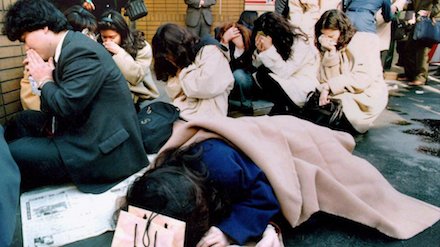
It was only one of several gas attacks perpetrated by Aum Shinrikyo during the 1990s; just nine months previous, they had killed nine people in a sarin attack in Matsumoto. But it is by far the most notorious. Images of stricken commuters, blinded and suffocating under the nerve agent’s influence, sprawled on the transit platforms or outside them shocked orderly Japan in 1995, especially so since it came fast on the heels of the devastating January 1995 Kobe earthquake.

These comprised “two of the gravest tragedies in Japan’s postwar history,” according to Haruki Murakami’s Underground: The Tokyo Gas Attack and the Japanese Psyche. “It is no exaggeration to say that there was a marked change in the Japanese consciousness ‘before’ and ‘after’ these events.” Japanese Justice Minister Yoko Kamikawa struck a similar chord in announcing the hangings today: “These crimes … plunged people not only in Japan but in other countries as well into deadly fear and shook society to its core.”

Its mastermind Shoko Asahara, the first man executed this morning, emerged soon thereafter into public view a bedraggled and half-blind fanatic, almost the picture of an agent of chaos. Shockingly, his cult had been able to thrive in the early 1990s thanks in part to murdering an attorney who was investigating Aum Shinrikyo back in 1989.

Beyond the seven hanged on July 6, 2018, six additional members of the cult still remain under sentence of death in Japan for the Tokyo subway atrocity.

On this day..

1798: Father John Murphy, Wexford Rebellion leader

Catholic priest John Murphy was executed on this date in 1798 for his part in the Irish Rebellion of 1798.


The Black 47 jam “Vinegar Hill” celebrates Father Murphy, imagining him confronting and embracing the choice to rebel …

I return to my prayers
And reflect upon Your tortured lips
But not a word do I hear
Just a veil of silence around the crucifix
And I remember the Bishop’s words
“When faith is gone, all hope is lost”
Well, so be it
I will rise up with my people
And to hell with the eternal cost!

An exemplar of that rare type persuadable to follow his moral commitments all the way out of the safety of a status quo sinecure, Father Murphy initially eschewed the trend towards armed rebellion in 1798.

This outbreak was itself a response to a violent martial law-backed campaign of repression to crush Ireland’s growing United Irishmen movement for self-rule, republicanism, and Catholic emancipation — each of them scarlet fighting words to the Crown. The risings that finally broke out had only scanty success, weakened as they were by months of arrests.

By far the strongest rising occurred in Wexford, so much so that the Wexford Rebellion is nearly metonymous for the Irish Rebellion as a whole. And our man, John Murphy, was a priest in Wexford Town.

Giving due heed to Ecclesiastes, Murphy pivoted quickly from his previous counsel that prospective rebels surrender their arms once he saw an enemy patrol gratuitously torch some homes, a decision that would immortalize his name at the cost of greatly shortening his life.

During the brief existence of the Wexford Republic, the padre surprisingly became one of its prominent combat commanders, and also one of the signal martyrs after the rebels were shattered at the Battle of Vinegar Hill on June 21, 1798.*

Murphy escaped that tragic battlefield only to have his remnant definitively routed a few days later.

He had only a few days remaining him at that point, days of hiding out with his bodyguard, James Gallagher. At last they were captured at a farm on July 2, and subjected that same day to a snap military tribunal and execution delayed only by the hours required to torture him.

After hanging to death, Murphy was decapitated so that the British could mount his head on a pike as a warning.

This 1798 rebellion they were able to crush, but Murphy has survived into legend. He flashes for only an instant in the sweep of history, springing almost out of the very soil into the firmament as an allegory of revolutionary redemption, brandishing together (as Black 47 puts it above) both his missal and his gun.


The ballad “Boolavogue” by Patrick Joseph McCall for the 1898 centennial of the rebellion pays tribute to Father Murphy:

At Vinegar Hill o’er the River Slaney
our heroes vainly stood back to back
And the yeos of Tullow took Father Murphy
and burned his body upon the rack
God grant you glory brave Father Murphy
and open heaven to all your men
The cause that called you may call tomorrow
in another fight for the Green again.

* There was a “Second Battle of Vinegar Hill” … comprising Irishmen but not in Ireland, for it was a convict rebellion in Australia in 1804. One of its leaders, Phillip Cunningham, was a survivor of the 1798 Irish Rebellion.

On this day..

1681: Archbishop Oliver Plunkett, the last Catholic martyr in Great Britain

Archbishop Oliver Plunkett earned the last Catholic martyr’s crown in Britain on this date in 1681.*

Product of County Meath blood and Italian seminary, Plunkett had been back floating around Ireland as its chief prelate since 1670. In this decade, the English-imposed laws burdening Catholics had been relaxed; Plunkett was able to minister his flock, openly at first and after 1673 as a fugitive whom Irish authorities did not much wish to pursue.

Plunkett’s safety speedily expired with the emergence in England of the Popish Plot, a security panic catalyzed like its modern-day analogues by equal parts bad faith and malice.

The concoctions of an opportunistic fabulist caused the English populace to become convinced in 1678 that a vast and treasonable Catholic conspiracy menaced the land; in its day, it was a delusion held so widely and deeply as to cow into silence and compliance all skeptics, even King Charles himself. Charles’s Lord Lieutenant in Ireland, the Earl of Essex, cynically leaned into the hysteria by whipping fears of a Plunkett-hatched invasion of Ireland by the French, although he well knew that Plunkett was “of a … peaceable temper & … comforable to ye Government.”

Plunkett spent months in hiding, refusing to flee Ireland, until he was finally arrested in December 1679. After proceedings in Ireland collapsed, the prelate was moved to London for a more manageable show trial, the entire transcript of which can be perused here.

In it, the Lord Chief Justice Sir Francis Pemberton chastises Plunkett for soliciting time to collect his witnesses, and concludes with a denunciation of the enemy religion that would not look far out fo place in many a present-day comments section.

truly yours is Treason of the highest Nature, ’tis a Treason in truth against God and your King, and the Country where you lived. You have done as much as you could to dishonour God in this Case; for the Bottom of your Treason was, your setting up your false Religion, than which there is not any Thing more displeasing to God, or more pernicious to Mankind in the World. A Religion that is ten Times worse than all the Heathenish Superstitions; the most dishonourable and derogatory to God and his Glory, of all Religions or pretended Religions whatsoever, for it undertakes to dispense with God’s Laws, and to pardon the Breach of them. So that certainly a greater Crime there cannot be committed against God, than for a Man to endeavour the Propagation of that Religion; but you to effect this, have designed the Death of our lawful Prince and King: And then your design of Blood in the Kingdom where you lived, to set all together by the Ears, to destroy poor innocent People, to prostitute their Lives and Liberties, and all that is dear to them, to the Tyranny of Rome and France.

Now tormented that his opportunistic fear-mongering was actually going to lay the archbishop in his grave, Essex implored the Catholic-sympathetic King Charles to spare Plunkett. “Then, my lord, be his blood on your own conscience,” snapped Charles, politically constrained from a beneficence he would have dearly loved to grant. “You could have saved him but would not, I would save him and dare not.”

On the first of July, he was drawn to Tyburn (a stained glass depiction of it can be found in this post), where he was hanged and quartered. (The strange Anglo-Irish plotter Edward Fitzharris preceded Plunkett on the scaffold, as an undercard attraction.) “He won more credit and repute, as well for himself as for his country, by one hour of suffering, than he could have acquired perhaps by hundreds of years of life,” one observer wrote.

This might very well be so. Aside from being the last Catholic martyr in the Isles, Plunkett is among the most warmly remembered, as evidenced by his recent remit as the patron saint of peace and reconciliation in post-Troubles Ireland — not to mention the loving preservation of his relics at St. Peter’s cathedral in Drogheda.

Readers might enjoy this 68-minute lecture on Plunkett’s life and times.


St. Oliver Plunkett’s head preserved in a shrine at Drogheda, Ireland. Photo by DAVID ILIFF. License: CC-BY-SA 3.0

* July 1 by the Julian calendar still then employed in England; by the Gregorian calendar adopted in most Catholic countries at this point, the date was July 11 — and some Catholic primary sources use the latter date.

On this day..

1661: Archibald Campbell

On this date in 1661, Presbyterian lord Archibald Campbell, the first Marquess of Argyll, lost his head at Edinburgh.

Once a privy councilor to King Charles I, “Red Argyll” had been in the 1640s a great champion of Scottish national liberty and a leader of the Presbyterians in the many-sided wars that tore apart the British Isles.

Scotland’s Presbyterians — who favored bottom-up church governance as opposed to the crown-controlled selection of bishops that’s known as episcopacy — made an initial alliance with English Parliamentarians to support one another in their mutual hostilities with King Charles I. And in Scotland’s civil war in the mid-1640s, Argyll’s Presbyterians defeated the Earl of Montrose‘s royalists.

But the failure of Oliver Cromwell‘s similarly victorious Parliament to deliver on its covenant fractured the Presbyterian party and drove Argyll to the political sideline.

Argyll’s own opposition to other Presbyterians’ attempted engagement with the imprisoned Charles I became untenable when, to the horror of his countrymen, Charles was beheaded by Parliament. As his entry in the Dictionary of National Biography notes, Charles’s execution “completely upset his calculations, which had all along been founded on a close union between the parliaments of Scotland and of England … the results of his safe and prudent policy were ruthlessly annihilated … [and] Argyll lost his presence of mind, and therefore his control of events in this stupendous conjuncture, and became as much a puppet in the hands of contending factions as was Charles II.” His growing ranks of foes derisively nicknamed him the “Glaed-Eyed Marquis”, attributing an obvious metaphorical import to his imperfect eyesight.

“Myself encountered so many difficulties that all remedies that were applied had the quite contrary operation,” he later wrote of those years when his influence waned. “[I was] a distracted man of a distracted subject in a distracted time wherein I lived.” It did not wane all at once: Argyll had the honor of crowning King Charles II at Scone on the first of January, 1651, and even tested the king with dynastic marriage inquiries for his daughter. (No dice.)

But as events ran away from him he fell into debt, disgrace, and irrelevancy.

When Charles II resumed the throne in 1660, Argyll presented himself at the court of his would-be father-in-law, and was surprised to find himself immediately thrown in the Tower. Like the Presbyterian cause itself, he was permanently and tragically alienated from both factions of the English Civil War: Cromwell always suspected Argyll a royalist for that whole crowning-the-king thing, and Charles always resented Argyll for his part in the destruction of his father.

The Glaed-Eyed Marquis found himself shipped off to Edinburgh to stand trial for treason. Although records of the trial are lost, it’s said that he was on the verge of total acquittal when Cromwell’s former commander in Scotland, George Monck, delivered a packet of incriminating letters. This story might be apocryphal but Argyll lost his head all the same, on Edinburgh’s distinctive Maiden.

Peruse here Argyll’s tart and downright comical last will and testament, satirizing many of the surviving figures of the day and bidding his heirs to lay his body “so shallow, that at the next trump of sedition, it may by the same raise-devil directory [i.e., Parliament] be conjured up again, and meet my exalted head, that bound-mark of Presbytery, its ne plus ultra, ‘Hitherto shall you go and no further.'”


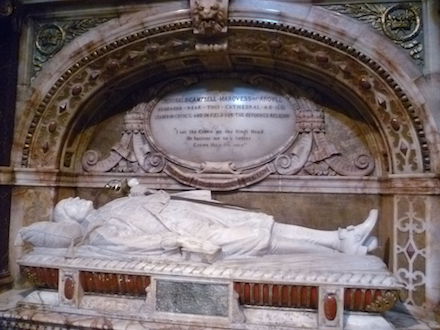
Memorial to Archibald Campbell in Edinburgh’s St Giles’ Cathedral with the epitaph “I set the Crown on the King’s Head. He hastens me to a better Crown than his own.” (cc) image from Kim Traynor.

Argyll’s son and heir, also named Archibald Campbell, was himself executed in 1685 for organizing a Scottish “Argyll’s Rising” against King James II in alliance with the Duke of Monmouth. Their descendants still maintain the rank of Duke of Argyll to this day.

On this day..

Feast Day of St. Baudilus

January 20 is the feast date of Christian martyr Saint Baudilus, patron of Nîmes, France — also known as Baudilio or Baudelio in Spain, where his cult is also quite widespread.

Baudilus supposedly dropped into a festival of the Roman god Vejovis in the late third century and paid his respects by desecrating the pagan shrine, with predictable consequences for Baudilus.

Baudilus was neither a native of that place nor the first to carry the religion of the Galilean there, but his spectacular and confrontational martyrdom granted Baudilus pride of place locally as Christianity rose.

The location of his tomb, called Valsainte, became a pilgrimage destination and eventually the place of a church and monastery; three springs of water were by legend attributed to the holy bounces of the saint’s decapitated head, and an oratory built for them dedicated to Baudilus.

His cult spread widely in southern France and especially in Spain where you can call him Baudilio, Baudelio, or even Boal. There are over 400 churches named for him, notably San Baudelio de Berlanga in central Spain, a hermitage nearing its thousandth year and renowned for its ancient friezes.

On this day..

1389: Fra Michele Berti, “Cristo povero crocifisso”

“This is a truth that resides in me, to which I cannot bear witness if I do not die.”

-Fra Michele Berti, at the stake

On this date in 1389, the Fraticelli friar Fra Michele Berti da Calci burned in Florence as a heretic.

This excommunicate movement of “Spiritual Franciscans” who insisted upon the poverty of an order that had come to enjoy its emoluments had for decades now dogged the Church with a persuasive critique and credo: “io credo in Cristo povero crocifisso,” as our man Michele Berti said to his inquisitors. “I believe in Christ, poor and crucified.”

The quote is from a remarkable surviving account, “La passione di frate Michele” — whose title explicating the saint’s similarity to ancient martyrologies reveals where its sympathies lie. It can be perused online in Italian here or here.

According to the passione, the Florentine populace joined Michele’s persecutors in urging him to reconcile and save his life, as he made his public progress across the city to his death dressed in a mantle painted with demons in a sea of fire. The friar’s steadfastness eventually turned onlookers to his side, so that as his procession neared the Prato della Giustizia, “a believer began to cry out, saying: stand firm, martyr of Christ, who will soon receive the crown.”

Awestruck after Berti went to the pyre singing Te Deum, the crowd began to murmur, and “many said he seems a saint, even his adversaries … and they could not have their fill of railing against the priests.”

In Umberto Eco’s great literary monument to the Fraticelli, The Name of the Rose, the young oblate Adso reminisces at one point of visiting Florence, and of witnessing an execution that appears to be modeled on on this very account including such details as Michael’s criticism of Pope John XXII and Thomas Aquinas, his refusal to kneel before a “heretic” bishop, and the tongue-lashing he gave to skulkcowl Franciscans en route to his death.

A heretic Fraticello, accused of crimes against religion and haled before the bishop and other ecclesiastics, was being subjected to severe inquisition at the time. And, following those who told me about it, I went to the place where the trial was taking place, for I heard the people say that this friar, Michael by name, was truly a very pious man who had preached penance and poverty, repeating the words of Saint Francis, and had been brought before the judges because of the spitefulness of certain women who, pretending to confess themselves to him, had then attributed sacrilegious notions to him; and he had indeed been seized by the bishop’s men in the house of those same women, a fact that amazed me, because a man of the church should never go to administer the sacraments in such unsuitable places; but this seemed to be a weakness of the Fraticelli, this failure to take propriety into due consideration, and perhaps there was some truth in the popular belief that held them to be of dubious morals (as it was always said of the Catharists that they were Bulgars and sodomites).

I came to the Church of San Salvatore, where the inquisition was in progress, but I could not enter, because of the great crowd outside it. However, some had hoisted themselves to the bars of the windows and, clinging there, could see and hear what was going on, and they reported it to those below. The inquisitors were reading to Brother Michael the confession he had made the day before, in which he said that Christ and his apostles “held nothing individually or in common as property,” but Michael protested that the notary had now added “many false consequences” and he shouted (this I heard from outside), “You will have to defend yourselves on the day of judgment!” But the inquisitors read the confession as they had drawn it up, and at the end they asked him whether he wanted humbly to follow the opinions of the church and all the people of the city. And I heard Michael shouting in a loud voice that he wanted to follow what he believed, namely that he “wanted to keep Christ poor and crucified, and Pope John XXII was a heretic because he said the opposite.”

A great debate ensued, in which the inquisitors, many of them Franciscans, sought to make him understand that the Scriptures had not said what he was saying, and he accused them of denying the very Rule of their order, and they assailed him, asking him whether he thought he understood Scripture better than they, who were masters. And Fra Michael, very stubborn indeed, contested them, so that they began provoking him with such assertions as “Then we want you to consider Christ a property owner and Pope John a Catholic and holy man.” And Michael, never faltering, said, “No, a heretic.” And they said they had never seen anyone so tenacious in his own wickedness. But among the crowd outside the building I heard many compare him to Christ before the Pharisees, and I realized that among the people many believed in his sanctity.

Finally the bishop’s men took him back to prison in irons. And that evening I was told that many monks, friends of the bishop, had gone to insult him and enjoin him to retract, but he answered like a man sure of his own truth. And he repeated to each of them that Christ was poor and that Saint Francis and Saint Dominic had said so as well, and that if for professing this upright opinion he had to be condemned to the stake, so much the better, because in a short time he would be able to see what the Scriptures describe, the twenty-four elders of the Apocalypse and Jesus Christ and Saint Francis and the glorious martyrs. And I was told tht he said, “If we read with such fervor the doctrine of certain sainted abbots, how much greater should be our fervor and our joy in desiring to be in their midst?” And after words of this sort, the inquisitors left the prison with grim faces, crying out in indignation (and I heard them), “He has a devil in him!”

The next day we learned that the sentence had been pronounced, and I learned that among the crimes of which he was accused, it was said that he even claimed that Saint Thomas Aquinas was not a saint nor did he enjoy eternal salvation, but was, on the contrary, damned and in a state of perdition — which seemed incredible to me. And the sentence concluded that, since the accused did not wish to mend his ways, he was to be ocnducted to the usual place of execution et ibidem igne et flammis igneis accensis concremetur et comburatur, ita quod penitus moriatur et anima a corpore separetur.

Then more men of the church went to visit him and warned him of what would happen, and said: “Brother Michael, the miters and copes have already been made, and painted on them are Fraticelli accompanied by devils.” To frighten him and force him finally to retract. But Brother Michael knelt down and said, “I believe that beside the pyre there will be our father Francis, and I further believe there will be Jesus and the apostles, and the glorious martyrs Bartholomew and Anthony.” Which was a way of refusing for the last time the inquisitors’ offers.

The next morning I, too, was on the bridge before the bishop’s palace, where the inquisitors had gathered. Brother Michael, still in irons, was brought to face them. One of his faithful followers knelt before him to receive his beneiction, and this follower was seized by the men-at-arms and taken at once to prison. Afterward, the inquisitors again read the sentence to the condemned man and asked him once more whether he wished to repent. At every point where the sentence said he was a heretic Michael replied, “I am no heretic; a sinner, yes, but Catholic,” and when the text named “the most venerable and holy Pope John XXII” Michael answered, “No, a heretic.” Then the bishop ordered Michael to come and kneel before him, and Michael said no one should kneel before heretics. They forced him to his knees and he murmured, “God will pardon me.” And after he had been led out in all his priestly vestments, a ritual began, and one by one his vestments were stripped away until he remained in that little garment that the Florentines called a “cioppa.” And as is the custom when a priest is defrocked, they seared the pads of his fingers with a hot iron and they shaved his head. Then he was handed over to the captain and his men, who treated him very harshly and put him in irons, to take him back to prison, and he said to the crowd, “Per Dominum moriemur.” He was to be burned, as I found out, only the next day.

And on this day they also went to ask him whether he wished to confess himself and receive communion. And he refused, saying it was a sin to accept sacraments from one in a state of sin. Here, I believe, he was wrong, and he showed he had been corrupted by the heresy of the Patarines.

Finally it was the day of the execution, and a gonfalonier came for him, and asked him why he was so stubborn when he had only to affirm what the whole populace affirmed and accept the opinion of Holy Mother Church. But Michael, very harshly, said, “I believe in Christ poor and crucified.” And the gonfalonier went away, making a helpless gesture. Then the captain arrived with his men and took Michael into the courtyard, where the bishop’s vicar reread the confession and the sentence to him.

I did not understand then why the men of the church and of the secular arm were so violent against people who wanted to live in poverty and I said to myself, if anything, they should fear men who wish to live in wealth and take money away from others, and introduce simoniacal practices into the church. And I spoke of this with a man standing near me, for I could not keep silent any more. He smiled mockingly and said to me that a monk who practices poverty sets a bad example for the populace, for then they cannot accept monks who do not practice it. And, he added, the preaching of poverty put the wrong ideas into the heads of the people, who would consider their poverty a source of pride, and pride can lead to many proud acts. And, finally, he said that I should know that preaching poverty for monks put you on the side of the Emperor, and this did not please the Pope. Except that at this point I did not understand why Brother Michael wanted to die so horribly to please the Emperor.

And in fact some of those present were saying, “He is not a saint, he was sent by Louis to stir up discord among the citizens, and the Fraticelli are Tuscans but behind them are the Emperor’s agents.” And others said, “He is a madman, he is possessed by the Devil, swollen with pride, and he enjoys martyrdom for his wicked pride; they make these monks read too many lives of the saints, it would be better for them to take a wife!” And still others added, “No, all Christians should be like him, ready to proclaim their faith, as in the time of the pagans.” As I listened to those voices, no longer knowing what to think myself, it so happened that I looked straight at the condemned man’s face, which at times was hidden by the crowd ahead of me. And I saw the face of a man looking at something that is not of this earth, as I had sometimes seen on statues of saints in ecstatic vision. And I understood that, madman or seer as he might be, he knowingly wanted to die because he believed that in dying he would defeat his enemy, whoever it was. And I understood that his example would lead others to death. And I remain amazed by the possessors of such steadfastness only because I do not know, even today, whether what prevails in them is a proud love of the truth they believe, which leads them to death, or a proud desire for death, which leads them to proclaim their truth, whatever it may be. And I am overwhelmed with admiration and fear.

But let us go back to the execution, for now all were heading for the place where Michael would be put to death.

The captain and his men brought him out of the gate, with his little skirt on him and some of the buttons undone, and as he walked with a broad stride and a bowed head, reciting his office, he seemed one of the martyrs. And the crowd was unbelievably large and many cried, “Do not die!” and he would answer, “I want to die for Christ.” “But you are not dying for Christ,” they said to him; and he waid, “No, for the truth.” When they came to a place called the Proconsul’s Corner, one man cried to him to pray to God for them all, and he blessed the crowd.

At the Church of the Baptist they shouted to him, “Save your life!” and he answered, “Rum for your life from sin!”; at the Old Market they shouted to him, “Live, live!” and he replied, “Save yourselves from hell”; at the New Market they yelled, “Repent, repent,” and he replied, “Repent of your usury.” And on reaching Santa Croce, he saw the monks of his order on the steps, and he reproached them because they did not follow the Rule of Saint Francis. And some of them shrugged, but others pulled the cowls over their faces to cover them, in shame.

And going toward the Justice Gate, many said to him, “Recant! Recant! Don’t insist on dying,” and he said, “Christ died for us.” And they said, “But you are not Christ, you must not die for us!” And he said, “But I want to die for him.” At the Field of Justice, one said to him he should do as a certain monk, his superior, had done, abjuring; but Michael answered that he would not abjure, and I saw many in the crowd agree and urge Michael to be strong: so I and many others realized those were his followers, and we moved away from them.

Finally we were outside the city and before the pyre appeared, the “hut,” as they called it there, because the wood was arranged in the form of a hut, and there a circle of armed horsemen formed, to keep people from coming too close. And there they bound Brother Michael to the stake. And again I heard someone shout to him, “But what is it you’re dying for?” And he answered, “For a truth that dwells in me, which I can proclaim only by death.”

They lit the fire. And Brother Michael, who had chanted the “Credo,” afterward chanted the “Te Deum.” He sang perhaps eight verses of it, then he bent over as if he had to sneeze, and fell to the ground, because his bonds had burned away. He was already dead: before the body is completely burned it has already died from the great heat, which makes the heart explode, and from the smoke that fills the chest.

Then the whole hut blazed up, like a torch, and there was a great glow, and if it had not been for the poor charred body of Michael, still glimpsed among the glowing coals, I would have said I was standing before the burning bush. And I was close enough to have a view (I recalled as I climbed the steps of the library) that made some words rise spontaneously to my lips, about ecstatic rapture; I had read them in the books of Saint Hildegard: “The flame consists of a splendid clarity, of an unusual vigor, and of an igneous ardor, but possesses the splendid clarity that it may illuminate and the igneous ardor that it may burn.”

On this day..