1807: Jenkin Ratford, Chesapeake-Leopard affair casualty

On this date in 1807, the British navy hanged Jenkin Ratford from the yardarm of the HMS Halifax off the coast of Maryland — an incident destined to become a rallying cry for the United States in the ill-fated War of 1812.

The U.S. at this moment was an upstart young country and naturally enough chafed at the lordly interpositions of her recent mother country. Great Britain had the navy, however, so the Americans could chafe all they liked. In the words of the tune that had emerged in the 18th century with Britain’s globe-straddling sea power

Rule, Britannia! Rule the waves
Britons never will be slaves.

The Britons who got to do the grunt work of wave-ruling might disagree.

Seaman in the Royal Navy, and that huge navy needed many seamen, was a harrowingly brutal position often filled by press gangs empowered to grab anyone not able to produce immediate evidence of exemption and have them by next morning swabbing the nearest frigate on a ration of wormy hardtack. Desertion was correspondingly popular and more radical resorts not unheard-of; the mutiny on the Bounty had occurred in 1789; two other mutinies much more alarmingly proximate to Old Blighty took place in 1797.

Britain’s willingness to extend impressment to stopping American ships and seizing crew members who couldn’t produce American identity papers made a great affront to the young Republic — an insulting reminder of its third-rate* place among the nations. Years before while American colonists were kicking redcoat ass in the Revolution, they had dreamt among other things of correcting America’s aggravating dependence on the British fleet. “No country on the globe is so happily situated, or so internally capable of raising a fleet as America. Tar, timber, iron, and cordage are her natural produce,” wrote Thomas Paine in Common Sense. “Ship building is America’s greatest pride, and in which she will, in time, excel the whole world.”

Congress got a start on that project with a 1794 naval act creating the original six frigates of the U.S. Navy. The USS Constitution is the most famous of these; one of her five sisters, the Chesapeake, will figure in the action of this date’s post.

In 1806, two French ships, the Cybelle and the Patriot, struggled into Maryland’s Chesapeake Bay for repairs after being crippled by a storm at sea — stalked by British ships that blockaded the mouth of the Chesapeake to trap them there.

The proximity of American soil proved an irresistible inducement for at least four sailors on the British ships to desert. Three of them — William Ware, Daniel Martin and John Strachan — were American victims of British impressment. The fourth, our man Jenkins Ratford, was a Limey. They then enlisted in the American Navy.

Great Britain’s demands for their return met with steady refusal on the American side. Knowing that the deserters had been posted to the Chesapeake, which was then outfitting for deployment to the Mediterranean, British ships in the vicinity of the North American coast were ordered to stop the Chesapeake on sight to recover the absconders.

This the HMS Leopard did do on June 22, 1807, and with a singular lack of subtlety: the Leopard battered the Chesapeake with broadsides. Shocked and unprepared, the Americans couldn’t even fire back before striking colors and yielding to a humiliating British search that hauled off Ware, Martin, Strachan and Ratford.
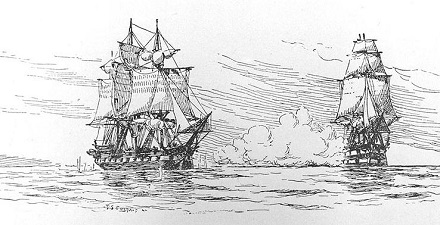

The HMS Leopard (easily recognizable since it’s the only ship firing!) vs. the USS Chesapeake.

While these unfortunates were sailed off to Halifax, Nova Scotia** for their trial, outrage spread on American shores — immediately advised of the incident since the Chesapeake† had had to limp directly back to Norfolk, Va., for repairs. Outrage at the British, but also outrage at the captain who failed to so much as resist the attack (he was court-martialed, and suspended from command for five years), and outrage for the national honor. Some, more vengeful than sensible, wanted immmediate hostilities with Great Britain. “Never since the battle of Lexington have I seen this country in such a state of exasperation as at present, and even that did not produce such unanimity,” U.S President Thomas Jefferson wrote to his friend, the French emigre Dupont de Nemours.‡

Ratford, the only actual British citizen among the shanghaied sailormen, was the only one executed. The Americans “merely” got prison sentences.

At the political level, President Jefferson had a thorny problem. The British could in no way be induced to meet the American demand to end impressment, for simultaneous with the scandal Napoleon was finalizing victories that would knock Britain’s continental allies out of an altogether more urgent war. No derogation of security interests could be entertained, and so for America, no diplomatic satisfaction could be forthcoming.

Instead of war, Jefferson responded by convincing Congress to enact an embargo on trade with Europe. It proved to be a counterproductive policy that damaged the U.S. far more than the European export markets it had intended to punish.

The U.S. and U.K. would come to blows soon enough, and if the War of 1812 was hardly fought because of the Chesapeake-Leopard affair, that incident was certainly among the contributing grievances.

Injuries more directly attributable were not hard to come by, however. When James Barron, the suspended former commander of the Chesapeake, sought reinstatement to the navy, early American naval hero Stephen Decatur opposed him with vehemence sufficient to induce Barron to challenge Decatur to a duel. Decatur was slain in the fight, shockingly pinching out one of America’s leading military figures at the age of 41.

The Chesapeake herself fared little better. The ship was captured by the British in the ill-fated War of 1812, and recommissioned into the hated Royal Navy. Sold off for scrap in 1819, its timbers were repurposed for a long-lived (and now historic) Hampshire watermill — the Chesapeake Mill.

* See what I did there.

** Halifax the city is where they were tried; the HMS Halifax, which was Ratford’s ship prior to desertion, is where Ratford was executed. It’s Halifaxes all the way down.

† Thanks to this incident, the very name “USS Chesapeake” became so blackened in American naval history that it has barely been touched for any vessel since.

‡ Father of the DuPont who founded the DuPont chemical company and made that family perpetual American plutocrats down to the present day.

On this day..

1648: Sir Charles Lucas and Sir George Lisle, royalists

The Death of Sir Charles Lucas and Sir George Lisle, Monday, Aug. 28, 1648

By the old wall at Colchester,
With moss and grass o’ergrown,
The curious, thoughtful wanderer
Will note a small, white stone.
Tis sunken now — yet slight it not;
That stone can speak, and tell
A tale of blood; it marks the spot
Where Lisle and Lucas fell.

On earth there is no abject thing
So abject as a fallen king.
And Charles, despoiled, cashiered, discrowned,
In his own halls a captive bound,
Spurned, crushed by countless ills forlorn,
Drinks to the dregs the cup of scorn.

Yet in that hour of blank despair,
Lisle, Lucas, Capel, Compton dare
Their wrecks of shattered strength to call
To Colchester’s beleaguered wall;
Round Charles, in hope ‘gainst hope to cling
Proclaim, e’en yet, that Charles is king;
And one more mighty effort try
For honour, love, and loyalty.

Vain all the dauntless venture — vain
Their valour, piety, and pain.
Who in the field the foe repels
Grim Famine in the city quells.
The soldier, gaunt and staggering, crawls
From post to post along the walls;
With leaden eyes the townsmen meet,
Like spectres, in the howling street.
No bread within — without, the foe —
No friend, no succour nigh —
The leaguer closer drawn — they know
They needs must yield, or die.

They yield — and Fairfax, bloody heart!
Ere yet the shades of evening part,
Dooms to a sudden, felon grave
Lisle, Lucas, bravest of the brave;
And Ireton, in exultant glee,
Hastes on the murderous tragedy.

“Haste on the murderous tragedy!
Nor let them live another night,
Nor mother, sister, brother see;
Nor give them space to order right
Their souls to meet their Maker’s sight!”

One hour — brief respite! So to prayer,
Last refuge of the soul, they went —
To prayer, and blessed Sacrament;
And then rose up, refreshed, to bear
Whate’er of added scorn or sting
The circumstance of death might bring.

“Lead Lucas forth!” Forth Lucas came,
And on the files of musqueteers
Smiled as in scorn; in step and frame
No trembling, and in soul no fears.
But, as from fields of carnage wet,
He oft had marched to victory,
Though vanquished, fettered, doomed to die,
He stands the victor-hero yet;
And cried, “In battle’s stern embrace
Oft I and death met face to face;
See now in death I death defy,
And mark how Lucas dares to die.”

He bowed his knees a little space,
With clasped hands, and eyes lift up;
And craved of Jesu parting grace
To sweeten pain’s last bitter cup;
Then laid his bosom bare, and cried,
“I’m ready: rebels, do your worst;”
Fell on his face, and groaned, and died,
Pierced with four savage wounds accurst.

“Haste on the murderous tragedy!
Yea, howl aloud for victims more;
And with remorseless butchery,
Let Lisle be bathed in Lucas’ gore.”

He treads the stage of death, his eye
Glancing defiance round —
He sees his brother’s body lie
Stretched on the bloody ground.
Tis more than e’en a Lisle can bear —
The mighty heart gives way;
He weeps amain, and kneeling there
Beside his dead, in love’s despair
Kisses the lifeless clay;
And sobs his requiem: “Oh, my friend,
My brother, thou hast reached thy goal!
Christ is thy rest — Christ me defend;
My spirit with thy spirit blend,
Thou peerless and unspotted soul!”

Then stands erect, the anguish past;
And marks in lines the levelled gun —
“Come nearer, men.” “Nay,” answered one,
“Fear not, good Sir, we’ll hit you fast.”
“Ah!” cried the warrior, “oft in fight
Nearer to me than now ye came;
In field and fort, by day and night
I met you, and ye missed your aim.
And oh, how oft as well ye know,
In hottest blood and deadliest strife,
I checked my hand, and spared the blow,
And sheathed my sword, and gave you life.
I die content; my God shall bring
Grace for my soul’s anneal;
I die for faith, for Charles my King,
And for my country’s weal.”

With invocations loud and deep
On Jesu’s blessed name.
E’en as he prayed, he fell asleep
When the death-volley came.
Where Lucas fell, there Lisle lay dead —
They slept on one same gory bed.
One in their common death; in life
One in the same dread, glorious strife;
As one to live in honour high,
So one in mighty heart to die.
One grave contains the sacred dead —
Go, ponder there awhile;
Then say with pride, “My country bred
A Lucas and a Lisle.”

On this day..

1864: William Howe, deserter

From the Philadelphia Daily Age, Aug. 30, 1864.


In view of the coming draft the Government has found it necessary to hang a man.

The victim selected was a poor man, with a wife and children living in Perkiomen township, Montgomery county. He was a small farmer, with six acres, and engaged occasionally in the manufacture of tobacco and cigars. He lived in a Democratic county and township, where trouble was possible as to the draft, and certain at the election.

He was a man of good character, and ordinarily of gentle disposition. His dying words were: “I commend my wife and little ones to the charity of the world, and I ask pardon of those I may have injured and hope they will forgive me and pray for my soul.”

He was a brave man, had proved it on the battle-field, and as the press report says he told his counsel, “he faced the last music like a soldier.”

Such, in brief, was William H. Howe, of Montgomery county, who, on Friday last, was hanged at Fort Mifflin, where, one of the “loyal” newspapers of this city remarks, “the proceedings were conducted most harmoniously.”


Fort Mifflin as it appeared in 1870. William Howe was the only prisoner ever known to have been executed there.

But this is not all: the Government, in selecting this victim and making this example, was determined to show the Democrats of Montgomery county, that no antecedent merits or services could soften its heart or mitigate its doom of vengeance.

Howe was one of those unfortunate men who, excited by prevalent enthusiasm, and imagining that the authorities would protect their soldiers, enlisted two years ago in a Pennsylvania volunteer regiment. He entered the service in August, 1862, just before Antietam — when Pope‘s army was defeated, and Washington was threatened, and Mr. Lincoln frightened out of his wits.

Howe was one of those of whom Mr. Seward wrote to Mr. Dayton: “Our new levies are coming in in great numbers and in high spirits.” He went through the whole campaign at Fredericksburg, being

one of the five men who came off the field with the colors of his regiment! He exchanged his musket for an Enfield rifle, and again went upon the field with our skirmishers, and remained there all night till next day. He escaped by swimming the Rappahannock river.

Such were his merits, who was ignominiously hanged last Friday.

Now, a word as to his delinquencies. We again quote the loyal reports:

At the time he left the regiment he was suffering from inflammation of the bowels, and the regimental hospital being burned down, and having neither surgeons nor medicines, he, with some twenty others, determined to look out for themselves for treatment and reported themselves to the hospitals at Washington. Afterwards he and Augustus Beiting, a member of his company, returned to their homes.

For some two months afterwards Howe was confined to his bed.

This, we presume, was called “desertion.”

Two poor fellows, wasted by the most agonizing of diseases, with no hospital roof to cover them, and, mark this! gentle reader, who hear of champagne dinners and tableaux in our suburban hospitals, “having neither surgeons nor medicines,” wander back to their homes, and lay their wearied limbs and throbbing temples on the humble bed in Perkiomen. This was the initiate crime, though not the one for which he died. Let us see what that was, for we have no wish to do injustice to the executioners. We do not at all agree with the Press, which says “that having once given the facts, a further statement is superfluous.”

The scene of the crime was his home in Montgomery county.

That county has a Perkiomen township, and a Chiltern township, not many miles apart. Little over a year ago, in the latter township, a poor but most respectable white man, Mrs. Butler’s gardener, walking quietly on a public road, was shot down like a dog by a negro soldier, and died in agony.

For this dark deed of blood, the penalty was a mild conviction for manslaughter, — which it as much resembled as it did arson or burglary, — a sentence for a few years, and, if we mistake not, a pardon.

The negro ruffian, unlike poor Howe, had never done a deed of valor, or probably fired a musket till he pulled the trigger at the wayfarer on the Chiltern lanes. He was one of the League pets — a Chestnut street darling, and had a claim on the sympathy and mercy of those who judge always gently a negro’s fault.

Not so William H. Howe, the white Perkiomen soldier.

His deed of wrong was this: About midnight of the 21st June, 1863, he was awakened from a deep sleep — till then the sleep of innocence — by an alarm supposed to be given by the companion who had accompanied him home, that the Provost Marshal was coming to arrest him.

The first impulse was incredulity. The next, to try to escape. The last, resistance.

The words Provost Marshal, associated in a soldier’s mind with thoughts of severity, and cruelty, and sternness, have an awful sound by day or night. Those who think all Provost Marshals resemble the effeminate fribbles who superintend the draft in our streets, can form no idea of the real spectre.

Howe seized his musket, probably the one he brought in triumph from the bloody field of Fredericksburg, and fired it in the darkness, killing the enrolling officer.

The negro’s deliberate homicide is manslaughter. The white man’s rash or passionate misadventure is capital murder.

“I never,” said Howe on the scaffold, “sought the life of the man I killed. I never wished it, and I feel God will pardon me for taking it as I did.”

This, then, is the deed for which this poor fellow was condemned and died — and for which, in view of the draft, no mercy was found in the hearts of Joseph Holt and Abraham Lincoln.

Of the trial by some unknown, irresponsible military court, of which the prisoner’s prosecutor was the President, we do not care to speak. We think of it as history does of the judges who, a hundred years ago, sent to his bloody grave, according to the forms of martial law, a gallant English sailor, whom the hard-hearted monarch of that day refused to pardon, but executed “to encourage the others.” It is a sad record altogether.

And then the feeble attempt at a habeas corpus in the Federal Court, and the citation of Wolfe Tone‘s case, with its suggestive hint at suicide! The whole thing seems like a hideous mockery.

The Judge’s idea that Howe, like Tone, had waived the writ by appearing before the court martial, seems a little odd, but we do not presume to criticise judicial action, and we are very sure the Judge must have been reluctant to deny relief to a Montgomery county man, one of his former constituents. The writ, however, was refused, and last Friday, the white man was hanged, and the enrolling officer was avenged.

Howe died like a brave man. He parted with his wife and three little children with deep emotion, and then his work was done.

He was taken in an ambulance by a back way from the Penitentiary, now, it seems, used as a military prison, to the river and thence in a boat to Fort Mifflin.

“Neither guard nor prisoner,” says the North American, “uttered one word during the run down to the Fort.” There was quite a crowd to welcome him.

“The steamer Don Juan,” says the Press, “was chartered for the purpose and took down the members of the Press club.”

“The gallows,” kindly loaned by the Inspectors of the County Prison, says the same paper, “was the one on which the Scupinskis, Arthur Spring and Maddocks were hanged.” In other words, the brave Fredericksburg soldier — the Perkiomen volunteer — was ostentatiously disgraced by being put on a level in this respect with mean, mercenary murderers — and Howe died without a murmur or complaint, keeping his word that “he would face the music like a soldier.” And thus the hideous narrative concludes: “The body was taken down and placed in charge of Mr. Black, the Government undertaker, who had it embalmed yesterday afternoon and sent to Howe’s widow.”

And it will be carried to his home — and the embalmer, proud of his skill, will take off the coffin lid, and the widow and the three little children will look at the swollen and blackened features of him they loved so well, and they will think of the pride with which he used to tell, and the interest with which they used to listen to the tale of his rescuing the regimental flag at Fredericksburg — and the neighbors will come and look, and in many a lacerated and agonized heart the question will be asked, “why was there no mercy for him?”

The Fishing Creek Confederacy details Civil War draft resistance in a different Democratic region of Pennsylvania.

To us the whole thing seems simply horrible; and badly as we think of it, doubly atrocious will have been the deed, if the reason given for this execution be the true one. The Press, which may certainly be considered the organ of the Administration here, thus accounts for the severity in this case:

The deceased exhibited great bravery at the first battle of Fredericksburg, and after several color bearers had been shot down, he seized the standard and bore it through the heat of the contest. These were noble traits, which he is yet entitled to. It is very evident that he did not intend to kill Mr. Bartlett, but society at that time, in that part of Pennsylvania, was tainted with Copperheadism, and it may be well supposed that the draft resisting, dark lantern conspirators had the effect to instil in the mind of Howe some of the poison for which their victim was hung instead of themselves.

According to this, this brave soldier was hanged because he lived in a Democratic region. The negro of the Chiltern Hills was spared because Government bankers, and Abolition lecturers and shoddy contractors there do congregate, and the township gives a Republican majority.

The patience of the people of Pennsylvania really seems inexhaustible; and all we can hope to do is to help to make up the awful record of atrocity for the long deferred, but inevitable day of retribution.

On this day..

1901: Three Boer rebels against the Cape Colony

On this date in 1901, Petrus Jacobus Fourie, Jan van Rensburg, and Lodewyk Francois Stephanus Pfeiffer were shot by the British at Graaff-Reinet.

They were among the numerous subjects of the British Cape Colony whose sympathy with the independent Boer republics which Britain was in the process of conquering extended so far as aiding their Dutch brethren’s resistance. In this case, the young men joined the famed Boer guerrilla Gideon Scheepers — and whatever one might say about the fuzziness of ethnic and national identity in a frontier region, this rated in London’s eyes as rebellion.

On July 6, 1901, Scheepers executed a raid on the town of Murraysburg — “Scheepersburg”, he called it — and put loyalist houses to the torch.

The British Gen. John French sent columns of men into the rugged Camdeboo Mountains in an effort to trap the irksome commando. Scheepers and most of his troop of about 240 men escaped, but about 27 or 28 Cape Colony rebels were captured (along with a few free staters, who could not be charged as rebels).

A particularly revolting incident happened in the execution of the three who were shot. This was, that the firing parties were a body of ten men, five with ball, and five with blank cartridges. After the word “present,” which brings the rifle to the shoulder, one of them “‘pulled off” before the command “fire” was given, and the bullet blew off the top of one man’s head.

-British guard Wilfrid H. Harrison in his Memoirs of a Socialist in South Africa

Eight of these people were executed as rebels over the ensuing weeks, with the aid of Jan Momberg, one of their erstwhile mates who turned Crown’s evidence against them to save his own life.

After Fourie, van Rensburg and Pfeiffer were shot on Aug. 19, Ignatius Nel and Daniel Olwagen — both teenagers — died at Graaff-Reinet on August 26; and, Hendrik van Vuuren, Fredrick Toy and Hendrik Veenstra were shot at Colesberg on September 4.

Though the British made an effort to obscure the final resting-places of these potential martyr figures, their graves were located. Fourie, van Rensburg and Pfeiffer, along with Ignatius Nel and Daniel Olwagen, are among the men subsequently exhumed and placed in a collective grave. A monument in Graaff-Reinet honors these and three other guerrillas executed there … one of whom is Gideon Scheepers himself, who was captured in October of 1901 and executed the following January.

There’s a good deal more about Scheeper’s rebels, and these men in particular, in a two-part article by a descendant of van Rensburg here: part 1 | part 2.

On this day..

1817: Not Hall or Read, prosecuted for blood-money

Miscarriages of justice perpetrated by actors in a position to extract private benefit from generating criminal prosecutions is a story as old as the hills. This one, as reprinted in the London Morning Chronicle, Aug. 25, 1817, at least has a happy ending:

EXTRAORDINARY CIRCUMSTANCE

Two soldiers, named Hall and Morrison, were on the 26th July tried for a highway robbery at the Stafford Assizes, before Baron Garrow, convicted, and ordered to be executed. They were prosecuted by a man named Read, a bricklayers labourer, who swore that they knocked him down and robbed him of a shilling and a penny, in a church-yard at Wolverhampton, on the 23d July. The evidence of the woman in whose house the prisoners resided, went to prove that they did not sleep at home on the night of the imputed robbery. To those two witnesses the evidence was confined, and against it there appeared nothing upon the trial, except the declarations of the prisoners, containing facts which were afterwards sworn to be others, and which, after the utmost labour of a few benevolent persons, were the means of saving the innocent prisoners from a death which appeared to all to be inevitable.

The two soldiers were, upon the 23d of July, drinking at an hour too late for admission at their lodging at Wolverhampton, and, after applying in vain to be allowed to go into the guardroom to sleep, walked about the village to kill time.

In loitering through the church-yard they met a man who seemed to be in want of work, and, like themselves, without a lodging for the night. A conversation ensued, and the stranger told them his name was Read; that he was a bricklayer’s labourer out of employment, and a Hertfordshire man.

It happened, that in his description he hit upon the part of the country from which one of the prisoners came. A jesting dialogue took place between them, and at length it was agreed that they should wrestle.

Hall was the friendly opponent of Read upon the occasion, and he was thrown in the first round of wrestling. In the second, however, Hall was more successful in the feat of activity, but his triumph nearly robbed him of his life. The vanquished man dropped a shilling and a penny from his pocket. Morrison immediately picked up the money, said it would do for beer, and put it into his pocket. The soldiers quizzed Read about his loss, and were heard by a watchman near the spot acknowledging that they had the shilling, and would certainly dispose of it in the most convivial way.

Read growled about his money, and showed a disposition to quarrel, but did not utter a word about his being robbed of it. About five o’clock in the morning the three were seen near the market-place by another watchman, and the soldiers were bantering Read upon the same subject.

The good humour of Read, however, at this time, appeared quite broken up; he spoke of having the soldiers taken into custody, but was answered by a laugh from them. A grocer, named Powis, saw them all under similar circumstances, and heard Read complain of no attempt at robbery, but saw that he was not pleased at being laughed at.

The grocer soon after met a man named Roberts, the keeper of the House of Correction at Wolverhampton, and mentioned to him that Read said two soldiers had got his money. The answer of Roberts, which did not strike the grocer as extraordinary at first, was, “I must see that man; this is a good job.”

The event, however, soon explained the language. Roberts immediately inquired after Read, questioned him upon the loss he had sustained, and in a very short time apprehended the two soldiers upon the charge of robbing Read in the highway of a shilling and a penny. Before the magistrate, Read swore that the soldiers knocked him down and robbed him of his money in the church-yard. Their commitment was immediately made out, and they were sent to the Assizes of Stafford, where, on the Saturday following they were tried and condemned for the capital offense.

The inhabitants of Wolverhampton knew nothing of the intention of Read upon the interference of Roberts in this transaction. It was generally concluded amongst them that the angry state of mind in which Read appeared, would have influenced him to swear a common assault, but nothing at all serious was apprehended from the wrestling bout. There was consequently no interference upon the part of those who were acquainted with many of the circumstances; and the matter died away until the village was struck with horror at an account in the Stafford paper of the proceedings of the Assizes. An old man was reading the paper in an ale-house to a number of politicians, who were not much affected at any thing they heard until he came to that part which stated the number of persons left for execution. Amongst the names were those of Hall and Morrison. The whole population of Wolverhampton instantly showed how they felt upon an occasion so dreadful.

The Rev. Mr. Guard, one of the most venerable characters in that part of the country, who officiates in the village where Hall’s family resides, upon hearing the event of the trial, set out for Wolverhampton, where he found the people already meeting and acting upon this subject. The men were to be hanged this day (Saturday last), and not a moment was to be lost. Mr. Guard, who had known Hall from his infancy, and would have staked his life upon the integrity of the young man, made a quick but deep inquiry into the facts, and having found every thing confirmatory of his innocence, followed Baron Garrow on his circuit to state what he had learned from the very best authority, and obtain a respite.

He saw Mr. Baron Garrow, but his Lordship appeared to see no reason to alter the opinion which he had formed from hearing the trial. The worthy Clergyman, however, was so well convinced of the truth of his own information, that he could not help exclaiming, with more zeal than discretion, “I see you are determined to hang these poor men.”

Mr. Baron Garrow was naturally offended at this intemperate observation, and an eminent Barrister remarked, that Mr. Guard’s object was wholly defeated by the use of it.

Mr. Guard was not, however, to be turned from the endeavour to save the lives of the two soldiers; there was another quarter to which he could apply. He immediately came to town, and went without ceremony to Lord Sidmouth, to whom he obtained an easy access. He remained in conversation with his Lordship between three and four hours, and Lord Sidmouth afterwards declared, that he never in his life saw such an interest taken in the fate of men who were not related by domestic ties to the individuals whom he was labouring to save. This meeting gave Mr. Guard hopes; though Lord Sidmouth had observed, that in cases of this kind the Judge was necessarily better acquainted with all the bearings of the evidence than the Secretary of State, and therefore his power was seldom interfered with, except under circumstances of strong fact.

Mr. Guard posted back to Wolverhampton the moment after he parted from the Secretary. A meeting of the inhabitants was called, at which Mr. Mander, and all the other respectable residents of Wolverhampton attended.

The witnesses were sworn, and a Petition to the Prince Regent was signed and delivered into the hands of Mr. Guard, who, accompanied by Mr. Charles Mander, very soon after arrived in town. These two gentlemen went, with Mr. Pearsall, of Cheapside, to Lord Sidmouth, and put into his hands the evidence of the innocence of the soldiers. His Lordship requested that Mr. Pearsall would relate the circumstance.

That gentleman repeated the manner in which Read and the two soldiers had acted in the presence of the watchmen and the grocer. Lord Sidmouth was just going up with the Recorder’s Report, and said, that upon his return he would examine the affidavits, and act upon them. Mr. Pearsall observed, that the men were ordered for execution on Saturday, but was assured by his Lordship that their case should not be neglected, and that the affidavits should be laid before the Attorney-General.

Upon the next meeting, Lord Sidmouth said there had been no necessity for laying the affidavits before the Attorney-General. The case, he observed, was one of the most interesting that ever came before him.

Indeed, such was the effect of the affidavits upon him, that he was not only immediately convinced that the soldiers should not be executed, but, in the absence of his clerks, he wrote the dispatch for their respite with his own hand, and sent it to the Sheriff; “because,” said his Lordship, “I could not endure the thought that the soldiers should have one hour more of unnecessary anxiety.”

Mr. Pearsall said there was no doubt that the men had no intention of felony; it would also appear, at another time, that the prosecutor had no intention of indicting them, until he was instigated by Roberts, with the view of gaining the reward called “Blood-money,” which was accordingly pocketed by Read and the keeper of the prison, to the amount of 80l.

Lord Sidmouth declared, that, under such circumstances, an immediate investigation should take place. He coincided in the opinion of the impropriety of Roberts’s conduct, and said a pardon would be instantly granted to the soldiers. He also complimented, in the warmest manner, the conduct of Mr. Guard and the other gentleman, who had exerted themselves. In the course of his observations to Lord Sidmouth, Mr. Guard said he would give up half his fortune to save the life of Hall, so convinced was he of his honesty.

While these operations were going forward in London, affidavits, copied from those handed to the Secretary, were brought to Mr. Baron Garrow by Lieut. Buchanan, of the same regiment as the soldiers, and a respite was instantly granted by his Lordship when he read them.

The Officer stated, that Baron Garrow, upon reading the affidavits, said, if the facts had been known before, their respite should have been granted; and asked whether they would, upon being pardoned, be taken into the regiment again? Lieutenant Buchanan immediately replied, that they would be most gladly received.

On this day..

1575: Charles du Puy-Montbrun, unequal

The intrepid Huguenot commander Charles du Puy-Montbrun was beheaded on this date in 1575.

We turn for this account to a 19th century history in the public domain by Henry Martyn Baird:


Whatever military advantages the Huguenots obtained in various parts of the realm were more than outweighed by the death of “the brave Montbrun.”

This daring and energetic leader, the terror of the enemy in Dauphiny, had just defeated a large body of Swiss auxiliaries, upon whom he inflicted a loss of eight or nine hundred men and eighteen ensigns, while that of the Huguenots scarcely amounted to half a dozen men.

But his brilliant success in this and other engagements had made Montbrun and his soldiers more incautious than usual.

They attacked a strong detachment of men-at-arms, and mistaking the confusion into which they threw the advance guard for a rout of the entire body, dispersed to gather the booty and offered a tempting opportunity to the Roman Catholics as they came up.

Montbrun, who, too late, discovered the danger of his troops, and endeavored to rally them, was at one time enveloped by the enemy, but would have made good his escape had there not been a broad ditch in his way. Here his horse missed its footing, and in the fall the leader’s thigh was broken.

In this pitiable plight he surrendered his sword to a Roman Catholic captain, from whom he received the assurance that his life would be spared.

The king and his mother had other views.

Henry, on receiving the grateful news of Montbrun’s capture, promptly gave orders that the prisoner be taken to Grenoble and tried by the Parliament of Dauphiny on a charge of treason.

Vain were the efforts of the Huguenots, equally vain the intercession of the Duke of Guise, who wished to have Montbrun exchanged for Besme, Coligny‘s murderer, recently fallen into Huguenot hands.

Henry and Catherine de’ Medici were determined that Montbrun should die. They urged the reluctant judges by reiterated commands; they overruled the objection that to put the prisoner to death would be to violate good faith and the laws of honorable warfare.

Catharine had not forgotten the honest Frenchman’s allusion to her “perfidious and degenerate” countrymen.

As for Henry, an insult received at Montbrun’s hands rankled in his breast and made forgiveness impossible. Some months before, the king had sent a message to him in a somewhat haughty tone, demanding the restoration of the royal baggage and certain prisoners taken by the Huguenots.

“What is this!” exclaimed the general. “The king writes to me as a king, and as if I were bound to obey him! I want him to know that that would be very well in time of peace; I should then recognize his royal claim. But in time of war, when men are armed and in the saddle, all men are equal.”

On hearing this, we are told, Henry swore that Montbrun should repent his insolence.

In his glee over the Huguenot’s mishap he recalled the prophecy and broke out with the exclamation, “Montbrun will now see whether he is my equal.”

Under these circumstances there was little chance for a Huguenot, were he never so innocent, to be acquitted by a servile parliament.

Accordingly Montbrun was condemned to be beheaded as a rebel against the king and a disturber of the public peace. The execution was hastened last natural death from the injury received should balk the malice of his relentless enemies.

A contemporary, who may even have been an eye-witness, describes the closing scene in words eloquent from their unaffected simplicity.

He was dragged, half dead, from the prison, and was carried in a chair to the place of execution, exhibiting in his affliction an assured countenance; while the Parliament of Grenoble trembled and the entire city lamented. He had been enjoined not to say a word to the people, unless he wished to have his tongue cut off.

Nevertheless he complained, in the presence of the whole parliament, of the wrong done to him, proving at great length his innocence and contemning the fury of his enemies who were attacking a man as good as dead. He showed that it was without cause that he was charged with being a rebel, since never had he had any design but to guarantee peaceable Frenchmen from the violence of strangers who abused the name and authority of the king.

His death was constant and Christian. He was a gentleman held in high esteem, inasmuch as he was neither avaricious nor rapacious, but on the contrary devoted to religion, bold, moderate, upright; yet he was too indulgent to his soldiers, whose license and excesses gained him much ill-will and many enemies in Dauphiny. His death so irritated these soldiers that they ravaged after a strange fashion the environs of Grenoble.

The death of so prominent and energetic a Huguenot captain was likely to embolden the Roman Catholic party, not only in Dauphiny but in the rest of the kingdom. In reality, it only transferred the supreme direction in warlike affairs to still more competent hands.

The young lieutenant of Montbrun, who shortly succeeded him in command, was Francois de Bonne, better known from his territorial designation as Sieur des Lesdiguieres, a future marshal of Henry the Fourth.

Although the resplendent military abilities of Lesdiguieres had not yet had an opportunity for display, it was not long before the Roman Catholics discovered that they gained nothing by the exchange.

Lesdiguieres was as brave as his master in arms, and he was his master’s superior in the skill and caution with which he sketched and executed his military plans. The discipline of the Huguenot army at once exhibited marked improvement.

On this day..

1849: Konrad Heilig and Gustav Tiedemann, Baden revolutionaries

Konrad Heilig and Gustav Tiedemann, two officers who joined the Baden Revolution(s) of 1848-1849, were shot on this date in 1849.

In southwest Germany’s edition of the revolutionary wave that swept Europe in 1848, Baden’s radical democrats attempted to topple the Grand Duchy of Baden in hopes of uniting with a (still aspirational) greater Germany.

Two separate risings were easily defeated in 1848.

Baden revolutionaries’ last gasp came in May-June 1849; its progress in detail is explored in a public domain volume, An Account of the Final Struggle, in Baden, for the Maintenance of Germany’s First National Representative Government.

Remnants of the left in Baden, exiles from the last go-rounds, and sympathetic soldiers who mutinied at the fortress of Karlsruhe and Ratstatt declared yet another abortive republic. Although the disturbance briefly forced Grand Duke Leopold to flee, other German states allied with Leopold’s exiled government to crush the rebellion. Revolutionary Baden had no chance in a test of arms against Prussia, which defeated the rebellion at Waghausel, then reduced the holdout fortress of Ratstatt. In all, 19 were shot there as rebels between August and October of 1849.

Rastatt saw the most blood flow in the execution of the law as enforced by the invaders. Here leader after leader was laid low, and his body thrown, without coffin or funeral service, into a big ditch prepared in the northern end of the cemetery. One day it was Major Konrad Heilig, the commander of the Rastatt artillery, who as a non-commissioned officer had been the pride of his men, as well as the tallest man in the army. He walked calmly to the place of execution smoking a cigar, and only when force was threatened allowed himself to be blindfolded …

Colonel Tiedemann … had been originally a lieutenant in the Baden army, [and] was the son of a well-known professor in the Heidelberg Uiversity, had gone to Greece and fought in the army of the country, and had a Greek wife and a young son in that far-away land …

In the year 1873, friends and companions-in-arms of the dead asked permission to erect a gravestone common to all those interred there; the Baden government offered no objection but Prussia stepped in with its veto, and the burial-place is still unmarked, although visited yearly by pilgrims from all parts of the world.

On this day..

1676: Matoonas, a Nipmuc shot on Boston Common

On this date in 1676, an indigenous Nipmuc named Matoonas was marched into Boston, condemned by a summary judicial proceeding, and immediately shot on Boston Common.

Though he was a so-called “Jesus Indian” — a converted Christian — Matoonas had become a principal adversary of the European colonists once long-building tensions exploded into King Philip’s War.

To the communal grievances that made up this war, Matoonas brought a very personal injury: back in 1671, his son Nehemiah had been accused by English colonists of murder and executed on that basis. And not just executed, but his rotting head set up on a pike at the gallows, to really rub it in.

Matoonas bided his time, but when the opportunity to fight back arrived he joined King Philip (Metacomet) with gusto. On July 14, 1675, Nipmuc warriors under his command raided the town of Mendon, Massachusetts, leaving five dead — the very first Anglo casualties of the war.

“A dark cloud of anxiety and fear now settled down upon the place,” a bicentennial a Rev. Carlton Staples recalled in a bicentennial address on Mendon’s history 1867. “With tears and lamentations they tenderly gathered the bodies of the slain and laid them away in some pleasant spot, we know not where. The houses and farms remote from this central point were abandoned, and the people fled to other places, or gathered here to save their flocks and growing crops. All sense of security was gone. They only dared to go abroad in companies. While some worked in the fields and gardens, others watched for the lurking foe.” A few months later, the settlers had to abandon Mendon altogether, and the Nipmuc burned the ghost town to the ground.

But the tide of the war soon turned against the natives, and Matoonas would find that he had his own lurking foe.

Sagamore John comes in, brings Mattoonus and his sonne prisoner. Mattoonus shot to death the same day by John’s men.

–diary of Samuel Sewall

A mysterious Nipmuc leader known as Sagamore John (“Sagamore” designates a sachem or chief) betrayed Matoonas in exchange for a pardon from the Massachusetts colony, marching Matoonas and his son right into Boston on the 27th of July.

After an improvised tribunal set down the inevitable punishment, Matoonas was lashed to a tree on Boston Common. Sagamore John performed the execution himself — although whether he volunteered or “volunteered” is not quite clear. The late Nipmuc raider’s head, too, was set on a pole — just opposite Nehemiah’s.


Memorial to Sagamore John in Medford, Mass. (cc) image from David Bruce.

On this day..

1918: Private David Stevenson, repeat deserter

(Thanks to Meaghan Good of the Charley Project for the guest post. -ed.)

On this dayJuly 18 in 1918, in Bully-Grenay in war-torn France, Private David Stevenson* of the Lowland Field Artillery was shot by the British Army for desertion and insubordination. “His record,” notes Cathryn Corns and John Hughes-Wilson in their book Blindfold and Alone: British Military Executions in the Great War, “is one of the longest amongst all surviving records of courts martial.”

Private Stevenson enlisted on August 17, 1915 and began misbehaving almost immediately. His disciplinary record can be summarized as follows:

September 1, 1915: AWOL, six days
September 13: AWOL, one day
September 18: AWOL, four days
September 30: AWOL, five days
October 5: AWOL, one day
October 7: AWOL, one day
October 11: AWOL, seven days
October 20: Malingering
January 15, 1916: AWOL, twenty-eight days
March 17: Drunk and disorderly
April 2: Drunk and disorderly
April 24: Escaping from a hospital
May 14: AWOL, nine days
May 28: Creating a disturbance, damaging public property
May 30: Noncompliance with an order
May 31: Creating a disturbance, damaging public property
June 7: AWOL, two days
June 14: AWOL, three days
July 15: AWOL, eighteen days
August 19: AWOL, seventy-four (!) days
November 18: AWOL, one day
November 21: Insolence to an NCO
December 1: AWOL, seven days
December 18: AWOL, eighteen days

In 1917, Pte. Stevenson was shipped out to France. Somehow he managed to maintain a clean record for several months, but soon he was back to his old habits again:

August 18, 1917: Lying to an NCO and hestitating to obey an order
August 27: Losing a folding saw by neglect
October 22: Desertion; tried by the Field General Court Martial (FGCM) and sentenced to five years in prison
December 20: Drunk in camp, entering a guard tent without permission, resisting escort.
March 8, 1918: AWOL, fifty-two days.

Apprehended on April 29, Stevenson was locked up at Army headquarters and was admitted to the No. 55 Casualty Clearing Station on May 5. He was supposed to get cleaned up and then returned to headquarters the next day, but instead he flew the coop. He later claimed he had just gone out for a walk and then got afraid he’d get into trouble if he went back, so he just “loitered about” until he was arrested three days later.

At his court martial, David Stevenson pleaded for mercy, saying, “If I could get another transfer to another regiment, I could prove myself a soldier.”

But by then the Army had had quite enough of him. His brigade commander wrote, “To my mind there are no redeeming points in this case.” General Henry Horne, 1st Baron Horne, agreed.

The authors of Blindfold and Alone note that Stevenson’s case left puzzling questions: “With his bad record, Stevenson must have known he was heading for a death sentence, and yet persisted with the behavior which would inevitably lead to his execution.” Why?

Lt. Gen. Sir Aylmer Gould Hunter-Weston summed up his superiors’ take on it nicely when he said Stevenson’s conduct could “only be explained by his obvious and habitual tendency to avoid all authority.”

* Not to be confused with the present-day British historian of the First World War also named David Stevenson.

On this day..

1865: Okada Izo, barbarian-expeller

On this date in 1865, the Japanese samurai Okada Izo was dispatched by crucifixion.

He was one of* the “Four Hitokiri“ — manslayers — whose legendary blades coruscated in the Bakumatsu era that marked Japan’s pivot from an isolationist feudal state, one where samurai were big men on prefectures, to a burgeoning modern power ruled by industry and mass conscription.

The irony was that dinosaurs like the Hitokiri helped bring the asteroid down on their own heads.

During the chaotic Bakumatsu period, triggered by Japan’s becoming involuntarily opened to the outside world, the emperor — long a figurehead marginalized by the shogun — entered the political fray under the xenophobic banner “revere the emperor, expel the barbarians.”

Warriors/assassins like the Hitokiri were wooed by the imperial camp and the promise of a policy that would maintain the purpose and privilege of elite swordsmen. But once power was conquered, the Meiji emperor repaid those knights’ exertions by doing the modernization thing that Hitokiri types had hoped to avoid.

Okada Izo was among the first barbarian-expellers to be caught up by the policy swing. After a couple of years running amok in Kyoto, the anti-foreigner movement was suppressed and its leader forced to commit seppuku, which was still more deference than Izo received.

The execution, usually conceived as the end, is the jumping-off point for the surreal time-and-space-hopping 2004 Takasha Miike bloodbath Izo, “one of the most difficult works of art to be made in recent times.”

* Along with fellow-execution victim Kawakami Gensai, and two other guys who met violent deaths that were not (more’s the pity for this site) executions.

On this day..