1862: James Andrews’s raiders, for the Great Locomotive Chase

On this date in 1862, seven federal raiders were hanged in Atlanta for the daring heist of a Confederate train two months prior. Among them were some of the very first Congressional Medal of Honor awardees.

In terms of its impact on the Civil War, the “Great Locomotive Chase” was a bust. But as pure Americana, you’ll have a hard job to top this caper.

The chase began a year to the day after the first shots had been fired between North and South. Despite the anniversary, the occasion promised nothing but the routine northbound passenger run for the locomotive General from Atlanta to Chattanooga, Tenn.

This line was a spur of the Confederate rail network, and we have already noted in these pages the interest that network held for pro-Union saboteurs. Chattanooga was its great hub: telegraph and rail lines from every quarter of the Confederacy converged there like the center of a spiderweb.

For this reason, Union Gen. Ormsby Mitchel, who had just occupied Huntsville, Ala., aspired to swing his army north to strike this vital city. His bold commandos nonchalantly boarding the northbound train this day were part of Mitchel’s larger operation: cut the rail line from Atlanta to prevent timely reinforcement of Chattanooga, then quickly conquer the strategic city.* Gen. Mitchel was 28 miles from Chattanooga on April 12, 1862, and if his special agents could turn their trick then the whole course of the war might change.

Not long after 5 a.m. on that April 12, the General pulled into a depot at Big Shanty (today, Kennesaw, Ga.). It had a short layover there for breakfast at the adacent Lacey Hotel.

But more important to the raiders’ leader James J. Andrews was what Big Shanty did not have: a telegraph.

While the train’s passengers and crew were settling in for the most important meal of the day, Andrews’s raiders efficiently decoupled the locomotive, its coal tender, and three box cars from the passenger cars. Most of the raiders loaded into the boxcars to be ready as muscle for the crazy flight ahead. But the day was to be a match of speed and ingenuity between the Union daredevil Andrews, and the Confederate train conductor William Fuller — who for the start could only watch in astonishment over his coffee as his General unexpectedly pulled away.

With no telegraph in the vicinity, Fuller had no way to send word up the line to stop the General. But umbrage either patriotic or professional carried him from that first moment in a Javert-like pursuit of his commandeered locomotive.

Fuller dashed out of Big Shanty and up the train tracks on foot with his team. It’s not as crazy as it sounds: negotiating hilly terrain, the General would be making only 15 or 20 miles per hour at speed — and she stopped regularly, to foul the rails behind her, and to cut the telegraph wire. Throughout the chase, or at least until its very last stretch, the Union men managed to keep the next station ahead ignorant of the General‘s treasonable mission by snipping telegraph wire, so on the occasions when they had to stop and answer to a Western & Atlantic Railroad official they were able to bluff their way onward with a story about driving a “powder train” requisitioned by General Beauregard himself.

But those stops took time, and Fuller’s dogged pursuit did not leave Andrews’s raiders much of that to spare.

A couple of miles up the line, Fuller et al found an old handcar, and were able to take to the rails themselves. Near 20 miles into the chase, they were able to commandeer a short-line locomotive, which took them to Kingston where they switched to a mail train. Neither of these vehicles could match the General‘s horsepower; however, Andrews had to keep stopping to cut more telegraph wires or to pry up a rail, and he really got pegged back when the General had to defer to other rail traffic on the single-line route. For instance, the Union commandos spent a frustrating hour on the siding at Kingston waiting out southbound trains.

Andrews’s party did not know for sure at this point that there was a pursuer making good use of this hour. But even so, they had a challenge to spend the scarce resource of time with their hijacked locomotive to best effect.

The objective of the raid was to wreck the Atlanta-Chattanooga rail line, in a way that would put it out of commission for many days and give Gen. Mitchel leave to overwhelm Chattanooga — something like firing a bridge or collapsing a tunnel. The stops they made as they passed various stations to cut the telegraphs or laboriously crowbar up a bit of the rail were essential to give them the ability to cover the next few miles, and bluff past the next station. But thanks to Fuller’s pursuit, there was not after these time-consuming little acts of sabotage a sufficient opportunity to accomplish the tactical purpose of the hijacking.


An extensive collection of links and images relating to the entire route of the chase is here.

In the coolest final stage, the segment most properly called the “Great Locomotive Chase”, Fuller’s gang grabbed a southbound locomotive, the Texas, and without bothering to turn it around they slammed it into reverse in hot pursuit of the northbound General.

The federals in the General tried dropping timbers, and even cutting loose boxcars behind them as railbound battering rams aimed at their inexorable hunter. The Texas kept coming.

By the time the Union boys reached a wooden covered bridge over the Oostanaula, it was apparent that the locomotive would soon exhaust her fuel. Still, the churning plumes of the backward Texas loomed just a few minutes behind. In his last chance to do what he had set out for, Andrews torched his final remaining box car and released it into the wooden bridge, hoping to set the entire structure ablaze and collapse it into the river. Unhappily for the General‘s illicit crew, looking backwards with desperate hope as their ride chugged off, boards sodden by a week’s worth of springtime rain showers stubbornly refused to kindle … and then the Texas arrived to clear away the incendiary.

As its fuel dwindled and its adversary closed, the General came to the end of her legendary run about 18 miles from Chattanooga. Andrews and party abandoned their engine to history and scattered into the woods — but none escaped the immediate Confederate manhunt.


The twenty raiders, plus two others who were supposed to be part of the operation but missed their rendezvous, were all court-martialed as spies: “lurking in and around Confederate camps as spies, for the purpose of obtaining information,” a description bearing very scant resemblance to their actual activities. Eight would hang on this basis.

The intrepid ringleader James Andrews, who was a civilian, was executed in Atlanta on June 7, all alone. His mates only learned of his fate while sitting at their trial in Chattanooga — an experience described in a memoir by one of their number, William Pittenger.

As the trial of different ones proceeded, we had still greater encouragement from the court itself. Members called on us, and told us to keep in good heart, as there was no evidence before them to convict any one. This cheered us somewhat, but there was still one thing which I did not like, and which looked as if something was wrong. The court would not let our boys be present to hear the pleading of counsel on either side, though they urgently requested it. They could neither hear what our lawyers had to say for them, nor what the Judge Advocate urged against them.

…

The trials proceeded rapidly. One man was taken out each day, and in about an hour returned. The table in the court room was covered with bottles, newspapers, and novels, and the court passed its time during trial in discussing these. This was very well if the trial was, as they said, a mere matter of formality; but if it was a trial in earnest, on which depended issues of life or death, it was most heartless conduct.

At last the number of seven was reached, and they would probably have proceeded in trying others, had not General Mitchel, who was continually troubling them, now advanced, and shelled Chattanooga from the opposite side of the Tennessee river. This at once broke up the court-martial, and sent the officers in hot haste to their regiments to resist his progress. Soon after, General Morgan advanced through Cumberland Gap, and threatened Knoxville, which also rendered it necessary to remove us.

Evacuated to Atlanta, they there “remained for a week in quietness and hope, thinking the worst of our trials were past,” Pettinger wrote. “Little did we foresee how fearful a storm was soon to burst over us.”

For its topicality to our site, we here excerpt Pettinger’s chapter 11 at some length:

One day while we were very merry, amusing ourselves with games and stories, we saw a squadron of cavalry approaching. This did not at first excite any attention, for it was a common thing to see bodies of horsemen in the streets; but soon we observed them halt at our gate, and surround the prison. What could this mean?

A moment after, the clink of the officers’ swords was heard as they ascended the stairway, and we knew that something unusual was about to take place. They paused at our door, threw it open, called the names of our seven companions, and took them out to the room opposite, putting the Tennesseeans in with us. One of our boys, named Robinson, was sick of a fever, and had to be raised to his feet, and supported out of the room.

With throbbing hearts we asked one another the meaning of these strange proceedings. Some supposed they were to receive their acquittal; others, still more sanguine, believed they were taken out of the room to be paroled, preparatory to an exchange.

I was sick, too, but rose to my feet, oppressed with a nameless fear. A half crazy Kentuckian, who was with the Tennesseeans, came to me and wanted to play a game of cards. I struck the greasy pack out of his hands, and bade him leave me.

A moment after, the door opened, and George D. Wilson entered, his step firm and his form erect, but his countenance pale as death. Some one asked a solution of the dreadful mystery, in a whisper, for his face silenced every one.

The raiders hanged June 18, 1862

  • William Hunter Campbell, a civilian
  • Pvt. Samuel Robertson
  • Sgt. Major Marion Ross
  • Sgt. John Scott
  • Pvt. Charles Shadrack
  • Pvt. Samuel Slavens
  • Pvt. George Davenport Wilson

“We are to be executed immediately,” was the awful reply, whispered with thrilling distinctness. The others came in all tied, ready for the scaffold. Then came the farewells — farewells with no hope of meeting again in this world! It was a moment that seemed an age of measureless sorrow.

Our comrades were brave; they were soldiers, and had often looked death in the face on the battle-field. They were ready, if need be, to die for their country; but to die on the scaffold — to die as murderers die — seemed almost too hard for human nature to bear.

Then, too, the prospect of a future world, into which they were thus to be hurled without a moment’s preparation, was black and appalling. Most of them had been careless, and had no hope beyond the grave. Wilson was a professed infidel, and many a time had argued the truth of the Christian religion with me for a half day at a time; but in this awful hour he said to me:

“Pittenger, I believe you are right, now! Oh! try to be better prepared when you come to die than I am.” Then, laying his hand on my head with a muttered “God bless you,” we parted.

Shadrack was profane and reckless, but good-hearted and merry. Now, turning to us with a voice, the forced calmness of which was more affecting than a wail of agony, he said:

“Boys, I am not prepared to meet Jesus.”

When asked by some of us in tears to think of heaven, he answered, still in tones of thrilling calmness, “I’ll try! I’ll try! But I know I am not prepared.”

Slavens, who was a man of immense strength and iron resolution, turned to his friend Buffum, and could only articulate, “Wife — children — tell” — when utterance failed.

Scott was married only three days before he came to the army, and the thought of his young and sorrowing wife nearly drove him to despair. He could only clasp his hands in silent agony.

Ross was the firmest of all. His eyes beamed with unnatural light, and there was not a tremor in his voice as he said, “Tell them at home, if any of you escape, that I died for my country, and did not regret it.”

All this transpired in a moment, and even then the Marshal and other officers standing by him in the door, exclaimed:

“Hurry up there! come on! we can’t wait!”

In this manner my poor comrades were hurried off. Robinson, who was too sick to walk, was dragged away with them. They asked leave to bid farewell to our other boys, who were confined in the adjoining room, but it was sternly refused!

Thus we parted. We saw the death cart containing our comrades drive off, surrounded by cavalry. In about an hour it came back empty. The tragedy was complete!

Later in the evening, the Provost-Marshal came to the prison, and, in reply to our questions, informed us that our friends “Had met their fate as brave men should die everywhere.”


((cc) image from Jason Riedy).

The next day we obtained from the guards, who were always willing to talk with us in the absence of the officers, full particulars of the seven-fold murder.

When our companions were mounted on the scaffold, Wilson asked permission to say a few words, which was granted — probably in the hope of hearing some confession which would justify them in the murder they were about to commit. But this was not his intention. It was a strange stand — a dying speech to a desperate audience, and under the most terrible circumstances.

But he was equal to the occasion. Unterrified by the near approach of death, he spoke his mind freely. He told them that “they were all in the wrong; that he had no hard feelings toward the Southern people for what they were about to do, because they had been duped by their leaders, and induced by them to engage in the work of rebellion. He also said, that though he was condemned as a spy, yet he was none, and they well knew it. He was only a soldier in the performance of the duty he had been detailed to do; that he did not regret to die for his country, but only regretted the manner of his death. He concluded by saying that they would yet live to regret the part they had taken in this rebellion, and would see the time when the old Union would be restored, and the flag of our country wave over the very ground occupied by his scaffold.”

This made a deep impression on the minds of those who listened, and I often afterward heard it spoken of in terms of the highest admiration. When he ceased, the signal was given, and the traps fell!

Five only remained dangling in the air; for two of the seven, Campbell and Slavens, being very heavy men, broke the ropes, and fell to the ground insensible. In a short time they recovered, and asked for a drink of water, which was given them. Then they requested an hour to pray before entering the future world which lay so near and dark before them. This last petition was indignantly refused, and as soon as the ropes could be adjusted, they were compelled to re-ascend the scaffold, and were again turned off!

The whole proceeding, from beginning to end, was marked by the most revolting haste. They seemed to wish, by thus affording no time to prepare for death, to murder soul and body both. Even the worst criminals in our country are allowed some weeks to ask for God’s mercy, before they are thrust into his presence; but our poor boys, whose only crime was loving and trying to serve their country, were not allowed one moment! Could the barbarity of fiends go further?

That afternoon was one of deepest gloom for those who remained. We knew not how soon we might be compelled to follow in the same path, and drink the same bitter cup our comrades drank. Once during the trial we had offered to accept the award of the court in one of the cases as the sentence of all, since we could not see the slightest reason for leaving some and taking others. At that time, however, we believed that all would be acquitted. Now every hope had vanished.

But even without the addition of fear for ourselves, the parting from our loved friends, whose voices were still ringing in our ears, while they themselves had passed beyond the gates of death into the unknown land of shadows, was enough to rend the stoutest heart. There were tears then from eyes that shrank before no danger.

But I could not shed a tear. A cloud of burning heat rushed to my head that seemed to scorch through every vein. For hours I scarcely knew where I was, or the loss I had sustained. Every glance around the room, which revealed the vacant places of our friends, would bring our sorrow freshly on us again. Thus the afternoon passed away in grief too deep for words. Slowly and silently the moments wore on, and no one ventured to whisper of hope.

Fearing they could suffer snap execution at any moment, the remaining raiders made their own hope.

Weeks later, a jail breakout freed eight; all eight covered the hundreds of miles to Union lines safely.

The last six, Pettinger included, were captured in the attempt and remained as war prisoners until the following March, when they were swapped back to the Union in a prisoner exchange.

Strange to say, the United States at the outset of the Civil War did not have a standing military decoration. One of the fruits of this fratricidal conflict was the creation of the Congressional Medal of Honor, which remains to this day the highest honor bestowed within the U.S. armed forces. Abraham Lincoln signed the enabling legislation in July of 1862; they were minted beginning at the end of that year and formally became available as decorations on March 3, 1864.

Our last six survivors — the six exchanged for Confederate POWs — presented themselves to Secretary of War Edwin Stanton on March 25, 1863. In the course of the visit, Stanton presented them with the first six Medals of Honor ever awarded; ultimately, 19 of Andrews’s Raiders received the award — whether living or dead. (Andrews himself was not eligible for it, as a civilian.)


We have included here several clips of the 1956 Disney film The Great Locomotive Chase. This escapade was also the subject of a 1926 Buster Keaton silent comedy, The General, which can be enjoyed in full online:

For a look at the real General in action in 1962 for the Great Chase’s centennial, take a gander at this video. The Texas is on public display at Atlanta’s Southern Museum‘s exhibit on the Great Locomotive Chase.

* In the event Union forces would probe Chattanooga in 1862, but that city was only besieged in earnest and captured at the end of 1863: it was from Chattanooga that Gen. William T. Sherman launched his famous march to the sea.

On this day..

1822: Armand Valle, carbonari plotter

On this date in 1822, Armand Valle was guillotined in Toulon.

We meet Restoration France in the 1820s under the sway of an Ultra-Royalist ministry — headed, from December 1821, by Jean-Baptiste de Villele. This was the faction whose perspective on the preceding generation’s tectonic events was to roll it all back; their legislative programme would be to restrict the franchise, reassemble great estates, and generally rebuild as much of the ancien regime as could be salvaged from the aftermath of the Tennis Court Oath.

Villele would serve as Louis’s Prime Minister for six and a half years, and he set the tone right away in 1822 by investigating as conspirators virtually any two Jacobins, Bonapartists, or Liberals who clinked glasses.

The man did have reason to fear.

A round of revolutions had rocked Europe in 1820-21; the Italian carbonari in particular certainly spread into France, right down to the name (charbonnerie). And over the preceding decades, each of the royalists’ rival factions had been rudely dispossessed of power in successive violent overturnings of each new social order; each movement nursed its own grievances and spawned true believers ready to spin ahead the cycle of revolutions by intrigue, or munition.

And in 1820 — and this was the proximate reason Villele had ascended to his current place in statecraft — someone had assassinated the heir to the throne, triggering a massive reaction.

Can we pity the secret policeman? Ultra-royalist France had to chase ghosts; the conspiracy against the Orleanists must have seemed omnipresent, yet ever receding as agents provocateur entrapped this or that suspected subversive who turned out to be some embarrassingly minor dissident. At the same time, the security-mad repressive atmosphere of the times — France even went so far as to introduce the death penalty for sacrilege* — tended to channel potentially “normal” political activity into murmured intrigues.

Even as France’s crackdown neatly generated its own self-justifying threat, the cases that it did bring to trial made the martyrs whose sacrifices vindicated the regime’s foes.

We have already met in these pages the Sergeants of La Rochelle, young officers of charbonnerie sympathies. Indeed, France’s citizen army, so recently grande, ran thick with characters who conceived of much worthier polities to exercise their arms for than Bourbon absolutism.

At the end of 1821, a conspiracy for a rising by the Belfort garrison had been suppressed; the liberal deputy (and American Revolution hero) Lafayette was compromised and only narrowly avoided being implicated.**

Just days after the abortive Belfort plot fizzled and with the brass on high alert, our man Armand Valle had the indiscretion to “[entertain] a number of half-pay and retired officers at a tavern at Toulon. After inveighing against the pretensions of the nobles and the growing power of the clergy, he read out to his audience the statutes of the Carbonari.” (Source, which misdates Valle’s subsequent execution) His suspicious superiors had him seized, and soon found half-destroyed documents written in his hand implicating Valle as a carbonarist recruiter.†

Valle perhaps stood a fair chance of beating or minimizing the imputation of treasonable design since the evidence against him was partial and suggestive, and did not point conclusively to an actual plot against the state. But at the court where his barristers attempted to mount such an argument, a martyr-minded Valle overwhelmed all doubts by repeatedly interrupting to rant against the proceedings, the judiciary, the monarchy, and their collusion with France’s enemies. Here, surely, was a man to gratify those frustrating exertions of police spies.

On June 10 before great crowds of the citizens of Toulon, he marched with his escort to the scaffold. That last journey of former captain Valle has been retold in several accounts as a heroic calvary. There is Valle dressed almost foppishly, forbidding women to weep for the demise of his young beauty; asking for a glass to toastt the braves and la patrie; bidding adieu to his country once more on the scaffold as the drum rolls drown out his last words.

This romantic tale is confirmed in the complacent reports of the president of the tribunal at Toulon: Valle takes the glass, he makes the toast, and then, “thrown down on the fatal machine, he tried to address the crowd. The drum roll swallowed up his voice.” (Source)

A decade after Valle’s beheading, fellow-travelers erected a monument to him inscribed, “The Faithful Armand Valle d’Arras, a member of the Legion of Honor, captain of the cavalry of the former Imperial Guard, died June 10, 1822 a martyr of freedom. In gratitude, the patriots of Toulon.” (There’s a photograph of the still-extant obelisk here, part of this French forum post of Toulon markers.)

* It never carried out such a sentence under the Anti-Sacrilege Act prior to that law’s repeal in 1830.

** Lafayette got word of the plot’s failure while en route to the scene, and prudently returned home, destroying whatever was incriminating.

† A Commandant Caron was Valle’s carbonari paymaster, and Valle’s arrest ruined a coup that Caron was planning — helping lead to the latter’s own exposure, arrest, and (later in 1822) execution.

On this day..

1945: George Green, Jr.

(Thanks to Meaghan Good of the Charley Project for the guest post. -ed.)

On this date in 1945, in Le Mans, France, Pvt. George Green Jr. of the 998th Quartermaster Salvage Collecting Company was hanged for the murder of his corporal the previous year.

Green was married, with one child.

The story of Corporal Tommie Lee Garrett’s senseless death began with a urine can. The soldiers of the platoon used a can at night rather than venture out into the open to answer nature’s call, and at 7:30 a.m. on November 18, 1944, Green knocked the can over accidentally. Corporal Garrett grabbed him by the shirt collar and told him to clean up the mess.*

Green stewed over what happened for the next hour and was heard to mutter darkly that he was “going to get” someone. At 8:30, as everyone was at a salvage dump sorting clothes, Green calmly raised his M1 carbine and fired it at Garrett’s chest from twelve feet away. The corporal was struck in the heart and died within minutes.

The incident was totally uncharacteristic of Green. He had a reputation as a good, efficient soldier who didn’t cause trouble. His supervisor from his civilian job (he’d been a janitor at a factory in Texarkana, Texas) submitted a sworn statement as to his good character. He had one prior court-martial for being drunk and disorderly but no other convictions in either military or civilian life.

Nevertheless, there were no mitigating circumstances in the case: Green had shot his victim in cold blood, without provocation, while he was stone cold sober. Even though he claimed he hadn’t intended to kill Corporal Garrett, there could only be one punishment.

In his final statement before he was hanged, Green said, “A person has no fear of death if he is right with God. Death is an honor. Jesus died for a crime he did not commit. I really did a crime, a bad crime.”

He’s buried at the American Military Cemetery at Oise-Aisne, along with the poet Joyce Kilmer and Eddie Slovik, the last American soldier ever executed for desertion.

* We’ve seen overturned urine cans lead to the gallows before.

On this day..

1895: Areski El Bachir, Algerian rebel

Algerian rebel Areski El Bachir was guillotined on this date in 1895 at Azazga with five of his companions.

Our man emerged in the 1880s bedeviling the French from Kabilya where the French had already had to suppress a rebellion. Collective punishment for that rising, onerous taxes, and the empire’s confiscations to benefit colonists all fired continuing resentment.

To French eyes, El Bachir was simply a bandit. But for periods of his nearly 15 years’ activity his word was next to law where the triclor could not reach. Kabilya’s colonial officials lived in fear of his revenge.

It required a dedicated military expedition mounted by the Governor-General of Algiers in order to capture El Bachir and disperse his band. Many of his followers were deported to the New Caledonia penal colony.

On this day..

1432: Francesco Bussone da Carmagnola, scheming condottiero

Italian mercenary Francesco Bussone da Carmagnola was beheaded on this date in 1432.

A successful condottiero was defined by a mixture of battlefield success and cutthroat scheming, and it was his clumsiness with the latter that did in Carmagnola.

His name denotes his origin, from a town in the Piedmont where despite his low birth, his talents raised him to a command for Filippo Maria Visconti‘s brutally successful campaign* to reunite his father’s divided patrimony and make the Duchy of Milan a peninsular power.

So you might think that Carmagnola stood to reap ample rewards for fastening himself to a rising star. But Visconti, perhaps fearing the prospect of a subordinate accumulating enough power to mount a coup d’etat, used a niggardly hand with the emoluments that his general was anticipating — and this led Carmagnola to ditch the Duchy and make an arrangement with its rival, Venice.

The turncoat had the satisfaction of smashing his former Milanese mates at the 1427 Battle of Maclodio, a battle that helped to achieve for Serene Republic its largest-ever Italian territorial expanse.

But his failure to follow up the victory aggressively soon tested the patience of his new patrons. After a short interval of peace, Venice resumed war with Milan in 1431, and here Carmagnola dilated unacceptably (Italian link), failing to advance on Cremona and instead proposing to winter his army — in August.

The Venetian Council of Ten also caught wind that Carmagnola was maintaining a secret correspondence with Milan and exploring the prospect of changing teams yet again.

Determined to have done with the snake, it summoned him back to Venice under the pretense of convening a war council for the 1432 campaign season. He arrived to find that it was too late in the day to meet the Doge, but as he started for his gondola to retire one of the Venetian gentlemen who had been sent to meet him instead directed his steps away.

“That is not my way,” Carmagnola objected.

“Yes, yes, this is your right path,” the man insisted — and Bussone, beholding him gesturing to the yawning gate of the Piombi dungeon, could only exclaim, “I am lost!”


The arrest of Francesco Bussone da Carmagnola

He was beheaded as a traitor between the scenic columns of San Marco and San Todaro. His widow returned to Milan and eventually repatriated the late commander’s remains to his native soil.

* Carmagnola left a nasty legacy to the world’s architectural heritage during this time by collapsing the Trezzo sull’Adda Bridge, the widest-spanning single-arch bridge ever built before the industrial age.

On this day..

1634: Mikhail Borisovich Shein, for failing to take Smolensk

On this date in 1634, the Russian general Mikhail Borisovich Shein was executed on Red Square for losing to the Poles.

Shein (English Wikipedia entry | Russian) was an accomplished boyar officer who had made his bones during Russia’s Time of Troubles.

During the Time of Troubles — 15 war-torn years following the end of Ivan the Terrible‘s dynasty — the neighboring Polish-Lithuanian Commonwealth had eagerly exploited Russia’s chaos, invading Russia, backing an imposter who tried to claim the throne, and at last settling for tearing off a chunk of territory in war.

By the 1630s, Russia had her shit back together under the first Romanov tsar, and when the Polish king died in 1632 saw an opportunity to return stripe for stripe on its opportunistic neighbor.

This was the Smolensk War, so named because the recapture of that city was its primary objective. Shein, the respected elder military statesman who had lost Smolensk to a Polish siege twenty-odd years before, was just the man to lead the campaign.

The span of time tested by the 1632-1633 Russian siege was not merely that measured by the larder of Smolensk’s vastly outnumbered garrison — but that of Poland-Lithuania’s unwieldy succession process. Although the successor king was self-evident, the span required for his actual election left a six-month interregnum: nothing compared to the Time of Troubles, but perhaps enough for a frontier reversal.

But as it happened, Shein could not force Smolensk’s capitulation in 1633 and by the latter half of that year a superior Polish army was arriving. By October of 1633, a year after the Russians had begun hostilities, not only was the siege of Smolensk broken, but the Russian camp itself was encircled by the Poles. Having no prospect of a relief force such had just delivered his enemies, Shein could not hold out for even a single Friedman Unit and soon surrendered. He received liberal terms: the Russians had to abandon their artillery, but Shein’s army returned to Moscow unharmed, with its standards.


The Surrender of the Russian Garrison of Smolensk before Vladislaus IV Vasa of Poland, by an unknown Polish artist (c. 1634)

Having seen their jolly war of choice come to such a humilitating pass, the Moscow boyars received their defeated commander in a rage. A tribunal vengefully condemned Shein, his second-in-command Artemii Vasilevich Izmailov, and Izmailov’s son Vasili, to death for treason and incompetence in command.

(According to Nancy Kollmann, a German scholar present in Russia in 1634 recorded that the execution took the men by surprise, as they had been led to believe that they would receive a last-minute commutation.)

In even the most slightly longer term, the debacle proved to be only a minor strategic setback. Poland was unable to follow up its victory with any inroads on Russian soil. That June, the two belligerents came to a peace restoring the status quo ante bellum — and they managed to pass a whole generation before they fought again.

On this day..

1864: Thomas Dawson, manhood sealed

(Thanks to Robert Elder of Last Words of the Executed — the blog, and the book — for the guest post. This post originally appeared on the Last Words blog here. Fans of this here site are highly likely to enjoy following Elder’s own pithy, almanac-style collection of last words on the scaffold. -ed.)

“You may break my neck, but you won’t break the seal of manhood.”

-Thomas R. Dawson, convicted of desertion and rape, hanging, Virginia.
Executed April 25, 1864

An Englishman who had served in the Crimean War, Dawson was already the recipient of both the Victoria Cross and the Cross of Honor. [but see this post’s comments -ed.] He had been serving in Company H, Twentieth Massachusetts Infantry, when he was convicted. “He was an excellent soldier,” according to the infantry record, “intelligent and obedient.” On the gallows, a misjudgment of rope length caused Dawson to hit the ground standing when he fell through the trapdoor.

Panicking, the executioner grabbed the end of the rope “and jerked the prisoner upwards until death slowly came.”

On this day..

1290: Alv Erlingsson, the Last Viking

Around the spring of 1290, bad-boy Norwegian nobleman Alv Erlingsson was broken on the wheel by a Danish sheriff.

Sometimes remembered as the “last Viking”, Erlinggson (English Wikipedia entry | Norwegian) wasn’t only one of the great lords of the Norse kingdom: he was a prolific pirate.

The 1280s saw Norway warring with the rising German merchant cities, the latter soon allied with Denmark.

Alv Erlingsson made his sea-dog bones in this conflict, terrorizing Hanseatic League fleets and eventually raiding the Danish coast as well. His “Viking” reputation proceeds not only from this mastery of the waves but from his willingness to direct it even against his own king and country.

Although he was a senior enough official to be dispatched as an envoy to the English king in 1286,* a falling-out with King Eric‘s brother Haakon led Erlingsson to actually attack Oslo the following year.** His marauders put it to the torch and murdered the garrison commander — after which Erlingsson was a robber baron in the fullest sense of both words.

He set up as a freebooter operating out of Riga and preying by land and sea on whomever he could lay a sword on: the Teutonic Knights fretted the “harmful wolves led by the Count of Tønsberg.” This too is a part of his Viking image: King Eric and the Hanse made peace soon enough so that everyone could resume getting rich on trade. Erlingsson didn’t, or couldn’t, make that arrangement and so made his way taking plunder from the fringes of proper civilization. From the standpoint of posterity he looks positively anachronistic.

Call it Viking or piratical, romantic or loathsome — it caught up with him quickly in 1290 when he was captured on the Danish coast. Now despite his high birth he had no clout of his own and no diplomatic protection to shield him from revenge against the devastation he had visited upon those lands.

Information on this amazing character is not as widely available as one might hope; there’s a useful biographical sketch of him by Gabriele Campbell here (already cited in this post). The same blogger also has a follow-up post unpacking the games of thrones taking place in the same milieu.

* England and Norway were on a friendly footing, and the countries were maneuvering towards terms for Norwegian-Scots Princess Margaret to come to the Scottish throne.

** Erlingsson’s successful 1287 attack on Oslo led directly to the initial construction (in the 1290s) of Akershus Fortress, to shore up that city’s defenses. This medieval castle still guards the port to this day; it also hosted the execution of Vidkun Quisling and several other condemned traitors after World War II.

On this day..

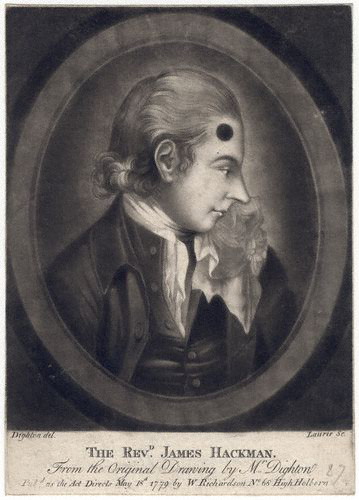
1779: James Hackman, sandwich wrecker

On this date in 1779, Londoners crowded Tyburn to witness the hanging of James Hackman for a sensational high-society murder.

Just twelve days before his date with the hemp, Hackman had walked up to Martha Ray at the Royal Opera and shot her in the head with a single-shot pistol. Then, he turned a second weapon on himself in a vain attempt to commit suicide.

The reader is not mistaken to detect here the mania of unrequited passion. Several years before the young Hackman was a handsome lieutenant introduced to Martha Ray’s social circle. She was a successful soprano on the London stage and though unmarried lived with the Earl of Sandwich as his wife in all but the illustrious name.


(cc image) from Molly Elliott.

Yes, this is the very Earl of Sandwich who pioneered the eating of things stuck between bread slices.* Sandwich — John Montagu to his parents — had other interests besides the munchies; he was the capable First Lord of the Admiralty throughout the 1770s. (As a result, Captain Cook, whose seafaring explorations were occurring at that time, kept naming islands for the Earl of Sandwich).

Domestic life for the Earl and his legal Countess — not “Earless”; that’s a different thing — wasn’t quite as satisfying. Dorothy Montagu, going gradually insane, separated from Sandwich. The lord plucked 17-year-old commoner Martha Ray — a quarter-century Sandwich’s junior — in 1759 and she lived as his mistress from there on out.*

Despite their age difference and never-formalized status they had a comfortable arrangement; Ray bore Sandwich five children** and the two appeared in public as a couple. The Earl sponsored Martha Ray’s opera career and education.

James Hackman met the Earl’s mistress around 1775 and the two formed an intimacy. Just how intimate they might have been has never been firmly established but is clear that as time passed the infatuation increasingly ran in only one direction. Hackman sold his commission in the 68th Regiment of Foot to become a Church of England deacon, perhaps angling by this expedient to woo Martha Ray away from Sandwich to a wholly respectable union.

She understandably demurred on this “opportunity” — leading the greenhorn Reverend to his blackguard act.

Hackman’s pointless waste of Martha Ray’s life and his own plucked his contemporaries’ sentimental heartstrings like nothing else. “All ranks of people … pitied the murderer’s fate,” remarks the Newgate Calendar. One newspaper report of the death sentence noted that “all present were greatly affected” at Hackman’s agitations “and however we may detest the crime, a tear of pity will fall from every humane eye on the fate of the unhappy criminal.” (General Advertiser and Morning Intelligencer, Apr. 17, 1779)

James Boswell was fascinated by the crime; he attended the trial and spilled many public and private words on its subject.

Boswell empathized with Hackman: in a report of the trial for the St. James’s Chronicle (Apr. 15-17, 1779) he opined that the “natural Effect of disappointed Love, however, shocking it may appear, is to excite the most horrid Resentment against his Object, at least to make us prefer the Destruction of our Mistress, to seeing her possessed by a Rival.” Not that Boswell condoned the murder, but “I would say to all that are conscious that their Passions are violent, Think ye that htis unfortunate Gentleman’s general Character is … worse than yours? No, it is not.”

While Human Justice is to be satisfied, let us consider that his Crime was neither premeditated‡ Cruelty, nor base Greediness. He is therefore an Object neither of Abhorrence nor of Contempt … Let us unite our fervent Prayers to the Throne of Heaven, that this our Brother may obtain Forgiveness through Jesus Christ, and be admitted in another State of Being to everlasting Happiness.

The kinship so many Londoners felt for this homicidal stalker moved print copy high and low, before Martha’s body had gone quite cold. Its most notable product was the 1780 Love and Madness, an epistolary novel of tragic passion presented via the (fictitious) letters exchanged by the supposed lovers. So heavily did this understanding of events by Hackman’s contemporaries color its subsequent remembrance that Love and Madness is also the title or subtitle of two 21st century nonfiction considerations of the affair. (1, 2 | Review of both)

Hackman for his part carried off the requisite public posture of resigned tragic nobility in the few days before he satisfied human justice. The General Evening Post, April 17-20 1779 described the execution:

This unfortunate gentleman received the sacrament in the morning with all the fervency and devotion of a sincere repenting criminal: — he repeated that affecting acknowledgment of his guilt, which on his trial drew tears from the audience, and seemed in a state of composure, unruffled with the idea of punishment, which, he said, was no more than he deserved.

At nine o’clock he came into the press-yard, where a great crowd of persons assembled to gratify their curiosity. That all might have an equal share of the sight, a lane was formed by the multitude on each side, through which Mr. Hackman passed, dressed in black, leaning on the arm of his friend the Rev. Mr. Porter, whose hand he squeezed as he muttered the solemn invocation to Heaven, not to forsake a sinner of so enormous a degree, in the trying hour of death.

…

Mr. Hackman was conveyed from Newgate in a mourning coach, attended by the Rev. Mr. Porter Mr. Villette, the ordinary of Newgate, and Mr. Leapingwell, a Sheriff’s officer.

He reached Tyburn about a quarter before eleven o’clock. When he arrived at the fatal tree, a cart lined with black was under the gallows ready to receive him. Mr. Porter and Mr. Villette ascended it by a pair of steps, and he followed them unsupported. As soon as he had got into it he walked forward, and fell on his knees, (a position seldom used by persons in his circumstances at Tyburn, as they always pray standing) and the Clergymen did the like, one on each side of him, where they remained praying for about fifteen minutes, then got up, when the rope was put about his neck, and tied to the gallows.

In this manner he remained praying between the two Divines for ten minutes more, when the Rev. Mr. Porter embraced him, and Mr. Villette took his leave, and both left the cart. The convict[‘]s cap being pulled over his face, he told the executioner to leave him to himself for a few minutes, and he would drop his handkerchief as a signal when he was ready, which he did after a few minutes pause, and was thereupon launched into eternity.

His whole behaviour was manly, but not bold: his mind seemed to be quite calm, from a firm belief in the mercies of his Saviour.

He wore not hat, not any bandage on his face where he gave himself the wound, that the public curiosity might not be interrupted in looking at him; saying, “that he wished to be made a public spectacle of, and hoped his death might be of service to mankind.”

He was no ways convulsed, nor was their [sic] any motion of the body that tended to shew it experienced any pain. Nothing more was to be seen than what proceeded from the jerk on quitting the cart.

The mob was more numerous than on any other occasion since the death of Dr. Dodd. It was expected Mr. Hackman would suffer at Covent-garden, and preparations were made by some speculating carpenters, who met with a mortifying disappointment.

After hanging the usual time, his body was put into a hearse, and taken to Surgeons-hall in the Old Bailey, where it was prepared for the inspection of the public.

Mr. Harkman expressed a wish to his friends, that the ceremony of anatomizing his body might be dispensed with; and that his corpse might be treated in the same manner as that of Lord Ferrers.

Mr. Hackman intimated to a particular friend, that if his remains could be deposited near those of Miss Ray he should feel inexpressible happiness in the hour of death.

A man who was standing near a dray in Oxford-street to see Mr. Hackman pass, was thrown down under one of the horses by the crowd; the horse being frightened, stamped on the man, and beat out his brains.

* Allegedly so that the Earl wouldn’t have to leave his beloved gambling table to dine.

** There is a wonderful bon mot that has enlivened compendia of anecdotes through the years, consisting of more or less the following exchange:

First speaker: You will either die on the gallows or of some social disease.

Second speaker: That depends upon whether I embrace your principles or your mistress.

Though it’s been variously attributed, it appears that the retort was originally delivered by the comic Samuel Foote to Lord Sandwich — about Martha Ray.

† Notable among the five children of Sandwich and Martha Ray: jurist Basil Montagu.

Sandwich’s wife also bore him a legitimate son, who eventually succeeded to the father’s Earldom; the title still exists today.

‡ Hackman had to be talked off simply pleading guilty but in the end he hung his trial hopes on arguing that he intended to kill himself, in Martha’s presence, and was overwhelmed by a momentary “phrensy”. A letter in his pocket meant to be delivered posthumously to his brother-in-law supported this claim; the fact that he brought two guns to meet her rebutted it.

Trial judge William Blackstone pointed out to Hackman’s jurors that the composure of the accused before and after the crime did not suggest a madman and that accepting Hackman’s claim of only an instant’s insanity could present a very slippery slope indeed for future murder prosecutions.

On this day..

1355: Filippo Calendario and Bertuccio Isarello, Doge stooges

This date in 1355 was the morning after the failed coup of Venetian Doge Marino Faliero. And it was the first date that vengeance began to fall upon the plotters.

Faliero, voted power by the fellow-noblemen who bossed the Serene Republic, intended to displace the patrician class with commoner support. The scheme called for Faliero’s supporters secretly to mobilize hundreds of men who on April 15 would gather at the Piazza San Marco and mount their surprise takeover. But the plot sank like a stone on the big day, with anticipated adherents turning out sparsely or flatly declining and word soon reaching aristocratic ears of trouble afoot. The would-be masters of Venice were soon rounded up without resistance by the real masters of Venice.

In this misfired drama, Faliero’s henchmen — the men upon whom fell the task of orchestrating the cells who would summon the traitor militia — were Filippo Calendario and Bertuccio Isarello. And on this, the following day, they were tried, sentenced, and by evening hung from upper windows of the Ducal Palace. Both men were gagged: one last precaution against the sort of popular exhortation that they had not managed when it counted.

“The earth was set in motion,” one chronicler recorded of the Venetian establishment’s reaction to the menace. (Source) Faliero would die the next day; in all, eleven gibbeted corpses festooned the palace as a warning against the next aspirant.

Isarello was the captain of a Venetian galley who had been appointed by Faliero — controversially bypassing the usual noble prerogatives — and had rewarded his prince by expertly harrying Genoese merchantmen.

Calendario (English Wikipedia entry | the more detailed German), Isarello’s father-in-law, was a stonemason, sculptor and architect who actually worked on the very palace he was hanged from.


Column capital of Drunken Noah dating from the period of Calendario’s work on the Venetian Ducal Palace. (cc) image from Honza Beran.

On this day..