On this date in 1322, Bartholomew de Badlesmere, the first (of only two) Baron Badlesmere, lost his head.
The barons in the dangerous age of Edward II were marked by where they made their political allegiances between the king and his rival the Earl of Lancaster.
The man could tack to the wind with the very best of them, or the very worst; he was reviled as the Benedict Arnold of 14th century England for chickenheartedly failing to protect the Earl of Gloucester when the latter impetuously charged to his death at Bannockburn. As a bard of the time put it,
This is the traitorous man Bartholomew, whom in all victories may God confound, because he has been to his master as changeable as a pharisee. Hence, as the representative of Judas, he shall be condemned to death … because he refused to come to his master’s support this traitor has deserved to be put to the rack … deserved to suffer judgment of decapitation.
As the 1320s began, he was a stalwart of what has been termed the “Middle Party”, whose position vis-a-vis Edward and Lancaster was what you would expect from the name.
Badlesmere badly misplayed a strong hand by defecting in the so-called “Despenser War” to the anti-Edwardian party, even though Lancaster pretty much hated his guts — and now the king did, too,* dissipating any mutual goodwill that might have been earned a few years before when the king’s favorite (and the war’s namesake) Hugh Despenser went and rescued Badlesmere’s wife from an attack.
And unlike at Bannockburn, Badlesmere here stepped into the trap rather than out of it.
Days after the battle, Badlesmere was caught skulking in a glade by the Earl of Mar and shipped to Canterbury for trial. He was condemned to death on this date, and sent directly from court to a hurdle dragged by a horse to Blean three miles away, where he was hanged and beheaded. He was one of 20 or so lords and knights Edward had put to death.
* In an affair that Edward II biographer Kathryn Warner thinks was neatly contrived by the king, his Queen Isabella called on Badlesmere’s wife when the latter held Leeds Castlesans husband. Lady Badlesmere refused to admit the queen, giving Edward a welcome excuse for besieging a fortress holding out against its sovereign.
On this date in 1969, the Central African Republic’s dictator Jean-Bedel Bokassa had his number two condemned for plotting against him, and summarily shot.
Back on New Year’s Eve of 1965, Alexandre Banza had been on the same team as Bokassa in the conspiring business — achieving a rapid promotion from Captain when he leveraged his command of the Camp Kassai military base in support of Bokassa’s successful coup against his (Bokassa’s) cousin, David Dacko.
This was a great career move for Captain Banza, who speedily became Colonel Banza and the Minister of State and Minister of Finance to boot. But it wasn’t long before this made man looked to Bokassa like his main threat.
Notorious for his vanity — a few years after the events of this post, Bokassa, an unabashed admirer of Napoleon, would proclaim himself Emperor of the “Central African Empire” — the chief looked askance at his finance minister’s willingness to challenge Bokassa’s profligacy. Over the year or two prior to Banza’s execution, Bokassa maneuvered to push him away from power … and Banza maneuvered to create a power base for himself from which to launch his own putsch.
In the end it was Camp Kassai that played the decisive role once again. The guy with Banza’s old job as camp commandant, one Lt. Jean-Claude Mandaba, was supposed to be in on the plan, but on the eve of the intended April 9, 1969 coup, he tipped off Bokassa.
As he stepped from his car, Mandaba and a couple of soldiers grabbed him. So fiercely did he struggle to escape that the soldiers had to break one of his arms before overpowering him. The ambushers then tied him up, stuffed him the trunk of a Mercedes, and took him to meet the man he had sought to depose. … [Bokassa] was jubilant at the sight of his former companion-in-arms being brought to him in chains. Banza was in poor shape after the journey to Berengo, but his torments were only beginning. Bokassa launched the interrogation by beating the prisoner almost senseless with his ever-present walking stick.
Bokassa was only narrowly dissuaded from thrashing this turncoat to death on the spot, and instead consented to a pro forma military tribunal — although rumors of the pre-death punishment visited on Banza once he was captured have muddied the waters quite a bit. Banza was reportedly hailed before the Cabinet and personally brutalized by Bokassa; Le Monde even reported that he’d been outright killed in this meeting and dragged through the streets by soldiers.
Bokassa was deposed by the French in 1979,* and condemned to death in absentia the following year. The former strongman voluntarily returned from exile in 1986 to face trial for a variety of abuses during his reign; his treatment of Alexandre Banza — and that of Banza’s family, a number of whom were arrested and some “disappeared” — formed part of the very extensive charge sheet. Though sentenced to death himself in that trial, Bokassa’s sentence was eventually commuted. The ex-emperor lived out his last years in a private home of his former capital.
On this day in 1945, mere weeks before Germany’s surrender, U.S. Private Benjamin F. Hopper of the 3170th Quartermaster Service Company was judicially hanged for murder.
On the night of the crime, Hopper and four other soldiers were hanging out in a cafe in the town of Welkenraedt, Belgium, just outside of Liege. Just after midnight, Hopper got into an argument with one of his companions, Private Randolph Jackson Jr.
The two men argued frequently and the other three in the group were used to it, and didn’t take them seriously when they started threatening to shoot each other. Finally Private Jackson handed Hopper his gun, presumably daring him to shoot. Hopper shot him dead, then told the witnesses, “You didn’t see nothing.”
At his court-martial, he did not testify and there was no defense. Hopper protested about this later, saying he didn’t get a fair trial: “My Defense Counsel said he was going to tell them. Told me to stay silent. So, he got up and told them I wasn’t guilty. He didn’t say much else.”
Unlike many military men sentenced to death during World War II, Hopper showed remorse for what he had done. Still he asked for leniency and penned a letter to General Eisenhower beginning:
Gen. Eisenhower
Dear Sir, I was tried for mudder and the court find me guilty and sences me to be hong Sir. And Sir I am asking you to please Sir look in to this mader close Sir for me because I have made a great mucstake Sir and wont you give me another chanch in the armey.
Hopper’s IQ tested at 50, putting him in the moderately mentally retarded range, and a psychiatrist who evaluated him stated he had a mental age of about nine, “bordering on mental deficiency.” Someone with that degree of mental disability would not be permitted to be executed today.
Some people argued that the death sentence should be commuted to life in prison, citing Hopper’s intellectual impairment and the lack of premeditation. Weighing against that was his prior recorded offenses of going AWOL and being in Liege without an official pass. The Brigadier General who reviewed the case recommended that the death sentence stand, and Eisenhower agreed.
Hopper died on a clear, warm morning in Le Mans, France. At 11:00 a.m., his hands and ankles were bound and he said his last words to the chaplain: “Father, I would like you to write to my mother.” The trap sprung at 11:01 and Hopper was pronounced dead at 11:24.
In an admittedly borderline “execution”, Louis de Bourbon, the Hugueunot Prince of Conde, was killed summarily at the end of the Battle of Jarnac on this date in 1569.
This nobleman’s conversion to Protestantism had been attended with the zeal so usual to that period. In the case of Conde (English Wikipedia link | French), that meant dipping his beak into some dramatic plotting.
Though nothing could be proved about him, the Catholic faction suspected him of being a leading spirit in the 1560 Amboise Conspiracy, a plot to kidnap King Francis II.
Nothing daunted by its failure, he spearheaded the even riskier Surprise de Meaux, a design to seize not only King Charles IX but the rest of the royal family in 1567. This time, failure triggered a whole new installment of the on-again, off-again Wars of Religion.
The Year of Our Lord 1569 found Conde at the head of the principal Huguenot army in an extremely tense country. On March 13, that army met the Catholic force of Marshal Gaspard de Saulx at the Battle of Jarnac.*
The result was a smashing victory for the Catholics. As the disaster unfolded, Conde, wounded and alone, tried to offer his surrender to an enemy guardsman. He was instead shot on the spot — and his body borne back to Catholic lines for jeering.
This crippling defeat set the stage for the uneasy truce that quelled religious bloodshed in 1570 — the truce that would be shattered by the 1572 St. Bartholomew’s Day Massacre.
* The teenage Walter Raleigh fought at this battle on the Huguenot side.
David Cobb, Private, Company C, 827th Engineer Battalion (Aviation), on March 12, 1943 achieved the milestone distinction of becoming the first U.S. soldier executed in Great Britain.
On December 27, 1942 — a mere 11 days after arriving in Britain — Cobb was ordered by a Lt. Robert Cobner to surrender his weapon when the private popped off to him during a routine inspection. Instead, Cobb shot Cobner dead.
He was hanged by the British executioner Thomas Pierrepoint at Shepton Mallet prison — a fortress dating to 1610 and still in use to the present day. The U.S. Army employed part of the prison during World War II to carry out 18 military executions; over half of these men were, like Cobb, black.
On this date in 1601, Queen Elizabeth’s last great favorite became the last man beheaded in the Tower of London.
Vain and dashing Robert Devereux rolled into the royal court in 1584 around age 19 and immediately established himself as the new favorite of the monarch, 30-some years his senior. They spent long walks and late nights in enchanted private company, and Devereux “commeth not to his owne lodginge tyll the birdes singe in the morninge.” Ye olde walke of shayme.
In becoming the (presumed) lover* of the aging Virgin Queen, the Earl of Essex was only following the family** trade: his stepfather Robert Dudley was the younger Elizabeth’s longtime intimate.
It is up to the artists to postulate the relative measures of passion and cynicism in these dalliances; many have tried, inspired by the scaffold sundering of one of history’s great May-December affairs. The Essex-Elizabeth drama was a popular topic for broadsides, ballads, and stage treatments from the 17th century to the present day.
He was wildly popular in London, but Essex was also afflicted by the follies of youth. Rash, temperamental, vainglorious; he aspired to leverage the favor of his sovereign into statesmanship and he achieved heroic repute for his swashbuckling raid on Cadiz.
Yet Essex reads like a whelp who never quite grew into a man’s boots. Every sketch of Essex includes, because it seems so starkly illustrative of his unstable character, the story of the time his impertinence led the queen to box his ears publicly — and the hothead’s hand flew instinctively to his sword-hilt. Everyone reconciled over this brush with lese-majeste, but only after Essex scribbled some skulking reproaches (“What, cannot princes err? cannot subjects receive wrong? is an earthly power or authority infinite?”) that he had the petulance to actually send to Elizabeth.
Essex chased martial glory with mixed results. His last great enterprise was an ill-starred 1599 offensive in Ireland to bring Gaelic rebels to heel in the Nine Years’ War.
Not for the last time an Englishman found this conquest more easily aspired than achieved. Essex liberally overused his authority to knight men as a reward for their service, but his soldiers mostly slogged to and fro with little headway to show for it. After a frustrating campaign season chasing his tail, Essex defied the increasingly strident directives to attack issuing from Elizabeth’s irate pen, and made terms with the Irish commander Hugh O’Neill, Earl of Tyrone. Then he defied Elizabeth’s order to remain in Ireland and hastened back to London to justify himself. It was said of him that he “never drew sword but to make knights.”
This was the beginning of Essex’s end. Elizabeth’s fury at the aimless military campaign was compounded when her churlish captain turned up from Ireland unbidden and burst into her private chambers while she was still dressing to report on his unauthorized summit. Cecil et al, whose ascendance Essex had meant to reverse with the triumph of his arms, now murmured that the earl had strayed near outright treason to parley with the rebel whom he was supposed to be routing. The Privy Council put him under house arrest.
Heaped in debt and deprived of the prestigious proximity to power he had enjoyed literally throughout his adulthood, the man’s turbulent spirit stirred strangely in York House. We have seen that Robert Devereux, Earl of Essex, was a man to abhor an indignity even past the point of self-preservation. He unwisely sent secret missives to try to turn the ongoing succession negotiations‡ against Robert Cecil; when the Privy Council caught wind of this intrusion, he refused its demand that he present himself to account for his actions. Instead, he made matters worse by mounting a pathetic march through London with his supporters.
This “Essex Rebellion” was meant to rally the citizenry to him and turn some sort of coup against Robert Cecil. It seems so foolhardy and ill-considered that it’s difficult to think what was in the earl’s head. If you squint at it just so, it perhaps had a big-R Romantic quality, a gallant band of brothers saving the nation from its duplicitous ministers; the night before the rebellion, Essex (a liberal arts patron in his time) splurged to have William Shakespeare’s company§ stage a special performance of Richard II — a play wherein the English monarch is deposed. Presumably this was his inspirational pregame speech.
Thinking much more clearly than Essex, Londoners vigorously ignored his summons and the marching party trudged alone — and surely increasingly frightened — through the city until it was stopped by a barricade. Its participants then fled back to Essex House where they soon found themselves surrounded.
Whatever the fancy that led the Earl of Essex on his fatal February 8 march, and whatever the extent of his ambitions for that occasion, the careless threat to the public peace went several bridges beyond a boyish foible that Elizabeth could overlook in her impulsive courtier. He was prosecuted for treason within days and Elizabeth signed his death warrant on February 20th. The only mercy extended the ex-favorite was to suffer the noble execution of beheading, rather than a traitor’s drawing and quartering. Essex also successfully appealed for a private execution within the walls of the Tower, away from the gawks of those London masses who had so signally failed to rebel along with him.
My sins are more in number than the hairs on my head. I have bestowed my youth in wantonness, lust and uncleanness; I have been puffed up with pride, vanity and love of this wicked world’s pleasures. For all which, I humbly beseech my Saviour Christ to be a mediator to the eternal Majesty for my pardon, especially for this my last sin, this great, this bloody, this crying, this infectious sin, whereby so many for love of me have been drawn to offend God, to offend their sovereign, to offend the world. I beseech God to forgive it us, and to forgive it me — most wretched of all.
He prayed a Psalm. Then, stretching out his neck on a low block and thrusting his arms from his sides, he bid the headsman strike. The executioner had to oblige his patient in triplicate in order to sever the puffed-up head.
The Earl of Essex has the distinction of being the last person beheaded on the Tower Green, within the walls off the Tower of London — the last name on the little placard of headless notables photographed by tour groups. Note that Essex was not the last person beheaded at the Tower, when the adjacent Tower Hill is included (that distinction belongs to Jacobite rebel Simon Fraser); nor was he the last person executed within the Tower (that distinction belongs to World War II spy Josef Jakobs, who was not beheaded but shot).
Weary and depressed, Elizabeth died little more than two years afterwards.
* There’s a mind-bending speculative hypothesis out there — cousin to the Shakespeare-focused Prince Tudor theory — that Essex was actually Elizabeth’s secret, illegitimate son. This secret history is obviously more congenial with the queen’s early favoritism for Essex than with her eventually chopping off his head.
** Essex was also a distant cousin of Elizabeth herself: his maternal great-grandmother was Mary Boleyn, sister of Anne Boleyn — who was Elizabeth’s mother.
† Walter Raleigh was a notable Cecil ally in this factional conflict. Raleigh attended Essex’s execution … and, of course, shared that fate many years afterwards.
‡ Elizabeth was nearing age 70; her childless death was imminent. James VI of Scotland was being vetted by Robert Cecil as the successor. Essex tried to stick his thumb in the pie by warning James that the Cecil faction would conspire to foist the English crown on the Spanish infanta — daughter of the Spanish king who had been the Catholic Mary Tudor’s husband. (The infanta was not Mary’s own daughter.) This was no idle threat, as at this point it was only a few years since the Spanish Armada had sallied for English seas.
§ Another noteworthy Shakespeare connection: one of the participants in the Essex Rebellion was the Earl of Southampton (he was spared execution). Southampton, whose given name was Henry Wriothesley, is often identified as the “Fair Youth” to whom Shakespeare dedicated numerous love sonnets. (Some of those are directly addressed to a Mr. “W.H.”)
On this date in 1937, Ethiopian prince Desta Damtew — the son-in-law of Emperor Haile Selassie — was captured by the Italian troops occupying his country, and summarily executed.
When Italy invaded Ethiopia in 1935, it committed a disproportionate quantity of its forces to the northern reaches of its target. Consequently, resistance was stronger in the south — and Ras Desta was one of its chiefs. In January 1936 he led Ethipoian forces at the Battle of Ganale Doria.
Though the two sides had forces of similar sizes, Italy’s was the mechanized, industrial army — and the Ras was routed by Gen. Rodolfo Graziani. It was a milepost for Graziani on his way to lasting infamy in Ethiopia as the conquered realm’s brutal Viceroy for 1937. (He was recalled at year’s end.) Graziani vowed that Italy would dominate Ethiopia “at whatever cost” and threatened “extreme severity towards anyone who resisted.”
On February 19, 1937 — Yekatit 12 by the Ethiopian calendar — two ethnic Eritreans expressed their resistance by pelting Graziani with grenades. He had shown his viceregal person at a hearts-and-minds almsgiving, and having been received with such cordiality, he returned immediately to the Extreme Severity plan.
While doctors dug shrapnel out of Graziani, somehow saving his life, an aide named Guido Cortese condemned untold numbers of humans to punitive death with a dread order:
Comrades, today is the day when we should show our devotion to our Viceroy by reacting and destroying the Ethiopians for three days. For three days I give you carte blanche to destroy and kill and do what you want to the Ethiopians.
For the next several days, Italian forces delivered a punitive rampage to their new subjects, claiming up to 30,000 lives.**
Desta Damtew, who had been lucky to flee the battlefield slaughter after Ganale Doria, was not directly a casualty off this three days’ bloodbath, but when he was captured in the bush along with fellow insurgent commander Beyene Merid, no-quarter treatment was a given. Both men were immediately shot.
The flow’r of a nation’s strength
Had thrown their valour and their might
Against the charging hordes of death
In history’s most unequal fight!
One man remained — the last of them —
To stand for Ethiopia:
All else surrendered, died or fled
But, he, the lion-hearted-Ras Desta.
Graziani, Italian butcher
Had valiant Desta quickly shot,
To seal his lips and tie his hands
In fear of what he called a plot.
With death of such a noble man,
A reign has passed to history;
But time will bring to us again
More men to fight for victory.
* Ras is a title, literally meaning “Head” and akin to “Prince” or “Duke”. Before he was royalty, Haile Selassie was born Tafari Makonnen, and then eventually known as Ras Tafari … hence, rastafarianism.
** According to Ethiopian figures. Italy’s numbers put the post-Yekatit 12 casualties “merely” in the hundreds.
If present-day electoral politics strike you as disreputable, take comfort in the knowledge that the Republic has survived its share of low-down, brass-knuckle campaigns in the past. The presidential election of 1828 might have been the very dirtiest.
This race pitted incumbent John Quincy Adams, the silver-spoon New Englander and son of Federalist founding father John Adams, against Andrew Jackson, the uncouth self-made westerner of Scotch peasant stock. Jackson was [in]famous for his duels, and his willingness to push the envelope on acceptable use of the military forces he commanded. Some foes saw him as an American Napoleon; some supporters, likewise.
One of the juiciest gobs of slung mud in that 1828 campaign involved Jackson’s actions as a Major General during the War of 1812, and specifically right around the Battle of New Orleans.
Karl Rove would have approved of this tactical attack on the strength of a candidate, for it was to this service that Jackson owed his national repute. De Tocqueville, who considered Jackson “a man of violent temper and very moderate talents,” said that he “was raised to the Presidency, and has been maintained there, solely by the recollection of a victory which he gained, twenty years ago, under the walls of New Orleans.”*
At any rate, back in 1815, when army regulars were engaged on the east coast (or in the quixotic attempt to invade Canada), battle in the south and west pitted shaky American militia against British-allied Indian tribes in dirty, bloody ethnic cleansing.
Immediately prior to New Orleans, Jackson, west Tennessee’s biggest landowner and therefore its militia commander, took his forces south to Alabama, combined them with other militia, and routed the Creek, ending the Creek War subplot to the War of 1812. ‘Twas this conquest gave Jackson his “Old Hickory” nickname for controlling the Muscogee Creeks of Hickory Ground.
Cool beans for A.J., but not everyone on his team was equally excited.
After the Creek surrendered at the newly-raised Fort Jackson — vanity, vanity, all is vanity! — a number of soldiers stationed there with the 1st Regiment West Tennessee Militia started agitating to pack up and leave, even with the British navy still lurking. Come September, some even went so far as to demonstratively tramp out of Fort Jackson, vowing to return to hearth and home.
These were not enlisted soldiers of a standing army, so they did not necessarily conceive themselves bound to fight the British in Louisiana or the Creeks in Alabama: rights and obligations and loyalties were still being sorted out in the young Republic. These deserters had, however, been mustered that June for an announced six-month term, and September was only three months later. Moreover, these weren’t the only rumblings of desertion in Jackson’s ambit, and since he was potentially facing the prospect of defending the whole Gulf Coast against the world’s preeminent military power using nothing but a motley collection of farmers, Indian allies, pirates, and what-have-you, Old Hickory was not inclined to countenance anything that could erode his forces’ tenuous unity. Like George Washington before him, Jackson shot some malcontents today to pre-empt trouble tomorrow.
On November 21, 1814, Jackson ordered the six deserters/mutineers to court-martial. The next day, he departed to New Orleans where he would cover himself with glory.
After winning that battle, Jackson adjudicated a message from the Alabama court-martial, announcing six men condemned who had not been recommended for leniency.
As is well-known, the War of 1812 had officially been settled by treaty for weeks at this point, but it took approximately f.o.r.e.v.e.r for word to get around in these pre-telegraph days. Jackson didn’t know the war was over: he did know that British ships were still lurking around in the Gulf. (They also didn’t know the war was over.)
So Jackson behaved just as if he had a going conflict on his hands and sent back confirmation of the sentences. His six mutineers were shot kneeling on their coffins before 1,500 troops in Mobile, Ala. on February 21, 1815. Only after that did everybody (British included) find out that there wasn’t anything left to fight for.
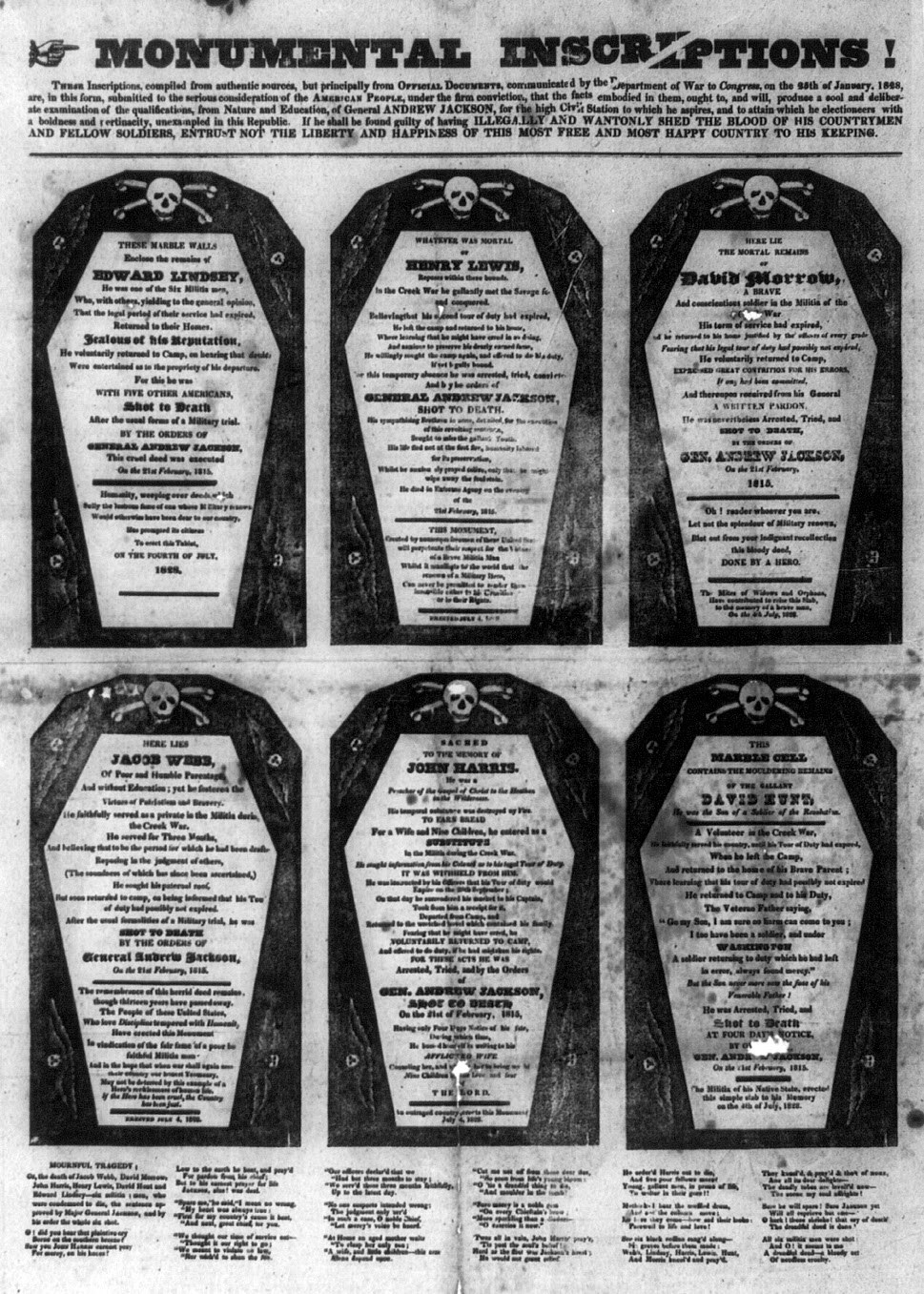
But when Andrew Jackson eventually ran for U.S. President in 1828, the poor militiamen were exhumed (only metaphorically!) to traduce the general, whose reputation already ran to the bloodthirsty. This was a country where a great many of the men casting ballots would be, actually or potentially, subject to militia duty: the prospect of a frontier Queeg actually executing militia was calculated to impair Jackson’s famous appeal to the common man and raise the specter of the president as a potential strongman.
Propaganda pamphlets circulated this execution story widely that year, the swiftboating of the 19th century.
Their inevitable inclusion of six coffin-shaped blocks to symbolize the dead men this date eventually gave to anti-Jackson broadsides the name “Coffin Handbills” — a term that eventually extended to the entire genre of political libels. This linguistic relic is surely due for a bicentennial resurrection.
Sordid campaigning over Jackson’s questionable military freelancing was somewhat ironic in 1828, since Jackson also had that reputation from his extra-legal Florida incursions, after the War of 1812. Those adventures rankled many within the Monroe administration, but were stoutly defended by Monroe’s Secretary of State — none other than John Quincy Adams. (Adams’s own signature graces the 1819 treaty with Spain which ceded Florida; it was largely secured by Jackson’s depredations.)
Irony or no, the attacks had to be dealt with.
Jackson’s partisans responded with equal vigor. For instance, newspapers (the excerpt below comes from the May 1, 1828 Maryland Gazette) carried a lengthy vindication penned by a Jackson partisan and fellow-Tennessean then sitting his first term in Congress … but destined in time to follow Jackson to the White House.**
I had supposed it scarcely possible that any candid, intelligent man, could for a moment doubt the correctness of General Jackson’s conduct, in relation to this subject … No man has ever been more misrepresented and slandered by his political adversaries than Gen. Jackson, and upon no subject more than that in relation to the execution of the ‘six militia men.’ …
The corps to which the ‘six militiamen’ belonged, was stationed at Fort Jackson. Between the 10th and 20th of September 1814, before the period even of three months, much less six months, had expired, an alarming mutiny, such as was seldom ever witnessed in any army, took place in the camp, of which these ‘six militia men’ were the ringleaders. Harris who seems to have been the principal, several days before the mutiny broke out, carried about a subscription paper thro’ the camp, obtaining the signatures of all who would agree to go home. In defiance of their officers commanding the post, they on the 19th of September 1814, violently and tumultuously assembled together, to the number of near two hundred, broke open the public stores, took out provisions, demolished the bake house, shot down breves, and in the face of authority, left the camp on the next morning ‘at the end of revielle beat;’ yelling and firing scattering guns as they departed, proclaiming to all who would, to follow them.
…
Th proceedings of the court martial were forwarded to General Jackson then at New Orleans, for his approval. The six ringleaders were not recommended to mercy by the court martial. No palliating circumstances existed in their case, known to him. He knew they had been tried by a court martial composed of their fellow citizens and neighbours at home. The news of peace had not then arrived. The enemy’s forces were still in our waters and on our border. When an attack might be made was unknown, and the militia under General Winchester‘s command at Mobile, were ‘threatening to mutiny.’ … General Jackson saw that the salvation of the country was still in jeopardy, if subordination was not preserved in the army. He approved the sentence, and these six unfortunate, tho’ guilty men, were executed. This approval of the sentence of the court martial was made at New Orleans on the 22d of January, 1815. The first intimation which the General had of the news of peace even by rumour, was received on the 18th or 19th of February, 1815 … Col. G.C. Russell, who commanded on the day the sentence of the court martial was carried into execution, states in a letter of the 29th of July, 1827, that ‘we had no knowledge of a treaty of peace having been signed at Ghent, till more than a month after the approval of the sentence, and fifteen or twenty days after its execution.’ The official news of peace did not reach General Jackson until the 18th of March, 1815, and on the 19th of the same month, the British commander received the official intelligence from his government. It was not until after this period that the British forces left their position on that border of the union.
The effect which the execution of these men produced in the army was most salutary. Not a whisper was afterwards heard of the mutiny which had threatened General Winchester’s command. Subordination was restored, and all the troops in the service were willing, and did without a murmur perform their duty. Mutiny and desertion were no longer heard of in that part of the military service.
…
it is impossible to conceive how censure can attach to General Jackson. At the time he approved the sentence of the six ringleaders, he pardoned all those who had been recommended to mercy by the court martial that tried them. At the time of the execution all acquiesced in its justice. Every officer in the army responded to the importance of the example, for the good of the service. At that time the whole country was satisfied. Not a whisper of censure was heard against the commanding General, or any member of the court martial in reference to it.
Polk, indeed, advised his friend Jackson closely during the latter’s 1828 campaign, and specifically counseled an active campaign to rebut the “six militiamen” attacks.
Polk’s energetic response and others like it must have worked well enough: Jackson crushed John Quincy Adams as handily as he had once done the Creeks, and wound up with his hatchet face on the American $20 bill.
* The De Tocqueville quote in the text is the part germane to this post, but it disdainfully goes on to pronounce New Orleans “a victory which was, however, a very ordinary achievement and which could only be remembered in a country where battles are rare. Now the people who are thus carried away by the illusions of glory are unquestionably the most cold and calculating, the most unmilitary, if I may so speak, and the most prosaic of all the nations of the earth.” Sniff.
** And to follow Jackson’s policy of dubious southerly land-grabs.
The retaliatory executions a U.S. Army lieutenant carried out on this date in 1861 helped set in motion a decade-long war with the Apaches.
Three years out of West Point and brand new to Arizona’s Fort Buchanan, George Bascom in retrospect was probably not the ideal ambassador to send out with orders to retrieve a young half-Apache boy kidnapped from a ranch by an Indian raid. (Along with all the cattle.)
Since nobody was present at the time, the identity of the raiders just wasn’t known — but someone’s suspicions affixed on the wily and dangerous* Chiricahua warrior Cochise. The Chiriachuas were just one group among the Apache peoples; they ranged from Mexico to southeastern New Mexico and southwestern Arizona, and were divided into many small local groups each with their own leader — like Cochise.
Lt. Bascom would be killed in a Civil War engagement a year after the events in this post without leaving posterity his memoirs, so his understanding of Apache society can only be guessed at. But his on-the-make bullheadedness is universal to every time and place where young men can be found. “Bascom was a fine-looking fellow, a Kentuckian, a West Pointer, and of course a gentleman,” Arizona frontiersman Charles Poston later remembered. “But he was unfortunately a fool.”
Lt. Bascom and Cochise.
The greenhorn lieutenant rode out with 54 cavalrymen to Apache Pass and lured Cochise to a confabulation. Cochise showed up with his brother, wife, and children — clearly expecting some sort of social call.
Cochise was entirely unaware of the kidnapping, and unaware that Bascom considered him the kidnapper. He offered to find out about it and retrieve the boy from whomever had him.
Bascom, whose troops had surrounded the tent during the parley, accused Cochise of lying to him. Cochise had twice the impertinent lieutnant’s years and at least that multiple of Bascom’s sense, and must have been affronted by his opposite number’s behavior — but when Bascom announced that he would be taking Cochise and his companions as prisoners pending the return of the raiders’ spoils, the Apache commander whipped a knife out of its sheath and instantly slashed his escape route through the wall of the tent. Bursting past the shocked troops (they were as inexperienced as their officer), Cochise escaped into the twilight. This “Bascom Affair” (to Anglos) is remembered more evocatively by Apaches as “Cut Through The Tent”.
But the tent-knifing was only the start of it.
Cochise’s party did not manage to follow his escape, so Bascom now held Cochise’s brother, wife, son, and two other warriors. The Apache tried to put himself in a negotiating position by seizing hostages of his own — first a Butterfield stagecoach stationmaster named Wallace, and later three white men seized from a passing wagon train.
Nor were the hostages’ the only lives at stake. Cochise’s band, including the soon-to-be-legendary Geronimo, had assembled and their campfires burned menacingly in the hills around the little stage station where Bascom’s force fortified themselves. Bascom could have defused it all with a hostage swap, but the kid had his orders and stubbornly refused to make the trade unless it included the one hostage Cochise didn’t have: that little boy from the ranch.
At length, reinforcements for the beleaguered cavalry began arriving, one such party bringing three other Apaches captured en route and entirely unrelated to Cochise. “Troops were sent out to search for us,” a much older Geronimo recalled in his memoirs. “But as we had disbanded, it was, of course, impossible for them to locate any hostile camp … while they searched we watched them from our hiding places and laughed at their failures.”
Despairing now of seeing his family again, Cochise had his hostages killed and dispersed, leaving the mutilated remains to be discovered by his antagonists with the help of circling buzzards. When they did so, they retaliated in fury — releasing only Cochise’s wife and child, but hanging the six other hostages, including Cochise’s brother. In the narration of Sgt. Daniel Robinson,
After witnessing the fiendish acts committed by the Apaches, the minds of our officers and men were filled with horror, and in retaliation, it was decided in Council, that the captive Indians should die. On the 19th we broke camp to return to our respective posts leaving a Sergeant and eight men to take charge of the station until relieved. We halted about half a mile from the station where there was a little grove of Cedar trees. The Indians were brought to the front with their hands tied behind their backs, and led up to the trees. Noosed picket ropes were placed around their necks, the ends thrown over the limbs of the trees and manned by an equal number of willing hands. A signal was given and away flew the spirits of the unfortunate Indians — not to the happy hunting grounds of Indian tradition. According to their ideas or belief in a hereafter, those who die by hanging can never reach that region of bliss. I was in an ambulance with the other Sergeant, and must confess it was a sad spectacle to look upon. An illustration of the Indians sense of Justice: “That the innocent must suffer for the guilty.” And the white man’s notion — “That the only good Indians are dead ones.” Whatever it may be, I do not think it was much worse than the present policy of penning them up on Reservations and starving them to death. (See Cochise: Firsthand Accounts of the Chiricahua Apache Chief.)
A devastating decade-long war against Cochise and his equally able father-in-law Mangas Coloradas ensued, and right when the army most needed its military resources for the Civil War. The conflict claimed hundreds or thousands of lives, crippled mining and ranching, and depopulated fearful white settlements around Apache country in favor of “gravestones … by the road-side like sentinels, bearing the invariable description ‘Killed by the Apaches'”.
A fort near the Texas border was later named for Bascom. The kidnapped boy was never recovered and grew up in a different Apache tribe.
Tom Jeffords (Jimmy Stewart): “Cochise didn’t start this war! A snooty little lieutenant fresh out of the east started it. He flew a flag of truce which Cochise honored, and then he hanged Cochise’s brother and five others under the flag.”
* Cochise was officially at peace with the Americans at this point and hostile to Mexicans. In “Cochise: Apache War Leader, 1858-1861,” in the Journal of Arizona History (Spring 1965), Barbara Ann Tyler argues that the reality of the situation was that his warband flexibly shifted between temporary peace and opportunistic small raids, moving north and south of the Mexican border as convenient.

 This nobleman’s conversion to Protestantism had been attended with the zeal so usual to that period. In the case of Conde (
 Vain and dashing
  An aristocrat who married Selassie’s