1943: The last five Young Guards shot in Krasnodon

On this date in 1943, days before their city was liberated, five members of the anti-occupation resistance were shot in Krasnodon in the Donbass.

That eastern Ukrainian city* had fallen under German-Italian-Romanan occupation in July 1942.

In response, some 100 local teens banded together into an anti-fascist underground — the Molodaya Gvardiya, or Young Guard. (English Wikipedia entry | Russian) Most of their number would give their lives in resistance.

During the few months of occupation, the Young Guards managed an impressive record of sabotage operations and propaganda coups. It busted 90 people out of the Germans’ concentration camp, and got the hammer and sickle hung up on government buildings to mark the silver anniversary of Red October. In December, the Young Guards managed to destroy the labor bureau (and its list of intended conscripts) on the eve of a planned deportation, sparing 2,000 people that dreadful fate.

The Germans finally got their hooks into the Young Guards and started mass arrests at the start of January. They brought in most of the Young Guards for torture and execution — smashing up the organization in their very last weeks in town.

The five put to death this date were the last of those martyrs, and the more tragic in that the occupiers were even then gearing up to evacuate as the Red Army closed in. (The Soviets took the city on February 15.) They were:


Oleg Koshevoy’s interrogation. Image from MolodGuard.ru’s stupendous images collection.

In September 1943, three Soviet citizens were publicly executed in the liberated city on charges of having aided the Germans in suppressing the Young Guards.

The Young Guards’ youth and intrepidity made them extremely congenial to the Soviets’ wartime demand for martyrs. At the urging of his Ukrainian deputy Nikita Khrushchev — who himself hailed from the Donbass — Stalin approved a number of the Young Guards (including this date’s Koshevoy and Shevtsova) as Heroes of the Soviet Union.

The Guards valorized in a 1945 novel, and then a 1948 film based on that novel. (Russian links, both.)

They’ve featured in postage stamps, public artwork, and every manner of patriotic commemoration ever since. They’ve even come in for a bit of post-Soviet “ownership” conflict (over the Guards’ degree of Communist Party affiliation) between Ukraine’s Russian- and Soviet-leaning east and the nationalist-sympathizing west.

Today the “Molodaya Gvardiya” brand might be most immediately recognizable as a youth organ of Vladimir Putin’s party — no connection to the young partisans, of course.

* Not to be confused with the Russian city of Krasnodar.

On this day..

1601: Starina Novak, hajduk

On this date in 1601, Serbian-Romanian hajduk Starina Novak was slow-roasted in Cluj with two of his captains.

The hajduk in the Balkans was a romantic figure who mixed traits of the “social bandit” outlaw with those of anti-Ottoman guerrilla. Colorful characters answering the archetype persisted into the 20th century.

Novak, who was around 70 by the time of his death, is still celebrated for his feats of arms on the soldiering side of the ledger in a running conflict with the Ottomans. Most of the sites about Starina Novak are in Serbian, like this one.

He emerges as a commander of Serbian and Bulgarian auxiliaries fighting with Michael the Brave in the 1590s to carve out of the Ottoman realm a kingdom of Wallachia, Transylvania, and Moldavia — roughly, present-day Romania plus Moldova. The enterprise was as glorious as its destiny was tragic.

By 1601 an Italian officer aptly christened Giorgio Basta had had enough of his erstwhile allies and double-crossed hajduk and upstart king alike.

The former he shopped as a traitor to Michael’s Hungarian allies, who put him to the stake in Cluj and made sure to throw water on the burning partisan throughout in order to prolong the ordeal. (The charred corpses of Novak and his associates were then impaled.) A few months later, Basta had Michael the Brave assassinated, and placed himself at the head of Michael’s hard-won kingdom.


A statue of Starina Novak keeps vigil in the city where he died. (cc) image from Bogdan Pop.

Being a national hero means your prior career in brigandage gets a little Robin Hood elbow grease.

In the Serbian epic “Starina Novak and Knez Bogosava” — translated here by polyglot friend of the site Sonechka — Novak attributes his turn to banditry to the impositions of his rulers, specifically (and ahistorically) blaming the 15th century despot’s wife Jerina for overtaxing him.

Novak and Radivoj are imbibing wine
By the brisk waters of Bosna,
At a certain Prince Bogosav’s.
And having sated themselves with wine,
Prince Bogosav began to talk:
“Brother, Old Novak,
Tell me straight, as if confessing,
Why did you, brother, become a hajduk?
What compels you
To break your neck, to wander the forest
As a brigand, pursuing your ignoble employ,
Unto your senescence, when your time has passed?”

Replies Old Novak:
“Brother, Prince Bogosav,
When you ask, I answer in earnest —
It was truly not my wish.
If you could recollect
The time when Jerina was building Smederevo
And ordered me to toil.
I labored for three years,
I pulled the trees and carried stones,
All on my own cart and oxen.
And in three years term,
I gained not a dinar,
Not even opanci to put on my feet.
But that, brother, I would have forgiven!
Having built Smederevo,
She began to mount towers,
To engild the gates and windows,
And imposed the duty on the vilayet,
For each house – three measures of gold,
Which is three hundred ducats, brother!
Those who had, gave her the treasure;
Those who gave, stayed.
I was a pauper,
With nothing to give,
I took my pickax, which I toiled with,
And with this pickax I turned to banditry,
No longer could I linger anywhere
In the domain of cursed Jerina,
But ran away to the icy Drina,
Then reached stony Bosnia.
And when I neared Romania,
I met a Turkish wedding party –
Escorting a noble girl,
All passed in peace,
Save for the Turkish groom.
On the great dark brown steed,
He did not want to pass in peace.
He pulls his three-tail whip
(encumbered with three bolts of weight)
And lashes me across my shoulders.
I begged him thrice in the God’s name:
‘I beg you, Turk,
So blessed you with fortune and heroism,
And happy joviality,
Go on, proceed along your way with peace —
Do you see that I am a poor man!’
Withal the Turk would not budge.
And ache had grasped me,
And the anger grew,
I pulled my pickax from my shoulder
And struck the Turk, mounting on his brown steed.
The blow was so light
That it threw him off his horse,
I came upon him,
Hit him twice, and then again three times
While rending him asunder.
I rummaged through his pockets,
And found there three bags of treasure;
I stashed them in my bosom;
Untied his sword,
Having untied it from his belt, I have attached it to my own;
In place I left the pickax,
So that the Turks will have a tool with which to bury,
And thenceforth I mounted his brown steed,
And headed straight to the Romanian forest.
This all was witnessed by the wedding party
That dared not pursue me.
They wanted not or dared not.
It happened forty years back.
I grew more fond of my Romanian forest
Than, brother, of a palace;
Because I guard the mountenous road,
I wait for young Sarajevans
And take their gold, and silver,
And finer cloth, and satin;
I dress myself and the gang;
So I can come and flee,
And stay in horrid places —
I fear nothing but God.”

For Bosnian-Serbian-Croatian speakers with a lot of time on their hands, here’s a reading of the original:

On this day..

1979: Julio Vargas Garayar, the last executed in Peru

This date in 1979 saw the last use of capital punishment in Peru. An Air Force sergeant named Julio Vargas Garayar was shot for selling classified information under the military junta of Francisco Morales Bermudez.

Peru abolished the death penalty later that same year as part of its uneasy transition to civilian rule: the country’s 1979 constitution restricted the death penalty to state offenses during wartime: treason, genocide, crimes against humanity, terrorism, war crimes, and murder.

Although Peru in subsequent years has had its share of conflict and extrajudicial executions, it has never since conducted an official execution — notwithstanding Alan Garcia‘s mid-2000s rumblings about amending the constitution to reintroduce the death penalty for child rape.

On this day..

1949: Hiroshi Iwanami

On this date in 1949, Dr. Hiroshi Iwanami was hanged on Guam for murdering ten American POWs during World War II.

The commanding officer of the naval hospital on Japan’s South Pacific stronghold of Truk, Iwanami was condemned by the postwar U.S. Navy war crimes tribunal for overseeing — and rather reveling in — the sadistic murders of ten American POWs that fell into his hands in 1944.

As described in Timothy Maga’s Judgment at Tokyo: The Japanese War Crimes Trials:

From the Newcastle (NSW, Australia) Morning Herald & Miners’ Advocate, July 16, 1947

In addition to murder, Iwanami was charged with “preventing the honorable burial” of bodies and with “dissection” and “mutilation” of them. Iwanami had used all ten of his victims for so-called medical experiments. Four of his January 1944 victims had tourniquets placed on their arms and legs by Iwanami for long periods. Two of the POWs had their tourniquets removed in two hours, and the other two at the end of seven hours. The latter two died immediately of shock, but the former survived. On the same day, four others were injected with streptococcus bacteria to cause blood poisoning. All four developed high fevers and soon died.

On February 1, 1944, the two survivors from the tourniquet experiment were marched to a hill in back of the hospital. Naked, with their legs stretched out as far as possible, the men were tied to stakes. Iwanami’s staff then placed a small explosive charge three feet in front of each foot of each victim. The resulting explosion blew off the feet of the men, but both victims survived. Their amazing endurance was short-lived, because Iwanami ordered the men strangled; an aide accomplished the task with his bare hands. Their bodies were returned to the hospital, where they were dissected, and all vital organs were placed in specimen jars. Only some of the organs from the blood poisoning victims were kept, and their bodies were tossed off a nearby cliff.

During an evening meal near the end of July 1944, Iwanami asked his staff if they would assist him in experiments on two more POWs. Instead of answering quickly in the affirmative, the men asked about the value of such experiments. Refusing to discuss the issue, Iwanami ordered his men, instead, to participate in the execution of the two POWs. This time there was no opposition to the order. The two Americans were suspended from a bar placed between two trees. With the order to “stab with spirit,” the hospital staff then began their bayonet practice. There was little left of the bodies after the practice was over, and those bodies, one of them headless, were buried near the scene of the execution. Shortly before his capture, Iwanami had the bodies exhumed and thrown into the sea.

… the trial was as bizarre as the defendants. Three of Iwanami’s old hospital staff members committed suicide, leaving word that they would rather die than testify against their commanding officer. Another, Lt. Shinji Sakagami, took great pride in the fact that he had strangled two POWs. A staunch advocate of the Japanese war effort and, like so many of his colleagues, convinced that death was better than surrender, he hoped his actions in Truk would serve as a warning to the future enemies of Japan. Iwanami was sentenced to death, although he attempted to cheat the hangman. Smuggling a small, sharpened pencil into his holding cell, Iwanami stood at one end of the tight quarters, shouted “Banzai,” and vaulted against the opposite wall. The pencil was held close to his heart, but it did little damage. Both witnesses on the scene and the commission wondered why a surgeon would have failed to aim the pencil properly. Iwanami’s hanging proceeded as planned, and the most generous verdict for a member of his staff was ten years in prison.

On this day..

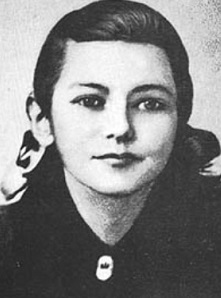
1944: Zinaida Portnova, Komsomol hero

On this date in 1944, Soviet partisan Zinaida Portnova was executed by the Germans occupying Belarus.

The youngest-ever female Hero of the Soviet Union (she was posthumously decorated in 1958), the Leningrad-born Portnova had a rude start in insurgency when the German blitz swept past her summer camp in Belarus and trapped her behind lines.

Said to have been radicalized when occupying soldiers struck her grandmother, the girl joined the youth arm of the local resistance, dubbed the “Young Avengers”.

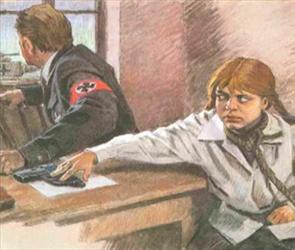
From surveilling enemy troop deployments and assembling weapons caches, Zinaida Portnova graduated to sabotage and ambushes … and capture. Even then she pulled off an action hero escape by snatching a gun and shooting her way out of custody, only to be re-arrested shortly thereafter.

She was shot a month shy of her 18th birthday.

A large number of Pioneer youth groups were subsequently dedicated to Zinaida Portnova, as was a museum of the Komsomol underground and a public monument in Minsk. She remains to this day an honored martyr of the Great Patriotic War.

On this day..

1865: Henry Regley and Charles King, General Sheridan’s deserters

On this date in 1865, two Union soldiers were shot as spies at Winchester, Virginia.

Union General Philip Sheridan and his famed Napoleon complex* were wintering in Winchester, Va. where he had recently clinched northern control of the Shenandoah Valley, and put its fertile farmlands to the torch to cripple the rebel army.

Sheridan, who had in the course of that campaign made his lasting fame by rallying his troops after an initially devastating Confederate surprise attack, was highly concerned at the prospect of rebel spies and infiltrators.

Our two poor fellows, Henry Regley and Charles King, were actually nothing of the sort — just bounty jumpers who donned the blue uniform to collect a cash reward for joining up, and then deserted at the first opportunity. Given the state’s primitive tools in the 1860s for monitoring individual citizens or verifying identity, many bounty jumpers simply repeated the enlistment-desertion cycle several times.

Being shot as a deserter was one of the occupational hazards — a small one, but a real one. But being shot as a spy? Well, General Sheridan was on the lookout.

These deserters on their way out of camp happened to bump into a patrol of “Confederates”: actually a Union detail Sheridan had uniformed like the enemy for sneaky reconnaissance. What ensued next was your basic comedy of mistaken identity … with a double execution at the end.

The following is a newspaper dispatch filed a few day later by one of their fellow soldiers writing under the pen name “Manatom” for the Newark Daily Advertiser; it comes from New Jersey Butterfly Boys in the Civil War: The Hussars of the Union Army

Henry Recli [sic] of Co. L and Christian A. Gross, alias Charles King of the same Company, a German by birth, left the regiment while at the present camp. A party of scouts led by Major [Young] of Gen. Sheridan’s staff, at their head, dressed in rebel uniforms met these men up the valley, a number of miles outside the picket lines. As they conversed with them, the deserters supposing them to be genuine rebels, gave them the contraband information, and stated that they had been trying to desert for some time. They assented to a proposal to exchange clothing, and then were arrested.

I am informed by Chaplain John L. Frazee, whose trying duty it was to be with the condemned during their last hours, that both persisted in their innocence to the last. When told by the Provost Marshall Lee, that they were to die at noon, they said they knew that the night before, when they were in Winchester, at which place Gross, who had always signed his name as Charles King, wrote a letter to friends in Philadelphia, signed Christian A. Gross, in which he expressed his doubts of the carrying out of the sentence. The chaplain believes this idea deceived them until the last moment, although they yielded a sort of mechanical compliance with the solemn services held with them in private, and kneeled in prayer before being taken from prison.


Private Friederich Jaeckel’s drawing in his diary of the two deserters, again via New Jersey Butterfly Boys. Though that book’s caption places this on January 6, 1864, context suggests this must in fact be our 1865 incident; there is no indication I can find of an executed pair in the army dating to exactly one year before.

The details of the execution of this kind are terribly formal and impressive. Fully three thousand cavalrymen were drawn upon three sides of a square upon a gentle slope a little way from headquarters. Each regimental and brigade staff was with its organization and centrally stationed was Gen. Custer and his staff and body guard. When the Division was arranged, Provost Marshall Lee gave orders that the condemned should be brought forth, and thoroughly unused as I was to seeing death in that shape, the memories clustering about that slow moving group, seem as if burned in my brain.

The Provost Marshall, preceded by the band, with a small body guard, led — then the firing party, made up of twelve picked men from our own regiment. A large open wagon, drawn by four white horses, came next — in which there were two coffins, upon each of which sat a doomed man riding backwards, with feet ironed and hands tied behind. Each had a long white scarf about the head. Besides these rode the Chaplain and a proper guard dismounted closed the rear.

The fine brigade band, which had marched in silence until near the Division, when the first side of the square was reached, began playing a Dead March, and thus did this little group march slowly around inside the whole army, and at last halt at an open grave — dug in the center.

The men were now lifted from the wagon, the Coffins duly placed, and the men seated as before facing the whole Division. Marshall Lee then, from his horse, read the order and warrant … brief religious services were held, the Chaplain reading a portion of the burial service, and offering prayer for the condemned. Neither had anything to say, and the Chaplain retired a few paces. The faces of the men were then covered, and the firing party quickly drawn up in line with pieces previously carefully loaded and placed in their hands. One of the twelve had, by a merciful regulation in the Articles of War, a blank cartridge, and each comrade had the hope that he should send no fatal ball.

More rapidly than I can trace this account was the preparation done. Ten paces off stood the line — each man sternly appreciative of his fearful duty.

“Attention” Ready! Aim! Fire! The report was almost as if one carbine had responded. Two bodies fallen backwards and dead were all that remained of Recli and Gross. The surgeon in a few moments pronounced life extinct; and the scene closed by marching the whole body of troops past their Coffins, lying as they fell — this most solemn warning one can imagine to the soldier — to be faithful to himself, his oath and his Country. MANATOM

* Abraham Lincoln’s hilarious description of the 1.65-meter (5′ 5″) “Little Phil”: “A brown, chunky little chap, with a long body, short legs, not enough neck to hang him, and such long arms that if his ankles itch he can scratch them without stooping.”


General Sheridan

On this day..

1460: Richard Neville, Earl of Salisbury

On the 31st of December in 1460, the Earl of Salisbury was beheaded the day after the Lancastrians routed the Yorkists at the Battle of Wakefield.

Salisbury — Richard Neville by name — was brother-in-law to the Yorkist claimant (and namesake) Richard Plantagenet, Duke of York, so you can guess which side Neville backed during these Wars of the Roses.

Actually, although your guess is spot on for the instance at hand, overlapping kin networks and cutthroat politicking made for an indistinct border between Lancastrians and Yorkists that some actors willingly crisscrossed. Richard Neville’s cousin Thomas Neville, for example, was a Lancastrian, who switched to the Yorkists, and then switched back to the Lancastrians. All this goes to show the treacherous environment for nobles who could go from the orbit of royal power themselves straight to the headsman’s block with each new battlefield reversal. And Salisbury, he was Team White Rose* right on down the line.

(The Neville family’s running feud with their fellow northern magnates, the Percys, helped to catalyze the York-Lancaster rivalry into open warfare.)

Salisbury led the Yorkist side to a notable early victory at the September 1459 Battle of Blore Heath, cunningly baiting the Lancastrians into a disadvantageous charge across a brook by feigning retreat. Then, runs Hall’s chronicle, “the Earl of Salisbury, which knew the sleights, strategies and policies of warlike affairs, suddenly returned, and shortly encountered with the Lord Audley and his chief captains, ere the residue of his army could pass the water … [and] so eagerly fought, that they slew the [Lancastrian commander] Lord Audley, and all his captains, and discomfited all the remnant of his people.”

The Yorkists didn’t do as well at the Battle of Ludford Bridge three weeks later and their leaders (Salisbury included) had to flee England to regroup.

This 1459-1461 period has especially rapid reversals of fortune for the contending parties in the Wars of the Roses, who seemed to alternate between them the results of the latest battle and with it the leadership of England.

As the most recent losers, Salisbury and his son, the Earl of Warwick — known as the “kingmaker”, this younger Richard Neville was one of the pivotal figures of the dynastic wars — had to flee England with many of the Yorkist leaders. But they mounted a re-invasion from Calais where Warwick was constable and the Nevilles pere and fils led separate columns that overran London, and captured the Lancastrian King Henry VI. Suddenly, the ex-fugitive York was the Lord Protector, England’s de facto ruler, and its de jure successor.

But as had been the case one year before, fickle Fortune abandoned the House of York almost immediately after raising it up. Two months later, their forces ventured battle with a much larger army of the regrouping Lancastrians; as night fell on December 30, 1460, York himself lay dead in his armor while his kinsman Salisbury was a prisoner with just hours left to live.

This was, of course, very far from the end for the Yorkist party, for both men left their causes to capable heirs. York’s 18-year-old son Edward inherited his father’s claims to the throne of England; together with Warwick, they counterattacked and crushed the Lancastrians at Towton on March 29, 1461** — finally deposing Henry VI and enthroning York’s eldest son as King Edward IV.

And they all lived happily ever after.

* The competing Rose devices used by the Yorkists, the Lancastrians, and the eventual Tudors, are one of the four suit markers we’ve used in our unique Executed Today playing card set. Pick up a pack or eight today why don’t you?

** The undercard fight to Towton was February’s Battle of Mortimer’s Cross, which also featured a crushing defeat of the Lancastrians — led on that occasion by a commander whom the Yorkists subsequently put to death, Owen Tudor.

Against any odds one could care to name, it was this Owen Tudor’s descendant who would eventually emerge from the Wars of the Roses as England’s legitimate-ish king, Henry VII — founder of the Tudor dynasty so very fruitful for this here execution blog.

On this day..

1502: Ramiro d’Orco, discarded by Cesare Borgia

On this date in 1502, Ramiro d’Orco (Ramiro de Lorqua or de Lorca) was put to death in the main square of the city he had governed mere days before.

In 1498, Cesare Borgia, the bastard son of Pope Alexander VI, resigned his cardinalate* to pursue a conqueror’s laurels.

Dynastically allied with France and backed by il papa‘s ducats and decrees, Cesare seized control of Romagna after Alexander helpfully pronounced his vicars there deposed.

As Borgia extended his sword up and down the peninsula, he left his Spanish steward Ramiro d’Orco in Romagna’s capital of Cesena as his governor. D’Orco was a capable, cruel ruler. But his fall likely owed as much to his master’s gifts for the condotierro racket as to d’Orco’s overeager resort to torture and public executions .

Borgia’s conquests multiplied his rivals, fellow condotierri who feared that he could soon come to dominate Italy. The discovery of one plot by former allies against him might have inspired Borgia to consider the damage that the captain of Romagna could do, should he shift his loyalties.

Borgia, not present for events, had d’Orco arrested by surprise on December 22. He was on Christmas condemned to death for graft, and by the next day’s light his black-bearded head surmounted a bloody pike. Borgia also thereby reaped the benefits of d’Orco’s brutality while also dissociating his own person from the resentment those methods had engendered.

Niccolo Machiavelli, Florentine emissary to the Borgia court, watched Cesare’s career closely. In The Prince, Machiavelli is full of skepticism for rulers who come to power through the “fortune” of inheritance or another ruler’s patronage — but Cesare Borgia rates an exception. The conqueror “laid sufficiently good foundations to his power.”

When the duke occupied the Romagna he found it under the rule of weak masters, who rather plundered their subjects than ruled them, and gave them more cause for disunion than for union, so that the country was full of robbery, quarrels, and every kind of violence; and so, wishing to bring back peace and obedience to authority, he considered it necessary to give it a good governor. Thereupon he promoted Messer Ramiro d’Orco, a swift and cruel man, to whom he gave the fullest power. This man in a short time restored peace and unity with the greatest success. Afterwards the duke considered that it was not advisable to confer such excessive authority, for he had no doubt but that he would become odious, so he set up a court of judgment in the country, under a most excellent president, wherein all cities had their advocates. And because he knew that the past severity had caused some hatred against himself, so, to clear himself in the minds of the people, and gain them entirely to himself, he desired to show that, if any cruelty had been practised, it had not originated with him, but in the natural sternness of the minister. Under this pretense he took Ramiro, and one morning caused him to be executed and left on the piazza at Cesena with the block and a bloody knife at his side. The barbarity of this spectacle caused the people to be at once satisfied and dismayed.

* In fact, he was the first cardinal ever to resign the position.

On this day..

1774: William Ferguson, redcoat

On the morning of December 24, 1774, the British 10th Regiment encamped on Boston Common shot a 28-year-old soldier named William Ferguson for desertion.

We do know a bit about Ferguson, but the most self-evidently notable thing about him is that he was in Boston in 1774 — his regiment of redcoats a most unwelcome interloper lately brought from Quebec where it had alit after being shipped overseas years before to fight in the North American theater of the Seven Years’ War.

Back in December of 1773, a year before our action, American patriots had ratcheted up the colonies’ running tax dispute with the mother country by dumping 45 tons of East India Company tea into Boston Harbor.

Over the ensuing twelvemonth, London and the colonies escalated unpleasantries to the point where King George III remarked that “The die is now cast. The colonies must either submit or triumph.”

The immediate British response to the Boston Tea Party, and the reason that William Ferguson and His Majesty’s 10th Regiment of Foot made their obnoxious camp on Boston Common, was that Parliament responded to the Tea Party with a series of punitive enactments directed at the colonies in general and Boston in particular: the Coercive Acts. (Or “Intolerable Acts”, as called by the colonists.)

Among other things, these measures:

  1. Closed the port of Boston;
  2. Exempted British officials in the colony from trials before colonial juries for any excesses they might commit against American insurgents, instead removing administration of justice safely to Britain; and,
  3. Put Massachusetts under a military governor: General Thomas Gage

Gage’s first order of business was to garrison truculent Boston (already occupied since 1768) with enough soldiery to enforce Parliament’s will. Throughout the summer and autumn of 1774, British troops arriving from elsewhere in the colonies — or from Canada (as with the 10th) — or mustered in Great Britain — poured into Boston. By the end of 1774, eleven regiments made camp on the Common. “Boston,” Gage wrote to the Secretary of War, “will keep quiet as long as the troops are there.”

But to dominate Boston was not to bring the colonies to heel.

General Gage soon realized that he had a tricky assignment: even while implementing laws designed specifically to antagonize Massachusetts, he simultaneously had to try to pre-empt the gestating American Revolution. Egregiously underestimating the vigor of colonial resistance and the resources required to quell it, London brushed off Gage’s entreaties for thousands of additional troops while counterproductively pressuring him to take more confrontational action against disloyal colonists.

Gage’s attempt to reconcile all these contradictory demands was to use his regiments in Boston in a series of targeted sorties into the Massachusetts countryside, in an effort to deprive colonial militias (and, now, a rebel shadow government that held sway outside of Boston) of the arms they would need in the event of open rebellion. Gage hoped he could pick off tactical objectives one by one, and ideally do so without firing any shots that might further inflame a tense situation. Some of his own subalterns sneeringly nicknamed him the “Old Woman” for insufficient bellicosity.

Gage’s plan was probably always doomed to failure. Massachusetts militiamen had already demonstrated a considerable propensity to redcoat inflammation; some one of these expeditions was bound sooner or later to send musket balls flying.

In April of 1775, that’s exactly what happened: a column of British soldiers, some from the 10th Regiment, marched out to seize a militia arms depot in the town of Concord. About sunrise of April 19, 1775 that column entered the village of Lexington on the approach to Concord and there exchanged with a colonial militia the first shots of the American Revolution.

The only British casualty of the “shot heard round the world” was a minor leg wound suffered by a private of the 10th named Johnson. (The subsequent Battle of Concord was a different story.)

Present for Lexington and Concord and presumably also in attendance at William Ferguson’s execution by musketry was yet another brother Tenther: Ensign Jeremy Lister. Lister’s diary of events is one of our firsthand accounts of the Battles of Lexington and Concord.

On this day..

1865: The Jacksonville Mutineers

On this date in 1865, six African-American infantrymen were shot in Fernandina, Florida, for the Jacksonville Mutiny.

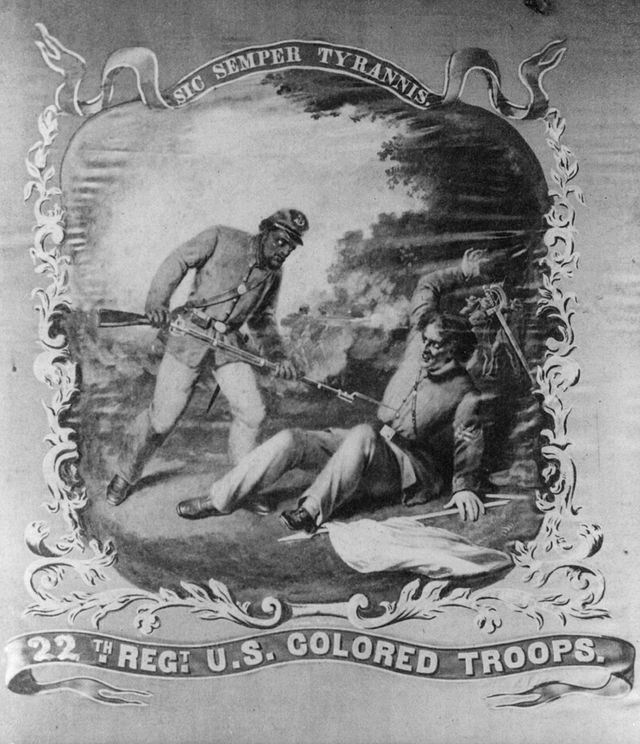
Formed in 1863, the 3rd Infantry Regiment, United States Colored Troops served in the trenchworks around Fort Wagner — the grinding siege in the summer of 1863 that followed the bloody attempt to storm the fort immortalized in the 1989 film Glory.

The Third was subsequently transferred to Union-occupied Jacksonville, Florida for duty garrisoning a conquered town of the Confederacy whose white citizens chafed doubly at their presence. But the unit had weathered both the boredom of the garrison and the hostility of white Floridians, and was set to muster out and return home on Halloween of 1865.

All U.S. Colored Troop regiments were officered by white men, putting an inevitable racial tinge on the inherent potential tension between enlistees and their commanders — the triggering event in our story. Heading the Third was a fellow named John L. Brower, Lieutenant Colonel by rank courtesy of his political connections but of nearly no actual military experience.

Ohio National Guard Judge Advocate General Kevin Bennett, in his 1992 article about the mutiny,* calls Brower a “martinet”; elevated to command of the Third on September 12 for what should have been a mostly ceremonial interim, Brower delighted in enforcing stringent wartime discipline months after Appomattox. While no man welcomes the taste of the lash when he’s one foot out the door back to civilian life, excess discipline meted out by cruel white overseers was particularly bad form for Colored Troop regiments.

From the standpoint of black Americans, the war had been all about destroying slavery; they had practically had to force this objective, and their own presence,** into the conflict. Being strung up by the thumbs for petty theft — Brower’s decreed punishment for one of his charges on October 29 — was far too evocative of the hated Slave Power.

“Inexperienced officers often assumed that because these men had been slaves before enlistment, they would bear to be treated as such afterwards,” one white Colored Troop commander later remembered. “Experience proved to the contrary. Any punishment resembling that meted out by the overseers caused irreparable damage.”†


The inclination of black troops to reject servile treatment and the anxiety that this provoked among their officers and the larger white community must surely be read in view of the perplexing new conditions following the Civil War.

Even among whites who supported it in principle, slavery abolition meant an unsettling and uncertain rearrangement of civilization — or at least, it potentially meant that. Would the economy continue to function without slavery? Would the daily conventions and assumptions that had sustained whites north and south have to be entirely renegotiated?

“Once let the black man get upon his person the brass letter, U.S., let him get an eagle on his button, and a musket on his shoulder and bullets in his pocket, there is no power on earth that can deny that he has earned the right to citizenship,” Frederick Douglass had proclaimed. Now that the war had finished, what else did those musket-toting sable fellows think they had earned the right to?

Press reports over the course of 1865 show a continuing theme of “Negro mutinies”: it is for wiser studies than this post to determine whether the trend such stories represent is disturbances among the black soldiery, or an exaggerated preoccupation among their white countrymen. In either event, Jacksonville was very far from unique even if the punishments were exemplary.


From the June 16, 1865 Cleveland Plain Dealer, concerning black soldiers on a steamer bound for Texas calling at Fort Monroe who, chagrined at the assignment, refused to permit the steamer’s resuming its journey.


From the June 19, 1865 Philadelphia Inquirer, concerning a company refusing to embark for Texas. “Certain evil disposed persons put it into the heads of these credulous colored soldiers that they were to be sent to Texas as servants for the white troops,” runs the report. “Doubtless some secret enemies of the Government instilled similar subtle falsehoods into the simple minds of the blacks who were disarmed at Fortress Monroe a few days ago.”


From the September 30, 1865 Daily National Intelligencer (Washington, D.C.), concerning a mutiny reported near Hilton, N.C.


From the Oct. 1, 1865 Daily Constitutionalist (Augusta, Ga.), reporting a disturbance begun when a black regiment demonstrated against a court-martial for one of their comrades accused (and acquitted) of stealing a hat.

In the midst of all of this — right about the time of the incident in this post, in fact — bulletins reached American shores of the Morant Bay Rebellion, a bloody rebellion of black laborers in British-controlled Jamaica. Slavery had been abolished on that Caribbean island more than 30 years prior: what did that uprising augur for the races in these United States?


Subtext becomes text: the Norwich (Conn.) Aurora, December 23, 1865. “The African released from restraint, and the passion of the savage provoked, will realize the scenes formerly witnessed in Hayti.” (The full article (pdf))

For our case, the name of the man punished like a slave is lost, but we do know what he did: steal some molasses from the kitchen. That’s how six of his comrades ultimately wound up looking down the barrels of their executioners.

A Lt. Greybill caught the greedy nosher and decreed a rough summary punishment, which the arriving Brower arrived helped to enforce on the resisting prisoner. “Tying up by the thumbs” was a brutal and humiliating treatment that lifted the man by those digits (often dislocated in the process) until only his toes remained on the ground, barely supporting his weight, and left him there for hours. In the film 12 Years a Slave, we see a man subjected to this sort of tiptoeing, but with a rope about the neck instead of about the thumbs.

Other enlisted men gathered around this pitiful scene, complaining about what they saw. A Private Jacob Plowden, who will eventually number among our day’s six executees, cried out that “it was a damn shame for a man to be tied up like that, white soldiers were not tied up that way nor other colored soldiers, only in our regiment.”

Plowden announced that “there was not going to be any more of it, that he would die on the spot but he would be damned if he wasn’t the man to cut him down.” Another private, Jonathan Miller, joined the incitement — “Let’s take him down, we are not going to have any more of tying men up by the thumbs.” A number of the black soldiers, 25 to 35 or so, began advancing on Brower and the hanging molasses-thief. Brower drew his sidearm and fired into them, wounding a man and sending the soldiers scurrying — some dispersing, but other dashing off to tents to arm themselves.

Several non-lethal fights now occurred in various spots around the camp between soldiers and officers, and eventually between the disaffected soldiers and arriving brethren from Company K, who had been summoned to calm the situation.

Lt. Col. Brower exchanged shots with several of the men who armed themselves, and in a bit of symmetry with the distasteful punishment that had started the whole mess, he had his thumb shot off in the process. One of the privates who had been heard complaining of the thumb-hanging, now playing peacemaker, grabbed the injured officer and escorted him to a safe building, warning some men who tried to pursue them to “stop their damn foolishness.”

Elsewhere, a Lt. Fenno sabered a protestor, and got bashed over the head with a fence-post in response. Neither injury was life-threatening to its recipient. Some shots were exchanged elsewhere in camp and/or fired demonstratively into the air, again to no fatal effect. And a Private James Thomas cut down the post where the source of all the disturbance, the fellow who just wanted an extra ration of molasses, was hanging.

This was the whole of the commotion, which Company K reinforcements soon quelled.

In a speedy series of court-martials lasting from Oct. 31 to Nov. 3, thirteen men were convicted of mutiny in this affair, and a fourteenth of conduct prejudicial to good order (his offense: not during the mutiny but after all was over, saying of Brower, “the God-damned son of a bitch, he shot my cousin. Where is he? Let me see him.”) A fifteenth man was acquitted. All 15 accused mounted their own defense, without counsel or aid — generally endeavoring to show that they had either not armed themselves or (and this was the decisive factor for the six whose conviction carried a death sentence) not fired their weapon.

The trial itself posed interesting procedural dilemmas, which Bennett explores at length in his article: first, because it was a mutiny case, the white officers of the Third who comprised the jurors were also, awkwardly, the brother-officers of the witnesses who testified against the mutineers.

And second, although the Civil War was over, Florida still technically remained in a state of rebellion, and this enabled the unit to convene a general court-martial, issue death sentences, and even carry them out without allowing any appeal to Washington. General John Foster gave the final approval to the sentences and transmitted case files to Washington after the fact; that was all the six condemned had by way of legal or executive review.

On December 10, he received a telegraph ordering him to suspend one of the death sentences in response to an inquiry raised by U.S. Senator Edgar Cowan: Cowan had been contacted by one of his constituents, who represented that Private David Craig, whom the constituent had raised from childhood, had written him complaining of his wrongful conviction. According to Sen. Cowan, the allegation was that Craig had been directed to collect arms from the mutineers as the disturbance came to an end, but was thereafter arrested in the confusion for being armed with the weapons he collected. But December 10 was nine days too late, and the late Private Craig’s case file disturbingly seems to have been lost from the National Archives.

The other five shot by musketry this date were:

  • Joseph Green
  • James Allen
  • Jacob Plowden
  • Joseph Nathaniel
  • Thomas Howard

Lt. Col. Brower only testified at one of the courts-martial, and was sent home almost immediately afterwards. He’d lost his thumb for his adventure as an officer and a gentleman, but between the original provocative punishment that he helped enforce, and then inflaming a tense situation by shooting at his soldiers, the brass was probably just as pleased to see him go as were his subordinates.

The non-executed mutineers who received prison terms (up to 15 years) had their sentences commuted following a review in 1866. The rest of the regiment mustered out as scheduled at the end of October, two days after the Jacksonville Mutiny.

* B. Kevin Bennett, “The Jacksonville Mutiny”, Civil War History, Volume 38, Number 1, March 1992. Bennett’s article is the source of all of the quotes in this post not otherwise cited.

** See I Freed Myself, or this podcast interview with its author, David Williams.

† See here for a fascinating instance of this at sea in June 1865, by the author of Becoming American under Fire: Irish Americans, African Americans, and the Politics of Citizenship during the Civil War Era

On this day..