1948: Hans Karl Möser, for rocketry

In 1943, punishing Allied bombing had chased Germany’s brilliant rocket scientist Wernher von Braun and his team away from the Baltic port of Peenemünde where their pioneering work on the V-2 rocket had taken such a heavy toll on London.

Casting about the Third Reich for a suitable spot to base the missile team, the rocketeers settled on the Kohnstein, a hill in Thuringia already hollowed out by gypsum mines. This tunnel network was readily adapted into a subterranean munitions factory called Mittelwerk — difficult for the Allies to find, and once they found it, difficult to bomb.
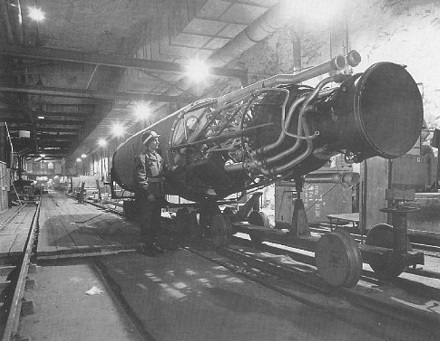

A U.S. Army soldier poses with a half-assembled V-2, one of about 250 such rockets found in the Mittelwerk labyrinth when the facility was captured.

With the facilities and the big brains in place, only one thing was missing: millions of man-hours of labor.

Nazi Germany had that in plentiful supply.

Beginning in late 1943, concentration camp inmates at Buchenwald began to be funneled out to a new facility, Mittelbau-Dora. Initially just a Buchenwald sub-camp, Dora grew over the course of 1944 into an immense facility holding 50,000 prisoners — a handful of German undesirables, but mostly captured foreign nationals: French, Dutch, Polish, Czech, and Russian. Short of food, sleep, and clothing for the 1944-1945 German winter, they were systematically worked to death in the Mittelwerk shafts to build a better bomb.

Our day’s principal, Hans Möser/Moeser (English Wikipedia entry | German) was an SS-Obersturmführer who made a living throughout the war years pulling guard detail in a number of concentration camps.

On May 1, 1944, Möser was transferred from Auschwitz to Mittelbau-Dora. It was the last job he would ever hold, but were Möser on the market today his C.V. would laud his team-player orientation and project management skills on a high-priority initiative. No doubt he was just the sort of reliable agent who understands how things are done that the world’s mad bombers need at their back.

“Ninety percent of the prisoners lived and worked in the tunnel of the mine,” testified one German who worked at Dora as a secretary and doctor’s aide.

As a result of the uninterrupted work in the mines and the absence of any installation for forced draft and ventilation, there prevailed a stuffy cold atmosphere, which made breathing difficult. The prisoners also slept in the subterranean tunnel in big chambers hewed out of the rocks, in five beds on top of each other. Already in 1944 3,500 prisoners used to sleep in such a room. In the tunnel of the mine there was no ater, the prisoners got absolutely insufficient quantities of tea for drinking purposes. But for weeks they were not able to wash themselves. As a result of the heavy work in the mines and of the bad food numerous prisoners died from exhaustion during their work.

According to that same testimony, the camp received a frightful order on Good Friday, which fell on March 30 in 1945: drive every last prisoner into those tunnels and bring down the caves around them. “No prisoner should be allowed to fall into Allied hands alive.”

The speedy arrival of the American 3rd Armored Division and 104th Infantry Division just days later prevented that order from taking effect.

The facilities themselves, too, were to be destroyed as part of Hitler’s scorched-earth “Nero Decree” intended to deny the benefit of German industry and infrastructure to the arriving conquerors. But Hitler’s War Production Minister Albert Speer was intentionally ignoring that order, a decision that might well have helped him avoid hanging at the Nuremberg trials.

Mittelwerk was a valuable capture indeed for the Allies. The Americans who first occupied it, and then the Russians who took it over a few months later, ransacked it for parts and technical specifications. The V-2 was the first man-made object to reach space, blasting at the speed of sound to the edge of orbit before plummeting back with its payload into the heart of London or wherever. It’s the ancestor of the long-range, intercontinental ballistic missiles that would come later, as well as the space programs of the countries who could build such missiles.

And of course, it wasn’t just the parts.

Wernher von Braun himself was the top prize of all — the young genius (he was just 33 when World War II ended) with the weapons of the future in his skull. As Germany collapsed in 1945, von Braun and his team of engineers had resolved to surrender themselves to the Americans rather than the Russians, but they too were subject to an order given the SS to execute the scientists if their capture appeared imminent. The Fuhrerbunker knew as well as the Allies how valuable this asset was.

In the event, von Braun managed to give himself up to a surprised American private. He disappeared into American custody, the crown jewel of “Operation Paperclip” that grabbed some 1,500 scientists from Germany and helpfully whitewashed their past misdeeds — misdeeds like Nazi party affiliation, and participating in slave labor camps.

Firing guided rockets into space was one thing. Unfortunately for our man Möser, his own skill set of bullying subordinates was not in short supply for either of the Cold War antagonists.

Möser was the one defendant (among 15) condemned to death at the resulting trial of Dora camp personnel. Rocket scientists, naturally, were not present for the occasion; Wernher von Braun and his team were hard at work at this time at Fort Bliss, Texas adapting the V-2 to the American Hermes program.

But at Dora, it had been Möser’s job to oversee camp discipline and labor strength for the slaves doing the grunt work manufacturing von Braun’s brainchild. Testimony convinced the court that the SS man had done this far too brutally, and perhaps with sadistic pleasure.

Several witnesses testified Möser frequently beat prisoners and participated in executions, often shooting at the men who were hanged for camp infractions — while they were hanging, or after they were taken off the gallows. (And of the latter, some already dead and some still alive.) “The accused told the twelfth witness that it was a pleasure to give the mercy shots, like shooting a deer.”

Möser for his part countered that he took no joy himself in the beatings and killings that he had to conduct as part of his job — and that the camp commandant had early on reprimanded him for leniency, threatening that “in view of the importance of the V-weapons operation, this could be interpreted as sabotage because it reduced the work efficiency.” How’s that for a hostile work environment?

(There’s a large .pdf of the entire trial summary here. Möser’s section begins on page 36 of the pdf (page 68 per the numbering in the scanned book pages).)

His presence on this here site betrays the outcome. On this date in 1948, Hans Möser was hanged at Landsberg Prison along with several other (unrelated) convicted war criminals.

On this day..

1730: Patrona Halil, Ottoman rebel

On this date in 1730, Patrona Halil, the virtual ruler of the Ottoman capital at the head of a popular rabble, was lured to Istanbul’s Topkapi Palace on the pretext of receiving an imperial honorific — and there seized by the sultan’s guards and put to summary death.

An Albanian shopkeep and Janissary, Halil (English Wikipedia entry | Turkish) had been at the fore of an extraordinarily successful rebellion that bears his name in Turkish histories.

Very recently the mortal terror of Europe, the Ottoman Empire was into its midlife crisis by the early 18th century — a long transition, as it would transpire, into its terminal “sick man of Europe” stage.

Incensed at the splendor of the grandees during the so-called “Tulip Period” — elites’ 1720s fad for that flower, which accompanied years of decadent, and perhaps impious, openness towards Europe — struggling* Istanbul artisan guilds revolted in 1730 over taxes imposed to pay for war with Persia.

Not for the last time, the impositions of the taxman only served to catalyze wider grievances that had already been mounting. Janissaries cast a gimlet eye on the sultan’s dalliances with European military innovations — which those feudal infantrymen rightly perceived as an existential threat. Everyday Turks and the ulama alike resented the cultural inroads of the West. In the paroxysm of 1730, these factions combined with the petite bourgeois guilds to shake the Porte far more deeply than some riot ought.

There had been many rebellions in Istanbul before, but this was the first to show a syndrome that was thereafter often repeated: an effort to Westernize military and administrative organization propounded by a section of the official elite, accompanied by some aping of Western manners, and used by another interest group to mobilize the masses against Westernization.*


Jean-Baptiste van Mour, a Flemish painter residing in Istanbul at the time. He’s notable for numerous paintings of the Tulip Era Ottoman Empire, including that of the sword-brandishing Patrona Halil further up this post.

The rebellion forced the execution of the grand vizier, and the abdication of Sultan Ahmed III in favor of his nephew Mahmud. Rioters sacked the estates of the wealthy and put a definitive end to the Tulip Period by trashing the delicate gardens emblematic of their sybaritic lords.

For nearly two months, the impertinent Halil was virtually the master of the capital. He rode with the new sultan to the ceremony investing him with Osman’s sword; he dictated appointments for his rude associates, like a Greek butcher named Yanaki who was to become Hospodar of Moldavia. At Halil’s whim, Mahmud was forced to order mansions put to the torch and (of course) that hated war tax rescinded.

Halil probably ought to have been better on his guard against the maneuver the sultan executed this date — and was always likely to attempt in some form. Then again, what he had already achieved, however briefly, was outlandish, and pointed to weaknesses in the Ottoman state far more durable than Halil himself. By slaying the insurgent chief, Mahmud got himself some breathing space: popular dissatisfaction, however, was too widely rooted to be destroyed at a single stroke, and would resume again with intermittent disturbances and purges well into 1731, with a successor revolt in 1740.†

And over a still longer arc, the parties of the Halil revolt would guard their prerogatives so jealously and effectively over the generations to come as to fatally compromise the capacity of the sultanate to compel the modernization that the Empire required. Patrona Halil’s revenge was two centuries in coming … but it was worth the wait.

* According to Robert W. Olson’s “The Esnaf and the Patrona Halil Rebellion of 1730: A Realignment in Ottoman Politics?”, Journal of the Economic and Social History of the Orient, September 1974, the major beefs of the esnaf (guilds) were a spiral of inflation brought by the devaluing Ottoman currency, the influx of immigrants to the capital, and taxes.

** Serif Mardin, “Center-Periphery Relations: A Key to Turkish Politics?”, Daedalus, Winter 1973.

† See Olson, “Jews, Janissaries, Esnaf and the Revolt of 1740 in Istanbul: Social Upheaval and Political Realignment in the Ottoman Empire”, Journal of the Economic and Social History of the Orient, May 1977.

On this day..

1329: Alberghettino II Manfredi, upstart condottiero

On this date in 1329, Italian condottiero Alberghettino II Manfredi was beheaded in Bologna.

He was the poor fruit of the Manfredi family, the lords of Faenza. Posterity doesn’t know a tremendous amount about Alberghettino, but one can infer a certain state of mind from his actions. While dad ran Faenza, his brother Ricciardo was on the condottiero cursus honorum as the temporary captain of nearby Imola.

In the mid-1320s, Alberghettino got his Fredo Corleone on by allying with the lord of Forli, a Faenza rival, in a treasonable (not to say Freudian) plot to supplant his father’s position.

He enjoyed a temporary run of the place from 1327-28 but was ousted by papal troops.

Forced to retire to Bologna, he returned immediately to conspiring with an attempt to make Bologna’s first man L-o-u-i-s, as in the Holy Roman Emperor Ludwig IV — at that moment barging about the Italic peninsula setting up antipopes.

That plot, too, failed. After that, on top of all his other woes, Alberghettino stood a head shorter than his more fortune-favored relations.

On this day..

1964: Louis Drouin and Marcel Numa, Jeune Haiti

On this date in 1964, the last two members of a noble and doomed rebel movement against Papa Doc Duvalier were shot in a repellent carnival outside the Haitian capital’s national cemetery.

Thirteen young Haitian expatriates had alit from sea, Granma-like, early that August of 1964, weeks after Duvalier was “elected” President-for-Life with an entirely plausible 99.9% of the vote.*

Taking to heart Machiavelli‘s maxim that it is better for a sovereign to be feared than loved, Papa Doc buttressed his rule with a vicious paramilitary force. Some 30,000 Haitians are thought to have been murdered during his 14-year reign, and many thousands of others fled into exile.

The Cuban example — a few plucky armed men in the mountain somehow toppling the ancien regime — must have inspired the U.S. exiles of the so-called Jeune Haiti. Certainly they did not want for the guerrilla’s raw courage and hardiness. In some alternate history their tramping through southern Haiti’s hills under the barrage of Hurricane Cleo is the stuff schoolchildren recite.

But in our world the rising Jeune Haiti hoped to spark did not materialize. Port-au-Prince brandished horrific reprisals against the rebels’ non-combatant family members in the city of Jeremie, and the men themselves were simply picked off in ones and twos in the bush. The last Jeune Haiti members still at liberty were killed in late October, leaving only the two whom the government had managed to capture. Papa Doc had evil plans for Marcel Numa and Louis Drouin.**

On November 12, a Thursday, government offices shuttered for the grotesque holiday, and schools were ordered to bring their pupils to this special lesson of the dictatorship. “No force will stop the invincible march of the Duvalierist revolution,” read a leaflet distributed at the execution. “It carries the strength of a torrent.” (Source)

Under the eyes of this curious throng and the whirr of cameras, Numa and Drouin were lashed to pine poles by the Tonton Macoutes. Un-blindfolded, they received the whispered last rites of a Catholic priest, and then were shot dead by a firing detail.

When the men’s bodies slide down the poles, Numa’s arms end up slightly above his shoulders and Drouin’s below his. Their heads return to an upright position above their kneeling bodies, until a soldier in camouflage walks over and delivers the final coup de grace, after which their heads slump forward and their bodies slide further toward the bottom of the pole. Blood spills out of Numa’s mouth. Drouin’s glasses fall to the ground, pieces of blood and brain matter clouding the cracked lenses.

The next day, Le Matin, the country’s national newspaper, described the stunned-looking crowd as “feverish, communicating in a mutual patriotic exaltation to curse adventurism and brigandage.”

“The government pamphlets circulating in Port-au-Prince last week left little to the imagination,” reported the November 27, 1964, edition of the American newsweekly Time. “‘Dr. Francois Duvalier will fulfill his sacrosanct mission. He has crushed and will always crush the attempts of the opposition. Think well, renegades. Here is the fate awaiting you and your kind.'”

* Actually a bit of a setback for Duvalier after winning every single vote (finaly tally of 1,320,748 to 0) in his 1961 “re-election”.

** Drouin, who was wounded in a battle and captured for that reason, openly lamented at his execution his failure to commit suicide.

On this day..

1898: Sokong, Lavari, and Kruba of the Imperri

Three Sierra Leone natives whose November 7, 1898 hanging we recall here might have had their fate written in the stars before time itself began, but a much more proximate document was the understanding concluded among European powers at the Berlin Conference of 1884-85.


“Deal table in the middle, plain chairs all round the walls, on one end a large shining map, marked with all the colors of a rainbow. There was a vast amount of red — good to see at any time, because one knows that some real work is done in there, a deuce of a lot of blue, a little green, smears of orange, and, on the East Coast, a purple patch, to show where the jolly pioneers of progress drink the jolly lager-beer.” –Joseph Conrad

This summit aimed to regularize the so-called “scramble for Africa” among rival European empires by setting forth some rules about who got to plant what flags where. One of those rules was known as the Principle of Effective Occupation: as the name suggests, the Principle was that a colonial power actually had to be in something like control of the territory it proposed to call its own.

The Berlin Conference kicked off a generation of frenetic jockeying and conquest that carved up the continent.

Further to Effective Occupation, the British expanded their longstanding coastal presence at Freetown by, in 1896, annexing the inland regions into something now christened the Protectorate of Sierra Leone.

All that Protectorating didn’t come cheap. Who better to pay for it than the Protectorated?

Britain’s proconsul accordingly dropped a Hut Tax on his subjects — a ruinously steep one that stoked an 1898 rebellion known as the Hut Tax War. The brief but bloody war (actually an amalgamation of two distinct rebellions, north and south) cost hundreds of lives on each side, not sparing civilians.

British colonial agent Thomas Joshua Alldridge, who authored several studies of the colony and its inhabitants, was part of the July expedition raiding a town called Bambaia on Sherbro Island.

I had already sent to the chief of this town, giving him an ultimatum — that if he would not by a certain day, come up and tender his unconditional submission, a punitive expedition would be the result. He was a notoriously bad character and did some terrible things, for which he was afterwards tried and hanged. The disregarding of the ultimatum caused the present expedition. I was informed that when we arrived at the waterside he had cleared out with the people before we could get into the town. Presently a few people returned, and it was evident that he was in hiding near; but to attempt to hunt for men in the African bush is a waste of time, the bush being their natural stronghold.

I sent messages by the people, and had it loudly called out that if he would return to the town by 4 o’clock that I would not destroy the place, but that if he did not appear before me by that time it would be burnt. As he did not do so and I could get no information whatever, the straggling and outlying parts of the town were fired, and in the morning the town itself was destroyed.

Hangings like the one Alldridge references here for the chief of Bambaia were meted out in great number to rebel leadership, some 96 executions known in just a few months. Alldridge knew the country in peacetime and not just in war, and would eventually publish several studies of the country from his observations. (The text just quoted comes from one such.)

In this 1896 photo, Alldridge recorded the election by the chiefs of Imperri — a region of Sherbro Island — of a paramount chief (Sokong). He’s the rightmost of the two seated men, wearing a black top hat; beside him sits a counselor described by Alldridge as the Imperri Prime Minister (Lavari).

The quality of this image isn’t the best; it’s just taken from a Google images scan of Alldridge’s public domain book A Transformed Colony: Sierra Leone, as it Was, and as it Is. Alldridge notes that both the Sokong and the Lavari later “suffered the full penalty of the law” for the rebellion.

That would presumably make those two leaders also part of this portrait, taken just four months before the rebellion’s outbreak at a meeting of Imperri chiefs in that town of Bambaia which Alldridge would later put to the torch:

This latter photo is online in a number of locations with the same descriptive caption:

Identified beneath the print are the Sokong, the Prime Minister and ‘a principal Kruba’ (military leader) with the following remark: ‘all of whom were tried for murder and hanged at Bonthe, Sherbro, 7th November 1898′.

Unfortunately, I’ve never been able to find a version of this photo that actually reproduces in situ the identifications alluded to. Perhaps there is a reader who can identify the Sokong and Lavari from the first picture in the second?

On this day..

1864: Four Confederate soldiers, under Burbridge’s Order 59

The Martyrs Monument of Midway, Ky., honors four Confederates publicly executed by the Union one hundred fifty years ago today.

A brutally contested frontier zone between North and South, Kentucky at this point was under martial law, governed by General Stephen Burbridge — but nearly anarchic on the ground in some areas.

In an effort to quell the activities of Confederate guerrillas-slash-outlaws, Burbridge issued a still-notorious directive called Order 59: Citing the “rapid increase in this district of lawless bands of armed men,” the order threatened to expel Southern sympathizers and seize their property. Moreover, it warned: “Whenever an unarmed Union citizen is murdered, four guerrillas will be selected from the prison and publicly shot to death at the most convenient place near the scene of the outrages.”

The outrages in question for this occasion were raids on Midway horse farms* (allegedly led by “Sue Mundy”) that, on November 1, resulted in a shootout fatal to one Adam Harper Jr.

Agreeably to Order 59, Burbridge had four of his prisoners — men with no specific connection to Harper’s death — shot on the town’s commons, forcing the local populace to attend the scene.

Rest
Soldiers
Rest
Thy
Warfare
Oe’r [sic?]

M. Jackson
J. Jackson
C. Rigsner
N. Adams

Shot by order of
Genl. Burbridge
Nov. 5 1864
In retaliation

Our Confederate Dead

Burbridge would be dismissed, and his Order 59 revoked, early the next year. “Thank God and President Lincoln,” was the reaction of the Louisville Journal.

Three other similar monuments in Kentucky (in Eminence, Jeffersontown, and St. Joseph) honor other soldiers executed under Burbridge’s retaliation policy.

* Midway knows from horses.

On this day..

82 BCE: The defeated populares of the Battle of the Colline Gate

On November 1 of 82 BCE, the Roman general Sulla clinched victory in his running civil war against the liberal populares by smashing them at a decisive battle at Rome’s Colline Gate. And on November 2 the victorious dictator* had his captured foes put to death en masse in the Villa Publica while Sulla himself laid out the new order in an address to the cowed Senate.

The roots of this climactic — although not literally final — battle stretch back years, decades even, to the populist Gracchi in the 130s and 120s, and even further than that. Rome’s burgeoning had strained her original social contract past the breaking point. Terms were renegotiated in bloody civil conflicts that saw Sulla emerge this date as master of the Caput Mundi.

The Gracchi all those years ago had tried (until the oligarchs’ faction assassinated them) to rebalance an increasingly stratified Roman society by introducing land reform and an early bread subsidy.

The Gracchi banner would eventually fall to Gaius Marius, a successful general noted among other things for defeating Jugurtha. His “Marian reforms” thoroughly overhauled military organization; crucially for the Roman social crisis, he opened to the propertyless masses service in the legions — formerly the preserve of the very landed citizen-farmer being squeezed out by the empire’s concentrating wealth.**

Marius’s program addressed two problems simultaneously: it gave the Roman poor a vector of upward mobility; and, it professionalized an army whose fighting capacity had slipped behind Rome’s imperial reach.

Because the capstone to a career in the newly-professionalized army would be a grant of land secured by Marius himself, it also introduced a dangerous personal alliance between vaunting commander and his troops, the seed of later centuries’ cycles of incessant rebellion.

During the decade of the 80s, a now-aged Marius was still the populares‘ standard-bearer, but was opposed now by the patrician general Sulla, Marius’s own former lieutenant during the war against Jugurtha.

Marius’s attempt to displace Sulla from command of a planned Roman expedition to the East to punish King Mighridates of Pontus for his abuse of Roman citizens in Asia Minor brought the two to open blows. Calling on his troops’ personal loyalty to him, Sulla broke an ancient taboo by marching on Rome itself.

Marius fled into Africa, a death sentence nipping at his heels. (Various artists have imagined him chilling in the ruins of Carthage.) Once Sulla sailed for Asia, however, Marius allied with the consul Lucius Cornelius Cinna and roared back from exile, seizing the capital and instituting a reign of terror against his political enemies. Plutarch:

whenever anybody else greeted Marius and got no salutation or greeting in return, this of itself was a signal for the man’s slaughter in the very street, so that even the friends of Marius, to a man, were full of anguish and horror whenever they drew near to greet him. So many were slain that at last Cinna’s appetite for murder was dulled and sated; but Marius, whose anger increased day by day and thirsted for blood, kept on killing all whom he held in any suspicion whatsoever. Every road and every city was filled with men pursuing and hunting down those who sought to escape or had hidden themselves. Moreover, the trust men placed in the ties of hospitality and friendship were found to be no security against the strokes of Fortune; for few there were, all told, who did not betray to the murderers those who had taken refuge with them.

He died about the age of 70 in 86 BCE, days into his unprecedented seventh consulship.

While all this transpired, Sulla had been several years detained in fighting Mithridates. By 83, he’d hung up the “Mission Accomplished” banner and made ready to march on Rome for the second time.

Marius was dead; his ally Cinna had also been killed in a mutiny. The populares party was now headed by Marius’s altogether less formidable son Gaius Marius the Younger and a plebeian consul named Carbo — guys nobody today has heard of, which pretty much tells you what happened next.

Attempting to stop Sulla in the south, Marius the Younger was thrashed and forced to retreat to Praeneste, where he would be bottled up harmlessly until he took his own life in desperation. Further north, Carbo was trounced and chased into exile (and eventual execution) by Sulla’s ally Pompey, the future Triumvir who got his possibly-sarcastic honorific “the Great” from his action in Sulla’s civil war.

The populares general Pontius Telesinus made the last stand of his movement hurling a force of Samnites and Roman Marian supporters at the capital where, at the Colline Gate, they momentarily pressed Sulla’s wing dangerously against the city wall before another future Triumvir, Crassus, overcame them from the opposite flank.

The ensuing slaughter on this date in 82 settled the Marius-versus-Sulla civil war: Sulla published a large proscription of former Marius supporters who were put to death by the thousands before the general resigned his dictatorship at the end of the year 81.†

Dan Carlin’s Hardcore History podcast series covers these events in Death Throes of the Republic, episode 3. In the indispensable History of Rome podcast, the relevant episodes are 31a. Marius | 31b. Marius | 32. The Social War | 33. Marius and Sulla | 34. No Greater Friend, No Worse Enemy.

* Sulla would be acclaimed dictator by the Senate a few weeks later, reviving an office that had been unused since Hannibal threatened Rome more than a century before.

** Pliny the Elder, writing in the first century AD:

there is a famous utterance of Manius Curius, who after celebrating triumphs and making a vast addition of territory to 290 B.C. the empire, said that a man not satisfied with seven acres must be deemed a dangerous citizen; for that was the acreage assigned for commoners after the expulsion of the kings. What therefore was the cause of such great fertility? The fields were tilled in those days by the hands of generals themselves, and we may well believe that the earth rejoiced in a laurel-decked ploughshare and a ploughman who had celebrated a triumph, whether it was that those farmers treated the seed with the same care as they managed their wars and marked out their fields with the same diligence as they arranged a camp, or whether everything prospers better under honourable hands because the work is done with greater attention. The honours bestowed on Serranus found [297 B.C.] him sowing seed, which was actually the origin of his surname. An apparitor brought to Cincinnatus his commission as dictator when he was ploughing his four-acre property on the Vatican, the land now called the Quintian Meadows, and indeed it is said that he had stripped for the work, and the messenger as he continued to linger said, ‘Put on your clothes, so that I may deliver the mandates of the Senate and People of Rome’. That was what apparitors were like even at that time, and their name itself a was given to them as summoning the senate and the leaders to put in an immediate appearance from their farms. But nowadays those agricultural operations are performed by slaves with fettered ankles and by the hands of malefactors with branded faces! although the Earth who is addressed as our mother and whose cultivation is spoken of as worship is not so dull that when we obtain even our farm-work from these persons one can believe that this is not done against her will and to her indignation. And we forsooth are surprised that we do not get the same profits from the labour of slave-gangs as used to be obtained from that of generals!

† Surviving the proscription was the son-in-law of the late consul Cinna, one Julius Caesar. He was able to pull strings with Sulla to get himself off the list.

On this day..

1814: Private John McMillan, deserter

HEAD QUARTERS, FALLS OF NIAGARA
OCTOBER 28TH 1814.

At a General Court Martial, held at Stamford, on the 25th instant, and continued by adjournment to the 28th of the same month, Private John McMillan, of the 2nd regiment of Lincoln Militia, was arraigned on the following charges, viz.: —

1st. For having deserted to the Enemy, with his Arms and Accoutrements, when on Duty, on or about the 6th of Octoer, 1813.

2nd. For having been taken bearing Arms in the Service of the Enemy on or about the 17th of September last.

And “The Court, after duly considering the Evidence for the Prosecution and on behalf of the Prisoner, were clearly of the opinion that he is guilty of both charges, and therefore Sentence him to suffer Death, at such place and time as His Honor the President may be pleased to direct.”

His Honor the President approves the finding and Sentence of the Court, and directs that the same be carried into Execution at Bridgewater [Niagara Falls] on Monday morning next, the 31st instant, at 11 o’clock

–British militia general order during the War of 1812

On this day..

1816: Francisco Jose de Caldas, wise person

Colombia polymath Francisco Jose de Caldas was shot on this date in 1816 during the Spanish commander Pablo Morillo‘s decimation of rebellious intelligentsia in separatist New Granada.

While Europe was mired in the Napoleonic Wars, those United Provinces of New Granada — roughly modern Colombia, which remembers its short-lived New Granada predecessor as la Patria Boba, the Foolish Fatherland — had asserted their independence. As we have detailed previously, it was Morillo who arrived from the mother country to disabuse them of this dream. Morillo did it with such a flair for the merciless that he earned the nickname El Pacificador.

Morillo conquered Bogota by May 1816 and for the rest of the year put large numbers of the pro-breakaway intelligentsia to political trials in an apparent attempt to cripple any future independence movements. (It didn’t work; during this very period, future liberator Simon Bolivar was making his first landings in Venezuela.)

A history by Jose Manuel Restrepo, a political figure of New Granada who was fortunate enough to escape the crackdown, lamented the fate of the men with whom he had once dreamed the dream.

for the space of six months, scarcely a week passed without the execution, in Santa Fe or the provinces, of three, four, or more individuals, shot as traitors. Thus perished the persons of the greatest wisdom, the most virtuous and wealthy, in New-Granada. The object which Morillo had in view, was to extinguish intelligence, remove men of influence, and destroy property, so that, in future, there should be none capable of originating or directing another revolution. New-Granada has deplored, and will for a long time deplore, among other illustrious victims, the loss of Doctors Camilo Torres, Joaquin Camacho, Jose Gregorio and Frutos Gutierrez, Crisanto Valenzuela, Miguel Pombo, Jorge Lozano, Francisco Antonio Ulloa, and Manuel Torices; and of military men, general Custodio Rovira, Libario Mejia, and the engineer Francisco Jose de Caldas. The murder of this celebrated mathematician and philosopher, was a piece of wanton cruelty on the part of Morillo. The exact sciences lost much by his premature death; and the geography of New-Granda especially, retrograded beyond measure, by the loss of the precious works which he had nearly perfected.

The spirit of these dark days is summarized by a reply Morillo supposedly made to petitions for him to spare the wise Caldas: “Spain does not need wise people.”

Present-day Colombia memorializes Francisco Jose de Caldas in the name of a department and numerous public monuments. (He also used to be on the 20-peso note when such a thing existed. Colombia’s smallest paper bill today is 1,000 pesos.)


Statue of Caldas on Bogota’s Plaza de Caldas. (cc) image from Mauromed.

On this day..

1781: Twelve Aymara rebels

[M]ore than 14,000 will have perished in this unhappy city, the great majority through starvation; others were shot, and still others were beheaded by the rebels in the fields that many attempted to cross even though they knew that the rebels would not show them any mercy if they looked Spanish in any way. And I, in the middle of all this misfortune and despite having as many bullets pass over me as passed over Carlos Federico of Prussia, I am still alive up to this date and after having satisfactorily carried out all the enterprises entrusted to me by my friend Commander Segurola, and having shown myself on all occasion to be very competent, and with a selfless love of service towards both Majesties, risking my life and everything I own to defend this hapless city. And everybody has celebrated, but especially said Commander, my activity and boldness at night as well as during the day, as I could always be found in the most dangerous areas of this wretched city, supervising and reprimanding those officers who were slack in their duties. Whatever happens from now on, God was served.

…

There is no Indian who is not a rebel; all die willingly for their Inca King, without coming to terms with God or his sacred law. On October 26th twelve rebels were beheaded and none of them were convinced to accept Jesus; and the same has happened with another 600 that have died in executions during both sieges.

…

The head of the infamous Tupac Catari still hangs from one of the gallows of this square, and on the 20th of last month they began to form the cases against twenty-four of the principal rebel officers who served under his perverse and iniquitous command. Equal diligence is being practiced against five women who are being held in the command post of this square. Among them is Catari’s sister and one of his women with the same inclinations as that iniquitous Indian, who must have come from the depths of hell.

More troops are needed from both Viceroyalties or from Spain, some 8,0000 to 10,000 men to make Our Sovereign’s name respected throughout the entire Sierra and to finally, once and for all, cut off some heads and be finished with all these cursed relics.

-Dec. 3, 1781 letter from Juan Bautisa Zavala “summarizing the calamities” of La Paz under Aymara siege over the foregoing months (As quoted in this anthology)

On this day..