1801: Periya and Chinna Marudhu

On this date in 1801, the brothers Periya Marudhu and Chinna Marudhu were hanged from the highest bastion of the fort of Tirupattur by the British — penalty for declaring the kingdom of Sviganga free from the British Empire.

The British East India Company had in the late 18th century established the foundation for the eventual Company Raj controlling India.

Sviganga was a small state only a few decades independent before the Company gobbled it up in 1790. But it proved more proud in its resistance than the Anglos might have expected. The widowed queen Velu Nachiyar put up a furious fight against the British in the 1780s, noted for its pioneering use of the suicide bomber: a Dalit woman who turned herself into a ghee torch and plunged into an enemy armory with explosive effect.

Velu Nachiyar died about 1790, leaving her patrimony to the administration of the Marudhu brothers. (The name is also rendered Marudu or Maruthu.)

The British policy was to rule India indirectly via arrangements with just such local elites. The pre-existing South India administrative class of Palaiyakkarars, better known to the British by the Anglicization “Polygars”, for instance, were simply bought off and put to tax collecting on behalf of the East India Company instead of domestic sovereigns.

These subcontinental subalterns did not prove to be quite as eager for the British yoke as the new hegemon might have hoped. They mounted a sequence of rebellions from 1799 to 1805 in a bid to claw back their autonomy. The British suppressed these risings only with considerable difficulty; an unnamed officer of the 73rd, in a letter published by the London Times on Jan. 7, 1802, paid the tribute of a colonist to his foes: “the Polygars are a race of people who inhabit the jungles and hill parts of India; they are braver than the generality of Indians, and cannot be said ever to have been conquered.”

The Marudhus joined this rebellion, allied with the Polygar Oomaithurai and leading a force pegged at upwards of 2,000. Finally besieged at Kalayar Kovil, the brothers found their fortress reduced and plundered by the British, and themselves delivered into enemy hands for exemplary justice. (Other captives, like Oomaithurai, were hauled further afield for punishment; Oomaithurai was executed on November 16 of the same year at Panchalankurichi.)

On this day..

1660: Francis Hacker and Daniel Axtell, regicides

On this date in 1660, the English soldiers Francis Hacker and Daniel Axtel(l) were executed for their roles in keeping the captured King Charles I, and for eventually seeing that late king to his beheading.

Francis Hacker

No hapless grunt, Hacker was a committed Roundhead even though most of his family stayed loyal to the Stuarts. When captured by the royalists at Leicester, Hacker “was so much prized by the enemy as they offered him the command of a choice regiment of horse to serve the king.”

Hacker disdainfully turned it down.

And as the wheel of fortune turned, the king would become Hacker’s prize. It was Hacker who commanded the detail of 32 halberdiers who marched the deposed monarch into Westminster Hall on January 20, 1649 to begin a weeklong trial — and a whole new historical era of parliamentary ascendancy.

Ten days later, when Charles was led out for beheading outside the Banqueting House, it was Hacker who escorted him. Hacker might have escaped even this much participation with his own life after the restoration of Charles’s son and heir, but it came out that he had even written, with Cromwell, the order to the executioner.

(It was an order that one of his comrades that day had very presciently refused to set his own hand to; come 1660, Hercules Huncks would owe his life to this refusal.)


Detailed view (click for a larger image) of an illustration of the king’s beheading. On the right of the scaffold, character “D” sporting a natty scabbard is Francis Hacker.

It’s a funny little thing to lose your life over, because — narrowly considered — it was nothing but a bit of bureaucracy. Hacker et al had been given from above a commission for the king’s death. On the occasion of the execution they had to convey from their party to the executioner a secondary writ licensing the day’s beheading.

But monarchs asserting divine prerogative certainly do not take such a view of mere paperwork.

“When you come to the Person of the King, what do our Law Books say he is? they call it, Caput Reipublicae, salus Populi, the Leiutenant of God”

–The regicides’ judge, delivering sentence

Huncks refusing to set his hand to this death warrant, it was Cromwell himself who personally dashed it off, then handed it to Hacker, who fatally countersigned it, just before the execution proceeded.

Meanwhile, Hacker’s subaltern Daniel Axtell razzed Huncks for chickening out. Axtell, who seemingly would be right at home in the kit of your most hated sports club, was indicted a regicide for his gauche fan behavior during the king’s trial, several times inciting soldiers (on pain of thrashing, per testimony in 1660) to chant for the king’s condemnation, whilst bullying any onlookers who dared to shout for Charles into silence.

Hacker did not bother to mount a defense; the verdicts were foreordained by political settlement.

Axtell argued superior orders, a defense best-known to us for its unsuccessful use by Nazis at Nuremberg but one which actually boasts a long history of failing to impress:

the Parliament, thus constituted, and having made their Generals, he by their Authority did constitute and appoint me to be an Inferior Officer in the Army, serving them in the quarters of the Parliament, and under and within their power; and what I have done, my Lord, it hath been done only as a Souldier, deriving my power from the General, he had his power from the Fountain, to wit, the Lords and Commons; and, my Lord, this being done, as hath been said by several, that I was there, and had command at Westminster-hall; truly, my Lord, if the Parliament command the General, and the General the inferiour Officers, I am bound by my Commission, according to the Laws and Customs of War to be where the Regiment is; I came not thither voluntarily, but by command of the General, who had a Commission (as I said before) from the Parliament. I was no Counsellor, no Contriver, I was no Parliament-man, none of the Judges, none that Sentenced, Signed, none that had any hand in the Execution, onely that which is charged is that I was an Officer in the Army.

Sounding equally modern, the court replied:

You are to obey them in their just commands, all unjust commands are invalid. If our Superiours should command us to undue and irregular things (much more if to the committing of Treason) we are in each Case to make use of our passive not active Obedience.*

The two men were drawn from Newgate to Tyburn this date and hanged.

Axtell was quartered, the customary fate of those regicides who had been put to death all the week preceding. Hacker, however, enjoyed the favor of hanging only, and was delivered and “was, by his Majesties great favour, given entire to his Friends, and buried” — perhaps because so many of Hacker’s family had remained true to Charles.

“If I had a thousand lives, I could lay them all down for the Cause”

-Axtell, at his execution

* Axtell’s trial has a good deal of detailed bickering over the superior-orders defense, but the court itself did also take pains to differentiate the things Axtell did as an officer, such as commanding troops (for which Axtell was not charged) — and his going the extra mile and surely beyond his commission to shout for the king’s death.

On this day..

1942: Coastwatchers on Tarawa

On this date in 1942, the Japanese military occupying the atoll of Tarawa beheaded 17 New Zealand Coastwatchers, along with five civilians.

Tarawa, a fishhook-shaped atoll that belongs to the Republic of Kiribati, was one of many specks of South Pacific land to which Australia and New Zealand deployed World War II Coastwatchers.

These small teams of mixed civilian and service personnel, as well as locals, kept up 24-hour watch for Japanese naval movements.* The tips provided by coastwatchers in the Solomon Islands during the Guadalcanal campaign led Vice Admiral William Halsey to exclaim that “the coastwatchers saved Guadalcanal, and Guadalcanal saved the Pacific.”

But their lonely forward positions also potentially exposed coastwatchers to considerable danger.

Even as Guadalcanal was unfolding in August and September in 1942, Japan was fortifying the occupied Gilbert Islands** (present-day Kiribati) in the wake of the Makin Island raid. Seventeen coastwatchers in the Gilberts were swept up in the process, and transferred to Tarawa along with five civilians (three British, one Australian, and one New Zealander). There they were held at the atoll’s old lunatic asylum, on the islet of Betio.

On Oct. 15, Allied planes bombed Tarawa. One of the captives got loose and ran onto the beach, frantically trying to signal the bombers. Instead, the Japanese — who fretted prisoners on their occupied islands becoming a fifth column in the event of an attack — summarily executed not only the signaler but all their captives.

“I saw the Europeans sitting in line,” one Tarawa local remembered later.

One Japanese started to kill the Europeans. He cut off the head of the first European, then the second, then the third, then I did not see any more because I fainted. When I came to, I saw the Japanese carrying the dead bodies to two pits.

In November 1943, a U.S. amphibious invasion took back the island at the bloody Battle of Tarawa. Twelve hundred Americans, and several times that many of the island’s Japanese defenders and Korean war slaves, were slain.

Old gun emplacements from that battle — as well as a monument to the New Zealand coastwatchers — can still be found on Tarawa.†

Catch these sights while they last. The average height above sea level for Kiribati is two meters, making global climate change liable to send the nation’s scattered islands to Atlantis. Kiribati residents have already begun turning up in Australia and New Zealand as climate change refugees.

* When the occasion arose, coastwatchers also rescued stranded Allied servicemen. After LTJG John F. Kennedy’s torpedo boat was rammed by a Japanese aircraft carrier in August 1942, it was a pair of Solomon Island natives dispatched by an Australian coastwatcher who found the future U.S. President and his surviving crew.

** Seven other coastwatchers besides those beheaded this date had been captured in the Gilberts when Japan first (but lightly) occupied it following Pearl Harbor. They survived the war as POWs in mainland Japan.

† There was a monument to the dead coastwatchers from shortly after the war. The remains of the seventeen, however, were long neglected by the New Zealand government, and have only recently been turned up … by Americans scouring Betio for casualties from the Battle of Tarawa.

On this day..

1990: The October 13 Massacre

This date is the dolorous anniversary of the “October 13 massacre”, a bloodbath wrapping up the Lebanese Civil War when the Syrian army executed hundreds of captured Lebanese.

The intractable war, which dated back to 1975 and made “Beirut” a 1980s watchword for conflict, had boiled down* to two rival governments: a Maronite military government based in East Beirut under the leadership of Michel Aoun, and the Syrian-sponsored Muslim government in West Beirut putatively headed by Selim al-Hoss. Over the course of 1989-1990 Aoun’s “war of liberation” against the occupying Syrian army all but emptied the city of Beirut.

Thanks to a complex political schism, Aoun was also ensconced in the city’s presidential palace from which he issued decrees denouncing and rejecting the political settlement that was supposed to return the country to normalcy.

Unfortunately for him — and moreso for the prisoners who are the day’s topic — Aoun was also supported by Iraq’s dictator Saddam Hussein. In August 1990, Hussein invaded Kuwait, precipitating an American attack on Iraq in response.

As this latter operation involved the U.S. attacking a Muslim oil-producing state with military resources it deployed for that purpose the politically sensitive sands of a neighboring Muslim oil-producing state, the U.S. spent the last months of 1990 working the Middle East diplomatic circuit to bring the region’s governments on board for the impending bout of ultraviolence.

Syria’s particular carrot was the green light to finish off Aoun — who, simultaneously, had of course been deprived of aid from the now-preoccupied Iraqis. This the Syrian army did with a massive attack on Beirut’s presidential palace beginning at seven in the morning on October 13th. The palace was overcome by 10:00 a.m., but resistance continued elsewhere throughout the day from pro-Aoun militias who had not received word of that gentleman’s surrender and escape to the French embassy.**

Several hundred people were killed during the onslaught into pro-Aoun enclaves. An unknown number of these ballparked to around two or three hundred are thought to have been killed by summary execution after capture (or after intentional rounding-up). A Lebanese nurse claimed that at the nearby village of Dahr al-Wahsh “I counted between 75 and 80 [executed] … Most of them had a bullet in the back of their heads or in their mouth. The corpses still carried the mark of cords around their wrists.” Other captured Lebanese fighters were reportedly deported to Syria and never heard from again.

There are several other atrocity accounts collected here. This two-part documentary on the end of the Lebanese civil war available on YouTube has several participants’ perspectives (including Aoun’s) on the chaotic situation marking the war’s last days: 1, 2.

* This is quite a gross oversimplification of a fractious civil conflict in which innumerable blocs continually rearranged their alliances.

“I had a chart on my wall of the constantly proliferating militias — four dozen or so by the time I left in 1985 — and their constantly shifting alliances and enmities,” one former Beirut denizen wrote recently. “Allies one day could be trying to kill one another the next, even within sects, over issues that had digressed far from their common cause.”

** Aoun went into exile in France, returning in 2005 when the Cedar Revolution finally drove the still-occupying Syrians out of Lebanon. He has served in the Lebanese parliament since that time, leading the country’s largest Christian party.

On this day..

610: Phocas, “will you rule better?”

It was on this date in 610 that the Byzantine Emperor Phocas was overthrown and put to summary execution — by the very hand, legend says, of his successor Heraclius.*

Perhaps Byzantium’s most anathematized emperor — one Byzantine historian elided his whole 8-year reign because “speaking of suffering is itself suffering” — Phocas’s own rise to the purple owed itself to extrajudicial executions.

That gentleman was a mere army officer of no regal proximity during the previous emperor’s campaigns to ward off the incursions of the Slavs and Avars into the Balkans. While this campaign on the whole enjoyed its successes, Phocas enters the historical scene about 600 as the leader of a delegation sent from the legions to Constantinople to object when the cash-poor imperial court refused to pony up ransom money for comrade soldiers taken prisoner. Phocas was abused at court, and the Avars executed their hostages.

By 602 the policy of having the soldiery take it in the braccae (soldiers’ own allotments had also been pinched by the same budget strictures) blew back when the foul-tempered army was ordered to winter on the far side of the remote Danube. The government collapsed in the face of a military mutiny; Phocas was crowned emperor; and he executed the former emperor Maurice, plus Maurice’s six sons. Much as we are accustomed to think of the old Roman emperors ever on the edge of violent overthrow, this event was for its contemporaries a great novelty and a dangerous precedent. There had not been a regime change by coup d’etat in Constantinople since that city’s namesake set it up as his capital nearly three centuries before.

This fact is a small part of Phocas’s vile reputation for later historians. But — and we will come to this — that reputation is also heavily colored by the perspective of the regime that would eventually overthrow Phocas himself. For Phocas’s subjects, while he had subjects, he was very far form universally hated. He found particular favor with the church, delivering the gorgeous pagan Pantheon to the pontiffs for use as a church. When touring Rome, you might learn that the very last imperial monument in the Forum is the Column of Phocas.**


Erected in gratitude by the Exarch of Ravenna.

Phocas’s reign, however, was defined by war with the Persians. And it was in the time of Phocas that King Khosrau, who actually owed his throne to previous Roman support, started breaking through the weakened Byzantine frontiers and tearing off huge pieces of territory.

By the last years of Phocas the Persians had taken Upper Mesopotamia and Armenia, and begun pressing into Anatolia where resistance collapsed with frightful ease. A Persian raid reached as far as Chalcedon in 608. There’s just something about having an enemy army in the suburbs of your capital that tends to overwhelm the value of any goodwill you got from cozying up to the pope.

In that same year (and this was surely a factor in the Persians’ shocking penetration into Anatolia) the Exarch of Africa began a revolt against the former centurion wearing the purple. From his position he was able to cut off grain shipments to the capital from the empire’s breadbasket, Egypt, which put Phocas in a truly desperate position. This exarch’s name was Heraclius but it was the man’s son, also named Heraclius, who would do the usurping.

Approaching the capital in 610, the Heraclii were able to quickly gather allies. Even the Excubitors, Constantinople’s Praetorian Guards under the leadership here of Phocas’s own son-in-law, saw where the winds were blowing and deserted immediately.

The rebels took Constantinople without a fight, and two patricians seized Phocas and presented him to the new sovereign.

“Is this how you have ruled, wretch?”

To which Phocas sneered,

“And will you rule better?”

Heraclius wasn’t in in the mood to be upstaged by his doomed predecessor, and got the latter’s execution, together with his own immediate coronation, enacted straighaway.

his right arm was removed from the shoulder, as well as his head, his hand was impaled on a sword, and thus it was paraded along the Mese, starting from the Forum. His head was put on a pole, and thus it too was paraded around. The rest of the body was dragged along on the belly, and was brought in the direction of the Chalce of the Hippodrome … And about the ninth hour of the same Monday, heraclius was crowned emperor in the most holy Great Church by Sergius patriarch of Constantinople. And on the following day, Tuesday … the head of Leontius the syrian [the former finance minister] was brought in and burnt in the Hippodrome, along with the image of Phocas which during his lifetime, foolish men wearing white robes had conducted into the Hippodrome with lighted candles. (Chronicon Paschale, as quoted here)

As if in retort to Phocas’s dying taunt, Heraclius held power for 30 distinguished years — “the brightness of the meridian sun,” in the estimation of Gibbon, for “the honor of Rome and Heraclius was gloriously retrieved by the exploits and trophies of six adventurous campaigns” that rescued Byzantium from the brink of destruction, drove back the Persians, enlarged the empire, and even returned the True Cross to Jerusalem. Heraclius himself commanded the army in the field, a practice long out of fashion for emperors. “Since the days of Scipio and Hannibal, no bolder enterprise has been attempted than that which Heraclius achieved for the deliverance of the empire.”

Phocas’s reputation did not profit from the comparison, and for Heraclius the last guy made a convenient foil to whom every evil of the realm could be attributed. We know Phocas almost exclusively through the accounts of later historians dating to this period, which is undoubtedly a factor in the black name our principal enjoys all the way to the present. The excellent History of Byzantium podcast attempts a balanced portrait of this era in an episode aptly named “In Fairness to Phocas”. The subsequent episode, “Heraclius to the Rescue”, deals with Phocas’s unpleasant exit from the scene.

* The new emperor personally executing his rival had a Roman precedent.

** Other Phocas achievement: he re-introduced the beard onto the imperial fashion scene. His predecessors had almost universally gone for the clean-cut look.

On this day..

1925: Shi Congbin, grievance

On this date in 1925 the Chinese warlord Sun Chuanfang had a captured enemy commander beheaded. In so doing, he signed his own death warrant too.

Our scene lies deep into China’s Warlord Era, the chaotic decade-plus after the collapsing empire gave way to a fractured republic: f rom 1916 to 1928, leagues of rival generals cut China into jigsaw pieces.

The chiefs of these shifting statelets, being warlords, fought numerous wars.

Sun Chuangfang, one of the generals of a warlord party known as the Zhili clique, was engaged in the south in 1925 in a campaign whose successful resolution would ultimately install him in Nanking with effective control of five provinces. In the service of achieving such a power base he must have thought little about destroying an enemy commander caught in a counterattack and mounting the man’s severed head on a pike to cow any opposition.

According to Eugenia Lean’s book about the amazing incident,

On October 3, 1925, while leading the Superior Iron Brigade (Tiejia jun), a brigade of mercenary troops, in an attempt to capture Guzhen, Shandong, Shi Congbin was surrounded by Sun Chuanfang’s troops with no support in sight. Shi’s four thousand soldiers were slaughtered, while Shi himself was taken prisoner and beheaded the next day upon Sun’s personal order. Shi Jianqiao [Shi Congbin’s daughter] related in heart-wrenching detail how her family would not have learned the truth except for the bravery and loyalty of one of Shi Congbin’s personal servants. “Only a single servant was able to flee home. When we asked him about news from the front line, he threw himself to the ground in tears. We knew the news was not good.” The servant had been too grief-stricken to speak. Only after he Shi family had gone to Tianjin did they learn all the facts behind Shi Congbin’s death.

The named daughter Shi Jianqiao was about 20 years old when she received this devastating news.

Years elapsed. The general, as we have said, rose to his acme, and then fell, and retired, and like as not he had never in the following decade tarried over the destruction of Shi Congbin.

But Shi Jianqiao did. She nursed her grievance and her sense of filial honor until when she was 30, she at last found her opportunity to strike back at her father’s slayer. Approaching the by-then-long-retired general as he performed Buddhist meditations, the faithful daughter shot him three times.

The supporting cast in Shi’s tale of revenge included the grieving widow and the suffering family her father had left behind. Even though there is little indication that the Shi family underwent any real financial strain, Shi Jianqiao nonetheless insisted that Shi Conbin’s death meant that a poor widow and six children, four of whom were still young, were left to fend for themselves. Sun Chuanfang was directly to blame for her family’s plight. The way in which Shi portrayed her mother was particularly important. Traditionally, dutiful daughters and chaste wives were expected to commit suicide if their fathers o husbands were killed unjustly. Such an extreme gesture was meant as an ultimate expression of loyalty and protest against injustice. But in this twentieth-century tale, Shi Jianqiao did not commit suicide and, moreover, justified her decision to live in terms of her filial piety to her mother. She portrayed her mother as particularly grief-stricken by the affair and argued that she needed to right the wrong committed against her father on behalf of her mother. In her GGRS, Shi declared, “Although all I wanted to do was die, my elderly moter’s illness gave me the will to live.” In her will, she stated, with similar effect, “To my dear mother … what I have been hiding from you for years, I can no longer hide. Our enemy has not yet been retaliated [against]. Father’s death can no longer be obscured … A sacrifice should be made for father’s revenge. In the future, five children will still be able to wait on you. They are all dutiful.” Shi Jianqiao’s act of revenge would be the ultimate gesture of filial piety, while her remaining siblings would be able to wait on her elderly mother in more mundane ways throughout the rest of her mother’s life.

Shi Jianqiao’s family loyalty attracted so much sympathy in China that she received a free pardon and even became a symbol of national resistance against the Japanese occupation. She died in 1979.

On this day..

1469: Humphrey and Charles Neville, Lancastrians

On this date in 1469, Lancastrian nobleman Sir Humphrey Neville and his brother Charles were beheaded at York under the eyes of King Edward IV.

These Nevilles — cousins to the Bastard of Faulconbridge, who we have met previously in these pages — lost their heads in the Lancastrian cause during England’s War(s) of the Roses over royal legitimacy.

For the Nevilles, as indeed for the House of Lancaster in general, everything had gone pear-shaped with the 1461 deposition of the feebleminded Lancastrian ruler Henry VI. That seated on Albion’s throne the Yorkist contender Edward IV; the imprisoned Henry’s queen, Margaret of Anjou — who had already been the effective sovereign in view of Henry’s mental incapacitation — retreated to Scotland. Humphrey Neville was among the irreconcilable Lancastrians who went with her; he would be captured raiding into England later that same year of 1461.

The House of Neville being one of the greatest in northern England (and having under its roof adherents to both white rose and red), Neville had his life secured by royal pardon and even received a knighthood from the usurping king — just the messy expediency of court politics.

The problem was that Neville just wouldn’t stay bought. 1464 finds him back in the field on the wrong team when the Lancastrians were routed at the Battle of Hexham; it is said that he hied himself thereafter to a cave on the banks of the Derwent and survived an outlaw, for five long years.

In 1469 Neville reappeared on the scene along with the shattered Lancastrian cause when the “Kingmaker” Earl of Warwick (yet another Neville) turned against King Edward and took him into custody — with the invaluable assistance of various northern disturbances in favor of the Lancastrian cause, a ruckus that Humphrey Neville probably helped to raise.

Warwick, however, found his own position as jailer of the king untenable. Neither could he himself quell the Lancastrian ultras who intended a proper restoration and not merely leveraging the royal prisoner — so to Warwick’s chagrin, he was forced to release King Edward in order to raise the army needed to move against the Lancastrian rebels who were supposed to be his allies.

Neville’s rising, and then Neville himself, were dispatched with ease — but the cost of doing so was the imminent failure of the entire Lancastrian movement.

On this day..

1651: Marubashi Chuya, Keian Uprising conspirator

On this date in 1651, the ronin Marubashi Chuya was crucified for a failed attempt to topple the Tokugawa shogunate.

Allegedly disaffected of the national unification dynasty by having lost his father to battle against it, Marubashi orchestrated, along with a fellow martial arts adept named Yui Shosetsu, a daring plot betrayed only by illness. When shogun Tokugawa Iemitsu died in 1651, leaving power to a 10-year-old heir, the conspirators meant to set fire to Edo (Tokyo) and seize Edo Castle as well as other cities.

But Marubashi came down with a very ill-timed fever and in delirium raved treasonable plot details that got passed along to Tokugawa authorities. The so-called Keian Uprising never made it into execution.


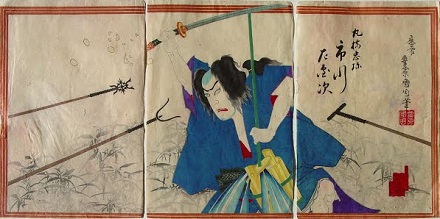
The Keian Uprising inspired many literary interpretations. This 1883 woodblock print depicts actor Ichikawa Sadanji as Marubashi Chûya.

This is more than can be said about the uprisers.

Yui managed to commit seppuku before capture, but Murabashi and a number of the other rebels paid the ultimate price. So too did family members of the rebels.

Marubashi’s is reputed to be the first execution to take place at the Suzugamori execution grounds. The little quarter-acre patch maintained this grim role for the ensuing 220 years, during which time an estimated 100,000 people were put to death there.

That venerable execution grounds was retired in 1871. There’s a memorial marking its onetime site in present-day Tokyo near the junction of Kyu-tokaido Street and Daiichikeihin Avenue.

On this day..

1946: Ernst Lohmeyer, theologian

On this date in 1946, the Soviets occupying East Germany executed Bible scholar Ernst Lohmeyer.

A fifty-five-year-old professor when the NKGB whisked him out of his apartment without explanation to his dumbfounded wife, Lohmeyer (English Wikipedia entry | German) was an important Protestant theologian of the interwar period with a knack for eschewing the opportunistic choice.

By refusing to disavow Jewish associates, his academic career got derailed in the 1930s, despite his producing influential critical commentary on the Gospel of Mark;* by patriotically serving in the Wehrmacht despite his reservations about the Third Reich, he set himself up to profile as an undesirable after World War II.

For a long time, Lohmeyer’s fate was, if not difficult to guess, obscure in its particulars. Not until 1957 was his execution in a forest near Hanshagen officially confirmed; he had been condemned by a military tribunal for participating in the German occupation of Sloviansk even though he wasn’t personally associated with any known atrocities.

The post-Soviet Russian state officially exonerated Lohmeyer in 1996. The University of Greifswald, where Lohmeyer was teaching when arrested, has a theology faculty building named for him.

* Lohmeyer postulated that the Gospel of Mark reflected a contemporary-to-the-evangelist (that is, post-Jesus) conflict between Christian communities in different locales, and that Mark himself was associated with Galilee’s Christians and therefore structured his narrative to exalt this location.

On this day..

1914: Seven retreating Frenchmen, with surprising results

One hundred years ago today, during the Battle of the Marne, seven French soldiers were shot without trial for retreating. Most of the resources about this Gallic tragedy are in French, and so are most of the links in today’s post.

The French book Fusille Vivant traces the life of Francois Waterlot, a prolific correspondent who wrote some 250 letters after surviving this date’s execution, before finally dying at the front the following year.

All were enlistees of France’s 327th Infantry Regiment. On the night of September 6, German shelling panicked their sister 270th Regiment into a disorderly retreat away from the front lines. That rout ran right into the 327th, behind them, and panicked that regiment too.

Further in the army’s rear, the hubbub awoke from his farmhouse bivouac division commander Gen. Rene Boutegourd. Boutegard had a simple solution, and ordered seven of the soldiers caught away from their posts to be executed the next morning by way of example. While the war’s later years would feature notoriously unfair courts-martial with predetermined sentences, Gen. Boutegourd didn’t even see the need to pay that much tribute to procedural regularity in this case.

The Battle of the Marne was still ongoing, and the situation in the field, pre-trench warfare, was fluid. Shoot them out of hand and be done with it! Then, the rest of the division will understand the consequences of unauthorized retreat.

Barbieux, Caffiaux, Clement, Delsarte, Dufour, Hubert, and Watrelot were stupefied to learn that they suddenly had mere hours left to live.

According to a postwar newspaper article — printed in 1922, when the bizarre case came to public attention and led to a posthumous pardon — they immediately began pleading for their lives. “Put us in the first wave of the next attack, but I beg you not to subject us to French balls,” Delsarte cried.

In those opening weeks of what was supposed to be a short war, with men’s minds still half at home in the pleasurable prewar idyll, the cruel frequency of the execution pour l’exemple had not yet set its stamp on things. The first such instance had occurred only the week before.

Maybe the men detailed to kill the “deserters” were equally stunned: it is hard to put down the results of the shootings merely to the uncertainties of technology or the hardiness of flesh and bone.

Palmyr Clement survived the fusillade and only died two agonizing days later from his firing squad injuries. This is a bizarre outcome even for those occasional cases where a fellow survives the scaffold. Implicit in such a fate is that there was no coup de grace administered after the volley. Is this oversight intentional — even an expression of distaste for the justice of the sentence soldiers had been tasked with visiting on their comrades?

And could distaste extend so far as an intentional or an indifferent failure of marksmanship by the firing details?

Such doubtful speculation can point to Francois Waterlot, who did Clement one better: he survived the execution full stop (dropping to the ground with the volley even though he was actually uninjured) and returned to the ranks, dying in battle on June 10, 1915. This uncommon feat earned him the nickname “le fusillé vivant”, “the shot alive” (somewhat literally) or “the living corpse” (more to the sense of it). That sobriquet is the title of a French book about Waterlot.

France executed about 600 of her own soldiers during World War I, the second-most (to Italy) of all belligerents in that conflagration. There is a great deal about this particular execution on this French page.

On this day..