2009: Haidar Ghanem, human rights activist

On this date last year, in the midst of Israel’s bloody incursion, Gaza’s Hamas government executed Palestinian journalist and human rights activist Haidar Ghanem as an Israeli spy.

Ghanem was the best-publicized of a number of Israeli collaborators to suffer that fate during the one-sided, three-week war.

“He was taken to an abandoned building in southern Gaza and shot to death,” a Palestinian source said. “Others were executed the same way.”

The Rafah resident had actually been a minor cause celebre back in 2002, when the Palestinian Authority condemned him to death for pinpointing Fatah activists for assassination by Israeli security, for which assignment he was supposedly recruited in the 1990’s while working as a field researcher for the Israeli human rights organization B’Tselem. International pressure got him released.

The Jerusalem Post reported that Ghanem confessed (as he had in the 2002 case) to the charges.

On this day..

1942: Eleven members of the Red Orchestra

On this date in 1942, eleven members* of a Berlin-based anti-Nazi resistance circle were executed at Plotzensee Prison — five by hanging, six by guillotine.

These members of the group organized around leftist Luftwaffe communications officer Harro Schulze-Boysen and intellectual Arvid Harnack were one of three Soviet intelligence nodes all of whom were confusingly designated Die Rote Kapelle.

That designation, assigned by Nazi intelligence rather than the networks themselves, has basically stuck and colored their postwar reputation with the anti-Communist politics of the Cold War.


Red affiliations that blackened Die Rote Kapelle’s memory west of the Berlin wall were more readily embraced by the Warsaw Pact. This East German stamp also honors John Sieg, a member of the circle who committed suicide upon his arrest.

And not only in retrospect: according to Gerald Reitlinger, the capture of known lefties misbehaving became the occasion of a McCarthyesque freakout full of internal political score-settling among the Nazis.

The affair of Burgess and Maclean will give some idea what capital can be made when someone with a leftish record enters and betrays a position of trust. The emotions roused are out of all proportion to the things that have been betrayed. [German military intelligence chief Wilhelm] Canaris declared that the conspiracy had cost the lives of 200,000 German soldiers.

While the cells in France/Belgium and Switzerland also covered by the “Red Orchestra” designation look like straight NKVD espionage operations, the Berliners were apparently more of a loose network of civilian dissidents who got pulled into (amateurish) spying as a part of their variety of quixotic protests from the very citadel of the Third Reich. When not nicking sensitive documents from Schulze-Boysen’s day job and haplessly attempting to ship them to the Russians, they made futile White Rose-like gestures of conscience, like anti-Nazi placarding under the cover of darkness, and more calculated stuff, like collecting war crimes evidence in the hopes of indicting their perpetrators after the war.

Well, what is one supposed to do as an anti-Nazi in Berlin in 1941?

And what if one is in a position to answer that question with, “provide effectual aid to the enormous army poised to destroy Hitler”?

Anne Nelson’s Red Orchestra: The Story of the Berlin Underground and the Circle of Friends Who Resisted Hitler (review | another) attempts to rehabilitate the Berlin circle from postwar red-smearing and underscore the everyday-ness of the participants (not all of them politically left) and the courage of their respective decisions to oppose Hitler actively.

Nelson’s book is new, but her argument is not unique.

Other books also titled Red Orchestra (Perrault, Tarrant | review of both) more strongly emphasize the commie-taskmaster dimension in what by any standard is thrilling real-life fare.

The German Resistance Memorial Center has salutes to the Red Orchestra’s members, networks and activities.

* Arvid Harnack’s American wife Mildred, initially condemned only to a prison term for her part in the Orchestra, had her sentence upgraded and followed her comrades’ fate on February 16, 1942.

On this day..

2002: Craig Neil Ogan, drug war informant

(Thanks to David Carson of the informative Texas Execution Information Center for the guest post, originally run on his site. -ed.)

Craig Neil Ogan, 47, was executed by lethal injection on 19 November 2002 in Huntsville, Texas for the murder of a police officer.

Mugshot clipped from Texas Department of Criminal Justice. More information, including some of Ogan’s own writing, at the Clark County Prosecutor site.

Craig Ogan had worked as an informant for the federal Drug Enforcement Agency since January 1988. Upon his request, the DEA relocated him from St. Louis to Houston in late 1989 after his identity had been revealed in a court proceeding. Ogan was under orders to not personally get involved in any drug transactions. He was also prohibited from carrying a weapon. Despite these instructions, Ogan insisted on arming himself and seeking involvement in drug transactions.

On 8 December 1989, Ogan, then 34, called the DEA agent who supervised him and told him that he was in a restaurant where he had just had an armed confrontation over a drug deal that fell through. He said that a man pointed a gun at his head and called him “narc.” He said that he feared for his life and asked for an escort from the restaurant. The agent arranged for two Houston police officers to escort Ogan from the restaurant back to his apartment. Once at the apartment, the officers watched as Ogan packed his belongings, which included a pistol, a sawed-off shotgun, and some knives. They then followed him to a motel. Ogan checked into a room, and the officers left at around 9:00 p.m.

At about 12:30 a.m., Ogan went to the lobby to complain about his telephone charges and the heater in his room. He argued loudly with the clerk and began kicking at a door. When the clerk called 9-1-1 for assistance, Ogan left.

Around this time, Houston police officers Clay Morgan Gainer and James C. Boswell pulled a car into a parking lot across the street from the motel, for a minor traffic violation. Ogan, then 34, walked over to them and knocked on the passenger window. Officer Boswell, 29, lowered his window and asked Ogan what he wanted. After a heated exchange, Boswell got out of the car. Ogan took Boswell’s pistol and shot him once in the head. He ran. Officer Gainer chased Ogan on foot, shot him in the back, and arrested him.

At Ogan’s trial, Gainer testified that when Boswell lowered his window and asked Ogan what he wanted, Ogan replied, “DEA dropped me off out here, and I’m cold.” Boswell told Ogan that they would help him as soon as they finished with the traffic stop, and to back away from the car. Boswell then raised his window. Ogan, however, demanded immediate attention. He knocked on Boswell’s window again, repeating that he was a DEA informant and that he was cold. Boswell told him, “You need to get out of here if you are not willing to step out of the way and wait. You either need to leave, or you are going to jail.” Ogan persisted with his demands. Boswell got out of the police car. According to Gainer, Boswell removed his sidearm from the holster and held it down against his leg. As he was reaching into the car to unlock the back door, Ogan grabbed Boswell’s gun and shot him once in the head. Ogan then said, “Well, [expletive] you then” and ran.

In addition to the above testimony, Darryl O’Leary, one of the two officers who escorted Ogan from the restaurant, testified that Ogan was “extremely excited” when he arrived. O’Leary said that when he told Ogan he could not take him until a backup officer arrived, Ogan became “impatient, hostile, and loud.”

Ogan had no prior criminal convictions. He had numerous assault charges that had been filed against him, then dismissed.

Sally Webster, a psychologist testifying for the defense, said that Ogan suffered from paranoia and had a passive-aggressive personality, but that these disorders were not mental illnesses and had no bearing on his competency to stand trial. She described Ogan’s mental state on 8 and 9 December as “anxious, agitated, almost hyperactive, very touchy, very worried.” Ogan’s lawyers called Webster to testify in an attempt to assert his mental state as a mitigating factor in determining his punishment, but the tactic backfired. Instead, prosecutors convinced the jury that Ogan’s history of high-strung paranoia made him a future danger to society.

A jury convicted Ogan of capital murder in June 1990 and sentenced him to death. The Texas Court of Criminal Appeals affirmed the conviction and sentence in April 1993. All of his subsequent appeals in state and federal court were denied.

In his appeals, Ogan’s attorneys claimed that their client suffered from a mental illness and that his trial counsel was incompetent for failing to use that in his defense. Ogan, who had an IQ of 140, had attended college, and spoke several languages, told a reporter, “They’re trying to sell me as a nut case. I don’t appreciate that.”

Ogan had a longstanding interest in espionage and had ambitions of joining the Central Intelligence Agency. In one of his letters from death row, he claimed that he had an appointment for an interview with the CIA the day he killed Officer Boswell. His career as a spy, however, never took off. At his trial, DEA agents testified that they considered Ogan to be, though a “marginally successful” informant, mostly a comical figure who ducked behind newspapers whenever a stranger entered their office. They derisively called him “special agent double-oh-five” behind his back. They also criticized him for getting involved in a drug deal without their permission, then calling for their assistance when it got him into trouble.

From death row, Ogan wrote letters that were posted on an anti-death-penalty web site. In one of them, he claimed that his execution represented the “premeditated mass murder” of possibly thousands of his potential descendants. He also provided his version of the conversation between himself and Officer Boswell. In Ogan’s account, he was extremely polite, courteous to a fault, and non-confrontational. Boswell and Gainer, on the other hand, were hostile to him without provocation and called him a “[expletive] DEA snitch.” Ogan wrote that when he told Boswell, “All right, sir; I was only asking for help,” Boswell then threw his door open and burst out of the car “in an insane rage, running/lunging furiously right at me, like a football tackle gone berserk, and clawing frantically at his gun/holster.”

An anti-death-penalty spokesman who visited Ogan on death row described him as “extremely tense.”

Ogan’s execution was delayed for nearly an hour as the Supreme Court considered late appeals questioning his mental competence.

“I would like to say first of all the real violent crimes in this case are acts committed by James Boswell and Clay Morgan Gaines,” Ogan said in his lengthy last statement. “I am not guilty; I acted in self-defense and reflex in the face of a police officer who was out of control,” he said. Ogan referred to a head injury Boswell had suffered and suggested that he had mental problems. He described Boswell as “filled with anger” and “mad at the world.” The lethal injection was given while Ogan was two minutes into his last statement. At 7:05 p.m., he was still talking about Boswell when he paused briefly to collect his thoughts. The lethal drugs took effect as Ogan then snorted, gasped, and lost consciousness. He was pronounced dead at 7:13 p.m.

By David Carson. Originally posted on 20 November 2002. Revised on 5 December 2002.
Sources: Texas Department of Criminal Justice, Texas Attorney General’s office, U.S. Fifth Circuit Court documents, Associated Press, Houston Chronicle, letters from Craig Ogan.

On this day..

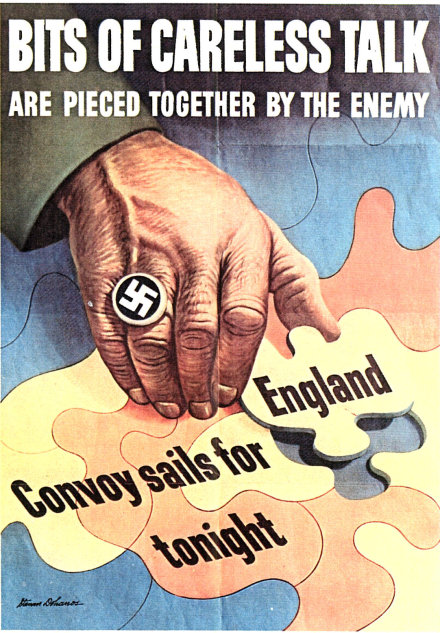
1942: Duncan Scott-Ford, because loose lips sink ships

On this date in 1942, British merchant sailor Duncan Scott-Ford was hanged at London’s Wandsworth Prison for giving German agents sensitive information about ship movements.

This, of course, was just the sort of thing everyone was trying to discourage.

… and a version to keep young soldiers on the pull Mata Hari-conscious:

For a case that so handily underscored the posters, the Scott-Ford affair made great copy … but not until a day after the hanging itself. Having kept everything secret, the papers were finally allowed on Nov. 4 to announce

that a British subject was executed for treachery at Wandsworth Prison yesterday morning.

Scott-Ford was paid 1,800 escudos by the enemy. This sum, which in English currency is equivalent only to about £18, was all that Scott-Ford in fact received from the enemy, though promises were held out to him which lured him deeper and deeper into the blackmailing clutches of the enemy. Thus when Scott-Ford returned on his second visit to Lisbon with the information which he had collected the Germans, instead of honouring their promises, threatened that they would expose him to the British authorities unless he continued to perform further services, to collect more valuable information and to undergo greater risks in their interest.

Some of the information which Scott-Ford gave to the enemy related to his own ship, and thus imperilled the lives of his own shipmates.

The moral to be drawn from this case is that British and allied seamen when visiting neutral ports should be constantly on their guard against strangers who may frequently approach them for apparently innocent purposes. Such strangers are apt to be enemy agents … (London Times, Nov. 4, 1942)

Shhhhh!

On this day..

1832: Not Javert, spared by Jean Valjean

On this, the second day of the abortive 1832 June Rebellion in Paris, police inspector Javert is faux-executed — and mercifully released — by his longtime quarry Jean Valjean in Victor Hugo’s classic Les Miserables.


Javert depicted in an theatrical poster, from the Les Miserables Gallery. The site identifies this as an 1899 poster, which may be mistaken since the actor billed for Javert died in January 1898.

Hugo’s monumental novel is structured by the implacable policeman’s pursuit of Jean Valjean, an absconded ex-con with a heart of gold.

Fate brings them together accidentally at the barricade of the (historical, but now forgotten) student uprising — Javert to spy on the student revolutionaries, who unmask him, and Jean Valjean to keep an eye on his adoptive daughter’s idealistic lover.

Jean Valjean’s timely contribution to the hopelessly outgunned revolutionaries gives him the pull to ask the favor of being the one to execute the spy.* Since Valjean has been hunted relentlessly by the lawman since breaking parole nearly two decades before, the hero has ample motivation to turn executioner.

Instead…

When Jean Valjean was left alone with Javert, he untied the rope which fastened the prisoner across the middle of the body, and the knot of which was under the table. After this he made him a sign to rise.

Javert obeyed with that indefinable smile in which the supremacy of enchained authority is condensed.

Jean Valjean took Javert by the martingale, as one would take a beast of burden by the breast-band, and, dragging the latter after him, emerged from the wine-shop slowly, because Javert, with his impeded limbs, could take only very short steps.

Jean Valjean had the pistol in his hand.

In this manner they crossed the inner trapezium of the barricade. The insurgents, all intent on the attack, which was imminent, had their backs turned to these two.

Marius alone, stationed on one side, at the extreme left of the barricade, saw them pass. This group of victim and executioner was illuminated by the sepulchral light which he bore in his own soul.

Jean Valjean with some difficulty, but without relaxing his hold for a single instant, made Javert, pinioned as he was, scale the little entrenchment in the Mondetour lane.

When they had crossed this barrier, they found themselves alone in the lane. No one saw them.

Jean Valjean thrust the pistol under his arm and fixed on Javert a look which it required no words to interpret: “Javert, it is I.”

Javert replied:

“Take your revenge.”

Jean Valjean drew from his pocket a knife, and opened it.

“A clasp-knife!” exclaimed Javert, “you are right. That suits you better.”

Jean Valjean cut the martingale which Javert had about his neck, then he cut the cords on his wrists, then, stooping down, he cut the cord on his feet; and, straightening himself up, he said to him:

“You are free.”

Javert was not easily astonished. Still, master of himself though he was, he could not repress a start. He remained open-mouthed and motionless.

Jean Valjean continued:

“I do not think that I shall escape from this place. But if, by chance, I do, I live, under the name of Fauchelevent, in the Rue de l’Homme Arme, No. 7.”

Javert snarled like a tiger, which made him half open one corner of his mouth, and he muttered between his teeth:

“Have a care.”

“Go,” said Jean Valjean.

Javert began again:

“Thou saidst Fauchelevent, Rue de l’Homme Arme?”

“Number 7.”

Javert repeated in a low voice: — “Number 7.”

He buttoned up his coat once more, resumed the military stiffness between his shoulders, made a half turn, folded his arms and, supporting his chin on one of his hands, he set out in the direction of the Halles. Jean Valjean followed him with his eyes:

A few minutes later, Javert turned round and shouted to Jean Valjean:

“You annoy me. Kill me, rather.”

Javert himself did not notice that he no longer addressed Jean Valjean as “thou.”

“Be off with you,” said Jean Valjean.

Javert retreated slowly. A moment later he turned the corner of the Rue des Precheurs.

When Javert had disappeared, Jean Valjean fired his pistol in the air.

Then he returned to the barricade and said:

“It is done.”

Or, has played in the modern hit musical adaptation:

In saving his own soul, Jean Valjean (conveniently!) manages to kill his pursuer just the same: the cognitive dissonance for such a hard, emotionless man being on the receiving end of this bit of redemptive mercy leads Javert to break character so far as to allow his man to escape. The inspector then commits suicide.

Les Miserables is available free several places online, including Gutenberg.org and The Literature Network.

* While the recent musical production of Les Miserables soft-pedals what was planned for Javert, Hugo leaves no room for doubt: as the students prepare for the fatal onslaught, their leader Enjolras decrees that “[t]he last man to leave this room will smash the skull of this spy.”

On this day..

1948: Witold Pilecki, Auschwitz infiltrator

On this date in 1948, Polish resistance hero Witold Pilecki was shot by Poland’s Communist government for a variety of subversions.


Witold Pilecki as an officer (top), imprisoned in Auschwitz (middle), and at his fatal trial (bottom).

A former cavalry officer turned Home Army figure,* Pilecki authored one of the Great War’s most daring (and oddly obscure) covert escapades. In 1940, he volunteered to infiltrate Auschwitz — whose operations were then largely opaque to the Polish resistance — and allowed himself to be rounded up by the Gestapo.

Pilecki spent 31 months in the notorious concentration camp, organizing an inmate resistance network and shipping intelligence about the camp’s operations to the Polish resistance and (through them) the western Allies.

Though his pleas for a raid to liberate Auschwitz were in vain, Pilecki’s report catalogued the today-familiar horrors of the camp.

One bit, as it turned out, was a bit of foreshadowing.

The fourth and most heavy kind of punishment was an execution by shooting: death effected quickly, how much more humane and desired by those undergoing torture. “Execution” is not the right term; the right one would be “shooting dead,” or just “killing.” … The butcher Palitsch** — a handsome boy, who did not used to beat anybody in the camp, as it was not his style, was the main author of macabre scenes in the courtyard. Those doomed stood naked in a row against the Black Wall, and he put a small calibre rifle under the skull in the back of their heads, and put an end to their lives.†

Pilecki escaped Auschwitz in 1943, rejoined the Home Army, and had the good fortune to wind up in Italy at war’s end.

Instead of retiring to write his memoirs, he slipped back into Poland to spy on the postwar Communist government … but the man who had lived through Nazi internment couldn’t pull the same trick on the reds, who were in the process of rooting out anti-Communist resistance elements.

Polish Prime Minister (and fellow Auschwitz survivor) Jozef Cyrankiewicz provided testimony against Pilecki in his show trial (Polish link) on espionage and arms charges.

Pilecki was executed May 25, 1948, at Warsaw’s Mokotow Prison just as he had seen so many killed at the Black Wall — with a single shot to the back of the head.

Pilecki was posthumously rehabilitated by the post-Cold War Polish government, and honored with the country’s highest decoration

* Pilecki co-founded an early resistance organization, the Secret Polish Army (Tajna Armia Polska, or TAP), subsequently absorbed by the Home Army.

** Gerhard Palitsch — or Palitzsch — was a notorious SS roll-call man thought to have personally executed some 20,000 people in the manner described by Pilecki.


An illustration of Gerhard Palitsch executing prisoners at the Black Wall, by Polish inmate Jan Komski

Disliked by camp commandant Rudolph Hoess, Palitsch’s proclivity for taking inmate mistresses eventually got him busted for race defilement, whereupon he himself landed in the camp’s confinement, obliged to “[beg] inmates who used to tremble before him for bread.” (People In Auschwitz)

He was not for the ovens or the Nuremberg trials, however, and instead found himself mustered to the eastern front, eventually dying in action against the Red Army in Hungary. This page (in Polish) assembles various inmate recollections of Gerhard Palitsch.

† As the translation in the cited source is a tad uneven, I’ve taken the liberty of cleaning it up a bit.

On this day..

1865: Not George S.E. Vaughn

On this date in 1865, Abraham Lincoln had a date for Ford’s Theater — and with John Wilkes Booth’s single-shot Derringer pistol.

Abraham Lincoln was famous for his clemencies.

But Honest Abe had one last order of business to attend to before his carriage called him away to destiny: the pardon of a convicted Confederate spy due to be shot in St. Louis two days hence. Lincoln’s handwritten clemency for George Vaughn was the last official act of his presidency.

Lincoln in Story (“The Life of the Martyr-President told in Authenticated Anecdotes,” a light 1901 volume for popular consumption) relates:

Before the war Vaughn, with his wife and children, lived in Canton, Mo. He was a friend of Martin E. Green, a brother of United States Senator James S. Green, both strong pro-slavery men. At the opening of the war Martin E. Green recruited a regiment and received a colonel’s commission from the Confederate Government. George Vaughn enlisted under Green’s command and fought through the war.

After a period of fighting, Green and Vaughn crossed into Mississippi from Tennessee, camping at Tupelo, Miss. Not having heard from his family, Green was anxious to hear from his old home, so he delegated Vaughn to go on the mission of delivering letters to his wife.

Vaughn had almost completed his trip, having reached La Grange, six miles south of Canton, when he was captured by a squad of Federal troops.

They searched his person, and, finding letters and papers concealed about him, he was tried as a spy and sentenced to be shot. John B. Henderson, Senator from Missouri, finally succeeded in getting an order from the President for a retrial, but the verdict remained as hitherto. Again Henderson appealed to Lincoln, who granted a third trial, with the same result.

Henderson was not disconcerted, and again went to Lincoln. It was on the afternoon of April 14, 1865 — a melancholy date — that the Senator called at the White House. He called the attention of Lincoln to the fact that the war was practically closed, and said: “Mr. Lincoln, this pardon should be granted in the interest of peace and conciliation.”

This story gravitates naturally to the clemency of “the Great Heart” (as, for instance, D.W. Griffith called Lincoln). Far be it from us to say otherwise, but this is also self-evidently a story of the unusual prerogatives of the well-connected: not just any accused spy could get two trial do-overs and then a pardon free and clear ordered straight from the White House.

Mr. Lincoln replied: “Senator, I agree with you. Go to Stanton and tell him this man must be released.”

Henderson went to the office of the Secretary of War. Stanton* became violently angry, and swore that he would permit no such procedure.

Vaughn had but two days to live, and Henderson hastened to make one more stand. After supper he went to the White House. The President was in his office, dressed to go to Ford’s Theatre, when the Senator entered and told of the meeting he had had with Stanton.

Lincoln turned to his desk and wrote a few lines on an official sheet of paper. As he handed it to Senator Henderson he remarked: “I think that will have precedence over Stanton.”

It was an order for an unconditional release and pardon — the last official paper ever signed by Abraham Lincoln.

Lincoln was dead within hours. Vaughn passed away in 1899 in Maryville, Mo.

* Stanton is supposed to have delivered the remark as Lincoln’s deathbed, “now he belongs to the ages” … an alleged epitaph whose actual content is subject, like all biography, to textual uncertainty and ideological redefinition.


Update: The excellent tale of a different soldier pardoned on this same date has recently been debunked by the National Archives in an academic scandal: in January 2011, researcher Thomas Lowry confessed to altering the pardon order for one Patrick Murphy from the true (and much less dramatic) date of April 14, 1864 to April 14, 1865.

Vaughn was actually pardoned just before Lincoln went to Ford’s Theater; Murphy (totally unconnected to Vaughn) was pardoned 365 days prior.

On this day..

1585: William Parry, Vile and Base

On this date in 1585, a Welsh doctor convicted of attempting to assassinate Queen Elizabeth I paid the penalty of treason at Westminster.

Not to be confused with William “The Refrigerator” Perry.

Whether William Parry really did so plot is a bit obscure, but as a spy and double agent who made the bread to service his considerable debts by informing on supposed Catholic plots against Her Majesty, he’d been walking a dangerous line for several years.

(Actually, Parry had done well to win a royal pardon — and then a seat in Parliament! — after receiving a death sentence for assaulting one of his creditors several years earlier.)

Parry seemingly attempted to entrap one Sir Edmund Neville* into a proposed “plot” to assassinate the Queen, perhaps intending to then inform upon him. Instead, it seems, Neville ratted out Parry. (Some versions of the tale have Parry actually making the attempt, and losing his nerve at the last moment.)

If the extensive account of the trial given in the public-domain The Lives and Criminal Trials of Celebrated Men is to be credited, Parry remarkably pled guilty to treason — portraying himself as a sort of off-the-wagon Catholic, continually plagued by and resisting the temptation to plant a blade in the queen — and played for clemency.

Death I do confess to have deserved; life I do with all humility crave, if it may stand with the Queen’s honour and policy of the time … Pardon poor Parry and relieve him [of his troubled conscience].

He then embarked on a strange hair-splitting dispute with the judges over whether he had ever really meant to kill Elizabeth.

He was hung, drawn and quartered at Westminster within a fortnight, now maintaining his total innocence — notwithstanding his epigram in doggerel.

It was pittie
One so wittie
Malcontent:
Leaving reason
Should to treason
So be bent.
But his gifts
Were but shifts
Void of grace:
And his braverie
Was but knaverie
Vile and base.

* Possibly a relative of fugitive Catholic noble Charles Neville, Earl of Westmoreland.

On this day..

2006: A female spy by al Qaeda

On this date three years ago — or at least, so says the date in the camera’s viewfinder — a female spy was “tried” and “executed” in Iraq by al Qaeda affiliated terrorists for spying.

Warning: This is (by design) a graphic and chilling video. I have little information beyond the assertion of the video posters as to its veracity. Whether or not it may be relied upon factually or dated reliably, it’s a gut-twisting video of a woman being shot in the head.

[flv:http://www.nothingtoxic.com/mediar.php?552d90ab9f59a971705f6bf3300da297.flv 440 330]

A longer version is on a very not-safe-for-work site here.

On this day..

1864: Two Dodds, as two spies, in two states, and twice botched

On January 8, 1864, young David Owen Dodd was hanged in Little Rock for spying on federal troops … and cavalryman Ephraim Dodd (no known relation) suffered the same fate for the same crime in Knoxville.

Just one of those strange coincidences.

Ephraim Dodd

Ephraim Shelby Dodd is the subject of an outstanding HistoryNet profile whose contents this blog can not so much improve upon as summarize.

A member of Terry’s Texas Rangers (“men who ride like Arabs and fight like devils”) Dodd was captured in December 1863 and convicted by his diary — a particularly harsh reading of his diary in which a reference to having passed himself off as a Yankee was interpreted as evidence of espionage. (The diary is available online and as part of a book on Terry’s Rangers.)

Knoxville worthies rallied to save him and Ephraim Dodd insisted upon his innocence, but not so vociferously that he displayed any terror of his fate.

Do not grieve for me, my dear parents, for I am leaving a world full of crime and sin for one of perfect bliss.

The hanging itself wasn’t bliss, exactly, despite a well-planned soundtrack.

From the “Death March” the music gradually slid into “Mary’s Dream,” and then we were carried back by the magic of the plaintive notes to juvenile days; to visions of “Sandy far at Sea,” and to the sad cadence of that fading refrain,

“When, soft and low, a voice she heard
Saying, Mary, weep no more for me.”

The solemn march, the wailing notes of the fife, and perhaps above all the calm, unmoved, manly bearing of the prisoner — so we thought — produced a mournful impression upon the spectators.

Points earned on artistic merit, however, were deducted for technique.

At a signal the bolt was now withdrawn, the culprit fell, but the cotton rope broke by the sudden tension, and the man lay stretched and stunned upon the frozen ground below. A mummer of horror, mingled with expressions of pity, ran through the assembled crowd. Recovering for an instant from the shock — for his neck was not broken — he said — perhaps incoherently: “Release me quick, if you please.” For some ten minutes the unfortunate man lay thus upon his back, without moving a muscle. Meantime the officers and men, whose painful duty it was to see to the execution of the law, adjusted this time two parts of the same rope instead of one, and the half-conscious man was borne up the fatal steps a second time, being partly supported upon the drop until the double noose had been adjusted. Not a word or sign of suffering all this time escaped his lips. In another moment the drop fell, and prisoner’s form now hung by the neck — the knot behind the head. Death finally ensued by strangulation. In ten minutes, Dr. Cogswell, the officiating surgeon, pronounced life extinct, and the body was taken down and buried.

David Owen Dodd

A few hours later and 500 miles down the way, the entirely unrelated hanging of David Owen Dodd proceeded in Little Rock, Ark.

David Dodd’s final resting place at Mount Holly cemetery. Image courtesy of Richard Theilig.

Only 17 at his hanging and not physically robust enough to get his brains blown out at Gettysburg, Dodd was sent by his father on a business trip across Union lines — everything legit, and carrying a pass — but got busted with morse code notations of Union troop strength in the city.

Unlike Ephraim, who was basically a normal soldier thrust into incriminating-looking circumstances by the chance of war, young David Dodd was rightly accused.

He didn’t bother protesting his innocence, but he also kept mum about his contacts. (Suggestively, a teenage girl and her father were whisked out of town and kept under guard in Vermont for the rest of the war.) That proud silence has won him quite a reputation in Arkansas as the Boy Hero of the Confederacy.

But similarities between the condemned men extended beyond their names. David’s parting filial reassurance could pass for a paraphrase of Ephraim’s.

[D]o not weep for me for I will be better off in heaven. I will soon be out of this world of sorrow and trouble.

And the hanging itself, conducted in a tense atmosphere, was likewise a botched job. In this case, the slight young man didn’t fall hard enough to break his neck, but did fall far enough to get his tiptoes on the ground, initiating an agonizingly protracted strangulation which the soldiers on detail expedited by (accounts differ) pulling on David Dodd’s legs and/or pulling up on the rope.

On this day..