One day after William Joyce became the last Briton put to death for treason, 27-year-old Theodore Schurch hanged for treachery at London’s Pentonville Prison.
Like Joyce, Schurch had enrolled in the British Union of Fascists as a teenager in the 1930’s, and it was reputedly at the party’s direction that he joined the army as a driver.
During World War II, Schurch crossed and recrossed enemy lines, delivering operational intelligence to the Italians and Germans by helping to interrogate prisoners of war, or posing as a P.O.W. himself to gain the confidences of other captured Allied soldiers.
Scurch’s army buddies seemed to think he was alright, and there was probably more than a shred of truth to the defense’s contention, paraphrased by the London Times (September 18, 1945), that the lad
was a poor, uneducated fool who was caught young [by fascist ideology] when he knew no better and jockeyed into a position from which he could not recover.
But obviously, one makes this argument when one is in no position to contest factually the capital charges against oneself, and indeed has admitted much of it. Schurch was convicted on all nine counts of treachery, plus one of desertion. Not a big fish, maybe — but just the right size to become the last man hanged in Britain for a crime other than murder.
He’s actually listed as a war casualty, which in a way he was, on the Commonwealth War Graves Commission’s Brookwood Memorial outside of London.
This morning in 1817, a Colombian seamstress was shot in Bogota for spying on the Spanish forces fighting to quell South America’s Bolivarian independence movements.
Policarpa Salavarrieta — it was the name her brother used for her; her legal given name and origin are romantically lost — was infiltrated into Bogota during the reconquista, when a Spain recovering from Napoleon’s intrusion deployed in force to quash the separatist aspirations of its New World colonies.
Although she was a known agitator in the city of Guadas, “La Pola” could slip into Bogota without drawing attention.
There, she used her skills as a domestic to hang around royalist households, sewing up clothes while snooping around, and helping revolutionaries recruit soldiers.
She was arrested when the Spanish busted the network, (the link is in Spanish) and shot publicly with her lover, Alejo Sabarain, and a number** of others — all men, none of them half so well-remembered or beloved as Salavarrieta. She was supposed to have ignored the priests murmuring te deums in her ear on the scaffold in order to exhort the onlookers to resistance.
Over the years to come, she would become an emblematic martyr of independence; just see how many times her theme is visited in this history of Colombian painting (Spanish again). She’s also the only historical (not mythological/allegorical) woman ever used on Colombian currency.
As will be readily surmised, of course, she merits her tribute because the movement in whose service she died soon rallied and carried the day.
* The Spanish territory of New Granada encompassed most of the ice cream of the South American cone.
** Various numbers are given for the day’s total execution count. This site (Spanish) says a total of nine — Policarpa Salavarrieta and eight men, including Alejo Sabarain — and persuasively names all of them.
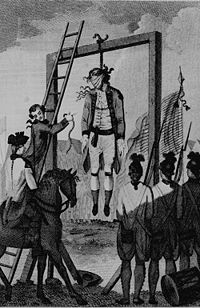
On this date in 1780, the honorable British Major John Andre got what Benedict Arnold had coming to him.
Piqued that his (quite considerable) brilliance in the field did not earn honors he thought his due, General Benedict Arnold contrived to betray West Point to the British during the American Revolution — the plot that made his name a synonym for treachery.
Enter Clinton’s adjutant John Andre, head of British Special Intelligence.
The dashing officer, well-liked in society on either side of the permeable divide between Tories and Patriots on the continent, slipped into Haverstraw, N.Y. to make the arrangements. On his way back — when he already thought himself safely clear of American-held territory — he was nabbed with the incriminating documents.
The narrowly-averted betrayal was mirrored by the narrowest of escapes: luckily for Benedict Arnold, Andre was received in custody by a subordinate officer of his, whose initial report to Arnold alerted the general to his danger and enabled him to escape to the British a whisker ahead of the law.
Treason, of the blackest dye, was yesterday discovered. General Arnold, who commanded at West Point, lost to every sentiment of honor, of private and public obligation, was about to deliver up that important post into the hands of the enemy. Such an event must have given the American cause a dangerous, if not a fatal wound; happily the treason has been timely discovered, to prevent the fatal misfortune. The providential train of circumstances which led to it, afford the most convincing proofs that the liberties of America are the object of Divine protection.
It was a gentlemanly war, and Andre didn’t seem like the guy to hang in the whole exchange. But his argument before a court-martial that he was merely availing “an advantage taken in war” by agreeing to talk to an enemy general who wanted to hand them the keys to a fort didn’t fly: he’d been behind enemy lines, out of uniform, sneaking around. That made him a spy.
And the British refused to obtain Andre’s liberty by trading the man the Americans really wanted to execute.
Instead, by year’s end, the hero of Saratoga was commanding redcoats in the field — perhaps a little nervously; when he asked a captured American what might happen to him should he be taken, the reply was “Cut off your right leg, bury it with full military honors, and then hang the rest of you on a gibbet.”
John Andre was left holding the bag, to the dismay of just about everyone American and British alike. This extended account of the luckless major’s last moments* is from the pen of Continental Army surgeon James Thacher.
Major Andre is no more among the living. I have just witnessed his exit. It was a tragical scene of the deepest interest. During his confinement and trial, he exhibited those proud and elevated sensibilities which designate greatness and dignity of mind. Not a murmur or a sigh ever escaped him, and the civilities and attentions bestowed on him were politely acknowledged…
The fatal hour having arrived, a large detachment of troops was paraded, and an immense concourse of people assembled; almost all our general and field officers, excepting his excellency [George Washington] and his staff, were present on horseback; melancholy and gloom pervaded all ranks, and the scene was affectingly awful … Major Andre walked from the stone house, in which he had been confined, between two of our subaltern officers, arm in arm; the eyes of the immense multitude were fixed on him, who, rising superior to the fears of death, appeared as if conscious of the dignified deportment which he displayed. He betrayed no want of fortitude, but retained a complacent smile on his countenance, and politely bowed to several gentlemen whom he knew, which was respectfully returned. It was his earnest desire to be shot, as being the mode of death most comformable to the feelings of a military man, and he had indulged the hope that his request would be granted. At the moment, therefore, when suddenly he came in view of the gallows, he involuntarily started backward, and made a pause. “Why this emotion, sir?” said an officer by his side. Instantly recovering his composure, he said, “I am reconciled to my death, but I detest the mode.” While waiting and standing near the gallows, I observed some degree of trepidation; placing his foot on a stone, and rolling it over and choking in his throat, as if attempting to swallow. So soon, however, as he perceived that things were in readiness, he stepped quickly into the wagon, and at this moment he appeared to shrink, but instantly elevating his head with firmness, he said, “It will be but a momentary pang,” and taking from his pocket two white handkerchiefs, the provost-marshal, with one, loosely pinioned his arms, and with the other, the victim, after taking off his had and stock, bandaged his own eyes with perfect firmness, which melted the hearts and moistened the cheeks, not only of his servant, but of the throng of spectators. The rope being appended to the gallows, he slipped the noose over his head and adjusted it to his neck, without the assistance of the awkward executioner. Colonel Scammel now informed him that he had an opportunity to speak, if he desired it; he raised the handkerchief from his eyes, and said, “I pray you to bear me witness that I meet my fate like a brave man.” The wagon being now removed from under him, he was suspended, and instantly expired; it proved indeed “but a momentary pang.” He was dressed in his royal regimentals and boots, and his remains, in the same dress, were placed in an ordinary coffin, and interred at the foot of the gallows; and the spot was consecrated by the tears of thousands.
Thus died, in the bloom of life, the accomplished Major Andre, the pride of the royal army, and the valued friend of Sir Henry Clinton. He was about twenty-nine years of age, in his person well proportioned, tall, genteel and graceful. His mien respectable and dignified. His countenance mild, expressive and prepossessing, indicative of an intelligent and amiable mind. … considered as a skilful, brave and enterprising officer, and he is reported to have been benevolent and humane to our people who have been prisoners in New York. … The heart of sensibility mourns when a life of so much worth is sacrified on a gibbet. General Washington was called to discharge a duty from which his soul revolted; and it is asserted that his hand could scarcely command his pen, when signing the warrant for the execution of Major Andre. … Could Arnold have been suspended on the gibbet erected for Andre, not a tear or a sigh would have been produced, but exultation and joy would have been visible on every countenance.
Andre makes a sort of loyalist counterpart to Nathan Hale. Interestingly, Thacher’s account — in which he uses his old diaries for a book that was published in 1823 — footnotes an extended narration of Nathan Hale in a comparative vein, complaining that “whilst almost every historian of the American Revolution has celebrated the virtues and lamented the fate of Andre, Hale has remained unnoticed, and it is scarcely known that such a character ever existed.” Today, in terms of their public recognizability, the two are rather reversed.
* Andre was to have been hanged October 1, but the matter was stayed when a British deputation arrived under flag of truce to make one last parley for their man’s life.
On this date in 1776, Revolutionary spy Nathan Hale was hanged by the British in Manhattan — allegedly uttering the immortal last words, “I only regret that I have but one life to lose for my country.”
Nathan Hale statuary (with bound feet and hands) ironically stationed at Washington D.C.’s Department of Justice. Like statues are at the Chicago Tribune building and the Yale University campus; dueling plaques in New York contend to mark the execution spot.
Two years out of Yale when the Revolution broke out in 1775, the Connecticut-born Hale hitched onto the Continental Army and was directly promoted to captain.
When British Gen. William Howe landed at New York in the summer of 1776, Nathan Hale volunteered to slip behind enemy lines and reconnoiter enemy strength for George Washington. It turned out to be his mission into eternity.
As one might suspect, there’s a great deal more to Nathan Hale than his last words — and a fair bit of uncertainty about what his last words really were. Hale’s Wikipedia page retails many versions of the line from many sources.
The sentiment commonly attributed him (formulated in slight variations, e.g., “I only regret that I have but one life to give to my country”) was supposed to have been reported by a British officer attending him; it’s certainly a punchier version than, e.g., a Revolutionary War era report of “I am so satisfied with the cause in which I have engaged, that my only regret is, that I have not more lives than one to offer in its service.” Gah.
If all these presumably paraphrased reports have the gist right, it’s possible the 21-year-old recited an identical sentiment in the tragic play Cato:*
How beautiful is death, when earn’d by virtue!
Who would not be that youth? What pity is it
That we can die but once to serve our country.
There’s much more about this short-lived character and his larger-than-life transfiguration in mythologia Americana. The Library of Congress has a collection of links, and William Phelps recently penned this new (and surprisingly, first) biography of the revolutionary legend.
* The play was all the rage among patriots; Patrick Henry might have plucked his immortal “give me liberty or give me death” line from it, too. (“It is not now time to talk of aught/But chains or conquest, liberty or death.”)
On this date in 1945, according to a fringe faction of American conservatism, the first victim of the Cold War was shot by Chinese Communists at Suchow, China, near Xi’an.
John Birch, a military chaplain proselytizing in China and an agent of the CIA’s precursor entity Office of Strategic Services, had the kind of portfolio sure to rub Mao’s boys the wrong way.
Apparently it was his personality that got him into trouble.
On recon duty days after the end of World War II, he bumped into a patrol of Red Chinese. According to Time, he failed his diplomacy check.
As the scene has been reconstructed, Birch argued violently with the Communist officer who wanted to disarm him. Birch was seized and shot after his hands had been tied. The Communists then bayoneted him at least 15 times and tossed his body on a heap of junk and garbage.
“In the confusing situation,” said [Birch’s commanding officer Major Gustav] Krause last week, “my instructions were to act with diplomacy. Birch made the Communist lieutenant lose face before his own men. Militarily, John Birch brought about his own death.”
Days after World War II — how does that square with your international Communist conspiracy? The incident was not especially notable at the time, but some elements later conceived John Birch the first American casualty of Communism during the Cold War, and in this guise he became the namesake of the John Birch Society (Wikipedia entry | homepage — evidently forward-thinking enough to have grabbed their own three-letter acronym)
Here’s candy magnate and founder Robert Welch, Jr., explaining:
Despite the young lieutenant’s credentials as a martyr of evangelical anti-Communism, the oft-loopy Society’s relationship to the mainstream conservative movement and the Republican Party it took over was never completely comfortable and eventually came to a definite sundering.
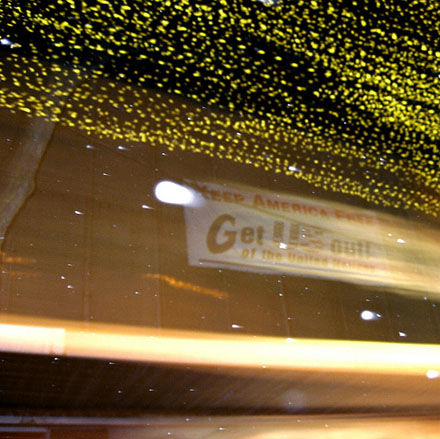
The Society soldiers on, its “Get US out of the United Nations” billboards a minor fixture of Americana from Port Angeles, Washington to this one in Ypsilanti, Michigan.
On this date in 1777, a general of the American Revolution laconically asserted his prerogatives with the hanging of a British spy.
A former ranger in the British service, Israel Putnam — he may or may not be the “don’t fire until you see the whites of their eyes” guy — was camped at Peekskill, New York, when he caught one Edmund Palmer stalking the camp.
It was early in the American Revolution, and American spies were being hanged by the British … but the commanders of Albion evidently entertained some notion that the shoe would not go on the other foot. When Palmer was condemned to death for spying, the British General Sir Henry Clinton hurried a missive to his opposite number under flag of truce claiming Palmer as a British lieutenant.
Old Put firmly believed “the speedy execution of spies is agreeable to the laws of nature and nations and absolutely necessary to the preservation of the army.” (According to the unimpeachable sourcing that is the “about” page of an intel e-learning university named for him.)
And Putnam’s reply to Clinton, a terse little masterpiece answering Cicero‘s dictum that “Brevity is a great praise of eloquence,” was one for the ages.
Headquarters, 7th August, 1777.
Sir — Edmund Palmer, an officer in the enemy’s service, was taken as a spy lurking within our lines; he has been tried as a spy, condemned as a spy, and shall be executed as a spy, and the flag is ordered to depart immediately.
Yours, &c.,
Israel Putnam
P.S. He has accordingly been executed.
(Some versions give the slightly zippier postscript as “afternoon — he is hanged.”)
Read all about this spry American Cincinnatus in Old Put, a now-public-domain book published for America’s centennial celebration; or at this enthusiastic fan page. Also of some now-current relevance: tangential background on the jurisdictional wrangling around military commissions at this period, here.
On this date in 1953, Julius and Ethel Rosenberg were put to death in Sing Sing’s electric chair as Soviet spies.
Divisive since it was handed down — or more precisely, since a famous article in London’s Guardian challenged the verdict and helped elevate it into a latter-day Dreyfus case — the Rosenbergs‘ sentence has inspired so much acrimony over several generations that merely to observe the date is to invite a debate capable of eminently more heat than light.
Where to begin with a case so towering in the recent cultural milieu?
A textbook might say that Julius and Ethel were convicted of passing atomic secrets to the Russians, that they maintained their innocence and their defenders carried that flame years after their deaths, and that intelligence files opened after the Cold War — notably the Venona project — apparently confirmed that Julius was a spy after all, though Ethel seems to have been little more than an approving bystander and Julius, come to think of it, never had anything so worthwhile as atomic secrets to share with Moscow. This information (which does have its own skeptics, albeit a small minority) undermines the maximal “absolute innocence” position that this day’s victims always asserted, but it’s a curious leap to take it as vindicating the legal outcome.
“My husband and I must be vindicated by history; we are the first victims of American fascism.”
Half a century on, juridical guilt or innocence seems distinctly secondary in the lasting importance of the Rosenberg trial, the two-year battle to save them, and their potent symbolic afterlives.
The Rosenbergs are the only stateside judicial executions for espionage since the Civil War.* That is a remarkable distinction, after all; so, how comes it that it is held by — to state the case against them in its strongest imaginable terms — two enthusiastic but bush-league players, and not by the likes of Aldrich Ames? How was it that a judge with a largely center-liberal career on the bench would read them a sentence of death hysterically accusing these Lower East Siders of causing the Korean War?
[Y]our conduct in putting into the hands of the Russians the A-bomb years before our best scientists predicted Russia would perfect the bomb has already caused, in my opinion, the Communist aggression in Korea, with the resultant casualties exceeding 50,000 and who knows but that millions more of innocent people may pay the price of your treason.
…
I feel that I must pass such sentence upon the principals in this diabolical conspiracy to destroy a God-fearing nation, which will demonstrate with finality that this nation’s security must remain inviolate; that traffic in military secrets, whether promoted by slavish devotion to a foreign ideology or by a desire for monetary gains must cease.
It is here in the age of McCarthyism, in the shadow of the USSR’s balance-altering A-bomb test in 1949, that the Rosenbergs stand in sharpest relief — not because of “guilt” or “innocence”, but as the ne plus ultra of that era’s range of social discipline.
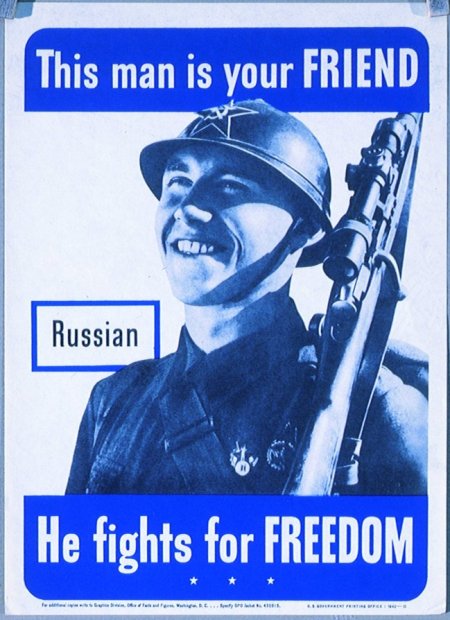
A few years before, the United States and the Soviet Union had made common cause against Hitler in World War II, the United States pumping war materiel to Russians bearing the brunt of the fighting.
No longer operative.
The Communist Party USA enjoyed membership rolls pushing six figures; other socialist parties and movements had found niches in American life in the interwar years.
As the Great War gave way to the Cold War, the great powers remained nominal allies (that’s the reason the Rosenbergs weren’t tried for treason), but shifted rapidly into conflict. The American polity organized to expel the red menace by rendering it foreign and criminal — ideological rigging for the forty years’ imperial contest ahead. Loyalty oaths, blacklists, the House Un-American Activities Committee … in the whole of the self-conscious construction of communism as “contagion”, the power and willingness of the state to kill Julius and Ethel Rosenberg formed the tip of the spear, and an ugly contrast to that same state’s solicitous handling of Nazi scientists then developing the vehicles to deliver atomic technology to Moscow in mushroom cloud form.
Though different in many particulars, the thrust will be familiar to any sentient denizen of post-9/11 America: the extreme penalty enforces a wall between the suspect and abject (but tolerated) loyal liberal and the enemy left. Depend upon Ann Coulter for the most brutal articulation:
We need to execute people like John Walker [the American-born soldier captured fighting for the Taliban in 2001] in order to physically intimidate liberals, by making them realize that they can be killed, too. Otherwise, they will turn out to be outright traitors.
Like most symbols, the Rosenbergs came by their exaltation by accident; at the strictly personal level, their deaths are nearly operatic performances of human stubbornness and bureaucratic inertia. Investigators rolling up a spy ring** were looking for confessions and names to keep the indictments coming.
Julius refused to provide either, so his wife was arrested for leverage against him on the reasoning that he would confess to protect her. The gambit failed: both prisoner and hostage remained obstinate. The government’s bluff had been called, and it ruthlessly executed its threat.
Had the two really been responsible for starting a war, execution would hardly begin to cover the bill — yet to the very foot of the chair, the condemned, and Julius especially for the sake of his wife, were pressed with offers of mercy for confessing and “naming names”.
Abjure or expire: show trial logic.
[audio:Julius_and_Ethel_Rosenberg.mp3]
An Execution in the Family
Given names to name, the personal mystery of their silence — the ultimate heroism or folly or tragedy or transcendence — only deepens the resonance of their fate both for contemporaries and posterity, the poignance of their orphaned children’s subsequent path, the contrast with Ethel’s brother David Greenglass who has since admitted to perjuring testimony against Ethel in order to shield his own wife. (Greenglass says the Rosenbergs died from the “stupidity” of not copping a deal of their own.)
Even before Julius and Ethel went to the chair this date,† they had become the emblem of a paranoid age. In the days following, Sartre savaged the United States for trying “to stop scientific progress by a human sacrifice”:
Your country is sick with fear. You’re afraid of everything: the Russians, the Chinese, the Europeans. You’re afraid of each other. You’re afraid of the shadow of your own bomb.
Decades later, the shadows haven’t faded altogether. In playwright Tony Kushner’s imagination, the spirit of Ethel stalks her real-life prosecutor, closeted McCarthy henchman Roy Cohn, as he succumbs to AIDS in the 1980’s.‡
Rosenberg resources — and vitriol — are in plentiful supply online and off. A good starting point on the case is this page at the University of Missouri – Kansas City. Be sure to check the tale of a last-ditch legal maneuver that almost succeeded.
* There is one partial exception in the unusual case of six German saboteurs electrocuted in Washington, D.C., during World War II on a charge sheet that included espionage. The hearing was held by a military commission and only one of the six was an American citizen, so it was far from the regular judicial process — if one can call it that — the Rosenbergs faced.
** Originating in the investigation of Klaus Fuchs, the man who actually did what Julius and Ethel Rosenberg were accused of doing — passing atomic secrets to Moscow — although with debatable ultimate effect for the Soviets’ research. Fuchs served nine-plus years in a British prison and was released to East Germany; more than a few were galled at the difference between his sentence and the Rosenbergs’.
Stateside, George Koval was another spy far more valuable to Moscow in the nuclear race than were the Rosenbergs. Koval got away clean and died in Moscow in 2006.
† Julius first, then Ethel. Her execution was botched; repeated shocks were required to kill her.
‡ Cohn’s posthumous autobiography did acknowledge illegally rigging the Rosenberg trial, as his Kushner character does.
On this date in 1987, a once-promising American intelligence asset was executed with a single gunshot to the head in Moscow — his treachery exposed by two of the most infamous Soviet moles in U.S. intelligence history.
A Lieutenant Colonel in the KGB posted to the Soviets’ official Washington, D.C. offices in 1980, Martynov had turned in 1982 and begun funneling intelligence to the CIA and FBI under the cryptonym “Gentile”. Truth be told, he was a mediocre source, but he was a younger officer with the chance to grow into a more important asset in the years ahead.
Fate had sized him up as an extra in someone else’s story instead.
In 1985, “the year of the spy” to those in the know for the volume of important cloak-and-dagger work, the Soviets landed two highly-placed moles in the American intelligence world — Aldrich Ames of the CIA and Robert Hanssen of the FBI.
Both those notorious turncoats shopped Martynov (among others); duly informed, Russian spymaster Victor Cherkashin conned Martynov into returning to Moscow where he could be arrested.
Here’s a 2001 New York Timesaccount on how it went down:
[Soviet counterintelligence officer Vitaliy] Yurchenko, unhappy with his lot as a defector [after coming over to the Americans in August 1985], suddenly redefected back to the Soviet Union in early November [1985, still]. Mr. Cherkashin has said in a previous interview that Mr. Yurchenko’s redefection presented an opportunity to lure Valeriy Martynov, a K.G.B. officer in the Washington station working for the F.B.I., back to the Soviet Union: The K.G.B. arranged for Mr. Martynov to serve as a member of an honor guard escorting Mr. Yurchenko back to Moscow.
When they arrived back in the Soviet Union, it was Mr. Martynov who was arrested; Mr. Yurchenko was given a job at the K.G.B. again.
No honor among thieves.
Martynov left a widow, Natalia, and two children. But he is remembered and written about exclusively in the context of the men who sold him out, who taken separately or together rate among recent history’s most catastrophic intelligence failures. (Or triumphs, depending on your point of view.)
Martynov’s ultimate tragedy, of course — one he shares with his more infamous American betrayers in this shadowland chess match — is that not by all the information he provided, and neither by his life nor his death, was the Cold War protracted or abbreviated by one single hour.
On this date in 1818, on the authority of a military tribunal of doubtful legality, a general who would become a president hanged two British citizens for aiding America’s Indian enemies.
You don’t get to be the $20 bill guy without knocking a few heads.
The First Seminole War saw the ambitious General Andrew Jackson appropriate for himself authority considerably beyond that authorized by Washington to escalate border conflicts around Spanish Florida into an outright invasion.
Though both Spanish and British interests had a foothold on the peninsula, neither was ever formally drawn into war; the conflict pitted Jackson’s armies against Seminole Indians who were also known to take in escaped slaves from over the border. Regardless the immediate casus belli, the war’s eventual effect was to force the Spanish to cede Florida, fitting it unmistakably into America’s evolving pattern of imperial conquests. But Europeans proved not to be exempt from Jackson’s fury.
The elderly Scottish trader Alexander Arbuthnot and the young British ex-marine Robert Ambrister were swept up as Jackson pillaged through Florida. Both had friendly relations with the natives, and somewhere amid personal pique, deliberate provocation, and squelching their knowledge of white Americans’ provocations against the Seminoles lay sufficient reason to string them up.
Due process
Jackson, who would win the White House himself on a populist platform in a decade’s time, has had many advocates in history; few of them would deny the man’s authoritarian streak.
A decidedly unsympathetic — arguably corrective — study of Jackson’s conduct in the Southeast during this period unravels Jackson’s reasoning as to how British citizens in Spanish territory were capitally liable in the eyes of a third country that neither state was at war with:
As soon as [Jackson] reached St. Marks, he set into motion the wheels of his personal justice system to punish Alexander Arbuthnot and Robert Ambrister for crimes against the United States.
Jackson appointed a military court of twelve voting officers, Edmund Pendleton Gaines presiding, to hear charges that Arbuthnot and Ambrister had aided and abetted the enemy of the United States in the Seminole War. Of the panel, five were Volunteer officers whom Jackson had personally recruited for the campaign. Even though partially stacking the board and conducting the proceeding as a court-martial in the Florida wilderness obviated the need for precise legal punctilio, Old Hickory ruminated over just how to go about the business. His original idea of charging his two prisoners with piracy had appeal because it allowed him to take action against these subjects of a neutral power for aiding one nation against another nation. Yet the similarities of such a circumstance to that of the Marquis de Lafayette’s Revolutionary War service nagged at Jackson as an embarrassing comparison. By the time he convened the court-martial, Jackson had hit upon the solution. “The laws of war did not apply to conflicts with savages,” he solemnly intoned, and thus was he able to dispense with not only the laws of war, but virtually all laws altogether. The court would charge Arbuthnot and Ambrister with assisting and encouraging the Seminoles. In Jackson’s legal universe, these were capital offenses.
The specific charges accused Arbuthnot of inciting the Creeks to make war on the United States, of spying for the Seminoles, and of inciting the Seminoles to kidnap, torture, and kill William Hambly and Edmund Doyle. Charges against Ambrister stated that he had aided and abetted Seminoles and had led Seminoles against the United States.
Arbuthnot requested counsel, and the court obliged him by appointing one, but he apparently managed most of his own defense. Some describe his efforts as eloquent, but both he and Ambrister must have realized that their part in this show was already scripted to its conclusion. Ambrister, in fact, finally abandoned all pretense of due process simply to throw himself on the mercy of the court.
(The original minutes of the trial are available from Google books here.)
Jackson’s justification of himself, essentially placing the condemned men outside the law by stripping them of their whiteness, will not much flatter his latter-day partisans:
These individuals were tried under my orders by a special court of select officers, legally convicted as exciters of this savage and negro war, legally condemned, and most justly punished for their iniquities … I hope the execution of these two unprincipled villains will prove an awful example to the world … that certain, though slow retribution awaits those unchristian wretches who, by false promises, delude and excite an Indian tribe to all the horrid deeds of savage war.
… although a further point takes a tack the modern reader may find more familiar:
The moment the American army retires from Florida the war hatchet will be again raised, and the same scenes of indiscriminate massacre, with which our frontier settlers have been visited, will be repeated, so long as the Indians within the territory of Spain are exposed to the delusion of false prophets and poison of foreign intrigue; so long as they can receive ammunition, munitions of war, from pretended traders and Spanish commandants, it will be impossible to restrain their outrages. … The savages, therefore, must be made dependent on us, and cannot be kept at peace without being persuaded of the certainty of chastisement being inflicted on the commission of the first offence.
Even at the end of his life, this day’s hanging was still flung against Jackson: “By the Eternal! You old Hags! If I get hold of you, I’ll hang you all up under the 7th section as I did Arbuthnot and Ambrister!” (click to see the entire cartoon)
(The letter is as read by a friendly congressman here.)
Jackson’s own popularity essentially carried the day against a measure of Congressional censure, but the affair caused him ongoing political annoyance; for Jackson’s enemies, it would forever impugn the man’s motives and behavior. (See the cartoon, which dates to the incipience of a later generation’s own imperial war.) The success that sufficed to exonerate him to his peers might seem rather less compelling to posterity.
* A 2004 Congressional Research Service report (pdf) on military tribunals also touches the Arbuthnot and Ambrister affair and hints, in its neutral way, at the Napoleonic direction Jackson’s legal reasoning would mark out:
Experts in military law have differed on the legitimacy of Jackson’s action. William Winthrop, writing toward the end of the nineteenth century, noted that if any officer ordered an execution in the manner of Jackson he “would now be indictable for murder.” To William Birkhimer, in his 1904 treatise, Jackson had asked the special court only for its opinion, both as to guilt and punishment, and the delivery of that opinion could not divest Jackson of the authority he possessed from the beginning: to proceed summarily against Arbuthnot and Ambrister and order their execution. Birkhimer’s analysis would allow generals to execute civilians without trial or to dispense with the fact-finding and judgment that results from trial proceedings.
It bears remembering that this incident was in fact only three years removed from Bonaparte’s last hurrah, and some few of Jackson’s countrymen saw such a figure in Old Hickory.
As dawn broke over the Piazzetta San Marco in Venice, the body of a man hung from the gallows between the columns. There were no witnesses to this execution — it was a quiet affair carried out under the veil of night. The citizens of the Serenissima were understandably worried. This man was not common criminal — he was a man from a distinguished noble family.
What events had led to a man of such stature becoming victim of such a fate?
Antonio the Ambassador
Antonio Foscarini was the third son of Nicolo di Alvise de ramo di S.Polo and Maria Barbarigo di Antonio.
Antonio began his diplomatic career as one of the representatives of the Republic of Venice to the Court of King Henri IV of France (1601) and was there, at Paris, in this capacity to celebrate Henri’s wedding to Marie de Medici. Despite being elected as Ambassador to France — “Ambasciatore ordinario in Francia” — (26th May 1607), he did not actually take up his position until February of the following year.
When he was elected Ambassador to England — “Ambasciatore ordinario in Inghilterra” — (July 1610), he again did not take up his position until the following year (4th May 1611). Unfortunately, Foscarini’s position came under question in Venice. One of Foscarini’s secretaries denounced his to the Council of Ten, accusing him of selling state secrets to Venice’s mortal enemy at the time — Spain.
Foscarini was summoned to return to Venice immediately. Upon his arrival he was imprisoned, where he remained for three years whilst in inquiry into the allegations took place. Foscarini was duly released upon being found “not guilty” (30th July 1618) — there was no blemish on his service record. Two years later he was elected Senator (1620).
The Council of Ten
The Council of Ten was formed in 1310 “to preserve the liberty and peace of the subjects of the republic and to protect them form the abuses of personal power”. In effect, the Council of Ten was actually made up of 17:
the Doge – who presided over all and was elected ruler for a specific term.
the Prime Minster – elected chairman of the government
the Signoria – comprised of three Capi (three chiefs of the Great Council); six Savii Grandi (modern-day Cabinet); three Savii da Terra Firma and three Savii agli Ordini or da Mar (Ministers of War, Finance and Marine).
These men, for there were no women, were elected for a specific term, depending upon their position. In effect, this ensured that any attempt on the part of one person or a family or a group to gain sole power was neutralized. Even the Church was excluded from taking any part in the government of the Republic.
The Countess of Arundel
At the age of 35, this formidable woman arrived in Venice in 1621.
Alatheia Talbot was the granddaughter of the infamous Bess of Hardwick (goddaughter of Queen Elizabeth I of England) and the wife of Thomas Howard, 2nd Earl of Arundel, and a leading figure at the court of King James I of England. Both Alatheia and Thomas were passionate art lovers, and used their boundless wealth to amass the first great private art collection in England. And this was the reason for Alatheia’s journey to Venice – that and the education of their sons. Alatheia left her children at the villa in Dolo whilst she continued onto Venice and settled in Palazzo Mocegnigo on Grand Canal.
The Senator & the Countess
It was whilst situated in the Palazzo Mocegnigo, that the Senator possibly renewed his acquaintance with the Countess. In his position as Ambassador to England, Foscarini would have come into contact with both the Countess and her husband, who was, we must remember, a prominent official of the royal Court. As to the true nature of this acquaintance, it has been suggested that the two were not particularly close.
Whatever the suggestion, on the evening of 8th April 1622 as Foscarini was departing the Senate, he was arrested on the orders of the Consiglio dei Dieci and charged with:
… having secretly and frequently been in the company of ministers of foreign powers, by day and by night, in their houses and elsewhere, in this city and outside it, in disguise and in normal dress, and having divulged to them, both orally and in writing, the most intimate secrets of the Republic, and having received money from them in return …
Less than a fortnight later, Foscarini was strangled in prison and the following morning found hung between the two columns in Piazzetta San Marco.
Aftermath
The news of Foscarini’s execution spread like wildfire throughout the length and breadth of Europe. Many rulers, upon hearing the news, were shocked.
Countess Alatheia was perturbed for her name had been linked with that of Foscarini. It was in her house that Foscarini had been accused of passing state secrets to Venice’s enemies — notably Spain (via the Secretary of Emperor Ferdinand) and the Church (via the Papal Nuncio).
Sir Henry Wotton, England’s Ambassador to Venice, notified Alatheia by letter that the Council of Ten would be passing a sentence of banishment upon her, and that it would be in her best interests to leave immediately.
But Sir Henry had greatly underestimated this woman — for she was aggressive adversary (they had crossed swords many times). Instead, Alatheia went immediately in person to Sir Henry, vigorously denying the charges and informing him of her intentions to seek an audience with the Doge, Antonio Priuli. Alatheia laid the blame for Foscarini’s death firmly at his doorstep, and let him know in no uncertain circumstances that she intended to bring about his dismissal.
Alatheia was granted her audience with the Doge. She was warmly received and assured that there was never any question of neither her banishment not implication in the recent tragic events. She generously accepted his assurances, but requested a public exoneration in writing in both Venice and London; this duly occurred. She was given lavish gifts by the Doge and with her wagons heavily laden with, left Venice six months later.
In January of 1623, a unique event occurred in Venice: Antonio Foscarini was posthumously exonerated by the Council of Ten. Ten months previously, it had unanimously found him guilty of treason and had him executed. King James I’s ambassador to the Serenissima, Sir Henry Wotton, characterized the event: “…surely in 312 years that the Council of Ten hath stood, there was never cast a greater blemish upon it.”
And so, after much investigation, Antonio Foscarini was officially exonerated of all charges (16th January 1623).
Throughout the summer, proof of Foscarini’s innocence gathered momentum, and was such that none could ignore it. Those who had accused Foscarini of the act of treason were brought before both the Inquisitors of the State and the Council of Ten themselves to answer certain questions. It was determined, during the course of events, that both accused had perjured themselves by making false accusations against Foscarini. Why they did so is not known, but Murray Brown presents a number of credible scenarios in his “The Myth of Antonio Foscarini’s Exoneration”.
The Council of Ten publicly confessed its error — copies were given to Foscarini’s family and were also distributed throughout Europe. Foscarini’s body was exhumed and he was given a state funeral. A statue of Foscarini is in Foscarini Chapel of the Church of S.Stae.


 As the scheme ripened, the turncoat asked

 A Lieutenant Colonel in the KGB posted to the Soviets’ official Washington, D.C. offices in 1980, Martynov had turned in 1982 and begun funneling intelligence to the CIA and FBI


 Antonio Foscarini was the third son of Nicolo di Alvise de ramo di S.Polo and Maria Barbarigo di Antonio.
