1986: Adolf Tolkachev, the Billion-Dollar Spy

The U.S.S.R. executed alleged* U.S. mole Adolf Tolkachev on this date in 1986.

Tolkachev (English Wikipedia entry | Russian) had grown up during the Stalin years — background he would cite by way of explaining his subsequent actions against the Soviet state and its “impassable, hypocritical demagoguery.” (His wife had been orphaned by the purges of the 1930s.)

Inspired, he said, by the dissidence of writer Aleksandr Solzhenitsyn (expelled from the Soviet Union in 1974) and bomb engineer Andrei Sakharov (prevented from leaving the Soviet Union to collect his 1975 Nobel Peace Prize), Tolkachev in the late 1970s boldly made contact** with U.S. intelligence officers at the Moscow petrol station where they fueled their cars. He immediately became one of the Americans’ most valuable assets — literally so; the 2015 book about him is titled The Billion Dollar Spy.

Tolkachev’s day job for a top-secret aviation laboratory gave him access to priceless documents on the development of the Soviet aircraft, radar, and weapons guidance and using a James Bond-esque miniature Pentax supplied him by Langley, Tolkachev snapped photos of those secrets for delivery to the Americans. It’s claimed — this is the reason for the billion-dollar stuff — that Tolkachev’s tips drove research and development in American military technology in vastly more effective directions.

The spy himself was paid for his risks in rubles and in a U.S. escrow fund pending his eventual defection.

But his last payment turned out to be a bullet, courtesy of betrayal by CIA turncoat Edward Lee Howard and/or that bane of spies Aldrich Ames.

* The date is supplied courtesy of a September 25, 1986 Politburo document referring to Tolkachev’s execution “yesterday”.

Note however that the prevailing Tolkachev story as presented in this post is disputed by CIA historian Benjamin Fischer, who has argued that “Adolf Tolkachev” was a KGB prank on its opposite number in the Cold War’s Spy vs. Spy game.

** Tolkachev really had to insist upon himself to his American handlers: the first four times he approached US embassy personnel with overtures he was rebuffed or ignored as a probable Soviet plant.

On this day..

1870: Charles Harth, Prussian spy

On this date in 1870, a spy of the Franco-Prussian War was shot in Paris.

Barely a month old at this point, the Franco-Prussian War was a fast-unfolding fiasco for the Franco side. For three weeks, French reverses as the Prussians pressed through the frontier had been the talk of the capital.

The action at this moment was the huge Prussian siege of Metz, for whose relief the French emperor Napoleon III — Marx’s original “first as tragedy, then as farce” guy — was even then mobilizing a relief force. Napoleon was ridiculously out in the field, personally “leading” the army; on September 1, his column would be intercepted by the Germans and the resulting Battle of Sedan ended with the emperor’s own capture and the demise of his Second French Empire.


“Discussing the War in a Paris Cafe”: Illustrated London News, September 17, 1870. Within a few months the burghers will have fled these uproarious cafes with the rise of the Paris Commune.

For the moment, however, that empire is still alive in its final hours; Charles Harth must number among the last executions it ever carried out. The London Standard reported the story under an August 27 dateline (we excerpt here from the Milwaukee Daily Sentinel‘s reprint of September 16):

Prussian blood has been drawn for the first time since the declaration of war within the enceinte of Paris.

Charles Harth, found guilty of having visited France for the purpose of spying out its weakness, died the death this morning. His trial took place on Monday, as you will remember, and after a very brief procedure, the court martial that tried the man condemned him without a single dissenting voice. The Prussians (who, by the way, are accused in the Paris Press to-day of having hanged a woman at Gorse) will protest, no doubt, against the manner in which their countryman was treated, but military law is short and sharp in its decrees, and his judges were satisfied of Harth’s culpability. If he was guilty, as we are bound to believe, there is no room for protest. He deserved his fate.

After his condemnation, in the first instance, he had the privilege of appeal, which was availed of, on his behalf, by his council, but the Court of Revision, which considered the case on Thursday, found no reason to reverse the judgment. M. Weber, the advocate assigned by the prisoner, appears to have stuck generously by him, and even to have forwarded a petition for mercy to the Empress Regent. However much it must have cost the Empress to refuse it, as Regent no other course was open to her. Mercy could not be extended to the enemy’s spy, while the enemy himself was on French soil, and French blood was bieng shed in torrents on the battle-field.

Accordingly the order was given that the sentence should be carried out. At 5 o’clock this morning Harth was awakened in his cell in the military prison in the Rue du Cherche Midi by a messenger, who announced to him that his hour had come. He received the news calmly, like a man who had given up all hope, and was expecting it; more than that, like a man who was prepared to meet the worst, with the courage of dogged resignation.

M. Roth de Lille, the Protestant pastor of the gaol, was shown into the cell of the doomed man, and remained with him until the cellular van that was to convey him to the scene of his execution drew up with a rumble and a clatter of horses hoofs at the prison gate. Harth entered it boldly, and the vehicle drove off through the quiet streets with their early freshness upon them escorted by twelve mounted gendarmes, armed cap a pie, and making music to the ride of death with their clunking accoutrements.

The Ecole Militaire, that huge pile of barracks that will be familiar to those who visited the Exposition of 1867, from its position facing the Champs de Mars, was fixed on as the place of execution. The Polygon of Vincennes is the spot usually designed, but the Ecole Militaire was nearer, and this is no time for the formalities of precedent. Whatever is done to paralyze the invader had better be done quickly.

The courtyard of the barracks was occupied by all the troops quartered there in marching order. The battalion of the Grenadiers of the Guard, that serves as depot, was there in line with fixed bayonets, and detachments of Lancers with their gay pennons, and brown, brawny Cuirassiers, and the guides — the daintiest of all the French cavalry — in their heavily-embroidered jackets, were there too. A pretty sight for a military man, these flashing arms and helmets and polished cuirasses in the cheerful morning sunshine.

How did it strike Charles Harth, for he had been a military man by his own admission, a Lieutenant in the Prussian infantry. When the prisoner stepped from the van and threw a rapid look over the assembled troops, he gave a few nervous twitches of his head.

The clock over the centre of the building chimed the quarter to six. Six precisely was the hour fixed for the shooting. The prisoner had yet fifteen minutes to live.

He was led into an angle of the court yard, where the troop horses are usually shod, and which forms a quiet corner to itself. Here he was placed close to the wall, and in front of a squad of twelve men of the Forty-second Regiment of the line, namely, two sergeants, four corporals, and half-a-dozen privates. The firing party stood in two ranks, the two sergeants being stationed in the rear.

As the prisoner was approached by the turnkeys of the military prison whose duty it was to tie his hands behind his back, he shrunk back and said, ‘No! I wish to die like a soldier.’ But on representations being made to him that there was no exception to the rule, he yielded. His eyes were then bandaged, when he expressed a wish to be allowed to give the word ‘fire.’ Adjt. Codont, who had acted as registrat to the court-marshal [sic], came forward and read the sentence amid an impressive silence.

At a pause at one of the paragraphs in the document, the prisoner, fancying the reading had been finished, cried” ‘Tirez, coquns, et ne me manquez pas.’ ‘Fire, you rascals, and mind you don’t miss!’ But the squad did not stir; it was waiting another signal.

As the last syllable died away on the Adjutant’s lips the officer commanding the firing party drew his sword, the soldiers raised their Chassepots to their shoulder and took aim, the sword was lowered, and a dozen shots went off like one, with a sudden startling detonation. Before the report of the discharge had smitten the straining ears of those who looked on, the prisoner fell forward with an inclination to his right side. Over his left breast, in the region of his heart, his shirt was torn into a jagged hole, where the bullets had entered.

As he lay motionless on the ground one of the sergeants in the rear of the firing party advanced through the little cloud of smoke and discharged his piece into the dead man’s brain. Dead man, I say, for Harth must have died before he reached the ground in his fall.

The troops were marched past the body, which was then lifted, limp and warm, and put, dressed as it was, into a coffin, and trotted off to the Cemetery of Mont Parnasse, where it was dropped into a grave which had been opened to receive it, and hastily hidden from view.

On this day..

1948: Meir Tobiansky, by summary judgment

On this date in 1948, an alleged spy was extrajudicially executed by the Israeli Defense Forces.

This execution occurred during a short truce punctuating Israel’s War of Independence, but prior to the ceasefire the nascent IDF had become suspicious at Jordan’s gift for accurately targeting critical infrastructure in Jerusalem.

Suspicions came to settle on Meir Tobianski a Lithuania-born former British officer who had become a captain in the Jewish militia Haganah: as an employee of the Jerusalem Electric Corporation, he would have made a great informant for enemy artillerymen.

On June 30, 1948, Tobianski was kidnapped and driven to a depopulated Arab village (present-day Harel, Israel), where four intelligence officers demanded to know if Tobianski had given any information to his British colleagues at the utility (he had), and then declared him condemned as a spy. (Efficiently, they had already prepared the firing squad ahead of time.)

The chief of these four, Isser Be’eri, was later charged with manslaughter for the affair, receiving a symbolic one-day sentence. His subordinates, who were never charged, had long careers in Israeli intelligence; one of them, Binyamin Gibli would go on to help cook up a subsequent espionage debacle, the Lavon Affair.

Tobianski has been officially rehabilitated by Israel. Despite the irregularity of the proceeding against him, he’s sometimes described as the first of only two executions in Israeli history, alongside the much more procedurally defensible hanging of Adolf Eichmann.

On this day..

1884: Field executions during the Bac Le ambush

On this date in 1884, a French expeditionary force’s summary battlefield executions marked its retreat from an ambush — and the approach of the Sino-French War.

Having established a foothood in south Vietnam (Cochinchina), France was pushing into north Vietnam (Tonkin) — a campaign that could open a potentially lucrative route straight into China.

For the same reason, China viewed Tonkin as its own security zone. The ensuing skirmishes had as we lay our scene been recently abated by the Tientsin Accord* — an accord on France’s terms, since she had lately enjoyed the run of play in the field.

One of those terms was Chinese withdrawal from Tonkin, and as one might expect the Chinese had little appetite to speedily effect such a submission. In June 1884, when a small French column commanded by a Lt. Col. Alphone Dugenne pushed into what was supposed to be France’s new satrapy, it expected to occupy undefended towns.

Instead, on June 23, having forded the rain-swollen Song Thuong River, Dugenne’s force encountered Chinese regulars manning a chain of clifftop forts.

Outnumbered and on unfamiliar ground, the French surely felt their vulnerability. “High rocks, deep canyons, dense woods and somber defiles, where a handful of resolute men could easily have stopped a whole army, were the principal features of the country,” according to a French-derived account published later that year in the U.S.** “The heat was intense, and fatigue overcame the soldiers, already tired by the thousands of ostacles of the road. The fiery atmosphere did not allow any rest, even during the night, and terrible showers of rain, accompanied with thunder and lightning, converted the rivulets into torrents which swept everything before them, soaked the poor soldiers and destroyed provisions.”

A delegation under flag of truce informed Dugenne that China’s commander was aware of the Tientsin Accord, but had received no superior orders to withdraw. This obviously put both forces in an uncomfortable position. The Chinese wanted time: was this a good faith sorting-out (the Tientsin arrangements were barely six weeks old), or a double game? When the eventual winners wrote the history of events, they called what ensued June 23-24 the Bac Le ambush.

Believing that he had an arrangement with his opposite number, Dugenne’s column moved ahead on the afternoon of the 23rd, in a defile ominously commanded by the Chinese positions. Suddenly — and accounts from the two sides each accuse the other of provoking the first shots — the French came under Chinese fire. “Every tree, every overhanging rock, concealed an invisible enemy, who, being perfectly under cover himself, safely inflicted death all around him,” our correspondent’s account runs.


Illustration of the Bac Le ambush from Le guet-apens de Bac-Le by a French officer who survived it, Jean-Francois-Alphonse Lecomte.

But the ambush did not become a massacre; the French were able to regroup, stabilize their position, and camp that night — the Chinese “so near that they could hear them talk.”

The next day, the French would find themselves hopelessly outgunned but not (yet) encircled, and by mid-morning would be effecting an orderly retreat. In the course of it, Dugenne ordered at least two sets of executions to maintain discipline: early in the morning, it was “the hanging of two Chinese spies who had just been caught … with great solemnity and a great apparat, which caused a hail of bullets to whiz from all sides, where the Chinese friends of the hanged men were concealed.”

Hours later, as his column formed up to withdraw, Dugenne harshly punished his own native Tonkinese auxiliaries, green recruits who had all but routed in the first moments of the ambush when they came under fire and whose ill discipline could not be brooked on retreat: Dugenne “gave an order before [retreating] to shoot down ten Tonquinese of the native troops.”

Dugenne reached friendly forces safely, and with him accounts of a “massacre” that would incense public opinion in Paris. China’s refusal to meet the ensuing French demands for satisfaction in this affair would by August trigger open war in Tonkin.

* Not to be confused with 1885’s Treaty of Tientsin, which actually ended the Sino-French War.

** San Francisco Evening Bulletin, Sep. 11, 1884

On this day..

1940: Three saboteurs and a spy, “Fusilles et oublies”

On this date in 1940, the collapsing French state “shot and forgot” four subversives at Pessac. These cases are heavily covered by the French-language blog Histoire penitentiaire et Justice militaire; many links in this post point to well-illustrated articles on that site, which make recommended reading for those inclined to delve deeper.

Late June finds France in the dark weeks after Dunkirk — the very day, in fact, when Marshall Petain’s government formally surrendered to the German blitz.

Elsewhere, the remains of the Third Republic had fled west to Bourdeaux, taking along its death row prisoners. The state that condemned them did not mean to let its imminent disappearance cheat it of their blood.

Jean Amourelle, a stenographer in the French Senate whose duties included shorthanding the secret proceedings of its military commissions, was caught routing intelligence to Germany.

Set to join him for this date’s execution were two pairs of brothers: Roger and Marcel Rambaud, and Leon and Maurice Lebeau. Seventeen-year-old Maurice Lebeau had his sentence commuted to hard labor, however, and was spared from the firing detail.

The Rambauds and Lebeaus were factory workers sentenced as saboteurs for compromising the engine of a French military plane, causing it to explode mid-flight: strange behavior for Communist proletarians explained by the temporary peace between Germany and the Soviet Union that (for the moment) positioned the Comintern-directed French Communist Party as an opponent of the war.

Despite the sacrifice of the Rambauds and Lebeaus, this posture was short-lived. Just one year later — June 22, 1941, in fact — Germany’s invasion of the USSR thrust Europe’s Communist movements into common fronts with anti-fascist parties, and France’s Communists into the forefront of French Resistance martyrs.

On this day..

1378: Pierre du Tertre and Jacques de Rue, Charles the Bad men

On this date* in 1378, Jacques de Rue and Pierre du Tertre, aides to King Charles II of Navarre, were beheaded at Les Halles.

Both men were casualties of their devious master’s most recent betrayals, part of a career that had honed the double game to nearly sadistic precision.

Navarre spent the latter half of the 14th century fouling up alignments in the Hundred Years’ War by constantly switching his allegiances between England and France. Come the 1370s, he was supposed to be on team France — having paid homage to the French king in 1371 — but was still conniving with the English whose expeditions might one day apply enough pressure to force France to restore him some lost domains.

The last great plot of the man contemporaries knew as Charles the Bad really fell apart in the spring of 1378 when the French detained en route to Normandy Jacques de Rue and Pierre du Tertre, two emissaries of Charles’s “criminal entourage”. They carried coded messages** confirming that Navarre was not only back to scheming with the English, but that he was trying to orchestrate the assassination of the French king by means of poison — plots that Jacques confirmed under torture.

France retaliated by attacking its disloyal partner’s Norman holdings and by year’s end the whole region had been chopped up between the French and the English, never to return to Navarrese hands. His retainers were put to death and their corpses strung up on Montfaucon.

This was the humiliating end to the political life of Charles the Bad: reduced to a client king dominated by France (to his north) and Castile (to his south). It would soon find its parallel in the horror ending of his actual life on New Year’s Day 1387:

Charles the Bad, having fallen into such a state of decay that he could not make use of his limbs, consulted his physician, who ordered him to be wrapped up from head to foot, in a linen cloth impregnated with brandy, so that he might be inclosed in it to the very neck as in a sack. It was night when this remedy was administered. One of the female attendants of the palace, charged to sew up the cloth that contained the patient, having come to the neck, the fixed point where she was to finish her seam, made a knot according to custom; but as there was still remaining an end of thread, instead of cutting it as usual with scissors, she had recourse to the candle, which immediately set fire to the whole cloth. Being terrified, she ran away, and abandoned the king, who was thus burnt alive in his own palace.

* There are some cites for May 21 out there, but the sourcing on June appears stronger to me, and references to the men’s interrogations and trial run to June. The beheading is also referred to as having taken place on a Monday, which fits June 21 (but not May 21) in 1378.

** According to CryptoSchool this is one of the oldest known documents in the history of cryptology. Devised personally by Charles of Navarre, its gambit was to “move the names of princes, castles and cities to other names not their own.” (Chronique Normande)

On this day..

1691: Mark Baggot, Jacobite spy

On May 20, 1691, Captain Mark Baggot was hanged as a spy in Dublin.

Baggot had maintained loyalty to King James II when that sovereign was deposed in the 1688 Glorious Revolution that elevated William of Orange to the English throne.

Though deeply unpopular in England, the Catholic James — still to this day England’s last Catholic monarch — had sympathetic subjects to flee to in Ireland. Apart from the religious sympatico, the Irish were still smarting from ravages dating back to Cromwell and before, authored in the main by factions who were direct ancestors of the Whigs, King James’s staunchest domestic foes.

In 1689, James landed in Ireland backed by the French and kicked off the Williamite-Jacobite War between the rival kings. This war was so nasty it even survived the flight of King James himself in 1690:* William refused to guarantee amnesty for a wide swath of the Jacobite leadership, who consequently saw no odds in laying down their weapons.

The latter months of 1690 and the early months of 1691 had the now-outnumbered Jacobites girding the defenses of the cities they held against the coming Williamite attacks that were sure to come. Intelligence was critical under such conditions, and here our man Mark Baggot enters the stage.

Baggot was dispatched from the Jacobite stronghold of Limerick to Williamite-held Dublin to scout the enemy, but there had the embarrassment of being captured trying to escape notice in women’s clothes.** (You may be certain that the Williamite press included this emasculating detail on every available occasion.)

A court-martial condemned Baggot to hang the very next day, March 25.†

But the secret agent bought himself two months’ respite by cooperating with his captors — making the whole mission a clear intelligence win for the Williamites, especially since they still got to hang their spy in the end.

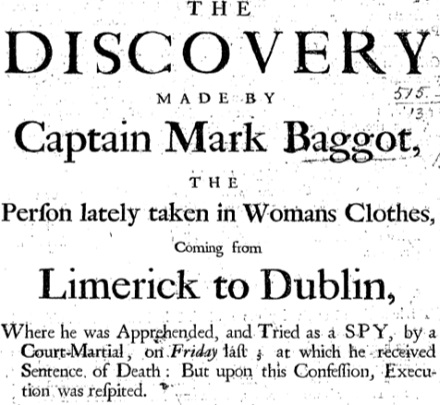
The resulting document has copy nearly as long as its unwieldy title …

The Discovery Made by Captain Mark Baggot, the Person Lately Taken in Womans Clothes, Coming from Limerick to Dublin, where He was Apprehended, and Tried as a Spy, by a Court-Martial ... at which He Received Sentence of Death: But Upon this Confession, Execution was Respited.

That the Irish army consists of forty thousand men of all sorts; that Tyrconnel was reducing them to thirty thousand; but SarsfieldSir Richard Nagle are pensioners of France.

That there is no good understanding between Tyrconnel and Sarsfield, having great jealousies of one another.

That King James has correspondence with, and intelligence from some persons in considerable places of trust here in England every ten days.

That the French fleet is hourly expected with thirty pieces of cannon, ammunition, provisions and arms; a French general, some marine men, but none of the army; they resolve to maintain their greatest force against the confederates in Flanders next campaign.

That the Irish army intends to move towards the frontiers, their greatest design being against Cork more than ny other place; what is left of the suburbs they intend to burn; they expect a great many deserters at their approach to the town. The commanders of the parties for this service are Colonel Dorrington and Colonel Clifford.

A spy, taken at Limerick, was hang’d here [Dublin], and confess’d that Major Corket was in particular favour, and held correspondence with the English, who was carried prisoner to Limerick, and suppos’d to have suffer’d death.

That the contributions paid to the new Irish are one peck of wheat or meal, 12 pound of butter every fortnight out of each plow lands.

That there is express order that no guns be removed from Limerick; that the English deserters are only paid and encouraged, but no pay given to the Irish.

That they are still fortifying Limerick.

That Ballyclough and Castletown, with some other places, were to be made garrisons by the Irish; that Sir Michael Creagh’s regiment of foot, under command of Colonel Lacy, are at Ballyclough, which places they are fortifying; that Strabane’s regiment of horse are at Charleveel and Buttifant, &c.

Baggot’s less than flattering report of the Jacobite forces’ condition proved bang-on: that July, the Williamites dealt a fatal blow to the Jacobite cause at the Battle of Aughrim — thanks to forcing a defile that the dug-in Jacobites ought to have held but for want of ammunition.‡ Shortly thereafter, Limerick capitulated to Williamite siege — its last Jacobite garrison escaping into exile, never to stir in Ireland again.

* He’s remembered in Ireland as “James the Shit” (Seamus a Chaca) because he ditched his supporters mid-war.

** Not the only Jacobite with a cross-dressing escapade to his name.

London Gazette, March 26-30, 1691, which calls the spy Baggot “a Person very well known.”

The Baggot(t)s (Bagods, Baggetts) were an English family that could trace lineage back to the age of William the Conqueror, with a very longstanding branch in Ireland. (Dublin still has streets that bear that name.) The 17th century Irish Baggots took it on the chin for their loyalty to the Stuarts, several dying in that service or being dispossessed. The family’s Baggotstown Castle in County Limerick was seized and razed by the Williamites months after the events in this post.

The date of Baggot’s execution is reported in the Gazette for May 25-28, 1691.

‡ “All the day, though he was sincking in his center and on his left, [the Williamites] yett durst not once, for his relief, attempt to traverse the cawsway, till despayr at the end compelled him to trye that experiment at all hazards … they confidently ventured to goe through, notwithstanding the fire from the castle on their right, which fire was insignificant; for it slew but a few in the passage. The reason of it was given, because the men had French pieces, the bore of which was small, and had English ball, which was too large. Here is a new miscarriage thro’ heedlessness. Why was not this foreseen and the dammage prevented?” (Source)

On this day..

1777: James Molesworth, in the words of the Founding Fathers

John Adams to Abigail Adams

Philadelphia
March 31, 1777

I know not the Time, when I have omitted to write you, so long. I have received but three Letters from you, since We parted, and these were short ones. Do you write by the Post? If you do there must have been some Legerdemain. The Post comes now constantly once a Week, and brings me News Papers, but no Letters. I have ventured to write by the Post, but whether my Letters are received or not, I dont know. If you distrust the Post, the Speaker or your Unkle Smith will find frequent Opportunities of conveying Letters.

I never was more desirous of hearing frequently from Home, and never before heard so seldom. We have Reports here, not very favourable to the Town of Boston. It is said that Dissipation prevails and that Toryism abounds, and is openly avowed at the Coffee Houses. I hope the Reports are false. Apostacies in Boston are more abominable than in any other Place. Toryism finds worse Quarter here. A poor fellow, detected here as a Spy, employed as he confesses by Lord Howe and Mr. Galloway to procure Pilots for Delaware River, and for other Purposes, was this day at Noon, executed on the Gallows in the Presence of an immense Crowd of Spectators. His Name was James Molesworth. He has been Mayors Clerk to three or four Mayors.

I believe you will think my Letters, very trifling. Indeed they are. I write in Trammells. Accidents have thrown so many Letters into the Hands of the Enemy, and they take such a malicious Pleasure, in exposing them, that I choose they should have nothing but Trifles from me to expose. For this Reason I never write any Thing of Consequence from Europe, from Philadelphia, from Camp, or any where else. If I could write freely I would lay open to you, the whole system of Politicks and War, and would delineate all the Characters in Either Drama, as minutely, altho I could not do it, so elegantly, as Tully did in his Letters to Atticus.

We have Letters however from France by a Vessell in at Portsmouth — of her important Cargo you have heard. There is News of very great Importance in the Letters, but I am not at Liberty. The News, however, is very agreable.


John Hancock to George Washington

Philada
April 4[-8], 1777

Sir,

The enclosed Resolves of Congress, which I have the Honour of transmitting, will naturally claim your Attention from their great Importance.

The Regulations relative to the Payment of the Troops and the Department of the Paymaster General, will I hope be the Means of introducing Order and Regularity into that Part of the Army; where, it must be confessed, they were extremely wanted.

General Gates having laid before Congress the Proceedings and Sentence of a Court Martial on a certain James Molesworth who was accused and found guilty of being a Spy, they immediately approved the same. He has since suffered the Punishment due to his Crime. From his repeated Confession, it appears, that Mr Galloway was extremely active in engaging him to undertake this infamous Business, and was the Person employed to make the Bargain with him. He says indeed, Lord Howe was present: but from the Description he gave of his Person, it is supposed he must be mistaken.

The Congress have directed Genl Gates to take Genl Fermoy with him to Ticonderoga, and such other french Officers as he may think proper. Genl St Clair being ordered to Ticonderoga, but previously to repair to this City to wait the further Order of Congress, you will please to direct him to repair here accordingly as soon as possible. I have the Honour to be with the most perfect Esteem & Respect Sir Your most obed. & very hble Serv.

John Hancock Presidt

On this day..

1988: Dmitri Polyakov, Cold War spy

Although it would not be publicly known until two years later, the retired Soviet Gen. Dmitri Polyakov was on March 15, 1988 executed for treason.

A World War II artillerist, Polyakov (English Wikipedia entry | Russian) was a military intelligence officer working as an embassy attache when he made contact with American agents in New York in 1961. For the next quarter-century — across assignments to Burma, India, the U.S., and back in Moscow — he would ship to the CIA and FBI some of its choicest morsels of the Cold War.

“Polyakov was the jewel in the crown,” former CIA chief James Woolsey lamented of his loss. Polyakov-supplied documents underscoring the extent of Russia’s split with China have been credited with spurring Richard Nixon’s overtures to Beijing.

The spy code-named Bourbon, Roam, and Top Hat had idiosyncratic motivations; he was not an ideological true believer like a Sorge nor a man afflicted by demons like a Vetrov. He accepted only a little bit of money from his handlers, mostly to support an innocuous wordworking hobby.

This Russian article indulges a variety of hypotheses — contempt for Khrushchev, the death of a son, an appetite for risk-taking — but nothing his U.S. contacts could learn of him rebutted the presentation he made of himself as a Russian patriot chagrined at the prospect that the corrupt Communist state could win the Cold War.

His revelations did much to check that possibility.

Polyakov retired as a general in 1980, having operated under the Kremlin’s nose for a phenomenally long period of time. (His U.S. contacts made sure to feed him some career-advancing secrets, too.) But he was betrayed in the 1980s by the USSR’s own moles, Robert Hanssen and Aldrich Ames and arrested in 1986.

His fate, imposed by the Military Collegium of the Soviet Supreme Court, thereafter was a mystery to his former handlers. Two months after his secret execution, U.S. President Ronald Reagan sought Polyakov’s pardon or his exchange for a captured Soviet mole at his May-June 1988 arms control summit with Mikhail Gorbachev. The solicitation was politely deferred.

On this day..

1968: Two Jordanians, a sergeant and a civilian

Soldier and Civilian Hanged By Jordan as Spies for Israel

AMMAN, Jordan, Feb. 29 — Two Jordanians, an army sergeant and a civilian, were publicly hanged at dawn today after having been convicted by a military tribunal on charges of spying for Israel.

The authorities said they had been caught in April, 1966, when the civilian, Mahmoud el-Haihi, 30 years old, was crossing into Jordan from Israel near his home in Tulkarm. He was said to have been carrying a message and money from Israeli military intelligence officer to Sgt. Fawzi Abdullah, 32, also from the Tulkarm area.

The death sentence was pronounced in January, 1967, and approved last month by King Hussein.

-New York Times, March 1, 1968

On this day..