On November 6, 1863, Old Geelong Gaol (op. cit.) hosted the hanging of James Murphy.
This horse thief, having been put to some light piece of penal servitude cleaning up the Warrnambool courthouse, noticed his minder kneeling over the fireplace and bashed that constable’s head with a three-point mason’s hammer.
Murphy made good his escape … for two days. He paid for those meager hours of harrowed liberty with his neck: a remarkable occasion, for it was noted that
[t]he executioner was a man sent down from Melbourne for the purpose, and a rather affecting scene took place when he was first introduced to his victim. It appeared the condemned man and he had been intimate friends in Tasmania, and as soon as he recognised him the tears began to roll down at the idea of his having to carry out the grim sentence of the law upon his old mate. He soon recovered his composure, however, and got through the remainder of his thankless office creditably.
The death mask taken from Murphy is still exhibited, and a display at the Old Gaol purports to re-create Murphy’s hanging. (His was the first of only two executions to take place within the gaol’s walls.)
One century ago today, California hanged two men at San Quentin: Earl Loomis, who murdered a Sacramento candy store proprietress in the course of a robbery, and Louis Bundy, who slew a Los Angeles messenger boy to steal a few dollars he could use to splurge on his girl.
Loomis, a hardened criminal, attracted the lesser notice; it was Bundy, who was an 18-year-old high schooler when he became a murderer, who drew a torrent of futile clemency appeals because of his youth and naivete. His crime dated to December of 1914, when he rang up the pharmacist and place a bogus order, along with a request to bring change for a $20 coin. The idea was to steal the change and buy his sweetheart a Christmas gift.
When the lackey turned up, it turned out to be a chum of Bundy’s, 15-year-old Harold Ziesche: Bundy bludgeoned him with a rock and an ax handle (sans ax) “because he knew me and would have squealed on me.”
As the San Jose Evening News reported in its hanging-day submission,* those appellants included former lieutenant governor A.J. Wallace among other political figures, numerous name-brand ministers (and even the strange Mormon boy-prophet Archie Inger), plus hundreds of Los Angeles schoolchildren.
All were bound for disappointment.
The Golden State was not averse per se to grants of mercy; a week prior to this date’s hanging, California’s pardons board spared three other condemned men, all murderers — and surely even in spurning Bundy in the same batch, the board’s action gave the young man’s supporters a thrill of hope for the intervention of Progressive Party governor (and death penalty skeptic) Hiram Johnson. Johnson had already reprieved Bundy in June, and then a second time in August.
He did not do it in November.
“I have done a great wrong and am sorry,” Bundy said on the scaffold. “I had hoped the law would see a way to let me have a chance, because I would like to have shown the world what I could do.” (Duluth (Minn.) News Tribune, Nov. 7, 1915.)
* Also the source of the headline image that surmounts this post.
Minutes after midnight on this date in 1949, Washington state hanged Arthur Bruce Perkins for stabbing and bludgeoning to death an Olympia couple during the course of a robbery two years prior.
An alcoholic delinquent from his teen years, Perkins moved to Olympia after being paroled from a stretch in the state reformatory on November 11, 1947. One of the victims living there, Geneva Jessup, “had practically been a foster mother to” Perkins, according to court records. “‘I called Mrs. Jessup Aunt Neenie.'”
Perkins and a friend were peacably repairing a broken-down vehicle near the Jessup home when Perkins got a phone call at that house. Precisely how events escalated so dramatically from this everyday neighborly scene into a bloodbath is not very well-developed, and Perkins did not seem inclined to elaborate on the point beyond what was necessary to expedite his conviction. (He had no last words on the gallows. “Some time perhaps, the truth of this whole affair will be known,” he had mused enigmatically in the hours before.) The best one can present by way of conflict is that Mrs. Jessup attempted to dissuade her “nephew” from an ill-considered marriage. The confession that he gave police suggests that a moment of heartbreak that became a mad and horrible crime.
[Mrs. Jessup] kept talking about [the woman Perkins intended to marry] and I slapped her first. I then realized what I had done and knew I could never face her again. The rock I used was in a flower pot or was used as a door jam. I remember the old man coming into the room and I knew right then I would have to kill him as he saw the whole thing. I think the knife was on the kitchen table or drain board. I don’t know how many times I stabbed them. I think I choked Mr. Jessup until he was unconcious and I think I hit him once or twice with my fist and then I remember stabbing him. She was standing up when I hit her and when it was all over I picked her up and put her on the davenport.
He fled towards Centralia, and was picked up within days. By then, he preferred to throw away his own life rather than confront in court the enormity of his deed. While driving Perkins to jail, the sheriff said,
he was in the back seat and he spoke up rather loud and asked me what my suggestion or what my advice would be to getting this thing over with as quick as possible, get it straightened around and he didn’t want to spend any long time in jail; said he wanted to be executed … I told him the best thing for him to do to simplify it would be to sign a confession, a short statement of the facts and then hire the poorest lawyer he could find.
The ensuing swell of human avarice arriving from every corner of the globe all but overwhelmed the frontier territory’s capacity; nearby San Francisco, “transformed … into a bawdy, bustling bedlam of mud-holes and shanties,” was so disordered that its laws were enforced extrajudicially by a self-appointed Vigilance Committee.
Coloma itself, the literal first mining town of the gold rush, boomed as the county seat of the new-christened El Dorado County. According to Alton Pryor, Coloma had 300 buildings and a hotel under construction by the summer of 1848, six months after the gold strike. (Today, Coloma is a near ghost town.) And like everywhere else, it had a job to manage the mad new world of desperate fortune-hunters ready to murder one another for the dust in their pockets.
Coloma has the distinction of giving birth to California’s first sheriff’s department, in 1852.
It’s almost surprising in such an environment that the original gold rush hotbed didn’t have an execution until 1854 — but Coloma made up for lost time* on November 3, 1854, by hanging two men, twice over.
The milestone perpetrators were classic frontier rascals, straight from a spaghetti Western rogues’ gallery. William Lipsey, a 25-year-old gambler, had murdered a fellow cardsharp in a drunken brawl over a game. James Logan, a 47-year-old miner “silvered o’er with age”, was condemned for killing a fellow miner in a claim dispute — though all the way to the gallows, Logan insisted to the last, before the 6,000 or so souls assembled to watch him die, that he had killed only in self-defense, remarking that
[h]e stood before them a condemned man, the victim of false testimony. It was true that he had taken the life of a fellow creature, but he had committed the deed in self-defence. He went to the claim where the tragedy took place, not as has been said to kill Fennel, but because the claim was his own, and he went to get possession of it. His own rash threats had brought him to the scaffold. In answer to propositions to settle the difficulty by law or arbitration, he had rashly replied that there was a shorter and better way — but he did not mean it. He went to the claim to get possession of it, but did not snap or present his pistol — he merely showed it. It was merely a single-barreled pistol. Fennel went and got a revolver, and came back and presented it at him, cocked. Fennel was advancing upon him with a cocked revolver when he presented his singlebarreled pistol. Any other testimony than this was false. He only snapped his pistol a moment before Fennel did his. The man who swore that he snapped his first swore a lie. They both snapped together. He had warned Fennel not to advance. He got behind Swift, and if he (Swift) had stood his ground, nobody would have been killed, But Swift flinched, and stepped aside. He then had to be killed himself, kill Fennel, or run away. He fired, and Fennel fell. He repeated that it was false that he snapped his pistol first; it was that snap that had brought him to the gallows, and the testimony about it was false.
In view of the halter (to which he pointed his finger) and in presence of that God before whom he was so shortly to appear, he was now speaking the truth. He would never have been hung if he had not had a principle of courage in his composition that prevented him from running away.
Lipsey, who was unquestionably guilty, did not have the older man’s composure and had to be half-dragged to the scaffold where he was so unmanned that he could not muster any last remark — though he was heard to murmur before dropped, “I don’t think I’m a murderer at heart.”
As the Coloma sheriff had no experience with executions, both men fell through their nooses and landed on the ground still alive. Still cool under pressure, Logan raised his hood to look around, got up, and walked back up to the gallows platform unassisted — but as the lawmen adjusted the hemp for the do-over, he recollected the letter of the death warrant and asked to see a watch.
“Ah, you have twenty minutes yet,” he exclaimed with a laugh. “If it was two o’clock I would demand my liberty under the law.”
* Coloma had another double hanging in 1855: outlaw Mickey Free hanged alongside Kentucky-born schoolmaster Jerry Crane, who murdered a student with whom he had become infatuated.
On this date in 1833, Ira West Gardner [Gardiner] hanged in Warren, Ohio — the only person ever executed in Trumbull County.
Gardner reads like the kind of rotter to inspire a Lifetime TV obsessed-stalker thriller: in the tiny township of Gustavus, he married a widow named Anna Buel[l] with a teenage daughter. Even the trial records are delicate on what transpired between young Maria and her stepfather — “for some reason, not very satisfactorily shown in the proof, she, for a short time before her death, evinced a strong desire to leave your roof, under circumstances which induced her friends to believe she was in fear of you.” The girl “was seen running from home disordered” and took refuge with a nearby farmer named Mills, where she turned up “barefooted, and without a handkerchief to put on her neck.” This was just two or three days before her murder on August 8, 1832; if the reader is getting a distinct whiff of sexual assault, well, one neighbor “told Gardner, that Maria had said, he had had criminal intercourse with her in a manner that would send him to the penitentiary.” Gardner denied it, but his obsessive behavior tells a different tale.
For Mills, Gardner showed the reasonable neighbor, and tried to persuade his absconded stepdaughter to return — but also agreed she was of age to go her own way if she preferred.
But to others, he made less compromising and much more sinister intimations, like “Maria has got to go home and live contented or I will be the death of her — I will have my revenge.” That’s actually less a sinister intimation than a highly specific threat.
Dad was able to put off his menacing aspect as a temporary fury that had come and gone, and he eventually negotiated with Maria via another neighbor, Bidwell, to allow her to return for her clothes. As soon as she got there, with Bidwell right there in the house too, Gardner suddenly produced a butcher’s knife and stabbed the unhappy object of his obsession in her chest and stomach. Though he was instantly subdued by Bidwell, the deed was done: Maria expired in ten painful minutes while Gardner ranted demonically to the arriving neighbors.
“I told you you had outwitted me last night, but that I would match you yet,” he said to one who had tried to reason with him. “I have done it, and got my revenge.” The killer was fixated on the idea of townsfolk who had lately tried to smooth out the situation as adversaries to “outwit”; to another he taunted, “I have now outgeneraled you as I told you I would — I did the deed, and did it effectually.”
(It was later found that this Scipio had also readied a pitchfork and an axe should he have the opportunity to chase after her.)
was escorted to the place of hanging by a great procession and band … people who had children away at school brought them home to witness the execution. We now wonder how these parents reasoned, but one of the young men who was thus brought many miles remembers that his father said he might never have another chance to see another hanging, and he was right. The children of the sixties were not like those of thirties, for the former always shivered as they passed the corner of South and Chestnut streets on the way to the cemetery, and dare not look towards the tree from which Gardner is supposed to have swung. Whether the tree was still standing at that time is not certain. Possibly children are like men and horses, less afraid where many people are congregated.
Sheriff Mygatt said that he did not believe he was going to be able to discharge his duty in the case of Gardner, but that he did work himself up to the point. He took the prisoner in his own carriage, led by Warren’s first band, which played a dire. The military organization formed a hollow square around the scaffold. Elder Mack, a Methodist minister, walked with Mr. Mygatt and the prisoner to the scaffold. A hymn was sung, in which the prisoner joined, and he was then swung to a great overhanging limb where he breathed his last.
“The young, beautiful & innocent Frances Maria Buel who was butchered by her stepfather” still has a marker in the East Gustavus Cemetery. Gardner rests in an unmarked grave.
One of the signal outrages of Bleeding Kansas was avenged with a hanging on this date in 1863.
“Bleeding Kansas” was the guerrilla war over slavery in the late 1850s that presaged the conflagration about to consume the Republic; here on the frontier, pro- and anti-slavery partisans traded atrocities in their respective campaigns to secure Kansas’s imminent entry to the Union as either a slave or a free state. The stakes, had America continued her antebellum course, were vital Congressional votes on which the continuance of the peculiar institution might one day hang.
The naked brutality of the conflict shocked its contemporaries; as one particularly notorious example, the sons of abolitionist crusader John Brown executed pro-slavery captives with broadswords.
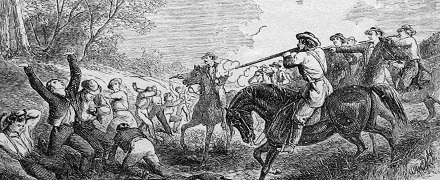
The Marais des Cygnes massacre was one of the last major horrors of that conflict: a party of 30 or so pro-slavery men led by Charles Hamilton seized 11 Free-Staters. They were mostly people who knew Hamilton personally, and seem to have gone along without resistance not anticipating what he had in store for them.
But Hamilton had told his men that on this campaign, “we are coming up there to kill snakes, and will treat all we find there as snakes.” (Source)
Much to their chagrin, these “snakes” were driven into a narrow ravine and lined up before Hamilton’s men’s guns. The volleys they delivered before fleeing back over the porous border into equally restive Missouri “only” killed five of their hostages: the other six survived by playing dead.
Five years later, one of those survivors, William Hairgrove, supplied the identification that damned William Griffith — whose claim that he only helped capture the Marais des Cygnes victims, and didn’t help shoot them was an especially lame offering at the height of the Civil War.
[a] little after noon Griffith was conveyed to the wood where he stepped onto the wooden platform a few inches above the ground. His wrists, knees and ankles were bound and the noose was adjusted. The black cap was pulled over his face at 1:07 p.m., and in but a moment William Hairgrove, one of the survivors of the massacre, cut the restraining rope with a hatchet; the four hundred pound weight dropped, jerking Griffith upward. The body rebounded and hung motionless while the attending physicians monitored his vital signs, and in twenty-five minutes they pronounced him dead.
A blush as of roses
Where rose never grew!
Great drops on the bunch-grass,
But not of the dew!
A taint in the sweet air
For wild bees to shun!
A stain that shall never
Bleach out in the sun!
Back, steed of the prairies!
Sweet song-bird, fly back!
Wheel hither, bald vulture!
Gray wolf, call thy pack!
The foul human vultures
Have feasted and fled;
The wolves of the Border
Have crept from the dead.
From the hearths of their cabins,
The fields of their corn,
Unwarned and unweaponed,
The victims were torn,—
By the whirlwind of murder
Swooped up and swept on
To the low, reedy fen-lands,
The Marsh of the Swan.
With a vain plea for mercy
No stout knee was crooked;
In the mouths of the rifles
Right manly they looked.
How paled the May sunshine,
O Marais du Cygne!
On death for the strong life,
On red grass for green!
In the homes of their rearing,
Yet warm with their lives,
Ye wait the dead only,
Poor children and wives!
Put out the red forge-fire,
The smith shall not come;
Unyoke the brown oxen,
The ploughman lies dumb.
Wind slow from the Swan’s Marsh,
O dreary death-train,
With pressed lips as bloodless
As lips of the slain!
Kiss down the young eyelids,
Smooth down the gray hairs;
Let tears quench the curses
That burn through your prayers.
Strong man of the prairies,
Mourn bitter and wild!
Wail, desolate woman!
Weep, fatherless child!
But the grain of God springs up
From ashes beneath,
And the crown of his harvest
Is life out of death.
Not in vain on the dial
The shade moves along,
To point the great contrasts
Of right and of wrong:
Free homes and free altars,
Free prairie and flood,—
The reeds of the Swan’s Marsh,
Whose bloom is of blood!
On the lintels of Kansas
That blood shall not dry;
Henceforth the Bad Angel
Shall harmless go by;
Henceforth to the sunset,
Unchecked on her way,
Shall Liberty follow
The march of the day.
The first judicial execution of a white man* in the history of the Utah Territory took place on this date in 1859.
One Thomas Ferguson earned the distinction by getting roaring drunk and shooting dead the shopkeeper who employed and boarded him. Allegedly, Alexander Carpenter’s provocation had been to accuse Ferguson of being party to the unknown burglars who had lately raided his Salt Lake City shop, which obviously got way under Ferguson’s skin.
“Crime has run riot in this city since the assassination of McNeill and Sergeant Pike” a hostile, non-Mormon correspondent wrote to the San Francisco Bulletin (letter dated Oct. 5, 1859, and published Oct. 27).
Till lately, no one has been arrested. Ferguson, a “Gentile,” murdered Carpenter, a Mormon, and for such an outrage “this people” will permit the sentence of death to be carried into effect; but the murderers of McNeill, of Pike, of Drown, of Arnold — the first two “Gentiles,” the last “apostates” — run at large to hold the community in terror and carry out other sentences.* An apostate committed suicide a few nights since by shooting himself twice in the back of the head!
Carpenter murdered his partner named Turner near Fort Laramie, Nebraska, brought their goods to this city, where, he said, (and convinced his associates,) he was tried and acquitted. Tried and acquitted in Utah for murder in Nebraska!
Both men were New Yorkers — and per a less strident observer writing to the New York Herald (datelined Oct. 7; published Nov. 7) neither of the two was Mormon. They had been allured to the West by the usual siren songs: wealth, fortune, fame. As young men do, these may have pictured themselves forever getting the drop on their enemies and never the other way around … and always with a dashing jailbreak at the ready if it came to that.
Unfortunately for Ferguson, he wasn’t the only Old West stock character in this tableau; a hanging-judge of dubious character named Charles Sinclair officiated the trial, so deep into his cups that he initially set Ferguson’s execution date for a Sunday. (It was changed to a Friday.) Ferguson himself gave the judge a right scorching from his scaffold rostrum on his way off this mortal coil:
I was tried by the statutes of Utah Territory, which give a man the privilege of being shot, beheaded or hanged. But was it given to me? No, it was not. All Judge Sinclair wanted was to sentence some one to be hanged, then he was willing to leave the Territory; and he had too much whiskey in his head to know the day he sentenced me to be executed on, and would not have known, if it had not been for the people of Utah laughing at him … A nice Judge to send to any country! (Source)
* The Espy file credits earlier executions of Native Americans, two Goshutes named Longhair and Antelope who hanged for slaying two whites during settler bush wars. (I would not venture to assert the judicial propriety, even by antebellum standards, of these proceedings.) And of course, Ferguson’s distinction excludes extrajudicial killings like the Mountain Meadows Massacre.
** The unpunished killings the correspondent names in this piece took place in the immediate aftermath of the 1857-1858 war between Mormon settlers in Utah and the federal government asserting its jurisdiction — a period when Brigham Young’s martial law had just been rescinded. Utah Gentiles inclined to read these incidents as emblematic of a lawless atmosphere in which reluctance to prosecute gave Mormons virtual impunity in their conduct towards the rest of the population.
For this just-in-time-for-Halloween wicked stepmother, we are indebted to the highly browsable The Word On The Street, a collection of highlight broadsides held by the National Library of Scotland.
ELIZABETH WARRINER was indicted for the Murder of J. Warriner, her Step-Son, at Surfleet, by administering poison to him. The prisoner was the second wife of a Farmer. The deceased was his Son by a former marriage, about 12 years of age. From the period of her marriage, the prisoner treated the child with great cruelty. On various occasions she was heard to say she would be the death of him. At length on the morning stated in the indictment, the boy, immediately after breakfast, which consisted of bread and milk, was taken ill. Medical aid was called in, but he breathed his last in the course of the day. After she had poisoned the unfortunate boy, she dragged him out of the house, and put him in the stable, and hanged him up, with a rope round his neck, to make people believe he had hung himself, as there was no marks of violence round the neck. The body was opened by a surgeon, when the stomach and intestines were found to exhibit all the appearance of arsenic having been administered. It was afterwards ascertained that a quantity of arsenic was in the possession of the father, who used it for some husbandry purpose, [and to] which the prisoner had access. It further turned out, that a small quantity was found [in t]he basin from which he had eaten his breakfast: and that the prisoner had given him his breakfast in that basin. This circumstance, added to a variety of others, which in the [cou]rse of the examination of the witnesses, seven in numher, came out, led to to the conclu[sion], that the prisoner administered the poison.
Mr. Justice Holroyd summed up tne evidence, and the Jury found her gulity, The [judge] in passing sentence, obserted to the prisoner, that the crime of murder in all cases [was] an heinous one, and in all countries was punished with death; but there were gradations e[ven] in this crime, and her’s [sic] was of the worst nature. She had destroyed her Step-Son; and no other motive could be assigned than that arising from a cruel, hardened, and vicious disposition — her crime was that of muder, the most heinous and cruel. — He hoped she would sincerely repent of her crime, and take all possible care of her soul during the few hours she had to live, so to be reconciled to her offended Maker; he feared she was not so convinced of the necessity of this as she ought to be, but trusted she would seek for that advice which would satisfy her of that necessity, and enable her to meet her future Judge, with a well-rounded hope in his mercy from the sincerity of her contrition; all that remained for him to do was to pass sentence upon her which the law required, which was, that she should be taken from whence she came, and on Saturday the 27th October, 1821, to be taken from thence, to the place of execution, there to be hanged by the neck till she was dead, and that her body should be delivered to the surgeons for dissection — concluding with — “and may the Lord have mercy on your soul.”
The moment she heard that her life was to be forfeited for the barbarous murder, and her cruel treatment to her Step-Son, she jumped up from the floor in the greatest agony, wringing her hands, and other symptoms of distraction.
About ten o’clock on Saturday morning, she ascended the fatal scaffold with a greater degree of fortitude and resignation than could have been expected; and addressed the numerous spectators around her in nearly the following words: “Good people, you see now before you an unfortunate woman, cut off just in the prime of life, and for the most dreadful of al [sic] crimes, Murder! let my dreadful fate be a warning to you not to suffer your passion to work forcibly on your minds, which has been the cause of the melancholy situation in which I am now placed; let me beg your prayers — good people pray for me; O pray for me.”
On the morning of her awful execution, she was dressed all in white, with a child suckling at her breast, which was taken from her by the executioner and her melancholy cries was heard at a great distance. It was shocking to the surrounding multitude.
She then dropped a handkerchief she held in her hand, as a signal, crying, O my Child! my Child! and was immediately launched into a dreadful eternity.
On this date in 1761, Richard Parrott, a middle-aged man from Harmondsworth, was hanged for the murder of his wife.
According to witness accounts, it all started over “a trifling dispute first arose between the prisoner and the deceased, whether their son or daughter, should go to the field for a cow.”
Parrott later claimed his wife, Anne, had “told a great many lies of him.” The end result was that he beat her and then cut off a large chunk of her tongue. The policeman who responded to the scene later described what he saw in graphic terms:
She lay on the bed, leaning over one side, spitting blood, but could not speak. Her mouth was swelled, and battered in such a manner, there was no such thing as seeing her tongue, She was so swelled and black, she looked like a blackamoor; I should not have known her, though I had known her from a little girl, being born in the same parish.
The assault had knocked out several of Anne’s teeth and badly bruised her. The swelling in her mouth was such that she could eat only broth, and that with great difficulty.
She died a few weeks later.
Before the tragic incident Richard had claimed his wife put “brimstone” in his clothes in an attempt to kill him. To save himself from the supposed brimstone he’d torn off the garments, cut them into pieces and buried them. Witnesses reported he had been “barbarous cruel” to his wife. Anne had told their son he was paranoid and “out of his mind,” and said she was afraid of him.
Nothing was done about it, however, until it was too late.
Nothing but the defence made for the prisoner, viz. Insanity, (supposing it to have a real foundation) can extenuate this horrid and most inhuman fact: nothing but the supposed madness of the perpetrator, can rescue it from being ranked among the most cruel deeds, that ever was perpetrated …
But these circumstances put together don’t remove the probability of the prisoner’s being insane when the fact was done. Subtilty and craft are known to attend this unaccountable distemper, in carrying on any mischief or outrage. The affections are generally inverted; love is turned into hatred, suspicion, jealousy, and rage; and the dearest object of love, is doomed to be the first victim of the perverted passions. The excuse he made when apprehended for this outrage, shews something like this, viz. That she had told lies of him, and he would prevent her doing the like again. Probably he resented her representing and declaring him to be out of his mind, as it appears on the trial she did, when she sent one of her sons for another of them twelve miles, to come and take care of his father, as being in that case. Nothing can provoke a madman more than to be thought or called mad; they are the last, generally speaking, who are sensible of it; and it is the last thing they will acknowledge. Happy had it been for his family, his friends, his neighbours, and parishioners, had they secured and put him under care for this fatal malady; they might have prevented this sad event to the deceased, this reproach to the survivors, who are in any degree blameable for this gross and dangerous neglect.
Found competent to hang by his jury, Parrott “seemed calm, sensible, and resigned” at the Tyburn gallows, where he hanged with three other people: thief Edward Garnet; infanticide Esther Rowden; and a grossly incompetent forger named Donald Campbell who was detected in his craft “by misspelling the names, and the inconsistency of placing 200l. at the top, and writing one hundred pounds in the body of the bill.”
We owe this date’s post, as with a number of others on this site, to Anthony Vaver, proprietor of the superb (albeit recently dormant) Early American Crime blog.
Vaver wrote the book on pre-Revolutionary War convict transportation to the Americas, and we were directed to the men featured today in a post Vaver ran on one of the most common resistance strategies — running away.
Being shipped out of Britain to the American colonies where they faced years of involuntary labor and the prospect of being bought and sold like slaves, convicts could hardly fail to ponder the advantages of escape.
Many did more than ponder: colonial newspapers are rife with adverts for absconded convict laborers, whose descriptions of the fugitives also make for a rich source on the everyday accoutrements of the 18th century working class. Pictured here are a very few arbitrarily chosen samples of the genre:
Such self-liberation did not always entail slipping away in an unsupervised moment: more direct means were occasionally employed, a fantasy that many surely entertained counterpoised by the threat of violent state reprisal. The four men who hanged together at Frederick, Maryland, made bold to put the dream into bloody actuality.
These men had been purchased by a merchant specializing in the convict labor trade — part of “a parcel of convicts” as the New York Gazetteer matter-of-factly described it (Aug. 5, 1773) which Archibald Moffman obtained “in order to dispose of them again to advantage.”
Instead it was Moffman who was disposed of. As Moffman and his nonplussed workingman retinue traveled through Maryland,
about two or three miles on the other side of Frederick-Town, one of the servants told his master that he was too much fatigued to go any further; they therefore all rested themselves on an old tree by the side of the main road. After some time, Moffman told them they must proceed on their journey, but they refused and immediately threw him backwards over the tree, dragged him about five steps into the woods, and then cut his throat from ear to ear; took his pocket book and then went over the mountain, calling at every tavern on the road.
But while the proximity of wilderness and the mutability of identity in the 18th century potentially facilitated escape, the colonies’ sparse habitation also made it harder to disappear into the obscurity of plain sight. Maryland was one of the most populous of the New World jurisdictions with barely 200,000 souls in 1770. It wasn’t that everybody knew everybody, but at such scales one could only go so long without engaging by chance the recognition of some acquaintance or busybody.
Seen in this light, the decision of our murderous fellows to call at every tavern on the road looks a mightily ill-considered course of action for men who ought to have felt the scourge of desperation at their backs. At one of these watering-holes, someone who had noticed these convict laborers on the road recently as they accompanied the yet-unkilled Moffman now ran into them sans oversight, and made inquiries — justifiably skeptical of the “parcel’s” story that their owner was following a few leisurely clicks behind. Failing to find Moffman on his way down the road, he sent up an alarm and the cutthroat tipplers were soon detained. Confession, conviction, and execution all followed within a matter of weeks.
The newspaper stories about this quartet do not so much as mention their names.


![The Last Dying Words, Speech, & Confession of Elizabeth Warriner. Who was Convicted at the last Lincoln Assizes, for the Horrid Murder of her Step-Son, J. Warriner, by poison, and who was Executed at the City of Linclon [sic], on Saturday the 27th of Oct. 1821.](https://www.executedtoday.com/images/Elizabeth_Warriner.jpg)


