1623: Amboyna Massacre

On February 27,* 1623, the Dutch East India Company beheaded twenty who had been waterboarded into confessing to a terrorist plot.
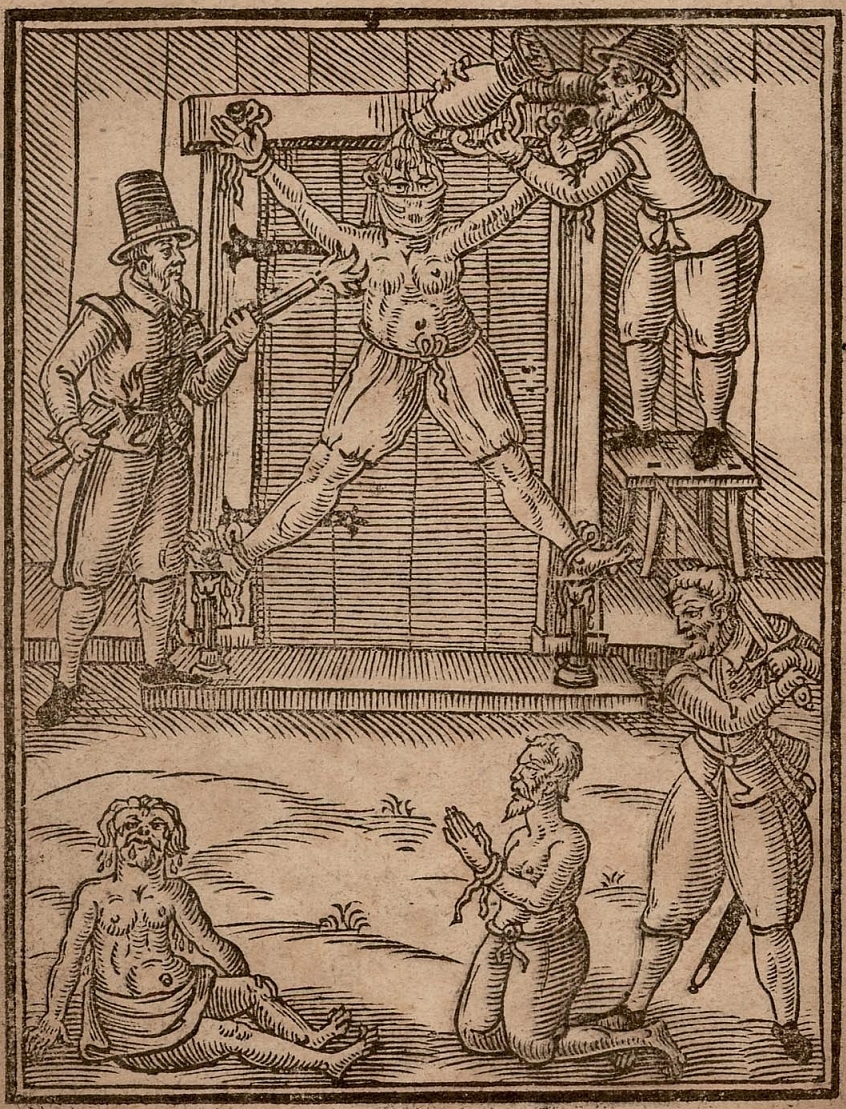
English prisoner suffering “waterboarding” faux-drowning torture, published under the name “A true relation of the unjust, cruell, and barbarous proceedings against the English at Amboyna in the East-Indies 1624”.

The torturers “poured the water softly upon his head until the cloth [wrapping his head] was full, up to the mouth and nostrils, and somewhat higher, so that he could not draw breath but he must suck in all the water.” More nasty description.

(cc) Image from Flickr | BiblioOdyssey

Posh Spice

As in modern times, this scenario originated with resource competition in the Muslim world … in this case, competition for spice, in Indonesia.

European colonialism had pitted the Dutch East India Company against its British counterpart on the archipelago, both scrabbling after the lucrative trade in cloves and pepper, with garnishes of nutmeg, cinnamon, mace, and ginger.

The two rival powers had, as we lay our story, recently come to a tense truce, dividing the commerce between them — and swapping mutual accusations of violating that pact. The arrangement basically gave the Dutch a bigger slice of the pie, so we’ll find them when the cloves hit the fan having the balance of power on their side.

Terrorists

We’re going to oversimplify to set the scene.

On Ambon Island, one of the very “Spice Islands” (i.e., the Moluccas) — at the Dutch-controlled fortification of a trading post also shared by the English — the Dutch merchant-governor Herman van Speult heard that a Japanese mercenary had asked about the Dutch fortifications.

The security-conscious van Speult ordered that unfortunate soldier interrogated under torture.

As tends to happen when the interrogators in such a case are convinced of a ticking time bomb situation, the torture uncovered a ticking time bomb situation.

The mercenary got the Dutch to stop burning and drowning him by “revealing” a highly implausible** English plot to seize the Dutch fort, with 20 guys or so and no prospect of imminent outside aid. Wouldn’t you know it: when the supposed confederates named by the mercenary were similarly tortured, they too admitted the plot. Van Speult’s English opposite number, Gabriel Towerson, was one of them.

The Amboyna Massacre followed anon, with Towerson and nine other British East India Company employees beheaded, along with nine Japanese mercenaries and one Portuguese. (The latter ten worked for the Dutch East India Company, not the British. A fifth column!)

They went to their deaths protesting their innocence, and many smuggled out written recantations to that same effect: “tortured … with that extream Torment of Fire and water, that Flesh and Blood could not endure it, and we take it upon our Salvation, that they have put us to Death Guiltless.”

Anger in the English Street

That last quote comes from Karen Chance, “The Amboyna Massacre in English Politics, 1624-1632,” in Albion: A Quarterly Journal Concerned with British Studies (Winter 1998).

As the title of that piece suggests, the Amboyna Massacre outraged Towerson’s countrymen and -women once word finally made it back to the mothership. (In addition to the torture/wrongful execution dimension, the legal authority of the Dutch trading concern to impose judicial punishment on their English counterparts was questionable at best.)

English demands for satisfaction against the perpetrators continued to complicate Dutch-English relations into the reign of Charles I and beyond. Even Oliver Cromwell required, as the price of peace for the First Anglo-Dutch War in the 1650s, punishment of any surviving offenders. (Which was apparently nobody at all.)

And still later, the burgeoning British Empire’s propaganda arm reached for the Amboyna narrative to justify seizing New Amsterdam on the grounds that the Dutch had attempted to spring a massacre on English settlers — “their Amboyna treacherous Cruelty extended itself from the East to the West Indies, and pursued thus the straight channel of Dutch blood”.

As for the trade-jockeying: the Netherlands’ commanding position in Indonesia ultimately squeezed the English out.** But don’t fret for Old Blighty: she turned attention to gobbling up India, and made a lot more bank than did the Dutch spice racket.

* February 27 was the date according to the Julian calendar in use at this time by the British. By the Gregorian calendar the Dutch were using, the massacre took place on March 9.

** For more on both the fanciful nature of the supposed plot, and the economics of the East Indies trade as it unfolded in the 17th century, see D.K. Bassett, “The ‘Amboyna Massacre’ of 1623”, Journal of Southeast Asian History, September 1960.

On this day..

1880: Ippolit Mlodetsky, Loris-Melikov’s would-be assassin

If you were a person of any privilege or official authority in late 19th century Russia, chances are that Narodnaya Volya was planning to take a shot at you.

If you were General Loris-Melikov, a Ukrainian Jew did that to you two days before this date in 1880.*

And if you were that errant assassin, Ippolit Mlodetsky, this was your execution date.

Even though Melikov rated as something of a liberal on the Russian autocracy spectrum, he had no qualms about ordering legal proceedings barely this side of summary.

Gen. Melikoff, on Wednesday evening, ordered a court-martial to assemble on Thursday morning. The trial of the prisoner was opened at 11 o’clock in the morning. The prisoner was insolent in his language and demeanor, and refused to stand up or take any part in the proceedings. He said he had nothing to add … that he did not want to be troubled any more, and wanted the matter finished. … at 1 o’clock … judgment was pronounced against him. The judgment on the prisoner sentenced him to be hanged, and his execution was appointed for 10 o’clock this (Friday) morning on the Simeonofsky Plain, near the Tsarskoe-selo Railway terminus.

And so he was.

Mlodetsky’s public hanging was witnessed by novelist Fyodor Dostoyevsky in the very square where Dostoyevsky himself had faced mock-execution for revolutionary activity 30 years before.

Dostoyevsky was, even then, pulling together his magnum opus, The Brothers Karamazov.

The very day Mlodetsky tried to kill Melikov found Fyodor Mikhailovich chatting with fellow reactionary journalist Aleksey Suvorin about the plague of terrorism and its accompanying social malaise.

On the day of the attempt by Mlodetsky on Loris Melikov I was with F. M. Dostoyevsky.

… Neither he nor I knew anything about the assassination. But our conversation presently turned to political crimes in general, and a [recent] explosion in the Winter Palace in particular. In the course of talking about this, Dostoyevsky commented on the odd attitude of the public to these crimes. Society seemed to sympathize with them, or, it might be truer to say, was not too clear about how to look upon them … (Quoted here.)

Dostoyevsky in this conversation revealed that for the planned sequel to The Brothers Karamazov — never to be realized in the event —

he was going to write a novel with Alyosha Karamazov as the hero. He planned to bring him out of the monastery and make a revolutionary of him. He would commit a political crime. He would be executed.

(Much more about this sequel in this paper.)

Melikov’s brush with death did not dissuade him from continuing to push for constitutional reforms as the antidote to terrorism, including introduction of a parliament. Tsar Alexander II was on the point of implementing that proposal … when he himself was assassinated by Narodnaya Volya, precipitating a political backlash.

That murder of Alexander II helped put the kibosh on the Karamazov sequel, which would thereafter have become politically problematic.

Nor was that the only artistic casualty of the Russian terrorists.

A discomfiting thematic similarity in Mlodetsky’s execution with that of the protagonist resulted in the cancellation of a just-opened opera: The Merchant Kalashnikov. (It would be a few more decades before that connection could appear ironic.)

* The assassination attempt occurred on February 20, with the execution on February 22, according to the Julian calendar still in use in Russia at that time. By the then-12-days-later Gregorian calendar, the dates were March 3 and March 5, respectively.

On this day..

1852: Martin Merino, Jesuit assassin

On this date in 1852, a 63-year-old Jesuit priest was garroted outside Madrid’s Toledo Gate for attempting to assassinate Queen Isabella II.

Only five days before, Martin Merino y Gomez (Spanish Wikipedia link) had slipped into the palace wearing his clerical robes, and planted a dagger in the Queen’s side. (Non-fatally; her corset partly shielded the blow.)

Despite some speculation that he might have been connected to some more elaborate plot, investigation found him to be a lone nut, “crazed with Liberal doctrines, disordered vanity, and bilious disease.”

Neither a clear motive nor a real link to any other actor was ever established. Merino died as a lone nut, and then his parricidal remains were burned to ashes and scattered to the winds.

On this day..

1918: Fanya Kaplan, Lenin’s would-be assassin

On this date in 1918, a 28-year-old Jewish revolutionary was shot in Moscow for attempting to murder Vladimir Lenin.

Fanya (“Fanny”) Kaplan had actually drawn a life sentence for trying the same trick on a tsarist official 12 years before, so you couldn’t say she was a reactionary element.

No, she was a member of the peasant-based Socialist Revolutionary Party, the SRs — the Bolsheviks’ onetime coalition partners who had splintered into left and right factions, the latter being shut out of power when the Constituent Assembly was closed.

A peasant herself, Kaplan was incensed at the Bolshevik power grab and shot Lenin twice at close range as he left a factory on August 30.

Taken immediately, Kaplan clammed up in interrogation.

My name is Fanya Kaplan. Today I shot at Lenin. I did it on my own. I will not say whom I obtained my revolver. I will give no details. I had resolved to kill Lenin long ago. I consider him a traitor to the Revolution. I was exiled to Akatoi for participating in an assassination attempt against a Tsarist official in Kiev. I spent eleven years at hard labour. After the Revolution I was freed. I favoured the Constituent Assembly and am still for it.

Realizing there was no information to be had from her, the Cheka had her executed four days after her crime — an affair organized by Yakov Sverdlov, the same guy who had recently disposed of the tsar.

On the same day Kaplan took her shots at Lenin, Bolshevik Moisei Uritsky was (successfully) assassinated. The two murders helped justify the Red Terror officially initiated on September 2 — which saw thousands of politically-motivated arrests and executions as the Bolsheviks consolidated their hold on power.


YouTube hosts a great many dreadful student dramatizations of historical events, but this one of Fanya Kaplan by Georgia Tech students is remarkably watchable.

On this day..

1868: Henry James O’Farrell, would-be assassin

On this date in 1868, the first Australian known to have attempted a political assassination received the short drop and sudden stop that often constitutes the wages of that distinguished profession.

It was March 12 — less than six weeks before — that Henry James O’Farrell, Dublin-born alcoholic vegetable merchant fresh from the asylum, had shot the visiting Prince Alfred, Duke of Edinburgh at a picnic in the Sydney suburb of Clontarf.

Someone was smiling down on Alfred that day, because the shot was deflected by a metal buckle and inflicted only a flesh wound. Onlookers tackled the assailant before he could finish the job.

O’Farrell claimed affiliation with the Irish nationalist Fenian brotherhood, which inflamed anti-Irish passions (some cynically whipped up by New South Wales Prime Minister Henry Parkes). Paranoia redoubled when a Fenian assassin killed a Canadian politician a few weeks later.*

Under the circumstances, it was a hopeless struggle for O’Farrell’s attorney, who strove to demonstrate (probably accurately) that his charge was not so much a terrorist as a madman. Even the Duke of Edinburgh’s own intercession for clemency did not secure it, eager as the populace was to make an offering of its loyalty.**

* Irish convicts transported to Australia, especially after the 1798 uprising, formed a significant demographic among early New South Wales settlers. (Source)

** Another offering was a still-extant hospital in Sydney named for Prince Alfred.

On this day..

1722: Arundel Cooke and John Woodburne, despite a novel defense

On this date in 1722, Arundel Cooke and John Woodburne were hanged at Bury St. Edmunds, curiously becoming the first victims [edit: or maybe not] of a law of unintended consequences.

This duo’s path to the gallows begins years before their births, when Stuart Restoration parliamentarian John Coventry trod on the royal toes and was in consequence beaten up by some of Monmouth‘s goons.

Incensed, parliament passed the Coventry Act.

By this statute it is enacted that if any person shall of malice aforethought, and by laying in wait, unlawfully cut or disable the tongue, put out an eye, slit the nose, cut off the nose or lip, or cut off or disable any limb or member of any other person, with intent to maim or disfigure him, such person, his counsellors, aiders and abettors, shall be guilty of felony, without benefit of clergy.

“Previous to the passing,” claims The Newgate Calendar, “it was customary for revengeful men to waylay another and cut and maim him, so that though he did not die of such wounds he might remain a cripple during the remainder of life, and such case was not then a capital offence. It was also a dangerous practice resorted to by thieves, who would often cut the sinews of men’s legs, called ham-stringing, in order to prevent their escape from being robbed.”

Sounds like an interesting time. One may well wonder how very customary this practice was, with the half-century lapse before the law found its first prey.

Cooke and Woodburne, for that matter, did not commit the sort of crime that long-ago parliament had had in mind.

Cooke, a well-off barrister, desired to secure for himself the sizable estate to which he was married, and hired working stiff John Woodburne to bump off his brother-in-law, on Christmas evening no less. The would-be assassin jumped him in a churchyard and

knocked down the unhappy man, and cut and maimed him in a terrible manner, in which he was abetted by the counsellor [Cooke].

Imagining they had dispatched him, Mr Cooke rewarded Woodburne with a few shillings and instantly went home; but he had not arrived more than a quarter of an hour before [the victim] knocked at the door, and entered, covered with wounds, and almost dead through loss of blood. He was unable to speak, but by his looks seemed to accuse Cooke with the intended murder, and was then put to bed and his wounds dressed by a surgeon. At the end of about a week he was so much mended that he was removed to his own house.

The perps were easily discovered, and having maimed the intended victim, appeared to fall within the compass of the Coventry Act.

But had they really committed a hanging offense? The defendant put his professional legal training to use.

[Cooke] urged that judgment could not pass on the verdict, because the Act of Parliament simply mentions an intention to maim or deface, whereas he was firmly resolved to have committed murder.

That’s a defense you don’t hear every day. Evidently, the court wanted to keep it that way.

Lord Chief Justice King, who presided on this occasion, declared he could not admit the force of Mr Cooke’s plea, consistent with his own oath as a judge — “For,” said he, “it would establish a principle in the law inconsistent with the first dictates of natural reason, as the greatest villain might, when convicted of a smaller offence, plead that the judgment must be arrested because he intended to commit a greater. In the present instance judgment cannot be arrested, as the intention is naturally implied when the crime is actually committed.”

Cooke’s university education and oleaginous lawyering did, however, enable him to make a successful request to be hanged before dawn on his scheduled day of execution, so as not to be exposed to the rude opprobrium of the commoners. John Woodburne (whether due to class position or the value he put on his last hours of life, the text does not inform us) was not extended the same courtesy, and swung later that day in full public view.

Part of the Themed Set: Selections from the Newgate Calendar.

On this day..

1927: Father Miguel Pro, “Viva Cristo Rey!”

On this date in 1927, the anti-clerical Mexican government made the emblematic martyr of the Cristero War.

This video is in Spanish, but the storyline is pretty easy to follow — young man finds faith, lives faith, dies faith.

Miguel Pro‘s dying cry, “Viva Cristo Rey!” — “Long live Christ the King!” — was a refrain of Cristeros, anti-government guerrillas who in the late 1920’s fought the revolutionary Mexican government’s attempts to forcibly restrict the power of the Catholic Church.

That conflict had been brewing for years, an outgrowth of Mexico’s own complex history of colonization and development — measures to restrict the church’s size, wealth, and social reach had been mooted and sometimes implemented well back to the middle of the 19th century.

Early in the 20th, the confrontation was merely a twist on its classic form: liberal state-builders and the Catholic hierarchy were (or increasingly saw themselves as) diametrically opposed in their vision for Mexico.

That conflict came to a head under president Plutarco Elias Calles, an irreligious northerner with a project of national capital development for whom the church’s intransigence from its agrarian strongholds was most unwelcome … and who seemed to delight in provoking Rome with sport like mandatory physicals for priests, not neglecting to publicize the incidence of venereal disease thereby revealed.

Liberals had already brought about drastically reduced clerical privileges in the Mexican Constitution of 1917; its somewhat draconian measures were neither fully enforced nor fully resisted, but initiated a period where the two hostile institutions rudely grappled for their respective spheres of influence on the ground.

Calles was the rudest grappler of all, and his 1926 Calles Law pushed for anti-clericalism stricter than the letter of the constitution … and sparked armed resistance.

It was an exceptionally dirty war with routine summary executions on both sides and thousands of Catholic refugees — a dangerous environment for any priest with legal sanctions against basically every practice of the vocation. (Photos of Cristeros, some in heroic resistance and others in grisly martyrdom, can be eyeballed here.)

Pro, a Jesuit who like many was forced underground, was under state surveillance and got picked up in the aftermath of an assassination attempt against a prominent politician. He was chosen to make an example of — without an actual trial, possibly because there’s no actual reason to think he was involved in the bombing.

Looking at these pictures of Pro’s last moments, it’s hard to believe that they were taken and circulated at government direction to cow the Cristero movement. Fail.


Led out to execution in a police courtyard. The place of his death today is (bizarrely) Calle Loteria Nacional.


Calmly at prayer before his death, under the eye of the firing squad commander.


Pro himself refused a blindfold. But why state authorities carrying out the execution with an eye towards public relations would allow him to die in this pose is anyone’s guess.


He blessed and forgave the firing squad, of course.


Just beginning to topple at the moment the bullets struck him.


Like many firing squad executions, this one failed to kill its victim with the ceremonial volley. Pro was finished off with a coup de grace.

Calles was simultaneously — the key measures were also enacted in 1926 — involved in a confrontation with the United States over oil rights, a situation that came to the brink of war, with Washington saber-rattling about “Soviet Mexico”. It’s tempting to wonder whether the two situations weren’t related, especially since the new American ambassador* who had arrived only the month before Pro’s execution would ultimately negotiate both situations’ resolutions.

While the natural resource politics went their separate way, the Mexican Revolution’s anti-clerical strain didn’t so much disappear by negotiation as fade away over decades, with regular new outbreaks.

One thinks of Mexico today as such so staunch a Catholic country that it’s hard to imagine that some of these provisions were only officially repealed in 1998.

As for Pro, he’s welcome in Mexico by now — celebrated by Pope John Paul II who ultimately beatified him, and the inspirational source of this hymn whose refrain is his famous last cry.

There’s a faithful site in his honor here, and apparently a shrine to him in Houston, Texas run by a group pushing for his canonization.

* The American ambassador in question, Dwight Morrow, invited Charles Lindbergh on a goodwill tour to Mexico, where the aviator would meet the diplomat’s daughter not long after Miguel Pro’s martyrdom. Little could Lindbergh and Anne Morrow suspect that their love match would set them on the path to their own famous encounter with capital punishment.

On this day..

1892: Jens Nielsen, the last in Denmark

On this date in 1892, serial arsonist Jens Nielsen was beheaded with an axe in the courtyard of Horsens prison — the last civil execution ever conducted in Denmark.

According to this Danish biography, Nielsen had incurred a long prison sentence for burning several farms in July 1883.

(He’d just returned from a fruitless stint in the New World, torching a warehouse in England on the return voyage.)

Apprehended immediately and sentenced to a long prison term, Jens confronted an age-old dilemma which was evidently noticeably acute among melancholy Danes: effecting state-assisted suicide on the scaffold.

These cases must have once been fairly frequent because Denmark, by an ordinance of December 18, 1767, deliberately abandoned the death penalty in cases where “melancholy and other dismal persons [committed murder] for the exclusive purpose of losing their lives.” The background for the provision was, in the words of Orste, “the thinking that was then current among the unenlightened that by murdering another person and thereby being sentenced to death, one might still attain salvation, whereas if one were to take one’s own life, one would be plunged into eternal damnation.”

The ordinance was ineffective in one case, at least, that of Jens Nielsen, who was born in 1862 and spent a most unhappy and unfortunate childhood. In 1884 he was sentenced to 16 years of hard labor for theft and arson. The following year he tried to kill a prison guard. He was tried, sentenced to death and received a commutation to life. He was then placed in solitary confinement. A year later he tried again to kill a guard, “realizing that he could not stand solitary confinement, did not have the nerve to commit suicide and wanted to force his execution.” He was again tried, sentenced to death and the sentence commuted. In 1892, having remained in solitary confinement all that time, he tried again to kill a guard. This time he got his wish, was sentenced to death and executed. (Source.)

He even managed to crack wise, “Thank you!” to the mayor who wished him God’s help on the way to the scaffold — envoy of the powers both temporal and ethereal that would finally loose his shackles.

Denmark’s death penalty law lingered into the 1930’s, but even the occasional death sentences were no longer carried out. Apart from a brief revival after World War II to punish war crimes committed during the Nazi occupation, nobody has been put to death in Denmark in — as of today — 116 years.

On this day..