1976: Lt. Col. Bukar Dimka and six coup confederates

On this date in 1976, Nigeria executed the leading spirit of an abortive Nigerian coup was shot for the “abortive” part of that coup.

That February 13, Bukar Dimka had taken to the airwaves to announce the assassination of Nigeria’s incumbent military strongman, Murtala Mohammed.*

Good morning fellow Nigerians.

This is Lt. Colonel B. Dimka of the Nigerian Army calling. I bring you good tidings. Murtala Muhammed’s deficiency has been detected. His government is now overthrown by the young revolutionaries. All the 19 military governors have no powers over the states they now govern. The states affairs will be run by military brigade commanders until further notice.

…

Any acts of looting or raids will be death. Everyone should be calm. Please stay by your radio for further announcements. All borders, air and sea ports are closed until futher notice. Curfew is imposed from 6am to 6pm. Thank you. We are all together.

-From Romancing the Gun: The Press as Promoter of Military Rule

They were not all together.

Mohammed’s second-in-command, Olusegun Obasanjo, instantly quashed the putsch and served notice that assassinating the head of state would not be welcome on his watch.**

A large body of coup conspirators were publicly executed within a month; the Nigerian Defense Minister was among them.

Dimka himself managed to remain at large for most of that month, so he wasn’t among that crop. Instead, Obasanjo had the pleasure of announcing Dimka’s execution separately, along with that of

a former state governor, Joseph Gomwalk … “two of the principal actors” in the coup.

–New York Times, May 16, 1976

The coup was thought to have aimed at restoring the guy Mohammed deposed, Yakubu Gowon, who was luckily in exile in England and therefore escaped a similarly grim fate.

Years later, he received an official pardon; Gowon is still alive, one of Nigeria’s elder political statesmen.

* When next in Lagos to transfer several million in oil wealth from a secret bank account, be sure to visit Mohammed’s bullet-ridden Mercedes.

** Obasanjo handed power to a democratic government in 1979; that government was itself later toppled by the military, but Obasanjo eventually served as Nigeria’s elected president from 1999 to 2007.

On this day..

1883: Joe Brady, the first of the Invincibles

“All patriots on earth must respect him (Joe Brady).”

–John Boyle O’Reilly

On this date in 1883, Britain set about the grim work of avenging the assassination of its Irish plenipotentiaries by hanging Joe Brady at Kilmainham Gaol.

“He was brought up as a stonemason,” the May 15, 1883 London Times recalled of the by-then-hanged man, “of herculean strength, his occupation developing the muscular power of his arms, which told with such terrible effect when he drove the knives into the bodies of his victims.”

Those knife-driven bodies belonged to Irish civil servant Thomas Henry Burke (a quisling figure, in the eyes of Irish nationalists) and the English politician Lord Frederick Cavendish, who were jumped while taking a stroll in a Dublin park on May 6, 1882.

The authors of their destruction — beyond Joe Brady, personally — were the splinter of radical Fenians known as “the Invincibles”, who figured on the vincibility of the collaborators and informers who made British control of Ireland possible. Especially their vincibility to stonemason-wielded surgical knives.

Efficient, and surely less than genteel, police work busted up the cell after those spectacular homicides, inducing leadership figures to turn state’s evidence against their subordinates. Four more men consequently hanged in the month following Brady’s execution. The stool pigeons got to walk.

History did not delay her verdict on these characters.

While Invincible-turned-informer James Carey was promptly murdered in retaliation, Brady et al joined nationalist mythology as martyrs who “died a Fenian blade.”

Ballad of Joe Brady

I am a bold undaunted youth, Joe Brady is my name,
From the chapel of North Anne Street one Sunday as I came,
All to my surprise who should I espy but Moreno and Cockade;
Says one unto the other: “Here comes our Fenian blade”.

I did not know the reason why they ordered me to stand,
I did not know the reason why they gave me such a command.
But when I saw James Carey there, I knew I was betrayed.
I’ll face death before dishonour and die a Fenian blade.

They marched me up North Anne Street without the least delay,
The people passed me on the path, it filled them with dismay.
My sister cried, “I see you Joe, if old Mallon gives me lave,
Keep up your heart for Ireland like a true-born Fenian Blade.

It happened in the Phoenix Park all in the month of May,
Lord Cavendish and Burke came out for to see the polo play.
James Carey gave the signal and his handkerchief he waved,
Then he gave full information against our Fenian blades.

It was in Kilmainham Prison the Invincibles were hung.
Mrs Kelly she stood there all in mourning for her son.
She threw back her shawl and said to all:
“Though he fills a lime-pit grave,
My son was no informer and he died a Fenian blade.”

And if the Times‘ report (the same May 15 article) is to be believed (reporters weren’t actually allowed to witness the execution itself), Brady wore that invincible conviction to the scaffold.

“Up to the last moment,” the paper reported, “he retained the animal courage which he displayed in the deed itself, which, though dastardly as regards the unarmed men whom he attacked, was daring in its other circumstances.”

Speaking of animal courage.

Our man Brady, very famous in Ireland around the turn of the century, makes a little appearance in the referential soup of James Joyce’s Ulysses* for animal spirits of a different sort: a conversation about his hanging provides the departure point for a Joycean meander into the phenomenon of scaffold priapism.

–There’s one thing it hasn’t a deterrent effect on, says Alf.

–What’s that? says Joe.

–The poor bugger’s tool that’s being hanged, says Alf.

–That so? says Joe.

–God’s truth, says Alf. I heard that from the head warder that was in

Kilmainham when they hanged Joe Brady, the invincible. He told me when they cut him down after the drop it was standing up in their faces like a poker.

–Ruling passion strong in death, says Joe, as someone said.

–That can be explained by science, says Bloom. It’s only a natural phenomenon, don’t you see, because on account of the …

And then he starts with his jawbreakers about phenomenon and science and this phenomenon and the other phenomenon.

The distinguished scientist Herr Professor Luitpold Blumenduft tendered medical evidence to the effect that the instantaneous fracture of the cervical vertebrae and consequent scission of the spinal cord would, according to the best approved tradition of medical science, be calculated to inevitably produce in the human subject a violent ganglionic stimulus of the nerve centres of the genital apparatus, thereby causing the elastic pores of the CORPORA CAVERNOSA to rapidly dilate in such a way as to instantaneously facilitate the flow of blood to that part of the human anatomy known as the penis or male organ resulting in the phenomenon which has been denominated by the faculty a morbid upwards and outwards philoprogenitive erection IN ARTICULO MORTIS PER DIMINUTIONEM CAPITIS.

* As was Brady’s getaway driver James “Skin-the-Goat” Fitzharris, who became a national celebrity by serving a long prison sentence for refusing to inform on anyone.

On this day..

1744: Jan, of Johonnes Van Houten

From the Proceedings of the New Jersey Historical Society, only one small instance of the “terrible example” in store for the Garden State’s “large body of slaves to be kept in subjection.”

May 10, 1744 — The negro man “Jan,” of Johonnes Van Houten, was tried “for poysoning and attempting to do the same to several blacks at the township of Bergen; to wit, the negro man of Arent Toers, named Lowis, and has some time past poysoned two wenches of Garret Ross, of the same precinct, and attempted several more.” Convicted and sentenced to be hanged May 11, between 10 and 12, at Bergen; “at the suitablest place, where Peter Marselis and Michel Vreeland shall think proper.”


Was it the slave trade that capitalized the Van Houten cracker empire?

On this day..

1900: Three Algerians in Setif

On this date in 1900, three Algerian criminals called (in the next day’s dispatch in Le Petit Parisien) Bou-Mechada-Saïd-ben-Mohamed, Chabli-Lakdar-ben-Abdallah and Boulakras-Tahad-ben-Saad were guillotined for a murder committed just 11 days before in Setif, Algeria.

On this day..

1323: Jourdain de l’Isle-Jourdain, Gascon rascal

On this date in 1323, Jourdain de l’Isle-Jourdain, lord of Casaubon, was “stripped naked, drawn on a hurdle from the Chatelet to the gibbet, and hanged there.” (Source)

This robber-baron‘s offense had been nothing less than the years-long defiance of his every actual and potential liege — consequence of the wide scope of action available to feudal nobles before the ascendance of absolutism.

Jourdain was the younger son of a lord, but managed to inherit a good chunk of land and marry into more of it … giving him power well beyond his merely nominal aristocratic rank.

Jourdain’s stomping ground was Gascony in the southwest of France, which in this period was a contested fringe of English and French authority* and so was under little true authority at all.

An unscrupulous operator could have a field day — or in Jourdain’s case, a field decade or two.

Joseph Klicklighter, “The Nobility of English Gascony: the case of Jourdain de l’Isle” in the Journal of Medieval History 13 (1987), pp. 327-342 documents Jourdain de l’Isle-Jourdain’s run of rapine in the “chaos and lawlessness” of 14th century Gascony.

He would occupy lands to extract official concessions, rip off the sailors and merchants crossing his territory, play English and French power off against one other (not neglecting to drag in the Avignonese pope John XXII, who had our crooked noble’s back as his kinsman), even rape, murder, and plunder outright. When forced to fight a judicial duel that turned out inconclusively, he peevishly razed a castle of his opponent.

“For years,” Klicklighter notes, “Jourdain de l’Isle was able to … pursue his wars and crimes and to flaunt ducal [English] and French authorities alike.”

Mind, he was hardly the only Gascon noble amok, but he seems to have been the most offensively undiplomatic of the lot. When the new French King Charles IV** sent armed envoys to summon him (along with other lords) to Paris, Jourdain had the envoys beheaded.

At last someone prevailed upon our man to make the trip, and despite arriving “in grand array and with great arrogance,” the French clapped him in prison with what we can only assume was relief. The Pope’s frantic appeals on Jourdain’s behalf didn’t do him any good: in fact, our man was hanged in a garment derisively sporting the papal insignia.

Though this date’s execution put an end to one man’s depravities, the violence attributable to his contumacious native region was just getting started. Fourteen years later, the next French monarch, Philip VI, went to put an end to this foolishness by definitively reclaiming Gascony for France … and triggered the Hundred Years War.

* Formally, Gascony was an English fief of the French crown. Functionally, that meant that whenever the English seneschal issued an edict, the local lords could ignore it by appealing to Parlement.

** Charles IV was the last ruler of the House of Capet … thanks in part to the dynasty-destroying Tour de Nesle scandal.

On this day..

1830: The slave Jerry, the last American execution by burning?

On this date in 1830,* a slave named Jerry was executed in Abbeville, South Carolina … by burning to death.

The slave was the property of a Miss Elizabeth McQuerns, a schoolteacher who hired him out — in which capacity he raped the wife of his subcontracted master.

This case is treated in an April 1990 piece for The South Carolina Historical Magazine by Lowry Ware, titled “The Burning of Jerry: The Last Slave Execution by Fire in South Carolina?” But in addition to being the last execution by fire in South Carolina, it might well be the last in the United States. (The quotes below are all via Ware.)

“Judicial,” for slaves, was of course something less than a robust vindication of the defendant’s rights — and burning sentences imposed in colonial and antebellum America were almost universally used against black slaves. One pictures a context not unlike that of extrajudicial burnings to follow in the decades yet to come.

According to a copy of the trial transcript McQuerns later filed for compensation (the original trial record is lost, Ware says),

the Court acquainted [Jerry] that they were to proceed immediately upon trial and would hear his answer to the charge against him and whatever witnesses he had to produce in his behalf as well as against him.

The witness produced to support the charge against the prisoner was heard and examined and there being no witness in behalf of the prisoner, the court after mature consideration of the case found the prisoner guilty … [and was condemned to] be sent to the Gaol of the said District and there remain until the first day of May next and then be brought back to an old field above West Donald still house, and there burnt to death between the hours of twelve and two o’clock.

…

But previous to awarding and ordering said sentence to be executed appraised and valued said Negro slave man named Jerry at four hundred dollars and direct the sum of ____ to be paid to Elizabeth McQuerns the owner of said Negro and the remainder of the sum of ____ dollars to ____ agreeably to the Act of Assembly made and provided.

Such a dramatically anachronistic sentence surely made its impression.

As remembered, decades later, by a minister named Samuel Leard who witnessed the execution as a teenager,

thousands of men, women and children, both white and colored, assembled together in an old field not far from the residence of Mr. Donald to witness the execution of a beastly criminal by burning alive at the stake. The crime cannot with propriety be named — the name and the memory of the criminal ought to be consigned to eternal oblivion. But there sat the prisoner, the waiting impatient crowd, the immense pile of pitch pine logs and kindling wood scattered around, the sheriff and his posse, the temporary platform for the preacher … for it was determined that the fiendish criminal should hear his own funeral sermon pronounced … As the poor doomed man ascended the pile, he began to pray audibly and this was kept up continuously during the process of chaining him to the stake, and until the mounting flames deprived him of a wretched life. This was the last execution by fire ever seen in South Carolina.

–Abbeville Press & Banner, July 2, 1879

In 1833, the Palmetto State humanely legislated that “that “on the conviction of a slave, or a free person of color, for a capital offence, the punishment shall be by hanging, and not otherwise.”

* The scanty documentation remaining of this case leaves the date less than completely ironclad, but the one issued in sentence attested in this piece will have to do.

On this day..

1689: Patrick O’Bryan, like a dog to his vomit

From the Newgate Calendar:


PATRICK O’BRYAN

Hanged once for Highway Robbery, but lived to rob and murder the Man for whom he had been executed. Finally hanged 30th of April, 1689

The parents of Patrick O’Bryan were very poor; they lived at Loughrea, a market-town in the county of Galway and province of Connaught in Ireland. Patrick came over into England in the reign of King Charles II, and listed himself into his Majesty’s Coldstream Regiment of Guards, so called from their being first raised at a place in Scotland which bears that name. But the small allowance of a private sentinel was far too little for him. The first thing he did was to run into debt at all the public-houses and shops that would trust him; and when his credit would maintain him no longer, he had recourse to borrowing of all he knew, being pretty well furnished with the common defence of his countrymen — a front that would brazen out anything, and even laugh at the persons whom he had imposed on to their very faces. By such means as these he subsisted for some time.

At last, when he found fraud would no longer support him, he went out upon the footpad. Dr Clewer, the parson of Croydon, was one of those whom he stopped. This man had in his youth been tried at the Old Bailey, and burnt in the hand, for stealing a silver cup. Patrick knew him very well, and greeted him upon their lucky meeting; telling him that he could not refuse lending a little assistance to one of his old profession. The doctor assured him that he had not made a word if he had had any money about him, but he had not so much as a single farthing. “Then,” says Patrick, “I must have your gown, sir.” “If you can win it,” quoth the doctor, “so you shall; but let me have the chance of a game at cards.” To this O’Bryan consented, and the reverend gentleman pulled out a pack of the devil’s books; with which they fairly played at all-fours, to decide who should have the black robe. Patrick had the fortune to win, and the other went home very contentedly, as he had lost his divinity in such an equitable manner.

There was in Patrick’s time a famous posture master in Pall Mall; his name was Clark. Our adventurer met him one day on Primrose Hill, and saluted him with “Stand and deliver.” But he was mightily disappointed, for the nimble harlequin jumped over his head, and instead of reviving his heart with a few guineas, made it sink into his breeches for fear, he imagining the devil was come to be merry with him before his time, for no human creature, he thought, could do the like. This belief was a little mortification to him at first; but he soon saw the truth of the story in the public prints, where Mr Clark’s friends took care to put it, and then our Teague’s qualm of conscience was changed into a vow of revenge if ever he met with his tumblership again; which, however, he never did.

O’Bryan at last entirely deserted from his regiment, and got a horse, on which he robbed on the highway a long time. One day in particular he met Nell Gwyn in her coach on the road to Winchester, and addressed himself to her in the following manner: “Madam, I am a gentleman, and, as you may see, a very able one. I have done a great many signal services to the fair sex, and have in return been all my life long maintained by them. Now, as I know you are a charitable w— —e, and have a great value for men of my abilities, I make bold to ask you for a little money, though I never have had the honour of serving you in particular. However, if an opportunity should ever fall in my way, you may depend upon it I will exert myself to the uttermost, for I scorn to be ungrateful.” Nell seemed very well pleased with what he had said, and made him a present of ten guineas. However, whether she wished for the opportunity he spoke of, or no, cannot be determined, because she did not explain herself; but if a person may guess from her general character, she never was afraid of a man in her life.

When Patrick robbed on the highway he perverted several young men to the same bad course of life. One Claudius Wilt in particular was hanged at Worcester for a robbery committed in his company, though it was the first he was ever concerned in. Several others came to the same end through his seducements; and he himself was at last executed at Gloucester for a fact committed within two miles of that city. When he had hung the usual time, his body was cut down and delivered to his acquaintance, that they might bury him as they pleased. But being carried home to one of their houses, somebody imagined they perceived life in him; whereupon an able surgeon was privately procured to bleed him, who by that and other means which he used brought him again to his senses.

The thing was kept an entire secret from the world, and it was hoped by his friends that he would spend the remainder of his forfeited life, which he had so surprisingly retrieved, to a much better purpose than he had employed the former part of it. These friends offered to contribute in any manner he should desire towards his living privately and honestly. He promised them very fairly, and for some time kept within due bounds, while the sense of what he had escaped remained fresh in his mind; but the time was not long before, in spite of all the admonitions and assistance he received, he returned again to his villainies like a dog to his vomit, leaving his kind benefactors, stealing a fresh horse, and taking once more to the highway, where he grew as audacious as ever.

It was not above a year after his former execution before he met with the gentleman again who had convicted him before, and attacked him in the same manner. The poor gentleman was not so much surprised at being stopped on the road as he was at seeing the person who did it, being certain it was the very man whom he had seen executed. This consternation was so great that he could not help discovering it, by saying: “How comes this to pass? I thought you had been hanged a twelvemonth ago.” “So I was,” says Patrick,” and therefore you ought to imagine that what you see now is only my ghost. However, lest you should be so uncivil as to hang my ghost too, I think it my best way to secure you.” Upon this he discharged a pistol through the gentleman’s head; and, not content with that, dismounting from his horse, he drew out a sharp hanger from his side and cut the dead carcass into several pieces.

This piece of barbarity was followed by another, which was rather more horrible yet. Patrick, with four more as bad as himself, having intelligence that Lancelot Wilmot, Esq., of Wiltshire, had a great deal of money and plate in his house which stood in a lonely place about a mile and a half from Trowbridge, they beset it one night and got in. When they were entered they tied and gagged the three servants, and then proceeded to the old gentleman’s room, where he was in bed with his lady. They served both these in the same manner, and then went into the daughter’s chamber. This young lady they severally forced one after another to their brutal pleasure, and when they had done, most inhumanly stabbed her, because she endeavoured to get from their arms. They next acted the same tragedy on the father and mother, which, they told them, was because they did not breed up their daughter to better manners. Then they rifled the house of everything valuable which they could find in it that was fit to be carried off, to the value in all of two thousand five hundred pounds, After which they set the building on fire, and left it to consume, with the unhappy servants who were in it.

Patrick continued above two years after this before he was apprehended, and possibly might never have been suspected of this fact if one of his bloody accomplices had not been hanged for another crime at Bedford. This wretch at the gallows confessed all the particulars, and discovered the persons concerned with him; a little while after which, O’Bryan was seized at his lodging in Little Suffolk Street, near the Haymarket, and committed to Newgate; from whence before the next assizes he was conveyed to Salisbury, where he owned the fact himself, and all the other particulars of his wicked actions that have been here related.

He was now a second time executed, and great care was taken to do it effectually. There was not, indeed, much danger of his recovering any more, because his body was immediately hung in chains near the place where the barbarous deed was perpetrated. He was in the thirty-first year of his age at the time of his execution, which was on Tuesday, the 30th of April, in the year 1689.

On this day..

1882: George Henry Lamson, aconitine poisoner

On this date in 1882, George Henry Lamson was hanged at England’s Wandsworth Prison for poisoning his brother-in-law in pursuit of an inheritance.

Once decorated for his volunteer medical practicioning in the benighted lands of eastern Europe, Dr. Lamson fell prey upon his return to England to morphine addiction which cleaned out his assets.
Desperate to resolve his debts, he administered a lethal aconitine dose to the paraplegic 18-year-old Percy John.

Apparently, the good doctor had learned all about this efficacious chemical at the knee of Queen Victoria’s own physician, Robert Christison.

Unfortunately, Lamson hadn’t been keeping up with his technical journals in the meantime: Christison had taught him that aconitine poisoning was undetectable, but a forensic technique to identify it had subsequently been developed.

(Minor-league milestone: Lamson’s was the first recorded criminal defense that attempted to blame ptomaine poisoning, a now-discredited theory that death can be induced by alkaloid toxins from decomposing food. But the lawyer making that defense would later write that he not only believed his client guilty, he also thought Lamson had iced his wife’s older brother, Herbert.)

The particulars of Lamson’s trial are recounted at length in this free book, from which we excerpt the interesting description of executioner William Marwood’s craft in arranging the scene.

Lamson was a more powerfully built man than he appeared, weighing upwards of 11 stone 12 Ibs., and the executioner, evidently fearing that hie strength would operate somewhat against a sharp and quick fall, fastened back his shoulders in a manner which precluded all possibility of the culprit resisting the action of the drop …

When the convict was pinioned the procession moved on, the clergyman the meanwhile reading the service of the Church appointed for the burial of the dead, the doomed man respondnig almost inaudibly to the words as they were uttered by the chaplain. It was with great difficulty now that he could walk at all; indeed, it is certain that had he not been supported by the two warders who stood on either side of him, he would have fallen to the earth. Suddenly he came in sight of the gallows, a black structure, about 30 yards distant. The grave, newly dug, was close at hand. The new and terrible spectacle here acted once more with painful effect upon the condemned man, for again he almost halted and fell. But the warders, never leaving hold of him, moved on, while Marwood came behind. At last the gallows was reached, and here the clergyman bade farewell to the prisoner, while Marwood began his preparations with the rope and the beam overhead. With a view to meet any accretion of fear which might now befall the culprit, a wise provision had been made. The drop was so arranged as to part in the middle, after the fashion of two folding doors ; but, lest the doomed man might not be able to stand upon the scaffold without assistance, two planks of deal had been placed over the drop, one on either side of the rope, so that up to the latest moment the two warders supporting the convict might stand securely and hold him up, without danger to themselves or inconvenience to the machinery of the gallows. In this way Lamson was now kept erect while Marwood fastened his legs and put the cap over his eyes. He must have fallen had the arrangement been otherwise, for his effort to appear composed had by this time failed. Indeed, from what now occurred it is evident that the convict yet hoped for a few moments more of life, for, as Marwood proceeded to pull the cap down over his face he pitifully begged that one more prayer might be recited by the chaplain. Willing as the executioner possibly might have been to listen to this request, he had, of course, no power to alter the progress of the service, and was obliged to disregard this last demand of the dying man. Signalling to the warders to withdraw their arms, he drew the lever, which released the bolt under the drop, and so launched the prisoner into eternity, [the] clergyman finished the Lord’s Prayer, in the midst of which he found himself when the lever had been pulled, and then, pronouncing the benediction, moved slowly back to the prison.

Though aconitine poisoning dates back to antiquity (the Greeks figured that the original dog from hell, Cerberus, drooled aconitine) and has been used as a literary device by Oscar Wilde, James Joyce, and J.K. Rowling, Dr. Lamson’s was long the last known case of criminal homicide by aconitine — until the 2009 conviction of a west London woman for slipping this illustrious mickey to her paramour in his chicken curry.

On this day..

1930: William Henry Podmore, inculpated

On this date in 1930, criminal forensics claimed an apparent — albeit controversial — victory with the hanging of William Henry Podmore.

Podmore was noosed by a chain of circumstantial evidence investigators used to connect him to a murder scene — that, specifically, of his former employer Vivian Messiter, whose badly decomposed corpse was found tucked in a garage nine months after it went missing.

The ensuing investigation went like a Roaring Twenties version of CSI.

First, famed pathologist Bernard Spilsbury established a cause of death: blunt force to the skull, apparently delivered by a bloodied hammer found nearby.

After that, it was a matter of connecting some malefactor to the handle of the hammer.

[A] scrap of paper, about two inches square, which was found behind a barrel in [the] garage … led ultimately to the conviction of the murderer. This fragment was caked with dirt and soaked in oil, and had been repeatedly trodden under foot, and the problem was to remove the dirt and oil, without also removing the pigment of the copying ink pencil.

After numerous experiments with various makes of copying ink pencil, petroleum spirit was found to be suitable for the purpose, and a message from a man calling himself “W. F. Thomas” was left upon the paper. Until then, it was not known that anyone of the name of “Thomas” (an alias of Podmore) had been in any way connected with the victim.*

This was still very far from placing a fellow on the gallows until a further bit of investigative prestidigitation produced an apparent motive:

a leaf from a note-book showing indentations which had, presumably, been made by the pressure of a pencil on another leaf of the book subsequently torn out. By means of photography with the use of oblique lighting to illuminate the edges of the indentations, words relating to bogus orders, with the initials of “Thomas,” were rendered visible.*

From such paper was the crown able to craft a case which the reader will readily discern: Podmore, a mechanic only temporarily in Mr. Messiter’s employ, had entered some fraudulent transactions upon which he claimed a commission, and a fatal altercation presumably ensued upon Messiter’s discovering the con. The fact that Podmore was already wanted for fraud and robbery elsewhere did not help the defendant’s situation.

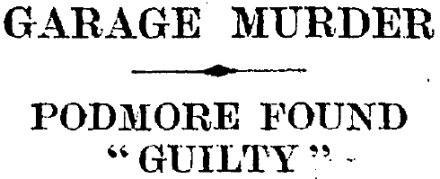
The “Garage Murder” investigation played out for months throughout 1929, much of which Podmore spent in jail on the other larceny charges while the cloud of suspicion gathered over him. In early March 1930, trial bulletins on counsels’ disputes over this novel evidence — its admissibility, its weight and application to the theory of the crime, and the sleuthing techniques employed to gather it — filled the papers almost daily.


The “Blog” of “Unnecessary” Quotation Marks agrees. (Headline from London Times, March 10, 1930)

Evidence that fit “like a crossword puzzle” (in the summing-up of the state’s attorney) nevertheless did not amount to anything so ironclad that Podmore wanted for public support: in the couple of weeks between a rejected appeal and Podmore’s execution, 12,000 people signed a petition for his reprieve, including 79 Members of Parliament.**

(Those crossword forensic clues had been buttressed by that classic recourse of the prosecutor, dubious jailhouse-snitch testimony as to the convenient spontaneous confession of the accused allegedly delivered to perfect strangers in the most injurious possible situation: that such specious evidence might have proved decisive in a matter of life and death seems to have moved a lot of signatures to the clemency petition.)

Given the circumstances, the Home Secretary took the unusual step of issuing a statement on its denial of this measure to calm the “disquiet in the public mind” — and expressing his confidence beyond any “scintilla of doubt as to the prisoner’s guilt.”†

* C. Ainsworth Mitchell, “Scientific Documentary Evidence in Criminal Trials,” Journal of Criminal Law and Criminology Vol. 23, No. 2 (July-August, 1932)

** London Times, April 16, 1930

† London Times, April 21, 1930. “I searched for many days,” Secretary Clynes said after the hanging (Times, April 23, 1930), “in the hope that I would find a reason for recommending a reprieve. I searched in vain.”

On this day..

1988: Stanislaw Czabanski, the last in Poland

On this date in 1988, in its last full year of Communist rule, Poland carried out its last hanging.

Stanislaw Czabanski, who killed a woman in Tarnow, was hanged in Krakow’s Montelupich Prison.

According to this 1996 survey of worldwide death penalty trends by British death penalty abolitionist Peter Hodgkinson,

In Poland, courts of regular jurisdiction rendered altogether 318 final death sentences between 1956 and 1988 (the last full year of communist rule), that is, on average, 10 death sentences per year … Seven death penalty sentences were passed on average each year in the 1960s; this number almost doubled in the 1970s. The decade of the 1980s was marked by the emergence of Solidarity, the first independent civic body ever in existence in a communist country, by the imposition of Martial Law in December of 1981, and by the repressive political climate in the subsequent years. However, one notices a pronounced decrease in the number of death sentences compared to the previous decade. Altogether sixty such sentences were passed between 1980 and 1988, an average of 7.7 per year … Jaruzelski‘s military regime used more carrots than sticks when dealing with the political opposition.

The contemporary artistic reflection of elites’ growing concern over capital punishment was the 1989 Krzysztof Kieslowski flick critiquing the death penalty in his Dekalog series.

Though Poland continued to hand out death sentences until the mid-Nineties, a moratorium on actual executions took hold.

One can, of course, never say what shall be for all time; while death penalty abolition was a condition for Poland’s European Union membership, the conservative-nationalist Kaczynski brothers have openly mooted reintroducing capital punishment.

On this day..