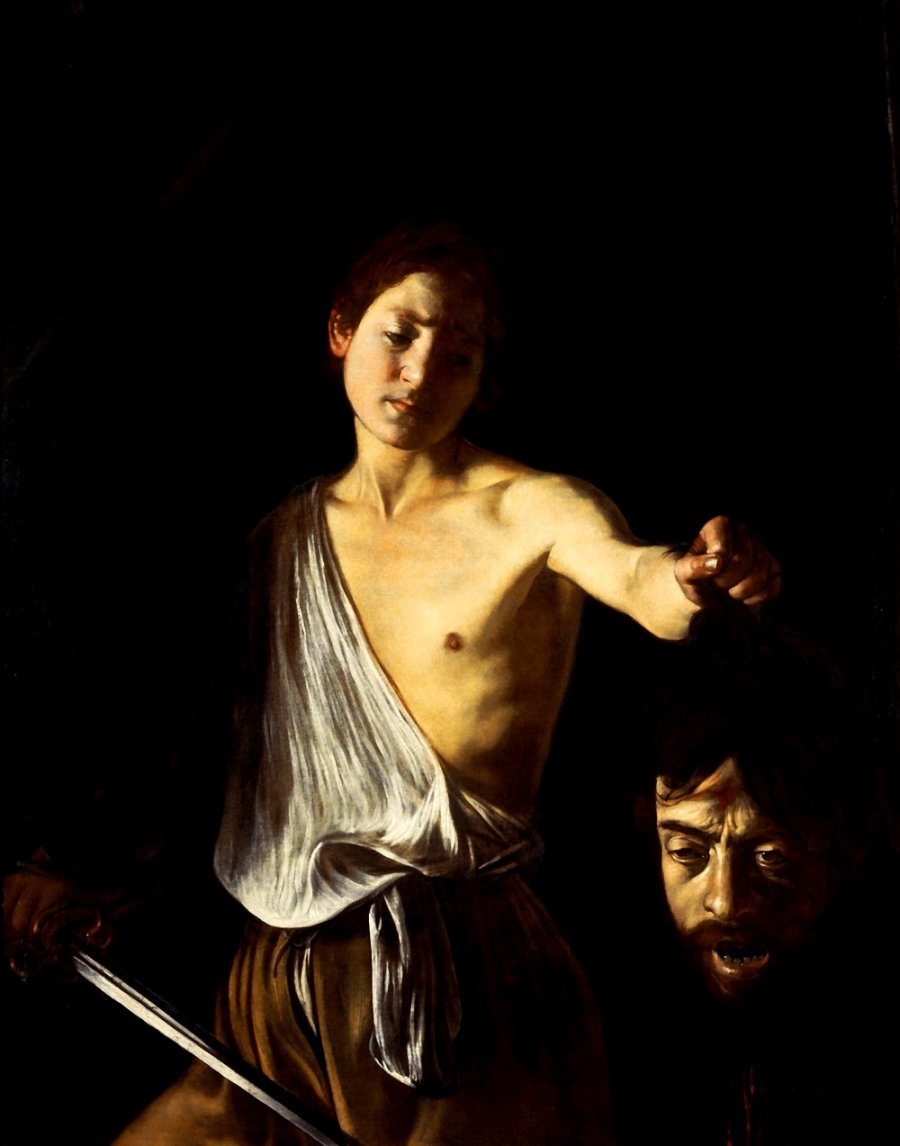
1841: Marius Darmes, frustrated regicide

Louis-Philippe, the affable, ovate monarch of France’s bourgeoisie from 1830 until the revolutionary year of 1848, was a popular guy for radicals to take a shot at.

By one expansive reckoning, there were no fewer than 19 assassination attempts against the Pear King, and five executions of intended regicides.

This date in 1841 saw the beheading of one Ennemond Marius Darmès for attempting to gun down the French king the previous October.

There was no mystery as to the shooter’s identity; the enthusiastic regicide had overstuffed his weapon with powder, and when he took his potshot it simply blew up in his hands. “I had him!” Darmes fumed as he was being arrested. “I was sure of my aim!” The only guy he had actually injured was himself. (Source)

Though it didn’t harm the king, the alarming incident did help precipitate the fall of a precarious and self-dealing government led by Adolphe Thiers, whose most illustrious appearance in these executioners’ annals was yet thirty years away.

With Thiers out of the way and a foe more doctrinaire animating the government, the ensuing months’ investigation were dedicated to tracing a connection between Darmes and alleged co-conspirators among revolutionary Parisians … a lot increasingly disaffected by the July Monarchy’s extreme oligarchical outlook.

And in a performance familiar in our own day, the terroristic extremity provided convenient pretext upon which to shush the much wider portion of the populace dissatisfied with the state. You’re either with us or you’re against us!

These desperate assailants of the King’s life are goaded on by the more cautious and even more unprincipled party who assail his character [Louis-Philippe himself made this same claim -ed.] … It is impossible, indeed, to foresee what the secret arts of calumny and the secret daring of their bloodthirsty illuminati may not effect; but we may say, with hearty English respect, when we look out upon these dangers, “God save the King!” (London Times editorial, May 31, 1841)

Out of solidarity or pride of ownership, Darmes denied those connections all the way to the shadow of the blade: two men who went on trial for their lives with him were acquitted.

According to a report filed by the London Times‘ Paris correspondent (printed June 2, 1841),

At half-past 5 o’clock this morning he was called down from his cell to the greffe, where the fatal toilette was to be performed previous to the execution. He quietly submitted to the operation, and when it was over, he mounted with his confessor into a vehicle, commonly called ponier a salade, which is used for the conveyance of prisoners. This carriage, escorted by municipal guards, cuirassiers, and chasseurs, proceeded up the Rue de l’Ouest, Rue d’Enfer and the adjoining Boulevard, down to the Barriere St. Jacques, where the scaffold had been erected during the night. Few spectators were in attendance. At 5 o’clock all the avenues leading to the Barriere had been occupied by the military, all traffic interrupted, and the people, who had congregated near the scaffold, were driven back a considerable distance. After he had alighted from the carriage his sentence was again read to him. The clergyman then took leave of him, and he ascended the steps of the ladder with a steady pace, followed by the executioner’s aids. It was only when he reached the platform that he came within view of the people; his head was still covered with a black veil, and a white shirt enveloped his whole body down to the feet, which were bare. The executioner having placed him with his back to the guillotine, a dialogue appeared to pass between them; and, from the negative shake of the head which Darmes occasionally gave, it was supposed that the executioner had held out to him a hope of salvation if he would make revelations. The conversation occupied between three and four minutes; the aids then seized him, and having placed him with his face towards the knife removed the black veil from his eyes, and took off his shirt. The sight of the instrument of execution appeared to strike him with awe; he started, and, feeling rather unsteady of his legs, he made a stride in order to maintain his equilibrium, and then looked on with calmness, surrendered himself into the hands of the executioner, and an instant before the knife dropped he was heard to exclaim — Vive la France. The body and head were then placed in a basket, and conveyed to the cemetery of Mont-Parnasse, where they were interred in the enclosure exclusively reserved for regicides.

Our favorite part of that is that the cemetery had a special VIP section set aside for regicides. Only in France.


Francophones can enjoy this French-language report on the investigation.

On this day..

2010: 18 in Libya

Last year on this date, Libya — having just days prior been controversially elected to the United Nations Human Rights Council* — celebrated by conducting 18 firing squad executions.

State media reported that 14 were shot in Tripoli, and four more in Benghazi, in unspecified cases that Amnesty International “fear[ed] … fail to satisfy international standards for fair trial.”

Among them were nationals of Nigeria, Chad, and Egypt who, particularly in the first case, might have been condemned at a tribunal entirely conducted in a language they could not understand.

Qaddafi’s Libya has always been opaque about its practice of capital punishment; if it met the international outcry for more information about these 18, this site is not aware of it.

But as with Libya’s neighbor in the so-called Arab Spring, it’s one small reminder that what goes around occasionally (maybe) comes around too.

* In view of the current unpleasantness, Tripoli has recently been suspended from the body.

On this day..

1606: Caravaggio murders Ranuccio Tomassoni

This site is occasionally prepared to stray outside its execution-anniversary beat to cover especially fascinating manifestations of the death penalty in history.

So for this date, we observe the anniversary not of a punishment, but of the crime itself: a capital homicide in the capital of the world that changed art forever.

NNDB summarizes Caravaggio as a “temperamental painter,” but a less generous interlocutor might prefer a descriptor like “lowlife.”

Painter, he certainly was.

Caravaggio’s pioneering realism and flair for the dramatic …


Caravaggio’s Judith Beheading Holofernes, 1598-1599. Though the young painter on the make would hardly want for models of public decapitation in 16th century Rome, the gendered intimacy with the act invites consideration of Caravaggio’s likely attendance at the execution of Beatrice Cenci.

… made him a rock star on the canvas.

Though the papacy in its dogmatic counter-reformation aspect may have viewed Caravaggio’s eye-catching chiaroscuro with suspicion, there were scudi enough to burst the coinpurse of a talent who could grace a chapel with awe-inspiring stuff like this:


Caravaggio’s Crucifixion of St. Peter, painted in 1601 for Rome’s Santa Maria del Popolo.

However many souls his stark brushwork won for the Church, Caravaggio’s reverential fare belied the creator’s own distinctly profane pastimes: gambling, boozing, brawling, and whoring around. He needed the intervention of well-placed patrons to duck prosecution on several occasions.

May 29, 1606 finds our “temperamental” antihero encountering a wealthy scoundrel by the handle of Ranuccio Tomassoni and a problem that would outstrip any political pull the artist could muster.

Allegedly, the two met to settle a paltry tennis wager, although this may have been a cover story for a rivalry over a courtesan.*

On whatever pretext, the young hotheads fell into a melee. Caravaggio won … and Tomassoni bled to death from the gash his foe dealt to his femoral artery.**

Caravaggio now had mortal blood on his hands. Homicides were treated very harshly by the authorities. Caravaggio was about to have a price put on his head, and if he were caught, that head would be summarily removed from his body and hung on a public street. Allies of Ranuccio bent on revenge were likely to be after him as well. … Caravaggio, the celebrated Italian painter, was now a notorious wanted killer. (Source)

Condemned an outlaw by Pope Paul V — himself fruit of Rome’s Borghese family, great patrons of art in their own right — Caravaggio fled the Eternal City. His brilliance went with him, perhaps even amplified by the exile.

“The fall from grace was huge,” a curator of late Caravaggio works argued. “It had a profound impact. He started expressing the psychological essence of the stories he is telling.”

The painter and killer had four years left to him — an exile spent sleeping clothed and armed, forever looking over his shoulder. But what his jangled nerves could still spare for the canvas would help launch the baroque artistic epoch and still influences us today.

Flight, fancy, and fortune took Caravaggio to Malta and to Sicily, but the year or so he spent as Naples’ visiting genius would make his artistic legacy: that city’s succeeding generations of painters took enthusiastic inspiration from Caravaggio’s Neapolitan offerings — like a Seven Works of Mercy that must have carried a very personal meaning for the hunted man.

He was reportedly as arrogant and hot-tempered on the run as he had been in Rome, but Caravaggio’s art in exile also traces his desperate attempts to undo the consequences of his bad behavior.

Exploiting his apparent affinity for the sawing off of heads, Caravaggio rendered his own head in a severed state in at least two apparently penitential paintings during this vulnerable period.

This Salome with the Head of John the Baptist was made for the Grand Master of the Knights of Malta after the latter had in 1608 booted Caravaggio from that island refuge:

While David with the Head of Goliath seems to have been created shortly before Caravaggio’s own death for the pope’s art-hounding “Cardinal Nephew” Scipione Borghese, in a bid to earn a pardon. Caravaggio’s self-portrait as the dead man, and Latin inscription “humility kills pride” on the Israelite hero’s sword, suggest an attempt to effect through his creative virtuosity his own execution in effigy.

That would be, at any rate, the only execution Caravaggio ultimately had to endure. He died in the summer of 1610 under unclear — and inevitably suspicious — circumstances while attempting to return to Rome.

A few biographical books about Caravaggio …

… and some Caravaggio art books

* Ranuccio Tomassoni was the pimp and lover of a prostitute named Fillide whom Caravaggio had painted years before, and become enamored of. This Fillide was also Caravaggio’s model for Judith in the arresting painting of the Biblical heroine in mid-decapitation above.

** Possibly, if you like the love triangle angle, in a botched attempt to castrate his rival.

On this day..

1872: Franks survives Fiji’s first hanging

On this date in 1872, the Melanesian realm of Fiji was favored with its first official public hanging.

It’s not as easy as it looks.

Enjoy this comprehensive botch from the firsthand account relayed by the New York Times:


A Fiji Execution.

The first attempt made in Fiji to carry a capital sentence into effect brought about one of the most remarkable incidents to be found in the annals of public executions. The Fiji Times of June 1 furnishes the following account:

“A horrible and brutalizing scene was witnessed last Tuesday morning by a number of persons who went to see the execution of the man Franks for the murder of Mr. Thomas Muir on board the Marion Rennie. He had been sentenced to suffer the extreme penalty of the law, and was to have been hanged on Monday, the 27th ult., but a gross miscarriage of justice was allowed to occur.

“The time appointed came and went, but the execution did not take place, for the simple reason that it did not suit the private convenience of the Sheriff. The poor wretch, who had by anticipation suffered the horrors of death, was then left in all the harrowing and unimaginable anxiety and uncertainty as to his fate from hour to hour until late in the evening, when he was informed that he must be hanged in the morning at 6 o’clock.

“Every preparation was made the previous night, the rope was fixed, and the noose adjusted. Rain fell, however, and wetted the rope, which was a very thick one, and in the morning it had to be dried before a fire. The time came, the rope was again fixed, the culprit and the hangman were on the scaffold, and before slipping the noose over the wretched man’s head the hangman had to sit down and place one of his feet in and pull with all his might to make the knot run; then after placing it over Frank’s head he had the utmost difficulty in making it fit anything like tight, but not nearly so tight as it should have been.

“Then the drop fell, and when the rope tightened with a slow dull thud, Franks was apparently dead for about three minutes, when his limbs began to move and he gave several groans, and then spoke. He prayed of those around him to put him out of his agony, to ‘let him meet his Maker in peace.’

“Then, through being improperly pinioned, he raised one arm and got hold of the rope, and so partly relieved himself from the fearful strain upon his neck. He still continued to beg to be put out of his misery, telling them he forgave them for the ‘black job’ they had made of it.

“But the frightful scene was not yet over.

“One of the officials, (the deputy was not to be found,) on the impulse of the moment, ran and cut the man down, when he fell heavily to the ground, there not being any attempt to catch him in his fall. Franks was then removed to the prison.

“Thus ended this ‘black job,’ which for horror is almost unparalleled. Its effect upon the spectators was such that one strong man actually fainted away.

“Thus the majesty of the law in Fiji has been asserted. Its most terrible sentence, death, has been attempted to be inflicted, and signally failed.

“The wretched man, after the terrible ordeal through which he passed, has been reprieved. Had another attempt been made to hang him, so strong was the feeling of indignation on the beach, we fully believe there would have been a riot.

“The question arises as to what should be done with the man. He has to all intents and purposes suffered the penalty of the law. Twice he has experienced horrors the like of which no man can imagine, and after being hanged and cut down by the officials, surely his punishment has ceased.

“The sentence was that he be hanged until ‘dead,’ but instead of being so hanged the officers of the law cut him down before death. The man should be free, for it must be clear that the law cannot punish him twice for the same offense.

“The best way to do now would be to pay his passage out of the country, and be rid of such a fellow from among us.

“Franks states that when the bolt was drawn and he fell, he thought he felt something break at the back of his neck, and he was praying and thinking of God and heaven. Then the memory of a wreck from which he was rescued passed before his mind. He saw himself cling to the chains till washed away; then seizing a rope attached to a floating spar, and clinging to it until washed back again on deck by a heavy sea. All the details of the wreck passed through his mind, and then came the thought, ‘Why do I not die?’ And finding he could breathe he suspected foul play and an intention to torture him by prolonging his sufferings. Then he spoke and clutched the rope, willing and wishing to die, but not a prolonged death.”

On this day..

1911: Laura and Lawrence Nelson lynched

A century ago today* Laura Nelson and her son Lawrence were lynched outside Okemah, Oklahoma.

“Two weeks ago,” mused the May 26, 1911 Tulsa World “Deputy Sheriff George H. Loney went to the Nelson home in search of some stolen meat. He found it and started to make an arrest when he was shot and killed. Both the Nelson woman and her son at first claimed to have fired the fatal shot, but it was later admitted that it was the son who fired it.”

So Laura found her way into the annals of lynched women by that most quintessentially maternal act: attempting to protect her child.

The bodies were posted partway down the road to a nearby all-black township — one little incendiary signpost en route to Oklahoma’s coming racial explosion.

As is typical in lynchings, the perpetrators remained permanently wink-wink “unknown”; indeed, the resulting investigation contributed some outstanding exemplars of racist patronizing — like the investigating judge’s charge to his grand jury of “the duty devolv[ing] upon us of a superior race and of greater intelligence to protect this weaker race from unjustifiable and lawless attacks.”

Thanks?

At least that compared favorably on the sympathy scale to the state’s governor, who slated the NAACP for stoking mob violence when the latter pressed for more vigorous anti-lynching action.

If your organization would interest itself to the extent of seeing that such outrages as this [i.e., the appointment of black federal officials in the state] are not perpetrated against our people, there would be fewer lynchings in the South than at this time, and you can do a great deal more to aid the Negro by seeing that other people of our section of the country are considered in these matters than you can issuing abusive statements against this country when a crime of this kind is committed.

Actually, a tweak here and there and that paragraph could go right into a present-day stump speech. The past, as they say, is not even past.


View Larger Map
The site of the lynching: present-day Route 56 where it crosses the North Canadian River west of Okemah.

One face in the crowd — his exact role in the lynching seems to be unknown — was a local real estate hustler by the name of Charley Guthrie.

This blustery conservative southern Democrat would, the next year, name his third child for the Confederate-friendly academic Woodrow Wilson, who was then making a run for the White House that would see the U.S. to the nadir of its race relations.

Young Woodrow Wilson Guthrie — you know him as Woody — grew up with some different principles from dad; the counterculture folk troubadour was sufficiently haunted by his father’s proximity to this horrific exercise of mob justice to expiate it in song.

* Many web sites give the date as May 23, but the primary sources are unequivocal; the correct date is May 25.

On this day..

2007: Christopher Newton

After Christopher Newton’s death in Lucasville, Ohio by lethal injection on this day in 2007, his attorney read a prepared last statement that apologized for the murder of a fellow inmate: “If I could take it back, I would.”

But the evidence of the “bizarre” execution says Newton was right where he wanted to be.

From the time the obese career criminal (pdf) garroted his cellmate in 2001,* he cooperated with investigators only to the extent that cooperation would grease the wheels of that so-called machinery of death. The entire thing was engineered to get Newton his last parole.

It still took him over five years to land on a gurney, but if you think that’s inefficient, get a load of the execution itself.

For going on two hours, the injection team poked and prodded at Newton’s veins in vain, trying to squeeze a lethal shunt into its gargantuan subject.

“We have told the team to take their time,” read a sign that a prison spokesperson held up in the hush-hush viewing chamber an hour into this discomfiting procedure. “His size is creating a problem.”

Minutes later, the 19-stone condemned man got a bathroom break during his own execution.

So far as anyone could see, the delay was anything but agony for Newton, who was generally observed smiling, laughing, and chatting it up with the prison personnel who were struggling to kill him. Finally, they managed to do it — an achievement which Ohio has latterly demonstrated is by no means a given.

* And allegedly drank some of Jason Brewer’s blood to boot, though this claim proceeding from a man who was intentionally pursuing a death sentence merits skepticism.

On this day..

1673: Thomas Cornell, on spectral evidence

(Thanks to Meaghan Good of the Charley Project for the guest post. -ed.)

On this day in 1673, alleged mother-slayer and arsonist Thomas Cornell was hanged in Portsmouth in the colony of Rhode Island.

The death of his elderly mother, Rebecca, and the subsequent homicide investigation have got to be one of the strangest murder stories in American colonial history.

The Cornells were a respectable and prosperous Quaker family, the ancestors of the man who founded Cornell University. (Their descendants also included Lizzie Borden of the “forty whacks” fame, but that’s another story.)

Rebecca, a 73-year-old widow, was the legal owner of the family’s hundred-acre spread by Narragansett Bay. Her oldest son, Thomas, and his wife and six children lived there with her, along with one lodger and one male servant, a Narragansett Indian named Wickopash.

Crowded as the house was, Rebecca had the master bedroom all to herself. It was well known that Rebecca and Thomas didn’t get along. For some time, both parties had been complaining bitterly about each other to anyone who would listen. Thomas resented the fact that, at 46, he was still financially dependent on his mother, who had made generous gifts from her late husband’s estate to her other children but not to him. Rebecca, for her part, said Thomas was “a Terror to her” and that she was neglected and had to fetch her own firewood.

None of her complaints were taken seriously until after her mysterious death, which is chronicled in Elaine Forman Crane’s 2002 book Killed Strangely: The Death of Rebecca Cornell.

Rebecca died on the evening of February 8, 1673.

That night, she refused to join the family for dinner because she didn’t like what was being served. After the meal was over, her grandson came to her room to check on her and found her charred body lying on the floor by the fireplace, burnt “to a cole.” She was recognizable only by her shoes.

Her death was originally ruled “an unhappie accident.”

It could have been spontaneous human combustion, but a more likely explanation is that embers from the fireplace or from the pipe Rebecca smoked landed on her dress.


An alleged victim of spontaneous human combustion.

No one heard her scream, no one smelled smoke, and somehow the fire didn’t spread to the rest of the house. No one seems to have suspected foul play at that time.

Two nights later, however, Rebecca’s younger brother, John Briggs, received a spiritual visitation from his sister as she slept. “See how I was burned with fire,” she said. He inferred that someone had intentionally burned her.

Briggs didn’t report his experience for a week, but when he did his account was taken seriously by the superstitious colonials. Rebecca’s body was exhumed and given a thorough inspection, and this time a wound was found on her upper abdomen. The authorities decided she had been stabbed by something like “the iron spyndell of a spinning whelle.” No murder weapon was ever produced, however.

Thomas quickly became the prime suspect: he was the last person to see Rebecca alive, and the whole town knew of the enmity between them. After Rebecca’s death, Thomas and his wife Sarah reportedly made some incredibly crass remarks; Sarah said her mother-in-law’s demise was “a wonderfull thing,” and Thomas said that his mother had always liked a good fire, and “God had answered her ends, for now shee had it.”

This hearsay was presented as evidence at Thomas’s trial, along with John Briggs’s dream.

Thomas was convicted and, although many of the townspeople had doubts about the verdict and death sentence, he chose not to appeal. He was hung before a crowd of over one thousand people.

Did Thomas Cornell murder his mother?

Certainly he wasn’t the only one who had the opportunity to do so; the house was full of people that night. In fact, a year after Thomas’s death, the servant Wickopash was tried as an accomplice to the murder. Nothing is known about the case against him, but he was acquitted.

In 1675, Rebecca’s son William tried to make a case against Thomas’s wife for the murder, but he failed to produce any witnesses or evidence against her.

Was this even a murder at all?

The fire, as noted above, could have been accidental; as for the “suspicious wound” the authorities found after they dug up the body, Rebecca could have stabbed herself in her struggles after her dress caught fire, or perhaps those who performed the exhumation saw only what they expected to see.

And there is yet a third possibility: prior to her death, Rebecca told her daughter she had contemplated suicide on several occasions, but her religious beliefs prohibited such action.

One final note: Thomas’s wife, Sarah, was pregnant at the time of his execution and later gave birth to a daughter.

She named the baby Innocent.

On this day..

2001: Terrance Anthony James, snitch-killer

On this date in 2001, Terrance Anthony James suffered lethal injection in Oklahoma for the vicious murder of a suspected jailhouse snitch.

Awaiting trial in 1983 for theft of government property, James became convinced that a fellow-inmate was responsible for his arrest, and proceeded to strangle Mark Allen Berry with a wire.

Usually, in death penalty cases, it’s the jailhouse snitch who does the killing.

On this day..

1894: Six anarchists in Barcelona

On this date in 1894, on the very day that anarchist terrorist par excellence Emile Henry was guillotined in Paris, six more anarchists were executed by firing squad outside Barcelona’s Montjuich Fortress.

Mariano Cerezuela, Bernat Siveval, Jaime Sogas, Jose Codina, Villarubbia, and Manuel Archs were condemned just weeks prior by a military court for complicity in the attempted assassination earlier that year of Spanish Marshal Arsenio Martinez Campos. Some had originally been rounded up in the general anti-anarchist crackdown after the bombing of the Liceu theater … although another man would be put to death for authoring that crime later in 1894.
Only one of their number, Sogas, died penitent.

In the report of the London Times (May 22, 1894),

[t]he condemned men were conveyed from the chapel, where they had spent the night, to the place of execution by an underground passage, the first two to appear being Sogas and Cerezuela. The former, who confessed last night, joined in the prayers offered by the priest, and he and Cerezuela walked quietly to their doom. The other prisoners, however, shouted all kinds of revolutionary cries. The convicts were placed in line, and at the first shot they all fell to the ground. It was found, however, that in the case of Sogas and Codina the bullets had not taken effect, and a second shot was necessary.

On this day..

1691: Jacob Leisler, “a Walloon who has sett at the head of the Rable”

On this date in 1691, Jacob Leisler was executed in New York, a New World casualty of the Glorious Revolution back in the mother country.

In an era when transatlantic communication moved at the speed of a galleon, the 1688 overthrow of England’s Stuart monarchy initiated an agonizing period of political uncertainty in Albion’s far-flung American provinces.

And to the question of who was really in charge were appended the many local political issues of the colonies — religious, economic, political.

One of the empire’s dominant fault political fault lines in the foregoing years had been the succession to follow England’s last Catholic monarch, James II. For Calvinists whose dynastic champion was the House of Orange, the marriage of their guy William III to James’s daughter raised the prospect of an eventual claim on the English throne. Those hopes seemed dashed when James fathered a son, to the elation of Catholics who now aspired to a lasting Catholic line.

When word reached New York, still a majority-Dutch city thanks to its original mother country, of the ascent of that their countryman William III and England’s Protestant establishment had forcibly disinherited the infant prince and his dad, it did not take long for local Dutch factions to run off the former King James’s plenipotentiaries. (An irony, since New York was named for that very same now-deposed King James: he’d been the Duke of York when it was seized for the Dutch in the 1660s.)

That ex-monarch’s brief reign had seen the establishment of a much-resented Dominion of New England, welding together everything from New Jersey to Maine into a super-colony whose high-handed boss was arrested by a Boston mob. (He sailed for England.) That gentleman’s lieutenant, in New York, likewise absconded as his own authority crumbled … a sort of American Glorious Revolution shadowing the one across the pond.

The Frankfurt-born Leisler was a colonial mercantile magnate, one of the 17th century’s wealthiest New Yorkers, notable for his Orangist sympathies and Calvinist religious inclination. It was to this important private citizen (who was also a militia captain) that de facto executive power fell in the New York colony — and it was indeed the New York colony specifically, since the reassertion of local prerogatives and pre-1685 administrative units had been one of the immediate consequences of the shakeout in America.


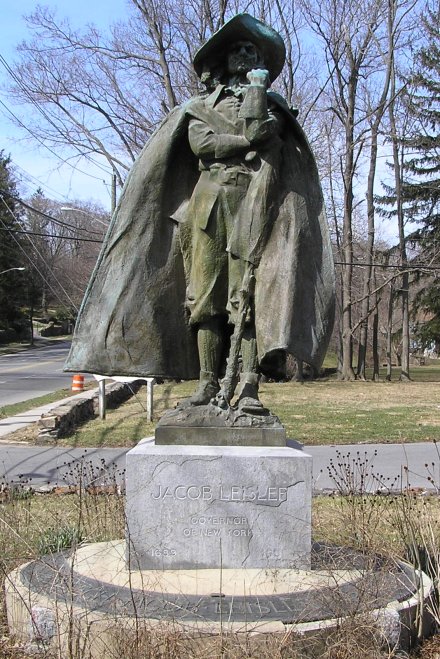
Statue of Jacob Leisler in New Rochelle, N.Y. — which Leisler helped create as a settlement for refugee Huguenots.

And once in the saddle, the Dutch Calvinist Leisler essentially ran a populist administration against the colonial oligarchy, which replied by vilifying him as a “usurper” and “rebel”.

Internal politics in New York and its neighbors during those months make fascinating reading.* Quakers and Catholics aligned against Protestants. Albany aligned against New York, until Leisler brought the former to heel. Clergy chose up sides. Leisler summoned a sort of proto-continental congress of colonial representatives (all the way to the West Indies) to hash out their situation.

And what was that situation? There had been a revolution, after all, and there was no agreed-upon representative of the royal authority present in New York. An assembly of militia leaders had asked Leisler to assume leadership, so was he really outside his rights to treat as his the London dispatches addressed to “such as, for the time being, take care for preserving the public peace and administering the law in New York”?

It’s a moment whose ferment of democratic energy can be read to presage the next century’s (proper) revolution.

Yet it was also not a revolution in the Cromwellian, world-turned-upside-down sense. For the English polity, and certainly for the conduct it preferred in its frontier possessions, continuity was the order of the day. Even in England herself, William and Mary were more than pleased to govern with Tories who could see their way to releasing their fealty to the Stuarts.

There was an empire to run, after all.

From that standpoint, Leisler’s anti-oligarchical policies and fractious disputes with other colonial elites were a bad business. There’s no sense in letting France make inroads because your governors are bickering over predestination or some such.

So formally, the realm’s new rulers continued all non-Catholic personnel in their posts. With the Dominion governors ejected, it was just a matter of dispatching fresh executives to take over. It’s just that this process required months … during which Leisler was managing New York the way he figured it ought to be managed, and his enemies were consequently painting him as a rebel.

Leisler pronounced himself, this whole time, anxious to submit his authority to the new governor upon the production of proper credentials. If he was surprised that the new monarchs tendered appointees of the very same factions recently expelled,** Leisler showed it only in his exactitude for procedure: because of a logistical cock-up, an aide to the new colonial governor arrived first, and when Leisler refused to hand over his fort without the royal warrant, a tense standoff ensued. It was resolved when the real governor, Henry Sloughter of ominous name, finally showed up.

Sloughter had his “predecessor” immediately arrested, along with others of his circle and harshly tried for treason and murder by a court stacked with anti-Leisler political enemies.†

Ultimately Leisler was condemned to die along with his secretary and son-in-law Jacob Milborne, but even Sloughter was loath to enforce the sentence. The story goes that Leisler’s most implacable foes had to get Sloughter drunk to put his signature on the death-warrant. (Sloughter died a couple of months later himself, for maximum operatic effect.)

On Saturday morning, May 16, 1691, the largest crowd ever gathered in New York City stood, rain soaked and weeping, all eyes fixed as a limp body was cut from the gallows and placed on the block. With a clean blow, the executioner’s ax cut off the head of the “halfe dead” Jacob Leisler — loyal lieutenant governor or rebel tyrant, depending on one’s point of view. Amid the “shrieks of the people,” fainting women (some “taken in labour”), and tumultuous jostling for “pieces of his garments” and strands of his hair, as “for a martyr,” the newly arrived and unfortunately named royal governor, Henry Sloughter, worried that his decision to execute Leisler might not, after all, end the “diseases and troubles of this Government.” Indeed, for years afterward New Yorkers bitterly divided over Leisler and the 1689 uprising that, in the wake of England’s Glorious Revolution, had led to his assumption of power in the provincial government.

-David Voorhees, who elsewhere contends that these divisions “continue to inform American politics to the present day.”*

A few years later, a more Leisler-friendly Parliament restored the dead man’s estate to his heirs, a sort of implicit admission that the whole head-chopping thing might have been a bit much.

This character figures to bear more historical consideration than he has heretofore enjoyed; further to that end, there’s a Jacob Leisler Papers Project devoted to marshaling at New York University the primary documents connected with Leisler.

* See, for instance, David Voorhees in “‘to assert our Right before it be quite lost’: The Leisler Rebellion in the Delaware River Valley” in Pennsylvania History, Winter 1997 — and, Voorhees again in “The ‘fervent Zeale’ of Jacob Leisler,” The William and Mary Quarterly, July 1994.

** Literally so: Francis Nicholson, whom Leisler ousted from New York, tried to get himself appointed governor; he was instead sent to Virginia and continued in royal service in the colonies for decades to come.

† e.g., Joseph Dudley, one of Leisler’s judges, whose penchant for authoritarian justice has been noted elsewhere in these pages.

On this day..