1996: John Martin Scripps, British serial killer

On this date in 1996, the first westerner hanged for murder in Singapore got his deserts in Changi Prison.

Mild-mannered John Martin Scripps had created a sensation in the city-state for turning South African tourist Gerard Lowe into a sack full of dismembered body parts at Clifford Pier.

“The tourist from hell” argued in defense that it had all been a gay panic after Lowe came onto him. Not a bit of it.

Turns out Scripps, recently absconded from British custody after his latest in a series of drug and theft arrests,* had used the same chop-shop m.o. on a Canadian mother and son in Thailand and, as with Lowe, leached their electronic assets thereafter.

(Ever the jet-setter, Scripps was also a suspect in three other murders — of two Brits in Central America and of an American male prostitute in San Francisco.)

“John disappeared on several trips and went to the United States and South-East Asia,” his Mexican ex-wife said later. “I knew something awful was happening, but I could not believe he had started killing people.”

After conviction, Scripps declined to appeal or petition for clemency, saying he wanted the law to take its course quickly. He was hanged alongside two drug traffickers.

* He’d learned butchery in prison — so well that he’d talked about opening a shop when he got out. Which is sort of what he did.

On this day..

1783: Philip, a negro slave of Henry Garrett

From the Chronicles of the Scotch-Irish settlement in Virginia

Called Court on Philip, a negro slave of Henry Garrett, and formerly property of Major Thomas Johnston, of Louisa County, charged with murdering Alexander Hunter, of Augusta County, and wounding the wife of Samuel Henry.–Guilty and to be hanged on 16th April next at 10 o’clock a. m. His value is fixed at £65.

On this day..

1982: Khalid Islambouli and the assassins of Anwar Sadat

With Egyptian President Hosni Mubarak’s recent unwilling separation from power, we remember today how he got into power in the first place — for this was the execution date in 1982 for the assassins of his predecessor, Anwar Sadat.

Here’s some raw-er footage:

The murdered president inherited the office from the first name in pan-Arab nationalism, Gamal Abdel Nasser.

Sadat led Egypt through the turbulent 1970s, fighting a war against Israel and then making peace with its Jewish neighbor to regain the Sinai, and generally proving himself more adept at the job than many had assumed.

But the secular dictatorship was increasingly afflicted by that then-emerging, now-familiar specter, Islamic fundamentalism — specifically aggrieved by those Camp David Accords, but also confronting Sadat’s neoliberal economic realignment and political disaffection.

Khalid Islambouli, the man who actually got Sadat, was a 26-year-old officer with an illicit affiliation to the Egyptian Islamic Jihad.

At an October 6, 1981 military parade, Islambouli led an orchestrated hit, leaping from military vehicles to bombard the presidential dais with grenades and automatic weapon fire.

Sadat was dead before he reached the hospital, and his office assumed by his vice president — Hosni Mubarak.

Unsurprisingly, he played rough with the assassins.

A military tribunal ultimately convicted 22 people of participating in the plot, sentencing five to death. While the state press was obviously supportive of the verdict,

Many Egyptians interviewed by Reuters considered the death sentences fair. “It is up to President Mubarak now to show his people that terrorism is unacceptable in Egypt by approving the sentences”, a shopkeeper said.*

And Mubarak did … albeit carefully.

Five self-proclaimed Muslim fundamentalists convicted of assassinating President Sadat of Egypt were executed at dawn today hours after their plea for mercy had been rejected by President Mubarak.

The two assassins who had been in the Army were executed by firing squad and the others, civilians, were hanged at a remote military base outside Cairo …

News of the executions was carried briefly on Cairo radio, then dropped from subsequent broadcasts. The evening newspaper did the same, an indication that the authorities may be sensitive to possible public reaction, Muslim fundamentalism being widespread in all the Egyptian universities.**

The precaution was, perhaps, well-taken.

Muslim fundamentalism would gain steam in Egypt during the years ahead, drawing a severe state response.

Islambouli’s younger brother Showqi almost accomplished an all-in-the-family twin killing by coming within a whisker’s breadth of assassinating Mubarak in 1995. The family name is still honored in the breach by other Muslim militants: there’s an “al-Islambouli Brigades of al-Qaeda” in Pakistan and an “al-Islambouli Brigades” in Chechnya.

* London Times, March 8, 1982

** London Times, April 16, 1982 (under an April 15 dateline)

On this day..

1967: Aaron Mitchell, Ronald Reagan’s first and only execution

On this date in 1967, Aaron Mitchell was gassed in California on the authority of a governor holding his first elected office — Ronald Reagan, future U.S. president and emerging avatar of conservative white ressentiment in the turbulent 1960s.

It was only 23 days after California’s last previous execution, in January 1963, that Mitchell killed a white cop during a shootout occasioned by his abortive bar robbery. He’d been on death row fighting execution ever since, with a few dozen others who had been there even longer.
That gummed-up death penalty process, for which the Golden State is so well-known today, was most vividly symbolized at the time by the 12-year death row odyssey of Caryl Chessman.

And it had been among the many grievances catalyzing a conservative backlash against the civil rights movement, the Great Society, anti-war protesters, permissive social mores … the whole aspect of Sixties counterculture and American liberalism.

Ronald Reagan was born to wield the sword against it all. The sword, or some little cyanide pellets.

Reagan, a film actor, had cut his political teeth as a spokesman for General Electric and against commie plots like Medicare.

After famously backing the failed 1964 presidential bid of Barry Goldwater, Reagan emerged as the favored son of the New Right, and in his first foray into electoral politics, steamrolled over incumbent Democrat Edmund Brown in California’s 1966 gubernatorial election.

Reagan had an undoubted gift for packaging the sometimes unpalatable ennui of his potential constituencies into soundbites that respectable people could repeat in public, which talent proved essential to his bright political future.

“Why is it,” he demanded during the campaign, “that no street in our city is safe for women after dark?” (Los Angeles Times, September 21, 1966) Stung by Republican attacks on rising crime rates, Gov. Brown had vainly pushed a tough-on-crime platform of his own in 1966.

Too little. Too late.

“Mr. Reagan is outspokenly in favor of capital punishment and he has just been elected by a tremendous majority,” said Jesse James Gilbert, 41, who has languished on Death Row for two years.* “If the courts begin to reflect his thinking, he will be in a position to become the greatest butcher governor in history.”

–Los Angeles Times, Dec. 4, 1966

What a different world it was from today’s that a major paper unabashedly used a death row prisoner’s own voice for analytical comment. Still, that same article noted (not in Gilbert’s voice, but as a plain fact on the ground) that “even a single execution could endanger Reagan’s chances for reelection or stifle voices which are beginning to urge him to seek the Republican Presidential nomination in 1968 or 1972.” A different world indeed.

Reagan had outspokenly run on capital punishment, however, and there’s such a thing as feeding your base. He surely was not going to execute nobody.

Mitchell was the man in line, and he certainly fit that not-safe-to-walk-the-streets-at-night angle, if you catch the drift. In an Ebony (June 1967) profile of his last days, Mitchell emerges at once radicalized and resigned, his four years awaiting death spent “researching and studying the race problem.”

“Every negro ever convicted of killing a police officer has died in that gas chamber,” Mitchell said on the day of his death. “So what chance did I have?”**

When the aide in charge of the clemency application is overtly pro-Scrooge future Attorney General Edwin Meese … not much chance, no.

So on this date, and in spite of an energetic protest outside San Quentin, a suicide attempt inside it, an open line to the governor’s office just in case, and a hysterical mother (who fled Mitchell’s clemency session in tears two days before, complaining that it was “a sham hearing”), Mitchell became the 501st person put to death since the state moved all executions from county auspices into state prisons.†

The 502nd would not take place until another quarter-century had elapsed.

Cold comfort to Mitchell, but Reagan himself did not vindicate Jesse Gilbert’s worst fears, and did not present the execution rubber-stamp of a later political generation; for his time and place, being visibly willing to approve some executions amply proved his credentials. (Newsweek called the governor a “man of conviction” after the Mitchell execution. (Source) Mission accomplished.)

Reagan would stay the next death date on his watch, that of Daniel Allen Roberts, over questions of mental competency; later in 1967, he would do the same for Robert Lee Massie just hours ahead of execution so that Massie could testify in another trial, inadvertently providing a bullet point in the conservative critique of death penalty squeamishness.

And in the event, the Great Communicator would be spared any great need to answer for a significant slate of individual clemency decisions. It was judicial activity far more than executive reticence that stayed the hand of California’s executioner; only one more execution after Mitchell’s took place in all of the U.S. before the country slipped into a complete death penalty moratorium from which it would not emerge for another decade.

And when the Reagan-appointed California Chief Justice Donald Wright authored a 1972 opinion striking down that state’s death penalty laws, it emptied death row outright.‡ (Sparing, among over 100 others, Charles Manson and Sirhan Sirhan.)

Capital punishment is impermissibly cruel. It degrades and dehumanizes all who participate in its processes. It is unnecessary to any legitimate goal of the state and is incompatible with the dignity of man and the judicial process. Our conclusion that the death penalty may no longer be exacted in California consistently with article I, section 6, of our Constitution is not grounded in sympathy for those who would commit crimes of violence, but in concern for the society that diminishes itself whenever it takes the life of one of its members. Lord Chancellor Gardiner reminded the House of Lords, debating abolition of capital punishment in England: “When we abolished the punishment for treason that you should be hanged, and then cut down while still alive, and then disembowelled while still alive, and then quartered, we did not abolish that punishment because we sympathised with traitors, but because we took the view that it was a punishment no longer consistent with our self respect.”

–California v. Anderson

That would not stand as the final word on capital punishment in California, but by the time other condemned prisoners had come to the end of their appeals, they were the concern of different governors.

Reagan left the California governor’s mansion in 1975 during the death penalty’s long hiatus; as U.S. president from 1981 to 1989, the death penalty was only just coming back online from that period, and that at the state level. Beyond platitudinous approval of the trend, Reagan never had to put his own signature on a federal death warrant.

So as it turned out, Aaron Mitchell was the first, last, and only man so distinguished.

And Reagan’s minuscule career execution count was hardly the anomaly that it might now appear. Prior to Reagan, the last Chief Executive who had actually entered the White House having previously forwarded any fellow to the executioner was … Dwight Eisenhower.

* Gilbert is the appellant in the 1967 U.S. Supreme Court decision Gilbert v. California, reversing his conviction because of a police lineup identification unconstitutionally obtained without his lawyer’s knowledge.

** The cop-killing Mitchell wasn’t getting any love from the beleaguered Brown administration, either; Brown almost had a shot to pull a Ricky Ray Rector with Mitchell during the campaign, but the prisoner won a judicial stay just 24 hours from execution in May 1966.

The now-former governor was quoted after Mitchell’s actual 1967 execution expressing general support for Reagan’s non-clemency in spite of Brown’s own philosophical opposition to capital punishment.

† A journalist who witnessed the gassing later described it as something less than a triumph of the killing arts.

as the gas hit him, his head immediately fell to his chest. Then his head came up and he looked directly into the window. For nearly seven minutes he sat up that way, with his chest heaving, saliva bubbling between his lips. He tucked his thumbs into his fists, and finally his head fell again … I believe he was aware many minutes … He appeared to be in great anguish

‡ “A mockery of the constitutional process,” fumed (pdf) Reagan, who claimed that Wright had told him he backed capital punishment. (See Governor Reagan: His Rise to Power)

On this day..

1705: Captain Thomas Green and two of his crew on the Worcester

On this date in 1705, another century’s supposed terrorist was hanged on Leith Sands with two of his “pirate” crew by a Scottish court “drunk with patriotic prejudice.”*

This execution took place in the feverish run-up to England and Scotland’s Acts of Union welding the neighboring realms into Great Britain in 1707.

Arising as it did from the same causes that animated that national marriage of convenience, Green’s execution also endangered it: Daniel Defoe, who was at this time a pro-Unionist mole (and prolific pamphleteer) for English pol Robert Harley, described this hanging as one of the six crises that had to be overcome en route to the Union.

A Man, A Plan, A Calamity

Panama.

That’s where it all started, for Green and Union alike.

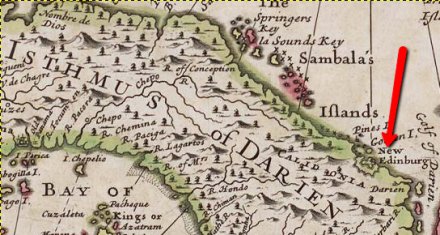
Mired in economic backwardness as neighboring European states carved up the world, Scotland made a bold, doomed bid for a chit in the empire game: the Darien scheme. One part visionary and (at least) two parts daft, this venture attempted to establish a Scottish colony on the Isthmus of Panama (aka the Isthmus of Darien) with a view to porting freight across the narrow strip of land separating Atlantic and Pacific, and dominating the dramatically more efficient east-west trade route that would result.


The intended Scottish colony in Panama; map from this University of Glasgow exhibit.

Students of the Panama Canal project will be aware that this malarial tropic would not be described as especially hospitable; to the natural disadvantages of the climate were added the political interpositions of England herself, whose hostility to the advent of her Caledonian neighbor as a New World rival was expressed in legislation choking the Darien adventure of foreign aid.

(Also a problem: Spain. The colony was abandoned at last under Spanish siege.)

So Scotland went it intrepidly, injudiciously alone in this last bid for real independent muscle in Europe. The hyperbole of the Isthmus’s publicists eventually sucked in 20 percent or more of the capital circulating in Scotland. And when Darien-dot-com went bust by 1700 at the cost of a couple thousand lives, it cratered the Scottish economy too. That set the stage for Edinburgh’s partnership in a different scheme: Great Britain.

Green with Envy

In the years following the Darien catastrophe, the Scottish corporation chartered to undertake it was still throwing stuff against the wall in the world trade game, trying to get something to stick to at least take the edge off the losses.

This company (theoretically a potential rival of England’s own East India Company) had suffered the further national indignity of having one of its ships, the Annandale, seized in the Thames for infringing the East India Company’s royal monopoly. Its appeals for redress falling on deaf ears, the Darien company apparently induced Scottish authorities to undertake the retaliatory seizure of an English merchant ship, the Worcester, that had the ill luck to weather a storm at the Firth of Forth.

Rumor soon connected this ship to another vanished Darien company vessel overdue from its return trip from the East Indies … and, as it quickly became understood by all right-thinking Scots, overtaken in the Indian Ocean by this same Worcester and its crew butchered.

Captain Thomas Green and his English crew were hailed before an Admiralty court** on piracy charges on this extremely fantastical connection in a virtual mob atmosphere.

It never was clearly established that an act of piracy had been committed as a distinct fact, but by putting certain circumstances together it was inferred that Green was guilty of piracy. The very shape in which the accusation is set forth, shows that the accusers could not point to the specific act of piracy which had been committed …

[There] was no specification as to the vessel taken, which might enable the accused to prove that it had not been taken; no names of parties murdered, who might be shown still to be alive; no ownership of cargo, which might admit of proof that the owner’s goods had arrived safe. As Green himself is made justly to say in the document published as his dying speech, “We are condemned as pirates and murderers on a coast far distant from this place — is there any of you who wants either a friend whom we have murdered, or whose goods we have taken?”

Worcester Sauce

The Worcester‘s Malabari cook provided a highly dubious charge — dubious, for he was not yet among the crew when it last called at the location he claimed the crime took place — of Green and crew hatchet-murdering approximately ten English-speaking mariners on an unnamed vessel off the Indian coast.

Upon this evidence, 14 or more members (the ready sources are a little loose on the total number) of the Worcester crew were condemned for piracy, and initially slated for three batches of hangings. Queen Anne‘s personal intervention managed a stay,

The Scottish Privy Council unto the very last hours debated what to do with the diplomatic appeals, with evidence forwarded from London to the effect that the crew these Worcester men had supposedly slaughtered were alive, their vessel having been hijacked in another place, by another man.

But a surging Scottish mob aggrieved by the preceding years’ misadventures and the impending shotgun marriage to Westminster rather than anything Green himself had really done was already engorged on the blood of the supposed English corsairs. Most of the Council thought better than to deny them their sacrifice.†

The Streets fill’d with Incredible Numbers of Men, Women and Children, calling for Justice upon those ENGLISH Murtherers. The Lord Chancellor Seafield‘s Coach happening to pass by, they stop’d it, broket he Sashes, haul’d him out, and oblig’d him to promise Execution should speedily be done before he could get from ’em … According to the Chancellors promise, soon after, on the same Day, being Wednesday, Captain Green, Madder [the mate], and Sympson [the gunner] were brought out, and convey’d to Execution, which was at Leith Road upon the Sands, and all the way was Huzza’d in Triumph as it were, and insulted with the sharpest and most bitter Invectives. Being come to the place of Execution, Good God! what a moving sight was it to see those Men stand upon the very Varge of Life, just launching in to Eternity, and at the same time see the whole Multitudet ransported with Joy!”

-From an anonymous Letter From Scotland To a Friend in London, quoted by James Kelly, “The Worcester Affair,” The Review of English Studies, Feb. 2000

In the event, these three were the only ones actually hanged; passions cooled enough for the other “pirates” to be quietly released.

But the wider, national passions unleashed by this date’s executions would long provide fodder for intemperate patriotic recrimination, and specifically anti-Unionist propaganda — on both sides of the border.

Competing propagandistic broadsides framed and re-framed the events, as the affair of unscrupulous English buccaneers or perfidious highland barbarians. (Defoe, maneuvering for Union, wrote to chill such bad-for-business hostility: “Nothing could be more horrid, than that the Scots should Execute these Men on a meer Pique at the English Nation. Nothing can be more like it, than to conclude rashly, that it is so, and improve it on purpose to Exasperate our People against the Scots.” (Kelly))

And that, of course, is precisely the viewpoint that prevailed.

While the hemp neckties issued to Green et al this date threatened to (ahem) scotch the Union project, that very danger might have ultimately hastened its completion — as elites recognized, in Defoe’s words, that Union represented “the only way to preserve the publick Tranquillity, and prevent the certain Mischiefs that threatened the whole Body,” (Kelly, again) and rammed it through with dispatch.‡

* English historian G.M. Trevelyan.

** A lengthy account of the trial can be found in this Google books freebie

† In their very scanty defense, the Scottish magistrates had reason to fear Scottish citizens.

‡ The ebb and flow of national resentment continued long after the Acts of Union, of course; continuing Scottish support for the restoration of the Stuart monarchy was one expression of Scottish nationalism and anti-Union sentiment.

On this day..

1994: Richard Beavers, hungry to die

On this date in 1994, Richard Beavers was executed by lethal injection in Texas.

Beavers abducted, robbed, and shot dead a young Houston couple — or so he thought; the woman survived and later testified against Beavers.

The Death Penalty Information Center’s executions database classes around 10% of all prisoners put to death in capital punishment’s modern American incarnation as “volunteers,” men and women who ultimately assent to their own execution — most famously including the very first, Gary Gilmore.

Beavers was among them. In the last weeks of his life, the legal issues surrounding his case were not the usual battery of dilatory strategems — but Beavers repelling (successfully) the attempted intervention of the Texas Resource Center’s appellate attorneys despite his objections.

Beavers may have embraced death, but that didn’t make him immune to the pleasures of the flesh.

Last meal request: Six pieces of french toast with syrup, jelly, butter, six barbecued spare ribs, six pieces of well-burned bacon, four scrambled eggs, five well-cooked sausage patties, french fries with ketchup, three slices of cheese, two pieces of yellow cake with chocolate fudge icing, and four cartons of milk.

Our day’s malefactor contributed no last statement to the annals, but was quoted as telling an Associated Press reporter that “it’s really a great day to die, to leave the body.” You’d think so too after that kind of meal.

On this day..

1984: Ronald Clark O’Bryan, candyman

Halloween lovers can thank Ronald Clark O’Bryan, executed just after midnight on this date in 1984,* for a major buzzkill.

O’Bryan spiked his own kids’ Halloween Pixy Stix with cyanide in an effort to kill off the urchins and collect the insurance. His 8-year-old son died.

Although O’Bryan was after his own kids, he might have given some out to the neighbors as well.

Nobody else died, or even got sick, but this was the era of the after-school special and satanic hysteria, so this pedestrian malefactor’s incidental connection to Halloween — after all, he could have just poisoned the kids’ Cheerios instead — metastasized into baseless urban legends of Stephen King villains spiking candy corn with rat poison and candy apples with razor blades.**

“The crime changed the way Texas youngsters, particularly those in the Houston area, celebrate Halloween,” the A.P. reported. “Some neighborhoods informally banned distribution of candy.”

Some nutbar kills his offspring for the insurance money back in the Ford administration, and that’s why you’re still getting crayons in your pillowcase sack. Crayons.

Siouxsie and the Banshees turned this creeper scenario to good effect in the 1986 song “Candyman”.

Beware the masked pretender
He always lies, this candyman
Those lips conspire in treachery
To strike in cloak and dagger, see!

Apparently you can lay a Rice Krispies treat at his grave in Forest Park East Cemetery.

* There are some reports out there of a March 30 execution, but newspaper accounts do appear to confirm that O’Bryan was put to death in the early moments of March 31, a Saturday.

** O’Bryan’s prosecuting attorney also still hates Halloween.

On this day..

1946: Phillip and William Heincy, father and son

(Thanks to author Dick Haws for graciously allowing us to reprint this chapter from Iowa and the Death Penalty: A Troubled Relationship, 1834-1965. Check out the book for more on the other 44 men (no women) hanged in the Hawkeye State. -ed.)

Phillip and William Heincy established several firsts when they were hanged on the same scaffold at the Iowa State Penitentiary in Fort Madison. They were the first — and only — father and son team to be executed by the State of Iowa. And Phillip, at 72, was the oldest. But it was the two men’s ignorance, their dim-wittedness, that also must have set some kind of record. Together, they had lived well over 100 years on the planet yet they had remained sublimely ignorant of the world around them. Phillip, or “Dad” to William, testified that he had gone to school off and on through the second grade, that he couldn’t write, couldn’t read, had never placed a long-distance telephone call, didn’t know the significance of Easter nor the number of months in a year, nor the number of days in a week, nor anything special about the Fourth of July, except that “I have to work every Fourth of July.” For his part, William, or “Bill” to “Dad,” testified he was born on Christmas Day 1900 but never knew the significance of that day nor Easter nor the Fourth of July. He said he had attended school for “parts of four years.” Their defense attorney, K. B. Welty, summed up his clients’ plight. “These men came into this world with very limited capacities, never attending Sunday School or church except for a few times, and school was limited, and society in which they traveled was limited and opportunities were limited because their intelligence did not permit them to get into proper society.”?

But that isolation didn’t prevent them from becoming ruthless criminals, and, in the end, murderers. Dad didn’t enter prison until he was 51, which suggests, as their Catholic priest on death row observed, that son Bill “apparently is the dominant personality and the father seems to follow his lead.” The two were Missourians and, in 1924, were arrested for the first time for stealing a Ford touring car and escaping from jail. Dad got seven years in a Missouri prison, Bill, four years. After their release, they headed north in to Iowa, and in 1931, near Iowa Falls, they held up a couple at gunpoint, kidnapped them and stole their car. About two weeks later, they shot it out with Mason City police and were apprehended. They were convicted under the false names they gave — P. H. Smith for Dad, W. H. Baker for Bill — and sentenced to a maximum of 25 years at the Iowa State Penitentiary. Dad was paroled after nine years, Bill got out after about 10 years.

In 1944, they were back together and ready to attack again. On the evening of Dec. 14, 1944, Bill and Dad boarded a train out of Quincy, Ill., bound for Spirit Lake in northern Iowa. During an earlier spring Dad had worked for a short time on a farm near Spirit Lake while Bill had helped out at a nearby resort on West Lake Okoboji, run by Robert and Esther Raebel, a prominent, deeply religious, childless couple who were known for the hours they spent with the children of the Spirit Lake Methodist Church. The Heincys would later claim they had headed to northern Iowa to retrieve a car they had stored there and to make some money hiring out to pick corn. Dickinson County Attorney W. B. Bedell never believed them; he maintained their only reason for coming to Spirit Lake was to steal and murder. Bedell cross-examined Dad, getting him to admit that he didn’t know where the car was, that he and his son carried no luggage with them, no extra clothes, no work gloves, but that they did bring along a gun and a billy club. “You didn’t expect to pick corn with a billy and a gun, did you?” Bedell asked. After arriving in Spirit Lake, Bill said in his confession, they loitered around the railroad depot for a few hours, undecided about what to do next. They went to a tavern and had a beer, then ate a sack of donuts. Then, almost by chance and with apparently little forethought, the two said in their confessions they decided to walk the four and one half miles to the Raebel resort, planning to rob the couple of the large amounts of money they believed they had on hand. Bill and Dad said they watched through a resort window as the Raebels ate supper, washed the dishes, and moved into the living room, where Esther addressed Christmas cards at a card table. When Robert got up to go down the basement to check the furnace, the Heincys struck, breaking into the resort. Bill, who was carrying both the .22-caliber revolver and the billy club, shot Robert just as he was coming back up the stairs. He staggered into the living room and fell on the floor, almost at his wife’s feet. The bullet entered his neck below the right ear and severed his aorta, causing him to bleed to death. From Esther, the Heincys demanded money and the car. She gave them all the money she had — about $28 — and the car keys. Before fleeing, Bill slugged the woman several times over the head with the billy club, knocking her unconscious to the floor. In their confessions, the Heincys said they believed they had killed both the Raebels, but, within about two hours, Mrs. Raebel had recovered enough to call the Okoboji telephone operator, who spread the alarm. Mrs. Raebel was also able to identify her assailants.

“Have you ever seen the men before?” she was asked at the coroner’s inquest.

“Oh, yes, absolutely,” she responded. “I just know it is those men, see, that worked at our place.”

“Both men worked at your place?”

“No, no, just the one. The old man stayed with Jens.”

“Jens Anderson?”

“Yes. He worked on the farm there. That is right.”

“Would you know the man’s name?”

“Well, his name, Heinke, something like that.”?

“Was it Heincy?”

“Yes, that is right. Yes,” she repeated and identified photographs of the two.

The Raebels’ car was found the next day abandoned in downtown Storm Lake. Nineteen days later, the Heincys were arrested without incident in Quincy, Ill. They were returned to Iowa, quickly confessed, pleaded guilty and awaited sentencing from Judge Fred M. Hudson. The Heincys hoped to escape the death penalty by arguing that they intended only to rob the Raebels, not kill them, that Robert’s death was unintentional. But Judge Hudson was unpersuaded. “If robbery was all they intended,” he asked rhetorically at their sentencing hearing, “why did they not stop there? The facts of these cases warrant the finding that these defendants completed their robbery and then in order to make good their escape and avoid detection and identification, purposely inflicted what they thought were fatal injuries upon both the victims of their robbery, and killed one victim and thought they had killed the other. In so doing they thought they had eliminated the only two persons who knew them and who could identify them as the robbers.” The judge said he also tried to determine whether one of the Heincys was more guilty than the other. “The younger man apparently did the shooting and most if not all of the beating,” Judge Hudson said. “However, the older man planned the robbery with him, entered upon the perpetration of it armed and knowing the younger man was armed and in what manner, demanded and received the money of at least part of it, handed the billy to the young man to use. How can it be said under our law that both are not equally guilty and responsible?” Bill and Dad were sentenced to be hanged on March 29, 1946.

The effort to spare the lives of the Heincys focused on Gov. Robert Blue, not the Iowa Supreme Court, because the Heincys’ attorney, K. B. Welty, did not believe his clients had been treated unfairly in the court process. “They (Dickinson County authorities) did a grand job,” he told the governor. The appeal to Gov. Blue didn’t come to a head until March 4, 1946 — only 25 days before the scheduled executions — and it raised arguments about the mental acuity of the Heincys. “Actually,” Welty told the governor, “these men are poor, wretched, depraved souls and, although you may feel there is no value of them to society, I say to your honor, we should not hang them. As you well know, we have institutions all over this country where we keep our mentally defective and crippled people.” Welty suggested that if the Heincy defense had had the money to hire psychiatrists, “possibly and probably a different result could have been obtained.” Welty also blamed society for allowing the Heincys freedom in the first place. “Perhaps they should have been kept in the penitentiary long ago and I presume that society has laxed in not seeing to it.” But the governor bored in on the question of the Heincys’ insanity, asking Welty whether the Dickinson County judge had heard any testimony about it. “No, your honor,” Welty responded. “You didn’t call any local doctors that would have any knowledge of psychiatry?” the governor asked. “No, sir,” Welty responded. “Did you raise that question with the court?” the governor continued. “No, sir,” Welty answered. “Do you feel they know the difference between right and wrong?” the governor asked. “Yes, sir, at times, but I think there are times in their lives that they were so crazed that they lost control of themselves,” Welty responded. “Any feeling on your part that they are insane, or are they uneducated persons who lack self-control?” the governor asked. “In respect to the elder Heincy, I have sensed that he is rather unbalanced,” Welty responded. “I think the younger fellow is not that bad.” The governor didn’t delay in announcing his decision. “Their whole history has disclosed that they were at war with society,” Gov. Blue said. “I can find in statements made to me no reason for granting executive clemency.”

But Welty battled on. Only days before the scheduled execution, he asked for a sanity hearing. Arguing that Dad Heincy had “the mentality of an 8-year-old boy,” Welty said, “we certainly would not hang an 8-year-old boy in this state. I can’t believe that the great State of Iowa, on the eve of its one hundredth birthday, will bloody its hands by taking lives in this manner. The time will come when this state will follow other intelligent states and do away with executions.” Welty was partially successful. The Iowa Board of Control ordered an immediate sanity examination of the Heincys. Two psychiatrists and a psychologist questioned the two men for more than two hours on the Wednesday before they were scheduled to be hanged. Their conclusion? Neither of the Heincys was insane nor feebleminded.

The hangings went off as scheduled. Dad and Bill, on the night before their executions, got baths, shaves and haircuts, and the prison-made suits, hats, shoes and ties. The traps were sprung by Dickinson County Sheriff Joe McQuirk at 6:01 a.m. Bill dropped a split second before Dad. Dad was pronounced dead after 11 minutes, Bill after 12.

NOTES
Sources include Governor’s Correspondence on Criminal Matters, Phillip Heincy file, State Historical Society of Iowa, Des Moines; Governor’s Correspondence on Criminal Matters, William Heincy file, State Historical Society of Iowa, Des Moines; the Spirit Lake Beacon; the Des Moines Tribune; the Des Moines Register.

On this day..

1872: Yoarashi Okinu, geisha

On this date in 1872, geisha Yoarashi (“Night Storm”) Okinu was beheaded at Tokyo’s Kozukappara execution grounds after killing her lover to run away with a kabuki actor.

A notorious dokufu, so-called “poison-women” that captivated that country in the late 19th century, Night Storm (English Wikipedia entry | Japanese) was of humble origins but became a sought-after geisha in Edo.

Her celebrity affairs are treated here (reliability: unknown), but the reason she’s in this here blog is poisoning off the second-last of them with arsenic in order to get free to run off with kabuki actor Arashi Rikaku.

Rikaku himself was up to his eyeballs in this same plot, and was arrested — our source says, during a kabuki performance! — and initially condemned to death. Since Okinu was pregnant, however, her execution was put off pending childbirth; eventually, Rikaku’s sentence was moderated from capital punishment altogether.

Okinu’s head was cut off, and displayed in public for several days. Her lover served three years in prison, then rebuilt his kabuki career as Ichikawa Gonjuro.

* The date was the “20th day of the 2nd month of the fifth year of Meiji”, using Japan’s system of dating years from the start of the current emperor’s reign. Helpful in nailing down the date: Tokyo’s first daily newspaper published its first issue on the very next day.

On this day..

1918: Emile Ferfaille, the last in Belgium

On this date in 1918, Belgium carried out its last execution for ordinary crimes — in fact, its only one since 1863.

Now, that figure excludes a reported 242 people executed from 1944 to 1947, in revenge for the Nazi occupation. (To say nothing of those conducted by the Nazis themselves.) But that’s quite a stunning run, considering that death penalty statutes were on the books until 1996: it’s just that the sentences were routinely commuted.

According to the information in this thread on the lively Francophone guillotine.cultureforum.net (it does what it says in the url), Ferfaille murdered his pregnant girlfriend to further his career tomcatting with his other not-yet-pregnant girls. (This being the fourth year of the Great War, a lot of his competition was fertilizing no-man’s lands.)

And as disreputable as hammering one’s lover to death and stuffing her in the vegetable garden is, we’re comfortable averring that it was probably not the single most villainous act to transpire in Belgium the whole of this past century and a half.

Farfaille’s exceptional fate was a consequence of his committing his particular atrocity during that same Great War that gave him such great odds with Flemish females.

Ferfaille was executed in Veurne, just up the road from Dunkirk in the tiny corner of Belgium not occupied by Germany … and he was executed during Germany’s Spring Offensive on the Western Front, its last desperate (and ultimately unsuccessful) gamble* to secure battlefield victory before the recently-committed Americans threw their corn-fed thumbs on the scale.

Despite the conventionality of the crime, Ferfaille’s capital punishment was decreed by military court, since the perp was a soldier. With shells kerploding in the distance, the rakish junior officer was set up to face a tribunal with a particular shortage of patience for his shenanigans. (Belgium also carried out military executions in World War I — it’s just that the others were for military crimes, like desertion.)

Although what remained of Belgium was not jumpy in the execution of its sentence. Quite the opposite.

Actually conducting this beheading** required requisitioning from France prolific belle epoque headsman Anatole Deibler (French Wikipedia entry), and his assistants, and their portable guillotine. (Belgium had a guillotine of its own, but it would have had to cross the front to get to Emile Ferfaille. War is hell that way.)

This party of death made a hazardous journey skirting the charnel house of the Western front, protected by all the might of two nations’ armies for their mission to kill one man in a season where thousands died namelessly day by day … sort of a Bizarro World Saving Private Ryan.

The train took these rather small-time ministers of doom to Dunkirk, where they transferred to a truck for Veurne, then under direct German bombardment. The execution crew stood in only a little less danger than its client, but it carried out the sentence, “publicly” in the town’s all-but-empty square. Due to German shelling, barely anyone in the public witnessed this milestone event.

* The manpower for a western push was facilitated by the recent removal of Germany’s eastern enemy consequent upon the Russian Revolution.

** The penalty demanded by law. Post-World War II executions all seem to have been firing squad affairs even though the letter of Belgian law still apparently prescribed beheading even then.

On this day..