Unspecified Year: Justine Moritz, Frankenstein family servant

Around this date in the unspecified 18th-century year of Mary Shelley’s Frankenstein, the titular family’s servant is put to death for the murder of their youngest child, William.

In the novel, smarty-pants university student Victor Frankenstein has created (and immediately rejected) his famous monster. Not long after, he receives a letter (dated May 12, “17–“) from his father informing him of the murder of his youngest brother.

About five in the morning I discovered my lovely boy, whom the night before I had seen blooming and active in health, stretched on the grass livid and motionless; the print of the murder’s finger was on his neck.

Covering the 600-plus kilometers home to Geneva, Victor becomes convinced that his creation is the culprit.* But upon reaching his destination, he finds that circumstantial evidence has accused the family’s blameless (and ironically named) servant, Justine.

He’s back just in time to watch, in horror, as she’s convicted — impotent (or at least that’s what he tells himself) to help her with his fantastical truth, and despairingly watching her friends abandon her to her fate.

Justine has grown up with Victor and the others, so the entire Frankenstein family remains convinced of the servant’s innocence, though they’re practically alone in Geneva in that belief.

A woodcut illustration of Justine in prison, by Lynd Ward — as seen here.

Shelley includes an interesting passage in which Justine (having already been convicted) is battered by her priest into falsely confessing to the crime. Though clearly anti-clerical in intent, it’s also a moment with remarkable current resonance given the prevalence of false confessions in modern wrongful conviction scenarios:

“I did confess, but I confessed a lie. I confessed, that I might obtain absolution; but now that falsehood lies heavier at my heart than all my other sins. The God of heaven forgive me! Ever since I was condemned, my confessor has besieged me; he threatened and menaced, until I almost began to think that I was the monster that he said I was. He threatened excommunication and hell fire in my last moments if I continued obdurate. Dear lady, I had none to support me; all looked on me as a wretch doomed to ignominy and perdition. What could I do? In an evil hour I subscribed to a lie; and now only am I truly miserable.”

The poor woman’s fate is sealed either way — and in her parting conversation with Victor and his future wife Elizabeth, we find Justine more at peace than the monster’s creator:

“I do not fear to die,” [Justine] said; “that pang is past. God raises my weakness and gives me courage to endure the worst. I leave a sad and bitter world; and if you remember me and think of me as of one unjustly condemned, I am resigned to the fate awaiting me. Learn from me, dear lady, to submit in patience to the will of heaven!”

During this conversation I [Victor] had retired to a corner of the prison room, where I could conceal the horrid anguish that possessed me. Despair! Who dared talk of that? The poor victim, who on the morrow was to pass the awful boundary between life and death, felt not, as I did, such deep and bitter agony.

…

“In these last moments I feel the sincerest gratitude towards those who think of me with kindness. How sweet is the affection of others to such a wretch as I am! It removes more than half my misfortune, and I feel as if I could die in peace now that my innocence is acknowledged by you, dear lady, and your cousin.”

Thus the poor sufferer tried to comfort others and herself. She indeed gained the resignation she desired. But I, the true murderer, felt the never-dying worm alive in my bosom, which allowed of no hope or consolation. Elizabeth also wept and was unhappy, but hers also was the misery of innocence, which, like a cloud that passes over the fair moon, for a while hides but cannot tarnish its brightness. Anguish and despair had penetrated into the core of my heart; I bore a hell within me which nothing could extinguish. We stayed several hours with Justine, and it was with great difficulty that Elizabeth could tear herself away. “I wish,” cried she, “that I were to die with you; I cannot live in this world of misery.”

Justine assumed an air of cheerfulness, while she with difficulty repressed her bitter tears. She embraced Elizabeth and said in a voice of half-suppressed emotion, “Farewell, sweet lady, dearest Elizabeth, my beloved and only friend; may heaven, in its bounty, bless and preserve you; may this be the last misfortune that you will ever suffer! Live, and be happy, and make others so.”

And on the morrow** Justine died. Elizabeth’s heart-rending eloquence failed to move the judges from their settled conviction in the criminality of the saintly sufferer. My passionate and indignant appeals were lost upon them. And when I received their cold answers and heard the harsh, unfeeling reasoning of these men, my purposed avowal died away on my lips. Thus I might proclaim myself a madman, but not revoke the sentence passed upon my wretched victim. She perished on the scaffold as a murderess!

Shelley gives us quite the gentle picture of the Frankenstein family, in which Victor is practically the only exponent of vengeance after the dreadful crime. Even the father’s initial letter home, written in the immediate shock after discovering the boy’s body, summons his son to come

not brooding thoughts of vengeance against the assassin, but with feelings of peace and gentleness, that will heal, instead of festering, the wounds of our minds.

After the hanging, dad again endeavors to keep Victor from wasting himself on rage … which it seems that Victor would have readily assented to had he not carried his secret burden of guilt:

“Do you think, Victor,” said he, “that I do not suffer also? No one could love a child more than I loved your brother” — tears came into his eyes as he spoke — “but is it not a duty to the survivors that we should refrain from augmenting their unhappiness by an appearance of immoderate grief? It is also a duty owed to yourself, for excessive sorrow prevents improvement or enjoyment, or even the discharge of daily usefulness, without which no man is fit for society.”

This advice, although good, was totally inapplicable to my case; I should have been the first to hide my grief and console my friends if remorse had not mingled its bitterness, and terror its alarm, with my other sensations.

Frankenstein is available free at Project Gutenberg. Of course, it has been adapted many times into other cultural artifacts; these are somewhat famous for their infidelity to the original work, and Justine tends to get short shrift in most (although she’s hanged in quite an over-the-top spectacle in the 1994 Kenneth Branagh vehicle Mary Shelley’s Frankenstein (review here)).

If Justine is usually pulled from the story, Hollywood has found a role for the scaffold elsewhere. Where Shelley has Victor haunting “charnel houses” and the like, the seminal and oft-imitated 1931 Boris Karloff film makes a point to include a hanged criminal for some of the creature’s parts — although “the brain is useless”:

But a criminal brain finds its way into the monster just the same, an explanation of its behavior completely antithetical to Mary Shelley’s:

* He’s right, of course — the creature later admits it — but you could certainly quibble with Victor’s methodology:

Nothing in human shape could have destroyed the fair child. HE was the murderer! I could not doubt it. The mere presence of the idea was an irresistible proof of the fact.

** The precise date is never disclosed, but the events are roughly dated by Victor’s subsequent narration, “it was about the middle of the month of August, nearly two months after the death of Justine, that miserable epoch from which I dated all my woe.”

On this day..

1975: Prince Faisal ibn Musa’id, royal assassin

On this date in 1975, a Saudi prince knelt in the public square before Riyadh’s Great Mosque, and 10,000 onlookers watched a golden-hilted sword took off his head for regicide.

It is little enough to say that, twelve weeks before, Faisal ibn Musa’id (transliterated several different ways — ibn or bin; Musa’id, Musaid, Musaed, or Musad) had approached his uncle King Faisal and shot him three times at point-blank range.

The reason(s) why a prince of the realm should do such an extraordinary thing are the real issue. They were murky then, and remain so to this day.

Certainly, when the monarch of the world’s leading oil producer is slain shortly after denying his product to the world’s leading oil consumer … well, speculation is bound to happen, even if the oil embargo was wrapped up a year before the murder. The assassin had studied (lackadaisically) in the United States a few years before, fueling hypotheses of a CIA hit, but there’s not even much of a satisfying just-so story to go with that, to say nothing of supporting evidence.

Whatever reasons there were seem to have been internal — a personal vendetta arising ultimately from the kingdom’s uneven confrontation with modernity so sensitively treated in Abdelrahman Munif’s Cities of Salt novels.*

The prince’s brother Khalid (or Khaled) had been slain by Saudi Arabia’s security forces in 1965 after demonstrating against television’s entry into the kingdom, an innovation authorized by King Faisal to the chagrin of strict Wahhabists. Khalid remains a martyr figure to Islamic fundamentalists to this day, and the conventional supposition is that Prince Faisal shot King Faisal in vengeance served 10 years cold; some accounts have him announcing as much at the moment of the murder.

(The conspiratorial palace intrigue version suspects Prince Fahd (or Faud) of using the aggrieved young man as his instrument in a coup; a defector from the Saudi diplomatic corps also inculpated Fahd along these lines. King Faisal’s death made Fahd the de facto ruler of Saudi Arabia upon the accession of a politically disinterested brother; Fahd ascended the throne officially when that brother died in 1982 — the succession was passing brother-to-brother, rather than father-to-son — and had steered the ship of state for 30 years by the time of his own death in 2005.)

The official inquiry concluded, as such things do, that Faisal killed Faisal alone, and though early reports had the shooter mentally unbalanced, authorities eventually figured him sane enough for trial and the full measure of the law’s majesty.

Faisal ibn Musa’id remains the only royal prince judicially executed by the House of Saud.

* An assassination inspired by Faisal’s shows up in the second novel of the cycle, Trench.

On this day..

1856: Dr. William Palmer, the Rugeley Poisoner

On this date in 1856, the Victorian poisoner William Palmer stepped on the scaffold at Stafford prison, eyed the trap suspiciously, and asked, “are you sure it’s safe?”

It wasn’t.

One of the more notorious characters of 19th century crime, Palmer hanged for poisoning a gambling buddy with strychnine, but he was widely thought to have left many more bodies in the ground. The philandering physician certainly had a knack for having people turn up suddenly dead around him:

  • The last four of his five legitimate children;
  • His illegitimate child;
  • Two people to whom he owed money;
  • His mother-in-law;
  • His wife (after Palmer took out insurance on her);
  • His brother (ditto);
  • And John Parsons Cook, whom Palmer was finally convicted of killing.

Evidence against Palmer was completely circumstantial, the public mood was completely prejudicial, and the case was completely sensational. It didn’t help Palmer’s cause that future Lord Chief Justice Sir Alexander Cockburn was on the case, inflicting a withering cross on the defendant. Neither did it help his cause as much as one might think having the victim’s body come up negative for any lethal dose of poison. Robert Graves wrote a book about the case, and reckoned it a likely frame-up. Most other popular recollections — like Madame Tussaud’s, where Palmer stood until 1979 — have figured him for the same cold-blooded poisoner his public thought him. Gambling debts on the verge of burying him afforded him very plausible motivation (Cook was supposedly killed because Palmer had fraudulently borrowed a few hundred pounds against his name and was about to be found out).

How quickly “crimes of the decade” fade away. Palmer was the O.J. Simpson of the 1850’s, although his spell in the public eye was only a few months. Parliament had to intervene to move his case from Staffordshire to London for want of an unprejudiced jury; 35,000 people crammed the streets overnight in the rain to watch him swing; and time was you could get yourself the Unabridged Edition of The Times‘ minute-by-minute report on the Palmer trial or bone up on the case in the 19th century’s legal tomes, to say nothing of the requisite (and in this case, poetic) broadsheet and enough cultural ejecta to stock a museum exhibit.

Palmer earned a passing name check in Sherlock Holmes — “When a doctor does go wrong he is the first of criminals. He has nerve and he has knowledge.” His case is supposed to be the source of the pub idiom “what’s your poison?”

Legend — scurrilous, of course — has it that his hometown of Rugeley even petitioned the government to change its name for fear of never escaping its association, but that the change would only be permitted if the town named itself after the Prime Minister: Lord Palmerston. Rugeley it remains.

* Notably, Palmer was convicted of poisoning in the face of exculpatory toxicology evidence. He denied the poisoning to the end.

On this day..

2001: Timothy McVeigh, Oklahoma City bomber

At 7:14 a.m. on this date in 2001, Oklahoma City bomber Timothy McVeigh was executed at the federal penitentiary in Terre Haute, Ind.

More ink has been spilled about the 33-year-old Gulf War veteran and his infamous crime than this space can possibly hope to summarize. Books can be — and have been — written debating whence McVeigh sprang and whether he was rightly convicted.

McVeigh tended to keep coy about his version of his activities on April 19, 1995,* but he was never less than frank about his philosophy.

Though his avowed motive, the Waco slaughter that occurred two years to the day before Oklahoma City, has never exactly been secret, the way he’s connected those events has also never been particularly welcome. And McVeigh would say that the fact that he suffered execution while the only parties punished in the Waco siege were the survivors makes his point.

For all its moral monstrosity, the Gulf War veteran’s critique of his violent actions vis-a-vis those the state claims legitimacy for makes discomfiting reading, and is not always so easy to answer. From our distance of time, knowing that three months after McVeigh’s execution another terrorist act to beggar Oklahoma City would propel the United States back into Iraq, it strikes eerily prescient notes.

In a 1998 essay, McVeigh savaged the government for its hypocritical posture towards the country he had once fought, Iraq:

The administration has said that Iraq has no right to stockpile chemical or biological weapons (“weapons of mass destruction”) — mainly because they have used them in the past.

Well, if that’s the standard by which these matters are decided, then the U.S. is the nation that set the precedent. The U.S. has stockpiled these same weapons (and more) for over 40 years. The U.S. claims that this was done for deterrent purposes during the “Cold War” with the Soviet Union. Why, then is it invalid for Iraq to claim the same reason (deterrence) — with respect to Iraq’s (real) war with, and the continued threat of, its neighbor Iran?

…

If Saddam is such a demon, and people are calling for war crimes charges and trials against him and his nation, why do we not hear the same cry for blood directed at those responsible for even greater amounts of “mass destruction” — like those responsible and involved in dropping bombs on [Dresden, Hanoi, Tripoli, Baghdad, Hiroshima and Nagasaki]?

…

The truth is, the use of a truck, a plane, or a missile for the delivery of a weapon of mass destruction does not alter the nature of the act itself.

These are weapons of mass destruction — and the method of delivery matters little to those on the receiving end of such weapons.

Whether you wish to admit it or not, when you approve, morally, of the bombing of foreign targets by the U.S. military, you are approving of acts morally equivalent to the bombing in Oklahoma City. The only difference is that this nation is not going to see any foreign casualties appear on the cover of Newsweek magazine.

It seems ironic and hypocritical that an act viciously condemned in Oklahoma City is now a “justified” response to a problem in a foreign land.

Another note sent shortly before his execution to author Gore Vidal travestied government warmaking talking points:

[T]his bombing was also meant as a pre-emptive (or pro-active) strike against those forces and their command and control centers within the federal building. When an aggressor force continually launches attacks from a particular base of operations, it is sound military strategy to take the fight to the enemy. Additionally, borrowing a page from U.S. foreign policy, I decided to send a message to a government that was becoming increasingly hostile, by bombing a government building and the government employees within that building who represent that government. Bombing the Murrah Federal Building was morally and strategically equivalent to the U.S. hitting a government building in Serbia, Iraq, or other nations. Based on observations of the policies of my own government, I viewed this action as an acceptable option. From this perspective what occurred in Oklahoma City was no different than what Americans rain on the heads of others all the time, and, subsequently, my mindset was and is one of clinical detachment.

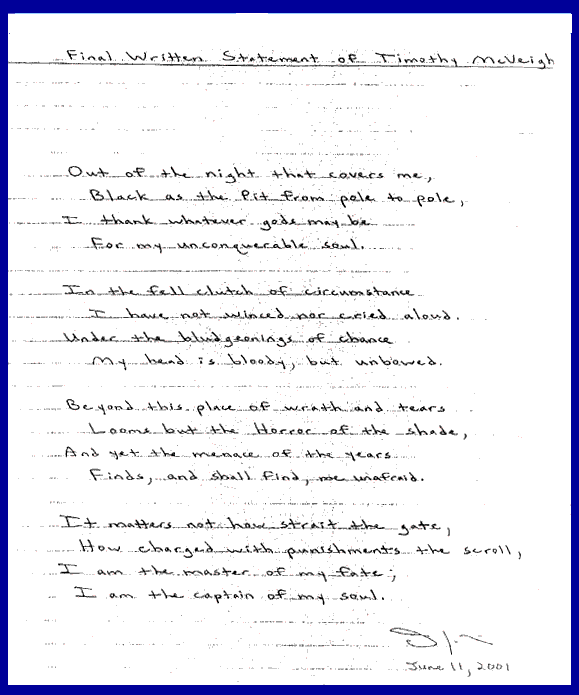
He broadcast clinical detachment in the execution itself — the first conducted by the federal government since 1963, technically imposed for the eight federal employees among his 168 victims — from his waiver of appeals to his unnervingly unblinking death mask to the stoic 19th century poem “Invictus” that formed his written (and only) final statement.

* Also — coincidentally or not — the execution date of Richard Snell in Arkansas, a militia man (and white supremacist, which McVeigh was not) who had once tried to blow up the Murrah building himself.

On this day..

1983: Simon Thelle Mogoerane, Jerry Mosololi and Marcus Motaung, anti-apartheid soldiers

This date at dawn in 1983, three African National Congress cadres were hanged — together with two unrelated common criminals — for attacks on apartheid-era South African police stations.

“Terrorists” in the eyes of the white government and “freedom fighters” in the eyes of many blacks, the “Moroka Three” — Simon Thelle Mogoerane, Jerry Mosololi and Marcus Motaung — bore arms against as part of the ANC’s military wing, Umkhonto we Sizwe (MK).

Their attacks in 1979 and 1981 had claimed the lives of four (black) policemen.

South African law until 1990 mandated hanging for a murder conviction without any extenuating circumstances — a “fact associated with the crime which serves in the mind of reasonable men to diminish morally, albeit not legally, the degree of the prisoner’s guilt.” The courtroom adjunct to MK’s guerrilla operations was establishing its position that its soldiers were prisoners of war under international law, and that that classification constituted an extenuating circumstance under South African law.

1977 protocols had extended the Geneva Conventions governing treatment of prisoners of war to explicitly cover anti-colonial and anti-racist insurgents. South Africa, unsurprisingly, did not ratify this amendment. The judge dismissed the argument that these protocols had acquired the binding force of customary international law — “we do not need to waste time.”

A decade or so later, in the waning years of apartheid, this sort of argument would find a toehold. But not in a defiantly “anti-terrorist” Pretoria of the early eighties.

The three were hanged in the face of worldwide appeals for clemency — such as this one from U.S. Congressmen and -women, and the pamphlet below by the British Anti-Apartheid Movement:

The entirety of this 24-page pamphlet is available free (at least for the remainder of this month) at the Aluka collection of digital Africa-related documents.

The executions likewise met outcry both domestic (South Africa banned public demonstrations) and international (like this U.N. resolution).

On this day..

1934: Three inept murderers (with a fourth to come)

On this date in 1934, three members of a quartet that had — eventually, with Keystone Cops ineptitude — killed a vagrant in an insurance scam during the Great Depression were electrocuted at Sing Sing.

Mike Malloy, the victim of Daniel Kriesberg, Anthony Marino and Frank Pasqua (and Joseph Murphy, whose execution this day was stayed, but who followed his collaborators to the chair on July 5 of that same year), has chiseled out a weirdly Bunyanesque footnote of Americana as “the man who wouldn’t die.”*

The troubles the would-be murderers had getting rid of the 50-year-old drunk after they conned him into signing less than $2,000 worth of insurance papers are outright black comedy. The New York Daily News remembered this noteworthy homicide last year. Yes, it’s murder, but it happened 75 years ago. Go ahead and laugh.

After several weeks of feeding Malloy free liquor [in an attempt to have him drink to death], Marino noted that it was starting to cost him money. More distressing was Malloy’s health: His pallor had lifted and spirits soared courtesy of the free booze. More active measures would be required to hasten Malloy’s demise.

Murphy, a former chemist, told Malloy that some “new stuff” had come in. Malloy drank it, commented on how smooth it tasted and then collapsed to the floor. They dragged him to the back room and anticipated that they would need to pay off a physician for a “hush job” death certificate.

One hour later, a refreshed Malloy bounded back to the bar with a mighty thirst, unaffected by the alcohol Murphy had laced with car antifreeze.

Over the next few days the gang spiked Malloy’s drinks with stronger doses of antifreeze, then turpentine and, finally, horse liniment with rat poison. Malloy kept beaming and kept drinking, soaking up the good times spent with his new friends. The crew decided a switch to food would best hasten Malloy’s death.

Marino served him raw oysters – soaked in wood alcohol. After downing two dozen, Malloy was so enthused by the cuisine that he encouraged Marino to open up a restaurant. The next course included an entrée of rotten sardines mixed with tin shavings. Same result.

Next, the plotters got Malloy stupefied and escorted him to Claremont Park, stripped off his coat, and in the middle of winter opened his shirt and poured 5 gallons of water on him before dumping him into a snowbank. If poisoned liquor and food couldn’t kill Malloy, then the cold blasts of a New York winter would.

Or so they thought. The next evening, Malloy showed up at the speakeasy wearing a new suit. He had really tied one on the night before, he explained, and wound up nearly naked in the park. Fortunately, the police had found him and a welfare organization outfitted him with new clothes.

Exasperated, the gang hired a cab driver, Harry Green, and offered him $150 to run Malloy down with his vehicle. On Jan. 30, 1933, a nearly unconsciously drunk Malloy was driven from Marino’s to Pelham Parkway. Murphy stood him up in the middle of the roadway, and Green backed up his taxi two full blocks to build up enough speed to complete the job. Somehow, Malloy stumbled to safety. They then took Malloy to Gun Hill Road. This time, Green hit him.

The gang gleefully retreated to Marino’s and again waited for an announcement of Malloy’s demise. For days nothing appeared in the newspapers.

Where was he? Malloy was recovering in the hospital under a different name, having sustained a fractured skull, a concussion and a broken shoulder. The indestructible barfly returned several weeks later to the speakeasy and announced he had an awful thirst. The boys’ jaws dropped.

Now desperate, they contacted a professional hit man, but his $500 fee was too expensive. They then shanghaied another drunk, Joe Murray, stupefied him with liquor and stuffed his coat pocket with Malloy’s ID and ran him over with a cab. Murray, a substitute for Malloy in every way, recovered from his injuries after two months in Lincoln Hospital. The only way to knock off Malloy, the gang determined, was murder, clean and simple.

They finally had to stuff a rubber hose down his maw and gas him through it.

Astonishingly, this blockheaded crew came within a fingernail’s breadth of getting away with it, just as they’d gotten away with their innumerable attempted murders** — evidence, really, of just how overrated an achievement the “perfect crime” is. A little baksheesh for a death certificate with a fake cause-of-death, a quick trip to the pauper’s cemetery, and they had already set about collecting the insurance policies before anyone got suspicious.

With four shiftless conspirators and at least two other people who’d been let in on the plot, though, once the sniffing started, their goose was cooked. Soon enough, so were the killers. And it only took the state of New York one try apiece.

* The young Steven Spielberg’s Amazing Stories television show dramatized this implausible story. Why The X-Files never made use of it, no one can say.

** The Daily News reckons it at six; a 1934 New York Times piece counted 10. The investigation suggested that they’d actually done someone else for insurance before, using the winter exposure method that Malloy survived.

On this day..

1997: Henry Francis Hays, whose crime cost the Klan

On this date in 1997, an Exalted Cyclops of the Ku Klux Klan went to Alabama’s “Yellow Mama” for lynching a black teenager.

Henry Francis Hays, son of a top Klan officer in Alabama, had vented dissatisfaction with a jury’s failure to convict a black defendant for a white policeman’s murder by grabbing and stringing up a random black, 19-year-old Michael Donald.

Hays and his 17-year-old accomplice skated for more than two years because Mobile’s finest figured a publicly hanged black man probably had it coming from some drug deal.* Only through the victim’s mother’s persistence — she got Jesse Jackson involved, which helped involve the FBI — did the real murderers feel the heat.

Before long, the Klan would wish it had stayed out of the kitchen.

After Hays’ conviction, Michael Donald’s mother brought a civil action against the United Klans of America with the help of the Southern Poverty Law Center. The $7 million liability verdict she won financially destroyed the United Klans — perpetrators of some of the 1960s’ most infamous anti-civil rights terror — and Donald was awarded its national headquarters building in Tuscaloosa, Ala.

This novel keys on the Michael Donald lynching as part of a (fictional) Mobile teen’s coming of age.

Hays wasn’t through making the sort of history he’d rather not have made.

When his turn in the electric chair finally came in 1997, he became the first white in Alabama put to death for an offense against a black in 84 years.**

Seemingly less cocksure in answering for his crime than he had been in committing it, Hays had always maintained his innocence. A few days before walking his last mile, he finally confessed to the Mobile chapter head of the NAACP.

* Michael Donald was not, in fact, involved in drugs.

** There haven’t been any other executions for white-on-black crime since Henry Hays, a span of 11 more years and 22 more executions as of this writing. (via the Death Penalty Information Center’s Execution Database)

On this day..

2004: Nam Cam, Vietnamese crime lord

On this date in 2004, at Ho Chi Minh City’s Long Binh execution ground, Vietnamese mafioso Truong Van Cam was shot with four of his lieutenants for ordering the murder of a rival crime lord.

An anti-communist soldier during the Vietnam War, “Nam Cam” (“Cam the fifth sibling”) survived a communist re-education camp and ingratiated himself sufficiently with the powers that be through the late 1970’s and 1980’s to ensconce himself as a wealthy and influential power broker within the country.

Nam Cam emerges from court after hearing his death sentence on June 5, 2003.

His arrest in 2001 for ordering a hit in a characteristic underworld turf war mushroomed into a vast corruption scandal, implicating a network of official protectors who ran interference for his criminal syndicate.

More than 150 people stood trial with Nam Cam — including “two expelled members of the 150-member Communist Party central committee, the former head of the state radio system, and the former director of police in Troung Nam Cam’s base of operation, Ho Chi Minh City.” (Source)

The doomed capo reportedly indulged the comfort of gloating that “the Communists may have thought they defeated South Vietnam, but I have shown that they are rotten to the core with corruption.”

The more things change …

On this day..

1718: John “Jack Ketch” Price, former hangman

On this date in 1718, the former common hangman got a taste of his own medicine.

As the 18th and especially 19th centuries unfolded and executions became more private, orderly and “humane,” the executioner’s office became more subtle and bourgeois. In the early 1700’s, however, it was commonly filled by a character who might just as easily have been on the other end of the rope. And once in a while … they were.

One disreputable character who performed the office for twenty years and more following the Stuart Restoration, Jack Ketch, lent his very name to the position (and its accoutrement — e.g., “Jack Ketch’s knot,” the hangman’s noose).

Our day’s victim, by the Christian name of John Price, was “Jack Ketch” in 1714-1715 until his debts caught up with him, and if the Newgate chronicle be believed wasn’t half-bad at the gig. Alas that he lost the position: his life in every other respect is reported by our sanctimonious interlocutors as one of drunken savagery.*

In such a state a couple of years later, he beat a woman to death during an attempted (or actual) rape at Bunhill Fields, at which location the law compelled him, in the parlance of the times, to “dance with Jack Ketch.” The prospect of hanging concentrated old Ketch’s mind wonderfully on the task of not missing one precious moment that might be spent drinking.

[H]e was no sooner confined in the condemned hold, than laying aside all thoughts of preparing himself for his latter end, he appeared quite void of all grace; and instead of repenting for his manifold sins and transgressions, he would daily go up to chapel intoxicated with cursed Geneva [i.e., gin] … As he was riding in the cart he several times pulled a bottle of Geneva out of his pocket to drink before he came to the place of execution

…

One would imagine that the dreadful scenes of calamity to which this man had been witness, if they had not taught him humanity, would at least have given him wisdom enough not to have perpetrated a crime that must necessarily bring him to a similarly fatal end to what he had so often seen of others: but perhaps his profession tended rather to harden his mind than otherwise.

Price/Ketch was not the only public executioner to find himself on the receiving end of his former trade, but he does seem to have the distinction of being the only one who was also gibbeted — his carcass hung up in an iron cage in the London district of Holloway.

Update: John Price’s career narrated by Lucy Inglis of Georgian London in a podcast interview with Early American Crime.

On this day..

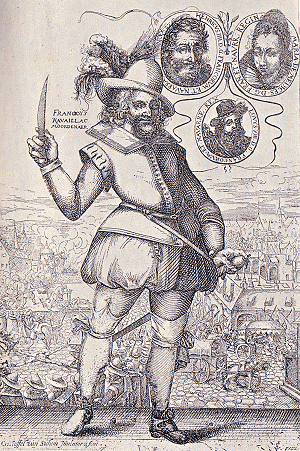
1610: Francois Ravaillac, because Paris was worth more than a mass

On this date in 1610, the fanatical Catholic who assassinated Henri IV of France was ripped apart on the Place de Greve.

The road to this man’s calvary begins long before his infamous crime, even long before the birth of his illustrious victim.

The Protestant Reformation — so richly represented in the executioner’s annals — had fractured France in the 16th century.

After decades of voluptuously indecisive Catholic-versus-Hugeunot slaughter, matters had finally been settled by the man upon whom French absolutism would erect its (ill-fated) edifice.

Henri IV, the first Bourbon monarch and a Huguenot, had unified the country by the sword, capped by his memorably politic conversion to Catholicism in 1593 to win over the holdout capital of Paris — the occasion of his understated declaration that “Paris is worth a mass”.

Let us tarry here to appreciate “the good king Henri” in a kaleidoscope of flattering artwork to the tune of Vive Henri IV, the monarchy’s unofficial anthem after its subject’s passing:

Did you catch that last image?

Henri’s fine gesture of sectarian triangulation and the reign of relative calm it inaugurated were naturally resented by godly partisans of both camps who either considered his conversion a betrayal or considered the king a closet Protestant.

At the crazed end of this latter spectrum, we meet our day’s principal, Francois Ravaillac.

Readers unconstrained by time may enjoy this Tolstoyan trek into the regicide’s mind and milieu, but it will suffice us to say that the modern shotgun-wielding postal clerk who just seemed like a quiet, harmless type to all his coworkers might like the cut of Ravaillac’s jib. A bit of a loner, a bit of a professional washout, with a penchant for religious visions and a passel of ill-arranged grievances … by this point in the movie, that’s about what you expect the police profiler to be reciting.*

It is only right that such a contemporary-sounding lone nut story ought to have a vigorous conspiratorial counternarrative.

There has always been a strong suspicion that behind Ravaillac’s hand was the work of the scheming Catholic Duc d’Epernon, perhaps even with the complicity of Henri’s wife Marie de’ Medici, who had conveniently been crowned as queen the day before the murder** and promptly teamed up with Epernon to cement an alliance with a traditional French rival, the ultra-Catholic Habsburgs.

Balzac, for one, had no doubt about it:

all of [her] actions were prejudicial to France … Marie de’ Medici wasted the wealth amassed by Henri IV.; she never purged herself of the charge of having known of the king’s assassination; her ‘intimate’ was d’Epernon, who did not ward off Ravaillac’s blow, and who was proved to have known the murderer personally for a long time. … [T]he victory Richelieu at last won over her (on the Day of the Dupes) was due solely to the discovery the cardinal made, and imparted to Louis XIII, of secret documents relating to the death of Henri IV.

The historical jury is out on that question, presumably for good.

If Ravaillac was a conspirator, he proved to be a damned good one, denying under repeated torture that he had any accomplices. On this date, the tortures reached their crescendo and conclusion — to the horrible delight of the Parisian mob, as reported by Alistair Horne (via The Corner):

On 27 May, still protesting that he had acted as a free agent on a divinely inspired mission, Ravaillac was put to death. Before being drawn and quartered, the lot of the regicide, on the Place de Grève scaffold he was scalded with burning sulphur, molten lead and boiling oil and resin, his flesh then torn by pincers. Then his arms and legs were attached to horses which pulled in opposite directions. One of the horses “foundered,” so a zealous chevalier offered his mount; “the animal was full of vigour and pulled away a thigh.” After an hour and a half of this horrendous cruelty, Ravaillac died, as the mob tried to prevent him receiving last rites. When he finally expired,

“…the entire populace, no matter what their rank, hurled themselves on the body with their swords, knives, sticks or anything else to hand and began beating, hacking and tearing at it. They snatched the limbs from the executioner, savagely chopping them up and dragging the pieces through the streets.”

Children made a bonfire and flung remains of Ravaillac’s body on it. According to one witness, Nicholas Pasquier, one woman actually ate some of the flesh. The executioner, supposed to have the body of the regicide reduced to ashes to complete the ritual demanded by the law, could find nothing but his shirt.

Ravaillac was the last Frenchman drawn and quartered for a century and a half — but his punishment as a regicide formed the precedent for that handed down in 1757 to Damiens.

* No need, though, as Francois wasn’t hard to catch: he stepped up to Henri’s carriage when it was caught in a traffic jam on May 14, 1610, and stabbed the king to death plain as can be. He was lucky (sort of) to avoid a lynching.

** Rubens later painted a gaudy celebration of this event.

On this day..