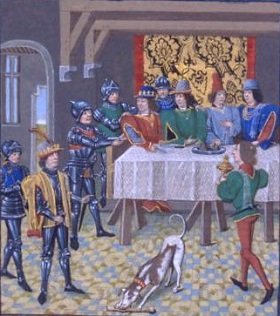
535: Amalasuntha, daughter of Theodoric

On or around this date in 535,* the Ostrogothic queen Amalasuntha was put to death in the Italian lake island of Martana (You can also find her name rendered Amalasountha and Amalaswintha.)
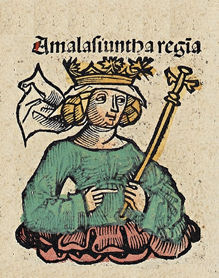
The Roman-educated princess had inherited rulership of the Ostrogothic Kingdom, a successor state to the lately fallen Roman Empire, from its redoutable founder Theodoric. Technically the crown had passed to Amalasuntha’s 10-year-old kid; ruling as regent in a perilous situation, mom cultivated an alliance with the Byzantine emperor Justinian.

Her son took to boozing and carousing and died as a teenager, so Amalasuntha sought a new male imprimatur for her reign by the expedient of marrying a wealthy cousin, Theodahad. Though the nuptial deal had been for Theo to butt out of actual governance, he immediately strove to convert his power from titular to actual and became his wife’s deadliest rival — and then clapped her in prison. From the History of the Wars of Byzantine scribbler Procopius:

Theodahad, upon receiving the supreme power, began to act in all things contrary to the hopes she had entertained and to the promises he had made. And after winning the adherence of the relatives of the Goths who had been slain by her — and they were both numerous and men of very high standing among the Goths — he suddenly put to death some of the connections of Amalasuntha and imprisoned her, the envoys not having as yet reached Byzantium. Now there is a certain lake in Tuscany called Vulsina, within which rises an island, exceedingly small but having a strong fortress upon it. There Theodatus confined Amalasuntha and kept her under guard.

A Roman diplomat named Peter had already been dispatched by this time from the court of Constantinople to do some routine statecraft with the Goths, and he learned of the surprise reshuffling of power when he met Theodohad’s envoys on the road.

Procopius says — or does he? — that Byzantium tried to twist the Goths’ shaggy arms in support of their matronly ally, but could not prevail against the vengeance of the deposed queen’s foes.

When the Emperor Justinian heard these things, he formed the purpose of throwing the Goths and Theodahad into confusion; accordingly he wrote a letter to Amalasuntha, stating that he was eager to give her every possible support, and at the same time he directed Peter by no means to conceal this message, but to make it known to Theodatus himself and to all the Goths. … Now when Peter arrived in Italy, it so happened that Amalasuntha had been removed from among men. For the relatives of the Goths who had been slain by her came before Theodahad declaring that neither his life nor theirs was secure unless Amalasuntha should be put out of their way as quickly as possible. And as soon as he gave in to them, they went to the island and killed Amalasuntha, — an act which grieved exceedingly all the Italians and the Goths as well. For the woman had the strictest regard for every kind of virtue … Theodahad, such was his stupid folly, while still holding the slayers of Amalasuntha in honour and favour kept trying to persuade Peter and the emperor that this unholy deed had been committed by the Goths by no means with his approval, but decidedly against his will.

The “stupid folly” helped to trigger Justinian’s war against the Goths, which resulted in Byzantium’s conquest of Italy and (temporary) reunification of the empire. It also led Amalasuntha’s son-in-law Vitiges to depose and murder Theodahad in his own turn: just another turn of the wheel among backstabbing aristocrats.

Speaking of which: despite the pious good faith Procopius presents for Byzantium in his history above, his gossipy Secret History rewrites the story to attribute Amalsuntha’s fall not to the Ostrogoths’ internal political rivalries but to a catty assassination by Byzantine empress Theodora, whose low-born origin shows through here in murderous insecurity:

At the time when Amalasuntha, desiring to leave the company of the Goths, decided to transform her life and to take the road to Byzantium, as has been stated in the previous narrative, Theodora, considering that the woman was of noble birth and a queen, and very comely to look upon and exceedingly quick at contriving ways and means for whatever she wanted, but feeling suspicious of her magnificent bearing and exceptionally virile manner, and at the same time fearing the fickleness of her husband Justinian, expressed her jealousy in no trivial way, but she schemed to lie in wait for the woman even unto her death. Straightway, then, she persuaded her husband to send Peter, unaccompanied by others, to be his ambassador to Italy. And as he was setting out, the Emperor gave him such instructions as have been set forth in the appropriate passage, where, however, it was impossible for me, through fear of the Empress, to reveal the truth of what took place. She herself, however, gave him one command only, namely, to put the woman out of the world as quickly as possible, causing the man to be carried away by the hope of great rewards if he should execute her commands. So as soon as he arrived in Italy — and indeed man’s nature knows not how to proceed in a hesitant, shrinking way to a foul murder when some office, perhaps, or a large sum of money is to be hoped for — he persuaded Theodahad, by what kind of exhortation I do not know, to destroy Amalasuntha. And as a reward for this he attained the rank of Magister, and acquired great power and a hatred surpassed by none.

* The allusion to April 30 comes from Procopius but is ambiguously presented. When it comes to the age of antiquity, however, we’re typically grateful to get any date whatever.

On this day..

1012: St. Alphege, Archbishop of Canterbury

April 19 was the death date in 1012, and the feast date in perpetuity, of Archbishop of Canterbury and Christian saint Aelfheah (also known as Alfege or Alphege).

When harrying Danish invaders under Thorkell the Tall put Canterbury cathedral to the sack in 1011, they seized this Anglo-Saxon cleric too in expectation of adding a VIP’s ransom to their sacrilegious pillage of candelabras and jeweled chalices.

Aelfheah turned out not to be the render-unto-Caesar type — or at least, not unto Ragnar — and stubbornly refused to raise his own ransom or to permit one to be paid for him. Seven months on into his captivity, some ill-disciplined Vikingers with their blood (and blood alcohol) up for an Easter pillage just decided to get rid of him — as detailed in the Anglo-Saxon Chronicle, which also helpfully provides us the date:

1012. Here in this year, there came to London town Ealdorman Eadric and all the foremost councillors of the English race, ordained and lay, before Easter — that Easter Day was on the 13 April. And they were there until after Easter, until all the tax was paid — that was 8 thousand pounds.

What we have here is the unprincipled nobleman Eadric Streona — destined for an Executed Today entry of his own — celebrating Christ’s resurrection by squeezing hard-pressed Londoners for the Danegeld needed to buy off Thorkell’s rampaging army. And beside that in the ledger, a vicar declines to save his own life at the cost of incrementing his flock’s suffering. The ransom-refusing Aelfheah is a patron saint of kidnap victims; he ought to be taxpayer ombudsman, too.

Then on Saturday the raiding-army became much stirred up against the bishop, because he did not want to offer them any money, and forbade that anything might be granted in return for him. Also they were very drunk, because there was wine brought from the south. Then they seized the bishop, led him to their ‘hustings’ on the Saturday in the octave of Easter, and then pelted him there with bones and the heads of cattle; and one of them struck him on the head with the butt of an axe, so that with the blow he sank down and his holy blood fell on the earth, and sent forth his holy soul to God’s kingdom. And in the morning the bishops [of Dorchester and of London] Eadnoth and Aelfhun and the inhabitants of the town took up the holy body, and carried it to London with all honour and buried it in St. Paul’s minster, and there now [i.e., to this day] God reveals the holy martyr’s powers.

Aelfheah was canonized by Gregory VII in 1078 — and was one of the rare clerics of the Anglo-Saxon era still officially revered after the Norman conquest.* It is said that Thomas a Becket had just prayed to Aelfheah before he too attained his predecessor’s martyrdom.

The British History Podcast hasn’t reached this incident as of this post’s publication, but it should do anon. Its Vikings coverage begins with episode 176.

* A thousand years on, a church named our man marks the purported spot of his execution/murder.

On this day..

316 BCE: Olympias, mother of Alexander the Great

On an unknown date about the spring of 316 BCE, Alexander the Great’s snake-worshipping mother Olympias surrendered to the siege of the former regent’s ambitious son — whereupon she was put to summary death.

The Epirote princess married Philip II of Macedon. Though Philip had put her aside for a younger queen, Olympias adroitly maneuvered her brilliant son* Alexander to the throne from which he conquered Babylonia and Persia, and history is not confident that she stopped short of regicide to secure Alexander’s precedence.

Olympias was famed for her snake-handling: Plutarch says that Philip’s interest in her waned when he beheld “a serpent … lying stretched out by the side of Olympias as she slept,” which led him to fear “that she was the partner of a superior being.” Sigmund Freud, eat your heart out.

Sired by the gods or no, Olympias’s son certainly outstripped his father — but once Alexander’s coruscating star burned itself out, Olympias had another kind of snakepit to contend with: the conqueror’s former generals jockeying for preeminence in their engorged empire.

The patina of dynastic legitimacy Olympias maintained as Alexander’s kin was not sufficient to prevent the situation collapsing into war; indeed, we have met this this civil strife previously in these pages, when Olympias had the upper hand in a battle in 317 BCE and ordered the execution of Alexander’s mentally disabled half-brother. Olympias gets her share of stick as old time Macedonia’s deadly ophiomormous femme fatale, but this was cruelty with a purpose: the addled king was the catspaw in whose name her foe Cassander (as his father Antipater before him) claimed power as “regent”.

Cassander, a mate of Alexander dating back to their Aristotle study group days, was not captured in this affair, nor was he driven from the field by it. Soon thereafter he turned the tables and trapped Olympias in Pydna, where she was obliged to surrender to his discretion. That same logic of murder in statecraft turned now against the queen. First century (BCE) Greek historian Diodorus Siculus:

Although Cassander had shut Olympias into Pydna in Macedonia, he was not able to assault the walls because of the winter storms, but by encamping about the city, throwing up a palisade from sea to sea, and blockading the port, he prevented any who might wish to aid the queen from doing so. And as supplies were rapidly exhausted, he created such famine among those within that they were completely incapacitated. In truth, they were brought to such extreme need that they gave each soldier five choenices of grain per month, sawed up wood and fed the sawdust to the imprisoned elephants, and slaughtered the pack animals and horses for food. While the situation of the city was so serious and while Olympias was still clinging to hopes of rescue from outside, the elephants died from lack of nourishment, the horsemen that were not in the ranks and did not receive any food whatever nearly all perished, and no small number of the soldiers also met the same fate. Some of the non-Greeks, their natural needs overcoming their scruples, found flesh to eat by collecting the bodies of the dead. Since the city was being quickly filled with corpses, those in charge of the queen’s company, though they buried some of the bodies, threw others over the city wall. The sight of these was horrible, and their stench was unbearable, not merely to ladies who were of the queen’s court and addicted to luxury, but also to those of the soldiers who were habituated to hardship.

As spring came on and their want increased from day to day, many of the soldiers gathered together and appealed to Olympias to let them go because of the lack of supplies. Since she could neither issue any food at all nor break the siege, she permitted them to withdraw. Cassander, after welcoming all the deserters and treating them in most friendly fashion, sent them to the various cities; for he hoped that when the Macedonians learned from them how weak Olympias was, they would despair of her cause. And he was not mistaken in his surmise about what would happen: those who had resolved to fight on the side of the besieged forces changed their minds and went over to Cassander; and the only men in Macedonia to preserve their loyalty were Aristonoüs and Monimus, of whom Aristonoüs was ruler of Amphipolis and Monimus of Pella. But Olympias, when she saw that most of her friends had gone over to Cassander and that those who remained were not strong enough to come to her aid, attempted to launch a quinquereme and by this means to save herself and her friends. When, however, a deserter brought news of this attempt to the enemy and Cassander sailed up and took the ship, Olympias, recognizing that her situation was beyond hope, sent envoys to treat of terms. When Cassander gave his opinion that she must put all her interests into his hands, she with difficulty persuaded him to grant the single exception that he guarantee her personal safety. As soon as he had gained possession of the city, he sent men to take over Pella and Amphipolis. Now Monimus, the ruler of Pella, on hearing the fate of Olympias, surrendered his city; but Aristonoüs at first was minded to cling to his position … [until] Olympias wrote to him demanding his loyalty and ordering him to surrender, he perceived that it was necessary to do as ordered and delivered the city to Cassander, receiving pledges for his own safety.

Cassander, seeing that Aristonoüs was respected because of the preferment he had received from Alexander, and being anxious to put out of the way any who were able to lead a revolt, caused his death through the agency of the kinsfolk of Cratevas. He also urged the relatives of those whom Olympias had slain to accuse the aforesaid woman in the general assembly of the Macedonians. They did as he had ordered; and, although Olympias was not present and had none to speak in her defence, the Macedonians condemned her to death. Cassander, however, sent some of his friends to Olympias advising her to escape secretly, promising to provide a ship for her and to carry her to Athens. He acted thus, not for the purpose of securing her safety, but in order that she, condemning herself to exile and meeting death on the voyage, might seem to have met a punishment that was deserved; for he was acting with caution both because of her rank and because of the fickleness of the Macedonians. As Olympias, however, refused to flee but on the contrary was ready to be judged before all the Macedonians, Cassander, fearing that the crowd might change its mind if it heard the queen defend herself and was reminded of all the benefits conferred on the entire nation by Alexander and Philip, sent to her two hundred soldiers who were best fitted for such a task, ordering them to slay her as soon as possible. They, accordingly, broke into the royal house, but when they beheld Olympias, overawed by her exalted rank, they withdrew with their task unfulfilled. But the relatives of her victims, wishing to curry favour with Cassander as well as to avenge their dead, murdered the queen, who uttered no ignoble or womanish plea.

Such was the end of Olympias, who had attained to the highest dignity of the women of her day, having been daughter of Neoptolemus, king of the Epirotes, sister of the Alexander who made a campaign into Italy, and also wife of Philip, who was the mightiest of all who down to this time had ruled in Europe, and mother of Alexander, whose deeds were the greatest and most glorious.

Cassander would emerge from all this mess in a sturdy enough position to declare himself king. His sons, however, were unable to sustain the family in power and this particular general proved merely the precursor of a different general‘s more successful post-Alexander dynasty.

A monumental tomb recently discovered in the Kasta burial mound at Amphipolis — said to beggar the gorgeous Vergina tomb in scale and grandeur — has been speculatively associated with Olympias and/or Alexander. (“Hopefully” might be the better word, since the bare hint of such a link would be a boon for the tourism sector.) The site is still being excavated, and is not yet open to the public.

* Legend holds that Olympias gave birth to Alexander on the same day Herostratus torched the Temple of Artemis.

On this day..

1554: A cat dressed as a prelate

Whatever might be said, from a state’s perspective, for the virtues of making a public spectacle of capital punishment, the scaffold could also double as a subversive rostrum.

Religious martyrs, vaunting outlaws, courageous dissidents — all these sometimes sought to speak their own dangerous voices through the sermon of their deaths. If most such displays are usually better remembered by rhetoricians than historians, it is still true that public executions carried the potential to whipsaw against the authorities conducting them. In these pages, we have seen the commoners who are supposed to be the spectacle’s audience force their way into proceedings by rescuing a woman at the block (murdering the executioner), tearing down the breaking-wheel and carrying away its prospective victim in triumph, rampaging through Edinburgh and lynching a brutal gendarme in the hanging party, and eerily refusing to attend a Italian execution in a show of silent menace.

And apart from high drama when the place of execution is put to its usual function, the site itself has underappreciated potential for popular expropriation.

That brings us to this date’s subject, courtesy of the Anne Boleyn Files: a grisly and caustic comment left on the gallows by some unknown Protestant in the first year of Queen Mary‘s Catholic reign. To situate this event in time and context, the Protestant rebellion of Thomas Wyatt had been crushed just two months before, leading to the precautionary beheading of potential Protestant rival Lady Jane Grey. Three days after the events here, on April 11, 1554, Wyatt himself went to the block.

The same 8. of April, being then Sunday, a cat with hir head shorn and the likenes of a vestment cast ouer hir, with hir fore feet tied togither, and a round peece of paper like a singing cake [communion wafer] betwirt them, was hanged on a gallowes in Cheape, neere to the crosse, in the parish of S. Mathew, which cat being taken downe, was caried to the Bish. of London, and he caused the same to be shewed at Pauls crosse, by the preacher D. Pendleton.

There’s no no record that the heretical “executioner” was ever outed, despite publication of a reward.

The xiij day of Aprell was a proclamasyon was made that what so mever he where that could bryng forth hym that dyd hang the catt on the galaus, he shuld have XX marke for y labur.

On this day..

1356: Four friends of Charles the Bad

On this date in 1356, the French King John II — John the Good, to history — avenged himself on his cousin and rival, Charles the Bad.

This affair embroils us in the French dynastic turmoil that spawned the Hundred Years’ War: five months after the nastiness in this post, King John was an English prisoner following the catastrophic Battle of Poitiers. It’s a good job he got his revenge in when he had the chance.

The fight — in its largest sense — was all about the throne of France, the poisonous fruit of the dynasty-wrecking Tour de Nesle affair of royal adultery decades before. That affair destroyed two princesses who could have become queens, and with it the potential of legitimate heirs for their husbands. With the family tree’s next generation barren, succession passed from brother to brother until the last brother died.

So now who’s big man in France?

Awkwardly, the last king’s nearest male relative also happened to be the king of France’s rival — his nephew, Edward III of England.

France barred Edward with a quickness, on the grounds that Edward was related via a female line. That put the patrimony in the hands of John the Good’s father, a previously un-royal cousin known as Philip the Fortunate. Less fortunately, this succession also conferred upon the new Valois line Edward’s rival claim and the associated interminable violent conflict.

Besides these two, there was yet another cousin who aspired to the French scepter: our guy Charles the Bad, King of the Pyrenees-hugging realm of Navarre. This guy’s mother had her legitimacy cast in doubt by the whole Tour de Nesle adultery thing years ago, and her woman bits had ruled her out of ruling France — but not Navarre. (No Salic Law in Navarre: a digression beyond this post.)

So Charles, her son and heir in Navarre, was at least as close to the Capetian dynasty as were his cousins — and maybe closer. He was also “one of the most complex characters of the 14th century,” in the judgment of Barbara Tuchman (A Distant Mirror: The Calamitous 14th Century). “A small, slight youth with glistening eyes and a voluble flow of words, he was volatile, intelligent, charming, violent, cunning as a fox, ambitious as Lucifer, and more truly than Byron ‘mad, bad and dangerous to know.’

“His only constant was hate.”

And Charles sure hated King John. Was it the political rivalry? The daughter John had foisted on him as a bride? The territory John nicked from Navarre to confer on John’s favorite as Constable of France?* Yes.

Charles had subtlety in his bag of clubs, and brutal directness too. In 1354, he revenged at least one slight by having his brother murder the aforementioned Constable — also a favorite and childhood friend** of King John — in a tavern ambush.

(There’s an audio introduction to Charles the Bad complete with hammy re-enactment of the homicide in episode 110 of the History of England podcast. What follows below leads off episode 111.)

Too weak politically at that moment to repay Charles in his own coin, John had to sullenly consent to a putative reconciliation … but he was only biding his time. Charles compounded the enmity by his scheming on-again, off-again negotiations with the English, hoping to leverage the war between those powers to his own advantage.

He was a constant thorn in King John’s side, and the latter had problem enough with the English invasions and the struggle he had to gin up tax revenue to oppose them. The apparent last straw: Charles buddied up to John’s son the Dauphin and tried to engineer a coup d’etat against John. John settled on a vengeful stroke to put both the King of Navarre and the crown prince in their places, a party-fouling scene to beggar Game of Thrones in Froissart’s description:

The king of France, on Tuesday the 5th of April, which was the Tuesday after midlent Sunday, set out early, completely armed, from Mainville, attended by about one hundred lances. There were with him his son the earl of Anjou, his brother the duke of Orleans, the lord John d’Artois, earl of Eu, the lord Charles his brother, cousins-german to the king, the earl of Tancarville, sir Arnold d’Andreghen, marshal of France, and many other barons and knights. They rode straight for the castle of Rouen, by a back way, without passing through the town, and on entering found, in the hall of the castle, Charles, duke of Normandy, Charles king of Navarre, John earl of Harcourt, the lords de Preaux, de Clerc, de Graville, and some others seated at dinner. The king immediately ordered them all, except the dauphin, to be arrested, as also sir William and sir Louis de Harcourt, brothers to the earl, the lord Fricquet de Friquart, the lord de Tournebeu, the lord Maubué de Mamesnars, two squires called Oliver Doublet and John de Vaubatu, and many others. He had them shut up in different rooms in the castle; and his reason for so doing was, that, since the reconciliation made on occasion of the death of the constable of France, the king of Navarre had conspired and done many things contrary to the honour of the king, and the good of his realm: the earl of Harcourt had also used many injurious expressions in the castle of Vaudreuil, when an assembly was holden there to grant a subsidy to the king of France against the said king, in order to prevent, as much as lay in his power, the subsidy from being agreed to. The king, after this, sat down to dinner, and afterwards, mounting his horse, rode, attended by all his company, to a field behind the castle, called the Field of Pardon.

The king then ordered the earl of Harcourt, the lord of Graville, the lord Maubué and Oliver Doublet to be brought thither in two carts: their heads were cut off,† and their bodies dragged to the gibbet at Rouen, where they were hung, and their heads placed upon the gibbet. In the course of that day and the morrow, the king set at liberty all the other prisoners, except three: Charles king of Navarre, who was conducted to prison in the Louvre at Paris, and afterwards to the Châtelet: some of the king’s council were appointed as a guard over him. Fricquet and Vaubatu were also confined in the Châtelet. Philip of Navarre, however, kept possession of several castles which the king his brother had in Normandy, and, when the king of France sent him orders to surrender them, refused to obey, but in conjunction with the lord Godfrey de Harcourt and other enemies of France, raised forces in the country of Coutantin, which they defended against the king’s troops.

* The post was vacant because the previous Constable had been executed.

** And distant kin, but who isn’t?

† By a convenient prisoner dragooned into the duty, who required many more hacks at the bone than there were heads to sever.

On this day..

845: The 42 Martyrs of Amorium

March 6 is the feast date of the 42 Martyrs of Amorium, the day in the year 845 when they submitted to the caliphate’s executioners in preference to conversion.

Though they were people of rank in their lifetimes, most of them are not known to posterity by name or even position. Devotionally, they govern no special sphere of intercession; iconographically, they have no special device. When depicted (itself unusual) it is simply as a gaggle of generic courtiers.*

It seems a fitting fate for mere individuals ground up between states and faiths; even so, their weedy tombs mark a fork on the path trod by Byzantium.

The 42 earned their martyrs’ crowns at the end of seven years’ imprisonment, so it is to the Byzantine war with the Abbasid Caliphate in 837-838 that we must return to unravel their story. This war was itself merely the resumption of a conflict that had been ongoing between the civilizations for two centuries since Arab conquerors emerged from the desert to found an empire.

With the connivance, encouragement, or cajoling of anti-caliphate rebel Babak Khorramdin, the young Byzantine emperor Theophilos broke four years of tense peace with destructive effect in 837, ravaging the Upper Euphrates.

“He captured and burned the fortress of Zapetra, putting to death the male population and carrying off the women and children,” John Bury wrote in A History of the Eastern Empire from the fall of Irene to the Accession of Basil I. Upon his return to the mandatory official Triumph, “[t]roops of children with garlands of flowers went out to meet the Emperor as he entered the capital. In the Hippodrome he competed himself in the first race, driving a white chariot and in the costume of a Blue charioteer;** and when he was crowned as winner, the spectators greeted him with the allusive cry, ‘Welcome, incomparable champion!'” Because the one thing 200 years of engaging the Arabs in back-and-forth raids, counterattacks, and suits for peace had taught Byzantium was that victories would surely prove durable.

In truth this war was also politics by other means — domestic politics, that is.

Theophilos really did aspire to incomparable championhood of something far more important than the position of the frontier: in matters religious, he was a stringent iconoclast and he meant to win Christendom firmly over to this philosophy.

The century-old schism within the communion — pitting iconoclasts, like Theophilos, who condemned as idolatrous the veneration of religious imagery against iconophiles or iconodules who embraced it — itself likely owed much to the stunning march of Arab arms and the wound Caliphate success had inflicted on a state and faith that had formerly presumed itself hegemonic. It was certainly the case that Roman superstition† perceived in the battlefield results of imperial adherents to the rival icon’isms a going divine referendum. God says go with whichever icon policy starts beating Islam!

Well might the triumphant Theophilos preen, then — right before the fall, like the Good Book says. Gibbon charged that Theophilos “was rash and fruitless” and “from his military toils he derived only the surname of the Unfortunate.”

The caliph al-Mu’tasim counterattacked the Unfortunate ruthlessly in 838, invading Anatolia in two huge columns that converged on a major city, Amorium.‡ There, they penetrated the city’s walls and put her to the sack — slaughtering unnumbered thousands and carrying away most survivors as slaves, outrageously unmolested by the chastisement of any Byzantine army.


12th century illustration from the Madrid Skylitzes, an edition of the chronicle written by 11th century Greek historian John Skylitzes. The volume was produced in Sicily; it’s got “Madrid” in the name because that’s where the sole surviving copy of it resides today.

Byzantium might have been fortunate on this occasion that, before he could extend his conquest, al-Mu’tasim’s domestic politics promptly recalled him to the caliphate to deal with plots against his own throne. But the raid devastated the martial credibility of Theophilos the incomparable champion, and with it the credibility of iconoclasm. Nor can there have been much fortune reckoned by the thousands of prisoners marched out of the smouldering ruins of Amorium to the new Arab capital Samarra — among whom we find this post’s titular 42 martyrs.

They were, or at least seemed, the crown jewels among the captives, meaning the ones with cash value. Constantinople and Samarra would engage in periodic negotiations over the next several years to exchange them; the Caliphate’s insistence on obtaining for their return a treasure equal to the cost it had incurred to attack Amorium in the first place put an unbridgeable gap between the sides.

The nameless and rankless commoners among them went to their nameless destinies; undoubtedly their experience was cruel and many died or were killed, but for those who endured the tribulations there was a return to hearth and home in a prisoner exchange in 841.

For the VIPs, deliverance sank into the Mesopotamian mud.

Both Theophilos and al-Mu’tasim died in 842 and sometime around there the respective empires seem to have given up trying to resolve the impasse about the Amorium ransom. A few more years on with no apparent relief forthcoming from the annoyance of maintaining these now-useless prisoners of war, someone in Samarra decided to dispose of them with the ultimatum.

Their martyrs’ glory assured their afterlife in Byzantine religious propaganda. Yes, these two Christian sects had made martyrs of one another within the empire. But iconoclasm really hinged on one crucial argument fatally undone by the 42 martyrs: victory. The pro-icon emperors from 797 to 813 had been associated with retreat and humiliation;§ one had even been killed on campaign in the Balkans leaving the Bulgar king Krum to fashion the imperial skull into a ceremonial goblet. That the iconoclast rulers of the succeeding generation had at least stabilized the situation was their ultimate scoreboard taunt. Amorium dispelled that glow of providential favor, especially when followed by the years-long abandonment of that razed city’s noble hostages to the heathen dungeon.

Little could the monk Euodios know that his iconoclasm-tweaking hagiography of these martyrs would prove a redundant step.

The late Theophilos had only an infant son, so governance after his death fell to a regency led by the empress Theodora. Despite her dead husband’s scruples, Theodora didn’t mind an icon one bit, and restored icon veneration to a favor it would never again lose for the six centuries remaining to Byzantium.

* See for example the leftmost group on the second row in this image. (Located here)

** One of the principal charioteering teams/factions that had, centuries before, nearly overthrown Justinian and Theodora.

† Among the Romans themselves for whom supernatural causation was an assumed fact on the ground, superstitio had a more attenuated meaning, contrasting with religio. That is far afield for this post; I use the term here advisedly from a post-Enlightenment cosmology.

‡ Amorium is no more today: just a ruin buried under a village. But not because of this siege.

§ Charlemagne being crowned “Holy Roman Emperor” in 800 was also a gesture of disregard for a weakened (and at that moment, female-ruled) Byzantium, which dignified itself the Roman Empire despite having long since abandoned Rome itself.

On this day..

1864: Private Samuel Jones, in retaliation for Private Daniel Bright

The New York Times of January 23, 1864

Gen. Getty:

DEAR SIR: We, the subscribers, request to say that there was found this morning a dead man, and still hanging, in our neighborhood, as the inclosed scrip which was found pinned to his back, will show you by whom it was done. We have made a suitable box and buried him near the place he was found hung. Should his friends wish to get his body, they can get it by applying to any of the subscribers. We trust that you will not attach any blame to any of the citizens of this neighborhood, as we were entirely ignorant of any of the circumstances until we found the body. From all we can learn, he was brought across the Chowan River to this place, and as soon as the men who had him in charge hung him, they went back.

It was signed by ten people of Pasquotank County, North Carolina.

The note they enclosed, retrieved from the hanging body, read:

NOTICE

Here hangs Private Samuel Jones, of Company B, Fifth Ohio regiment, by order of Maj.-Gen. Pickett, in retaliation for Private Daniel Bright, of Company L, Sixty-second Georgia regiment, hung Dec. 18, 1863, by order of Brig.-Gen. Wild.

Bright, a member of the newly-formed 66th North Carolina guerrillas, had been hanged as a spy. Jones had been obtained by casting lots among Union prisoners of war held at the Confederate capital of Richmond, in response to Pickett’s demand for some Yankee to execute tit for tat. (Pickett’s proclivity for retaliatory executions would soon require him to quit the country at the end of the Civil War.)

On this day..

1553: Pedro de Valdivia, founder of Santiago

On Christmas Day of 1553, the Spanish conquistador Pedro de Valdivia, noted as the founder of Santiago, Chile,* was executed by Mapuche Indians who had captured him in battle.

Valdivia got his start in New World bloodsport in the train of the Pizarro brothers, and cashed in with mining concessions as a reward for his able service in the Pizarros’ campaign against yet another conquistador, Diego de Almagro.

Not content to wax fat on Incan silver, Valdivia secured permission to pick up Almagro’s aborted mission: the conquest of Chile. With a force of about 150 Spaniards and many times that number of native allies, he successfully crossed the Atacama desert (bypassing Andean tribes that had proven hostile to Almagro) and attained the Mapocho river valley. There he created Santiago** on February 12, 1541, and almost immediately established the Spanish colony — distinct from Peru — whose headquarters it would be.

It didn’t take long for these interlopers to incur native resistance which would long slow the imperial development of Chile. Later in 1541, an Indian attack razed Santiago, although its Spanish defenders just managed to hold on to the rubble and begin a laborious process of vigilant rebuilding.

While the future metropolis, which lies about the north-south midpoint of the present-day state, grew stone by stone, Valdivia endeavored to carry his conquest to the south. This would soon provoke the furious resistance of the Mapuche people and become the Arauco War, which simmered for decades. (Or centuries, depending on the degree of continuity one might attribute to various rebellions.)

Having seen the Spanish throw up a chain of forts in their territory the better to control new gold mines, the Mapuche counterattacked and overran the fort at Tucapel — led by a bold young commander named Lautaro, who had only recently fled from the personal service of Valdivia himself. Grievously underestimating the vigor of his foe, Valdivia set out to pacify the rebels with a mere 40 Spanish soldiers “because at that time the Indians were but lightly esteemed.” (Marmolejo; see below) Approaching an eerily empty Fort Tucapel on Christmas Day, his token force was suddenly engulfed by thousands of ambushing Mapuche and massacred to a man.

Almost to a man.

Valdivia had the misfortune of being taken alive.

The conquistador was put to death shortly after the battle. The chronicler Jeronimo de Vivar simply said that the commander Caupolican ordered him speared to death — but others went in for more frightful descriptions of an event they surely did not witness.

Alonso de Gongora Marmolejo, who like Vivar was a contemporary to the death of the governor, claimed (Spanish link) that “the Indians kindled a fire before him, and cut off his arms from the elbow to the wrist with their blades; they took care not to permit him his death, and so devoured his roasted flash before his eyes.”

As a founding figure in Chilean history, Valdivia has enjoyed frequent literary treatment, as has his impressive mistress Ines de Suarez. (Isabel Allende’s Ines of my Soul is a recent example.) It is likely that none will ever surpass in literary importance the 16th century epic of of the conquest of Chile La Araucana. Although its author, Alonso de Ercilla, did not sail for America until several years after Valdivia’s death, he — naturally — made the late conqueror one of his principal subjects.

* And the namesake of Valdivia, Chile.

** The name pays tribute to Saint James.

On this day..

1946: Gen. Leopold Okulicki murdered in Soviet prison

The fate of the last Commander in Chief of Home Army General Leopold Okulicki “Niedzwiadka”, imprisoned in Moscow and murdered there, symbolize the postwar fate of the Home Army and of Poland.

-2012 resolution of the Polish parliament

On this date in 1946, Polish Home Army General Leopold Okulicki was murdered by the NKVD in a Moscow prison.

Okulicki (English Wikipedia entry | the much more detailed Polish) embarked his military career at the tender age of 16, when he ditched school in favor of an Austrian legion on the eastern front of World War I — then segued directly into newly independent Poland‘s subsequent war against the Soviets.

Already a veteran soldier, Okulicki proceeded to the Warsaw military academy and made soldiering his career. He had advanced to the brass by the time Hitler and Stalin destroyed Poland in 1939. Okulicki had the tragic honor to maintain the hopeless defense of Warsaw, but went underground thereafter with the remains of the Polish state — hunted by Germans and Soviets alike.

The NKVD caught him in January 1941, but his residence in the discomfiting environs of Lubyanka prison was ended by the Soviet Union’s arrangement with Poland following Operation Barbarossa. Paroled back into the field, he played a leading part for the Polish Home Army for the balance of the war — finally becoming its supreme commander in the last weeks of the war.

Now that the Nazis were no longer knocking on the gates of Moscow, the Soviets renewed their interest in detaining Okulicki, which was again effected with relative ease. (Comparing German and Soviet secret police, Okulicki would say that the NKVD made the Gestapo look like child’s play.) Sentenced “only” to a 10-year prison term at the Russians’ postwar show trial of Polish leadership, Okulicki disappeared into Soviet detention and was never seen again.

In the Khrushchev era, the USSR revealed that Okulicki had died on Christmas eve of 1946 at Butyrka prison; subsequent revelations of the medical records there revealed that he had succumbed to organ damage suggestive of having been beaten to death — perhaps as punishment for hunger-striking.

The post-Communist Russian state has posthumously exonerated Okulicki of his show-trial conviction; he is, of course, an honored figure in post-Communist Poland where many streets and squares bear his name.


Plaque honoring Gen. Okulicki in Warsaw. (cc) image from Tadeusz Rudzki.

On this day..

1557: Galvarino, Mapuche warrior

On this date in 1557, the handless Mapuche cacique Galvarino was executed by the Spanish during the Arauco War.

The Mapuche people, still extant today, inhabited present-day Chile and Argentina; Spanish explorers pushing south from the wreck of the Inca Empire encountered them, and naturally antagonized them.

Rebellion broke out among the Mapuche in 1553, led by Caupolican and his able commander Lautaro; they won some signal victories but the conflict was never decisively finished by either side. The Arauco War — encompassing many distinct rebellions and campaigns punctuated by relative calm — ran until the early 19th century.

Our fellow Galvarino was elevated to folk hero status by the Spanish in the very first period of rebellion when he was captured in battle at Lagunillas. Instead of cutting off his head, the Europeans chopped off his hands — then sent him (with a number of like mutilated prisoners) back to his people. The intent was to make a terrifying example, but Galvarino made the example his own: brandishing the bloodied stumps and oratorical fury to match, he incited his comrades to further resistance.

At the Battle of Millarapue on this date in 1557, hours before his execution, the Spanish beheld him urging on the Mapuche:

My Brothers, why have you stopped attacking these Christians, seeing the manifest damage that from the day which they entered our kingdom until today they have done and are doing? And they still will do to you what you see that they have done and they are doing? And still they will do to you what you see that they have done to me, cut your hands off, if you are not diligent in making the most of wreaking destruction on these so injurious people for us and or or our children and women!

But by evening, the Spanish carried the day — and once again had Galvarino in their custody.

“The poet Ercilla, impressed by the Indian’s valor, made every effort to keep him from being executed, arguing that he had seen Galvarino changing sides and joining the Spanish troops,” writes Guillermo I. Castillo-Feliu in Culture and Customs of Chile. “Galvarino, displaying his mutilated arms, until then covered by a shawl, refused Ercilla’s offer to commute his death sentence and said that he only wished that he could tear his enemies apart with his teeth.”

They put him to death straightaway. Accounts of the execution method range from hanging to impalement to being thrown to dogs.

On this day..