1922: Four anti-Treaty Irish Republicans

On this date in 1922, Irish Republicans Rory O’Connor, Liam Mellows, Richard Barrett and Joe McKelvey were shot.


Stagey-looking fake propaganda photo of Rory O’Connor’s (very real) Dec. 8, 1922 execution.

These four were militant foes of the 1921 Anglo-Irish Treaty, which was to the Troubles as the Apple of Discord was to the Trojan War.

Furious at the betrayed dream (and, briefly, reality) of a united Irish republic, they were among those who occupied central Dublin’s Four Courts in April 1922, hoping to draw Britain into a counterproductive intervention.

It was a move straight from the playbook of tragic guerrilla-cum-statesman Michael Collins … except that Collins was on the other side in 1922. Collins, then Chairman of the Provisional Government for the new Irish state (and negotiator of the hated treaty) spent that spring trying to convince the Four Corners occupiers to back off, but also not intervening to force their garrison out.

Noninterference came to an end after some other Irish militants assassinated British Field-Marshal Sir Henry Wilson in June 1922. London put the political screws to Michael Collins, leading to the anomalous sight of the onetime anti-British revolutionary turning British-lent artillery against Dublin republicans.


Times change.

The Four Courts guys, imprisoned from July, would provide an even more poignant illustration of Ireland’s heartbreaking house-divided history.

For it was the Provisional Government’s Minister of Justice Kevin O’Higgins who ordered the executions — a man who had once been so tight with the executed Rory O’Connor that O’Connor was in his wedding party. (Where they toasted the Easter Rising martyrs.)

What could turn men so tight against one another? On December 7, anti-Treaty gunmen killed Sean Hales, an IRA man whom Collins had brought over to the pro-Treaty side. In a ruthless reprisal, Higgins approved the summary execution of his former comrades.

According to the official announcement* — which was bitterly denounced as lawless by the Free State’s Labour parliamentarians —

The execution took place this morning at Mountjoy Gaol of the following persons taken in arms against the Irish Government: — Rory O’Connor, Liam Mellowes, Joseph McKelvey, and Richard Barrett, as a reprisal for the assassination on his way to Dail Eireann on December 7 of Brigadier Sean Hales, T.D., and as a solemn warning to those associated with them who are engaged in a conspiracy of assassination against the representatives of the Irish people.

Bloody ironies would stack one upon the other. The rest of Sean Hales’s family had remained staunchly anti-Treaty, and publicly denounced the executions.

Sean’s own brother Tom Hales had famously withstood British torture in 1921. But Tom is even more famous for a different deed: in August 1922, Tom Hales led the republican column that ambushed and killed Michael Collins.

Many more bodies lay ahead.

* Quoted in the December 9,1922 London Times, along with some of the opposition firestorm that ensued in the Dail. “Mr. Cathal O’Shannon, shouting indignantly at the Government, said they were not fit to govern, and described the executions as the greatest crime, without exception, committed in Ireland in the last ten years. ‘You have no authority,’ he said, ‘to execute these men. You murdered them.'”

On this day..

1930: Yang Kaihui, Mao Zedong’s wife

(Thanks to Meaghan Good of the Charley Project for the guest post. -ed.)

On this date in 1930, Yang Kaihui was executed in Changsha, China.

The 29-year-old mother of three was beheaded for her refusal to renounce the Chinese Communist Party and Mao Zedong. She was technically Mao’s second wife; a previous marriage had been arranged for Mao by his parents, but he and the woman never lived together and the marriage was never consummated.

Yang and Mao grew up together in Changhsa — she was the daughter of one of his teachers — and fell in love as young adults. Yang, like Mao, was an enthusiastic Communist. She joined the CCP in 1921, becoming one of its earliest members. She never held any official position in the CCP, however, and wasn’t terribly active in the movement, since she had to raise the children.

Mao and Yang truly loved one another. Phillip Short, in his biography of Mao, writes of this period: “Perhaps for the only time in Mao’s life, he had a truly happy family to come home to … It was a surprisingly traditional Chinese household.”

But Mao became more and more absorbed in dangerous revolutionary work, and he and Yang were often separated when he traveled. The last time she saw her husband was in 1927, the year the Chinese Civil War started and Mao became a guerrilla leader, hiding in the mountains, far from his family. They maintained sporadic contact after that, but often what little she knew about his activities came from the papers.

During the final years of her life, Yang missed her husband desperately and had thoughts of suicide. “No matter how hard I try,” she wrote once, “I cannot stop loving him.”

Yang predicted she might meet with a violent death. She was right: on October 24, 1930, a warlord loyal to the nationalists captured her and one of her sons.

She did not break under threats and torture, and refused to give in and publicly repudiate her husband and Communism, even though her captors offered to spare her life if she did so. She became one of the CCP’s earliest martyrs.

Yang was executed more for being Mao’s wife than she was for anything she’d done herself. She wasn’t the only woman who would be killed for being married to a prominent member of the CCP; the wife of Zhu De had met with the same fate in 1929.

Mao, who had always called Yang his true love, was reportedly devastated by her death and wrote, “the death of Kaihui cannot be redeemed by a hundred deaths of mine!” He wrote a poem about her in 1957 that suggests he still grieved for her even then. But it must be noted that he never tried to rescue her or his sons when he knew their home had turned into a battleground and their lives were in danger.


Propaganda poster of Yang and Mao.

Tragedy followed the lives of Yang and Mao’s three sons.

The youngest boy, Anlong, died of dysentery in Shanghai at the age of four, soon after his mother’s execution. The oldest, Anying, was killed in the Korean War. Middle child Anqing lived to be 83, but perhaps as a consequence of watching his mother being put to death as a youth, he suffered bouts of mental illness throughout his life. He died quietly in China in 2007.

On this day..

1943: The Zalkind family

(Thanks to Meaghan Good of the Charley Project for the guest post. -ed.)

Sometime in the autumn of 1943, a refined actor had a family of Vilna/Vilnius Jews summarily hanged on a public gallows.

Vilna* was one of the major Jewish ghettos in Nazi-occupied Eastern Europe.

Noted for its rich cultural life, the Vilna Ghetto, which at its peak contained approximately 40,000 people, lasted from September 6, 1941 to September 24, 1943. By the end of its existence, however, through starvation, overwork, disease, and bullets, the ghetto’s population had been reduced by three-quarters.

In late September 1943, the ghetto was liquidated. Most of the inhabitants were taken to the nearby forest in Ponar and shot, or sent to extermination camps in Poland or work camps in Estonia, where almost all of them died.

The convivial Bruno Kittel

The liquidation was supervised by German Oberscharführer Bruno Kittel. (He is not to be confused with Otto “Bruno” Kittel, the Luftwaffe flying ace.)

Kittel was an actor. He graduated from the theater school in Berlin and from the plundering school in Frankfurt. On Sundays he played songs on his saxophone at the Vilna radio station. Kittel was not only the youngest of his colleagues; he was the most zealous … [His] reputation extended from Riga to Lodz to Warsaw.

At first glance, you would never guess that Kittel was an executioner. Constantly smiling with his dazzling white teeth, he was perfumed, elegant, polite, and refined.

After the ghetto was no more, a few skilled craftsmen and artisans whose work was essential to the war effort remained within the city at one of three labor camps.

Karl Plagge, a German major in charge of the HKP 562 camp, was sympathetic to the plight of his workers and worked to save their lives, albeit without much success. For this, he would later be honored as a Righteous Gentile by Yad Vashem.

During the liquidation, in an attempt to avoid capture, many of the Vilna Jews concealed themselves in hiding places and bunkers, called “malines” or “malinas”. Sadly, the Nazis caught almost all of them, but a few were able to wait out the carnage and then escape.

The Zalkind family were among the fortunate people who were able to remain in hiding throughout the liquidation.

But they did not survive for very long afterwards.

Their final days are described in The Complete Black Book of Russian Jewry, a collection of accounts of atrocities in the Soviet Union from which the observation about Kittel above is also drawn.

Journalists and historians began gathering eyewitness statements before the war was even over, and Ilya Ehrenburg and Vasily Grossman assembled and edited the accounts and finished the Black Book in 1946. It was the first major documentary work on the Holocaust. However, Stalin refused to allow its publication and had the type-plates and galley proofs destroyed in 1948.

A few copies survived, and the book was finally published in Russian in 1993. The English translation came out in 2002.

The full names of the Mr. and Mrs. Zalkind and their son are not recorded. Yad Vashem’s Central Database of Shoah Victims’ Names lists a Masha Zalkind, age 34, a store manager who was married to Moshe, and Hone Khona Zalkind, 2, whose parents were Masha and Moshe. Both lived in Vilna during the war and were killed in 1943; they might well be the mother and son from this story.

There are several Moshe Zalkinds listed. One, a tailor who was born in 1907, lived in Vilna and was married to Masha. He’s the closest match, but it says he was in Estonia during the war and was killed in 1944.

In any case, the Zalkinds were on the Aryan side of Vilna, probably posing as Christians with forged identity papers, when they were spotted in the street by Bruno Kittel. The Black Book records::

Suspecting they were Jews, Kittel stopped them and had them sent to the concentration camp [at 37 Suboch Street], where he determined that their name was Zalkind and that up until now they had been hiding in a malina. He ordered a gallows to be erected in the middle of the yard and summoned sixty SS men from the Gestapo. When everything was ready and the yard was full of SS surrounding the doomed Zalkinds — husband, wife and child — Kittel said:

“For having violated my order and hiding in the city, you will now be hanged in front of everyone.”

Kittel went over to the gallows to be sure that the rope was strong; then he began the execution process. The child was the first to be hanged. Then the mother. When the noose was tightened around the father’s neck, the rope broke.

Kittel ordered a new noose to be made. But as soon as Zalkind was hanging from it, the rope broke again.

Kittel was simply amused by it all.

“If the rope should break a hundred times, I’ll hang you a hundred times,” he said. And he ordered the hangman to prepare another rope.

Following the rule of collective responsibility, after Mr. Zalkind finally died, Kittel randomly selected fifty inmates of the camp, loaded them into a van and hauled them off to their deaths at Ponar.

Only a few hundred of the Vilna Ghetto’s Jews, mostly those assisted by Major Plagge, survived the Nazi era. Some of the Germans who helped wipe out this city’s once-vibrant Jewish community were apprehended after the war and prosecuted.

Bruno Kittel, however, disappeared without a trace and was never found at all.

* At the time, Vilna was part of Poland. Vilna was its Yiddish name; the Polish name was Wilnow. The city is now the capital of Lithuania and called Vilnius.

On this day..

1848: Robert Blum, German democrat

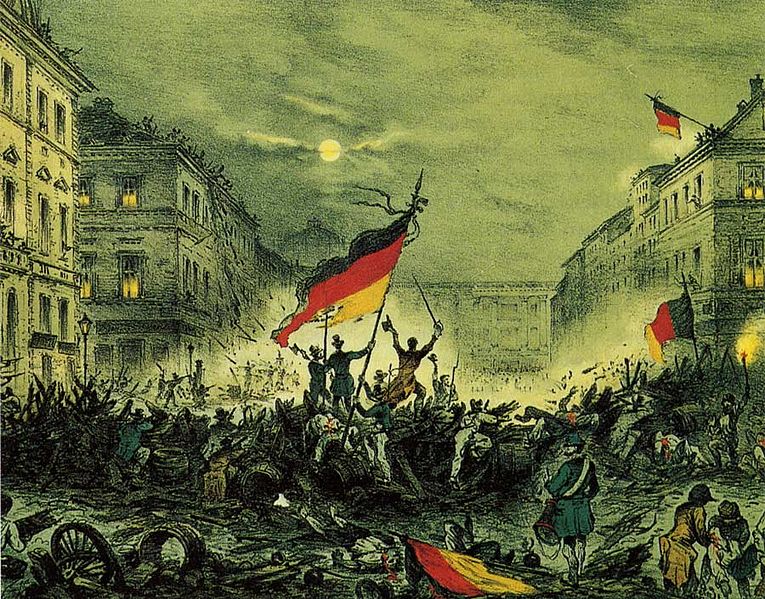
On this date in 1848, a day short of his forty-second birthday, the German revolutionist Robert Blum was summarily shot in Vienna — a tragic victim of Germany’s Revolutions of 1848.

Marker at Robert Blum’s birthplace in Cologne reads “I die for the German liberty that I fought for. May the fatherland remember me.” (cc) image from Elke Wetzig.

Blum grew up in a penniless proletarian family but drifted into the literary set. He spent the 1830s penning liberal-minded plays, poetry, newspaper correspondence. He uncovered a magnetic personality and a gift for organization.

By the 1840s he was a — maybe the — preeminent left-liberal in the Kingdom of Saxony: pro-parliamentary democracy, anti-violence, for a wide grant of civil liberties and mass education.

The pressures, both liberal and radical, pushed to the brink the small realms in the German Confederation, as well as the neighboring Austrian Empire. Both struggled to handle even the liberals’ demands like expanding the franchise and freedom of the press, with old hereditary polities that might not be up to changing times. Germany, Marx and Engels wrote in the Communist Manifesto (1847), “is on the eve of a bourgeois revolution.”

Right on cue…

That pregnant year of 1848 found Blum in the Frankfurt parliament, and his neither-fish-nor-fowl leftism — a little too out there for mainstream liberals; a little too bourgeois for real radicals — made Blum the perfect pick for a solidarity mission.

When in September 1848 the Austrian army was defeated trying to crush a Hungarian rebellion, the Habsburg capital of Vienna took the example and mounted a revolution of its own, putting the government to flight.

Blum was sent as sympathetic delegate to this abortive Viennese commune, but found himself trapped in the city when the Austrian army encircled it in late October.

The Austrians, when they caught him, sent their own message back by denying him any form of deference for his parliamentary rank. Blum’s direct condemnation was a stark warning by the Habsburg state to agitators, but also to their putative brethren dreaming of a Greater Germany. Austria wasn’t buying what the Großdeutsche people were selling.


Detail view (click for the full image) of Carl Steffeck’s painting of Robert Blum’s execution. Here’s a YouTube recreation (in German).

Blum went on to a posthumous career as a star liberal martyr among the German circles who had use for such a character.

Blum’s seven-year-old son Hans grew up to follow his father’s literary footsteps … but from quite the other side of the aisle. He was a pro-Bismarck nationalist.

On this day..

1864: Retaliatory executions by John Mosby

Though executioners don’t quite bat 1.000 — who does, at any human endeavor? — the field on the whole succeeds more often than not.

On this date in 1864, the Confederate guerrilla John S. Mosby had seven Union prisoners executed, but he only managed to kill three of them — an efficiency very well below the Mendoza Line for the executioner’s trade.

It was a rare competence gap for the brilliant cavalryman.

The irregulars Mosby commanded in the Shenandoah Valley had frustrated for six months the consolidation of rampant northern armies, thereby preserving the Confederate capital of Richmond and extending the Civil War.

The situation had quick become intolerable for the Union, and Gen. Ulysses Grant emphasized (pdf) to Gen. Phil Sheridan the cruel anti-insurgent tactics he would countenance for “the necessity of clearing out the country so that it would not support Mosby’s gang. So long as the war lasts they must be prevented from raising another crop.”

By way of example-setting, the Union army had summarily executed six of Mosby’s rangers at Front Royal in September — followed by a seventh who was captured in early October in Rappahanock County.

Incensed, the Confederate “gray ghost” began stockpiling blue bodies from the offending command of George Armstrong Custer — yes, the Little Bighorn guy; he was perceived by Mosby to be responsible for the atrocity, although the actual paper trail on the execution order seems to be a little sketchy.

Mosby, who fancied himself the genteel sort who would closely abide the laws of war when fighting for the right to maintain human chattel, sent a lawlerly appeal up the chain of command seeking permission “to hang an equal number of Custer’s men.” General Robert E. Lee and Confederate Secretary of War James Sedden granted it.

Twenty-seven captives were therefore assembled and subjected to a lethal lottery. Jay Simson’s Custer and the Front Royal Executions of 1864 recounts this horrible affair in an excrutiatingly page-turning narration.

The preparations began innocently enough on a quiet Sunday morning (November 6, 1864) when 27 Union prisoners of war were ushered with no explanation about what was happening out of a brick storehouse located in Rectortown, Virginia …

[They] were then marched to the banks of Goose Creek, about half a mile away. some, but definitely not all, of this specially selected pool of 27 prisoners belonged to Custer’s commands both past and present … [but] of the seven men eventually selected to die on Mosby’s orders only two were actually members of the Michigan Cavalry Brigade.

All 27 of the prisoners were lined up along Goose Creek and then made to draw slips of paper from a hat. Twenty of those slips of paper which were part of the macabre lottery were simply that, blank pieces of paper. The other seven — one for each of Mosby’s men executed at Front Royal and in Rappahanock County — were marked with a number …

Of the men who were forced to draw those slips of paper, some of them simply stared into space. Others, once they understood what was happening, prayed. There were a few of them who simply broke down.

Among the prisoners was a young drummer boy … who broke down completely, sobbing … He drew a blank slip and immediately proclaimed: “Damn it, ain’t I lucky!” When a second drummer boy was found to be unlucky enough to have drawn one of the marked slips of paper, upon the request of the men who had been spared, Mosby personally ordered the boy to be released from the seven condemned prisoners and the 18 remaining prisoners (excluding the first drummer boy) drew from the slips of paper for a second time.

Then one of the seven adults also got himself swapped out of the scrap by flashing a Masonic sign at a Confederate lodge member. The things that stand between life and death.

Out of the nine to come under death’s pall and the seven who were actually marched overnight to the place of execution (as close to Custer’s camp as Mosby dared) only three were there successfully ushered past death’s threshold.

At 4 a.m. on Monday, November 7, 1864 (the day before the election which would give Abraham Lincoln his second term in the White House and would therefore become the signature on the death warrant of the Confederacy), the Rangers and their prisoners reached the execution site in Beemer’s Woods, a mile west of Berryville, and the executions were carried forward. However, everything did not go exactly according to plan.

In the pre-dawn darkness and confusion (either through carelessness or lack of caring for their orders, since none of the prisoners had actually been involved in depredations against Confederate civilians) the Rangers allowed two of the seven prisoners (one of whom, G.H. Soule, 5th Michigan Cavalry Regiment, punched out a guard) to escape outright. Two other prisoners were apparently shot in the head, but surviving, having only been grazed, also escaped since they pretended, and were apparently believed, to be dead. The remaining three prisoners were hanged. The identities and whether or not these three prisoners were members of either Custer or Powell’s commands are unknown. Lt. Thompson, in accordance with his orders attached a placard to one of the hanged men (just as similar placards had been attached to the bodies of all three of Mosby’s hanged men). Mosby’s placard read: “These men have been hung in retaliation for an equal number of Colonel Mosby’s men hung by order of General Custer at Front Royal. Measure for Measure.”

Believing his purpose accomplished, or at any rate close enough for rebel government work, Mosby then wrote to Union General Sheridan justifying the action and assuring him that future “prisoners falling into my hands will be treated with the kindness due to their condition, unless some new act of barbarity shall compel me, reluctantly, to adopt a line of policy repugnant to humanity.”

The letter, and the 3-out-of-7 reprisal, actually worked — with no further measures exacted for measure or tits given for tat. For the waning months of the war the rival forces confined themselves to killing one another on the battlefield, and not in the stockade.

Well, mostly: one of the conspirators in the plot to assassinate Abraham Lincoln in April 1865 — which did assassinate Lincoln, but was really a wider attempt to decapitate the entire northern government — was a former Mosby’s ranger named Lewis Powell aka Payne. Lincoln killer John Wilkes Booth also seemed to flee in Mosby’s direction (Mosby’s units were still in the field, not covered by the April 9 Appomattox surrender.) There exists an unproven but delicious speculative hypothesis that the hand of John Mosby was among those behind an exponentially more ambitious “line of policy repugnant to humanity.”

Be that as it may, Mosby actually became a Republican after the war — for which he received some Southern death threats — and lived fifty eventful years. Among other things, the aged Mosby regaled the young George Patton (whose father Mosby knew) with Civil War stories.

On this day..

1944: Boy Ecury, Aruban Dutch Resistance hero

On this date in 1944, Dutch Resistance hero Boy Ecury was shot by the occupying Germans.

Ecury (English Wikipedia entry | Dutch) grew up in Oranjestad, capital of the Dutch-controlled Caribbean island of Aruba, but had packed off to the Netherlands to finish school by the time World War II broke out. He spent the early Forties with a Resistance group sabotaging German assets and the like.

This insurgent clique eventually got rolled up, and Boy Ecury was arrested on November 5, 1944. He had only that one night to enjoy the legendary hospitality of the occupiers before he and several others of his group were shot the next day.

The young martyr’s body was repatriated to Aruba after the war and buried with honors; a public memorial still stands to him in Oranjestad.

Boy’s sister, the venerable poet Nydia Ecury, just passed away earlier this year.

On this day..

2000: Yopougon Massacre

This date in 2000 saw the most notorious incident in a dreadful wave of election violence in the West African nation of Ivory Coast.

The context was the aftermath of a contentious 2000 presidential election summoned by a coup government that had overthrown the previous regime the year before.

Ivorian politics pitted the more prosperous coastal Christian south against the more rural Muslim inlands, but the 2000 election did not: Alassane Ouattara, the northern/Muslim standard-bearer was eliminated from the election by a conveniently-introduced summer 2000 law disqualifying candidates with a foreign parent. Ouattara was a former Ivorian Prime Minister, but for this election, he wasn’t Ivorian enough to stand.

Political bad blood became political bloodsport with the Oct. 22 election.

On Thursday, Oct. 26, 2000 — which was also the day that election’s winner Laurent Gbagbo was officially sworn in, despite thousands protesting — pro-Gbagbo militias went to town on Ouattara supporters, Muslims, immigrants.

In pro-Gbagbo sections of Abidjan like the suburbs of Abobo and Yopougon, ethnic Dyula or Dioula were rounded up en masse, mosques attacked by mobs, and people menaced, beaten, or worse.

The Human Rights Watch report “The New Racism: The Political Manipulation of Ethnicity in Côte d’Ivoire” gathers a number of these eyewitness accounts, including the summary execution/mass murder of 57 that would make global headlines (French link):

In the late afternoon of October 27, the bullet-ridden bodies of fifty-seven young men were found dumped in two piles in a forest clearing on the outskirts of Yopougon. After speaking with two survivors of and several witnesses to events surrounding the massacre, Human Rights Watch researchers established that paramilitary gendarmes based at the Gendarme Camp of Abobo were directly responsible for the killings. This incident was the single worst atrocity of the election period.

The massacre took place on October 26, 2000 in two stages. The first involved the shooting of detainees at the Gendarme Camp of Abobo, where young men rounded up from Abobo neighborhood were taken during the morning and early afternoon of October 26, 2000. Prior to the shooting detainees were subject to … brutality and torture … At approximately 3:00 p.m…. at least two gendarmes opened fire on the detainees held there, killing some thirty to forty.

The second stage showed the signs of being a well-planned operation. Well-armed gendarmes deployed intoa neighborhood bordering the Gendarme Camp of Abobo and rounded up between eight and thirteen young men who were used as porters to load the dead onto a truck and later dispose of the bodies in the forest. The porters and all other survivors were then gunned down, though some were not killed. These survivors described the presence of one truck, two jeeps, and the involvement of some thirty gendarmes in this operation.

Two men (they’re both directly quoted in the Human Rights Watch report) survived the second stage of the massacre by playing dead.

This unpunished incident — eight gendarmes were tried, but all acquitted — has blended into the rich tapestry of grievances stoking Ivory Coast tensions down to the present day.

Laurent Gbagbo … under arrest. (Not for this massacre.)

When outright civil war erupted in 2002, anti-Gbagbo rebels reportedly yelled “This is for Yopougon!” when gunning down policemen.

In 2010 Ouattara beat Gbagbo in yet another presidential election. That led to a fresh round of nasty civil war.

That war’s upshot was to seat Ouattara — he’s President of the Ivory Coast as of this writing — and to extradite Gbagbo for war crimes proceedings at the Hague. But in the course of that more recent bloodletting, Yopougon once again became a massacre site, and its football pitch “an open-air cemetery”.

On this day..

1569: Vladimir of Staritsa, royal cousin

On this date in 1569, Vladimir of Staritsa was forced by Ivan the Terrible’s goons to drink poison.

Vladimir was Ivan’s (barely) younger cousin, both of them grandsons of Russia’s state-building Ivan the Great.

Ivan the Terrible, of course, was the heir to the throne, an inheritance he received at the tender age of three when his father died unexpectedly — leading to Ivan’s famously miserable childhood of being kicked around by the boyars.

The dreadful relationship thereby fostered between throne and nobles came to a crossroads in 1553, when Ivan the Terrible appeared to be on his deathbed. The fading tsar tried to get those boyars to swear loyalty to Ivan’s infant son. Most of the boyars openly preferred the adult Vladimir of Staritsa.

This dramatic encounter is a pivotal episode in Sergei Eisenstein’s classic film Ivan the Terrible.

Instead of dying, Ivan surprisingly recovered. Awkward!

Vladimir actually survived this episode, and he himself may not even have been actively trying to claim the throne: the boyars hated Ivan plenty without his seditious assistance.

And for a while it looked as if any ill feelings were water under the bridge. Vladimir swore loyalty to Ivan upon the latter’s recovery, fought military campaigns alongside Ivan, and was even depended upon by Ivan as a guarantor of peace among Ivan’s own several potentially rivalrous sons.*

But that was the 1550s.

As the 1560s unfolded, Ivan grew increasingly mistrustful of his boyars’ loyalty.** According to this volume, an elevation of Vladimir to the throne was the object of at least one plot during those years. As Ivan’s only male cousin, he was a natural successor should Ivan be deposed, and therefore a natural focal point for Ivan’s enemies.

When Ivan eventually gave rein to his paranoia and unleashed the bloody purges of the oprichnina, Vladimir inevitably succumbed. Ivan decreed his death and forced him to administer the sentence by his own hand with a draught of poison, even going so far as to extirpate Vladimir’s wife and children, too.†

In a twist of the cruel irony Russian history is so susceptible to, Ivan the Terrible’s homicidal suspicion of his relations helped to doom Ivan’s own Rurik dynasty: after Ivan accidentally killed his own son and heir in a fit of pique, the succession which might have found a backup option in Vladimir and his offspring instead utterly collapsed — plunging Russia into the “Time of Troubles” out of which one of those former boyar families, the Romanovs, emerged with the throne after all.

* See Sergei Bogatyrev, “Reinventing the Russian Monarchy in the 1550s: Ivan the Terrible, the Dynasty, and the Church”, The Slavonic and East European Review, Apr. 2007. (pdf here)

** Ivan’s nasty turn after 1560 might trace to the untimely death of his wife Anastasia Romanovna, whom Ivan suspected might have been poisoned by those hated boyars.

† One daughter Maria Vladimirovna of Staritsa, survived.

On this day..

1646: Zhu Yujian, the Prince of Tang

On this date in 1646, Zhu Yujian was captured and summarily executed at Tingzhou.

This gentleman went under the title Prince of Tang, making him Beavis and Butthead’s favorite Ming despot. Indeed, he was a direct descendant of the founder of that illustrious dynasty. Unfortunately for the Prince of Tang, that descent was of the ninth generation, which meant that the Ming were well into their decadence and decline.

The Prince of Tang had spent essentially the whole of his adult life seeing the state eaten away by sclerotic bureaucracy, internal revolts, economic breakdown … and, as a consequence of all that erosion, by the incursions of the Manchus.

The first ruler of those people’s successor Qing dynasty was already on the Chinese throne at this point, having seized the capital Beijing in 1644. The splintering thereafter of Ming officials and loyalists led to, among other transitional formations, a “Southern Ming dynasty” — far southern, almost to Burma. The Prince of Tang would accede to this contingent remnant of a once-glorious dominion, and enjoy the conceit of the purple and its prospect of imminent violent death for the last 14 months of his life.

When his able military commander Zheng Zhilong saw the writing on the wall and defected, Qing soldiers pouring through defenseless passes and over the Qiantang River swiftly routed the demoralized southern Ming in the summer of 1646.

The Longwu Emperor — that’s what the Prince of Tang was styling himself, the name inaptly meaning “plentiful and martial” — spent his last days being driven from pillar to post ahead of the Qing before he was finally overtaken and put to summary death with his wife.

The Southern Ming would fight on another fifteen years, but the particular familial branch embodied by the Prince of Tang met an unceremonious end long before the Ming as a whole succumbed. Zhu Yujian’s younger brother succeeded him as “the Shaowu emperor” that December and squandered the scant resources of his statelet — “lacking court dress, the thousands of officials who were appointed to the Shaowu government … had to buy theatrical robes from local actors” — on a few weeks’ counterproductive civil strife with a rival Ming claimant until the Qing utterly overran them.

On this day..

782: 4,500 Saxons by order of Charlemagne

On an unknown date in the latter half of 782, Charlemagne did some seriously nasty business with a captured army of Saxons.

In the late 8th century, the King of the Franks was fighting a decades-long running campaign against Saxon tribes at the edge of his sprawling European empire.

One part Christianizing the pagans and two (or more) parts territorial aggrandizement, Charlemagne’s exertions on the Rhinish frontier were opposed by Widukind, or Witikind, or Widochind, whose “forest-child” name belies its owner’s legendary ferocity.


Widukind was reclaimed in the Renaissance as a patriotic or national figure. (Source)

In the summer of 782, when Charlemagne perhaps thought he had whatever passed for peace among the querulous Saxons, Widukind raised a revolt and dealt the Franks a stinging defeat that put a couple of imperial legates into the ground and made some martyrs out of clerics he found in the wrong place at the time.

Charlemagne’s forces counterattacked and routed the Saxons at the Battle of Suntel (or Sonnethal) Mountain, and thereupon

questioned the primores of the Saxons, all of whom be had summoned to attend him, as to who was responsible for the rebellion which had taken place. And since they all declared that Widukind was the author of this wickedness but were unable to deliver him up in view of the fact that he had taken himself off to the Northmen once the deed had been done, no fewer than 4500 of the others, those who had fallen in with his promptings and committed such a gross outrage, were handed over and at the place on the river Aller called Verden, at the king’s command, all beheaded in a single day. Thus was punishment executed; and the king then retired to winter-quarters at Thionville, where he celebrated both the Lord’s birthday and Easter in the customary fashion.

This merciless slaughter of prisoners is one of the lasting blights on Charlemagne’s impressive reputation. Even so, the reputation had the last word: three years later, Witikind was finally defeated and delivered up, in person, to the Frankish ruler … who accepted the Saxon pagan’s submission and forced him to convert to Christianity.


Charlemagne receives Witikind’s submission at Paderborn in 785.

On this day..