1682: Ivan Khovansky

On this date in 1682, the boyar Ivan Andreyevich Khovansky went from being the power behind the throne to one of the skulls under it.
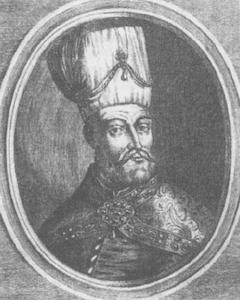
A veteran military commander, Khovansky (English Wikipedia entry | Russian) became a key figure in the months after the death of Tsar Feodor III of Russia. This perilous political moment left the throne in the hands of two underage half-brothers overseen by a female regent.

With benefit of hindsight we know that 10-year-old (in 1682) Peter will emerge from this troika to become the mighty Tsar Peter the Great. In 1682, it was anybody’s guess whether any of these dubious prospective autocrats might survive at all.

Peter in particular had cause to fear for his life in May 1682 when the Streltsy, a hereditary guard of Moscow musketeers, bloodily rebelled in favor of his co-heir’s privileges and against his own, rampaging through the Kremlin murdering princes in Peter’s circle. And at the head of these furies stood Khovansky.

Many years later, Peter would revenge himself upon the Streltsy for this horror but in the moment it carried the day, incidentally also carrying Khovansky to a preeminent position in the state.

But he was pitted almost immediately against his erstwhile patron and ally, the regent Sophia Alekseyevna.

Even though the Streltsy rebellion had been conducted on Sophia’s behalf, she could see as well as the next tsar the perils of embracing these latter-day praetorians‘ authority to remake the government by force … and the Streltsy made sure to remind her of it almost immediately when the “Old Believer” movement that predominated among its ranks started raising complaints about Sophia’s religious accommodations.*

Fearing an overmighty nobleman at the head of a treasonable host — and Khovansky has been suspected by both his contemporaries and posterity of coveting the regency for himself — Sophia and the young co-tsars briefly fled Moscow “because we could not tolerate the many offences, unlawful and gross actions and violations committed by criminals and traitors.” Meanwhile she maneuvered adroitly to isolate him politically and had the boyar Duma vote his attainder.

His fate was sealed by the discovery of an anonymous (probably fabricated) letter of denunciation. On 17 September, her own name day, Sophia succeeded in luring Ivan Khovansky and his son Ivan to the royal summer residence at Vozdvizhenskoe outside Moscow. The charges against them centred on their ‘evil designs upon the health and authority of the great sovereigns’ which involved no less than plotting to use the strel’tsy to kill the tsars, Tsaritsa Natalia, Sophia and the patriarch, then to raise rebellion all over Moscow and snatch the throne. The lesser charges included association with ‘accursed schismatics’, embezzlement, dereliction of military duty, and insulting the boyars. The charges were full of inconsistencies and illogicalities, but their sheer weight sealed the Khovanskys’ fate and Prince Ivan and his son were beheaded on the spot … The strel’tsy were forced to swear an oath of loyalty based on a set of conditions, the final clause of which threatened death to anyone who ‘speaks approvingly of the deeds of late, or boasts of committing murder or makes up phrases inciting rebellion as before, or stirs up people to commit criminal acts.’ (Source)

He’s the subject of the Mussorgsky opera Khovanshchina.

* Old Believers wanted a rollback of religious reforms decreed in recent years; Sophia said no dice. Once Peter the Great took over, Sophia and Old Believers alike would end up in the same boat.

On this day..

1869: An Dehai, beloved eunuch

The imperial eunuch An Dehai was beheaded in Jinan on this date in 1869.

He was so much the favorite that it’s been clained that the redoubtable Empress Dowager Cixi had outright fallen in love with the courtier.

This was a circumstance destined to sharpen both An’s confidence in his position, and the blades of the inevitable enemies within the Forbidden City who were keen to be rid of him.

In 1869, the eunuch was dispatched to Nanjing as Cixi’s envoy to arrange the wedding gowns for the marriage of her son, the titular boy-emperor in whose name Cixi wielded power. On this trip, Cixi openly flaunted the protocol requiring eunuchs keep themselves inconspicuous, and also allegedly used the occasion to feather his bed with a bit of opportunistic extortion.

This, at any rate, was the report that an imperial governor relayed back to Prince Gong, who had once helped Cixi seize power in the state but had now become her rival. Gong got a quorum of the Grand Council to sign off on An’s execution while Cixi was off at the opera. She was so bereaved to discover his fate that she had his belongings lovingly gathered up for permanent safekeeping.

On this day..

1952: Mustafa Khamis and Muhammad al-Baqri, Egyptian labor activists

On this date in 1952, Egypt’s revolutionary military government sent a gallows warning to the labor movement.

The towering political figure of the whole Arab world until his death in 1970, Gamal Abdel Nasser led a coup that toppled Egypt’s monarchy just weeks prior to the execution we mark here. (On July 23, 1952; it’s known for that reason as the July 23 Revolution.)

They had bold plans for their countrymen, these young officers: egalitarian land reform, pan-Arabism, release from the hated grip of colonialism.

But don’t mistake that for an invitation to present just any grievance.

the Free Officers were not willing to tolerate a militant, independent trade union movement. The armed forces and workers clashed in Kafr al-Dawwar, 15 miles south of Alexandria. On August 12 and 13, 1952, the 9,000 workers at the Misr Fine Spinning and Weaving Company conducted a strike and demonstration seeking a freely elected union (a pro-company, yellow union had been established in 1943), removal of several managers considered particularly abusive, and the satisfaction of economic demands. Despite the workers’ proclaimed support for the new regime, the army quickly intervened to crush them. A rapidly convened military tribunal convicted 13 workers. Eleven received prison sentences; Mustafa Khamis and Muhammad al-Baqri were sentenced to death and executed on September 7. (Source)

Nasserite Egypt quashed independent labor organizing in these early years, eventually banning all union activity outside of the state-controlled Egyptian Trade Union Federation.

On this day..

1799: Ettore Carafa

On this date in 1799, a nobleman turned republican was turned into a martyr.

Fruit of the distinguished Carafa family, Ettore Carafa (English Wikipedia entry | Italian) was the Count of Ruvo but preferred the ennoblement of all mankind.

After a youthful trip to Paris on the verge of the French Revolution, Carafa returned to make himself the scandal of the Neapolitan aristocracy by such behaviors as translating the Declaration of the Rights of Man and of the Citizen and wearing the republican tricolor to the opera. Carafa was eventually obliged to break out of prison and take sanctuary in the Cisalpine Republic but he returned in glory (and no little satisfaction) with the 1799 Parthenopean Republic, when Naples briefly went republican, too. Commissioned an officer in revolutionary Naples’s army, he besieged his hometown of Andria.

Alas, this democratic interlude did not even live out the year, and many of its leading lights paid the forfeit to a violent reaction. Naples’s briefly-exiled queen was Marie Antoinette‘s sister and nowise forgiving when it came to Jacobin types and certainly not “such a man as Carafa, fit match as he was to Caracciolo, and held in almost equal terror by the Court.”

Carafa was one of its last holdouts, defending Pescara from siege well after Naples itself had fallen.

On September 4, 1799, Carafa mounted the guillotine with aplomb, his last words a command to the executioner Tommaso Paradiso, “You will tell your queen how a Carafa can die!” Then he slid himself under the knife on his back, boldly looking up at the instrument of death as it crashed through him.

On this day..

1937: Alexander Shlyapnikov, Workers’ Opposition leader

September 2 was the execution date during the purge year of 1937 for Old Bolshevik trade unionist Alexander Shlyapnikov.

The metalworker Shlyapnikov was a man who came by his revolutionary politics right from the shop floor. At the age of 10 he left school to work in a foundry, “having learnt to read and write. School was no mother to me, and it was not the teachers who educated me … the teachers were young and very rude, and they often meted out justice to their young charges with their fists. Even during these years, life taught me that there is no justice in this world.” (Source) Born to an Old Believer family, his fervor for justice had an initial religious bent, but after moving from provincial Murom to St. Petersburg/Petrograd* he discarded godliness and became a labor militant of sufficient stature to start turning up on blacklists before he was out of his teens.

During the political chill following Russia’s failed 1905 revolution, the oft-arrested Shliapikov worked abroad in western Europe — by now both a master of his difficult craft, and a Bolshevik who had led an armed rising in his hometown of Murom. Here he became socially and politically close with Lenin and all the brand-name Communist exiles, as well as with European labor unions and left parties.

He also shuttled to and from Russia coordinating the movement’s internal and external actors; he’s left us a memoir of the political maneuvers and adventurous border-crossings of these years. Thanks to this role, Shliapnikov was the most senior Bolshevik on the scene in Petrograd when the February Revolution broke out; he was immediately a key figure in the Petrograd Soviet, and was the Bolshevik state’s first Commissar for Labor.

As the newborn USSR solidified in form and function, Shlyapnikov nursed growing concerns about its distance from — and tendency to run roughshod over — actual workers. He soon became a leading voice for the Workers’ Opposition** around 1919 to 1921. Where the Bolsheviks held that theirs was an ascendant workers’ polity that had subsumed mere guilds, Shlyapnikov insisted on the trade unions as distinct from the Soviet state and the Communist party — “a syndicalist deviation” in Lenin’s charge. The Workers’ Opposition was prescient in its critique of the once-utopian project’s creeping bureaucratizm, with real workers’ material interests, dissenting perspectives, and local idiosyncracies giving way everywhere to the center’s policy orthodoxy dictated through “apparatuses of power … located practically in hands alien to the interests of the working class.” (Source)

Although prominent in its day, the Workers’ Opposition viewpoint was not destined to carry forward into Soviet theory or practice. After bread shortages drove workers and sailors at Kronstadt into a rebellion that the Bolsheviks crushed in 1921, the Workers’ Opposition tendency was quashed within the party. Shlyapnikov thereafter held second-rate posts, and was several times investigated by the Communist Party for “factionalism,” finally being expelled under Stalin in 1933.†

He was favored with a 2016 biography by Barbara C. Allen, Alexander Shlyapnikov, 1885-1937: Life of an Old Bolshevik (review). Allen discussed Shlyapnikov in an interview with the indispensable Sean’s Russia Blog podcast, here. We yield to Allen’s description of Shlyapnikov’s demise among the purging of Old Bolsheviks following the Kirov affair — tragic, banal, and heroic in his plain refusal to gratify his persecutors with any manner of confession or groveling.

In April 1937 he was accused according to article 58-8 and 58-11 of the RSFSR law code of having led a counterrevolutionary group called the Workers’ Opposition, of having linked up with the ‘counterrevolutionary Trotskyist-Zinovievist terrorist bloc’ and of having ‘tried to conclude a bloc with Ruth Fischer for joint struggle against the policy and measures of the Comintern.’ It alleged that he advocated ‘individual terror’ and that groups he directed in Omsk, Rostov-on-Don, Kiev, Odessa, Baku, Kharkov and Moscow had ‘prepared and tried to realise the murder of comrade Stalin.’ Acknowledging that Shlyapnikov did not confess his guilt, the accusation established it through the testimony of Zinoviev, Safarov, Vardin and others. It recommended that the Military Collegium of the USSR Supreme Court should try him and apply the 1 December 1934 law. Applying to cases of terrorist acts, this law ordered the immediate execution of capital-punishment sentences, with no appeals.

The USSR Supreme Court Military Collegium met on 2 September 1937 in closed session to sentence Shlyapnikov, who appeared before the court in a two-hour long session. Refusing to admit his guilt, he also detailed his objections to others’ testimony against him. Given the last word, Shlyapnikov declared that he was ‘not hostile towards soviet power.’ Perhaps as a last ironic remark, he confessed guilt only to ‘a liberal attitude towards those around him.’ Nevertheless, the court on the same day found him guilty under article 58, paragraphs 8 and 11, of having led ‘an anti-Soviet terrorist organisation, the so-called “Workers’ Opposition,”‘ which carried out ‘counterrevolutionary activity directed towards the topping of soviet power.’ He was convicted of having been in contact with ‘leaders of Trotskyist-Zinovievist and Right-Bukharinist terrorist organisations’ and of having ordered members of his ‘anti-Soviet organisation’ to carry out ‘terrorist acts’ against party and government leaders. Then the Military Collegium sentenced him to ‘the highest measure of punishment — execution by shooting with confiscation of all personal property.’ Below this was pencilled: ‘the sentence was carried out on that day in Moscow.’ Despite ‘eyewitness’ tales that he survived for years longer, either abroad or under a false name in the Gulag, documents attest to the fact that shortly after his 1937 execution, Alexander Shlyapnikov’s body was cremated and buried in Donskoy cemetery in a common grave.

* Peter the Great‘s jewel was still St. Petersburg when Shlyapnikov arrived there in the last years of the 19th century; it was renamed Petrograd in 1914 and carried that name during the events of the 1917 revolutions and thereafter. It became Leningrad in 1926, a name that stuck for the remainder of the Soviet era.

** Alexandra Kollontai was also a noteworthy Workers’ Opposition exponent; her apologia makes for sad reading considering the Soviet state’s coming vector towards sclerotic authoritarianism.

† Stalin’s ideological mediocrity is commonplace observation but perhaps its signal instance occurred upon his arrival to revolutionary Petrograd before Lenin: where Shlyapnikov was refusing to entangle the Bolsheviks with the Provisional Government (post-February revolution, pre-October revolution), Stalin insisted on a more moderate and cooperative attitude. When Lenin arrived shortly thereafter, his April Theses famously re-set Bolshevik policy in Shlyapnikov’s more intransigent direction — a defeat to which Stalin owed the Bolshevik conquest of power and his own eventual opportunity to execute men like Shlyapnikov.

On this day..

1816: Joaquim Camacho

On the last of August in 1816, the Colombian statesman Joaquin Camacho was executed as a traitor to Spain.

Blind and paralyzed — he had to be carried to his firing squad in his chair — this lawyer-turned-journalist decorated the 1810-1816 “Foolish Fatherland” era of present-day Colombia, when New Granada declared independence from a Spain bogged down by the Napoleonic Wars.

In fact, multiple regions and municipalities within New Grenada each began declaring their own sovereignty in 1810. The July 20, 1810, declaration by Bogota — then and now the capital city — is still commemorated as Colombia’s Independence Day.

And Camacho (English Wikipedia entry | Spanish) was right in the middle of it.

On the morning of July 20, in a maneuver intentionally staged to coax the Spanish authorities into showing their backsides to New Granada’s patriots, Camacho presented himself to the viceroy to request the calling of a council in Bogota — a request he would (and did) certainly refuse. Elsewhere in the iconic “Flower Vase Incident,” Camacho’s comrades solicited of a wealthy royalist merchant the use of his ornamental flower vase to welcome the arrival of a noted fellow-traveler. They too were predictably refused, and escalated the expected affront into a fistfight and thence to a riot in the market. The backlash against these indignities gave cover to proclaim the independence of Bogota — with Camacho among the signatories of the declaration at a public meeting that evening.

During the exciting years that followed, Camacho served in the Congress of the United Provinces of New Granada and for a few months in 1814-1815 as one of a triumvirate collectively exercising the office of president.

All such offices were swept away by the Spanish reconquest of New Granada under Pablo Morillo, who lived up to his chilling nickname “El Pacificador”. Camacho was among numerous separatist and revolutionary leaders put to death to control New Granada, several of whom we have already encountered in these annals. It worked … for all of three years, until Simon Bolivar accomplished permanently what Camacho et al and died in seeking.

On this day..

476: Orestes, father of the last Roman Emperor

On this date in 476, the father of the very last Roman emperor was put to death by a Germanic chief … a week before that last emperor was forced to abdicate his throne and the whole Roman experiment with it.

The final generation of Roman Emperors comprise a parade of nondescript interregnums, but the very last regnum fell to 16-year-old Romulus Augustulus whose destiny it was to seal the long fall of the (western) Roman Empire.

This youth with the apt nomen had been plopped in the purple by his dad, a Pannonian-born general named Orestes. Orestes had made his bones in the court of Attila the Hun before signing on as a free agent with Rome when the Hunnic polity collapsed after Attila’s death; he accordingly enjoyed the regard of the heavily-Germanic enlistees of Rome’s armies — a simpatico that constituted a great asset for Rome and a great danger for her sovereign. Our opportunistic general was able to turn this force against the previous emperor,* but as Gibbon notes, “having now attained the summit of his ambitious hopes,” Orestes encountered the danger of his disloyal soldiery from the opposite end of the spear.

[H]e soon discovered, before the end of the first year, that the lessons of perjury and ingratitude, which a rebel must inculcate, will be resorted to against himself; and that the precarious sovereign of Italy was only permitted to choose, whether he would be the slave, or the victim, of his Barbarian mercenaries. The dangerous alliance of these strangers had oppressed and insulted the last remains of Roman freedom and dignity. At each revolution, their pay and privileges were augmented; but their insolence increased in a still more extravagant degree; they envied the fortune of their brethren in Gaul, Spain, and Africa, whose victorious arms had acquired an independent and perpetual inheritance; and they insisted on their peremptory demand, that a third part of the lands of Italy should be immediately divided among them. Orestes, with a spirit, which, in another situation, might be entitled to our esteem, chose rather to encounter the rage of an armed multitude, than to subscribe the ruin of an innocent people. He rejected the audacious demand; and his refusal was favorable to the ambition of Odoacer; a bold Barbarian, who assured his fellow-soldiers, that, if they dared to associate under his command, they might soon extort the justice which had been denied to their dutiful petitions. From all the camps and garrisons of Italy, the confederates, actuated by the same resentment and the same hopes, impatiently flocked to the standard of this popular leader; and the unfortunate patrician, overwhelmed by the torrent, hastily retreated to the strong city of Pavia, the episcopal seat of the holy Epiphanites. Pavia was immediately besieged, the fortifications were stormed, the town was pillaged; and although the bishop might labor, with much zeal and some success, to save the property of the church, and the chastity of female captives, the tumult could only be appeased by the execution of Orestes.

As for the young puppet-emperor Romulus Augustulus himself, the conqueror who now proclaimed himself King of Italy wasn’t a vindictive man. “The life of this inoffensive youth was spared by the generous clemency of Odoacer; who dismissed him, with his whole family, from the Imperial palace, fixed his annual allowance at six thousand pieces of gold, and assigned the castle of Lucullus, in Campania, for the place of his exile or retirement.” This gesture of charity did not save Odoacer from suffering a violent death in his own turn.

* Julius Nepos has a claim on being the last Western Roman Emperor, insofar as Orestes’s revolt did not kill him but chased him to an exile where he pathetically maintained an ineffectual claim to the purple until his assassination in 480. It was only with Nepos’s death that the Western Roman Empire was formally abolished.

On this day..

1936: Melquiades Alvarez, a liberal in a revolutionary time

On this date in 1936, the Spanish politician Melquíades Álvarez was shot by the Republicans.

A centrist who disdained “two equally despicable fanaticisms … red fanaticism and black bigotry,” Alvarez (English Wikipedia entry | the more comprehensive Spanish) fell into the chasm torn by the Spanish Civil War.

The Gijon-born former barrister noted for his oratory had been in public life as a liberal back to the last years of the 19th century and in 1912 co-founded the Reform or Reformist Party. Although sympathetic to the democratic aspirations of the Republican movement, the Reform Party was cool to forcing a confrontation with Spain’s monarchy. He was briefly president of the Congress of Deputies before the military coup of Primo de Rivera. Alvarez opposed Primo, judiciously.

I recalled many years ago going to see another vacillating Liberal, the unfortunate Melquiades Alvarez, after he had ventured to criticise Primo at a public dinner. He was shivering in a travelling rug waiting to be arrested while he told with pride that he had made his speech in such guarded, euphemistic and even allegorical terms that no one would have been quite sure what he meant. He vacillated to the end and now the militia have shot him in the Carcel Modelo.

V.S. Pritchett

By the onset of the Republic in the 1930s, Alvarez’s institutionalism and anti-Marxism had his political tendency drifting rightwards in a revolutionary era, to the extent of actually joining the conservative coalition known as CEDA. Alvarez would surely have said that the Republic left him; a liberal to a fault, he even in these years defended the son of Primo de Rivera when this founder of the fascist Falange was arrested for conspiring to overthrow the Republic.

So the start of General Francisco Franco’s rebellion in 1936 found Alvarez in Madrid as a center-right parliamentarian — right in the path of a sharp political repression immediately leveled by the Republicans against perceived internal enemies. Alvarez and other right-leaning politicians were arrested in early August. Many, like Alvarez, were eventually shot by Republican militias after the barest of legal proceedings.

“You kill a man who only did you good,” Alvarez spat at his executioners before they opened up on him. “You slaughter in the worst way any idea of freedom and democracy, you pack of cowards and scoundrels!” (Quote translated from this Spanish-language pdf account of Alvarez’s last days.)


In this 1917 cartoon, Alvarez, a key political player during Spain’s crisis and near-revolution that year, swaps the caps of monarchism and republicanism in an “illusion” … for “everything remains the same”

On this day..

984: Pope John XIV

On this date in 984, the deposed Pope John XIV* was killed in prison.

Pietro Canepanova was his name by birth, and Bishop of Pavia was his rank when elected.

The papacy’s political axis in these prostrated times was the influence of the Holy Roman Empire. The Saxon emperor Otto II had given years of exertion to projecting imperial power over Rome and the Holy See, which although much weaker than the empire lay spatially at the fringes of effective imperial influence. The upshot was a fractious curial snakepit directed at any given moment by Otto’s degree of proximity and attention.**

John’s death, whose circumstances aren’t known with certainty,† was a sort of tragic middle act for the empire’s Roman project.

A decade before, the imperial-backed pontiff Benedict VI had been overthrown and murdered by a rival, known to history as Antipope Boniface VII. Boniface was backed by a Roman patrician family known as the Crescentii — rivals to Otto in our story.

The Boniface/Crescentii usurpation required Otto’s Italian hand to seize the city, and Boniface legged it for Constantinople with as much of the Vatican treasury as he could stuff into his chasuble. Behind, in his cloud of dust, the Germans installed a new guy, Benedict VII.

When Benedict died in 983, Otto was personally knocking about Italy,‡ so he popped into Rome to guarantee John XIV’s succession. But the pestilential atmosphere was not merely figurative in these parts, and a malaria outbreak killed Otto within days. His unexpected death left the succession to a three-year-old son, Otto III … which meant a period of ebbing imperial muscle as felt by remote marches like Italy. John XIV had lost his protection.

Still hanging around all this while, Antipope Boniface VII jumped at the opportunity to mount St. Peter’s throne once more and invaded Rome with the support of Byzantium and of the Crescentii, sending Pope John to the dungeons of Sant’Angelo where he was quietly offed.

Boniface’s own reign is largely obscure to posterity but it can’t be considered successful given that at his death in July 985, “the body of Boniface was exposed to the insults of the populace, dragged through the streets of the city, and finally, naked and covered with wounds, flung under the statue of Marcus Aurelius.”

Still, the Crescentii held the whip hand for years … until little Otto III grew up and returned to Rome in the 990s with a vengeance.

* Fun papal trivia: owing to some confusion in Middle Ages scriptoria, it was for a time erroneously believed that our Pope John XIV in fact compassed two different and very short-lived Popes John — “Iohannes XIV and Iohannes XIV bis” (the second). As a result, the regnal numbering for this particular name went all wonky and eventually skipped an increment: a pope took the name John XXI in 1276 mistakenly thinking himself to be the 21st of that name, even though the previous John (more than 200 years before — the span during which the numbering goof entered the parchments) was John XIX. There has never been a Pope John XX.

** Although the players are different, the situation reminds of the circumstances around the Cadaver Synod a century prior — when the imperial instigator in question was Charlemagne’s waning Carolingian dynasty.

† He might have been starved to death, or strangled, or poisoned, or indeed slain via almost any means convenient to the new pope’s goons. The probability that the death was ordered by the new pope qualifies this borderline case for consideration as an “execution.”

‡ He was campaigning against the Byzantines and the Saracens to extend imperial power to southern Italy and Sicily.

On this day..

1648: Sultan Ibrahim the Mad

On this date in 1648, the once-debauched and now-deposed Ottoman sultan Ibrahim I “the Mad” was strangled to make way for his seven-year-old son.

He’s fondly remembered as a debauched madman at the helm of state but you’d go crazy too with his upbringing. He was locked up by his famously brutal brother Sultan Murad in the palace Kafes — literally, “cages”, where potentially dangerous rival claimants lived under constant surveillance — and could not but dwell on the Damoclean sword constantly dangling at his throat. Justifiably nervous about the ever-present danger of a coup — Murad owed his own throne to the Janissaries deposing and murdering a prior sultan in 1622 — Murad had three of his caged brothers put to death. Ibrahim woke each day from the ages of 8 to 25 in his gilded cage knowing that Murad was one foul mood away from ordering his own death, too.

So paranoid was he that when informed that he was to come to the throne as sultan, he suspected a trick meant to implicate himself in treason. Only the combined assurance of his and Murad’s mother and the Grand Vizier* plus a personal inspection of the late Murad’s corpse convinced him to accept rulership of the Ottoman Empire.

And once he did so, he was able to unite in his person the pathologies of imprisonment with those of absolutism.

Freed from the terror of his cell, he gave himself to sensuality that was noted for both volume and transgressiveness: forcing himself on the Grand Mufti’s daughter, scouring his empire for the fattest woman he could find and elevating her to the pinnacle of his harem, and pony playing a virile stallion in his gardens to virginal women who were made to disrobe and act his mares. But don’t forget the wild mood swings! Becoming convinced that his harem was indulging in sub-imperial frolics, he once had 278 of them drowned in the Bosporous.

We will leave to wiser observers of the Porte than we just where among these legends we enter into the calumnies of the enemies who eventually toppled him. That happened in 1648 and had more to do with his profligacy in matters financial, for he gobbled jewelry and expensive furs as voraciously as maidenheads, and then put the Ottoman economy under a fearful strain by launching a ruinous war of choice against Venice that would drag on for 24 years and result in the Venetian navy blockading his capital.

Pitiably, his last days were spent back in the Kafe after he was displaced by rebelling Janissaries driven to fury by the growing tax burden required to support a war that brought only immiseration. Maybe it was a mercy that he had not years thereafter to pace the gardens under the eyes of burly minders with unknown orders, but for 10 days** that quarter of the palace redounded with his wails until

on August 18, the executioners entered the “Cage”. With the Koran in his hand, Ibrahim cried out: “Behold! God’s book! By what writ shall you murder me?” and “Is there no one among those who have eaten my bread who will take pity on me and protect me? These cruel men have come to kill me. Mercy! Mercy!”

* In 1644, Ibrahim would have this same Grand Vizier executed.

** We would be remiss on this grim site not to mention the fate that befell his Grand Vizier on August 8, when Ibrahim fell: torn apart by an angry mob for attempting to impose a heavy tax, he gained the posthumous nickname “Hezarpare” (“thousand pieces”).

On this day..