1704: Roland Laporte, posthumously, and five aides, humously

On this date in 1704, the great Camisard commander Pierre Laporte was publicly burned. He was already two days dead, but the same could not be said by five comrades-in-rebellion who were quite alive as they were broken on the wheel.

Familiarly known by the nom de guerre “Roland”, Laporte (English Wikipedia entry | the far more detailed French) was a whelp of 22 when entrusted with command of about 400 Protestant guerrillas operating around Lassalle, and his native Mialet.

These were rebels in a very dirty regional civil war in France’s heavily Protestant southeast, following the crown’s revocation of tolerance for the heretics. Roland proved himself one of its ablest prosecutors, putting Catholics to fire and sword be they enemy troops or wrongthinking neighbors.

By 1704 the insurgency was circling the drain as Camisard officers were either killed off or bought off. Our self-proclaimed “general of the children of god” was not the type to be had for 30 pieces of silver plus an army commission,* and so only violence would do for him. On August 14, betrayed by an informer who was amenable to purchase, Roland was slain in a Catholic ambush at Castelnau-les-Valence. Five officers escorting him opted not to go down fighting and surrendered instead, which proved a regrettable decision.

But even death could not slake the vengeance of his foes. “On the 16th August, 1704, the body of Roland Laporte, general of the Camisards … was dragged into Nimes at the tail of a cart and burnt, while 5 of his companions were broken on the wheel around his funeral pyre.”

For the unusually interested reader, there’s a 1954 French biography by Henri Bosc — who also authored a multi-volume history of the Camisard war — titled Un Grand Chef Camisard Pierre Laporte dit Roland, 1680-1704. It’s long out of print and appears to be difficult to come by.

* Not long before Roland’s defeat, just such a deal had shockingly induced fellow Camisard commander Jean Cavalier to turn coat.

On this day..

1765: Andrew Oliver lynched in effigy to the Liberty Tree

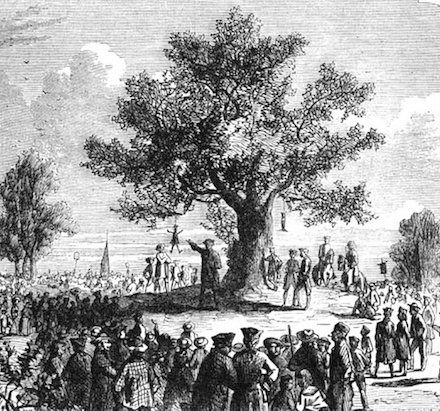
On this date in 1765, Boston patriots lynched the merchant designated as the imperial taxman. They only did so in effigy, but the “execution” scared him permanently off the job while also making a gallows-tree into one of the earliest symbols of American independence.

One of the key pre-revolution irritants for the future United States, the 1765 Stamp Act imposed taxes in the form of stamp duties on a variety of printed products, for the purpose of funding the British army deployed to North America. It was a levy long familiar to London lawmakers but it sent the colonies right around the bend, and since the colonies sat no Member of Parliament who could flip an official wig it also popularized the classic revolutionary slogan about “taxation without representation.”*

Enacted in the spring of 1765 and due to take effect in November, the Stamp Act drew immediate outrage in the colonies and especially in that hotbed of subversion, Boston.

There, Andrew Oliver, scion of a shipping magnate clan, was tapped to collect the levy. It figured to be just the latest in a series of lucrative state appointments. How was he to know in advance that this particular legislation would unleash the crazies? Perhaps he should have given more heed to the publication of ominous warnings over the roster of tax collector names.


Boston Post-Boy, August 5, 1765

On the morning of Wednesday, August 14, a crowd of irate Bostonians mobbed the corner of Essex Street and Orange Street (present-day Washington Street) and upon a large elm tree strung up an effigy of Oliver alongside a boot — the footwear comprising a second, punny, effigy of the Stamp Act’s sponsor the Earl of Bute.

“What greater Joy can NEW-ENGLAND see,” ran the menacing note pinned to the mannequin, “Than STAMPMEN hanging on a Tree!” As is clear from the following newspaper account, versions of which circulated widely in New England, these were no mere theatrics but a very proximate physical threat; even the elm’s property owner dared not take down the provocative display for fear that the crowd would pull down his house. Likewise taking the better part of valor, Oliver pledged to anti-tax colonists that he would not take the office, and he kept his word.**


Providence Gazette, August 24, 1765

After this triumphant debut, the elm in question became a common rallying-point for the hotheaded set, a frequent stage for speechifying, rabble-rousing, and fresh instances of popular justice all further to the patriot cause until, as Nathaniel Hawthorne put it, “after a while, it seemed as if the liberty of the country was connected with Liberty Tree.” Of course, it’s all a question of whose liberty; a Tory gloss on this deciduous republican made it “an Idol for the Mob to Worship; it was properly the Tree ordeal, where those, whom the Rioters pitched upon as State delinquents, were carried to for Trial, or brought to as the Test of political Orthodoxy.” When besieged in Boston in 1775-1776, British Tories cut the damned thing down, so for subsequent generations it was only the Liberty Stump.


“The Colonists Under Liberty Tree,” illustration from Cassell’s Illustrated History of England, Volume 5, page 109 (1865)

The Liberty Tree is commemorated today at its former site, and forever in verse by revolutionary firebrand Thomas Paine.

In a chariot of light from the regions of day,
The Goddess of Liberty came;
Ten thousand celestials directed the way,
And hither conducted the dame.

A fair budding branch from the gardens above,
Where millions with millions agree,
She brought in her hand as a pledge of her love,
And the plant she named Liberty Tree.

The celestial exotic struck deep in the ground,
Like a native it flourished and bore;
The fame of its fruit drew the nations around,
To seek out this peaceable shore.

Unmindful of names or distinctions they came,
For freemen like brothers agree;
With one spirit endued, they one friendship pursued,
And their temple was Liberty Tree.

Beneath this fair tree, like the patriarchs of old,
Their bread in contentment they ate
Unvexed with the troubles of silver and gold,
The cares of the grand and the great.

With timber and tar they Old England supplied,
And supported her power on the sea;
Her battles they fought, without getting a groat,
For the honor of Liberty Tree.

But hear, O ye swains, ’tis a tale most profane,
How all the tyrannical powers,
Kings, Commons and Lords, are uniting amain,
To cut down this guardian of ours;

From the east to the west blow the trumpet to arms,
Through the land let the sound of it flee,
Let the far and the near, all unite with a cheer,
In defence of our Liberty Tree.

* Visitors to the U.S. capital of Washington D.C., whose 700,000 residents cast no votes in the Congress they live cheek by jowl with, can find this familiar grievance right on the city’s license plates.

** How far this surly bunch was prepared to go on August 14, 1765, one can only guess at; however, in later years, there would be several instances of Bostonians tarring and feathering various tax collectors. These guys did not do civility politics.

On this day..

1849: Celigny Ardouin, Haitian Minister of the Interior

Haitian politician Celigny Ardouin was executed on this date in 1849.

The brother of historian Beaubrun Ardouin (and the already-deceased poet Coriolan Ardouin), Celigny Ardouin was the country’s former Interior Minister but was purged when the slave-turned-general-turned-president Faustin Soulouque, appointed as a figurehead president for the country’s elites, mounted a self-coup to establish himself as the emperor.

Ardouin had opposed Soulouque’s initial selection, and the emerging dictator had opportunistically accused his old foe of orchestrating disturbances in support of a senator who was frustratingly safe from Soulouque’s executioners thanks to French diplomatic pressure.

On this day..

1939: Las Trece Rosas

The Spanish Civil War’s victorious fascists shot Las Trece Rosas — “the thirteen roses” — on this date in 1939.


Plaque at the Cementerio de la Almudena in Madrid in honor of 13 young women shot there by Francoist troops on August 5, 1939. (cc) image by Alvaro Ibanez.

Earlier that 1939, Franco had clinched victory by finally capturing the capital city after a siege of 29 months. A punishing suppression of the Spain’s leftist elements ensued, running to hundreds of thousands imprisoned, executed, or chased into exile.

Our 13 Roses were members of a communist/socialist youth group, JSU, and they had been arrested in rolling-up of that organization. They were crowded into the overflowing dungeons of the notorious women’s prison Las Ventas.

A few Spanish-language books about Las Trece Rosas

And there they resided on July 29, 1939, when their JSU comrades struck back against the dictatorship by assassinating Isaac Gabaldón, the commander of Madrid’s fascist police.* The 13 Roses were immediately court-martialed and executed in revenge. Their names follow; there’s a bit more detail about them in Spanish here:

  • Carmen Barrero Aguado (age 24)
  • Martina Barroso García (age 22)
  • Blanca Brissac Vázquez (age 29)
  • Pilar Bueno Ibáñez (age 27)
  • Julia Conesa Conesa (age 19)
  • Adelina García Casillas (age 19)
  • Elena Gil Olaya (age 20)
  • Virtudes González García (age 18)
  • Ana López Gallego (age 21)
  • Joaquina López Laffite (age 23)
  • Dionisia Manzanero Salas (age 20)
  • Victoria Muñoz García (age 19)
  • Luisa Rodríguez de la Fuente (age 18)

The affair is the subject of a 2007 Spanish film.

* Gabaldon’s predecessor, the police commander under the Spanish Republic, Jose Aranguren, had been removed from his post and executed in April.

On this day..

1540: The Botolph Plotters of Calais, the last English Carthusian, and Thomas More’s son-in-law

The 4. of August, Thomas Empson sometime a monke of Westminster, which had beene prisoner in Newgate more than three yeares, was brought before the Justices of goale deliverie at Newgate, and for that he would not aske the king pardon for denying his supremacie, nor be sworne thereto, his monkes cowle was plucked from his backe, and his body repried till the king were informed of his obstinacie. The same 4. of August were brawen to Tiborne 6. persons, and one led betwixt twaine, to wit, Laurence Cooke, prior of Dancaster, William Horne a lay brother of the Charterhouse of London, Giles Horne gentleman, Clement Phillip gentleman of Caleis, and servant to the lord Lisle, Edmond Bromholme priest, chaplaine to the said lord Lisley, Darby Gening, Robert Bird, all hanged and quartered, and had beene attainted by parliament, for deniall of the kings supremacie.

John Stow, Annals of England to 1603 (see page 977 of this archive.org version)*

Tyburn hosted a mass execution on this date mingling several different offenders with a Catholic bent from Henrician England’s religion/politics bloodsport.

The most politically intriguing are Clement Phillip (or Philpott) and Edmund Brindholme, two members of the retinue of the Viscount Lisle. Lord Lisle governed Calais, Henry VIII’s vital French bridgehead.

Phillip and Brindholme were part of the “Botolph Plot”, so named for a fellow-servant called Gregory Botolf or Botolph.

Botolph was an energetic conspirator and/or trumped-up con man who represented to his mates that he was shuttling mash notes with the exiled Cardinal Reginald Pole, Henry VIII’s once-loved, now-despised nemesis noted for his noisy denunciations of the king’s break with Rome. Botolph’s declared objective was to “get the towne of Calais into the hands of the Pope and Cardynal Pole; this was the matter that I went to Rome for; and I have consulted with the Holy Father the Pope and with the Reverent Father Cardynall Pole.”

The implausibility of these fanciful pretensions — one chronicle calls this guy “Gregory Sweetlips” which gives you an idea of his credibility — stood in inverse relationship to the damage such a plot’s execution would inflict: Calais was a commercially and strategically important port that had been in English hands for nearly 200 years; for a dynasty perpetually nervous of its prestige, fumbling it away could have proven catastrophic.** So once a plan to betray it from the very governor’s household was exposed, the crown prosecuted it ferociously, although as best I can determine Botolph himself appears to have successfully escaped the royal vengeance.

Lord Lisle himself was also clapped in the Tower† for his servants’ misbehavior but no attainder was ever proceeded upon. In 1542, Henry cut him a break and released him; Lisle would already have been near or past the age of 70 by this point, which we mention as context in reporting that news of his intended release caused the poor ex-governor to keel over dead of a heart attack. “Henry VIII’s Mercy was as fatal as his Judgments,” one waggish historian would later remark.‡

Things might have gone less mercifully for Lisle had not his situation happened to overlap with the fall of Thomas Cromwell, which unfolded that same summer of 1540.

Cromwell was beheaded on July 28, significantly upstaging this August 4 coterie, and events in Calais might have played a part in that unhappy end. Politically weakened by his authorship of the failed Anne of Cleves marriage, Cromwell’s defeat is sometimes read in the light of excessive reformation zeal unleashed in Calais. (Like most theses about Tudor England, the Calais-reformers line has its detractors.) One possible way to read the Botolph Plot stuff is as one of Cromwell’s very last, desperate gambits: threatened by the conservative Duke of Norfolk, who had the whip hand during this brief interval thanks to his kinship to incoming queen Catherine Howard, Cromwell struck back against his persecutors “with the concentrated energy of a desperate gambler” (Source) … by going hard after the papist plot in Calais and implicating in the treason Howard’s ally, the aforementioned Lisle.


In William Horn(e) the crown completed the destruction of the Carthusian order, which had been violently suppressed several years previous — with 18 executions into the bargain. Eleven more Carthusians had avoided the scaffold only to be consigned to the dungeons where pestilence and neglect took their toll, until only Horn survived.

Nobody seems quite able to put a finger on why Horn was kept alive all that time: was he just hardier or “luckier” than the rest, or was he being intentionally saved as an accent upon an occasion such as this? With him went Friar Lawrence Cook, the last Carmelite executed in the king’s suppression of that order: he hailed from Yorkshire and had once countenanced that region’s subversive (in Henry’s eyes) Pilgrimage of Grace.

In a similar vein, we also find among this batch Giles Heron, a son-in-law of the first name in Catholic obstinacy, Sir/Saint Thomas More. Heron had kept his head about him and even sat on the Middlesex grand jury that recommended proceedings against Anne Boleyn, which is the sort of thing a Thomas More client wouldn’t mind doing at all.

Alas, he was in the judgment of a contemporary “wise in words, but foolish in deeds” during such dangerous times. Comfortably situated as a rentier landlord, Heron appears to have fallen into a ferocious tiff with a tenant who revenged an eviction by informing to Cromwell’s spies about Heron’s divergences from the new orthodoxy. The evidence of this tenant, one Lyons, eventually led Parliament to attaint Heron. The confiscated estates would be restored to Heron descendants under Queen Mary.

Darby Gynnyng — to use a more Gaelic rendering of his name — was a bit more forceful about his dissidence, for he came “late of Dublin,” where he “has maintained divers of the King’s enemies in Ireland, especially Fitz Garrard whom he succoured and accompanied.”

* A somewhat different roster for the same date is supplied by Wriothesley’s Chronicle (p. 121 of this archive.org version) which might be double-counting his “six persons more” to suggest so many as 13.

This yeare, the fowerth daie of Awgust, were drawen from the Tower of London to Tiburne, Giles Heron, gentleman, Clement Philpott, gentleman, late of Callis, and servant to the Lord Lile, Darbie Gynning, Edmonde Bryndholme, priest, William Horn, late a lay brother of the Charter Howse of London, and another, with six persons more, were there hanged drawn, and quartered, and one Charles Carow, gentleman, was that daie hanged for robbing of my Ladie Carowe, all which persons were attaynted by the whole Parliament for treason.

** The Tudors actually did lose Calais to French siege in 1558. These were the last months of the ailing Queen Mary’s rule; she’s reported to have wailed on her deathbed that “When I am dead and cut open, they will find Philip [her husband] and Calais inscribed on my heart.”

† Seized upon Lord Lisle’s arrest were seven years of correspondence comprising more than 3,000 distinct documents. This trove has survived to present times and become an invaluable resource for historians’ exploration of Tudor life. It’s known as the Lisle Papers; there are published collections and commentaries on them available by the late Muriel St. Clare Byrne.

‡ Still, this was a better fate than that enjoyed by the next Viscount Lisle, John Dudley, who briefly exercised de facto rulership of England only to have his head cut off after the fall of Lady Jane Grey.

On this day..

1938: Mikhail Viktorov, Soviet naval commander

Soviet admiral* Mikhail Viktorov fell in the purges on this date in 1938.

A young officer fresh from the Naval Academy when World War I broke out, Viktorov (English Wikipedia entry | Russian) made a timely switch to the Bolshevik side during the Civil War and scaled the heights of the Soviet navy.

He commanded the Baltic Fleet in the latter 1920s, and the Pacific Fleet in the 1930s, and finally — fleetingly — became chief of the Soviet navy in 1937, filling dead man’s boots when his predecessor was arrested and executed.**

The same fate awaited Viktorov, a perilous occupational hazard in those days.

He was rehabilitated posthumously in 1956.

* Viktorov’s rank was “Fleet’s Flag Officer, First Rank”; in 1938, this was the equivalent of admiral, and after a 1940 reorganization it was replaced full stop with admiral.

** It appears to me that fully seven consecutive heads of the Soviet Navy eventually ended up executed in the 1930s and 1940s (not all of them directly deposed from running the navy). Pantserzhanskiy, Zof, Muklevich, Orlov, our man Viktorov, and also his successors Smirnov and Frinovsky.

On this day..

1681: Donald Cargill, Covenanter rebel

Scottish Covenanter Donald Cargill ascended his Edinburgh gallows on this date in 1681 with the undaunted last words, “The Lord knows I go on this ladder with less fear and perturbation of mind, than ever I entered the pulpit to preach.”

This Cameronian radical had been a fugitive for many years, ever since he darkened a thanksgiving service for King Charles II’s restoration by voicing from the pulpit of his Glasgow parish what many feared in their hearts: that Presbyterians were about to get the rough end of the restoration pineapple.

We are not come here to keep this day upon the account for which others keep it. We thought once to have blessed the day wherein the king came home again, but now we think we shall have reason to curse it; and if any of you come here in order to the solemnising of this day, we desire you to remove.

That was the end of Cargill’s career as a licensed preacher. His remaining years were illicit services, ducking arrests, and a flight to the Netherlands; he was wounded in service of the Covenanter cause at the 1679 Battle of Bothwell Bridge.

Back in Scotland by 1680, Cargill’s Queensferry Declaration* dared an open case for rebellion in pursuit of “the overthrow of the kingdom of darkness, and whatever is contrary to the kingdom of Christ,” for

now it cannot be called a government, but a lustful rage, exercised with as little right reason, and more cruelty than beasts; and they themselves can no more be called governors, but public grassators, and public judgements, which all ought to set themselves against, as they would do against pestilence, sword and famine raging among them.

The grassators finally got him the following year.

There’s a short biography of our man, The Life of Donald Cargill, available in the public domain which remarks (discount accordingly for hagiographical perspective), that Cargill was memorialized by an associate as

affectionate, affable, and tender-hearted to all such as he thought had anything of the image of God in them, sober and temperate in his diet, saying commonly, ‘It was well won that was won off the flesh,’ generous, liberal, and most charitable to the poor; a great hater of covetousness, a frequent visitor of the sick; much alone, loving to be retired, but when about his Master’s public work, laying hold of every opportunity to edify; in conversation still dropping what might minister grace to the hearers. His countenance was edifying to beholders; often sighing with deep groans; preaching in season and out of season upon all hazards; ever the same in judgment and practice. From his youth he was much given to the duty of secret prayer for whole nights together wherein it was observed that, both in secret and in families, he always sat straight upon his kneesk with his hands lifted up; and in the posturel as some took notice, he died with the rope about his neck.

* The thrust of this militant manifesto is similar to the Sanquhar Declaration issued by Cargill’s ally Richard Cameron, also in 1680.

On this day..

1402: Fang Xiaoru, of the ten agnates

On this date in 1402, the Yongle Emperor cemented his seizure of the throne by purging Confucian scholar-bureaucrat Fang Xiaoru with a legendary extermination to ten degrees of kinship.

Our numerous executions on this occasion bring us to the close of a three-year civil war that ensued the death of the Ming dynasty founder, known as the Hongwu Emperor. In this conflict, the old man’s designated successor, a grandson who took the ironic regnal moniker of Jianwen Emperor (meaning “establishing civility”), was defeated and deposed by one of the old man’s sons, a prince whose name can be transliterated as Zhu Di or Chu Ti.

The uncle was much the abler commander while the nephew was plagued by defections. In July of 1402, Zhu Di’s forces captured the capital city of Nanjing; the Jianwen emperor vanished into history’s fogs — burned to death, Zhu Di would claim, citing an unrecognizable corpse charred in the blaze that consumed the imperial palace; rumors long persisted that he had occulted himself into the mountains robed as a monk.

Either way, Zhu Di had occasion now to announce himself the Yongle Emperor. “Perpetual happiness,” that one means. And to make sure that everyone would real happy with the new arrangements, Boss Yongle insisted on the immediate fealty of the capital’s intelligentsia. “Those who are guilty I do not dare to pardon,” he said of the late emperor’s ex-ministers. “Those who are innocent I do not dare to execute.”

Most of those presented with these alternatives chose judiciously, as attested by the Yongle Emperor’s subsequent 22-year reign.

But our principal Fang Xiaoru was the most famous among a number of scholars to stand athwart history yelling stop.* For malcontents like Fang, the Yongle Emperor offered a compelling dissuasion in the form of the ancient “extermination of nine agnates”: the collective execution of the traitor’s entire family, compassing nine different classes of relations.

  1. The criminal himself
  2. His parents
  3. His grandparents
  4. His children (and children’s spouses)
  5. His grandchildren
  6. The criminal’s spouse
  7. The spouse’s parents
  8. The criminal’s aunts and uncles
  9. The criminal’s cousins

We don’t know how all his cousins and in-laws felt about the matter but for his own part, Fang was undaunted: “Never mind nine agnates; give me ten!” And that’s just what they did, drafting the scholar’s own pupils into the hecatomb as the tenth degree, an extremity unequaled in the history of China or academia.

All told, the ten agnates numbered 873 people, among perhaps as many as ten thousand noncompliant officials and family members purged overall. Yet still as he died, hewed apart at the waist, Fang dipped his finger in his own gore and scrawled on the floor his own last verdict on the new emperor: the single Chinese character meaning “usurper”.


An execution by “waist severing” delivers what it promises.

* Others include Huang Zicheng and Lian Zining. See “Venerating the Martyrs of the 1402 Usurpation: History and Memory in the Mid and Late Ming Dynasty” by Peter Ditmanson, T’oung Pao, Second Series, Vol. 93, Fasc. 1/3 (2007), pp. 110-158.

On this day..

1951: Arno Esch, liberal

On this date in 1951, liberal East German activist Arno Esch was shot in Lubyanka Prison outside of Moscow.

Plaque at the University of Rostock honoring Esch. (cc) image by Schiwago.

Just 17 when World War II ended, Esch emerged as a leading student activist for the Liberal Democratic Party in the postwar Soviet Occupation Zone — a pacifist who advocated political liberalization and civil rights.

These weren’t times for any common fronts: “a liberal Chinese is closer to me than a German communist,” Esch remarked, denoting a clear and present danger in the communist zone: his party attempted in vain to form a coalition across the nascent Iron Curtain with its like-minded brethren in the western zones.

Esch was arrested in 1949 and prosecuted as a spy and counterrevolutionary by a Soviet military tribunal.

On this day..

1942: Nikola Vaptsarov, Bulgarian poet

Poet Nikola Vaptsarov was shot on this date in 1942 for organizing anti-fascist resistance in Axis Bulgaria.

A communist machinist — the Varna naval academy where he learned engineering is now named for him* — Vaptsarov — Vaptsarov was a proper proletarian poet who only ever versified on the side.

Nevertheless, he was well-known in his time and remains so to this day in Bulgaria, particularly given his political bona fides and martyrdom thereto, which bear ready comparison to Spanish Civil War martyr Frederico Garcia Lorca.

Spain

What were you to me?
Nothing.
A land forgotten and remote,
a land of knights and high plateaux.
What were you to me?
The hearth
where blazed a strange and cruel love,
a wild intoxicant
of blood,
of glinting blades
and serenades,
of passion,
jealousy
and psalms.

Now you are my destiny,
now I live and share your fate.
In your struggle to be free
wholly I participate.

Now I’m stirred, now I rejoice
at all your victories in the fight.
In your youth and strength I trust
and my own strength with yours unite.

Crouching in machine-gun nests,
I fight on to victory,
down among Toledo’s streets,
on the outskirts of Madrid.

A worker in a cotton shirt
torn by bullets near me lies,
Ceaselessly the warm blood streams
from the cap pulled o’er his eyes.

It is my blood that I feel humming
through my veins, as suddenly
in him I recognize the friend
I once knew in a factory

where we shoveled coal together,
stoking the same furnace fire,
and found there was no barrier
to check our young and bold desire.

Sleep, my comrade, sleep in peace!
Though now the blood the blood-red flag be furled,
your blood into mine will pass
and stir the peoples of the world.

The blood you gave, already flows
through village, factory, town and state,
arouses, urges and inspires
all working men to demonstrate.

That workers never will lose heart,
but will advance relentlessly,
determined both to work and fight
and shed their blood that men be free.

Today your blood builds barricades,
infuses courage in our hearts,
and with a reckless joy proclaims:
‘Madrid is ours!
Madrid is ours!’

The world is ours! Friend, have no fear!
The whole expanding universe
its ours!
Beneath the southern sky
sleep
and have faith,
have faith in us!

-Vaptsarov

Vaptsarov published his lone book, Motor Songs, in 1940, which was the same year he was interned demonstrating against Bulgaria’s tenuous neutrality and in favor of alliance with the USSR. A few months after his release, the Third Reich forced Bulgaria into the Axis. A member of the Central Military Committee of the Bulgarian Communist Party, Vaptsarov was arrested for doing just the sort of things that such a committee would be doing in 1942.

A Selected Poems volume of his was published posthumously; it can be enjoyed free here.** Perhaps the most moving entry is the very last one, a short composition dedicated to his wife just hours before his execution.

On Parting

To my wife

Sometimes I’ll come when you’re asleep,
An unexpected visitor.
Don’t leave me outside in the street,
Don’t bar the door!

I’ll enter quietly, softly sit
And gaze upon you in the dark.
Then, when my eyes have gazed their fill,
I’ll kiss you and depart.

The fight is hard and pitiless.
The fight is epic, as they say.
I fell. Another takes my place —
Why single out a name?

After the firing squad — the worms.
Thus does the simple logic go.
But in the storm we’ll be with you,
My people, for we loved you so.

2 p.m. — 23.VII.1942

* You’ll also find the man’s tribute on the frigid slopes of Vaptsarov Peak on the Antarctic Livingston Island. More accessibly, there are museums to him in the Bulgarian capital of Sofia as well as Vaptsarov’s hometown of Bansko.

** Some other sites with Vaptsarov poems: here and here.

On this day..