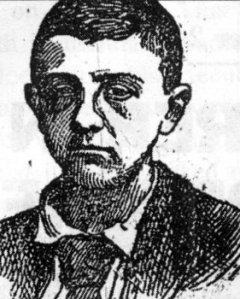
1890: Otto Leuth

(Thanks to Meaghan Good of the Charley Project for the guest post. -ed.)

On this date in 1890 at the Columbus Penitentiary in Ohio, a sullen German-American teenager named Otto Leuth (sometimes spelled “Lueth”) paid with his life for the brutal murder of his seven-year-old neighbor, Maggie Thompson.

John Stark Bellamy II, writing of the murder in his book The Corpse in the Cellar: And Further Tales of Cleveland Woe, noted how familiar the case sounds to modern ears:

[T]he sickening murder of an innocent child; yet another child accused for the dreadful deed; a sensational trial, replete with dubiously “expert” testimony, suspicious “confessions,” allegations of police “third-degree” methods, and charges of biased press; not to mention “latchkey” children, systematic child abuse, saccharine sympathy for the guilty, and charges of ethnic favoritism.

Yet it happened over a century ago.

Otto, sixteen at the time he killed little Maggie Thompson, had had a hard life, as Bellamy explains in his book. His mother, Lena, testified at his trial that she

went into veritably demonic fits of rage, during which she was in the habit of physically abusing her children, especially Otto. From an early age, she blandly admitted, she had pulled his hair, kicked him, beaten him, walked on him, and often hit him with any object that came to hand. Once, when Otto was eight, she had beaten him with a chair leg and, when [Otto’s father] Henry tried to intervene, stabbed Henry twice with a convenient butcher knife. Just a few months before Maggie Thompson’s murder, Lena had repeatedly slammed Otto’s head into a wooden door.

It speaks volumes of the difference between that century and this one that nobody who heard Lena’s testimony seemed to think this was in any way excessive, never mind cruel; on the contrary, one person praised her methods as being “good German discipline.”

On May 9, 1889, sixteen-year-old Otto was alone at his family’s home at 47 Merchant Avenue in Tremont, a suburb of Cleveland. He was used to being alone: his mother had been committed to a mental hospital some months before, his father was wrapped up in his cabinet-making business, and his older brother had moved out of the house.


Otto (top) and his victim.

That morning, down the street at 24 Merchant Avenue, Maggie Thompson set off for school. Her mother, Clara, dropped her off at the front gate; it was the last time she would see her daughter alive.

Maggie attended the morning classes and, when school was dismissed for lunch at 11:15 a.m., started on the four-block walk home. En route, she vanished without a trace, as if “the sidewalk might have opened and swallowed the girl.”

Naturally there was a frantic search, lead by her devastated parents and the Cleveland Police Department, who tore the city apart looking for her.

But, although there were numerous false sightings and a few wild stories about Maggie’s disappearance, in spite of everyone’s efforts they couldn’t find her.

Otto participated in the search, along with most of the neighborhood. Nearly every day he would approach Clara Thompson and solicitously ask if she’d heard any news of her child.

In early June, Clarissa Shevel, the woman who lived with her husband in the back of the Lueths’ two-family house, asked Otto to do something about the terrible stench that pervaded the entire building. Otto suggested the odor was caused by a dead animal. He bought some chloride of lime and put it in the ventilation hole, then burned some sulfur, but it didn’t help.

Around that time he was witnessed carrying some badly stained bedding to the smokehouse at the back of the property.

On June 9, Otto’s mother Lena, who had by now been discharged from the mental hospital, became fed up with the smell and sent her husband Henry down to the cellar to investigate. He came back up a few minutes later, deeply shaken, and ran out to find a policeman.

In the Lueths’ cellar was the nude corpse of Maggie Thompson.

She was wrapped in one of Lena’s dresses and her own clothes lay underneath her. She had been beaten to death and her body was so badly decomposed that her parents had to identify her by scars on her hips.

The police promptly arrested everyone who lived at the house: Henry and Lena Lueth, Clarissa Shevel and her husband, and Otto, who was picked up on his way home from the ice cream parlor. All five suspects were separated and subjected to a serious “sweating,” but Otto was the prime suspect. He had a reputation as a bully, and he’d been at home alone for much of the previous month.

Bellamy records:

The climax came at 3:30 a.m., when an agonized female shriek resounded from the floor below the sweating room. “Who is that?” cried Otto to Detective Francis Douglass. “Your mother, I believe,” replied Douglass. “She had nothing to do with it!” blurted out Otto. “Who did?” queried Douglass. Otto: “I did it! I did it!” Douglass: “Did what, Otto?” “I killed her! I killed her! Please give me your revolver so I can kill myself!”

Resisting the temptation, the police instead took his verbal confession, wrote it down, had him sign it and escorted him to a cell.

Otto said he had been standing outside his parents’ home at about 11:30 a.m. on May 9 when he encountered Maggie. She asked him if he could donate any buttons to the “button-string” she was making, and he said he had four and would give them to her if she came inside.

Maggie obediently followed him in, and he led her upstairs to his bedroom, where he attempted to rape her. When she screamed, he hit her with a nearby hammer.

Otto said he thought he’d probably killed her with the first blow, but he kept striking her until her head was a pulp and the bed was covered in blood. After an unsuccessful attempt to have sex with her body, he fled the scene. He did go back to the house that night, but spent the next several days at his brother’s home.

Six days later, just before his mother was supposed to come home, Otto returned home to clean up. He carried Maggie’s corpse to the family cellar and left it lying there; he didn’t even bother to bury it or cover it up.

Given Otto’s confession, the circumstantial evidence and the revulsion his crime invoked in the city of Cleveland, his lawyer didn’t have much to work with. Not even trying for an acquittal, his defense instead claimed Otto was mentally impaired and/or insane.

Otto had a strange depression in his skull and his attorney suggested he was brain-damaged — which might very well have been true, given the abuse he had suffered at Lena’s hands. Several members of his family, including his mother and brother, had epilepsy, and his attorney suggested he might have had a seizure and committed his crime without even knowing what he was doing.

Such a scenario was possible. The problem was, though, that none of the medical experts who testified for the defense could diagnose Otto with epilepsy.

The claims of subnormal intelligence were contradicted by the testimony of Otto’s former teachers. Although his pathetic attempts to conceal Maggie’s body might indicate otherwise, his intellect seems to have been about average. Before he quit school at age 13, he had been an unexceptional student with some talent as a violinist.

Otto’s lawyer also said his client had not, in fact, attempted to sexually assault Maggie Thompson either before or after death, and Otto had invented that part of his confession because the police were pressing him to cough up an explanation for his motiveless crime. But given the fact that Maggie’s body was found naked, this claim didn’t carry much weight either.

It was no surprise that, when the trial concluded on December 27, 1889, the jury came back with a verdict of guilty without a recommendation of mercy. Perhaps the only surprising thing was that they actually bothered to deliberate for a whole four and a half hours.

Otto rapidly exhausted his appeals and was hanged eight months after his trial, alongside another killer, one John “Brocky” Smith of Cincinnati. Two other men had also been scheduled to die that night, but one got reprieved and the other’s execution was postponed.

Otto left behind a statement where he admitted he’d killed Maggie Thompson, but denied his previous claims that he’d tried to rape her. He died calmly and without a fuss, standing on the trap and saying simply “All right, let her go.”

On this day..

1987: Dale Selby Pierre, Hi-Fi Murderer

On this date in 1987, Utah executed Dale Selby Pierre for one of the most notorious crimes in that state’s history — the Hi-Fi Murders.

Pierre, along with two fellow airmen from the Hill Air Force Base, William Andrews and Keith Roberts, began an armed robbery of a hi-fi shop in nearby Ogden near closing time on the evening of April 22, 1974.

The night that unfolded would be a visit to an antechamber of hell not only for the two young clerks on duty at the time, but three other people who wandered into the store while the crooks were still in it — each of whom was added to the growing pen of hostages Pierre et al kept in the basement.

After plundering the shop of $25,000 worth of electronics, Pierre and Andrews went to get rid of their prisoners by making them drink liquid Drano.

This method of homicide, theoretically an elegantly quiet one which would facilitate a clean getaway, had been cribbed from a murder scene in the 1973 Dirty Harry movie Magnum Force.

The struggles of Cortney Naisbitt, one of the surviving victims, forms the subject of Victim: The Other Side of Murder — a classic of the true-crime genre and of the victim’s rights movement.

But human flesh is hardier than celluloid.

Unlike the poor prostitute in Magnum Force, Pierre and Andrews’s victims groaned and gurgled, their blistering mouths suppurating so much fluid that duct tape to quiet them down wouldn’t stick. And the Drano didn’t kill them, or at least it was sure taking its time.

“I remember the noise they were making, the sounds of pain they were making,” Pierre told his clemency hearing. “It was something greater than sad.”

Since they hadn’t got rid of their victims quite so cleanly, Pierre simply set about shooting them — and in the case of Michelle Ansley, a 19-year-old in her first (and last) week on the job at the Hi-Fi shop, raping her first. These execution-style murders had only mixed results, and one of the hostages — 43-year-old Orren Walker — being noticeably not dead, had a ball-point pen kicked into his ear in an attempt to finish him off.

Somehow, Walker still survived, as did 16-year-old Cortney Naisbitt, who suffered severe brain damage. (Both have since died.) Stanley Walker, Carol Naisbitt, and Ansley were not so “lucky.” But neither were the perps: since Andrews had openly talked at the Air Force base about boosting that very hi-fi shop and even killing anyone who “gets in the way,” suspicious fellow airmen soon turned them in.

The 21st century’s more polished and calculating strategic communications consultant probably would have advised keeping well clear of such an incendiary crime, but death penalty opponents actually pushed clemency hard in the Hi-Fi case.* For the NAACP, the sentences underscored racial disparity in the death penalty.

Rubbish, one might say, given the killers’ epically villainous conduct. But one member of the all-white jury was apparently passed a note by parties unknown reading “Hang the niggers.” And the NAACP noted that Utah gave death sentences to these guys, but not to a white supremacist who murdered two black men for jogging with white women.

None of this cut any ice with Utah. Years later, the killers themselves had a hard time fitting that monstrous night into any kind of comprehensible rationale. Pierre:

The crime took a course of its own. It wasn’t planned that way. People kept coming in and I just panicked. The only way to prevent what happened was to have been moved away from the Air Force entirely … Of course the alcohol and the pills I was consuming didn’t help — valiums, reds, black beauties and yellow jackets … I tell myself, “You have to accept responsibility for it — you did it, you were there. You can’t rationalize it.”


Dale Pierre pleads his case to the Utah clemency board.

Dale Pierre was the very first person put to death in Utah after its famously groundbreaking execution of Gary Gilmore in 1977. But in fact, the Hi-Fi killers had preceded the eager volunteer Gilmore on Utah’s death row, and Gilmore as he walked his last mile reportedly wisecracked to Pierre and Andrews, “I’ll be seeing you directly.”

Pierre’s accomplice William Andrews was also finally executed in 1992, after a then-unimaginable (and anything but “direct”) 18 years on death row — nearly half his life. Their fellow accomplice Keith Roberts didn’t personally take part in the cellar hecatomb and therefore avoided the death sentence: he was paroled in 1987.

* The clemency push was much stronger for William Andrews than for Dale Pierre, since Andrews was also making the argument that he hadn’t directly killed anyone and hadn’t intended to. As a matter of fact, the manipulative Andrews was and is widely doubted on that point — but any such claim was wholly unavailable to the acknowledged triggerman Pierre.

On this day..

1887: Israel Lipski

(Thanks to Meaghan Good of the Charley Project for the guest post. -ed.)

On this day in 1887, 22-year-old Israel Lipski was hanged at Newgate Prison for the murder of Miriam Angel.

His trial and execution were well-publicized in their day, and were the subject of a 1984 book, The Trials of Israel Lipski: A True Story of a Victorian Murder in the East End of London by Martin L. Friedland.

But Lipski has been largely forgotten now … except as a footnote in a much more famous unsolved murder.

Lipski was of Polish-Jewish origin. His real name was Israel Lobulsk; he changed it when he moved to the UK.

He lived in a boardinghouse and worked as an umbrella and walking-stick salesman. Miriam, who was also Jewish, lodged at the same address, 16 Batty Street.

Miriam was found dead in her bed June 28 of that year. She’d been killed in an unusual way: she was forced to consume nitric acid, also known as aquafortis, a strong corrosive chemical now used in rocket fuel. She was six months pregnant at the time of her death.

Lipski was found hiding under her bed. He too had consumed nitric acid and the inside of his mouth was burned. Investigators later determined he’d purchased an ounce of the chemical that very morning. They theorized he had killed Miriam during a rape attempt.

Lipski, for this part, insisted he was innocent of any crime and told an extraordinary story: he stumbled across two co-workers in Miriam’s room rifling through her things. Miriam was already dead at this point. The two men attacked and robbed him, poured the nitric acid down his throat and threw him under the bed, where he fainted.

The judge’s summing-up to the jury, described by one news account as “lucid and temperate,” went with the rape theory:

… that the murderer of Miriam Angel entered her room under the influence of unlawful passion; that, balked in this design, his passion turned to homicidal fury; and that in a reaction of shame and terror he had taken a dose of the same poison that he had given to his victim. If that theory was probable, continued the judge, the murder was much more likely to have been the work of one man than two.

The climate of pervasive anti-Semitism in East London during this time sealed Lipski’s fate. London’s Jewish population, largely impoverished Polish and Russian refugees, was ever liable to blame for a wide variety of social problems. On top of everything else, Lipski’s legal defense was abysmal and the judge clearly biased. He might have been guilty, but the fairness of his trial is questionable.

Following Lipski’s conviction and death sentence there was worried speculation that he might, after all, be innocent. Several prominent people, including members of Parliament and investigative journalist William Stead, petitioned the Home Secretary for a reprieve or commutation. (Stead referred to Lipski as “the young martyr” and the “much injured young exile.”) The wind went out of their sails, however, after Lipski’s confession was published:

I, Israel Lipski, before I appear before God in judgment, desire to speak the whole truth concerning the crime of which I am accused. I will not die with a lie on my lips. I will not let others suffer even in suspicion for my sin. I alone was guilty of the murder of Miriam Angel.

I thought the woman had money in her room, so I entered, the door being unlocked and the woman asleep. I had no thought of violating her, and I swear I never approached her with that object, nor did I wrong her in this way. Miriam Angel awoke before I could search about for money, and cried out, but very softly. Thereupon I struck her on the head and seized her by the neck, and closed her mouth with my hand, so that she should not arouse the attention of those who were about the house.

I had long been tired of my life, and had bought a pennyworth of aquafortis that morning for the purpose of putting an end to myself. Suddenly I thought of the bottle I had in my pocket, and drew it out and poured some of the contents down her throat. She fainted and, recognizing my desperate condition, I took the rest. The bottle was an old one which I had formerly used … The quantity of aquafortis I took had no effect on me.

Hearing the voices of people coming upstairs, I crawled under the bed. The woman seemed already dead. There was only a very short time from the moment of my entering the room until I was taken away.

Even before his execution, “Lipski” became a part of Londoners’ vocabulary. It was used as both a slur against Jews and as a verb, the way a certain kind of suffocation murder still known as “burking” was named after William Burke of “Burke and Hare” fame.

A year after Israel Lipski’s execution, the name “Lipski” once again came under scrutiny after a murder suspect yelled it out in front of a witness, leaving scholars and true-crime buffs to speculate about its meaning for the next 120 years and counting.

The victim in that case was a prostitute named Elizabeth Stride. The suspect is known only by his trade name, Jack the Ripper.

But that’s another story.

On this day..

1932: Richard Johnson, great-grandfather of Craig Watkins

On this date in 1932, two African-American men were electrocuted in Huntsville, Texas.

Richard Johnson was a career criminal already serving a 35-year sentence for various burglaries when he busted out of prison in 1931. He teamed up with 20-year-old Richard Brown to rob a white couple in a parked car.

When the man, Ted Nodruft, tried to drive away, they shot him (he died the next day), and then proceeded to rape his fiancee and steal her jewelry. When caught, each man tried to throw the lion’s share of blame on the other.

These two on their own hardly stand out to posterity, and certainly not in the context of notoriously execution-friendly Texas, whose “List of individuals executed in Texas” Wikipedia entry (most states have such a page) is actually paginated by decade. Here’s the doings for the rest of the 1930s in the still-newish Texas electric chair.

We pause to note them here on this site because they made unexpected headlines earlier this year when Dallas County District Attorney Craig Watkins — the first elected black D.A. in Texas history — publicly revealed that Richard Johnson was his great-grandfather.

Long before that revelation, Watkins had already earned nationwide plaudits for doing what every district attorney should be doing as a matter of course: publicly emphasizing justice rather than conviction counts as his office’s guiding principle, greeting the rising tide of exonerations with a proactive program to search out potential miscarriages of justice rather than doubling down on them … hell, even apologizing to people whose lives have been ripped apart by wrongful convictions.

Watkins knew about the “dark secret of our family” for many years before he mentioned it in the run-up to witnessing his first execution (it was topical because Watkins used the trip to also visit his great-grandfather’s grave in the prison cemetery). How exactly that blood tie has helped to shape Craig Watkins’s outlook is hard to say, but not for any reticence on the DA’s part: he’s been disarmingly public about speaking to the real ambiguities and human costs of the criminal justice system that prosecutors are usually not supposed to acknowledge.

The broader issue is, look, I have walked 25 men out of prison for crimes they didn’t commit. We have gotten this case in Williamson County, where the DA withheld evidence, or it’s alleged that he withheld evidence. Because of that, a guy spent 25 years on death row. The Supreme Court of Texas has instituted a court of inquiry to look into the actions of this individual. At the time he was DA; now he is a judge. You have got the Todd Willingham case. We have had all of these folks who have been exonerated that were on death row throughout our nation.

And so my concern, basically, is, look, we are seeking the ultimate punishment against someone, and we need to have all the safeguards in place to make sure that we don’t wrongly execute someone. And I think with all the evidence that we have seen, I think anyone that does not come to the conclusion that a person has been executed in this country for a crime they didn’t commit is being irresponsible. So that’s my position. Like I said, I can argue from my moralistic standpoint all day, but that’s not where the argument should be had. It should be one of logistics. Are we making mistakes? Do we need to reevaluate the process to make sure we are not making mistakes?

Watkins personally opposes the death penalty on moral grounds, but seeks it routinely in his capacity as district attorney. Here’s the man expanding on some of those themes in a 30-minute interview with the Dallas-Fort Worth NBC affiliate:

Watkins (or someone in his office) blogs infrequently here, and tweets @craigmwatkins.

On this day..

2011: A day in the death penalty around the world

China

On the morning of July 19, 2011, two Chinese politicians were executed for corruption.

Xu Maiyong (right), former vice mayor of Hangzhou in Zhejiang and bearer of the Santa Claus-esque nickname “Plenty Xu”, was on the hook for $30 million of embezzlement as part of a wide-ranging campaign of public graft in service of a suitably luxuriant lifestyle filled with homes and mistresses.

Jiang Renjie, deputy mayor in charge of urban planning, construction, transportation, communications and housing in Suzhou, had made about half that much in bribes from developers around 2001-2004.


United States

On July 19, 2011, Arizona executed 52-year-old Thomas Paul West, a mere 24 years after he beat a man to death while robbing his Tucson trailer in June 1987.

West had the depressing background so common to condemned prisoners, a litany of childhood sexual abuse that drove him to drug abuse and a PTSD diagnosis: he would claim that he “freaked out” when the homeowner Donald Bortle surprised him and started yelling at him, and that he didn’t think he’d killed Bortle at all.

He lost a closely divided clemency vote shortly before his death on a 3-2 margin. He also lost judicial appeals over Arizona’s having illegally obtained the execution drug sodium thiopental, and then switched the injection protocol at the last minute to the instead use the hip new killing-drug pentobarbital. He even lost after he was already dead.

The Grand Canyon State, more famous perhaps for its outre immigration policies, is an emerging death penalty hot spot.

Per the Death Penalty Information Center’s database, Arizona didn’t conduct its first 21st-century execution until 2007, nor its second until 2010. But West was the fourth man (no women since 1930) put to death there in 2011, and the state could carry out up to seven in 2012.


Iran

The public triple-hanging in Azadi Square in the ethnically Kurdish west Iranian city of Kermanshah on this date was just a drop in the bucket relative to Iran’s hundreds-strong annual execution toll. But this one made the headlines.

Fazel Hawramy of Kurdishblogger.com provided the following video of the public hanging to Amnesty International, which helped focus worldwide attention on the event … although to what real consequence for “the continuing horror of the death penalty in Iran” (Amnesty’s words) is harder to say.

Equally hard to say from here is what relationship the hanged men’s rape conviction had to reality.

Warning: This is a snuff film.

On this day..

1944: George Stinney, Jr., age 14

(Thanks to Meaghan Good of the Charley Project for the guest post. -ed.)

On this date in 1944, a five-foot-one-inch, ninety-pound prisoner walked into the death chamber of the Central Correctional Institute in Columbia, South Carolina and was executed in the electric chair.

He was so small that the guards had trouble strapping him into the chair and fitting the electrodes on. When the first jolt of electricity hit him, the mask fell off his face, revealing an expression of horror.

His name was George Junius Stinney Jr., and at fourteen years, seven months and twenty-six days, he was the youngest person to be legally executed in the U.S. in the 20th century. In spite of this startling distinction, his death went practically unnoticed in the press.

Stinney, a black youth from a poor family in the town of Alcolu, was condemned for the double murder of two white girls he knew: Betty June Binnicker, age 11, and Mary Emma Thames, age 8. The girls had gone out on their bicycles on March 23, 1944, and along the way they saw Stinney and his sister and asked where to look for flowers. The Stinneys said they didn’t know.

The next day, the two girls’ bodies were found in a muddy, water-filled ditch. They had both sustained severe head injuries; their skulls were shattered. A fifteen-inch railroad spike was found nearby.

A few hours later, Stinney was arrested and locked in a room with several police officers and no one else. According to later testimony, at first he claimed the girls had suddenly attacked him and he hit them with the railroad spike in self-defense. However, a short time later he gave a second statement confessing to premeditated murder.

Stinney allegedly stated he had wanted to have sex with Betty June, but he couldn’t do so until the younger girl was out of the way, so he killed Mary Emma with the railroad spike. Betty June ran away, but Stinney caught up with her. When she resisted his sexual advances, he killed her too and dragged both bodies into the ditch. That’s the story.

When the townspeople found out that Stinney had confessed and would be charged with murder, a lynch mob formed outside the jail. Authorities took the boy to another jail in Columbia, fifty miles away, for his own safety; fearing for their own lives, Stinney’s family also fled town.

The trial took place on April 24, one month and one day after the murders, beginning at 2:30 p.m. Virtually the only evidence against Stinney was the testimony of the sheriff who heard the confession: there was no written record of the confession. Stinney’s defense attorney, who planned to run for state office, did not contest the confession and called no witnesses, but only claimed his client was too young to be held responsible for the murders. However, under South Carolina law at the time, a fourteen-year-old was legally an adult.

The jury was sent out at 5:00 p.m. and returned with a guilty verdict just ten minutes later.

There was no appeal.

Some local churches and the NAACP asked the governor for a commutation, citing Stinney’s age — but the governor allowed the execution to proceed. The entire drama from homicides to execution spanned less than 90 days.

One of Betty June Binnicker’s sisters reflected fifty years later, “Everybody knew that he done it, even before they had the trial they knew that he done it. But I don’t think that they had too much of a trial.”

More than sixty-five years after Stinney died, a community activist called for the case to be reopened, suggesting Stinney may have have been innocent. The evidence against him was absurdly slight. He had no history of violent behavior, and it seems unlikely that this short, slender boy would be strong enough to overpower two girls and beat them to death. Stinney’s brother, now a pastor in Brooklyn, said the family always believed in his innocence. Both his brother and his sister recalled that he had been a smart boy, a good student and artistic, and their family had been a close and loving one.

As one article noted, “Stinney’s trial and subsequent execution were suspicious at best and a miscarriage of justice at worst … This was South Carolina in 1944, with a black male defendant, two young white female victims, and an all white, male jury. Stinney never stood a chance.”


Stinney-inspired scene from the TV movie Carolina Skeletons.

On this day..

1474: Peter von Hagenbach, war crimes milestone

On this date in 1474, Peter von Hagenbach was tried in a remarkable judicial proceeding in the Rhine city of Breisach, found guilty, and publicly beheaded by the end of the day.

This Alsatian knight in the train of Charles the Bold had been installed by that Burgundian duke as his satrap in in the Upper Rhine, in lands that Burgundy held on lease from the Habsburgs.

He made a legendary villain of himself in the early 1470s:

His regime of arbitrariness and terror extended to murder, rape, illegal taxation and wanton confiscation of pivate property, and the victim[s] of his depredations included inhabitants of neighbouring territories as well as Swiss merchants on their way to and from the Frankfurt fair … the outrages of Hagenbach, remarkable even by the standards of the late fifteenth century, greatly contributed to forging what, until then, had been considered impossible, that is, alliances against Burgundy by all her neighbours: Austria, Berne, France, and the towns and knights of the Upper Rhine, all formerly at loggerheads with one another.

After overturning Burgundian authority in the Upper Rhine, that unique alliance aired its many grievances with Hagenbach at a unique tribunal. There, the ex-knight was prosecuted before judges drawn from the several Germanic and Swiss principalities who had allied against him.


Breisach: seems like a nice place to oppress. (cc) image from Routard5.

This unusual procedure gained a special prominence in the 20th century postwar era as historical precedent for “war crimes” prosecutions. Since that time, there’s been a going debate over just what kind of precedent it really makes.

Executed Today is pleased to welcome Prof. Gregory Gordon of the University of North Dakota law school — a rising star in international human rights law.

Gordon wrote a 2012 paper re-examining the Hagenbach case attempting to reconcile both the legal and historiographical perspectives on Peter von Hagenbach.

ET: You characterize the present-day understanding of the Hagenbach case as proceeding from Georg Schwarzenberger‘s recovery of the incident further to providing legitimizing precedent for the Nuremberg tribunals. Between 1474 and World War II, did anyone think of this case as one with a wider import for jurisprudence? (And if not, do we know anything about how Schwarzenberger unearthed it?)

GG: To the extent anyone did, from my research, it would have been historians, not jurists per se. Hagenbach was the object of a fair amount of historical scholarship but that had evolved over the years. In the initial period after the trial, Hagenbach was portrayed as the quintessential bogeyman. But over the centuries, historians began to view him in a different light. By 1945, a more nuanced view of Hagenbach had been established. I have not researched Schwarzenberger’s biography in great detail. So I’m not sure how his eureka moment arose. What is clear is that the Nuremberg trial caused him to focus on Hagenbach (my sense is that Hagenbach was fairly well known in Europe — his supposed mummified head was on display in an Upper Alsace museum, for example — but given the absence of anything resembling Nuremberg before Nuremberg, people tended to ignore the details of the Hagenbach legal proceedings).

And my sense is that Schwarzenberger had an agenda — he realized the case could help legitimize what many would claim to be illegitimate ex post facto law at Nuremberg. So he relied on the earlier historical accounts of the Hagenbach case (it seems he based his seminal Manchester Guardian article primarily on the account of French historian Prosper de Barante). And thus he created a fissure between legal scholars and contemporary historians.

Who tried Hagenbach, under what authority, and how were the different interested parties formally represented? Whose idea was all this? What can we tell of the public atmosphere surrounding the trial — was there bottom-up pressure to do this?

After the League of Constance (consisting of various regional polities fed up with Hagenbach) paid off his debt for him, Archduke Sigismund of Austria resumed control over the Upper Alsace territory mortgaged to Charles the Bold. And thus Sigismund made the decision to have Hagenbach tried by the international ad hoc tribunal (another inexplicable link in the chain: Hagenbach escaped lynch-mob justice on Easter Sunday, April 10, 1474 — only thanks to Breisach resident Friedrich Kappelar’s decision to arrest him and await instructions from Sigismund).

Diebold Schilling the Elder made this illustration of the proceedings for a chronicle in 1485.

Sigismund’s decision to convene an ad hoc international tribunal was utterly remarkable for the time. And it is not clear how or why Sigismund came up with it (although historians suggest it had something to do with the prominent position Hagenbach held as representative of the Duke of Burgundy).

Numerous representatives of sovereigns from around the region, twenty-eight in all — including sixteen knights, sat as part of this international ad hoc tribunal.

Eight of the judges were nominated by Breisach, and two by each of the other allied Alsatian and Upper Rhenanian towns [Strasbourg, Sélestat, Colmar, Basel, Thann, Kenzingen, Neuburg am Rhein, and Freiburg im Breisgau] as well as by Berne, a member of the Swiss Confederation, and Solothurn, allied with Berne.

In fact, each sovereign represented a member of the League of Constance (Berne being the only representative of the Swiss cantons).

Thomas Schutz, the chief magistrate of Ensisheim, was designated as the tribunal’s presiding judge. The nominal trial prosecutuor was the new Alsatian bailiff chosen by Sigismund to replace Hagenbach — Hermann von Eptingen. Eptingen, for his part, chose Heinrich Iselin, one of the commissioners from Basel (one of the League of Constance’s members), to present the prosecution’s case to the court. The other representative from Basel, Hans Irmy, took on Hagenbach’s representation. At some point later in the trial, Iselin resigned because, as the evidence came in, he felt the case lacked merit (and even made a motion to withdraw the charges). He was then replaced by Hildebrand Rasp. Hagenbach also requested additional attorneys and the tribunal assigned him two attorneys — one from Colmar and one from Selestat.

The trial was held in open air before the Breisach mayor’s residence and was attended by “a multitude” of people from Breisach and surrounding towns. It appears as if it were somewhat of a circus atmosphere.

Is there a degree to which the pre-modern characteristics of the belligerents — Burgundian duchies, Swiss cantons, the Holy Roman Empire patchwork — set a contradictory precedent for the postwar world?

Let me quote my paper:

Nothing in history leading up to that moment in 1474 would have suggested the remarkable course of action taken by Sigismund. It is tempting to see that decision as an historic anomaly that would not be repeated for centuries to come. But on closer inspection, Sigismund’s choice to hold a trial before an international court fits well within the historical narrative of that era.

It was a time of religious and political disintegration. The Holy Roman Empire was fading into irrelevance and the Catholic Church was on the verge of losing its European hegemony. It was the eve of the nation-state — a unique moment when the old collective structures were dying and the new ones had yet to be born. Given the interstitial political turbulence, the time was ripe for a plural approach to law enforcement in the cosmopolitan geographic center of Europe. Hagenbach’s inter-regional depredations, which helped forge a rare pan-Germanic consensus, provided the perfect forum to experiment with international justice during that fragmented time. The Westphalian order, already on the horizon, would foreclose any such future experiments until Nazi brutality put a chink in the Westphalian armor and inspired an unprecedented transnational justice operation in the wake of a truly global war. In that sense, although on much different scales, Breisach and Nuremberg have much in common. And should the nation-state ever manage to reassert its absolute supremacy again, Breisach will undoubtedly be on the lips of future international jurists seeking, as before, to end impunity at the expense of sovereignty.

You discuss a revisionist thesis about Hagenbach that essentially says he wasn’t a monster, and even that he was a forward-thinking but star-crossed reformer. Why do you think that we can, in fact, conclude that there’s something to the claim that Hagenbach was tyrannous or criminal? What do you consider the most credible charges, and the ones that to his judges would have distinguished Hagenbach from a run-of-the-mill brutal lord or military commander?

What evidence supports the view that the good burghers of Alsace were the victims of Sir Peter’s violence? Their treatment of the wayward knight after his arrest is most revealing in this regard.

While torture may have been commonplace in ordinary criminal inquisitions of the time, the severity of torment inflicted leads one to believe it was inspired by and directed at the kind of mass, depraved criminality of which Hagenbach has traditionally been accused. Significantly, in this regard, in addition to enduring horrific torture, he was stripped of his knighthood. Degradation of knighthood was exceedingly rare in the Middle Ages and reserved only for the most extreme and infamous crimes.

And there is other evidence to suggest Hagenbach’s culpability for atrocities. Most telling perhaps is the trial record itself.

Hans Irmy, it must be remembered, mounted a valiant and spirited defense to the very end. And yet the record does not reveal his even attempting to refute the charge that Hagenbach planned to exterminate the citizens of Breisach or that he murdered the four petitioning residents of Thann. At most, he offered the rejected defense of superior orders. Nor did Irmy (or Hagenbach, for that matter), directly deny the rape charges (merely objecting that taking women in this fashion was common practice and/or he had paid for services rendered). Rape, as opposed to murder, appears to have been Hagenbach’s preferred weapon of terror and atrocity.

And there is a plausible explanation for why Hagenbach would have wanted to murder the citizens of Breisach.

Hagenbach was aware of other towns that had plotted to kill him during the previous year and, when requesting entry to create defensive fortifications in anticipation of an attack by the League of Constance, he had already been denied admittance with his troops into Thann and Ensisheim. He was only able to gain entry into Breisach because his mercenaries were already present there. Given the animosity shown him in these other towns and the previous conspiracy to kill him, Hagenbach did not want to take any chances. Killing Breisach’s citizens would have permitted him to use the town as a defensive fortification without the risk of an uprising from its citizens.

Did Hagenbach slaughter thousands of innocent civilians in concentrated liquidation campaigns? There is no evidence to suggest he did — he was not a fifteenth century proto-Nazi. But the record suggests that he terrorized the local population by murdering civilians, raping numerous women and conspiring to commit a large-scale massacre in Breisach. It should be noted that the rape charges are the most persuasive as there are numerous examples and they were never directly refuted.

And Hagenbach’s back story further validates this view of him. He was the product of a Burgundian ducal culture that was steeped in and glorified violence — the reflection of its bellicose chief, Charles the Bold (known to his enemies as Charles the Terrible). The duchy was in almost a permanent state of war with one enemy or another during Charles’s reign. Charles the Bold’s Burgundy was in the practice of laying siege to towns and routinely killing civilians who resisted — Liege, Dinant, Neuss — all were subjected to horrific violence by Burgundian troops, and Hagenbach played a leading role in the first two. And within that violent culture, Hagenbach was Charles’s fiercest, most loyal lieutenant. In that regard, Sir Peter’s steadfast reliance on superior orders at trial speaks volumes.

And it is not to be overlooked that a criminal disposition was apparent even before Hagenbach cast his lot with Charles the Bold. The reported kidnapping of Marquard Baldeck, the Swiss banker for whom Hagenbach demanded ransom, is telling in that regard. As noted previously, Hagenbach supposedly demanded ransom from Baldeck’s family and the scheme was scuttled only when Philip the Good ordered Baldeck released without any extortion payment. Hagenbach also seems to have fabricated a murder plot against Charles the Bold, which he falsely pinned on a court rival to have him eliminated.

Add to this Hagenbach’s contempt for the emerging bourgeoisie and townspeople, as well as a deep animosity toward the Swiss, and his stewardship of the Upper Rhine represented the perfect storm. By 1474, he had indeed become the scourge of the Sundgau. In this regard, it is interesting to note Burgundy expert Richard Vaughan’s insight that, in fact, it may have been Hagenbach driving policy and tactics in Charles’s Alsatian territory, not the other way around:

Many of Hagenbach’s activities were undertaken at [Charles’s] express command, though often as a result of representations made to him by Hagenbach in the first place. It is possible, for example, that Charles only agreed to sign the treaty of St. Omer on Hagenbach’s persuasion. In the duke’s letters to Hagenbach of 8 August 1470 he orders him to undertake the siege and conquest of Ortenberg castle, ‘in accordance with your memorandum (advertissement)’, which seems to imply that Charles was here acting on detailed advice to take Ortenberg sent him by Hagenbach. As to other mortgaged places, the bailiff wrote to Charles describing how he had seized possession of Landser and seeking the duke’s approval, which was given on 6 January 1474. . . . On 26 December 1470 he wrote congratulating Hagenbach on taking Ortenberg . . .”

Finally, it should be pointed out that Hagenbach may be responsible for atrocities in the region, even if he personally did not commit or order or was unaware of all of them. In particular, the Picard and Wallon mercenaries he hired toward the end of his reign had a well-known reputation for being unruly, violent and hostile toward the local Alsatian population. French historian Emile Paul Toutey, for example, describes Picard soldiers engaging in mass rape of Breisach’s women toward the very end of 1473. These troops may have acted on their own initiative but Hagenbach was their superior and, at the very least, he bore command responsibility. And this may also have contributed toward the writing of Hagenbach’s black legend.

Did the Hagenbach case, in your opinion, actually break new legal ground relative to what had occurred up through 1473? Does it have any analogues you’re aware of over the next century or two, prior to the advent of the Westphalian system?

In my opinion, nothing in the historical record up through 1473 suggests the possibility (certainly not the likelihood!) of what actually took place in 1474.

Eminent German historian Hermann Heimpel does note that the contemplated trial was consistent with other legal actions in late fifteenth century Swabia. What must have seemed entirely unprecedented, though, was the make-up of the court that would sit in judgment of Peter von Hagenbach. He was not to be tried by a local judge. Instead, numerous representatives of sovereigns from around the region, twenty-eight in all — including sixteen knights — would sit as part of an international ad hoc tribunal. Nothing after this, until the Versailles Treaty’s Article 227 contemplated international ad hoc tribunal trial of Kaiser Wilhelm II post-World War I (which never took place since the Dutch refused to extradite), even suggested such a procedure.

Hagenbach tried to raise a “superior orders” type of defense, claiming that Charles the Bold had ordered him to do the nasty things that were imputed to him. The dismissal of this defense does sound pretty modern, but was it mere expedience on the part of the court since it had no way to compel evidence from Charles the Bold?

That’s a great question! I don’t think so. Why? Because Hans Irmy asked for a trial continuance to contact Charles the Bold to appear before the tribunal and corroborate Hagenbach’s claims of superior orders. The tribunal flatly denied the motion for continuance. There was not even an attempt to contact the Duke of Burgundy. Like the decision to try Hagenbach before an ad hoc international tribunal, the decision to deny the motion (and flatly reject the defense) seems nothing other than ground-breaking. In short, it was an epochal precedent.

What interpretive conflicts does this case raise for you when considering it as a legal scholar, versus as a historian? How do you think people today should understand Peter von Hagenbach’s prosecution?

Again, I quote from my paper:

My piece attempts to identify and resolve certain vertical and horizontal dissonances in Hagenbach scholarship. With respect to the former, this has amounted to an exercise in historiographic and historical archeology. The recent attention lavished on the case by international criminal law (ICL) experts is informed by a cartoonish conception of the defendant — an ultra-violent, sexually depraved monster who ran amok for years along the Upper Rhine and terrorized its population. Consistent with that interpretation, the authorities who captured and tried him engaged in a righteous and visionary justice enterprise. They came out on the winning side of a Manichean struggle that gave birth to ICL and ennobled its pedigree.

Digging deeper, though, one finds a very different narrative developed initially by nineteenth century historians and embraced by most of their twentieth century confreres. They saw Hagenbach as a would-be administrative reformer whose efforts were thwarted by xenophobic subjects and a parsimonious superior. In trying to transform a fragmented archipelago of city-states into a cohesive governmental entity, Hagenbach was despised because he threatened an ingrained culture of seigneurial privilege and parochial complacency. In his efforts to redeem property put in hock by Sigismund, he likely reinforced views of Burgundy as excessively acquisitive and bent on conquest (this was exacerbated by Charles’s own efforts to accede to the imperial throne). And in levying taxes to pay for good government, Hagenbach stoked local fears of financial servitude and ruin. But in doing the Duke’s bidding, he did not have the Duke’s support. And so he was left to flounder, his undoing hastened by his admitted crass and prurient behavior. They point out that his trial, a marketplace spectacle based on torture-extracted confessions, was little more than drumhead justice. It was akin to executing Charles the Bold in effigy. Peter von Hagenbach may not have been the most adroit governor and perhaps he did manifest contempt for the rising merchant and urban classes. But, the revisionists would contend, his final deserts were not just at all.

Digging deeper still, the bottom layer of historiography consists of the journalistic rough draft and the first generations of historians that followed. It is largely consistent with the modern ICL expert view but without the larger historical perspective and legal focus. And it is more regionally tinged and archaic. This layer is at once more reliable, given its comtemporaneity or relative proximity, and less reliable, given the inherent biases of its initial chroniclers and the disproportionate influence they exerted on sixteenth through eighteenth century historians.

But my piece demonstrates that each layer is not necessarily inconsistent with the others. In fact, there are many points of convergence. And it is there that a unified, coherent narrative can be stitched together. Hagenbach was coarse and confrontational. But he was also hardworking and loyal and wanted to do right by his master. His entire career had been built on pleasing Charles the Bold. He undoubtedly meant to reform and upgrade the administration of his Alsatian fiefdom. And consequently resentment of the bailiff grew over the years as he pushed while the Alsatians pulled. Hostilities boiled over in 1473 and matters came to a head in 1474. Charles’s loyal lieutenant with a criminal past and odd sexual predilections felt increasingly boxed in and he eventually lashed out. The almost exclusive procedural focus of his defense at trial strongly supports accounts of the resulting crime spree.

It should also be noted that modern Hagenbach scholarship is characterized by a certain horizontal dissonance as well — between jurists and historians. Given the historical points of convergence just noted, however, these two schools ought to find common ground too. Certain views of the revisionist historians concerning the Hagenbach judicial proceedings are not without merit. The Breisach ad hoc tribunal may not have been a kangaroo court but it bears no resemblance to the well-oiled machine of modern international criminal justice administration. The defendant was hideously tortured for days before the trial. He was given no notice of the charges or allegations against him in advance of the hearing. He had no time to speak with a lawyer before standing in front of the judges. The proceeding itself was held on a market square in a circus atmosphere and concluded within a matter of hours. He was not able to call his most important (and only) witness to the stand – Charles the Bold. And there is no indication of a high burden of proof or that any such burden even rested with the prosecution. The Breisach Trial was certainly not the paragon of due process.

On the other hand, this was the late Middle Ages — centuries removed from our modern notions of due process. Torture was part of standard pre-trial procedure at that time. And the trial itself seems relatively fair for that era. Hagenbach was represented by a zealous advocate in Hans Irmy and he was given two additional lawyers of his choice. There is as well a flip side to the “public spectacle” aspect of his trial — transparency. Hagenbach could have been summarily condemned in front of a secretive Star Chamber but his trial was held in public (and that was consistent with local custom). He was able to confront witnesses called against him. He had twenty-eight finders of fact (compared to twelve in the modern jury system). And Charles the Bold, his sole designated witness, was not allowed to testify because the defense of superior orders was rejected ab initio. As well, the proceedings lasted from early in the morning until late at night — which could equate to two or three modern court days. There seems to have been significant deliberation among the twenty-eight judges suggesting that a consensus was cobbled together after carefully sifting through the evidence. In an age of witch-hunts, trials by ordeal, the Star Chamber, and the Inquisition, this was an exceedingly fair trial.

And in many ways it seems inappropriate to use twenty-first century ICL terminology to analyze a fifteenth century judicial proceeding. But if that terminology is used, this piece has demonstrated that the Breisach Trial has many of the hallmarks of a modern international atrocity adjudication. As a threshold matter, regardless of anything else, it is the first recorded case in history to reject the defense of superior orders. In itself, that distinction invests the trial with universal historic importance in the development of atrocity law.

On this day..

1962: James Hanratty, the killer all along

Fifty years ago today, still insisting that he had “a clean conscience,” James Hanratty was hanged at Bedford Prison for the murder of Michael Gregsten and the rape-shooting of his mistress Valerie Storie.

Hanratty, a petty criminal with no history of violence — “I try to live a respectable life, except for my housebreaking” he testified* — fell into a web of questionable circumstantial evidence, plus the (also questionable**) eyewitness identification of the surviving Ms. Storie.

It was called the “A6 murder” because a stickup man had forced the lovers at gunpoint to drive him along that road, until pulling them over at the aptly-named Deadman’s Hill where he did the vicious deeds and left his victims for dead.

This was a bizarre and shocking crime, and the investigation led back to Hanratty only via a winding, almost accidental trail.

The murder weapon materialized on a bus, wiped clean of fingerprints; later, cartridges to match it materialized at a boarding house, and a confused reconstruction of whose aliases were occupying which rooms there uncertainly suggested Hanratty as a suspect.

The case, checking in at a then-record 21 trial days, featured 70 witnesses battling over inconclusive data points like the doubtful relationship between autobiographical remarks made by the killer and Hanratty’s actual biography, and Hanratty’s want of an apparent motive for an act so foreign to his previous m.o. On the other hand, some witnesses put him in incriminating places, and Hanratty damningly lied about and changed his alibi.

What to do? A jury mired in hours of inconclusive deliberation at one point sent back to the court to clarify the concept of “reasonable doubt.” In the end, it decided its doubts weren’t reasonable enough to spare James Hanratty the noose.

Meanwhile, another suspect from the same boarding-house, Peter Alphon, behaved extremely erratically in the run-up to Hanratty’s hanging, hounded Hanratty’s friend until the latter committed suicide, and then eventually (after the hanging) confessed outright. For Hanratty’s many advocates, Alphon looked an awful lot like reasonable doubt … or more.

This case was long a cause celebre for death penalty foes in the U.K. owing to its evidentiary shakiness; none of the other seven put to death in Great Britain after Hanratty were plausible innocents.


John Lennon and Yoko Ono commiserate with James Hanratty’s parents in 1969. (Photo by Express/Express/Getty Images, via here.)

In 2000, DNA tests conducted on Valerie Storie’s underwear and the handkerchief which wrapped the recovered gun finally offered the prospect of more certain forensic identification than had been available at the time of the trial. Those tests matched (pdf) James Hanratty’s DNA … and nobody else’s.

While this result has not resolved all controversy about the A6 murder case — witness this book-length forum discussion — nor ended the Hanratty family’s campaign for exoneration, it’s pretty well cut the legs from Hanratty’s actual-innocence argument. Whatever one can say about the original trial, it sure looks like Hanratty was the killer all along.

A few books about James Hanratty and the A6 case

* Feb. 8, 1962 testimony, as reported in the next day’s London Times.

** Aside from the inherent unreliability eyewitness testimony, Valerie Storie at one point picked an airman stand-in in a lineup; when she later identified Hanratty, it was not by his appearance but by his cockney accent.

On this day..

1911: Joseph Christock

On this date in 1911, Joseph Christock — a “loose-jawed, low-browed fellow, a brother to the ox, under the fine-spun skin of the human” — was hanged for murder.

The last person executed in Schuylkill County, Pennsylvania had, a mere five months before, been a hired farmhand … until he drank himself stupid on cider and proceeded to rape the lady of the farm and murder both her and her 65-year-old mother.

The crime was a straightforward one, even if the prisoner was determined to run out the clock making what reads like a rather self-conscious display of bravado. (He wrote his own death-date into his Bible and coolly showed it off to a reporter; he also attempted suicide several times.)

The definitive blog post on Joseph Christock is this one at Coal Region History Chronicles, but we were drawn to this comment left below it …

my grandfather, charles reigle was a asst. warden at this time and joesph christock made an astrological drawing the night before the hanging which i possess along with a photo of my grandfather,joesph christock and the warden which i also posses.

I took the liberty of following up this comment, and Mr. Ron Young generously sent me copies of the images below, along with the following explanation.

The one is a photo of my grandfather, Charles Riegle, and the other is a drawing cristock made for my grandmother, Sarah Riegle. They,along with my mother, Dora and i don`t remember how many more of 13 children they had were living in a house right outside of the prison walls. The drawing always intrigued me because it looks astological, but could mean a number of things. My grandfather passed aroung 1938, so a lot of the stories, i heard were at a young age.

We don’t have any special research to add on this occasion, but submit them here with great gratitude to Mr. Young, and in the spirit of the uncanny. These small artifacts, from the doomed flesh of a long-dead murderer via two generations of a warden’s family, across a random meeting on the Internet and thence to points unknown.

On this day..

2010: Paul Warner Powell, jurisprudentially confused

On this date in 2010, Paul Warner Powell was electrocuted in Virginia — the last human being, as of this writing, to be put to death by that method, although he is not likely to retain that distinction long-term.

However many might be yet to ride the lightning, it is doubtful that any will usurp this virulent racist’s place on dumbest-criminals lists.

Powell confronted a 16-year-old acquaintance about her relationship with an African-American, and in the altercation that followed our man stabbed Stacie Reed in the heart.

Then the charmer laid in wait in the house for the return of Stacie’s 14-year-old sister, whom he raped and left (so he thought) stabbed to death in the basement. Kristie Reed survived an abdomen wound and a slashed throat.

So far, just a regular malevolent criminal.

But his fate turned on a small legal technicality followed by a monumentally foolish blunder.

Initially death-sentenced for the murder (of Stacie) aggravated by the rape (of Kristie), that sentence was vacated by the Commonwealth’s high court on the grounds that rape could only aggravate the murder into a capital crime if it was the murder victim (Stacie) who was raped. Prosecutors had not shown that.

Erroneously believing this decision to have freed him from any risk of execution thanks to double jeopardy, Powell then proceeded to scribble a lengthy jeering diatribe to his prosecutor “to show you how stupid all of y’all mother fuckers are.”

The entire very profane letter is here. Apart from its intrinsically monstrous narrative, it made this very unwise admission about how things went with the murder victim Stacie:

I told her that all I wanted to do was fuck her and then I would leave and that we could do it the easy way or the hard way.

… she got up and started fighting with me and clawed me face. We wrestled around a little and then I slammed her to the floor. When she hit the floor I sat on top of her and pinned her hands down again. She said she would fuck me and I told her that if she tried fighting with me again, I would kill her.

This freely-confessed attempted rape (it was not consummated — hence the state’s previous inability to charge it) qualified as the exact aggravating factor whose want had just enabled Powell to escape death row. And in fact, prosecutors were able to use it to try Powell for his life once again. This time, they got him — and it stuck.*

Better to remain silent and be thought a fool, than to open your mouth and remove all doubt.

Powell, it turned out, was an energetic correspondent.

Apart from the aforementioned lethal missive, he posted other bigoted mash notes to his prosecutor “Fat Ebert”; he sent menacing taunts to the victims’ mother Lorraine Whoberry; and he even began swapping racy billets-doux with the married forewoman of his first jury who, guilt-stricken at having sent a man to his death, started writing the murderer and wound up falling for him and testifying on his behalf at his second sentencing.

Just a bizarre case all around.

Whoberry, the mother of Stacie and Kristie and the woman whom Powell had crudely harassed by mail from prison, founded the STACIE Foundation to teach compassion for violent crime victims. Whoberry even had some compassion of her own for Powell, eventually forgiving him; the two spoke amicably by phone on the night before Powell’s execution.**

* This raises our periodic reminder to anyone who should come to be of interest in a legal investigation not to talk to the police, period.

However, it is our firm conviction that Executed Today attracts a caliber of reader who intuit the inadvisability of confessing one’s capital crimes in florid written detail.

** Forgiveness or no, Whoberry did continue to support Powell’s execution.

On this day..