1606: Henry Garnet, Gunpowder Plot confessor

On this date in 1606, the English Jesuit Henry Garnet was hanged, drawn and quartered in the churchyard of Old St. Paul’s Cathedral.
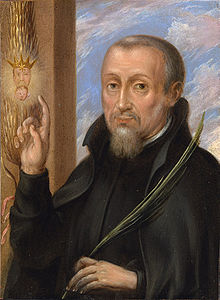
Garnet, “the prime scholar of Winchester College” as a gifted young student, left England to enter the Society of Jesus and study under Robert Bellarmine, a theologian so Catholic that he would later bring the hammer down on Galileo’s heliocentrism.

After eleven years in letters on the continent, the Society called Garnet to return to England in 1586 as the lead missionary to his native realm’s Catholic minority. It was a lonely burden for Garnet, especially after his opposite number Robert Southwell was arrested in 1592. (Southwell, too, went to the scaffold.) But Garnet carried it off as well as anyone. He remained free for nearly twenty years — creating an underground press and numerous illegal cells.

“Under his care the Jesuits in the English mission increased from one to forty, and that not a single letter of complaint, it is said, was sent to headquarters against him,” lauds the Catholic Encyclopedia.

Theologically, Garnet was noted for his defense of the doctrine of equivocation — that is (in the hostile reading of its Protestant interlocutors) of finding hair-splitting rationales for lying. It was an intellectual exercise of many centuries’ vintage, but for England’s beleaguered Catholics it was as urgent as life and death. Most specifically, this doctrine reckoned an oath insufficient to compel a truthful response to official inquiries as to the whereabouts and activities of fellow-Catholics who’d be liable with discovery to attain martyrdom. The liberal definition of “truth” to include an outright lie with a “secret meaning reserved in [one’s] mind” was obviously ripe for the scorn of persecutors for whom it was little but treason neatly clothed.

Knock, knock! Who’s there, in th’ other devil’s name?
Faith, here’s an equivocator that could swear in both
the scales against either scale, who committed
treason enough for God’s sake, yet could not
equivocate to heaven. O, come in, equivocator.

–Macbeth (c. 1606), Act 2, Scene 3

Much of Garnet’s last weeks in custody ahead of his execution were spent in harrowing the doctrine of equivocation; indeed, this is even the very last exchange he had with doctors of the English church sent to accompany him.

One of those standing near him then asked him, “Whether he still held the same opinion as he had formerly expressed about equivocation, and whether he thought it lawful to equivocate at the point of death?” He refused to give an opinion at that time; and the Dean of St. Paul’s sharply inveighing against equivocation, and saying that seditious doctrine of that kind was the parent of all such impious treasons and designs as those for which he suffered, Garnet said, “that how equivocation was lawful, and when, he had shewn his mind elsewhere, and that he should, at any rate, use no equivocation now.”

There were nevertheless equivocations that Garnet would never countenance. His A Treatise of Christian Renunciation, compiling quotes from Church fathers detailing the things a good Catholic must be prepared to renounce for his faith, excoriated those who attended Anglican chuches. Their pretense, he said, was nothing but their own comfort.

Certaine private persons, who have wholly addicted them selves to make them Gods either of their belly and ease, or of the wicked mammon, setting God behind all things which may delight them … refuse also to beleeve that the do amisse …

Judas with a kisse dost thou betray me? amongst hereticks dost thou professe me? no other place to professe chastity, but in the bedd of a harlott?

Harried as they were, England’s Catholics greeted with anticipation the 1603 accession of King James: raised Protestant, but the son of the Catholic Mary, Queen of Scots. Garnet shared Catholics’ hope that James would ease off harassment of the Old Faith; he even authorized the betrayal of fellow-Catholics’ regicidal Bye Plot as a show of loyalty and to pre-empt a possible backlash. “Quiete et pacifice,” he begged.

But toleration was still not quickly forthcoming, and soon Catholics had reverted to “a stage of desperation.” James was only in his thirties: would the trials be neverending?

Garnet continued endeavouring to keep Catholics calm and give the new sovereign the political space necessary to relax persecution. But many of his flock soon tired of quiete et pacifice.

In 1605, there would be another try — one that is still remember, remembered to this day.

Here Garnet again gets into hot water with theological doctrine. Garnet caught indirect wind of Guy Fawkes’ terrorist plot — but he heard it kind-of-sort-of under the seal of the confessional: another priest who himself had heard the design under confession told it to Garnet in a more ambiguous circumstance.

Garnet’s excuses here might strike the reader as far too fine; certainly that is how his prosecutors viewed it. The circumstances of the plot’s revelation certainly appeared to give the priest enough leave to find a way to reveal it, especially since he knew about it for many months before that almost-fateful Fifth of November. Garnet seems to have wanted the resolution — or loathed to plant another Judas-kiss. Maybe he thought his exhortations could stop it without anyone winding up drawn on a hurdle. Maybe, after 19 furtive years knowing every morning that his next sleep might be in a dungeon, his heart of hearts wanted to see it to go ahead.

When the attempt to explosively decapitate the English state was discovered Garnet was hunted to ground; his last days of “liberty” were spent stuffed in a coffin-sized priest hole at Hindlip Hall before the “customs of nature which must of necessity be done” finally forced him to out into the sight of his captors.

His fate looks like a foregone conclusion in retrospect, but Garnet did fight it — for two months before his condemnation, and five more weeks after from trial until his execution during which he maneuvered to exculpate himself. (See Investigating Gunpowder Treason for an exploration of this.) Since Reformation English law of course did not recognize the seal of the confessional, the most charitable reading of Garnet’s own admissions start at misprision of treason. It is but a single step from there to the scaffold if one supposes his long silence shrouded any sort of approval of or aid to the plotters.

Garnet received the mercy of being hanged to death before he was cut down for the public butchery part of his sentence.

On this day..

1634: Mikhail Borisovich Shein, for failing to take Smolensk

On this date in 1634, the Russian general Mikhail Borisovich Shein was executed on Red Square for losing to the Poles.

Shein (English Wikipedia entry | Russian) was an accomplished boyar officer who had made his bones during Russia’s Time of Troubles.

During the Time of Troubles — 15 war-torn years following the end of Ivan the Terrible‘s dynasty — the neighboring Polish-Lithuanian Commonwealth had eagerly exploited Russia’s chaos, invading Russia, backing an imposter who tried to claim the throne, and at last settling for tearing off a chunk of territory in war.

By the 1630s, Russia had her shit back together under the first Romanov tsar, and when the Polish king died in 1632 saw an opportunity to return stripe for stripe on its opportunistic neighbor.

This was the Smolensk War, so named because the recapture of that city was its primary objective. Shein, the respected elder military statesman who had lost Smolensk to a Polish siege twenty-odd years before, was just the man to lead the campaign.

The span of time tested by the 1632-1633 Russian siege was not merely that measured by the larder of Smolensk’s vastly outnumbered garrison — but that of Poland-Lithuania’s unwieldy succession process. Although the successor king was self-evident, the span required for his actual election left a six-month interregnum: nothing compared to the Time of Troubles, but perhaps enough for a frontier reversal.

But as it happened, Shein could not force Smolensk’s capitulation in 1633 and by the latter half of that year a superior Polish army was arriving. By October of 1633, a year after the Russians had begun hostilities, not only was the siege of Smolensk broken, but the Russian camp itself was encircled by the Poles. Having no prospect of a relief force such had just delivered his enemies, Shein could not hold out for even a single Friedman Unit and soon surrendered. He received liberal terms: the Russians had to abandon their artillery, but Shein’s army returned to Moscow unharmed, with its standards.


The Surrender of the Russian Garrison of Smolensk before Vladislaus IV Vasa of Poland, by an unknown Polish artist (c. 1634)

Having seen their jolly war of choice come to such a humilitating pass, the Moscow boyars received their defeated commander in a rage. A tribunal vengefully condemned Shein, his second-in-command Artemii Vasilevich Izmailov, and Izmailov’s son Vasili, to death for treason and incompetence in command.

(According to Nancy Kollmann, a German scholar present in Russia in 1634 recorded that the execution took the men by surprise, as they had been led to believe that they would receive a last-minute commutation.)

In even the most slightly longer term, the debacle proved to be only a minor strategic setback. Poland was unable to follow up its victory with any inroads on Russian soil. That June, the two belligerents came to a peace restoring the status quo ante bellum — and they managed to pass a whole generation before they fought again.

On this day..

1945: Robert Limpert, Ansbach antifascist

The ferocious commitment of the Third Reich to fight to the last man even when World War II was long past hope of German victory provided the occasion (or the pretext) for many of that bloody conflict’s most poignant and pointless deaths.

In these execution-focused pages we have seen the death penalty meted out to ideological enemies whom the Nazis hastened to dispose of in their last hours; almost infinitely more numerous were everyday people who by Berlin’s Götterdämmerung were made so much meat for the ordnance of the advancing Allies.

On this date in 1945, Robert Limpert’s effort to avoid the latter fate for his native Ansbach caused him to suffer the pangs of an entirely gratuitous execution.

Only 19 years old, Limpert had been disqualified from even desperate war’s-end military conscription by a severe heart problem.

He had made little secret of his antiwar views in the earlier years of the war. Even so, it was a deep shock while he was studying at the University of Wurzburg to see that ancient city devastated by a March 16 bombing raid that claimed 5,000 lives and destroyed most of its historic center.

He wandered back to Ansbach horrified, and sure that this city ought not share Wurzburg’s ordeal.

By April 18, American troops were just a few kilometers from the town. Limpert had spent the night before surreptitiously distributing pamphlets calling for a bloodless surrender, as he had on several earlier days. (Sample rhetoric: “Death to the Nazi hangmen.”)

According to Stephen Fritz, who describes this story in detail in his Endkampf: Soldiers, Civilians, and the Death of the Third Reich, Ansbach was in a state of near-collapse that Wednesday. Party officials were discreetly discarding their soon-to-be-incriminating insignia, and crowds jostled each other to loot canned goods for the prospective months of want ahead.

Though the Ansbach populace was violently hostile to the idea of inviting bombardment by fighting the Americans, word was that the rigorous commandant, Col. Ernst Meyer, did indeed mean to do so. Trying to prevent a disaster from befalling his city, Limpert that morning cut the telephone wires from the Col. Meyer’s command post to the nearby troops at the front — an act observed and reported by two diligent Hitler Youth.

What followed was a cruel exertion of a military machine aggrieved by Limpert’s entirely well-founded lese-majeste. The cut wire didn’t matter at all because the command post had already been abandoned. But it was reported, and policemen and bureaucrats began mindlessly following procedures. “In the chaos, nothing would have been easier than to drop the matter quietly and let Limpert go,” Fritz observes.

Meyer was frenetically trying to organize defenses that did not want to be organized and by the time he caught wind of of the Limpert investigation he was fit to be tied.

“For me,” he said later, “there was no doubt that I had found the man who had already engaged in treason for the past eight days [pamphleting against the war] … While forward in the front lines … brave soldiers risked their lives to defend the homeland, a coward attacked them in the back. I now had to act. I said, ‘Gentlemen, we’ll now immediately form a court-martial …’ Silence everywhere. I had the impression of a certain helplessness.” (Fritz, again)

Meyer’s aides were reluctant to speak. It was obvious that the Americans would occupy Ansbach with hours, but also obvious that an insufficiency of zeal could have any one of them shot on the spot. One or two of them hesitatingly suggested further investigation — an overtly correct notion that would be tantamount to dropping the case under the circumstances.

Meyer brusquely announced, “I sentence Limpert to death by hanging; the sentence will be carried out immediately.” According to Zippold [a constable], Meyer also declared that the entire Limpert family would be executed, whereupon both policem[e]n rushed to their defense. Unwilling to press the issue, Meyer said curtly, “We don’t have any time, let’s get going.”

In NS-Offizier war ich nicht, Col. Meyer’s daughter, Ute Althaus, grapples with his perspective on Limpert’s hanging — which Meyer always felt was justified.

It was past 1 in the afternoon when Meyer stalked out to the entrance of the city hall to conduct the execution personally. While all of Ansbach, all of the western front, sabotaged his frenzied defense of the Reich, Meyer had this boy at his mercy. The colonel poured all of his rectitude and despair into taking away at least this one life.

Nevertheless, Meyer was not an executioner. Nothing was ready for his improvised hanging, and while the colonel tied up the nearest rope he could get someone to fetch him, Robert Limpert twisted away and escaped. He made it maybe 100 yards: no bystander dared to answer his pleas for help as he was tackled, kicked, and dragged back to his gallows.

The story has it that Meyer, after hanging Limpert twice — the noose broke the first time — pinned some of the treasonable pamphlets to the body, then immediately hopped on a bicycle and fled directly out of town. Maybe the folklore has become a bit exaggerated on that point … but he can’t have stayed much longer. The Americans were there by supper time to cut Robert Limpert’s body down.

Today, several plaques in Ansbach honor Limpert.

On this day..

1355: Filippo Calendario and Bertuccio Isarello, Doge stooges

This date in 1355 was the morning after the failed coup of Venetian Doge Marino Faliero. And it was the first date that vengeance began to fall upon the plotters.

Faliero, voted power by the fellow-noblemen who bossed the Serene Republic, intended to displace the patrician class with commoner support. The scheme called for Faliero’s supporters secretly to mobilize hundreds of men who on April 15 would gather at the Piazza San Marco and mount their surprise takeover. But the plot sank like a stone on the big day, with anticipated adherents turning out sparsely or flatly declining and word soon reaching aristocratic ears of trouble afoot. The would-be masters of Venice were soon rounded up without resistance by the real masters of Venice.

In this misfired drama, Faliero’s henchmen — the men upon whom fell the task of orchestrating the cells who would summon the traitor militia — were Filippo Calendario and Bertuccio Isarello. And on this, the following day, they were tried, sentenced, and by evening hung from upper windows of the Ducal Palace. Both men were gagged: one last precaution against the sort of popular exhortation that they had not managed when it counted.

“The earth was set in motion,” one chronicler recorded of the Venetian establishment’s reaction to the menace. (Source) Faliero would die the next day; in all, eleven gibbeted corpses festooned the palace as a warning against the next aspirant.

Isarello was the captain of a Venetian galley who had been appointed by Faliero — controversially bypassing the usual noble prerogatives — and had rewarded his prince by expertly harrying Genoese merchantmen.

Calendario (English Wikipedia entry | the more detailed German), Isarello’s father-in-law, was a stonemason, sculptor and architect who actually worked on the very palace he was hanged from.


Column capital of Drunken Noah dating from the period of Calendario’s work on the Venetian Ducal Palace. (cc) image from Honza Beran.

On this day..

1322: Bartholomew de Badlesmere

On this date in 1322, Bartholomew de Badlesmere, the first (of only two) Baron Badlesmere, lost his head.

The barons in the dangerous age of Edward II were marked by where they made their political allegiances between the king and his rival the Earl of Lancaster.

Badlesmere? He … evolved.

The man could tack to the wind with the very best of them, or the very worst; he was reviled as the Benedict Arnold of 14th century England for chickenheartedly failing to protect the Earl of Gloucester when the latter impetuously charged to his death at Bannockburn. As a bard of the time put it,

This is the traitorous man Bartholomew, whom in all victories may God confound, because he has been to his master as changeable as a pharisee. Hence, as the representative of Judas, he shall be condemned to death … because he refused to come to his master’s support this traitor has deserved to be put to the rack … deserved to suffer judgment of decapitation.

As the 1320s began, he was a stalwart of what has been termed the “Middle Party”, whose position vis-a-vis Edward and Lancaster was what you would expect from the name.

Badlesmere badly misplayed a strong hand by defecting in the so-called “Despenser War” to the anti-Edwardian party, even though Lancaster pretty much hated his guts — and now the king did, too,* dissipating any mutual goodwill that might have been earned a few years before when the king’s favorite (and the war’s namesake) Hugh Despenser went and rescued Badlesmere’s wife from an attack.

And unlike at Bannockburn, Badlesmere here stepped into the trap rather than out of it.

Lancaster’s party was decisively defeated on March 16, 1322 at the Battle of Boroughbridge.

Days after the battle, Badlesmere was caught skulking in a glade by the Earl of Mar and shipped to Canterbury for trial. He was condemned to death on this date, and sent directly from court to a hurdle dragged by a horse to Blean three miles away, where he was hanged and beheaded. He was one of 20 or so lords and knights Edward had put to death.

Lancaster himself was another — although a “Contrariant” whom he didn’t execute, Roger Mortimer, would make Edward regret his clemency by overthrowing the king four years later.

* In an affair that Edward II biographer Kathryn Warner thinks was neatly contrived by the king, his Queen Isabella called on Badlesmere’s wife when the latter held Leeds Castle sans husband. Lady Badlesmere refused to admit the queen, giving Edward a welcome excuse for besieging a fortress holding out against its sovereign.

On this day..

1969: Alexandre Banza, Central African Republic politician

On this date in 1969, the Central African Republic’s dictator Jean-Bedel Bokassa had his number two condemned for plotting against him, and summarily shot.

Back on New Year’s Eve of 1965, Alexandre Banza had been on the same team as Bokassa in the conspiring business — achieving a rapid promotion from Captain when he leveraged his command of the Camp Kassai military base in support of Bokassa’s successful coup against his (Bokassa’s) cousin, David Dacko.

This was a great career move for Captain Banza, who speedily became Colonel Banza and the Minister of State and Minister of Finance to boot. But it wasn’t long before this made man looked to Bokassa like his main threat.

Notorious for his vanity — a few years after the events of this post, Bokassa, an unabashed admirer of Napoleon, would proclaim himself Emperor of the “Central African Empire” — the chief looked askance at his finance minister’s willingness to challenge Bokassa’s profligacy. Over the year or two prior to Banza’s execution, Bokassa maneuvered to push him away from power … and Banza maneuvered to create a power base for himself from which to launch his own putsch.

In the end it was Camp Kassai that played the decisive role once again. The guy with Banza’s old job as camp commandant, one Lt. Jean-Claude Mandaba, was supposed to be in on the plan, but on the eve of the intended April 9, 1969 coup, he tipped off Bokassa.

“The following afternoon Banza arrived at Camp Kassai with plans for the coup in his pocket,” writes Brian Titley in his Dark Age: The Political Odyssey of Emperor Bokassa:

As he stepped from his car, Mandaba and a couple of soldiers grabbed him. So fiercely did he struggle to escape that the soldiers had to break one of his arms before overpowering him. The ambushers then tied him up, stuffed him the trunk of a Mercedes, and took him to meet the man he had sought to depose. … [Bokassa] was jubilant at the sight of his former companion-in-arms being brought to him in chains. Banza was in poor shape after the journey to Berengo, but his torments were only beginning. Bokassa launched the interrogation by beating the prisoner almost senseless with his ever-present walking stick.

Bokassa was only narrowly dissuaded from thrashing this turncoat to death on the spot, and instead consented to a pro forma military tribunal — although rumors of the pre-death punishment visited on Banza once he was captured have muddied the waters quite a bit. Banza was reportedly hailed before the Cabinet and personally brutalized by Bokassa; Le Monde even reported that he’d been outright killed in this meeting and dragged through the streets by soldiers.

Bokassa was deposed by the French in 1979,* and condemned to death in absentia the following year. The former strongman voluntarily returned from exile in 1986 to face trial for a variety of abuses during his reign; his treatment of Alexandre Banza — and that of Banza’s family, a number of whom were arrested and some “disappeared” — formed part of the very extensive charge sheet. Though sentenced to death himself in that trial, Bokassa’s sentence was eventually commuted. The ex-emperor lived out his last years in a private home of his former capital.

* France’s “last colonial expedition,” in the words of one of her diplomats.

On this day..

1864: Kastus Kalinouski, Belarus revolutionary

On this date in 1864, Kastus Kalinouski was hanged in a public square in Vilnius.

A peasant revolutionary from the European frontiers of tsarism, Kalinouski is a present-day independence hero for Poland, Belarus, and Lithuania. (His name is variously rendered Konstanty Kalinowski, Kastus Kalinouski, and Konstantinas Kalinauskas for those respective homelands.)

These various polities had been joint constituents of the old Polish-Lithuanian Commonwealth, gobbled up by Russia at the end of the 18th century.

Dissatisfaction with membership in this adoptive empire progressed differently among different demographics of the old Commonwealth, but it really blossomed in the wreckage of the 1850s Crimean War. Chastened after being drubbed by an industrial power, Russia finally emancipated her serfs — but the emancipation proved to bear as much confiscation as liberation, to the chagrin of the emancipatees.

In Poland, Belarus, and Lithuania, peasant anger at the raw deal dovetailed nicely with stirring national sentiment. Kalinouski, a young barrister, launched the flagship (clandestine) publication for that audience, Muzyckaja Prauda (Peasant’s Truth). It was one of the first periodicals published in Belarusian, and it was not calculated to reconcile his countrymen to Moscow.

Six years have passed since the peasants’ freedom began to be talked about. They have talked, discussed, and written a great deal, but they have done nothing. And this manifesto which the tsar, together with the Senate and the landlords, has written for us, is so stupid that the devil only knows what it resembles-there is no truth in it, there is no benefit whatsoever in it for us.

-From the first issue of Peasant’s Truth

Kalinouski’s literary adventures mirrored a prominent role among the leadership of the January Uprising to throw off the Romanov yoke.

But it proved to be the case that, although scrapping with Great Britain might be one thing, the Russian army was more than a match for her internal foes. It crushed the January Uprising.

In prison awaiting execution, Kalinouski bequeathed one last literary vindication, his Letters from Beneath the Gallows.

Friends, my brothers!

From under the Russian gallows I am writing to you for the last time. It is sad to leave my native land and you, my dear people. My breast sighs and my heart is sore, but it is not a sad lot to perish for your truth. Hear my last words in sincerity, my people, for it is as if they were written from this world only for your good … as day and night do not reign together, so also true learning does not go together with Russian slavery. As long as this lies over us, we shall have nothing. There will be no truth, no riches, no learning. They will only drive us like cattle not to our well-being, but to our perdition.

… go and fight with the whole people for your human and national rights, for your faith, for your native land. For I say to you from beneath the gallows, my people, you will only then live happily, when no Russian remains over you! (Source)


A plaque in Vilnius marks the spot of Kastus Kalinouski’s execution on 22 March 1864 (10 March by the Julian calendar).

On this day..

1601: Robert Devereux, Earl of Essex

On this date in 1601, Queen Elizabeth’s last great favorite became the last man beheaded in the Tower of London.

Vain and dashing Robert Devereux rolled into the royal court in 1584 around age 19 and immediately established himself as the new favorite of the monarch, 30-some years his senior. They spent long walks and late nights in enchanted private company, and Devereux “commeth not to his owne lodginge tyll the birdes singe in the morninge.” Ye olde walke of shayme.

In becoming the (presumed) lover* of the aging Virgin Queen, the Earl of Essex was only following the family** trade: his stepfather Robert Dudley was the younger Elizabeth’s longtime intimate.

It is up to the artists to postulate the relative measures of passion and cynicism in these dalliances; many have tried, inspired by the scaffold sundering of one of history’s great May-December affairs. The Essex-Elizabeth drama was a popular topic for broadsides, ballads, and stage treatments from the 17th century to the present day.


Benjamin Britten put the Elizabeth-Essex romance into opera in Gloriana, based on Lytton Strachey’s popular book.

He was wildly popular in London, but Essex was also afflicted by the follies of youth. Rash, temperamental, vainglorious; he aspired to leverage the favor of his sovereign into statesmanship and he achieved heroic repute for his swashbuckling raid on Cadiz.

Yet Essex reads like a whelp who never quite grew into a man’s boots. Every sketch of Essex includes, because it seems so starkly illustrative of his unstable character, the story of the time his impertinence led the queen to box his ears publicly — and the hothead’s hand flew instinctively to his sword-hilt. Everyone reconciled over this brush with lese-majeste, but only after Essex scribbled some skulking reproaches (“What, cannot princes err? cannot subjects receive wrong? is an earthly power or authority infinite?”) that he had the petulance to actually send to Elizabeth.

The less mercurial Earl of Salisbury, Robert Cecil, who was the son of Elizabeth’s earliest close advisor and the protege of her spymaster, was just two years Essex’s senior but smoothly outmaneuvered the loverboy in their mutual pursuit of England’s Secretaryship of State.†

Essex chased martial glory with mixed results. His last great enterprise was an ill-starred 1599 offensive in Ireland to bring Gaelic rebels to heel in the Nine Years’ War.

Not for the last time an Englishman found this conquest more easily aspired than achieved. Essex liberally overused his authority to knight men as a reward for their service, but his soldiers mostly slogged to and fro with little headway to show for it. After a frustrating campaign season chasing his tail, Essex defied the increasingly strident directives to attack issuing from Elizabeth’s irate pen, and made terms with the Irish commander Hugh O’Neill, Earl of Tyrone. Then he defied Elizabeth’s order to remain in Ireland and hastened back to London to justify himself. It was said of him that he “never drew sword but to make knights.”

This was the beginning of Essex’s end. Elizabeth’s fury at the aimless military campaign was compounded when her churlish captain turned up from Ireland unbidden and burst into her private chambers while she was still dressing to report on his unauthorized summit. Cecil et al, whose ascendance Essex had meant to reverse with the triumph of his arms, now murmured that the earl had strayed near outright treason to parley with the rebel whom he was supposed to be routing. The Privy Council put him under house arrest.

Heaped in debt and deprived of the prestigious proximity to power he had enjoyed literally throughout his adulthood, the man’s turbulent spirit stirred strangely in York House. We have seen that Robert Devereux, Earl of Essex, was a man to abhor an indignity even past the point of self-preservation. He unwisely sent secret missives to try to turn the ongoing succession negotiations‡ against Robert Cecil; when the Privy Council caught wind of this intrusion, he refused its demand that he present himself to account for his actions. Instead, he made matters worse by mounting a pathetic march through London with his supporters.

This “Essex Rebellion” was meant to rally the citizenry to him and turn some sort of coup against Robert Cecil. It seems so foolhardy and ill-considered that it’s difficult to think what was in the earl’s head. If you squint at it just so, it perhaps had a big-R Romantic quality, a gallant band of brothers saving the nation from its duplicitous ministers; the night before the rebellion, Essex (a liberal arts patron in his time) splurged to have William Shakespeare’s company§ stage a special performance of Richard II — a play wherein the English monarch is deposed. Presumably this was his inspirational pregame speech.

Thinking much more clearly than Essex, Londoners vigorously ignored his summons and the marching party trudged alone — and surely increasingly frightened — through the city until it was stopped by a barricade. Its participants then fled back to Essex House where they soon found themselves surrounded.

Whatever the fancy that led the Earl of Essex on his fatal February 8 march, and whatever the extent of his ambitions for that occasion, the careless threat to the public peace went several bridges beyond a boyish foible that Elizabeth could overlook in her impulsive courtier. He was prosecuted for treason within days and Elizabeth signed his death warrant on February 20th. The only mercy extended the ex-favorite was to suffer the noble execution of beheading, rather than a traitor’s drawing and quartering. Essex also successfully appealed for a private execution within the walls of the Tower, away from the gawks of those London masses who had so signally failed to rebel along with him.

On the specially built wooden platform, Essex favored his select audience with a bog-standard execution-day mea culpa:

My sins are more in number than the hairs on my head. I have bestowed my youth in wantonness, lust and uncleanness; I have been puffed up with pride, vanity and love of this wicked world’s pleasures. For all which, I humbly beseech my Saviour Christ to be a mediator to the eternal Majesty for my pardon, especially for this my last sin, this great, this bloody, this crying, this infectious sin, whereby so many for love of me have been drawn to offend God, to offend their sovereign, to offend the world. I beseech God to forgive it us, and to forgive it me — most wretched of all.

He prayed a Psalm. Then, stretching out his neck on a low block and thrusting his arms from his sides, he bid the headsman strike. The executioner had to oblige his patient in triplicate in order to sever the puffed-up head.

The Earl of Essex has the distinction of being the last person beheaded on the Tower Green, within the walls off the Tower of London — the last name on the little placard of headless notables photographed by tour groups. Note that Essex was not the last person beheaded at the Tower, when the adjacent Tower Hill is included (that distinction belongs to Jacobite rebel Simon Fraser); nor was he the last person executed within the Tower (that distinction belongs to World War II spy Josef Jakobs, who was not beheaded but shot).

Weary and depressed, Elizabeth died little more than two years afterwards.

* There’s a mind-bending speculative hypothesis out there — cousin to the Shakespeare-focused Prince Tudor theory — that Essex was actually Elizabeth’s secret, illegitimate son. This secret history is obviously more congenial with the queen’s early favoritism for Essex than with her eventually chopping off his head.

** Essex was also a distant cousin of Elizabeth herself: his maternal great-grandmother was Mary Boleyn, sister of Anne Boleyn — who was Elizabeth’s mother.

† Walter Raleigh was a notable Cecil ally in this factional conflict. Raleigh attended Essex’s execution … and, of course, shared that fate many years afterwards.

‡ Elizabeth was nearing age 70; her childless death was imminent. James VI of Scotland was being vetted by Robert Cecil as the successor. Essex tried to stick his thumb in the pie by warning James that the Cecil faction would conspire to foist the English crown on the Spanish infanta — daughter of the Spanish king who had been the Catholic Mary Tudor’s husband. (The infanta was not Mary’s own daughter.) This was no idle threat, as at this point it was only a few years since the Spanish Armada had sallied for English seas.

§ Another noteworthy Shakespeare connection: one of the participants in the Essex Rebellion was the Earl of Southampton (he was spared execution). Southampton, whose given name was Henry Wriothesley, is often identified as the “Fair Youth” to whom Shakespeare dedicated numerous love sonnets. (Some of those are directly addressed to a Mr. “W.H.”)

On this day..

1513: Pietro Boscoli and Agostino Capponi, but not Niccolo Machiavelli

Niccolo Machiavelli‘s exile from Florentine politics — and subsequent entry into the intellectual canon — was cinched this date in 1513 when two of his friends (or possibly co-conspirators) were executed for a plot against the Medici.

Before he was an adjective, Machiavelli was a powerful minister of state for the Florentine Republic — the polity ensuing the 1498 execution of Savonarola.

Days after that stern friar burned to ashes on the Piazza della Signoria, Machiavelli was named the secondo segretario fiorentino,* alongside a primo segretario counterpart, the older and more cautious Marcello Virgilio Adriani.

What a moment this was to be a Florentine! The mighty Medici had been chased out of Florence and with the fall of Savonarola and his grim morals police the humanist dream of a classical republic suddenly seemed within grasp.

Machiavelli was just 29 years old when he reached this office, bursting with a patriot’s reckless exuberance — and a virile young man’s hedonism. He delighted in whores and in boozing around with his Chancery cronies Agostino Vespucci** and Biagio Buonaccorsi.

The correspondence of these indiscreet young Turks fill with profane and cutting takes on the leading citizens of Florence; Machiavelli, who was known in his own time as a playwright and not a political philosopher, was even bold enough to put such ridicule in print. The 1504 play Le Maschere is tragically lost, but by surviving accounts it lampooned “under feigned names, many citizens who were still living.”†

A few books about Niccolo Machiavelli

While not scribbling pasquinades and getting laid, the Second Secretary had matters of state to attend to. We have met him in these pages, as the Florentine ambassador to the court of Cesare Borgia; Machiavelli could not help but admire the condottiero‘s ruthlessness. Machiavelli also represented Florence in Rome, Spain and France.

Showing an equal aptitude for politics by other means, Machiavelli moved the Florentine military muscle towards a citizen militia, presciently replacing its dependence on mercenaries. In 1509 this force captured Pisa.

But Machiavelli’s excessive regard for this strategic advance married to his excessive affinity for the republic of Piero Soderini undid him in the end. While the First Secretary, Adriani, quietly cultivated contacts of various political persuasions, Machiavelli went all in against the stirring Medicean party. This became a problem when the fortunes of peninsular war drove Florence’s French allies away, leaving the city ripe for recapture by Giuliano de’ Medici, who also happened to be the brother of the pope in waiting.

In 1512, a hastily-assembled city militia of about three or four thousand infantry and 100 men-at-arms met an overwhelming Spanish-Papal-Medicean force at Prato. Scrambling to defend a lost cause, Machiavelli had mustered about a third of the militia and was trying to organize the city’s defenses. Florence’s crushing defeat in this battle and the ensuing civic massacre in Prato (with “countless murders, sacrileges and rapes”) convinced the Florentines to depose Piero Soderini and throw open the gates to Giuliano de’ Medici.

This was the end of Machiavelli the statesman … and, of course, the birth of Machiavelli the philosopher. The ensuing 15 years’ frustrating exile left him no other outlet for his political passions save his pen; needless to say, works like The Prince and Discourses on Livy retain exalted seats in the canon down to the present day. (They made little impression on Machiavelli’s contemporaries; Florentines still knew him for the plays he kept writing.)

A few books by Niccolo Machiavelli

When evening comes, I return home and enter my study; on the threshold I take off my workday clothes, covered with mud and dirt, and put on the garments of the court and palace. Fitted out appropriately, I step inside the venerable courts of the ancients, where I nourish myself on that food that alone is mine and for which I was born; where I am unashamed to converse with them and to question them about the motives for their actions, and they, out of their human kindness, answer me. And for four hours at a time I feel no boredom, I forget all my troubles, I do not dread poverty, and I am not terrified of death. I metamorphose into them completely.

-Machiavelli, December 10, 1513

The cautious primo segretario Adriani, who could better see where the winds were blowing, survived the transition by having the wisdom not to align himself with the losing party. Whatever the verdict of posterity, the 1510s were Adriani’s time to bask in the center of events while Machiavelli did his work of ages in obscurity.

But what cinched Machiavelli’s unhappy permanent banishment from Florentine politics — notwithstanding unctuous expedients like dedicating The Prince to the Medici ruler — were the events culminating in two February 23, 1513 beheadings.

Machiavelli had been dismissed in November 1512. Four months later, a nascent (or wildly exaggerated) anti-Medici conspiracy led by a republican named Pietro Boscoli came to light. Its chief, and paltry, evidence was little more than a written list of around 20 fellow-travelers, upon which appeared the name of Niccolo Machiavelli. It’s more than likely that the “treason” comprised merely to the idle chatter of some disaffected republicans, but after a generation in exile the newly restored Medici dynasty wasn’t taking any chances.

For the onetime Second Secretary, this meant prison and torture by the strappado. Three months on, he was released to his estate with no political succor save the haunts in his head.

But the head he got to keep — and that was better than one could say for Pietro Boscoli.

Boscoli and one Agostino Capponi were beheaded early in the morning of February 23, a bare eight hours after their death sentences were announced. Their last hours were recorded as a Recitazione by a young friend named Luca della Robbia: the tender Passion scene of Boscoli in particular struggling to come to grips with his shockingly sudden fate. The full narrative can be found in translation by Alison Knowles Frazier in The Art of Executing Well: Rituals of Execution in Renaissance Italy. We excerpt a little taste below:

At about 8 o’clock, having had his supper, Boscoli was brought with his legs in irons to the chapel where … he was told that he had to die …

Pietro Paolo cried out “Oh Pietro Paolo, oh poor Pietro Paolo! What has become of you!”

Then I, moved by the greatest compassion, seeing my beloved friend in such great distress, went first to him as lovingly as I could, with a gesture full of mercy, and greeted him like this: “God save you, dearest friend. ‘Do not fear those who kill the body, for they cannot kill the soul.’“

Poor Pietro Paolo struggles on here for 15-odd pages in evident anguish, veering between practical considerations of the family he is leaving behind and whom to rustle up as his last-minute confessor, and his uncertain spiritual readiness for death (he was particularly upset at being told of his fate after dinner, for “I am too loaded down with food, and I have eaten salty things, so that I don’t feel able to join my spirit to God”). Della Robbia stays with him the whole time; in the latter’s introduction, he says he “noted diligently all his words, both questions and replies, and kept them in my memory … that such a great and well-formed example of strength and spiritedness would not be lost” and recorded them faithfully later on.

By the end, Boscoli has reconciled his mind to the scaffold.

He is escorted down the stairs from the chapel of the Bargello to its interior courtyard where

leaving the first step, he encountered the Confraternity’s‡ crucifix.

“What am I to do?” [Boscoli] said.

“This is your captain, who comes to arm you,” the friar responded. “Greet him, honor him, ask him to make you strong.”

Then he said, “Greetings, Lord Jesus. I adore you, hanging on the cross. Make me, I beg you, like to your Passion. True Lord, I ask you for peace.”

And thus, going down the second step, he kept commending himself, saying, “‘Into your hands, Lord, I commend my spirit. You redeemed me, Lord, God of truth.’” When he was on the little platform of the stair, he said, “Is it enough, a good preparation towards God? For I feel some battle. Recall to me those three things.”

Then I, who was behind him, said, “Well you know that it is enough. Say to him, Fra Cipriano, that verse by David, ‘Your ear heard the preparation of their heart, Lord.’”

“Okay, yes,” the friar replied, “Your ear heard the preparations …,” and told him once again the three things.§

And he answered, and said, “‘Let your ear hear the preparation of my heart, Lord Jesus.'”


Then the executioner, because he wanted to put a kerchief over his eyes, asked his forgiveness and offered to pray to God for him.

“Go ahead and do your duty,” Pietro Paolo said. “And when you have put me at the block, leave me like that for a bit and then finish me off, and that you pray God for me, I accept.”

The reason why he asked for a little time at the block, was that he had all night long always desired a great joining with God and he didn’t feel that he had achieved it as he desired, so that he hoped in that last moment to make a great effort and so to offer himself wholly to God …

And placing himself down, and the executioner, giving him the shortest time, cleanly removed his head, which, so cut, continued to move its mouth for a time.

Agostino Capponi, whom della Robbia has seen only glancingly over his long narrative, follows Boscoli. Although Capponi required two blows of the executioner’s blade, he perhaps went into the hereafter with a soul better at peace — for he “retained on his face a certain wry expression, perhaps not distant from true sincerity.”

* Summary of Machiavelli’s career based on William Landon’s Politics, Patriotism and Language: Niccolò Machiavelli’s «Secular Patria» and the Creation of an Italian National Identity.

** Machiavelli’s clerk Agostino Vespucci — a cousin of the explorer Amerigo Vespucci for whom the American continents were named — made the headlines recently when discovery of a scribble he left in the margin of a 16th century text established the identity of the long-mysterious first lady of Renaissance art, Mona Lisa: she was Lisa del Giocondo, the wife of a Florentine cloth merchant.

† Landon says the primo segretario Adriani encouraged Machiavelli to publish this play, even though Adriani himself is one of its targets — in Landon’s view, because Adriani was playing a long game for power, and revenge: quietly encouraging Machiavelli’s excesses while positioning himself politically to profit from his consequent fall.

‡ The Confraternity of the Blacks: a lay brotherhood associated with Florence’s [former] Chiesa di Santa Maria Vergine della Croce al Tempio, tasked with the spiritual assistance of prisoners condemned to death.

§ Shortly before proceeding to execution, Boscoli steeled himself for the ordeal by resolving that “In this journey I have to have three things. I have to believe the faith. I have to have firm hope that God will pardon me. And the third is that I have to suffer this death for love of Christ and not for others.”

On this day..

205: Plautianus, purple proximity

On this date in 205, the Roman patrician Gaius Fulvius Plautianus was put to summary execution for aspiring to the purple.

Maternal cousin and longtime ally to Septimius Severus, Plautianus had helped himself to a generous slice of power and wealth when his friend became emperor. He got his bristly mug onto imperial coinage and even dynastically married his daughter to Severus’s nasty son and heir* Caracalla.

And so liberally did Plautianus wet his beak on the perquisites of this power that, Cassius Dio reports, “the populace in the Circus once exclaimed: ‘Why do you tremble? Why are you pale? You possess more than do the three.'” The three meant Severus himself and his two sons.

Severus for a time blithely ignored his friend’s aggrandizement, and Plautianus made the political personal by appropriating for himself the estates of numerous senators whose proscription he helped Severus implement.

But the enormous influence of his prefect soon began to present a threat that the emperor could not afford to ignore. In the coming years of the Third Century Crisis, this pattern would repeat itself with numbing regularity: the prestige of some figure would raise the prospect of his seizing the throne; the mere possibility would then thrust sovereign and potential usurper into a destructive mutual dash towards pre-emptive violence.

It’s anyone’s guess whether Plautianus was already contemplating a putsch as the natural progression of his authority, but the decision was made for him by the contempt with which Caracalla treated that daughter he’d been made to marry. The heir “was exceedingly hostile to the the girl, and to her father too,” and even “daily promised to kill her and her father as soon as he became sole ruler of the empire.” (Herodian of Antioch)

Resolving to strike before the young hothead was in a position to effect his threats, Plautianus allegedly engaged one of his loyal servants to assassinate the imperial family.**

The plot was instead betrayed, and Plautianus was produced before his former colleague to be handled as they had once handled those proscribed senators. After his immediate execution, his body was cast into the streets and Caracalla’s unwanted wife sent to a miserable exile.†

The History of Rome podcast covers the reign of Severus and the fate of Plautianus in episode 101, “And All Was of Little Value”.

* Co-heir, with his brother Geta — whom Caracalla murdered at the first opportunity after dear old dad died.

** The would-be assassin presented Severus with a written order for his death in the hand of his master. Cassius Dio quite justly suspects this a stitch-up: “These circumstances in particular betrayed the fraud; for Plautianus would never have dared to give such instructions either to ten centurions at once, or in Rome, or in the palace, or on that day, or at that hour, and especially not in writing.”

† Caracalla had his former wife murdered in 212.

On this day..