1691: Jacob Leisler, “a Walloon who has sett at the head of the Rable”

On this date in 1691, Jacob Leisler was executed in New York, a New World casualty of the Glorious Revolution back in the mother country.

In an era when transatlantic communication moved at the speed of a galleon, the 1688 overthrow of England’s Stuart monarchy initiated an agonizing period of political uncertainty in Albion’s far-flung American provinces.

And to the question of who was really in charge were appended the many local political issues of the colonies — religious, economic, political.

One of the empire’s dominant fault political fault lines in the foregoing years had been the succession to follow England’s last Catholic monarch, James II. For Calvinists whose dynastic champion was the House of Orange, the marriage of their guy William III to James’s daughter raised the prospect of an eventual claim on the English throne. Those hopes seemed dashed when James fathered a son, to the elation of Catholics who now aspired to a lasting Catholic line.

When word reached New York, still a majority-Dutch city thanks to its original mother country, of the ascent of that their countryman William III and England’s Protestant establishment had forcibly disinherited the infant prince and his dad, it did not take long for local Dutch factions to run off the former King James’s plenipotentiaries. (An irony, since New York was named for that very same now-deposed King James: he’d been the Duke of York when it was seized for the Dutch in the 1660s.)

That ex-monarch’s brief reign had seen the establishment of a much-resented Dominion of New England, welding together everything from New Jersey to Maine into a super-colony whose high-handed boss was arrested by a Boston mob. (He sailed for England.) That gentleman’s lieutenant, in New York, likewise absconded as his own authority crumbled … a sort of American Glorious Revolution shadowing the one across the pond.

The Frankfurt-born Leisler was a colonial mercantile magnate, one of the 17th century’s wealthiest New Yorkers, notable for his Orangist sympathies and Calvinist religious inclination. It was to this important private citizen (who was also a militia captain) that de facto executive power fell in the New York colony — and it was indeed the New York colony specifically, since the reassertion of local prerogatives and pre-1685 administrative units had been one of the immediate consequences of the shakeout in America.
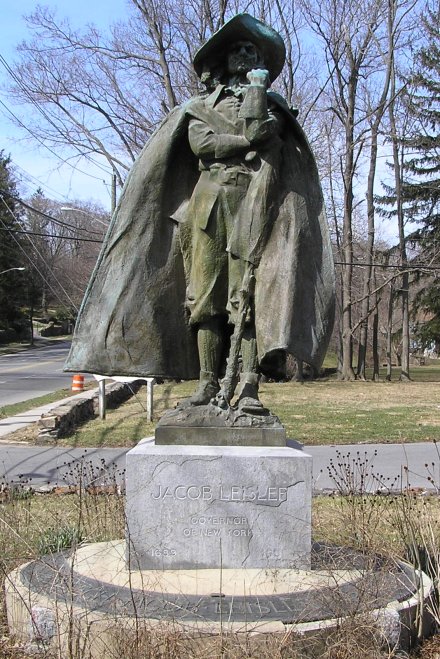

Statue of Jacob Leisler in New Rochelle, N.Y. — which Leisler helped create as a settlement for refugee Huguenots.

And once in the saddle, the Dutch Calvinist Leisler essentially ran a populist administration against the colonial oligarchy, which replied by vilifying him as a “usurper” and “rebel”.

Internal politics in New York and its neighbors during those months make fascinating reading.* Quakers and Catholics aligned against Protestants. Albany aligned against New York, until Leisler brought the former to heel. Clergy chose up sides. Leisler summoned a sort of proto-continental congress of colonial representatives (all the way to the West Indies) to hash out their situation.

And what was that situation? There had been a revolution, after all, and there was no agreed-upon representative of the royal authority present in New York. An assembly of militia leaders had asked Leisler to assume leadership, so was he really outside his rights to treat as his the London dispatches addressed to “such as, for the time being, take care for preserving the public peace and administering the law in New York”?

It’s a moment whose ferment of democratic energy can be read to presage the next century’s (proper) revolution.

Yet it was also not a revolution in the Cromwellian, world-turned-upside-down sense. For the English polity, and certainly for the conduct it preferred in its frontier possessions, continuity was the order of the day. Even in England herself, William and Mary were more than pleased to govern with Tories who could see their way to releasing their fealty to the Stuarts.

There was an empire to run, after all.

From that standpoint, Leisler’s anti-oligarchical policies and fractious disputes with other colonial elites were a bad business. There’s no sense in letting France make inroads because your governors are bickering over predestination or some such.

So formally, the realm’s new rulers continued all non-Catholic personnel in their posts. With the Dominion governors ejected, it was just a matter of dispatching fresh executives to take over. It’s just that this process required months … during which Leisler was managing New York the way he figured it ought to be managed, and his enemies were consequently painting him as a rebel.

Leisler pronounced himself, this whole time, anxious to submit his authority to the new governor upon the production of proper credentials. If he was surprised that the new monarchs tendered appointees of the very same factions recently expelled,** Leisler showed it only in his exactitude for procedure: because of a logistical cock-up, an aide to the new colonial governor arrived first, and when Leisler refused to hand over his fort without the royal warrant, a tense standoff ensued. It was resolved when the real governor, Henry Sloughter of ominous name, finally showed up.

Sloughter had his “predecessor” immediately arrested, along with others of his circle and harshly tried for treason and murder by a court stacked with anti-Leisler political enemies.†

Ultimately Leisler was condemned to die along with his secretary and son-in-law Jacob Milborne, but even Sloughter was loath to enforce the sentence. The story goes that Leisler’s most implacable foes had to get Sloughter drunk to put his signature on the death-warrant. (Sloughter died a couple of months later himself, for maximum operatic effect.)

On Saturday morning, May 16, 1691, the largest crowd ever gathered in New York City stood, rain soaked and weeping, all eyes fixed as a limp body was cut from the gallows and placed on the block. With a clean blow, the executioner’s ax cut off the head of the “halfe dead” Jacob Leisler — loyal lieutenant governor or rebel tyrant, depending on one’s point of view. Amid the “shrieks of the people,” fainting women (some “taken in labour”), and tumultuous jostling for “pieces of his garments” and strands of his hair, as “for a martyr,” the newly arrived and unfortunately named royal governor, Henry Sloughter, worried that his decision to execute Leisler might not, after all, end the “diseases and troubles of this Government.” Indeed, for years afterward New Yorkers bitterly divided over Leisler and the 1689 uprising that, in the wake of England’s Glorious Revolution, had led to his assumption of power in the provincial government.

-David Voorhees, who elsewhere contends that these divisions “continue to inform American politics to the present day.”*

A few years later, a more Leisler-friendly Parliament restored the dead man’s estate to his heirs, a sort of implicit admission that the whole head-chopping thing might have been a bit much.

This character figures to bear more historical consideration than he has heretofore enjoyed; further to that end, there’s a Jacob Leisler Papers Project devoted to marshaling at New York University the primary documents connected with Leisler.

* See, for instance, David Voorhees in “‘to assert our Right before it be quite lost’: The Leisler Rebellion in the Delaware River Valley” in Pennsylvania History, Winter 1997 — and, Voorhees again in “The ‘fervent Zeale’ of Jacob Leisler,” The William and Mary Quarterly, July 1994.

** Literally so: Francis Nicholson, whom Leisler ousted from New York, tried to get himself appointed governor; he was instead sent to Virginia and continued in royal service in the colonies for decades to come.

† e.g., Joseph Dudley, one of Leisler’s judges, whose penchant for authoritarian justice has been noted elsewhere in these pages.

On this day..

1766: Thomas Arthur de Lally-Tollendal, undiplomatic

On this date in 1766, a refugee noble with more honor than sense lost his head in Paris.

Thomas Arthur, comte de Lally, baron de Tollendal — more efficiently known as Lally, or as Lally-Tollendal, though he’s not to be confused in this with his son, a French Revolution bit player — entered this world in County Galway, the child of a minor lord.

Since said lord hewed to the Jacobite party favoring restoration of the Stuarts to the English throne, the family found itself relocated with the exiled Pretender to a continental power whose spiritual and temporal interests were similarly inimical to the Hanoverian king.

Our man landed himself, like a proper retainer of his adoptive liege, a gig in the French army in which capacity he actually served at the Jacobites’ last doomed British hurrah, the 1746 Battle of Falkirk.

But his problems came from his Bourbon service much further afield — in India.

There, his expeditionary force suffered reversal after reversal at the hands of the hated Brits, even then in the process of appending India to their dominions.

Our general’s military misadventures were compounded by impolitic high-handedness towards his officers and men, and to the locals whose alliances he needed. He was, in the main, a man ill-suited to the job entrusted to him. As the Memoirs of Sanson remark, “his temper, his obstinacy, and especially his contempt for all means of action except brutal strength, were destined to lead him into mistakes in a position demanding more knowledge of politics than science of war. Sixteen years before Lally-Tollendal’s appointment, Dupleix, with scanty forces, at enmity with the Company, receiving neither help nor subsidies from the mother country, had held in check English power in the Indian peninsula by mere diplomatic proficiency. Lally knew how to conquer; but he was incapable of studying and detecting the secrets of Dupleix’s policy.”

By the time the bad news that established all this hit France, the subcontinent was pretty much Britain’s to command — just another piece of the imperial butt-kicking France suffered in the Seven Years’ War.

And Lally’s enemies were holding him personally responsible as a potential traitor. After all, he was conveniently now in English custody.

Incensed at having his honor impugned, Lally unwisely obtained English parole to return to repel these charges. He proved no more diplomatic with the barristers than he had been with the Hindus:

he was so convinced of his own innocence that he was imprudent enough to impeach the officers who had served under his orders, together with the administrators of the colony. He charged them with such violence that his death and condemnation became indispensable for their justification … When the accused appeared before his judges, he was no more able to control his temper than when he was in India … answering, fuming, retorting, stigmatising the cowardice of some, the cupidity of others, and hinting that the only guilty party was the powerless Government.

Just the sort of vindication liable to appeal more to posterity than to said government. Louis XV, another man unequal to his position, was by this autumn of his reign plumbing the nadir of his unpopularity; for the officer who had risked his life in battle under French colors throughout adulthood, Louis calculated more profit in severity (or expedience) than in clemency. Hey, it had worked for the English.

And really, for a Stuart adherent, sacrificial execution was kind of an apt fate.

We guess it worked.

“The people were pleased with all that made his punishment ignominious: the cart, the handcuffs, and the gag,” recorded aristocrat-of-letters Madame du Deffand (Source) “He was a great rascal, and besides he was very disagreeable.”

Thomas Carlyle, in his The French Revolution, spared in Lally’s defense a few sentences of delicious invective for the rotting regime that did him in.

The Parlement of Paris may count itself an unloved body; mean, not magnanimous, on the political side. Were the King weak, always (as now) has his Parlement barked, cur-like at his heels; with what popular cry there might be. Were he strong, it barked before his face; hunting for him as his alert beagle. An unjust Body; where foul influences have more than once worked shameful perversion of judgment. Does not, in these very days, the blood of murdered Lally cry aloud for vengeance? Baited, circumvented, driven mad like the snared lion, Valour had to sink extinguished under vindictive Chicane. Behold him, that hapless Lally, his wild dark soul looking through his wild dark face; trailed on the ignominious death-hurdle; the voice of his despair choked by a wooden gag! The wild fire-soul that has known only peril and toil; and, for threescore years, has buffeted against Fate’s obstruction and men’s perfidy, like genius and courage amid poltroonery, dishonesty and commonplace; faithfully enduring and endeavouring,–O Parlement of Paris, dost thou reward it with a gibbet and a gag?

There’s a public-domain 19th century lecture on our man’s adventurous career here. And there’s a monument back home near Tuam, Ireland.

On this day..

1972: Deniz Gezmis, Yusuf Aslan, and Huseyin Inan, Turkish revolutionaries

On this date in 1972, three Turkish youths hanged at Ankara Central Prison for attempting to “overthrow the constitutional order.”

Deniz Gezmis

“The three urban guerrillas,” reported the New York Times the next day, “stood on chairs placed on a platform as the nooses were placed around their necks. They asked for and were given the right to kick the chairs out from under themselves.”

Deniz Gezmis, the best-known of them, was a 1960s student radical who eventually helped found the People’s Liberation Army of Turkey (THKO) and received guerrilla training in Syria from Palestinian terrorists.

As Turkey made the turn into the 1970s, left-right violence made the country all but ungovernable.

Gezmis and his comrades got in on the action by kidnapping four U.S. radar technicians for ransom in March 1971, leading Turkish journalist Abdi Ipekci to declare that “it is necessary to halt this anarchy which is pushing our country to a dark and bloody future.”*

The Turkish armed forces were right on the case, and just days later intervened with a bloodless military coup.

The servicemen were released unharmed … but there was a bloodbath waiting for others on account of THKO.

An army-backed conservative government started shuttering left-wing papers, banning left-wing organizations, and eventually imposed outright martial law.

Our principals became the first hanged under that regime, but scores of others** were also tried for their lives for revolutionary activities. Since the young socialists had robbed banks and taken hostages but never actually killed anyone, their actual executions were controversial within the government itself … and ultimately undertaken on the unseemly “three for three” body count equivalence to the Prime Minister and two aides who had hanged when Turkey last had a leftist coup government.

In the streets, paramilitary violence continued.

During the trials of Gezmis and other radicals, Israeli ambassador Efraim Elrom, a Polish emigre who had interrogated Adolf Eichmann, was kidnapped and murdered in Istanbul by THKO activists. (The kidnapping in turn prompted an intensified crackdown — arbitrary detention, torture, the usual stuff.) Years later, another communist cell assassinated the man who had presided as Prime Minister when Gezmis hanged, Nihat Erim, allegedly in revenge for this date’s executions.


London Times, May 8, 1972.

Conversely, for Gezmis, the handsome young Che Guevara of Turkish insurrectionary Marxism — this date was only the beginning of a rich afterlife as iconic martyr.


Graffiti of Gezmis and Che Guevara, with a sentiment common to both. (cc) image from somebody_

Also imprisoned in the roundup of radical activists was Turkish writer Erdal Oz, who turned the conversations he had with this date’s doomed into a notable book.

* Quoted in the March 8, 1971 London Times. Ipekci was eventually murdered by the Turkish assassin who subsequently tried to kill Pope John Paul II — Mehmet Ali Agca.

** e.g., Irfan Solmazer, a Senator who had been involved in Turkey’s left-wing coup a decade before. (He wasn’t executed.)

On this day..

1534: Elizabeth Barton, the Holy Maid of Kent

On this date in 1534, Elizabeth Barton was hanged at Tyburn with her “conspirators” for having prophesied the death of Henry VIII and (in the words of the parliamentary attainder against them) “traterously attempted many notable actes intendyng therbye the disturbaunce of the pease and tranquyllytie of this Realm.”

A country servant-girl, this Elizabeth Barton had begun having divine visions around Easter 1525, and developed a popular following for her gift of prophecy, generally delivered during spooky (perhaps epileptic) fits and trances.

This was all just fine with everyone, since King Henry was still a good Catholic at the time; Barton took orders in the St. Sepulchre Nunnery and continued her career in the seer business.

Elizabeth Barton wasn’t going to leave her place in Henrician England … but to paraphrase Ronald Reagan, Henrician England was about to leave her.

And like so many entries that age has given this site, it all went back to Henry’s leaving his first queen, Catherine of Aragon.

If one likes to see in the prophetic tradition a refracted expression of popular sentiment, speaking a religious rather than a political language, Elizabeth Barton’s divine gift set her up to be the mystical exponent of the English populace’s visceral reaction against Henry’s ascending paramour, Anne Boleyn.

Rather rashly, Barton began publicly warning her sovereign against his bedchamber gambit, threatening that if the proposed Boleyn union should come to pass, he “should no longer be King of this realm…and should die a villain’s death.”

That would be compassing the death of the king — which is treason.

Barton articulated a fear of Henry’s policies which was shared by many of his subjects. The anticipated breach with Rome made the citizens of England insecure about the future stability of the realm, and prognostications concerning the state of the country abounded. Barton was not alone in foretelling that wars and plagues would soon rack the country; or in prophesying that the King would be overthrown, that his death was imminent, that he would die as a villain. Many people were discussing such prophecies, by means of which they could “objectify their fears and hopes” in an age of change and disruption.

-Diane Watt, “Reconstructing the Word: the Political Prophecies of Elizabeth Barton (1506-1534)”, Renaissance Quarterly, Spring 1997

So it’s probably only fitting that this creature of her times would be devoured by the Tudor state which made its Reformation from the top.

Devoured, not only bodily.

As the Tudor king breaks with Rome, Barton becomes almost totally obscure to us, the real person who dared to stand openly against her king subsumed entirely by the edifice of state propaganda. As Watt observes, “as a result of her fate … almost all the first-hand evidence concerning Barton’s life and revelations has been destroyed” and “the surviving image of her has therefore been shaped by those who suppressed her visions and prophecies.”

We have her mystical utterances mostly indirectly, through the interlocutors charged with refuting her, and we have the expedient charges against her of fraud, contumacy, and (of course) sexual indiscretion leveled by her foes.


“The Imposture of the Holy Maid of Kent”

Arrested with a circle of supporters, Barton was forced into a public recantation in November 1533 by her persecutors. One supposes such a recantation was in any event obtained under some duress; undoubtedly it was, as the disgusted Spanish ambassador recorded, staged “to blot out from people’s minds the impression they have that the Nun is a saint and a prophet.” (Cited by Watt)

If said duress included an easing of the charges against herself or her associates, Barton was to be disappointed.

She was attainted for treason* in January (the evidence against her being insufficient for a judicial verdict of treason); the bill of attainder also required the public to hand over any writings about her alleged prophecies or revelations, like the popular pamphlets that had circulated with official approval in the 1520’s: there would be nothing to nurture a people’s cult for this exponent of resistance. Over the decades to come, the early writings sympathetic (and proximate) to Barton would be almost completely annihilated, supplanted by Protestant works that rendered Barton a trickster, a puppet, a sham — magnified her retraction into the definitive statement. It was a propaganda victory almost as chilling as Barton’s corporeal fate: even her potentially sympathetic Catholic audiences can latterly make no reliable judgment about her.

And so Barton moulders.

In April 1534, the usurping consort once more apparently pregnant with Henry’s long-sought heir, the once-popular, now-deflated prophetess of the old queen and the old faith was emblematically put to death with her former adherents on a most significant day in the city of London.

[T]his day the Nun of Kent, with two Friars Observant, two monks and one secular priest, were drawn from the Tower to Tyburn, and there hanged and headed. God, if it be his pleasure, have mercy on their souls. Also this day the most part of this City are sworn to the king and his legitimate issue by the Queen’s Grace now had and hereafter to come, and so shall all the realm over be sworn in like manner.

-Letter from John Husee to Lord Lisle, April 20, 1534 (Source)

We trust everybody got the message.

But in case anyone missed the point, there would be plentiful reminders still to come.

* Chancellor Thomas More had some traffic with Barton — very cautious, as befits a skeptical elite’s approach to a loose cannon commoner — and was briefly in some danger of being named in the indictment against her. When his loyal daughter Meg joyously reported to him that he’d been cleared, he’s supposed to have replied, “In faith, Meg, ‘quod differtur non aufertur’, what is put off is not put away.” But it probably didn’t require heavenly foresight for More to perceive the wheel of fortune about to turn on him, too. By the time of Barton’s actual execution, More had already been clapped in the Tower himself.

On this day..

1942: Anton Schmid

(Thanks to Meaghan Good of the Charley Project for the guest post. -ed.)

On this day in 1942, Sergeant Anton Schmid was executed for high treason. His crime: saving the lives of Jews in Nazi-occupied Vilna, Poland (now part of Lithuania and called Vilnius).

Schmid was born in Vienna and owned a radio shop there before he was drafted into the German Army following the Anschluss in 1938.

After Germany’s invasion of Russia in mid-1941, Schmid was put in charge of a unit in Vilna, tasked with collecting and reassigning soldiers who had been separated from their units. He witnessed the sufferings of the Jewish population in the Vilna Ghetto and was so horrified, he decided to take action.

Schmid used his position in the military to help Jews by employing them as workers for his unit, forging papers to get them out of prison and out of the ghetto, and using Army trucks to escort them away from the city.

At great personal risk, he would go into the ghetto to hand out food and warn the inhabitants when the Germans were planning roundups. In dire situations he would even hide people in his own apartment to protect them from the Nazis. He maintained close contact with Jewish resistance organizations and assisted their activities in a variety of ways.

According to one account by a Jewish woman who was herself killed later in 1942,

[Schmid] would mock the Jews and say how easily they could be fooled, and at the same time tried to find out what the Germans were planning. As soon as he learned something new, he would tell his Jews and order them to tell their friends so that they could hide until the situation stabilized … He negotiated on their behalf like a dedicated father, without fear of being punished if he was found out. He put them in his working place and provided them with food and drink. He gave them soup and bread. In short, in those chaotic days of massacres he managed to save dozens of Jews …

Although the Jewish Underground warned Schmid that his activities had become too widely known and he was in great danger, he refused to put a stop to his effort to save the Vilna Jews. In response to their concerns he reportedly said that if given a choice between “living as a murderer and dying as a rescuer,” he would choose to die.

He saved an estimated 250 to 300 people before his arrest in January or February 1942.

At his court-marshal, his attorney tried to say Schmid had taken the Jews out of the Vilna Ghetto because he thought they could better serve the Reich elsewhere. Schmid refused to allow this, however, openly proclaiming that he had been trying to save Jewish lives. He was convicted on February 25 and sentenced to die.

In a letter to his wife and daughter, just days before his death, he tried to explain himself:

Here there were a great many Jews who were being rounded up by the Lithuanian militia and shot to death in a meadow outside the city, groups of 2-3,000 at a time. On the way there, they were smashing children against trees and such like. You can imagine how I felt … You know how I am with my soft heart. I couldn’t think otherwise and helped them… This is a heavy blow for us, but please forgive me. I was just behaving like a human being and didn’t want to hurt anyone.

In 1967, twenty-five years after his death, Schmid was honored as a Righteous Gentile by Yad Vashem. His widow attended the ceremony on his behalf and accepted a medal reading “Whoever saves one life, saves the entire world.”

A street in Vienna and a military base in Germany are named after him.

On this day..

Unspecified year: Snowball’s animal fifth column

“Four days” after an unspecified “early spring” date in George Orwell’s classic allegory of Soviet communism, Animal Farm, a show trial and mass execution of animals purporting to work for the book’s Trotsky figure signals the titular farm’s unmistakable collapse into dystopia.

In the book, a revolution of animals displaces the farm’s human owner, Jones — the hated ruler of the ancien regime.

The farm’s early cooperative elan soon shatters, with a pig bearing the unsubtle name of Napoleon becoming the revolution’s autocrat, and fostering a paranoid security climate against phantasmal plots by his fellow swine and onetime comrade, the exiled Snowball.

Let’s watch.

Napoleon ordered all the animals to assemble in the yard. When they were all gathered together, Napoleon emerged from the farmhouse, wearing both his medals (for he had recently awarded himself “Animal Hero, First Class”, and “Animal Hero, Second Class”), with his nine huge dogs frisking round him and uttering growls that sent shivers down all the animals’ spines. They all cowered silently in their places, seeming to know in advance that some terrible thing was about to happen.

Napoleon stood sternly surveying his audience; then he uttered a high-pitched whimper. Immediately the dogs bounded forward, seized four of the pigs by the ear and dragged them, squealing with pain and terror, to Napoleon’s feet.0 …

The four pigs waited, trembling, with guilt written on every line of their countenances. Napoleon now called upon them to confess their crimes. … Without any further prompting they confessed that they had been secretly in touch with Snowball ever since his expulsion, that they had collaborated with him in destroying the windmill, and that they had entered into an agreement with him to hand over Animal Farm to Mr. Frederick. They added that Snowball had privately admitted to them that he had been Jones’s secret agent for years past. When they had finished their confession, the dogs promptly tore their throats out, and in a terrible voice Napoleon demanded whether any other animal had anything to confess.

The three hens who had been the ringleaders in the attempted rebellion over the eggs now came forward and stated that Snowball had appeared to them in a dream and incited them to disobey Napoleon’s orders. They, too, were slaughtered. Then a goose came forward and confessed to having secreted six ears of corn during the last year’s harvest and eaten them in the night. Then a sheep confessed to having urinated in the drinking pool — urged to do this, so she said, by Snowball — and two other sheep confessed to having murdered an old ram, an especially devoted follower of Napoleon, by chasing him round and round a bonfire when he was suffering from a cough. They were all slain on the spot. And so the tale of confessions and executions went on, until there was a pile of corpses lying before Napoleon’s feet and the air was heavy with the smell of blood, which had been unknown there since the expulsion of Jones.

When it was all over, the remaining animals, except for the pigs and dogs, crept away in a body. They were shaken and miserable. They did not know which was more shocking — the treachery of the animals who had leagued themselves with Snowball, or the cruel retribution they had just witnessed. In the old days there had often been scenes of bloodshed equally terrible, but it seemed to all of them that it was far worse now that it was happening among themselves. Since Jones had left the farm, until today, no animal had killed another animal.

Animal Farm was published in 1945. In this 1954 British animated feature, the downer of an ending — with the corrupt pig rulers becoming literally indistinguishable from people — was dumped in favor of an ending where the animals revolt again.

On this day..

1943: Elise and Otto Hampel, postcard writers

(Thanks to Meaghan Good of the Charley Project for the guest post. -ed.)

On this day in 1943, a working-class German couple were executed for treason and sedition in Berlin, Germany: Otto and Elise Hampel’s reign of postcard-writing terror had finally come to its conclusion.

On the surface, the Hampels seemed like two very ordinary people. Elise had an elementary school education and worked as a domestic servant before she married Otto in 1935. Otto, a World War I veteran six years older than Elise, was a factory laborer.


Two of the treasonous postcards.

They lived modest, anonymous lives in Berlin and doubtless would have continued to do so if Elise’s brother, a soldier in the German Army, had not been killed in action in France in 1940.

Elise’s brother’s death was the catalyst for the Hampels’ tragically brave and utterly ineffectual two-year campaign of resistance against Hitler’s Germany.

Together the couple hand-wrote over 200 postcards and leaflets speaking out against the Nazi regime. The postcards urged people not to serve in the German Army, to refuse to donate to Nazi organizations, and generally do everything they could to resist the government. Otto and Elise scattered the cards in mailboxes, stairwells and other locations all over Berlin. The idea was that people would find the cards, read them and show them others, and thus the seed of rebellion would take root.

What actually happened was that almost all the cards were delivered to the authorities immediately. Nobody wanted to be caught in possession of such dangerous words.

Because of the sheer number of postcards and the long duration of their distribution, the Gestapo at first thought they were dealing with a much larger group of traitors. Doubtless they were frustrated that this riffraff, who couldn’t even write properly (the postcards were full of grammatical errors and misspellings), were able to evade them for so long. But the Hampels’ resistance activities eventually caught up with them.

They were unrepentant after their arrests in October 1942, and had little to say for themselves, beyond Otto’s statement that he was “happy” about protesting against Hitler. Roland Freisler‘s People’s Court duly condemned them to die for “preparation for high treason” and “demoralizing the troops.” They were executed by guillotine in the Plötzensee Prison.

For some reason, unlike their equally courageous, foolish and doomed counterparts in the White Rose, the Hampels’ story didn’t really catch on with historians.

They were saved from oblivion by the dangerously unstable, drug-addicted author Rudolf Ditzen, aka Hans Fallada, who came upon their Gestapo file after the war.

His 1947 novel, Every Man Dies Alone, written in just 24 days, is closely based on Elise and Otto’s story. This book was Fallada’s swan song; he died weeks before its publication. Titled Jeder stirbt fĂĽr sich allein in Germany, it was not translated into English until 2009 — but it then became a runaway bestseller in the United States and (under the title Alone in Berlin) in Great Britain.

On this day..

1945: Kim Malthe-Bruun, Yours, but not forever

(Thanks to Meaghan Good of the Charley Project for the guest post. -ed.)

On this day in 1945, Kim Malthe-Bruun was executed by firing squad in the Vestre Fængsel Prison in Copenhagen. His crime was being a member of the Danish Resistance Movement in German-occupied Denmark; he had stolen a customs boat and used it to smuggle arms from Sweden to Denmark to be used against the Nazis.

Kim was born in Saskatchewan, Canada in 1923, and moved to Denmark at the age of nine with his sister and mother. He quit school at seventeen to become a merchant seaman, then joined the Danish Resistance in 1944. Kim was arrested on December 19, 1944, held in various detention cells over the next few months, tortured, and condemned to die, along with three other members of his resistance group. Doubtless the Nazis were anxious to execute them all while they still could; Germany’s surrender was less than a month away.

In 1949, Kim’s mother, Vibeke Malthe-Bruun, published a collection of his letters and diary entries. The book, titled Kim, became a bestseller in Denmark and made Kim revered as a national hero. It was published in English in 1955, under the title Heroic Heart: the Diary and Letters of Kim Malthe-Bruun. Most of the sources about him are in Danish.

Kim’s writings reveal him to be a deeply sensitive and caring young man, wise beyond his years. On April 4, two days before his death, Kim wrote his last letter to his girlfriend, Hanne, urging her to go on with her life:

I don’t expect you to forget me. Why should you forget something so beautiful as that which existed between us? But you mustn’t become a slave to this memory … Don’t let it blind you and keep you from seeing all the wonderful things life has in store for you. Don’t be unhappy …

You will live on and you will have other beautiful adventures, but promise me — this you owe to everything I have lived for — that never will the thought of me come between you and life … Gradually as bigger and more important things appear, I shall glide into the background and be a tiny speck of the soil out of which your happiness and your development will keep on growing …

You see, Hanne, one day you will meet the man who will be your husband. The thought of me will flash through you, and you will perhaps deep down have a vague, uneasy feeling that you are betraying me or something in you which is pure and sacred. Lift up your head once more, Hanne, look straight into my eyes which are smiling at you and you will understand that the only way to betray me is by not completely following your natural instincts. When you see him, let your heart go out to meet him — not to drown your sorrow but because you truly love him.

He closed with:

Yours, but not forever.

The author Lois Lowry was inspired by Kim’s story and based a character on him in her book Number the Stars. The novel, which is about the rescue of the Danish Jews, won the 1990 Newberry Medal, one of the most prestigious awards in children’s literature.

On this day..

1918: Robert Prager lynched during war hysteria

On this date in 1918, German coalminer Robert Prager was lynched near Collinsville, Ill., for making disloyal utterances against the United States as his adoptive country entered World War I.

Basically the most visible and famed victim of patriotic anti-German bellicosity, Prager ironically is rather difficult to reconstruct as an unambiguous anti-war activist. After his mob execution, a baker would even come forward to say that he had been thrown in the clink when Prager accused him … of badmouthing a patriotic display. Prager himself had tried to enlist in the Navy and been rejected for medical reasons.

“Prager was, in fact, as loyal to the United States as any native-born citizen, and his innocence was attested to by many who knew him,” according to Donald Hickey in the summer 1969 Journal of the Illinois State Historical Society. “Two of the men with whom he boarded attested to Prager’s loyalty. One said that although Prager was a radical socialist, he had said he was ‘all for the United States’ when this country entered the war.”

But he was a socialist, and a German, and seems like the sort whom others might have found personally unpleasant. It is in the midst of a tiresome local dispute with a union leader (the union also rejected him) that Prager came to the unwelcome attention of the rabble: the union leadership accused him of being a spy, which led Prager to post handbills around town denouncing this lot for their scurrilous accusation. This obviously did him more harm than good and as the public conviction that Prager was disloyal took hold, it overran the halfhearted efforts of the town’s putative authorities to keep a semblance of order.

A mob on April 4 captured Prager at his home, paraded him, made him kiss the flag — momentarily rescued and hustled off to jail by police and a mayor who tried to talk the mob out of its design — then shanghaied from his “protective” custody cell and taken to the outskirts of Collinsville for hanging on a tree.

Eleven men stood trial for the affair over three weeks. Once the matter was finally rested with the jury, they were instantly acquitted.

There was wild applauding and cheers from ‘most everyone present. Relatives, friends and acquaintances rushed toward the bar to shake hands with the defendants. …

There was a peculiar coincidence at the trial Saturday. The Jackie Band was in Edwardsville for a patriotic demonstration.

When a shower of rain came up the musicians were sent to the court house where it had been arranged to give a program. At 2:40 o’clock judge Bernreuter ordered a recess after the completion of arguments and before reading the instructions.

Then word was sent that the band might play until court re-convened. The first number of all concerts is the Star Spangled Banner and it was played Saturday.

The strains from the Jackie Band caused tears to flow down the cheeks of Riegel. He was still crying when he returned to the court room.

As the jury came in with its verdict the band was at the head of a procession of draft boys and in passing the court house played “Over There.”

While Prager’s murder stands as the most emblematic event of anti-German intimidation during America’s months in the Great War, it was far from the only one: many others nearly as ugly stopped just this side of homicide. Papers were rife with reports of German immigrants being made to kiss the flag; clapped in jail for suspect utterances; of being menaced by mobs.

Outrageously, Germany made propagandistic use of these events, which the virtuous Entente powers would certainly never do.


Washington Post, April 11, 1918.

A number of federal lawmakers, as well as former presidents William Howard Taft and Theodore Roosevelt, condemned the lynching, mostly in the familiar coded terms with which lynchings were opposed in those days: one would rather let justice take its course. Mob rule is itself disloyal. Etc. (See Hickey)

But the right-thinking potentates of the war party were also finding themselves relieved that a polity which had re-seated the current president on the slogan “he kept us out of war” would so pliably turn towards bellicosity. This charade so mechanically familiar in our time was still an arcane and uncertain art in America’s imperial adolescence.

“The recent lynching of a German in Illinois and violent outbreaks of the same character in other parts of the country,” intoned the Washington Post, “have awakened the Department of Justice to the need of a law which will enable government officers to prosecute pro-Germans rather than leave them to be dealt with by mob law.”

Oh. Danke very much.

An unsigned editorialist in the paper’s April 12 edition opined so nauseatingly brutal and specious that in another age it would have earned its author an immediate contract with Fox News:

Stamping Out Treason

The question whether or not the laxity of the laws against treasonable utterances has been responsible for the people’s acts in taking the law into their own hands has been much debated of late.

While sedition may have been encouraged to some extent because of the comparatively mild risks involved, it is quite probable that the pro-German intrigues would have been carried on if the risk had been greater. This suggests the thought that other reasons must be looked for to account for the general revulsion of public sentiment against the treason spreaders and the prompt punishment meted out to them in so many instances.

A plausible explanation is found in the fact that the open and ingenuous American mind had been fed up on German lies to the point where it broke out in fierce revolt. At the beginning of the war, and even after the entrance of America into it, there remained debatable points in many minds. Though of a minor nature and scarcely affecting the larger issue, these points were emphasized by enemy agencies which had been at work from the beginning. But as the truth has been laid bare the indignation of the people has grown stronger. The fact that the rounding-up process has been most vigorously conducted in the middle West tells its own story in this respect. It was that section which was slowest to wake up. There the enemy propaganda apparently worked with most success. So it is there that the people have arisen unitedly in their righteous wrath against the treason talkers.

The comparative absence of outbreaks of this character in the East is explainable on the same theory. In the East the public mind toward the war was much earlier divested of errors. Consequently the enemy agents were more wary in their utterances, not because of any greater stringency of the law, but because of their appreciation of the temper of the people.

In spite of excesses such as lynchings, it is a healthful and wholesome awakening in the interior part of the country. Enemy propaganda must be stopped, even if a few lynchings may occur. The people know what they want. They are not seeking to subvert law and order.

Other powerful institutions were not quite so sanguine as the Post: the lynching was discussed hours after it occurred in the U.S. cabinet, no doubt mindful that it was also being denounced in the German Reichstag. And indeed all concerned marshaled these animal spirits of the populace towards killing men by the thousands under the auspices of the state rather than singly by drunken small-town mobs.

Fears of German reprisals against American prisoners never seem to have materialized; neither is there any other documented lynching in the short course of America’s World War I involvement that was conducted on unambiguously “patriotic” grounds.

* Any number of other papers joined the Post in this campaign, including the St. Louis Post-Dispatch and the Chicago Tribune. A few weeks later, they got their wish — the Sedition Act, under which the Socialist Eugene Debs was arrested for speaking against the war.

On this day..

1942: Not Hersh Smolar, saved by Genesis

(Thanks to Meaghan Good of the Charley Project for the guest post. -ed.)

On this day in 1942, the Nazis issued an ultimatum to the Judenrat of the Minsk Ghetto in Belarus: turn over Hersh Smolar for torture and execution by noon, or they would all face execution themselves.

Smolar, a dedicated Communist who was a writer and editor in civilian life, had been a problem for the Germans for quite some time. He was a leader in the resistance of the Minsk Ghetto, and that resistance was a force to be reckoned with. Smolar and others like him formed an underground organization that printed leaflets about Soviet successes in the war, occasionally hid non-Jewish Communists and escaped Russian prisoners of war within the ghetto (the infectious disease ward of the hospital was a great hiding place: the Germans never went there), and above all tried to save the lives of as many Jews as possible.

The Minsk Ghetto underground formed links with underground resistance organizations on the outside and they worked together. Unlike the rest of Eastern Europe, the general population of Belarus was as a whole sympathetic and helpful to the Jews. The result was that Jews were able to escape the ghetto and join partisan groups in the forest by the thousands, surviving and taking out Nazis at the same time.

The Minsk Ghetto leaked like a sieve. By the time it was liquidated, 10,000 of its residents had joined partisan groups in the forest.

Smolar, of course, had tried to keep his activities a secret from the Nazis, but he couldn’t avoid their attention forever. Unfortunately the Minsk Ghetto Underground wasn’t very good at keeping itself a secret and twice it was decimated by mass arrests.

By the spring of 1942, Smolar was a hunted man, and in hiding. On April 1 he was in the hospital’s infectious disease ward, disguised as a typhus patient, meaning his face could be covered. (Typhus patients suffer extreme sensitivity to light.) The Judenrat paid him a visit and told him about the Nazis’ ultimatum.

Some of the Judenrat members were prepared to turn Smolar in, so only one person would have to die. Of course, the ideal solution would be where no one would die. They turned to the Tanakh for guidance, specifically the story of Joseph. When Joseph’s brothers sold him into slavery in Egypt and told their father he had died, they dipped his coat in the blood of a kid and presented this as proof of his death.

Displaying the sincerest and brassiest form of flattery, one of the Judenrat members took a blank passport, filled it out with Smolar’s photograph and details, smeared it with blood from a recent Nazi victim, and took it to the Gestapo officers. He explained that they had apparently gotten Smolar in a random shooting, as the passport had just been found on a mutilated body at the cemetery.

And the Germans actually fell for this. April Fools!

Barbara Epstein’s excellent book The Minsk Ghetto 1941-1943: Jewish Resistance and Soviet Internationalism records the rest of the story: Smolar remained in hiding in the hospital for another four months. Eventually he left the infectious disease ward and moved to a specially constructed hiding place in the attic chimney, which was only large enough to stand in.

Presumably he was very happy in August 1942, when the time came for him to leave the ghetto and join a partisan group in the forest. He survived the war … as did about 4,500 other Jewish partisans from the Minsk Ghetto.

Smolar wrote a memoir about his experiences and the Minsk Ghetto Underground in general, titled The Minsk Ghetto: Soviet-Jewish Partisans Against the Nazis. He died in Israel in 1993, age 88.

On this day..
