39: Gnaeus Cornelius Lentulus Gaetulicus, erotic poet

On an uncertain date likely around early October* in 39 A.D., former Roman Consul Gnaeus Cornelius Lentulus Gaetulicus (not to be confused with Publius Cornelius Lentulus) was executed at the order of Caligula for his part in some sort of plot long lost to history.

In his public life, Gaetulicus was a Machiavellian politician connected to the fallen Praetorian Guard captain Sejanus (their kids were at one point engaged to be married). He evidently survived the post-Sejanus purge with an adroit bit of written diplomacy to the Praetorian’s patron-cum-executioner the Emperor Tiberius, tactfully pointing out that the Emperor had made the same errant choice of alliance. Thus did Gaetulicus retain both his head and his career.

After a decade milking his German province, and Tiberius shuffled off the mortal coil and young Caligula now ruling the empire, Gaetulicus seemingly** involved himself in something treasonable with Marcus Aemilius Lepidus, the latter a recent fave of Caligula and briefly his designated heir.

Or, if you credit scandal-mongering Roman historian Cassius Dio‘s description of the Emperor’s deadly northward road trip, he did it out of some whim of rivalry or opportunity for pecuniary advantage.

Gaius had now spent practically all the money in Rome and the rest of Italy, gathered from every source from which he could in any way get it, and as no source of revenue in considerable amount or practicable to collect could be found there, and his expenses were pressing him hard, he set out for Gaul, ostensibly because the hostile Germans were stirring up trouble, but in reality with the purpose of exploiting both Gaul with its abounding wealth and Spain also. However, he did not openly announce his expedition beforehand, but went first to one of the suburbs and then suddenly set out on the journey, taking with him many actors, many gladiators, horses, women, and all the other trappings of luxury. When he reached his destination, he did no harm to any of the enemy — in fact, as soon as he had proceeded a short distance beyond the Rhine, he returned, and then set out as if to conduct a campaign against Britain, but turned back from the ocean’s edge, showing no little vexation at his lieutenants who won some slight success — but upon the subject peoples, the allies, and the citizens he inflicted vast and innumerable ills. In the first place, he despoiled those who possessed anything, on any and every excuse; and secondly, both private citizens and cities brought him large gifts voluntarily, as it was made to appear. He murdered some men on the ground that they were rebelling, and others on the ground that they were conspiring against him; but the real complaint was one and the same for the whole people — the fact that they were rich. By selling their possessions himself, he realized far greater sums than would otherwise have been the case; for everybody was compelled to buy them at any price and for much more than their value, for the reasons I have mentioned. Accordingly, he sent also for the finest and most precious heirlooms of the monarchy and sold them off by auction, selling with them the fame of the persons who had once used them. Thus he would make some comment on each one, such as, “this belonged to my father,” “this to my mother,” “this to my grandfather,”, “this to my great-grandfather,” “this Egyptian piece was Antony’s, the prize of victory for Augustus.” At the same time he also explained the necessity of selling them, so that no one could persist in pretending to be poor; and thus he made them buy the reputation of each article along with the thing itself.

In spite of all this he did not secure any surplus, but kept up his customary expenditures, not only for other objects that interested him — exhibiting, for example, some games at Lugdunum — but especially for the legions. For he had gathered together two hundred thousand troops, or, as some say, two hundred and fifty thousand. He was acclaimed imperator by them seven times, as his whim directed, though he had won no battle and slain no enemy. To be sure, he did once by a ruse seize and bind a few of the foe, whereas he used up a large part of his own force, striking some of them down one at a time and butchering others then masse. Thus, on one occasion, when he saw a crowd of prisoners or some other persons, he gave orders in the famous phrase, that they should all be slain “from baldhead to baldhead.” At another time he was playing at dice, and finding that he had no money, he called for the census lists of the Gauls and ordered the wealthiest of them to be put to death; then, returning to his fellow-gamesters, he said: “Here you are playing for a few denarii, while I have taken in a good one hundred and fifty millions.” So these men perished without any consideration. Indeed, one of them, Julius Sacerdos, who was fairly well off, yet not so extremely wealthy as to become the object of attack on that account, was slain simply because of a similarity of names. This shows how carelessly everything was done. As for the others who perished, there is no need of my naming over most of them, but I will mention those of whom history requires some record. In the first place, then, he put to death Lentulus Gaetulicus, who had an excellent reputation in every way and had been governor of Germany for ten years, for the reason that he was endeared to the soldiers. Another of his victims was Lepidus, that lover and favourite of his, the husband of Drusilla, the man who had together with Gaius maintained improper relations with the emperor’s other sisters, Agrippina and Julia, the man whom he had allowed to stand for office five years earlier than was permitted by law and whom he kept declaring he would leave as his successor to the throne. To celebrate this man’s death he gave the soldiers money, as though he had defeated some enemies, and sent three daggers to Mars Ultor in Rome. He deported his sisters to the Pontian Islands because of their relations with Lepidus, having first accused them in a communication to the senate of many impious and immoral actions. Agrippina was given Lepidus’ bones in an urn and bidden to carry it back to Rome, keeping it in her bosom during the whole journey.

It’s a pity that the details of this affair, whatever they were, have been lost to history. The History of Rome podcast treats this episode among a review of Caligula’s gnarly reign

According to Post-Augustan Poetry, Gaetulicus

was consul in 26 A.D., and for ten years was legatus in Upper Germany, where his combination of firmness and clemency won him great popularity. He conspired against Caligula while holding this command, and was put to death. Pliny the younger speaks of him as the writer of sportive and lascivious erotic verse, and Martial writes of him in very similar terms. His mistress was named Caesennia, and was herself a poetess.

Only a fragment (which I have not been able to locate online) of a Latin verse describing Britain remains affirmatively attributed to this poet, though he is sometimes speculatively identified with the “Gaetulicus” to whom some epigrams in the Greek Anthology (or “Palatine Anthology”) are attributed e.g.

TO APHRODITE EUPLOIA

Guardian of the seabeach, to thee I send these cakes, and the gifts of
a scanty sacrifice; for to-morrow I shall cross the broad wave of the
Ionian sea, hastening to our Eidothea’s arms. But shine thou
favourably on my love as on my mast, O Cyprian, mistress of the bride-
chamber and the beach.

* Date ballparked by public sacrifices offered in Rome on October 27 “to mark the exposure of the evil plots of Gnaeus Lentulus Gaetulicus against Gaius Germanicus.” (Agrippina: Sex, Power, and Politics in the Early Empire, which speculates at some length on what the dimensions of a Gaetulicus plot might have been.)

** Though Lepidus was executed at about the same time, and Cassius Dio suggests a connection, it’s not completely clear that they conspired together. Since Cassius Dio (and Suetonius, who also connects them in Life of Claudius), wrote generations after the events themselves, we want for dependable information.

On this day..

1815: Joachim Murat, Napoleonic Marshal

On this date in 1815, French Marshal-cum-Neapolitan King Joachim Murat was shot in Pizzo, Italy, for a failed attempt to regain his throne.

The charismatic cavalryman cuts a snazzy figure in the Napoleonic era, from its very infancy: it was Murat who secured for the 26-year-old Bonaparte the cannon used to deliver the “whiff of grapeshot” whose odor set Napoleon on the path to becoming Emperor.

Murat knew a good thing when he had it, and thereafter zipped around with the peripatetic conqueror, finding time between dashing mounted charges to marry Napoleon’s sister Caroline.

Murat’s honors multiplied with his commander’s victories: “First Horseman of Europe” (whatever that means); Grand Duke of Berg and Cleves; at last, in 1808, he was appointed King of Naples and Sicily, beneficiary via Caroline of the Corsican’s policy of installing family members to helm his satellite kingdoms.

Still, that elevation didn’t mean Murat would just retire to his Mediterranean villa and his mistresses: he was on call when Bonaparte went to invade Russia.

Leo Tolstoy, undoubtedly a hostile witness in his epic War and Peace, renders Murat as something of an oblivious dunderhead:

Though it was quite incomprehensible why he should be King of Naples, he was called so, and was himself convinced that he was so, and therefore assumed a more solemn and important air than formerly. He was so sure that he really was the King of Naples that when, on the eve of his departure from that city, while walking through the streets with his wife, some Italians called out to him: “Viva il re!” he turned to his wife with a pensive smile and said: “Poor fellows, they don’t know that I am leaving them tomorrow!”

But though he firmly believed himself to be King of Naples and pitied the grief felt by the subjects he was abandoning, latterly, after he had been ordered to return to military service — and especially since his last interview with Napoleon in Danzig, when his august brother-in-law had told him: “I made you King that you should reign in my way, but not in yours!” — he had cheerfully taken up his familiar business, and — like a well-fed but not overfat horse that feels himself in harness and grows skittish between the shafts — he dressed up in clothes as variegated and expensive as possible, and gaily and contentedly galloped along the roads of Poland, without himself knowing why or whither.

Like his fellow-Marshal Michel Ney, Murat nevertheless had the realpolitik chops to get on after their thrust to Moscow had so calamitously reversed — in Murat’s case, by cutting a deal with the Austrian Empire to retain his kingship.

But also like Ney, he couldn’t resist joining Napoleon’s ill-fated 1815 reunion tour. Murat could have survived the consequent loss of his throne, but made a quixotic bid to invade with only a handful of men the former possession whose people he quite wrongly imagined would rally to his cause.

Not the realization of the day-dreams of the most dreaming youth, not the visible acting of the strangest visions which the dramatist and romance-writer have conceived, could strike us with more wonder than the simple narration of that which befel the son of the baker of Cahors in his passage from the ranks of the French army to the throne and sceptre of Naples; and, alas! one step farther, an unquiet and a mournful one, to that small court in the castle of Pizzo, where the hero of a hundred fights, — the Achilles of the chivalrous French, — gazed for a second, with uncovered eye and serene brow on the party drawn out to send the death-volley home to his heart.

Well, this depiction of Murat’s end is plainly of more sympathetic character than Tolstoy would have done.

… the disgraceful tribunal, after consultation, declared, “That Joachim Murat, having by the fate of arms returned to the private station whence he sprung, had rashly landed in the Neapolitan dominions with twenty-eight followers, no longer relying upon war, but upon tumults and rioting; that he had excited the people to rebellion; that he had offended the rightful King; that he had attempted to throw the kingdom of Naples and the whole of Italy into confusion; and that therefore, as a public enemy, he was condemned to die, by authority of the law of the Decennium, which was still in vigour.” This very law, by a strange caprice of fortune, was one which Joachim himself had passed seven years before. He had, however, humanely suspended its operations many times, at particular seasons of his rule; and yet this very law, so passed, and so suspended by him, was made the instrument of his death.

The prisoner listened to his sentence with coolness and contempt. He was then led into a little court of the castle, where he found a party of soldiers drawn up in two files. Upon these preparations he looked calmly, and refused to permit his eyes to be covered. Then advancing in front of the party, and, placing himself in an attitude to meet the bullets, he called out to the soldiers, “Spare my face — aim at the heart.” No sooner had he uttered these words than the party fired, and he, who had been so lately King of the Two Sicilies, fell dead, holding fast with his hands the portraits of his family …

* More evidence that blood is thicker than water, since Napoleon and Murat were not chummy. According to Memoirs of Napoleon, His Court and Family, by the wife of another Napoleonic general,

The Emperor did not cherish for Murat the sincere friendship which he entertained for the other officers of the army of Italy. He used frequently to make him the subject of derision; and many of us have heard him laugh at the King of Naples, whom he used to call a Franconi King.

On this day..

1283: Dafydd ap Gruffydd, Prince of Wales

(Thanks to Jonathan Shipley of A Writer’s Desk for the guest post. -ed.)

Do not cross King Edward I.

If you cross “Longshanks,” as the regal man was called, you’re in for some serious pain. And then, eventually, you’ll die, like Dafydd ap Gruffydd did this day in 1283.

It is Dafydd, a Prince of Wales, who became the first prominent person in recorded history to have been hanged, drawn and quartered.

Yes, Dafydd’s death was particularly gruesome. Having fought alongside King Edward against Dafydd’s own brother and then returning to his brother’s side attacking King Edward’s Englishmen at Hawarden Castle, made the king rather peeved.

The English conquest of Wales: end of an era.

When Longshanks got the better of him, Dafydd was dragged through the streets of Shrewsbury attached to a horse’s tail. He was then hanged, but not enough to kill him, just enough to make it awfully uncomfortable.

More uncomfortable was the emasculation.

Perhaps more uncomfortable than being emasculated was when Dafydd was disemboweled and his entrails burned before his eyes.

Then they cut off his head, which must have been a relief.

Then they cut off his limbs.

Then they parboiled his head for later viewing.

(William Wallace met the same fate from the same king a couple of decades later.)

It wasn’t always so gruesome for Dafydd ap Gruffydd, the well-to-do Welshman. Things were going quite well there for a time -– as good as a bloody power struggle with your brother can be. Prince of Gwynedd, son of Gruffudd ap Llywelyn, grandson of the mightly Llweyln the Great, Dafydd ap Gruffydd was born in 1238 under the English King Henry III. In his teens, that wily rebel, Dafydd joined one brother (Owain Goch ap Gruffydd) to challenge another brother (Llywelyn ap Gruffydd) for power. Llwelyn won at the Battle of Bryn Derwin. In 1263 Dafydd tried again, joining King Henry against his brother. In 1274 he tried once again. This time with the new king, “Longshanks.”

Things were great. Dafydd was favored by the king. He married Lady Elizabeth Ferrers, daughter of the 5th Earl of Derby. He enjoyed a manor in Norfolk, before exchanging it for another in Northampton. Indeed, it was high society living for the Welshman.

But Wales wanted independence from England. In the spring of 1282 Dafydd, with his brother (the one he tried to defeat many times before, Llywelyn) attacked an English castle. Foolish. Compelled to help his brother yet not being prepared for all-out war, Dafydd crossed the king and the king, angered, pursued him with a vengeance. Troops marched out. Fortifications (Caernarfon Castle, Conwy Castle, Harlech Castle, etc.) were thrown up to squash any thoughts of any further Welsh rebellion, and seed the future Welsh tourist industry.

Come December of 1282, Llywelyn, Dafydd’s dear brother, was lured into a trap and killed. Dafydd became prince, for a brief and stressful span, what the pursuit of the Enligh army, and a king behind it all still fuming over being backstabbed by a Welshman.

Whenever the English caught up with him, he escaped. In April he went north to Dolbadarn Castle. In May he moved to Garth Celyn. Then to a bog. It was by Bera Mountain, in said bog, that Dafydd and his younger brother Owain were captured on June 22, 1284. Dafydd’s wife was taken prisoner, as were their seven daughters, and one niece. About a week later Edward proclaimed the last of the ‘treacherous lineage’ were now his. Dafydd’s fate was then discussed by parliament.

He was condemned to death, the first person known to have been tried and executed for what, from that time onwards, would be described as high treason against the King. And treasonous blokes don’t get off very easily when it comes to a peaceful execution. No, his entrails were burned before him for “his sacrilege in committing his crimes in the week of Christ’s passion.” His body was chopped up “for plotting the king’s death.” A gentlemen by the name of Geoffrey carried out the execution of the last native Prince of Wales. His payment? 20 shillings.

On this day..

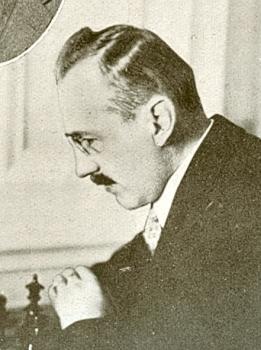
1941: Karel Treybal, Grand Master

On this date in 1941, chess grand master Karel Treybal was shot in occupied Czechoslovakia as a suspected subversive for illegally stockpiling weapons.

The Bohemia-born Treybal was one of the great Czech players from the turn of the century.

Competing as an amateur — his day job was as a barrister — his attacking play made him one of the world’s best for most of his adult life. (Chess aficionados can browse his big matches here and here, or take in some Treybal chess puzzles. It says here that Treybal once played countryman Franz Kafka.)

Like everyone else standing between the great imperial powers come wartime, grand masters were just so many pawns.

The particulars of Treybal’s death seem murky: whether or not he received a nominal Nazi trial before his execution; whether there was anything to the weapons charges against him. Word, nonetheless, got right around.

According to a UP report datelined this very day that ran in the New York Times on Oct. 3,

German occupation forces have executed nearly 1,000 persons in Europe, in some cases shooting them by the carloads, in reprisal for a mounting tide of violence in the occupied countries, a compilation showed tonight.

German dispatches said eighteen persons were executed in Bohemia-Moravia today [Thursday, Oct. 2 -ed.], and thirty-nine yesterday. Six were executed Sunday, twenty Monday and fifty-eight Tuesday, according to earlier German announcements, making the total so far this week 141.

Those executed today were said to include Josef Benes, manager of the Farmers’ Association at Raudnitz; Anton Kvarda, manager of the trades school at Rakonitz; Karel Treybal, salesman; Josef Smrkovsky, business man, and Manzel Svoboda, former Czech Army lieutenant.

From Norway to Greece the executions have been Germany’s answer to all forms of opposition — sabotage, espionage, armed resistance, murder, treason, arson, aiding the enemy, listening to the foreign radio, operating illegal markets, dynamiting and the ill-inclusive “Communist” activity.

A postwar tournament was played in tribute of Treybal and the great Czech women’s champion Vera Menchik.

On this day..

1898: The Six Gentlemen of the Hundred Days’ Reform

This afternoon in 1898, six liberals got the chop for their hopeless attempt to give a tottering empire the reforms it desperately needed.

The Hundred Days’ Reform — actually 103 days, from June 11 to September 21 — marked the attempt by China’s Guangxu Emperor to implement a far-reaching modernization programme backed by forward-thinking officials with a mind to correct China’s supine position vis-a-vis the West, and even vis-a-vis its neighbors.

“Reform has never come about in any country without the flow of blood. No one in China in modern times has sacrificed himself for the cause of reform, and because of this China is still a poor and backward country. Therefore, I request that the sacrifices begin with myself.” –Tan Sitong

The Wuxu Constitutional Reform still stands as the great attempt made by Chinese progressives who tried to follow the example of the modern powers in order to save China from extinction. Represented by Kang Youwei and Liang Qichao, the bourgeois reformists were imbued with the spirit of national salvation; they carefully set about designing a blueprint for a constitutional monarchy based on the example of Western countries. They advocated the establishment of parliament and a national conference, and wanted to see honest and fair-minded people with the courage to criticize authority installed in a position of power. National policies should be discussed by the monarch and the people. They also wanted a constitution to stipulate the rights and obligations of the monarch, officials, and the people. The constitution was to be the highest code for all people in the country. They also wanted to establish a system featuring a tripartite balance of forces: parliament was to legislate, the magistracy to deal with issues of justice, the government with administration. All of these would be under the monarch.

The constitutional reform was to take place with radical intellectuals submitting their memoranda to Emperor Guang Xu, who alone had the power to promulgate them. The feudal diehards being in a position of strength and the national bourgeoisie being weak, however, the new politics survived no more than 100 days or so. When the forces of reaction inevitably clamped down on the movement, the six reformists who had inspired the movement for constitutional reform met their deaths like heroes.

Although sincere in its aspirations, the reform movement was bound to fail, as it depended on a reform “from top to bottom”, which ultimately had to be enacted by the emperor. The Hundred Days’ Constitutional Reform, however, remains a landmark event in the modern history of China, its failure notwithstanding. The Chinese bourgeoisie in fact succeeded in spreading democratic and constitutionalist ideas widely, and this had a significant effect on future generations. The political and legal theory of the Western bourgeoisie could now take root in the soil of China.*

The emperor’s Machiavellian conservative aunt, the Empress Dowager Cixi, who had been the power behind the Chinese throne since 1861, made the sure reform didn’t see two hundred days with a “coup” that didn’t formally overthrow the Emperor — just made him irrelevant.

Troublemakers further down the food chain didn’t get off so easily.

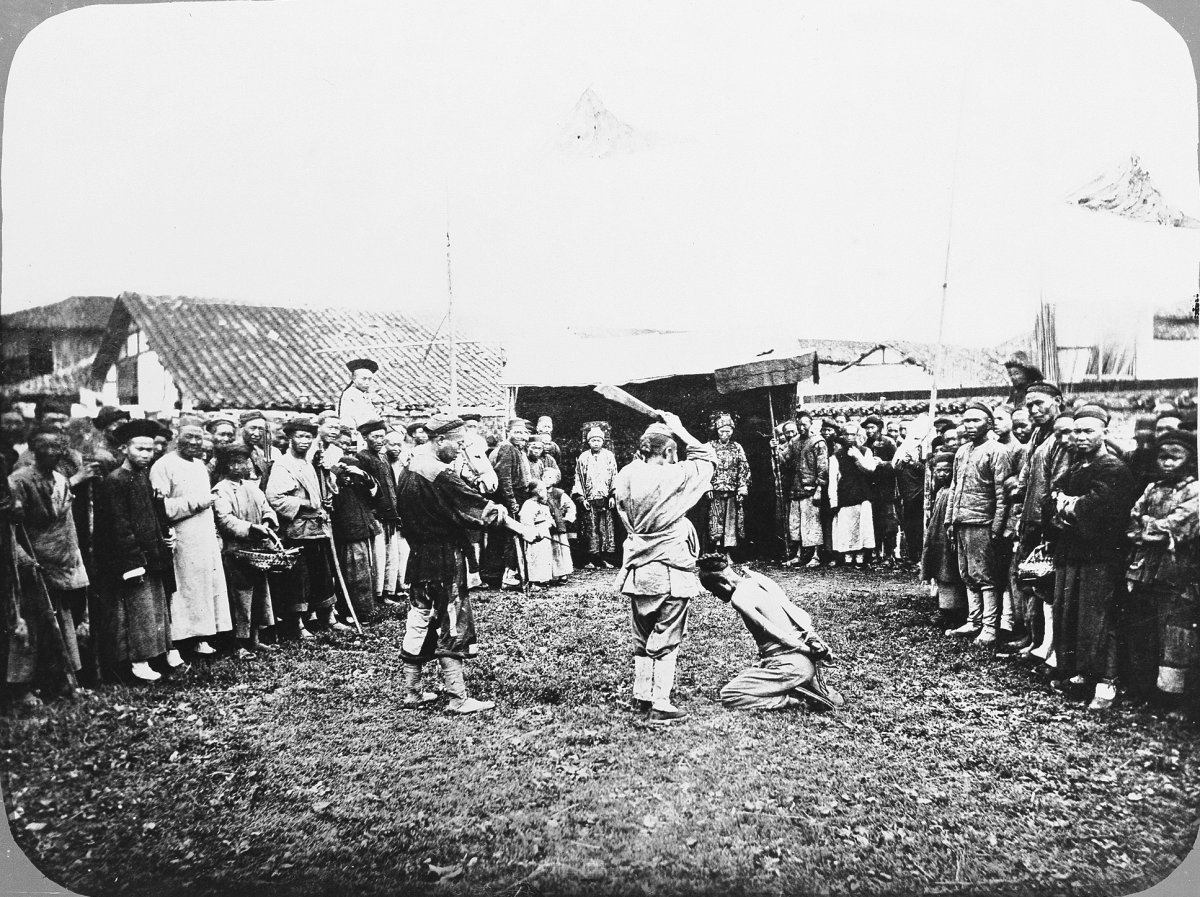
Kang Youwei, the reform movement’s chief exponent, escaped to Japan. Six others suffered the wrath of the Dowager Empress: Kang Guangren (Kang Youwei’s brother), Lin Xu, Yang Shenxiu, Yang Rui and Liu Guangdi … along with the young reformer Tan Sitong, who notably refused imprecations to flee arrest.

The sword’s blade across my neck,
I look toward heaven — laughing.
-Etched on a prison wall, allegedly by Tan Sitong


Photo of an unspecified 1867 Qing beheading in Canton.

* “The Chinese Legal Tradition and the European View of the Rule of Law” by Wu Shu-Chen in The Rule of Law History, Theory and Criticism, Part VI.

On this day..

1764: Lt. Vasily Mirovich, for attempting to topple Catherine the Great

On this date* in 1764, one of history’s greatest monarchs cemented her still-uncertain hold on power by beheading a rebellious lieutenant.

Ivan VI: Born under a bad tsar.

Succession in the Russian Empire had been disputatious ever since Peter the Great went and killed off his last male son, eventually putting far-flung branches of the family into a contest for power.

To skip over much regal jockeying, Peter’s vicious niece Anna, who reigned in the 1730s, had installed her infant nephew Ivan VI as successor just before her own death.

The little Tsar of All the Russias was displaced before his second birthday by Peter the Great’s daughter Elizabeth, who clapped the former emperor in a dungeon in Schlusselburg fortress to grow up ignorant and alone, isolated from the parties who might scheme to bid for power in his name. Two Caesars are too many.

Into this dangerous scene stepped Sophia Augusta Frederica, better known to posterity by the name she took upon her politically savvy conversion to Orthodoxy: Catherine.

This Catherine immigrated to wed Elizabeth’s simpleminded heir, then overthrew him a few months into his reign.

Catherine had ultimate power, but she wasn’t yet “Catherine the Great”: as a foreigner with the late Romanov’s blood on her hands (if only indirectly), it was nowhere written that she would rule Russia for 34 brilliant years. And with the throne came its rival claimants … like Ivan, now an adult and potentially more “legitimate” than this imported German princess.

Ivan was held in Man in the Iron Mask-like secrecy, known only as “Nameless Prisoner Number One”; his warders had strict orders to murder him on the spot were any attempt made to liberate him.

Two years into Catherine’s reign, Lt. Vasily Mirovich, “a tormented young officer … with dreams of restoring his family’s fortunes,” attempted just that. As commanded, the guards put an end to Ivan’s troubles.

Those guards got cash rewards and promotions for their diligence. Mirovich got death. (Other soldiers whom he had rallied to his cause were condemned to run the gauntlet; I have been unable to ascertain if any were killed by this punishment.)

Mirovich was executed in St. Petersburg. When his head was held up to the crowd, it had a terrifying impact, the death penalty not actually having been exercised in Russia for 22 years.** Mirovich himself faced his execution calmly, convincing some of the bystanders that he was expecting to be pardoned at the last minute. His remains were left on public display until the evening, when they were burnt along with the gallows.

And so the first two years of the reign of Catherine II, who set so much store by reason and enlightened principles, had included two assassinations and an execution.

The woman of letters, the correspondent of philosophers, the Semiramis of the North … like the age’s other great enlightened despot, Frederick the Great, Catherine had to rule. She had not the luxury to dispense with statecraft’s cruel necessities.

Her admirers would have to be content with making her excuses. Fortunately, admirers always are.

“These are family matters with which I do not meddle,” wrote Voltaire. “Besides, it is not a bad thing to have a fault to repair; this engages her to make great efforts in order to force the public to esteem and admiration”

* September 26 (pdf) was the date on the Gregorian calendar then prevalent in Europe; it was September 15 by the older Julian calendar still used in Russia at the time.

** Not carrying out the death penalty had been a signature policy of Ivan’s usurper Elizabeth. The elimination of capital punishment in “backwards” Russia for an entire generation during the Age of Absolutism surely urges caution against any assumption that death penalty repeal is a one-way street.

On this day..

1989: Henri Zongo and Jean-Baptiste Boukary Lengani

This evening in 1989, the number two and three men in Burkina Faso’s military government were seized and summarily executed for allegedly plotting a coup of their own.


Lengani and Zongo

Henri Zongo and Jean-Baptiste Boukary Lengani certainly had the pedigree for it; they’d conspired along with Blaise Compaore in the 1983 putsch that brought Thomas Sankara to power … and then Zongo, Lengani and Compaore had overthrown Sankara four years later.

On this date, a triumvirate increasingly strained by personal rivalries and economic disagreements was unilaterally dissolved.

According to the official announcement, Zongo and Lengani planned to seize the airport while President Compaore was out of the country, shooting down his returning plane if necessary.

Whether accurate or pretext, their elimination (along with two other conspirators) helped Compaore consolidate his hold on Burkina Faso — a country he still governs to this day.

On this day..

1961: Adnan Menderes

On this date in 1961, the Turkish Prime Minister deposed in the previous year’s military coup was hanged at the island of Imrali.

Condemned at the same trial as his comrades in government,* Adnan Menderes delayed his execution with an unsuccessful suicide bid. Revived from a sleeping pill-induced coma, the gag about Istanbul was that he would soon be fit enough to hang.

Twenty-four hours and one involuntary stomach-pumping later, and he was.

The 62-year-old Smyrna/Izmir native had had a memorable run. He served in Ataturk’s army, then toppled Ataturk’s political party: Menderes won the first three free elections in Turkey in 1950, 1954, and 1957, a feat never since replicated. He was notorious for his temper and sensitivity to criticism, reportedly given to smashing things in his office and demonstrably given to firing ministers and aides for even trifling differences of opinion. Just months before his ouster, he’d survived a plane crash in England — “the former Premier,” observed the New York Times,** “might have gone down in Turkish history as a great patriot and champion of the people” if he had died in it.

His ignominious end didn’t blacken his name to posterity. Years later, he (and the officials who preceded him to the gallows) was posthumously pardoned and reburied in an Istanbul mausoleum. Today, he’s so far from public opprobrium that his name can be found on public accommodations like airports and ferries

There’s more information about Menderes available online in Turkish, including this biography and this film:

* Among the co-defendants also condemned but reprieved was Mahmut Celal Bayar, President of the Republic of Turkey. Bayar died in 1986 at age 103, supposedly the longest-lived head of state or head of government in all of history.

** September 17, 1961.

Part of the Daily Double: Turkey’s “Left-Wing Coup”.

On this day..

1961: Fatin Rustu Zorlu and Hasan Polatkan

On this date in 1961, two former Turkish ministers of state were hanged together on the island of Imrali.*

A ten-month trial on the island of Yassiada had ended just the previous day, condemning 15 to death; 12 sentences were commuted, leaving only the biggest fish to fry.

Zorlu, the former Foreign Minister, and Polatkan, late the Finance Minister, were both implicated in the financial crimes often characteristic of high office. Zorlu was also condemned for helping instigate a notorious 1955 anti-Greek riot. The two were helicoptered to Imrali for a pre-dawn hanging.

Zorlu, at least, was reported to have died game. He helped slip the noose over his own neck, and at his hanging “asked that he be allowed to kick away the chair himself. Permission was granted.” (Los Angeles Times, September 18, 1961)

* Tangentially, the prison on Imrali is the one American drug-smuggler Billy Hayes subsequently escaped from. Hayes went on to write Midnight Express, later adapted for the silver screen by Oliver Stone.

Part of the Daily Double: Turkey’s “Left-Wing Coup”.

On this day..

1820: John Baird and Andrew Hardie, for the Radical War

On this date in 1820, Scottish radicals John Baird and Andrew Hardie were hanged and then posthumously beheaded (execution broadside | another) at Stirling for treason.

They were the casualties (along with James Wilson, who suffered the same fate on August 30) of the “Radical War”, a short-lived Scottish uprising for economic and political reform.

The whole realm was convulsed by the birth pangs of industrial capitalism: artisans driven into factories; urbanization, exacerbated by lagging political representation for burgeoning population centers; and the revolutionary ideas of 1789 everywhere afoot in Europe.

Indeed, ever since the cataclysmic French Revolution, nervous authorities had kept a very tight lid on excesses of popular agitation. On May 1, 1820, London police hanged the Cato Street conspirators, a small group of radicals baited into plotting an assassination by an agent provocateur who meant to destroy them.

Similar methods were employed further north.

Troubled by dangerous reform movements, the government itself helped instigate a violent rising so it could identify and round up radical elements.

Long story short: in spite of giving itself a bit of a fright with the breadth of response to a general strike, it got a few easily crushed firebreathers to march out in arms. Baird and Hardie, two weavers (an artisan profession that had been particularly affected and therefore particularly radicalized by incipient industrialization), were two of its leaders.

While this blog naturally gravitates to the activities of the iron fist, the crown had wit enough to wear the velvet glove as well. Agitation like the Radical War and the Cato Street conspiracy helped shape the context of gradual constitutional concessions that enabled the British Empire to adapt itself to its changing circumstances. In 1822, the great Scottish jurist Lord Jeffrey (who defended Baird and Hardie at the bar) would write in a private correspondence, “I rather think we are tending to a revolution, steadily, though slowly — so slowly, that it may not come for fifty years yet.”

Traitors’ heads were all a part of the dialectic of authority and legitimacy, the prospect of popular violence in the streets and official violence on the scaffold helping validate moderate reforms as sensible accommodations by both state and populace.

As Gordon Pentland puts it,*

The lesson was one for putative radicals and the authorities as well — attempted risings and executions were to be expected if the opportunities to engage in constitutional activities … were shut down in favour of relying on the machinations of spies.

This lesson looks simple enough in retrospect. But states that did not heed it as the 19th century unfolded ultimately charted a very different course.

That intervening history, Pentland observes, has left layers of contesting interpretative frameworks to debate the proper understanding of the Radical War “martyrs”.

The usability of 1820 was enhanced by its leaving, like William Wallace, precious little in the way of documentary information on actions and intentions. This has allowed the martyrs to be imagined and reimagined in a number of different ways and recruited to a range of political narratives: as the innocent victims of rancorous Tory persecution and as an object lesson in the strengths of British popular constitutionalism; as heirs to the Covenanters and as exemplars of the continuing constitutional duty to resist tyranny; as prototype proletarian revolutionaries; and, latterly, as insurrectionary republican nationalists.

* “‘Betrayed by Infamous Spies’? The Commemoration of Scotland’s ‘Radical War’ of 1820”, Past & Present, November 2008, 201(1).

On this day..