On this date in 1942, the Orthodox Bishop Gorazd — Matej Pavlík is what his parents named him — was shot in Prague along with priests of Sts. Cyril and Methodius Cathedral for sheltering the Czechoslovakian resistance fighters who had lately assassinated Nazi Reichsprotektor Reinhard Heydrich.
The Nazis besieged the church — fiercely, but hopelessly defended.
With the Germans already visiting unspeakable collective punishment for the murder, the act of sheltering the assassins had trouble written all over it.
The Serbian-consecrated first bishop of the Czech Orthodox Church, Gorazd sought to limit the potential scope of reprisals by writing the German authorities, directly claiming responsibility — even though, in fact, he hadn’t found out who his sanctuary was concealing until several days after they had already been installed by sympathetic priests.
He enjoyed the characteristic hospitality of the Gestapo, and was shot at Kobylisy along with priests Vaclav Cikl and Jan Sonnevend; theologian Vladimir Petrek followed them the next day.
From left to right (not counting the guards, of course): Jan Sonnevend, Vaclav Cikl, Vladimir Petrek, and the bearded Bishop Gorazd, at their public show trial September 3. From the Czech Ministry of Defense’s slick and well-illustrated publication (pdf) on Operation Anthropoid.
The Czech Orthodox Church was suppressed while the Germans held Czechoslovakia. Bishop Gorazd is recognized in the Orthodox martyrology on August 22nd (the date of his death per the Julian calendar).
The aged woman had evidently taken in the fugitives John Hickes and Richard Nelthorpe as a humanitarian gesture when they happened to show up at her door; despite her late husband’s part in the regicide of Charles I, Alice Lisle doesn’t seem to have been the political type.
So the fact that Lisle was charged with treason was a national (indeed, transatlantic) controversy … and the fact that she was the first of the thousand-plus rebel prisoners tried set the tone for the legal circuit this month that became remembered as the Bloody Assizes.
In an attainder later reversed under William and Mary, Lisle was convicted and condemned to burn (the sentence was commuted to beheading) by notorious hanging judge Lord Jeffreys.
If Lady Alice knew her guests to have been concerned in the insurrection, she was undoubtedly guilty of what in strictness is a capital crime … [t]he feeling which makes the most loyal subject shrink from the thought of giving up to a shameful death the rebel who, vanquished, hunted down, and in mortal agony, begs for a morsel of bread and a cup of water, may be a weakness: but it is surely a weakness very nearly allied to virtue … no English ruler who has been thus baffled, the savage and implacable James [II] alone excepted, has had the barbarity even to think of putting a lady to a cruel and shameful death for so venial and amiable a transgression.
Odious as the law was, it was strained for the purpose of destroying Alice Lisle … [T]he witnesses prevaricated. The jury, consisting of the principal gentlemen of Hampshire, shrank from the thought of sending a fellow creature to the stake for conduct which seemed deserving rather of praise than of blame. Jeffreys was beside himself with fury … He stormed, cursed, and swore in language which no wellbred man would have used at a race or a cockfight …
The jury retired, and remained long in consultation. The judge grew impatient. He could not conceive, he said, how, in so plain a case, they should even have left the box. He sent a messenger to tell them that, if they did not instantly return, he would adjourn the court and lock them up all night. Thus put to the torture, they came, but came to say that they doubted whether the charge had been made out. Jeffreys expostulated with them vehemently, and, after another consultation, they gave a reluctant verdict of Guilty.
Lisle was the only victim of the Assizes at Winchester, but her death would preview the wholesale slaughters to follow.
Jeffreys reached Dorchester the next day and his pitiless tribunal began its work of sentencing hundreds to the various modes of English execution, or else to convict transportation — a fate more lucrative for the crown, but little less terrible to its victims.
“More than three hundred prisoners were to be tried,” Macaulay noted. “The work seemed heavy; but Jeffreys had a contrivance for making it light. He let it be understood that the only chance of obtaining pardon or respite was to plead guilty.”
For all that, the Assizes greatly injured the Stuart cause, precisely because of indiscriminately butchering the likes of Alice Lisle.
Judge Jeffreys’ reputation as a vicious, politically-motivated jurist landed him in the Tower of London by 1689, when he, er, injudiciously stuck around after James II fled the country; reportedly, Jeffreys was lucky to make it to the Tower under guard from the mob that wanted to tear him apart.
To Tyburn thee let carrion Horses draw,
In jolting Cart, without so much as straw;
Jaded, may they lye down i’ th’ road, and tyr’d,
And (worse than one fair hanging, twice bemir’d)
May’st thou be maul’d with Pulchers Sexton’s Sermon,
‘Till thou roar out for Hemp-sake, Drive on Car-man.
Pelted and Curst i’ th’ road by every one,
E’ne to be hang’d may’st thou the Gauntlet run.
Not one good Woman who in Conscience can
Cry out,–‘Tis pitty,–Troth, a proper Man.
Stupid and dull, may’st thou rub off like Hone,
Without an open, or a smother’d groan;
May the Knot miss the place, and fitted be
To plague and torture, not deliver thee;
Be half a day in Dying thus, and then
Revive like Savage, to be hang’d agen.
In Pity now thou shalt no longer Live,
For when thus satisfy’d, I can forgive.
Yikes. Jeffreys actually succumbed to a kidney disease a few months into his captivity. Close enough.
On this date in 1851, Venezuelan-born adventurer Narciso Lopez was garroted in Havana for his repeated expeditions to overturn Spanish dominion in Cuba.
Narciso Lopez had fought for the Spanish against Simon Bolivar, and migrated to Cuba when Bolivar carried the day.
Initially a loyal government functionary, Lopez gradually became sweet on the anti-Spanish cause, and fled Cuba for the United States (pursued by a death sentence in absentia) when a treasonable conspiracy of his was discovered.
Like MacArthur, he meant to return — and did.
Lopez crisscrossed the United States, drumming up support for filibustering raids on Cuba meant to detach it from Spain and make it an American slave state.
In this proposed enterprise, wedded alike to both national expansionism and southern sectionalism, Lopez rubbed shoulders with the likes of Jefferson Davis and Robert E. Lee, even helping precipitate criminal charges against a former U.S. Senator who backed him.
But the five expeditions went from bad to worse, until Lopez was captured in August 1851.
Between the wide Gulf sky and the waters of Havana harbor, the Gothic Morro Castle’s high tabby walls gleamed in the Sunday morning light on September 1, 1851. Though it was barely seven o’clock, a noisy crowd of four thousand already had gathered in a public plaza just across the harbor from the Morro. The plaza spread below the walls of the Punta, a small citadel guarding the western side of Havana’s finger-shaped harbor. At the center of the crowd’s attention on the cloudless dawn was a ten-foot high wooden scaffold that rose from the plaza. At its top was a garrote, an iron chair with a pair of clasps on its back. The mechanics of this grim machine were simple: just below its clasps, designed to grip the condemned man’s head, was a metal collar for his throat. With a turn of the screw on the garrote’s back, the collar tightens, strangling the prisoner.
…
Lopez was brought out at seven o’clock. At age fifty-four, with his mustache, white hair, and dark piercing eyes, he remained a handsome man. Accompanied by a line of Spanish soldiers, he wore a long white gown and a white cap. His wrists were tied in front. Another rope, binding his elbows, was knotted from behind, its strands held by guards. With two friends who had been allowed to join him, Lopez climbed the steps of the wooden tower. At the top he knelt in prayer for a moment, then rose and faced the crowd. “Countrymen,” he said in a steady voice that observers would recall as one of remarkable composure, “I most solemnly, in this last awful moment of my life, ask your pardon for any injury I have caused you. It was not my wish to injure anyone, my object was your freedom and happiness.” When an officer interrupted, Lopez quickly concluded, “My intention was good, and my hope is in God.”
He bowed, took his seat in the iron chair, and eased his head back. The executioner, a black man, placed the iron clamps around Lopez’s throat. His feet were then tied to bolts on the sides of the chair. He exchanged a few words with his friends and kissed a small cross. Then, with a turn of a screw, Narciso Lopez’s three-year campaign to vanquish Spain’s dominion over Cuba came to an end.
This forbidding example put a real damper on American plans to annex Cuba (for a while), but hardly stanched the North American appetite for filibustering.
Despite the bad end of his own project, Lopez managed to bequeath the eventually independent Cuba the flag (Spanish link) which it still flies today.
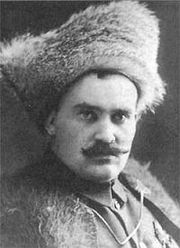
At 11 p.m. this date in 1946, White general turned Japanese collaborator Grigory Semenov (or Semyonov) was hanged for a generation’s worth of anti-Soviet depredations in the Far East.
The tsarist officer Semenov joined the Russian Civil War as a notoriously vicious White commander with the grandiosely retro title of Ataman of the Baikal Cossacks.
According to G. Patrick March, Semenov’s “penchant for killing, torturing, and looting” extended to executing a captured socialist by tossing the man into his locomotive’s fuel chamber.
Although also a rival in the suicidally fractious White political jostle, Semenov was the designated successor of Aleksandr Kolchak when the latter was shot in 1920, but by that time there wasn’t much left to succeed.
Knocking around the interwar era in gloryless exile, Semenov was an easy recruit for the Japanese war machine, which was in the market by the late 1930’s for locals with command experience and a grudge against Moscow and put him on retainer in Manchuria. Like the Soviet-Japanese front in general after Khalkin Gol, nothing much came of that enterprise; the Ataman’s last great hurrah was but a footnote for Japan, and his death would be a footnote in the annals of postwar victors’ justice.
Having picked a loser two wars in a row, Semenov was captured during the short-lived Soviet invasion of Manchuria at the tail end of the war and packed off for the inevitable. Five co-defendants, including Semenov’s son Mikhail, suffered death as well — although they were simply shot, while Semenov was ignominiously hanged. (According to White Terror: Cossack Warlords of the Trans-Siberian, the hanging was either botched or engineered to be an ugly strangulation job.)
The execution stemmed from a civil war fought by crown against nobles struggling to preserve their feudal rights — and specifically, a 1465 battle won by the nobles’ intrepid standard-bearer Charles the Bold. Louis was grumpy at his governor of Paris for not relieving him in time, and when the wheel of courtly politics turned sufficiently, that incident supplied enough suspicion to destroy Melun.
The war, caused by the League of the Public Good, which restored liberty and fortune to Chabannes, deprived his enemy, the count de Melun, not only of both, but of life also. When we are told that Melun was so addicted to pleasure, luxury and sloth, as to have acquired the name of the Sardanapalus of his times, we can form no very flattering estimate of his character. Yet he stood high in the good graces of Louis XI, and participated largely in the spoils of Chabannes. In his capacity of governor of Paris and the Bastile, he was also entrusted with the custody of that nobleman. It was not till after the battle of Montlheri that Louis began to suspect him. The monarch had, indeed, some excuse for suspicion. Melun had at least been criminally negligent, in a post which demanded the utmost vigilance. He had prevented a sally from the city during the battle, which might have turned the scale in the king’s favour, and he had been ignorant of, or winked at, a correspondence carried on with the chiefs of the League by some of the disaffected citizens. These indications of treachery were strengthened by two circumstances; some of the cannon of the Bastile had been spiked, and the gates of the fortress, on the side next the country, had been left open while the besiegers were making an attack. The escape of Chabannes might also afford a reason for doubting his keeper’s fidelity. Louis, however, was, at this moment, too closely pressed by his numerous enemies to enter into an investigation of the subject; and he, therefore, only dismissed the governor.
The Battle of Montlhery
Melun retired to his estates, and imagined that the storm was blown over. He was mistaken. As soon as Louis had disembarrassed himself, he instituted a rigid enquiry into the conduct of his disgraced favourite. One of the most active in pushing it on was a man who was indebted to the count for his rise in life; the cardinal Balue, of whom further mention is about to be made. The result of the enquiry was, a charge of having maintained a secret correspondence with the heads of the League, especially with the duke of Britanny. Melun was in consequence arrested, and conveyed to Chateau Galliard, in Normandy, by the provost Tristan l’Hermite, of infamous memory.*
The trial was commenced without delay, and, as he refused to confess to any crime, he was put to the torture. With respect to his correspondence with the chiefs of the League, he avowed it, but pleaded that it had the king’s sanction. It is probable that this was really the case. Many motives might have induced the king to allow of his officer corresponding with the enemy. But Louis had now resolved upon the destruction of Melun; and, as he never scrupled at falsehood when he had any point to gain by it, he denied that he had given the permission. By adding that he had long had cause to be dissatisfied with the prisoner, he gave a broad hint as to what kind of verdict he desired.** The judges, as in duty bound, pronounced Melun guilty, and he was consigned to the scaffold. His execution took place in 1468. Of his confiscated property, a considerable portion was bestowed on Charbannes.
It is said, that the executioner having only wounded him at the first stroke, Melun raised his head from the block, and declared, that he had not deserved death, but that, since the king willed it, he was satisfied. If this be true, we must own that tame submission to the injustice of a despot was never more strikingly displayed.
Had Melun lived but a little longer, he might have triumphed in the downfall and punishment of his ungrateful enemy, the cardinal, which took place in 1469 … The cardinal, and his his friend and agent William d’Harancourt, bishop of Verdun, were in close correspondence with his enemies.†
Though Melun generally goes down as a guy who caught a bum rap — probably even Louis XI thought so, given the subsequent fall of Melun’s rivals — this 19th century history of France observes that such consideration turns on noblesse oblige, for while “such crime on the part of a burgess was considered worthy of death, nobles practised breach of faith as a pastime, and a lucrative one, until it was rendered a serious matter by sending the guilty to the scaffold.”
* For instance, in Victor Hugo’s The Hunchback of Notre Dame, Tristan l’Hermite is the man dispatched by Louis XI to seize Esmeralda from the cathedral for hanging.
On August 21, 1915, the Turkish governor of Syria had 11 Arab nationalists publicly hanged in Beirut for seditious contacts with the French.
A larger and more famous batch would follow these the next year, like today’s victims the fruit of the French consul‘s leaving an incriminating list of potential allies in its embassy when it bugged out.
[i]n all, fifty-eight individuals were tried and sentenced to death; forty-five of these were either out of the country or avoided arrest; two were given reprieves; and the other eleven, ten Muslims and one Christian, were disgracefully hanged. This public display of terror was only a prelude to additional steps taken as part of the wartime policy of repression…
Lightly defended, Jemal argued that he had no means other than those of terror to hold the area. He claimed that the executions had, in fact, forestalled a rising in Syria. Others, however … see Jemal’s actions in Syria as turning the tide against Istanbul, “causing the Arab Muslims in the area to make up their minds once and for all to break away from the Turkish Empire.” Jemal had perpetrated a “Remember-the-Alamo” for the Lebanese. Throughout the country, the story of his perfidy was passed from person to person and from village to village … One can hardly measure the significance of these hangings in stimulating people to abandon their Ottoman attachment.
By the next year, Arabs had risen in revolt, in alliance — as Pasha had feared — with the Triple Entente.
(Thanks to Jeff Matthews of the Around Naples Encyclopedia for allowing us to run this abridged version of a much more detailed entry in that encyclopedia that’s well worth the read. -ed.)
Failed revolutionaries usually wind up as footnotes in history books. Certainly, the period between 1789 (the beginning of the French Revolution) and 1805 (the year in which Napoleon crowned himself emperor) is one of such turmoil in Europe that it is easy not to see any but those who are larger than life.
Eleonora Fonseca Pimentel vaulted onto the Naples literary scene as a teenage pop princess with a hit poem for the nuptials of King Ferdinand and Maria Carolina (the latter was Marie Antoinette‘s sister).
Pimentel parlayed her puissant pen into a permanent position on the salon circuit, doing late-18th-century literary things like quoting classics and maintaining voluminous correspondences.
By the revolutionary 1790’s, she’d risen to become the aforementioned Queen Maria Carolina’s librarian, but was among those inspired by the liberta, egalita, fraternita of the French Revolution. When Napoleon tore through northern Italy and conquered as far as Rome, the monarchy rode out to reconquer the Eternal Cityget itself decimated, and Naples’ dreamers had their chance.
Pimentel turned her literary talents to the Republic’s service, including some outstandingly vituperative verse savaging the exiled Maria Caroline as a lesbian and threatening her with the guillotine.
-ed.
Eleonora Fonseca Pimentel is one such overlooked person. She was a major figure, but on a small stage, connected with the little known and failed Neapolitan revolution and subsequent short-lived Neapolitan republic of 1799. It was a sister of the French republic and one of many set up in the 1790s in Europe, all of which—the Neapolitan version included—have been relegated to the status of “also-rans” in history.
Eleonora was an unlikely revolutionary. She was born in Rome in 1751 of Portuguese nobility and would be hanged in Piazza Mercato in Naples in 1799 in a grotesque caricature of an execution. Her executioner, Maria Caroline of Hapsburg, Queen of Naples during the Neapolitan Revolution was also born in 1751. That was also the decade of the great Lisbon earthquake, about which an anonymous poet wrote lines as if describing the dramatic events that would soon shake Europe the way the earth had shaken Portugal:
With her last earthquake this round world shall rise,
The sun shall lose his fires in endless night,
And the moon turned to blood, glare horrid light,
When comets dire shall sweep athwart the sky,
And stars like leaves before the tempest fly.
Certainly, the last days of one of Portugal’s daughters, Eleonora Fonseca Pimentel, seem contained in that verse.
Stendahl, in Rome, Florence and Naples (1826) , reports at length a conversation about the Neapolitan Revolution and its grisly conclusion with a young man he identifies only as T***, an eye-witness to the events, themselves. Stendahl concludes: “I have been careful to suppress, during the course of this narrative, all the more gruesome details. Robespierre, whatever his faults, has this at least to be said in his favor: he did not count a majority of personal friends among the total number of his victims. Those whom he sacrificed, he sacrificed to a system, however ill-founded; not to his petty, personal spite.”
In Piazza Mercato, the fortunate among those sentenced to death* were beheaded swiftly. The less fortunate, among whom was Eleonora, were hanged. In her case, it was a ghoulish affair. Her body was left dangling from the gallows for a day, exposed to further jibes and humiliation, such as the popular verse making the rounds at the execution (cited in Albanese 1998):
A signora donna Lionora,
che cantava ncopp’ o triato,
mo abballa mmiezo ‘ o mercato,
viva viva ‘u papa santo,
c’ha mannato i cannuncini,
pe scaccià li giacubini!
Viva a’ forca ‘e Masto Donato
Sant’Antonio sta priato.
Roughly:
To lady Eleonora
who used to sing upon the stage
and now dances in market square,
long live the Holy Pope,
who sent us the guns
to chase away the Jacobins!
Long live the gallows and Master Donato [a traditional name for the hangman]
Praise be to Sant’Antonio.
Eleonora was calm at the gallows. She asked for some coffee, and—true to her intellect to the last—her last words were in Latin: “Forsan et haec olim meninisse juvabit,” a citation from Virgil—“Perhaps one day this will be worth remembering.”
Giuseppe Boschetto, La Pimentel Conducted to the Gallows, 1869
One of the most interesting memories of the Revolution is the Palazzo Serra di Cassano, on via Monte di Dio. It was the home of Giovanni Serra, Duke of Cassano, one of Eleonora’s closest friends. Looking down at the crowd as he was about to die, he said, “I have always wanted good for them and now they cheer at my death” [cited in Albanese 1998]. The next day, his father closed the portal of the building that opens onto the Royal Palace and said it would remain closed until the ideals his son had died for were realized. The door is still closed.
The greatest memorial in recent memory, however, was when Vanessa Redgrave, the English actress, stepped out on the stage of the San Carlo Theater on Friday, January 8, 1999, and recited, in magnificent Italian, the title role in Eleonora, a 3-hour oratorio, an absolute hymn of praise to Eleonora Fonseca Pimentel. It was composed by Roberto de Simone, prominent Neapolitan composer and musicologist. The production had had a two-week run-up in the Neapolitan daily, il Mattino, replete with histories of the Neapolitan revolution, fragments of Eleonora’s poetry, long citations from historical heavyweights such as Benedetto Croce, and even the news that a descendant of Eleonora’s (through her brother’s line), another Fonseca Pimentel, would be at the premiere. The production, itself, was generally well received. The next day, the critic from il Mattino called it “an allegory of all the martyrs in history” (Gargano 1999). “Art is liberty,” he wrote, “and must free itself from the bonds of time like an ever-evolving presepio,” thus comparing the production to the traditional Neapolitan manger scene that celebrates the birth of the Savior. Heady praise, indeed.
Visit the Around Naples Encyclopedia for an expanded version of this post with much more about Eleonora Fonseca Pimentel’s biography, the unfolding of the Revolution, and its legacy.
Bibliography
Acton, Harold. The Bourbons of Naples. London: Prion Books, 1957.
Albanese, Camillo. Cronache di una Rivoluzione, Napoli 1799. Milan: Franco Angeli, 1998.
Bradford, Ernle. Nelson, The Essential Hero. London: MacMillan, 1977.
Croce, Benedetto. “Eleonora de Fonseca Pimentel.” Monograph. Rome: Tipografia nazionale, 1887.
Croce, Benedetto , et al. La Rivoluzione Napoletana. 1999 reprint by Tullio Pironti, ed. Naples: Morano, 1899.
Croce, Benedetto. “Eleonora de Fonseca Pimentel e il Monitore Napoletano” in La Rivoluzione Napoletana di 1799. Bari: Laterza, 1926.
Cuoco, Vincenzo. Saggio Storico sulla Rivoluzione Napoletana nel 1799. Milano: 1806.
Diana, Rosario. Forward to Vincenzo Cuoco, Pl atone in Italia. Naples: Pagano, 2000.
Gargano, Pietro. “Quei martiri nostri fratelli.” Il Mattino, January 9, 1999.
Gurgo, Bice. Eleonora Fonseca Pimentel. Napoli: Cooperativa Libreria, 1935.
Irace, Clorinda. E.F.P. Le tracce, i luoghi. Naples: Lions Club, 1977.
Macciocchi, Maria Antonietta. Cara Eleonora. Milan: Biblioteca Universale Rizzoli, 1993.
Stendahl. Rome, Florence and Naples. 1826.(Richard N. Coe, trans.) London: John Calder, 1959.
Urgnani, Elena. La Vicenda Letteraria e Politica di Eleonora de Fonseca Pimentel. Il Pensiero e la storia. Ed. Istituto Italiano per gli Studi Filosofici. Vol. 54. Naples: La Città del Sole, 1998.
In 1626, Henri de Talleyrand-Périgord, Comte de Chalais, head of wardrobe to King Louis XIII, was one member of that house whose neck was shortened for an offense against the king’s court.
Henri — as he shall be herein known, so as not to confuse him with his many relatives — was the youngest of three children. Born in 1599, he served in the military at the unsuccessful Siege of Montauban in 1621 and 1622. (The defeat (temporarily) preserved Huguenot rights in France.)
In 1623, Henri returned from war and married Charlotte de Castille (not to be confused with the modern porn star!). It was not long after that rumors of Castille’s impropriety started making the rounds, as immortalized in Tallemant de Réaux‘s verse, whose rough translation is as follows:
Pontgibault boasts,
On seeing the slit
Of the Countess of Alais
Who likes the strong ballet,
And says hers is more charming
Than the Chalais’.
And that, not so roughly translated, is why Pontgibault received a visit from an irate Henri.
Henri is alleged to have challenged a duel, where he cock-blocked his cuckold — permanently. The European ideals of chivalry yet persisted, so there was some question whether this affair constituted murder, and the trial was the talk of France through the winter of 1623.
Madame de Chevreuse, former lover of Henry Rich (later Earl of Holland), had a string of lovers, and it’s questionable whether Henri was among them. Whether he was or not, she ignited in him a passion that would lead to his execution.
The impetus for this execution was ostensibly a plot to save Gaston d’Orléans, who, by decree of Louis XIII, was to marry Marie de Bourbon, duchesse de Montpensier. The union would bring significant wealth into the family of Louis XIII.
Backed by his First Minister Cardinal Richelieu, the king was insistent. For several years, Richelieu had also been reducing the power of the nobility and consolidating central authority around the king, which was not the way Madame de Chevreuse envisioned the world.
Instead, she sought to install Gaston d’Orléans on the throne, thus advancing her agenda to restore power to the nobility. The forced marriage became a convenient excuse to enact her plan against Richelieu. And her charming way with men made it easy to find participants.
Madame de Chevreuse and d’Ornano were at the heart of the conspiracy, but their reach extended as far as England and Spain. She was also supported by Anne of Austria, who is thought to have played a critical role in organizing the conspirators. At the very least, the collective hope was to make Monseiur abandon Louis XIII’s court and seek an alliance with the Hugenots, who would be sympathetic to a cause against the Catholic Church.
At some point, Richelieu caught wind of d’Ornano’s involvement in a conspiracy against the throne; not knowing the extent of the effort, he had d’Ornano detained. Lest their plot be found out, the conspirators encouraged Gaston to initiate a war; this was particularly true of Comte de Soissons, who posted a reward should Monseiur take up arms against his brother.
Gaston hesitated, and a new plan was enacted.
Instead, some of the conspirators would take audience with Richelieu and either detain or kill him, depending on the story. Needless to say, the plan failed, and the conspirators were found out. Chalais tried to lay low while the plot against the king and his minister unfolded, but he did not sufficiently distance himself from Madame de Chevreuse: Gaston was exposed and named names, and Chalais, not well-connected enough to fight the charges against him, was captured at Nantz on July 8.
Henri de Talleyrand-Périgord, Comte de Chalais, was sentenced to death by beheading for lèse-majesté, and on August 19, 1626, he mounted the scaffold at Place de Bouffay in Nantz. In a last, cruel twist, the conspiracy had bought off the town executioner in hopes that, lacking a practitioner of the macabre art, Chalais might be spared. But a replacement had been hastily found: a man himself condemned to death:
The [replacement] was so unskillful that, besides two blows from a Swiss sword, which had been purchased on the spot, he gave him thirty-four with an adze such as carpenters use; and was obliged to turn the body round to finish the severing of the neck, the patient exclaiming up to the twentieth blow: ‘Jesus, Maria et Regina Cali!’
No other conspirators were put to the sword, and Gaston and his brother eventually made up. Richelieu, meanwhile, gained more power and transitioned France from a feudal state to an absolute monarchy under Louis XIII and his successor, Louis XIV. His dealings form the backdrop of The Three Musketeers.
As for Madame de Chevreuse — who also figures in The Three Musketeers, scheming behind the scenes against Richelieu and crushed on by Aramis — she fled to Château d’Dampierre, then was exiled to England, where she fell in with the Duke of Lorraine (and became his mistress); she attempted to organize several more coups against the Red Eminence, but each fell short of the mark.
Madame de Chevreuse eventually ended up in Spain, then moved back to England, then shipped out to Flanders, where she connected once again with the Comte de Soissons and attempted to usurp the throne before it could be passed to Louis XIV. When Richelieu finally passed, she sought to oust his replacement, this time relying on César de Bourbon, duc de Vendôme, who was also involved in the Chalais conspiracy. After this failure, Madame de Chevreuse retired to Gagny.
Elizabeth Stone writes of Madame de Chevreuse in Political Women, “It was not she evidently who made of Buckingham a species of paladin without genius; a brilliant adventurer of Charles IV of Lorraine; of Chalais a hair-brained blunderer, rash enough to commit himself in a conspiracy against Richelieu, on the faith of the faithless Duke d’Orleans; of Châteauneaf, an ambitious statesman, impatient of holding second rank in the Government, without being capable of taking the first.”
Be that as it may, she is a compelling historical figure, and the Chalais conspiracy formed the basis for the operatic tragedy Maria di Rohan.
(A complete discussion of Talleyrand-Périgord’s life can be found here. (French link) Breathless French court gossip in a 19th century biography of Chevreuse here.)
On this date in 1944, German Communist Ernst Thälmann was shot at the Buchenwald concentration camp.
A true proletarian turned proletarian leader (and reliable adherent to Moscow’s line), Thalmann stood for election to the German presidency no the Communist Party ticket against Hindenburg and Hitler in 1932 (he’d also run in 1925).
Hitler wasn’t a very good winner.*
The Gestapo nabbed Thalmann in its sweep for leftists following the Reichstag Fire. Eleven years he waited in prison — being tortured, naturally — for his turn on the stage of a show trial. Or any trial at all.
It never took place.
Instead, the Weimar Communist leader languished in detention as the horror of Naziism swallowed Germany, with nothing to give the anti-fascist cause but his name — here adopted by a Spanish Civil War battalion.
We have such cinematic treatment of the man because after the war, the legitimately proletarian, demonstrably antifascist, ideologically unsullied, and conveniently dead Thalmann made ideal material for the Communist East German state’s national pantheon.
The myth employed all of the media available to a modern industrialized state. In addition to the scholarship produced by professional historians, popular works with a similar agenda also appeared. Irma, the slain party leader’s daughter, wrote a biography of her father intended for children. Max Zimmering wrote one of several children’s novels about Thalmann, and East German poets lionized the martyred communist leader. … Thalmann memorials were built, and membership in the SED’s youth organization, the Free German Youth (FDJ), began with the Thalmann Pioneers. Finally, Thalmann’s life was the topic of several films and television movies, the most important being the two features, Ernst Thalmann – Sohn seiner Klasse (Ernst Thalmann – Son of His Class, 1954) and Ernst Thalmann – Fuhrer seiner Klasse (Ernst Thalmann – Leader of His Class, 1955).
* Yes, this is glib; Hindenburg, not Hitler, won the 1932 election. However, the Nazis’ plurality victory in that year’s Reichstag election also gave Hitler the juice to demand the Chancellorship and set himself up to wield total power in Germany. Whatever the ballot boxes on any particular day had to say, Hitler obviously won the early 1930’s.
Mohamed Oufkir’s wife and six children were “disappeared” to a desert prison, not to emerge for 18 years. Daughter Malika, a royal favorite in happier times, wrote Stolen Lives about that ordeal. (Interview | Another)
We find him today, 13 months later as the arrow of time flies, in the same story — on the other end of the gun-barrel.
At around 4 o’clock this afternoon, a stunning attempt on the monarch took place as he flew back to Morocco from France. The king’s 727 was attacked by F-5 fighters of the Moroccan Air Force, surviving, it is said, when the quick-thinking king himself took the radio, pretended to be a flight engineer, and informed the attacking fighters that the pilots were dead and the king mortally wounded.
The ruse tricked the attacking pilots into allowing the crippled plane to make its landing in Rabat; they returned too late to strafe the airfield when they realized their mistake.
This quashed coup was swiftly laid at the door of Oufkir, the powerful Defence Minister.
Oufkir was declared to have committed suicide late this night, or else in the small hours of August 17; this still-standing official explanation has always had its doubters, with more extravagant versions implicating the offended sovereign himself in dealing out the punishment. Probably not, but here’s foreign correspondent Stephen O. Douglas’s reconstruction in Morocco Under King Hassan:
[Interior Minister Mohamed] Benhima said that when Oufkir arrived at the Skhirat palace at 11 p.m. he was met in an anteroom by General Mawlay Hafid and Colonel Dlimi, and when he realised that the king knew he had masterminded the plot he pulled out a revolver saying, ‘I know what to expect.’ Benhima added, ‘The two witnesses tried to stop him. In the struggle he fired three shots, one wounding him in the chest, the second I don’t know where, but the third was the most fatal.’ He said this was ‘the truthful and authentic version’.
‘General Oufkir committed suicide. He was not killed. It has been asked if it was a suicide of loyalty or a suicide of treason. Well then, I am authorised to tell you, to certify that since 1 p.m. today, and considering the elements of inquiry we have in our possession, I can affirm that it was a suicide of treason and not a suicide of loyalty,’ Benhima said.
Later at the same news conference, Benhima indicated he was just as astonished as most of the journalists. He said he and Oufkir were ‘great friends. We appreciated each other very much and had confidence in each other. We had a common denominator: our loyalty, and I think we wore the same decoration, given to us on the same day for the same reasons. He was a great patriot, a great minister. As I just told one of your colleagues, I cannot figure how he could have done what he did. But he is one of the most attractive people I have known, and what I have said about him today is painful to me, but the truth had to be told.’
I learned later that during the fatal night a military ambulance took Oufkir’s blood-stained body back to his Souissi house where it was placed on the floor of a playroom. His wife Fatima was away on vacation on the Mediterranean coast and there were very few people in the house. They found Oufkir had four bullet wounds, three in the back and the fourth having gone through the nape of his neck and out through his left eye, shattering his glasses, the coup de grace. Suddenly someone decided it was a mistake to send the corpse back to his family and it was hastily retrieved the same night. Thus evidence that he may have been ‘suicided’ disappeared.
Hassan somehow escaped the day with his crown, but with two attempts to overthrow him over the previous 13 months and a need to purge the many unreliable Oufkir loyalists in the armed forces — well, as the London Times put it (Aug. 22, 1972), “short of his incredible good fortune there is little else that can be cited in real terms to guarantee the perpetuation of his rule.” You could have made good coin wagering informed observers of the time that Hassan would live and reign another 27 years and be internationally saluted at his peaceful death at age 70.

 With the Germans already visiting unspeakable collective punishment for the murder, the act of sheltering the assassins had trouble written all over it.


 The tsarist officer


 A true proletarian turned proletarian leader (and reliable adherent to Moscow’s line),