1964: Mohamed Chabani

On this date in 1964 — one day shy of his 30th birthday — Algerian officer Mohamed Chabani was executed as a traitor.

It’s a verdict that posterity has washed its hands of; Chabani (other transliterations include Shabani and Chaabani) was officially rehabilitated in 1984 and his name decorates public spaces in Algeria.

But in 1964, when Algeria was but two years into her post-France independence, this former FLN fighter become Algeria’s youngest colonel was governor of the fourth military district in Biskra when he fell foul of the Defence Minister Houari Boumediene.

Boumediene was in the process in this interim of consolidating power to his own circle; the following year he would overthrow President Ahmed Ben Bella and rule Algeria until his death in 1978. Boumediene allegedly feared that Chabani would form an independent bloc that could oppose him, and attempted to have the young commander assassinated.

“How long is it since you began to travel by short stages and side-tracks?” the Marquise de Merteuil demanded of Valmont in a different context. “My friend, when you want to get somewhere — post horses and the main road!”

Boumediene’s main road was to arrest Chabani for a supposed separatist plot to break away oil-rich southern Algeria and have him shot in Oran.

On this day..

1853: Gasparich Mark Kilit

On this date in 1853, Hungarian patriot-priest Gasparich Mark Kilit was executed by the Austrian empire for his part in the failed revolutions of 1848-1849.

Gasparich — it’s a Hungarian link, as are most sources about the man — was a Franciscan who served as a camp priest to the nationalist insurgents under Perczel, who made him a Major.

After the revolutions were defeated and suppressed, he managed to live a couple of years under a pseudonym. But, writing for a Hungarian newspaper and dabbling with new radical movements, he was hardly keeping his head down. He’d even become a socialist on top of everything else. Captured late in 1852, Gasparich’s fate might have been sealed by the early 1853 attempted assassination of Emperor Franz Joseph and the resulting pall of state security.

Gasparich was hanged at a pig field outside Bratislava in the early hours of September 2, 1853.

A street and a monument in Zalaegerszeg, the capital of the man’s native haunts, preserve Gasparich’s name for the ages.

On this day..

1588: Eight Catholics after the defeat of the Spanish Armada

On this date in 1588, Elizabethan England celebrated the defeat of the Spanish Armada with Catholic gallows spread throughout London, claiming eight souls in all.

It was earlier that August that English pluck, Dutch reinforcements, and the Protestant Wind had connived to see off that great Spanish fleet and the prospect of Catholic and continental domination.

Although Catholics were liable for life and limb throughout these years it’s hard to put down the large-scale public hangings (some with full drawing-and-quartering pains) of priests and laymen down to coincidental timing, particularly given the unusual choice to distribute them to several gallows all around London. Here, surely, was a triumphant gloat for the furtive adherents of the old faith to ponder.

The Catholic Encylcopedia’s entry on the Venerable Robert Morton, a priest who was put to death at Lincoln’s Inn Fields, surveys the carnage:

At the same time and place suffered Hugh Moor, a layman, aged 25, of Grantham, Lincolnshire, and Gray’s Inn, London, for having been reconciled to the Church by Fr. Thomas Stephenson, S.J. On the same day suffered (1) at Mile End, William Dean, a priest (q. v.); and Henry Webley, a layman, born in the city of Gloucester; (2) near the Theatre, William Gunter, a priest, born at Raglan, Monmouthshire, educated at Reims; (3) at Clerkenwell, Thomas Holford, a priest, born at Aston, in Acton, Cheshire, educated at Reims, who was hanged only; and (4) between Brentford and Hounslow, Middlesex, James Claxton or Clarkson, a priest, born in Yorkshire and educated at Reims; and Thomas Felton, born at Bermondsey Abbey in 1567, son of B. John Felton,* tonsured 1583 and about to be professed a Minim, who had suffered terrible tortures in prison.

Another priest, plus four additional lay Catholics, quaffed the same bitter cup on August 30.

* No relation, however, to the executed assassin John Felton forty years on: that man’s father made his way in the world hunting Catholic recusants to inform upon.

On this day..

1651: Christopher Love

(Thanks to English Presbyterian poet Robert Wild for the guest post in verse, celebrating the martyrdom of his coreligionist Christopher Love. Love died for seditious correspondence with the exiled Stuart then-pretender Charles II. Days after Love lost his head, Charles very nearly did likewise when he lost the decisive Battle of Worcester to Oliver Cromwell — famously escaping the rout by a harrowing, six-week flight that repeatedly came within an ace of landing him with his father in our deck of execution playing cards. -ed.)

THE TRAGEDY OF CHRISTOPHER LOVE AT TOWER HILL August 22. 1651.

Prologue.
New from a slaughtred Monarchs Herse I come,
A mourner to a Murthr’d Prophet’s Tombe:
Pardon, Great Charles his Ghost, my Muse had stood
Yet three years longer, till sh’had wept a flood;
Too mean a Sacrifice for Royall Blood.
But Heaven doe by Thunder call
For her attendance at Love’s Funerall.
Forgive Great Sir, this Sacriledge in me,
The Tear he must have, it is his Fee;
‘Tis due to him, and yet ’tis stol’n from Thee.

ARGUMENT.
‘Twas when the raging Dog did rule the Skies,
And with his Scorching face did tyrannize,
When cruell Cromwell, whelp of that mad Star,
But sure more firery than his Syre by far;
Had dryed the Northern Fife, and with his heat
Put frozen Scotland in a Bloody sweat:
When he had Conquered, and his furious Traine
Had chas’d the North-Bear, and pursu’d Charle’s waine
Into the English Orb; then ’twas thy Fate
(Sweet Love) to be a present for our State.
A greater Sacrifice there could not come,
Then a Divine to bleed his welcome home
For He, and Herod, think no dish so good,
As a Iohn Baptists Head serv’d up in blood.

ACT I.
The Philistins are set in their High Court,
And Love, like Sampsons, fetch’d to make them sport:
Unto the Stake the smiling Prisoner’s brought,
Not to be Try’d, but baited, most men thought;
Monsters, like men, must worry him: and thus
He fights with Beasts, like Paul at Ephesus.
Adams, Far and Huntington, with all the pack
Of foysting Hounds were set upon his back.
Prideaux and Keeble stands and cries A’loe;
It was a full Cry, and it would not doe.
Oh how he foyl’d them, Standers-by did swear,
That he the Judge, and they the Traytors were:
For there he prov’d, although he seem’d a Lambe,
Stout, like a Lyon, from whose Den he came!

ACT II.
It is Decreed; nor shall thy Worth, dear Love,
Resist their Vows, nor their revenge remove.
Though prayers were joyn’d to prayers, & tears to tears,
No softnesse in their Rocky hearts appears;
Nor Heaven nor Earth abate their fury can,
But they will have thy Head, thy Head, good Man.
Sure some She sectary longed, and in hast
Must try how Presbyterian Blood did tast.
‘Tis fit she have the best, and therefore thine,
Thine must be broach’d, blest Saint, its drink Divine.
No sooner was the dreadfull Sentence read,
The Prisoner straight bow’d his condemned Head:
And by that humble posture told them all,
It was an Head that did not fear a fall.

ACT III.
And now I wish the fatall stroke were given;
I’m sure our Martyr longs to be in Heaven,
And Heaven to have him there; one moments blow
Makes him tryumphant; but here comes his woe,
His enemies will grant a months suspence
If’t be but for the nonce to keep him thence:
And that he may tread in his Saviours wayes,
He shall be tempted too, his forty dayes:
And with such baits too, cast thy self but down,
Fall, and but worship, and your life’s your own.
Thus cry’d his Enemies, and ’twas their pride
To wound his Body, and his Soul beside.
One plot they have more, when their other fail,
If Devils cannot, disciples may prevail.
Lets tempt him by his friends, make Peter cry
Good Master spare thy self, and do not die.
One friend intreats, a second weeps, a third
Cries your Petition wants the other word:
I’le write it for you, saith a fourth; your life,
Your life Sir, cries a fift; pity your wife,
And the Babe in her: Thus this Diamond’s cut,
By Diamonds onely, and to terrour put.
Me thinks I hear him still, you wounding heart;
Good friends forbear, for every word’s a dart:
‘Tis cruell pity, this I do professe,
You’ld love me more, if you did love me lesse:
Friends, Children, Wife, Life, all are dear I know,
But all’s too dear, if I should buy them so.
Thus like a Rock that routs the waves he stands,
And snaps a sunder, Sampson-like these bands.

ACT IV.
The day is come, the Prisoner longs to go,
And chides the lingring Sun for tarrying so.
Which blushing seemes to answer from the skie,
That it was loath to see a Martyr die.
Me thinks I heard beheaded Saints above
Call to each other, Sirs, make room for Love.
Who, when he came to tread the fatall Stage,
Which prov’d his glory, and his Enemies rage.
His bloud ne’re run to his Heart, Christs Blood was there
Reviving it, his own was all to spare:
Which rising in his Cheeks, did seem to say,
Is this the bloud you thirst for? Tak’t I pray.
Spectators in his looks such life did see,
That they appear’d more like to die than he.
But oh his speech, me thinks I hear it still;
It ravish’d Friends, and did his enemies kill:
His keener words did their sharp Axe exceed,
That made his head, but he their hearts to bleed:
Which he concludes with gracious prayer, and so
The Lamb lay down, and took the butchers blow:
His Soul makes Heaven shine brighter by a Star,
And now we’re sure there’s one Saint Christopher.*

ACT V.
Love lyes a bleeding, and the world shall see
Heaven Act a part in this black Tragedie.
The Sun no sooner spide the Head o’th’ floore,
But he pull’d in his own, and look’d no more:
The Clouds which scattered, and in colours were,
Met all together, and in black appear:
Lightnings, which fill’d the air with Blazing light,
Did serve for Torches all that dismall night:
In which, and all next day for many howers,
Heaven groan’d in Thunder, and did weep in showers.
Nor doe I wonder that God Thundred so
When his Bonarges murthered lay below:
Witnesses trembled, Prideaux, Bradshaw, Keeble,
And all the guilty Court look’d pale and feeble.
Timerous Ienkins, and cold-hearted Drake
Hold out, you need no base Petitions make:
Your enemies thus Thunder-struck no doubt,
Will be beholding to you to goe out.
But if you will Recant, now thundring Heaven
Such approbation to Loves Cause hath given.
I’le adde but this; Your Consciences, perhaps,
Ere long, shall feele far greater Thunder-claps.

Epilogue.
But stay, my Muse growes fearfull too, and must
Beg that these Lines be buried with thy dust:
Shelter, blessed Love, this Verse within thy shroud,
For none but Heaven dares takes thy part aloud.
The Author begs this, least if he be known,
Whilst he bewailes thy Head, he loose his own.**

FINIS.

* A little wink by the author. The Saint Christopher was a supposed early Christian martyr depicted as either or both of a Canaanite giant or a dog-headed man — real tall-tale stuff. His historicity came under fire from iconoclastic critics of the Humanist and Reformation traditions; for example, Erasmus pooh-poohed this folklore in his In Praise of Folly.

** Wild usually worked anonymously in his time, for obvious reasons.

On this day..

1151: Konrad von Freistritz, ruined

On this date in 1151, Konrad von Freistritz, the nobleman who built Henneburg castle, was beheaded for treason along with his brother Adalram.

The few Germanic sources for this event do not appear to preserve the particulars of his misbehavior, although his situation as a descendant of the recently diminished Aribonen dynasty suggests a probability.

Ruins of his former fortress persist in Styria (present-day Austria), not to be confused with the far more picturesque Bavarian Henneburg castle, adjacent to Stadtprozelten — nor with the Henneberg ruin in Thüringen.

As with its builder’s biography, not a whole hell of a lot of the castle remains, but some photos of mossy rubble can be perused here.

On this day..

1819: Antonia Santos, Bolivarian revolutionary

Today is the bicentennial of the July 28, 1819 execution by firing squad of Bolivarian independence heroine Maria Antonia Santos Plata.

Monument to Antonia Santos in Socorro, Colombia.

This New Grenada peasant (English Wikipedia entry | the more extensive Spanish) led Bolivar-aligned guerrillas resisting the Spanish reconquest in her home Province of Socorro.

She was captured during the last months of Spanish hegemony, but even as she awaited execution of her sentence her comrades in arms continuing in the field played a part in the crucial Bolivarian victory at the Battle of Pantano de Vargas.

She was shot at 10:30 in the morning on the main square of Socorro, along with Pascual Becerra and Isidro Bravo.

A battalion of the Colombian army’s Seventh Brigade is named for Antonia Santos.

On this day..

1971: Four for Sudan’s Siesta Coup

On this date in 1971, four leftist officers who had briefly overthrown the government of Sudan were shot — just one day after their coup collapsed.

This was but a brief and early interruption in what proved to be the 16-year (1969-1985) reign of Col. Gaafar Nimeiry, who himself had taken power at gunpoint two years earlier.

Although Nimeiry initially had the support of Sudan’s then-robust Communist Party, the colonel soon clamped down on the staunchest and most pro-Moscow Communists, eventually inviting the attempted coup.

The “Siesta Coup” was mounted on the scorching afternoon of July 19 while city traffic was greatly thinned by the absence of everyone who could arrange to duck into a shady refuge instead, and it worked at first: Communist officers bloodlessly seized control of the government and of Nimeiry’s own person. But very few Sudanese people — and almost no governments in the region — had enthusiasm for the usurpers; Muammar Qaddafi even had Libyan fighter jets intercept and force down a Khartoum-bound British Airways flight carrying two coup-friendly politicians from London, so that he could arrest them on the tarmac in Benghazi.*

On July 22 anti-Communist soldiers deposed the coup government and restored Nimeiry. Within hours, four principal actors in the Siesta Coup were being dispatched to their eternal rest; the others were Maj. Hashem al?Atta, commander in chief of the armed forces for the coup government; Col. Abdel Moneim Ahmed; Lt. Col. Osman Hussein; and Capt. Muaweya Abdel Hal.


The doomed Hashem al Atta passes his waning hours enduring a harangue from Khalid Hassan Abbas.

* Those two men, Farouk Osman Hamadallah and Babakr al-Nur Osman, were returned to Khartoum as soon as Nimeiry was back in the saddle, and were also executed within days.

On this day..

1985: Hezekiah Ochuka, ruler of Kenya for six hours

On this date in 1985, Kenya air force private Hezekiah Ochuka was hanged for his August 1, 1982 coup d’etat.

By ethnicity a politically marginalized Luo, Ochuka led a putsch of junior airmen whose announcement of leadership over the radio startled Kenyans rising for their breakfast on August 1, 1982.

That leadership lasted only six hours before forces loyal to the ethnically Kikuyu president Daniel arap Moi suppressed it. Some 300 souls were killed in the course of events.

The subsequent security sweep took up not only the putschists themselves but exploited the opportunity to crack down on prominent opposition figures — men like Jaramogi Oginga Odinga and George Anyona, who were tossed into the brutal Nyayo House torture center essentially for being anti-Moi politicians — and beyond them thousands of ordinary Kenyans thought vaguely proximate to sedition by virtue of their politics, lineage, or station in life.

Ochuka himself fled to neighboring Tanzania hoping to find asylum; instead, he was extradited back to Kenya for capital trial and hanged along with two of his collaborators, Corporals Bramwel Injeni Njereman and Walter Odira Ojode, in a badly botched execution.

These men retain to this day the distinction of being the last judicially executed in Kenyan history, even though Kenya still has the death penalty on its books.

On this day..

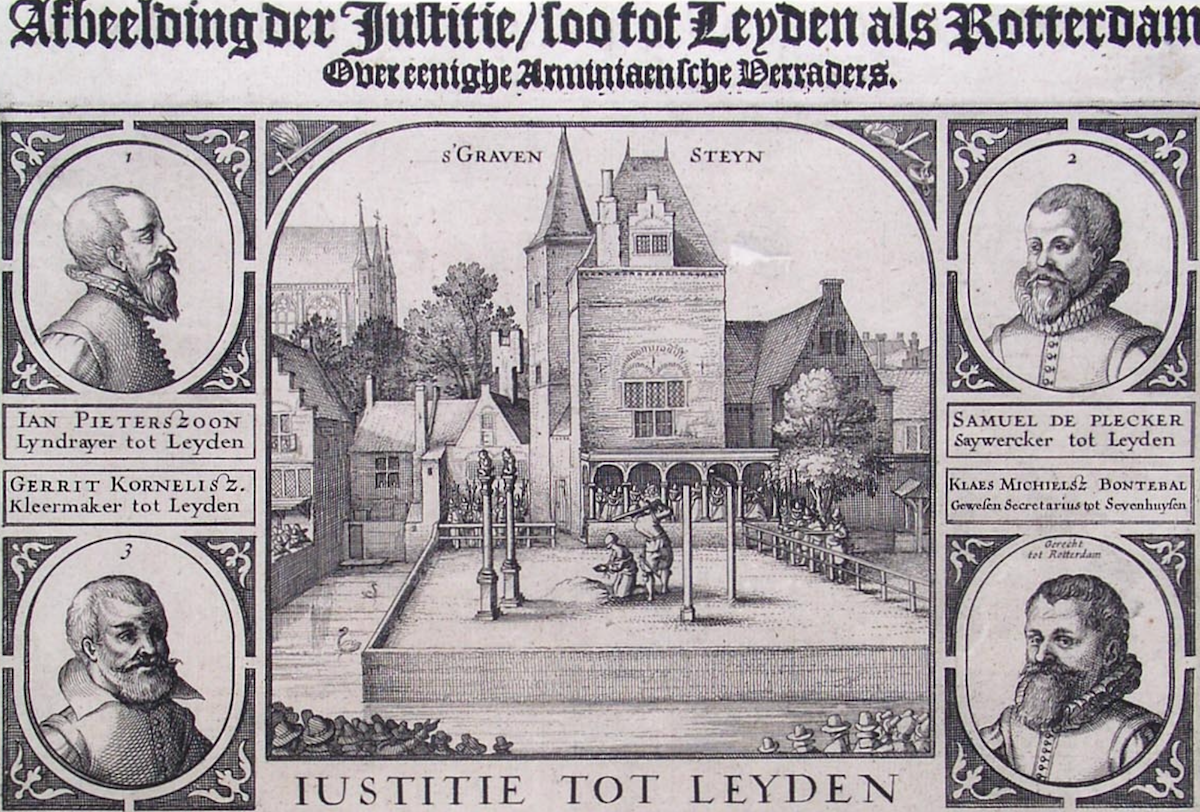
1623: Claes Michielsz Bontebal, Maurice murder moneybags

We’ve previously addressed in these pages the 1623 execution of Reinier van Oldenbarnevelt for attempting to assassinate Maurice, Prince of Orange in revenge for his, Maurice’s, 1619 execution of Oldenbarnevelt’s father.

Well, the scheme here was to hire a number of assassins for the attack, a plan which guaranteed that someone would blab and blow the whole deal. But before the blabbing and the blowing, the hiring required a vast cash outlay — 6,000 guilders to be precise.

Claes Michielsz Bontebal (English Wikipedia entry | Dutch) was one of the financiers who did the hiring, and got caught in the blowback after the blabbing. He was executed with three other conspirators


Detail view of a 1623 print reporting the beheading (click for a larger view with portraits of Bontebal and his collaborators).

On this day..

1685: Archibald Campbell

On this date in 1685, the 9th Earl of Argyll went the same way as the 8th.

We’ve addressed in these pages the travails borne by Archibald Campbell, 8th Earl of Argyll, whose once considerable power was overwhelmed by the Wars of the Three Kingdoms and came to an end under the blade of the Edinburgh maiden.

While imprisoned awaiting the chop, the 8th Earl composed for his much-reduced heir, also named Archibald Campbell, composed a volume titled Instructions to a son with a variety of foreshadowing maxims.

You have a great task to do, you must from the bottome climb up to the mount of Honour, a very abrupt and difficult ascent; which yet, nevertheless by observing the sure footings of some of your progenitors, and the slips of others, particu?larly those recent slidings of mine own, (for other they are not) you may at last attain the top, and by your own merit and your Princes favour, your House may be Culminant again.

If it shall so happen … have a care then of that Precipice; let no revenge or ambition blind you into destruction; you may poise your self with your wings of Honour and Greatness, but venture not, nor presume to fly.

Covet not with immoderate hast Lands, Riches, Honour, for it is seldom that men whose rash desires and designs are laid out that way, compass their full content, and for the most part meet with a destiny far other then they expected; and when they are once so disappointed, Fortune or rather Providence so much amazeth the judgment even of wise men, as in time of danger they know not what resolution is best to be taken. You will not be necessitated through the want of these three, so as to reach at them unlawfully, and endanger what you have in possession, and your self together

…

‘Tis folly to complain of life, more to be troubled at the end of it, by the reason we ought more to complain of our birth, that made and produced us mortal, then of our death, which will render us immortal.
To be long or short lived is no more then this, we come either sooner or later (no great choice) to our grave. He is very desirous of life, who is un?willing to dye when all the world is weary of him.

The kid did his late dad proud in the 1660s, regaining the attainted earldom and re-establishing the rank and wealth of their house. Argyll — and by this name henceforth we refer to Argyll fils — nurtured Presbyterian sympathies which told strongly against him when a failed Presbyterian rebellion touched off the fruitful-for-this-site era of the Killing Time.

From this point his position speedily eroded and his evasion of an oath of loyalty to Protestantism — when he finally took it he added his own unauthorized disclaimer, “only in as far as it is consistent with itself” — got him arrested, and a dubious charge of libeling the king was questionably stretched to compass a death sentence. That was around the end of 1681; on December 20 of that year, his daughter Sophia Lindsay visited him, accompanied by their page. When secluded in the dungeon, the page and the doomed man swapped clothes, and Argyll clattered away in servants’ livery to hiding in London safehouses and continental refuges.

Having already been taken for a traitor, this Argyll on the lam went all-in for unambiguous sedition. Ciphered communications of his were among the papers seized from Baillie of Jerviswood after the exposure of the Rye House Plot.

With the passing of King Charles II in 1685 and the long-feared succession of his Catholic brother James II, Scots in Holland mounted an invasion of their home country in an attempt to topple the government. Our man lent it both leadership and title: it’s known as Argyll’s Rising and was intended to complement/support the English Whig rising under the Duke of Monmouth.

Argyll’s expedition turned up in Scotland in May 1685 and instantly went sideways. Amid leadership conflicts and lukewarm recruitment, the rebellion collapsed. Argyll was captured by a militia who “would fain have concealed his rank, as they durst not release him; but he was recognised by their officer. He was led to Edinburgh, where he was treated with the same indignities as had formerly been the lot of Montrose. As the king had ordered him if taken to be put to death within three days, he was executed on his former iniquitous sentence (30th). He met his fate with piety and fortitude; embracing the instrument of death, he called it (in allusion to its name) the sweetest maiden he had ever kissed.”


The Last Sleep of Argyle (1860s) by Edward Matthew Ward: the man was reported to have slept so serenely on his last night on earth that he had to be awakened for execution.

The next generation of Campbell chiefs finally got the political calibration right, supporting the invasion of William and Mary to overthrow James II which elevated the Argylls to the dukedom which their heirs maintain to this day.

On this day..