1937: Mikhail Tukhachevsky and seven other Soviet commanders purged

Early this date in 1937,* Soviet Marshal Mikhail Tukhachevsky was executed by a gunshot to the head for allegedly plotting a coup d’etat against Stalin.

One of the most infamous trials** of the Soviet Union’s Great Purge, which would strip the Red Army of much of its officer corps on the eve of its existential test against the Wehrmacht, the Case of the Trotskyist Anti-Soviet Military Organization has always offered fodder for debating the whys and wherefores.

The bare facts are that nine extremely high-ranking members of the military brass were suddenly arrested and within a few weeks (except the one who committed suicide first) shot on the staggering charge of counterrevolutionary conspiracy. Foremost among the victims was Marshal of the Soviet Union Mikhail Tukhachevsky, notable in the annals of military history for pioneering (along with several other Soviet officers, notably Triandafillov) the military doctrine of “deep battle” or “deep operations”.

Deep Battle

Reflecting on the grinding, indecisive struggles of attrition that characterized World War I and the Russian Civil War (both conflicts Tukhachevsky served in), he sought a theory of offensive warfare for modern armies fighting in large and complex engagements — the operational art. In an early (1923) formulation, Tukhachevsky noted

the impossibility in the presence of modern wide fronts to destroy an enemy army by a single blow compels us to achieve this by a series of successive operations … A series of annihilating operations, introduced successively and combined by continuous pursuit, can replace the annihilating engagement, which in former armies was a better type of combat. (Cited here.)

Deep operations would require sophisticated application of technology to strike an opposing army’s entire support structure behind its lines in coordinated operations, rather than the unproductive World War I tactic of throwing waves of cannon fodder across No Man’s Land in the hope of achieving a breakthrough by sheer mass alone. It ripened into official Red Army doctrine in the 1930’s, decreeing

[s]imultaneous assault on enemy defenses by aviation and artillery to the depths of the defense, penetration of the tactical zone of the defense by attacking units with widespread use of tank forces and violent development of tactical success into operational success with the aim of the complete encirclement and destruction of the enemy. The main role is performed by the infantry, and the mutual support of all types of forces are organized in its interests. (Cited here.)

What Happened?

The mystery has always been exactly why Stalin should shoot Tukhachevsky, even if any question beginning “why should Stalin shoot …” nearly answers itself.

Explanations particular to Tukhachevsky range from rivalries within the army (early blocs of officers appointed by Trotsky and Stalin formed professional rivalries; Trotsky had given Tukhachevsky his first Soviet command) to purely personal enmity between the two men. Many have speculated that a genuine “plot” of some sort — whether a coup or assassination, or more mundane political scheming — was indeed afoot against the Soviet dictator. Tukhachevsky’s (officially sanctioned) links with a German military then developing its own similar operational concepts have told against him in some readings.

Author Robert Conquest put about the theory that Heinrich Himmler’s intelligence operatives had contrived to pass the Soviets forged documents pointing to Tukhachevsky’s German collaboration, the better to weaken the Bolshevik defenses. Conversely — and in his diary, Goebbels attributed this riff on the Dolchstosslegende to Hitler himself — a contrarian take has long defended at least this particular purge as a judicious one by Uncle Joe, insuring that wartime Russia would not be hamstrung by “defeatist” elements or other players who might develop both the means and motive for ending the war on German terms.

Inquiries along these lines, of course, expand beyond the particular case into the larger questions of why Stalin purged the army as a whole, and what ultimate effect that purge had on the Soviets’ military readiness in 1941.

Legacy

With Tukhachevsky’s fall, accompanied by other military reformers, the “deep operations” school acquired sufficient taint to abjure the company of the judicious officer. Nevertheless, Tukhachevsky’s influence would play its part in the Great War: his onetime associate Georgy Zhukov, who may have only accidentally avoided being purged himself, deployed Tukhachevskian mobile tactics to crush Japan’s Siberian aspirations at the Battle of Khalkhin-Gol in 1939; duly elevated for this victory to the precarious post of Marshal of the Soviet Union, Zhukov was a crucial commander in the defeat of Nazi Germany.

Tukhachevsky, along with all those shot this day, was rehabilitated during the Khrushchev era.

Sorry about shooting you in the head. Here’s a commemorative stamp.

* The condemned received their death sentence at 23:35 on June 11, the sentence to be carried out “immediately” — it seems likely but not completely certain that it had become the 12th by the time the executions actually took place, and different sources report different different dates of death. According to the contemporaneous New York Times report, Soviet authorities announced that the executions had taken place on the 12th. (As an interesting side note, the Times that day also blurbed exiled Stalin rival Leon Trotsky reading in the tea leaves of Tukhachevsky’s death “the beginning of the end for the Stalinist dictatorship.”)

** Not, however, a show trial — Tukhachevsky et al were tried in secret.

On this day..

1983: Simon Thelle Mogoerane, Jerry Mosololi and Marcus Motaung, anti-apartheid soldiers

This date at dawn in 1983, three African National Congress cadres were hanged — together with two unrelated common criminals — for attacks on apartheid-era South African police stations.

“Terrorists” in the eyes of the white government and “freedom fighters” in the eyes of many blacks, the “Moroka Three” — Simon Thelle Mogoerane, Jerry Mosololi and Marcus Motaung — bore arms against as part of the ANC’s military wing, Umkhonto we Sizwe (MK).

Their attacks in 1979 and 1981 had claimed the lives of four (black) policemen.

South African law until 1990 mandated hanging for a murder conviction without any extenuating circumstances — a “fact associated with the crime which serves in the mind of reasonable men to diminish morally, albeit not legally, the degree of the prisoner’s guilt.” The courtroom adjunct to MK’s guerrilla operations was establishing its position that its soldiers were prisoners of war under international law, and that that classification constituted an extenuating circumstance under South African law.

1977 protocols had extended the Geneva Conventions governing treatment of prisoners of war to explicitly cover anti-colonial and anti-racist insurgents. South Africa, unsurprisingly, did not ratify this amendment. The judge dismissed the argument that these protocols had acquired the binding force of customary international law — “we do not need to waste time.”

A decade or so later, in the waning years of apartheid, this sort of argument would find a toehold. But not in a defiantly “anti-terrorist” Pretoria of the early eighties.

The three were hanged in the face of worldwide appeals for clemency — such as this one from U.S. Congressmen and -women, and the pamphlet below by the British Anti-Apartheid Movement:

The entirety of this 24-page pamphlet is available free (at least for the remainder of this month) at the Aluka collection of digital Africa-related documents.

The executions likewise met outcry both domestic (South Africa banned public demonstrations) and international (like this U.N. resolution).

On this day..

1568: The Counts of Egmont and Hoorn, insufficiently Inquisitorial

On this date in 1568, two Flemish nobles were beheaded at Brussels’ Grand Place for treason to the Spanish crown that then ruled the Low Countries.

Lamoral, Count of Egmont and Philip de Montmorency, Count of Hoorn had a beef with the introduction of the Inquisition into the Netherlands by Egmont’s cousin, King Philip II, and got to hanging around with dubious characters like William of Orange.

Unluckily for this day’s duo, William didn’t teach them to read the writing on the wall.

After the Counts went easy on an outbreak of Protestant Iconoclasm, the Catholic king sent the hammer in the person of the Duke of Alba (or Alva).

Let this long-expired generation counsel posterity to find itself elsewhere when one’s door is darkened by a man known as “the Iron Duke”. William had the wit to get out of town. Egmont and Hoorn hung around, depending on their (professedly) clean consciences.

Oops.

Count Egmont Before His Death, by Louis Gallait

The beheadings were widely protested both locally and abroad, and festered as a grievance against the empire — a grievance that, as the nascent conflict evolved into a revolution that would detach the Netherlands from Spain, elevated these distinctly non-revolutionary wealthy nobles into freethinking martyrs of independence.

Two centuries later, Goethe put the story on the stage with his play Egmont (original German | English translation), a production for which Beethoven subsequently composed gorgeous orchestral companion pieces.

Here’s the lovely, lovely Ludwig Van’s beloved (including by Goethe himself) Overture to Egmont, Op. 84:

On this day..

1966: Evariste Kimba and three other “plotters” against Mobutu

On this date in 1966, the Congo’s last civilian Prime Minister and three former cabinet officials “walked unfalteringly to the gallows in the main square”* of Kinshasa and were hanged before a crowd a hundred thousand strong as Lt. Gen. Joseph-Desire Mobutu consolidated his ruinous Zairian dictatorship.

A cycle of weak governments and nationwide chaos had befallen the resource-rich former Belgian Congo in the early 1960’s after the CIA eliminated the leftist Prime Minister Patrice Lumumba. Evariste Kimba was, when the cycle ended in the fall of 1965, the most recent man to succeed to Lumumba’s title — though hardly his stature — in the tottering government of Joseph Kasavubu (or Kasa-Vubu).

Acting once again with western support, the general later to rename himself Mobutu Sese-Seko overthrew civilian rule on November 25, 1965.

To judge by either tenure (he ruled for more than 31 years) or personal enrichment (rumored to be $5 billion sapped from the poverty-ridden country during that time), Mobutu would rate as one of the 20th century’s most successful evil dictators.

But nobody knew at first that he wouldn’t be another forgettable here-today, shot-tomorrow general. And to see that didn’t happen, Mobutu showed the iron fist early, and made clear that he would brook no resistance, especially not from the old regime’s politicos. A true post-partisan, he declared in 1966 a five-year ban on party activity.

That formed the backdrop, or the pretext, or both, for squelching the “Pentecost Plot”, a supposed attempt by Kimba, along with former ministers Jérôme Anany, Emmanuel Bamba and André Mahamba, to mount a coup of their own.

Pentecost was Sunday, May 29 that year. The four were arrested on May 30 — “[o]n the morning of their arrest the Information Service of the Congo announced, in the name of the government, that they would ‘now appear before a military tribunal which will condemn them to death and they will be hanged.'” (source) When you know the result already, there’s no sense dragging things out: the Pentecost Plotters were tried, convicted and sentenced on June 1 (they denied the charges and received a six-minute deliberation), and hanged on June 2.

Kinshasa’s major football arena, Kamanyola Stadium, was renamed Stade des Martyrs de la Pentecôte in honor of this day’s victims shortly after Mobutu was ousted by guerrilla commander Laurent Kabila in 1997.

* New York Times

On this day..

1593: John Penry, Shakespeare’s midwife?

On this date in 1593, a Welsh divine with a poor impression of the Church of England was hustled off from dinner to be strung up for sedition.

Dismayed by the poor quality of pastors in his native Wales — men of poor character, poor education, and poor command of Welsh — John Penry was one of many calling for a reformed Episcopal clergy. Critiques of his type formed the germ of the Puritan movement already underway, which would blossom after his death.

Penry would have been around to see all that if he hadn’t hacked off the realm’s chief vicar by running a salty underground press, most notably publishing the pseudonymous Martin Marprelate.

(These satiric treats can be savored here. The identity of their author(s) has always been debated — Penry himself is one candidate, though not a fashionable one today, as his attributed writing seems too earnest to have come from the same pen as Martin Marprelate.)

Hold the Dessert

The Oxford man dodged the law for a good three years in the Scottish reaches, until he couldn’t resist moving to London, where (fittingly) a local clergyman recognized him.

The mere draft — nasty, but uncirculated — of a petition sufficed for the condemnation on grounds of sedition, and the annoyed Archbishop had the pleasure of inking his John Hancock on the Welshman’s death warrant.

Penry seems to have had a few friends in high places and some hope of cheating the executioner; he must have been taken by surprise when the sheriff burst in during the late afternoon this day to haul him immediately to a gallows at St. Thomas a Watering — unannounced, the better to keep attendance down,* with the prisoner denied the customary parting speech.

“Hang him with his pen”

But was Penry’s ill turn a boon to the world of literature?

The day after Penry’s execution, star English playwright Christopher Marlowe was killed in a fray whose timing some find a bit suspicious.

Some enthusiasts think Marlowe faked his death and went on to write Shakespeare under a pen name. And if he did that, his confederates would have needed a body to pass off as Marlowe’s … the body, perhaps, of a man of Marlowe’s age and class who’d just been hanged a couple of miles up the road.

The Welsh Martyr

Shakespeare aside, Penry remains “the Welsh martyr” to this day, reckoned the greatest Protestant martyr of his land. (For more about him, a sympathetic 19th century tract, John Penry, the Pilgrim Martyr, is available free from Google books.)

The injury of his draconian sentence is so far from forgotten in Wales that — hot off the presses — the 21st century Archbishop of Canterbury is being asked for a mea culpa on behalf of his 16th century predecessor.

Coincidentally, John Penry is also the name of a murderer and longtime death row prisoner in the USA, once the subject of a landmark decision** permitting the execution of the mentally retarded. That modern Penry is now serving a life sentence.

* Penry’s family and friends didn’t know about the hanging until it had already happened.

** Since reversed.

On this day..

1987: Valery Martynov, betrayed by Aldrich Ames and Robert Hanssen

On this date in 1987, a once-promising American intelligence asset was executed with a single gunshot to the head in Moscow — his treachery exposed by two of the most infamous Soviet moles in U.S. intelligence history.

A Lieutenant Colonel in the KGB posted to the Soviets’ official Washington, D.C. offices in 1980, Martynov had turned in 1982 and begun funneling intelligence to the CIA and FBI under the cryptonym “Gentile”. Truth be told, he was a mediocre source, but he was a younger officer with the chance to grow into a more important asset in the years ahead.
Fate had sized him up as an extra in someone else’s story instead.

In 1985, “the year of the spy” to those in the know for the volume of important cloak-and-dagger work, the Soviets landed two highly-placed moles in the American intelligence world — Aldrich Ames of the CIA and Robert Hanssen of the FBI.

Both those notorious turncoats shopped Martynov (among others); duly informed, Russian spymaster Victor Cherkashin conned Martynov into returning to Moscow where he could be arrested.

Here’s a 2001 New York Times account on how it went down:

[Soviet counterintelligence officer Vitaliy] Yurchenko, unhappy with his lot as a defector [after coming over to the Americans in August 1985], suddenly redefected back to the Soviet Union in early November [1985, still]. Mr. Cherkashin has said in a previous interview that Mr. Yurchenko’s redefection presented an opportunity to lure Valeriy Martynov, a K.G.B. officer in the Washington station working for the F.B.I., back to the Soviet Union: The K.G.B. arranged for Mr. Martynov to serve as a member of an honor guard escorting Mr. Yurchenko back to Moscow.

When they arrived back in the Soviet Union, it was Mr. Martynov who was arrested; Mr. Yurchenko was given a job at the K.G.B. again.

No honor among thieves.

Martynov left a widow, Natalia, and two children. But he is remembered and written about exclusively in the context of the men who sold him out, who taken separately or together rate among recent history’s most catastrophic intelligence failures. (Or triumphs, depending on your point of view.)

Martynov’s ultimate tragedy, of course — one he shares with his more infamous American betrayers in this shadowland chess match — is that not by all the information he provided, and neither by his life nor his death, was the Cold War protracted or abbreviated by one single hour.

Books about the Ames and Hanssen cases

On this day..

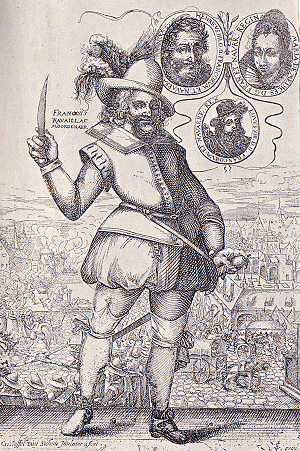
1610: Francois Ravaillac, because Paris was worth more than a mass

On this date in 1610, the fanatical Catholic who assassinated Henri IV of France was ripped apart on the Place de Greve.

The road to this man’s calvary begins long before his infamous crime, even long before the birth of his illustrious victim.

The Protestant Reformation — so richly represented in the executioner’s annals — had fractured France in the 16th century.

After decades of voluptuously indecisive Catholic-versus-Hugeunot slaughter, matters had finally been settled by the man upon whom French absolutism would erect its (ill-fated) edifice.

Henri IV, the first Bourbon monarch and a Huguenot, had unified the country by the sword, capped by his memorably politic conversion to Catholicism in 1593 to win over the holdout capital of Paris — the occasion of his understated declaration that “Paris is worth a mass”.

Let us tarry here to appreciate “the good king Henri” in a kaleidoscope of flattering artwork to the tune of Vive Henri IV, the monarchy’s unofficial anthem after its subject’s passing:

Did you catch that last image?

Henri’s fine gesture of sectarian triangulation and the reign of relative calm it inaugurated were naturally resented by godly partisans of both camps who either considered his conversion a betrayal or considered the king a closet Protestant.

At the crazed end of this latter spectrum, we meet our day’s principal, Francois Ravaillac.

Readers unconstrained by time may enjoy this Tolstoyan trek into the regicide’s mind and milieu, but it will suffice us to say that the modern shotgun-wielding postal clerk who just seemed like a quiet, harmless type to all his coworkers might like the cut of Ravaillac’s jib. A bit of a loner, a bit of a professional washout, with a penchant for religious visions and a passel of ill-arranged grievances … by this point in the movie, that’s about what you expect the police profiler to be reciting.*

It is only right that such a contemporary-sounding lone nut story ought to have a vigorous conspiratorial counternarrative.

There has always been a strong suspicion that behind Ravaillac’s hand was the work of the scheming Catholic Duc d’Epernon, perhaps even with the complicity of Henri’s wife Marie de’ Medici, who had conveniently been crowned as queen the day before the murder** and promptly teamed up with Epernon to cement an alliance with a traditional French rival, the ultra-Catholic Habsburgs.

Balzac, for one, had no doubt about it:

all of [her] actions were prejudicial to France … Marie de’ Medici wasted the wealth amassed by Henri IV.; she never purged herself of the charge of having known of the king’s assassination; her ‘intimate’ was d’Epernon, who did not ward off Ravaillac’s blow, and who was proved to have known the murderer personally for a long time. … [T]he victory Richelieu at last won over her (on the Day of the Dupes) was due solely to the discovery the cardinal made, and imparted to Louis XIII, of secret documents relating to the death of Henri IV.

The historical jury is out on that question, presumably for good.

If Ravaillac was a conspirator, he proved to be a damned good one, denying under repeated torture that he had any accomplices. On this date, the tortures reached their crescendo and conclusion — to the horrible delight of the Parisian mob, as reported by Alistair Horne (via The Corner):

On 27 May, still protesting that he had acted as a free agent on a divinely inspired mission, Ravaillac was put to death. Before being drawn and quartered, the lot of the regicide, on the Place de Grève scaffold he was scalded with burning sulphur, molten lead and boiling oil and resin, his flesh then torn by pincers. Then his arms and legs were attached to horses which pulled in opposite directions. One of the horses “foundered,” so a zealous chevalier offered his mount; “the animal was full of vigour and pulled away a thigh.” After an hour and a half of this horrendous cruelty, Ravaillac died, as the mob tried to prevent him receiving last rites. When he finally expired,

“…the entire populace, no matter what their rank, hurled themselves on the body with their swords, knives, sticks or anything else to hand and began beating, hacking and tearing at it. They snatched the limbs from the executioner, savagely chopping them up and dragging the pieces through the streets.”

Children made a bonfire and flung remains of Ravaillac’s body on it. According to one witness, Nicholas Pasquier, one woman actually ate some of the flesh. The executioner, supposed to have the body of the regicide reduced to ashes to complete the ritual demanded by the law, could find nothing but his shirt.

Ravaillac was the last Frenchman drawn and quartered for a century and a half — but his punishment as a regicide formed the precedent for that handed down in 1757 to Damiens.

* No need, though, as Francois wasn’t hard to catch: he stepped up to Henri’s carriage when it was caught in a traffic jam on May 14, 1610, and stabbed the king to death plain as can be. He was lucky (sort of) to avoid a lynching.

** Rubens later painted a gaudy celebration of this event.

On this day..

1536: Anne Boleyn

On this date in 1536, Anne Boleyn lost her head.

Any queen decapitated by her king would of course rate an entry in these grim pages. But this does not quite explain Anne Boleyn‘s enduring appeal, relevance and recognizability for the most casual of modern observers, and her concomitant footprint in popular culture, even with the “Greek tragedy” quality of her life.

Anne stands at the fulcrum of England’s epochal leap into modernity. Whether she was that fulcrum might depend on the reader’s sympathy for the Great Man theory of history, but little more do we injure our headless queen to regard her as the woman for her time and place — the accidental hero (or villain) raised up and thrown down by the tectonic forces of her milieu.

Through Anne was born — for reasons of momentary political arrangements of long-forgotten dynasts, which seems a shockingly parochial proximate cause — the English Reformation, and through the Reformation was born the crown’s decisive triumph over the nobility, the broad middle class nurtured on the spoils of Catholic monasteries, the rising Britannia fit to rule. Most would take as an epitaph historical accidents of such magnitude.

Of course, by those same accidents, Anne was the instrument of thousands of deaths herself, and little did she appear troubled in life by the corpses upon which she ascended the throne.

Her own family maps the change wrought on England. An ancestor was beheaded in the Wars of the Roses, medieval England’s last great breakdown; her uncle Thomas Howard was one of the throwback scheming Dukes, mastered by his sovereign to the extent of issuing Anne’s capital sentence from his own lips;* the beheaded woman’s daughter, Queen Elizabeth I, set a recognizably centralized English state on the path of empire.

Fitting tribute that, from the Tower where she met her end** to lands undreamt-of in her time, people still, like Henry, find her captivating.

[audio:http://www.bl.uk/whatson/podcasts/podcast95533.mp3]

* Anne’s father also declared for her guilt. Unprincipled as these men undoubtedly were, it cannot have been a pleasant responsibility; the question of whether she was actually guilty of adultery-cum-treason, the fatal charge extracted from a supposed lover by torture, has been hotly and inconclusively disputed by posterity.

** With a solemn speech submissive to Henry but not admitting any guilt — in an earlier moment of levity, she had famously remarked of the French swordsman hired to do the job, “I heard say the executioner was very good, and I have a little neck.”

On this day..

1941: Maurice Bavaud, who couldn’t get a shot off

Early this morning in 1941, a Swiss theology student had his head cut off at Berlin’s Plotzensee Prison for plotting to kill Adolph Hitler.

Maurice Bavaud, 25 at his execution, cuts one of the more quixotic (the link is French) of the many figures who schemed Hitler’s death — and also one of the more affecting, for at this early date he might have spared Europe most of the great war’s horror.

But Bavaud was also, fundamentally, a poor assassin.

Apparently motivated by pique at Germany’s repression of Catholicism — he’s most commonly cast as a lone gunmen, although there are also theories that he was affiliated with a wider network of students — Bavaud slipped into Germany in 1938 and spent the ensuing weeks knocking around Bavaria looking for a chance to do the thing.

That November, the chancellor turned up for the 15th anniversary of the Beer Hall Putsch* … to which Bavaud secured VIP seating. The aspiring assassin had only a low-caliber pistol, but as the Fuhrer passed his vicinity, a copse of saluting arms from the spectators around him obstructed any chance to shoot. November 9, 1938 instead became famous for other reasons.

One can appreciate at this juncture the young man’s discouragement and desire to leave Germany. One can understand that, penniless, he felt obliged to sneak aboard a passenger train. But one will strain very hard to imagine why even the most desperate straits should impel a man to do either of these things while still carrying the incriminating pistol and notes revealing his plans. When he was nabbed for skipping the fare, his situation quickly became catastrophic, with the help of Gestapo torturers. (One can see, in Bavaud’s own hand, a 1940 letter to his family informing them of his sentence here.)

Switzerland essentially exerted no diplomatic effort on behalf of their subject, and this fact informed the Swiss courts which, years after the war, posthumously reduced Bavaud’s sentence. Germany eventually paid reparations to the family of the man who tried to off their head of state.

Update: Maurice Bavaud has been officially rehabilitated by Switzerland.

* He wasn’t even the best failed Hitler assassin in the Bürgerbräukeller that day.

On this day..

1916: James Connolly, socialist revolutionary

On this date in 1916, James Connolly was tied to a chair and executed by firing squad along with Sean Mac Diarmada.

James Connolly: Irish revolutionary.

Connolly was born to Irish immigrant parents in Scotland. His first experience in his ancestral home of Ireland was during his stint in the British Army where, stationed in and around Cork, he had the opportunity to witness firsthand both the poor treatment of the native Irish by the British forces as well as the grave disparities between the landowning and peasant classes. When he returned home to Scotland, he fell in with the socialist crowd and quickly rose through the ranks to become one of the movement’s leaders. He actively participated in socialist organizations in several countries and joined the ranks of the Industrial Workers of the World.

A variety of circumstances brought him back to Ireland, where he led Irish socialists in seeking rights for the working class, joining the Irish Transport and General Workers’ Union in 1912. He went on to head the union two years later when the General Secretary, “Big” Jim Larkin, left for a speaking tour. In this capacity, he found a crowd for his increasingly open talks of revolution. Frustrated by what he saw as the unwillingness of the bourgeois Irish Volunteers, Connolly spoke persistently about sacrificing his own life in the name of economic freedom for Ireland, starting The Workers’ Republic journal, then printing his treatise The Re-Conquest of Ireland in 1915. Connolly headed just one revolutionary faction in Ireland at the time. Not wishing to have their festivities spoiled by Connolly, the Irish Republican Brotherhood, another revolutionary paramilitary group, decided to invite him to their Easter party.

The General Post Office in Dublin after the uprising.

The Easter Rising, which had little support from the Irish public at the time, began on April 24, 1916. Connolly led the Dublin Brigrade, which held the Dublin General Post Office, and so was in essence a sort of Commander-in-Chief during the uprising. Six days later, the Easter Rising came to a close with a surrender to British troops; its leaders, who had issued a proclamation of Irish freedom, were quickly sentenced to death by firing squad in the courtyard of Kilmainham Gaol in Dublin.

Injured during the fighting, Connolly had only been given a few more days to live by the doctors that attended him at the Royal Hospital Kilmainham. Unable to stand on his own due to his injuries, he was tied to a chair in order to face the firing squad.

The rapidity and brutality of the executions shocked the Irish public and the conditions of Connolly’s death were most shocking of all. After the executions, the corpses of the 15 put to death (killed between May 3 and May 12) were placed into an unmarked mass grave. The Irish people, previously largely indifferent to the republican rantings of the revolutionaries, angrily regarded British action against the leaders of the Easter Rising, granting legitimacy to the rebellion.

The death of Connolly and the other leaders of the six-day siege presaged the final revolution that led to a free Irish state. Two of Connolly’s cohorts in the Easter campaign were Eamon de Valera and Michael Collins; within a half dozen years, the two* expanded revolutionary tactics through Sinn Fein that forced the British to the bargaining table, meetings that would give rise to the bitterly partitioned Ireland of today. Connolly is still regarded as one of the greatest Britons, though he spent his life fighting the British, and the Irish have celebrated his memory through several songs.

* While de Valera and Collins were regarded as the primary players in Irish statehood, the Easter Rising included dozens of revolutionaries who would spend their lives fighting for Irish independence.

On this day..