1514: György Dózsa, Transylvanian Braveheart

On this date in 1514, the leader of a Hungarian peasant uprising that scared the ermine robes off the feudal nobles met a punishment from the unspeakable depths of their medieval imaginations.

While Marki Sandor’s 1913 biographical treatment of this character — also rendered Georghe Doja or Dosa, or as György Székely for his native soil — is available online, it seems to be available only in Hungarian.

Since readily-accessible non-Magyar sources such as Dozsa’s Wikipedia page all appear to spring root and branch from the public domain edition of the 1911 Encyclopedia Britannica … well, who is Executed Today to buck the trend? (Some paragraph breaks added for readability.)

GYORGY DOZSA (d. 1514), Hungarian revolutionist, was a Szekler squire and soldier of fortune, who won such a reputation for valour in the Turkish wars that the Hungarian chancellor, Tamas Bakocz, on his return from Rome in 1514 with a papal bull preaching a holy war in Hungary against the Moslems, appointed him to organize and direct the movement.

In a few weeks he collected thousands of so-called Kuruczok (a corruption of Cruciati), consisting for the most part of small yeomen, peasants, wandering students, friars and parish priests, the humblest and most oppressed portion of the community, to whom alone a crusade against the Turk could have the slightest attraction.

They assembled in their counties, and by the time Dozsa had drilled them into some sort of discipline and self-confidence, they began to air the grievances of their class. No measures had been taken to supply these voluntary crusaders with food or clothing; as harvest-time approached, the landlords commanded them to return to reap the fields, and on their refusing to do so, proceeded to maltreat their wives and families and set their armed retainers upon the half-starved multitudes. Instantly the movement was diverted from its original object, and the peasants and their leaders began a war of extermination against the landlords.

By this time Dozsa was losing control of the rabble, which had fallen under the influence of the socialist parson of Czegled, Lorincz Meszaros. The rebellion was the more dangerous as the town rabble was on the side of the peasants, and in Buda and other places the cavalry sent against the Kuruczok were unhorsed as they passed through the gates. The rebellion spread like lightning, principally in the central or purely Magyar provinces, where hundreds of manor-houses and castles were burnt and thousands of the gentry done to death by impalement, crucifixion and other unspeakable methods.

Dozsa’s camp at Czegled was the centre of the jacquerie, and from thence he sent out his bands in every direction, pillaging and burning. In vain the papal bull was revoked, in vain the king issued a proclamation commanding the peasantry to return to their homes under pain of death. By this time the rising had attained the dimensions of a revolution; all the feudal levies of the kingdom were called out against it; and mercenaries were hired in haste from Venice, Bohemia and the emperor.

Meanwhile Dozsa had captured the city and fortress of Csanad, and signalized his victory by impaling the bishop and the castellan. Subsequently, at Arad, the lord treasurer, Istvan Telegdy, was seized and tortured to death with satanic ingenuity. It should, however, in fairness be added that only notorious bloodsuckers, or obstinately resisting noblemen, were destroyed in this way. Those who freely submitted were always released on parole, and Dozsa not only never broke his given word, but frequently assisted the escape of fugitives. But he could not always control his followers when their blood was up, and infinite damage was done before he could stop it.

At first, too, it seemed as if the government were incapable of coping with him.

In the course of the summer he took the fortresses of Arad, Lippa and Vilagos; provided himself with guns and trained gunners; and one of his bands advanced to within five leagues of the capital. But his halfnaked, ill-armed ploughboys were at last overmatched by the mailclad chivalry of the nobles. Dozsa, too, had become demoralized by success. After Csánad, he issued proclamations which can only be described as nihilistic. His suppression had become a political necessity.

He was finally routed at Temesvar* by the combined forces of Janos Zapolya and Istvan Bathory.

The radicalism of this revolt is not to be downplayed; Friedrich Engels’ The Peasant War in Germany, reports that Dozsa declared a republic and abolished nobility.

As with his French predecessor Guillaume Cale, his punishment would demarcate the feudal order by horrifically mocking its victim’s pretension to political authority. This description of Dozsa’s unenviable end comes from The History of Hungary and the Magyars, a 19th century text available free at Google Books, beginning with :

[After hearing his sentence, Dozsa] exclaimed — addressing the crowd whom he saw shuddering at his approaching doom — “Come back tomorrow, you miserable slaves, and see if I shrink in the midst of my sufferings! If a single groan escapes my lips, may my name be covered with eternal infamy!”

On the following day, he was placed almost naked on a burning throne, and his head was encircled by a crown of red-hot iron. Fourteen of his followers had been kept without food for several days, and were then brought into his presence, and while he was yet living the flesh was torn from his bones and cast to them that they might satiate their hunger. “To it hounds!” was his bitter exclamation, “ye are of my own rearing!”

This insurrectionist’s confrontation with backward power structures would offer plentiful fodder for those lands’ now-fallen Communist regimes; his name adorns many streets and monuments in Hungary and Romania.

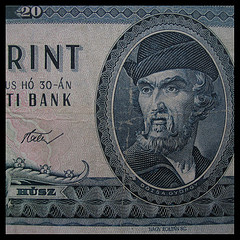
However, Dozsa was well on his way into the nationalist pantheon before Communist ascendancy. Nineteenth-century composer Ferenc Erkel, for instance,** wrote an opera about him, and poet/nationalist revolutionary Petofi Sandor saluted him in verse in 1847.

The latter text is available in Hungarian on Dozsa’s Hungarian Wikipedia page, which also attributes at least two plays about him to the Interwar period.

* aka Timisoara — in modern-day Romania, where the execution actually took place.

** Dozsa was actually captured in a fortress constructed by John Hunyadi, whose executed son is a fellow nationalist martyr (playing for the traditional-authority team), and the subject of one of Erkel’s more famous operas.
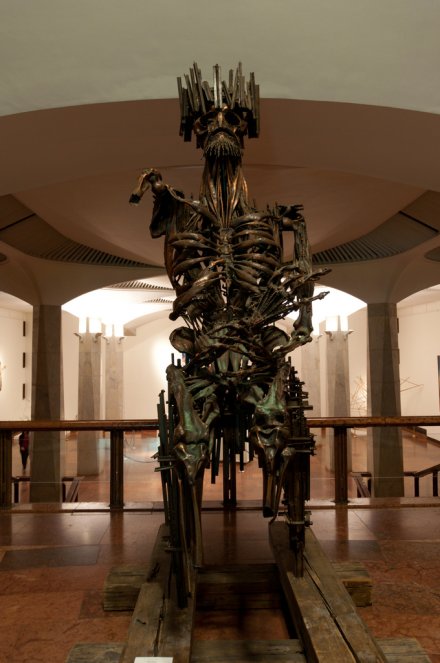

Sculpture of Gyorgy Dozsa burned on his throne, from Budapest’s Hungarian National Museum. (cc) image from redteam.

On this day..

1685: James Scott, Duke of Monmouth

On this date in 1685, the haughty Duke of Monmouth mounted the scaffold at London’s Tower Hill to suffer beheading for treason, and tipped the headsman with the words, “Here are six guineas for you and do not hack me as you did my Lord Russell. I have heard you struck him four or five times; If you strike me twice, I cannot promise you not to stir.”*

Upon this tart public reminder of his recent and infamous failure of craft, the eponymous executioner Jack Ketch quite came apart.

Monmouth, certainly, would have appreciated the advance that would bring the guillotine. Beheading by a free-swinging axe was a ghoulishly inexact procedure: bad aim, insufficient force, an untimely flinch, or the tough neck muscles of a grizzled campaigner regularly complicated the process, often to the fury of spectators. Jack Ketch is sometimes reported a sadist, and sometimes a professional hangman so rarely summoned to give a nobleman the chop that he simply lacked proficiency. Either way, he’d been on the job for a generation by this time: his reputation for infelicity with the blade preceded him.

Historical fiction from the perspective of the Duke of Monmouth.

Monmouth, an illegitimate son of King Charles II, had cause to dread Ketch’s offices for the rebellious culmination of a long power struggle with his uncle, the future King James II.

The personal contest between these men for the throne of England was the echo of the decades-old struggles straining the English polity — the Reformation and the reach of royal authority.

As it became known that the king’s brother James had gone from Catholic sympathizer to Catholic convert, Protestants began maneuvering to keep him from inheriting the crown. For three years, Parliament pushed the Exclusion Bill, which would have excluded James from succession.**

Favor among the bill’s supporters settled on the Protestant playboy Monmouth — politically convenient rumors that he was actually a legitimate child began circulating. “Weak, bad, and beautiful,” this unfriendly-to-Monmouth free book has him; whatever he was, his allies in the House of Commons were handily outmaneuvered. The Exclusion measures failed, and in 1685, James II began his reign as England’s last Roman Catholic monarch.

Monmouth’s hopes had been raised, however, and he proceeded to invade England at Dorset with a somewhat ragtag army that was routed by the Protestant royal troops who remained loyal to James at the Battle of Sedgemoor — not quite the last battle fought on English soil, but the last consequential one (the last fought with pitchforks makes a livelier distinction). Monmouth was caught trying to get away in a shepherd’s disguise. Other fugitives of his cause were hunted mercilessly.

The defeated duke was reputedly not above begging the sovereign for his life; obviously, that didn’t work out. But his cause was a popular one, nearing reverence among some commoners. Jack Ketch may have had a case of the butterflies even before the duke undressed him … and as it turns out, Ketch almost left the scaffold worse than his victim.

Here is the scene in Macaulay’s words:

The hangman addressed himself to his office. But he had been disconcerted by what the Duke had said. The first blow inflicted only a slight wound. The Duke struggled, rose from the block, and looked reproachfully at the executioner. The head sank down once more. The stroke was repeated again and again; but still the neck was not severed, and the body continued to move. Yells of rage and horror rose from the crowd. Ketch flung down the axe with a curse. ‘I cannot do it,’ he said; ‘my heart fails me.’ ‘Take up the axe, man,’ cried the sheriff. ‘Fling him over the rails,’ roared the mob. At length the axe was taken up. Two more blows extinguished the last remains of life; but a knife was used to separate the head from the shoulders. The crowd was wrought up to such an ecstasy of rage that the executioner was in danger of being torn in pieces, and was conveyed away under a strong guard.

In the meantime many handkerchiefs were dipped in the Duke’s blood; for, by a large part of the multitude he was regarded as a martyr who had died for the Protestant religion.

Just the sort of soil for posthumous tall tales — that his execution was bogus and he was in hiding to return again, or had been packed off to France to become the Man in the Iron Mask. One possibly better-founded legend is that his head was set back upon its stump to sit him for what must have been a pungent portrait.

Protestant opponents of James were much thicker on the ground than the Duke’s own person, of course. They soon succeeded where Monmouth had failed.

* Slightly different versions of this address from the Duke to the executioner are recorded. Macaulay omits the “if you strike me twice” clause but adds “My servant will give you some more gold if you do the work well”; a more polite (barely) construction suggests “Do not serve me as you did my Lord Russell.”

** The factions in this dispute — the “Petitioners” (supporting the bill) and the “Abhorrers” (supporting the king) — evolved into the Whig and Tory political parties.

Part of the Themed Set: Embarrassed Executioners.

On this day..

1865: Four for Abraham Lincoln’s assassination

On a sweltering July 7, 1865, a mere 12 weeks after Abraham Lincoln was shot at Ford’s Theater, four of his assassin’s accomplices were hanged in the courtyard of the District of Columbia’s Washington Arsenal — present-day Fort McNair, and specifically its tennis courts.

Booth, on the far left, playing Marc Antony in Julius Caesar opposite his brothers. He had Brutus’ example in mind, as he wrote in his diary while on the run: “with every man’s hand against me, I am here in despair. And why? For doing what Brutus was honored for.”

The exact nature of the conspiracy against the man who had seen the North to victory in the Civil War has been debated ever since actor John Wilkes Booth lodged a ball from his one-shot Derringer behind Honest Abe’s ear. But it was a conspiracy — an astoundingly bold one.

Simultaneous with Booth’s successful attack upon Lincoln, there was an unsuccessful attempt to kill Secretary of State William Seward; it would emerge in the investigation that another man had been detailed to murder Vice President Andrew Johnson, but got drunk and chickened out. The apparent upshot: with the President and Vice President dead, new national elections would be required to replace the Senator who would become acting president — and with the Secretary of State dead too, there’d be nobody to implement them. Booth was trying to paralyze the North with its own constitutional machinery in some desperate hope of reviving the defeated South.

Ten Against D.C.

Hundreds were detained in the stunning assassination’s immediate aftermath, but ten would ultimately be the federals’ targets. A massive manhunt pursued Booth through southern Maryland and into Virginia, where he was killed in a shootout. John Surratt, who had conspired with Booth in an earlier plot to kidnap the president — that failed plot had been reconfigured into the assassination — escaped from the country.

The other eight were rounded up and stashed at the Arsenal to face a military tribunal. It was a highly controversial arrangement: the war had entered a gray area — Robert E. Lee’s surrender just days before the murder had effectively ended the war, but when the trial opened in May Confederate President Jefferson Davis was still at large, and the last Southern general wouldn’t lay down his arms until late June. The District of Columbia was still technically under martial law … so would it do to use a military court?

Military Tribunal

So the government asked itself: government, would you rather have looser evidentiary rules and a lower bar of conviction than you would have in civil court? The government duly produced for the government an opinion that the military characteristic of the assassination — that is, to help whatever southern war effort still obtained — licensed the government to use the military courts.

That didn’t sit well with everyone. One former Attorney General griped:

If the offenders are done to death by that tribunal, however truly guilty, they will pass for martyrs with half the world.

Indeed, a year later, the Supreme Court’s landmark ex parte Milligan ruling would forbid the use of military courts where civilian courts are open — which they were in Washington, D.C.

That, of course, was too late to help Booth’s comrades. It would be a military trial, with a majority vote needed for conviction and no right of appeal but to the president for the most infamous crime of the Republic. Everyone had a pretty good idea what the results would be.

A cartoon depicting the defendants as Gallow's (sic) Birds.

Rogues’ Gallery

Two of the four today were doomed from the outset under any juridical arrangement imaginable: Lewis Powell (also known as Lewis Paine or Lewis Payne) had made the attempt on Secretary of State Seward; David Herold had guided him there with the getaway horse, and later escaped along with Booth. They were in way past their eyeballs. George Atzerodt, the schmo who couldn’t rise to the occasion of popping Andrew Johnson, looks a bit more peripheral from the distance of a century and a half, but in the weeks following the assassination he was much too close to the action to have any hope. All received death sentences.

Two others — Michael O’Laughlen and Samuel Arnold — had been involved in Booth’s earlier scheme to kidnap the president, but didn’t seem to have much to do with the murder. Still another two — Ned Spangler and Dr. Samuel Mudd* — were lesser participants. They all received long prison sentences for their pains, and the three of them still surviving were pardoned by Andrew Johnson as he left the presidency in 1869.

That left Mary Surratt, mother of the fugitive John and the only woman in the dock, the focus of attention and controversy. The 42-year-old widow owned a downtown boardinghouse, plus a tavern of sufficient importance at a Prince George’s County, Maryland, crossroads, that its community was called Surrattsville.**

The conspirators met frequently in her lodgings; Surratt maintained her innocence beyond that, but evidence and witness testimony began to pile up heavily against her … especially when Seward assailant Lewis Powell wandered into her place looking for refuge right while the police were questioning her. Booth and Herold turned out to have made a pit stop at her Surrattsville tavern to pick up a package of guns that Mary had prepared for them.

Though Surratt’s avowal of ignorance was not widely believed, a gesture of presidential mercy was anticipated — many thought (and think) she went on trial as a virtual hostage for her absconded son, who declined to take the bait. Strangely, five members of the nine-judge panel who condemned Mary Surratt turned around and asked President Johnson for clemency. Johnson claimed never to have seen the memo, but his mind seemed pretty made up — when Surratt won a habeas corpus stay on the morning of her scheduled hanging, he promptly “specially-suspended” the writ specifically to hang her:

I, Andrew Johnson, President of the United States do hereby declare that the writ of habeas corpus had been heretofore suspended in such cases as this; and I do hereby specially-suspend this writ, and direct that you proceed to execute the order heretofore given upon the judgment of the Military Commission.

Harsh treatment, and possibly well-deserved, for the first woman executed by the U.S. government. Even so, it does seem a curious thing when all is said and done that the mother of “the nest that hatched the egg” was worth a special suspension of the Great Writ, and even the stagehand who just held Booth’s horse for him caught six years, but old Jeff Davis — who apart from having figureheaded a treasonous four-year insurrection was implicated for giving Booth’s kidnapping plot official Confederate sanction — got to retire to write his memoirs.

Fine pages on the Lincoln assassination are here, here and here. There are also contemporary newspaper accounts posted online as filed for The Boston Post and The New York Herald.

The Surratt houses, by the way, are still standing. The Maryland tavern is kept as the Surratt House Museum by the Surratt Society. The downtown boarding house is a Chinese restaurant … marked with a plaque remembering more momentous doings than bubble tea.

The Chinatown restaurant where Mary Surratt had her boarding house ...

... as marked by plaque ...

... and how it looked back then.

* The panel voted 5-4 to hang Mudd, a Maryland doctor who not only set the leg Booth broke when he leaped onto the stage after shooting Lincoln, but then misdirected Booth’s pursuers. However, the rules for the trial said a two-thirds majority was required for execution.

** They changed the name after the unpleasantness. Today, it’s Clinton, Maryland.

On this day..

1535: Thomas More, the king’s good servant but God’s first

On this date in 1535, Sir — later Saint — Thomas More kept his conscience at the expense of his head on Tower Hill.

For all More‘s greatness — as intellectual, polemicist, lawyer, statesman, father — none of his many gifts at the end could avail him beside his commitment to Catholicism at the dawn of the English Reformation.

Yet it is for those gifts that he cut such a commanding presence in his times, for those very reasons that his sovereign hounded his first citizen to assent to the divorce and remarriage he was fixed upon.

A devotee and friend of Erasmus from years before, More was in Henry’s more orthodox youth the king’s very scourge of Protestantism. His scatological invective against Martin Luther in Responsio ad Lutherum — much in the impolite tenor of Catholic-Protestant rhetoric continent-wide, it should be noted — is of the sort to crimson the cheeks of the milquetoast modern:

Since he has written that he already has a prior right to bespatter and besmirch the royal crown with shit, will we not have the posterior right to proclaim the beshitted tongue of this practitioner of posterioristics most fit to lick with his anterior the very posterior of a pissing she-mule until he shall have learned more correctly to infer posterior conclusions from prior premises?

Over that hairshirt, he wore the robes of state. But his engagement with the world had a selective bent that must have exasperated his colleague and predecessor as Lord Chancellor, Cardinal Wolsey. Orson Welles and Paul Scofield spar here in the definitive More hagiography A Man for All Seasons over the intellectual’s delicate refusal to dirty his gloves with the great matter of state before them — the annulment the king demanded of his marriage to the Queen (and More’s friend) Catherine of Aragon:

Peas in a pod, these two: Wolsey, the cleric grounded in realpolitik; More, the barrister who trusts to God. (More considered holy orders as a young man.)

Our man’s reputation for honesty in a den of hypocrites has certainly outrun Wolsey’s. Still, all More’s disdain for the deal-making that invests the sovereign majesty and all his foreboding for the relationship he had with his dangerous king were not quite enough to stop him accepting the Chancellorship and the opportunity to stamp out Lutheranism … knowing perfectly well the simultaneous thrust of Henry’s boudoir policy.

It all cuts quite a contrast to More’s (barely) pre-Reformation text, Utopia (available free from Project Gutenberg), which named a literary genre and described an imagined society of tolerant primitive communism that surely would have blanched at its inventor’s coming role in the state’s machinations:

I can have no other notion of all the other governments that I see or know, than that they are a conspiracy of the rich, who, on pretence of managing the public, only pursue their private ends, and devise all the ways and arts they can find out; first, that they may, without danger, preserve all that they have so ill-acquired, and then, that they may engage the poor to toil and labour for them at as low rates as possible, and oppress them as much as they please

…

[E]very man might be of what religion he pleased, and might endeavour to draw others to it by the force of argument and by amicable and modest ways, but without bitterness against those of other opinions; but that he ought to use no other force but that of persuasion, and was neither to mix with it reproaches nor violence* …

It’s not a given that More himself agrees with every (or even any) sentiment expressed in Utopia, but his most famous work’s criticism of the death penalty too liberally applied makes interesting reading.

[E]xtreme justice is an extreme injury: for we ought not to approve of those terrible laws that make the smallest offences capital … God has commanded us not to kill, and shall we kill so easily for a little money [i.e., execute petty thieves]? But if one shall say, that by that law we are only forbid to kill any except when the laws of the land allow of it, upon the same grounds, laws may be made, in some cases, to allow of adultery and perjury: for God having taken from us the right of disposing either of our own or of other people’s lives, if it is pretended that the mutual consent of men in making laws can authorise man-slaughter in cases in which God has given us no example, that it frees people from the obligation of the divine law, and so makes murder a lawful action, what is this, but to give a preference to human laws before the divine? and, if this is once admitted, by the same rule men may, in all other things, put what restrictions they please upon the laws of God.

This insistence on the supremacy of divine law over human institutions forms the basis of his objection to parliament’s overthrowing the papacy — which he expressed openly only after he was convicted by obviously perjured “jailhouse snitch” testimony

[Y]ou have no authority, without the common consent of all Christians, to make a law or Act of Parliament or Council against the union of Christendom.

Paul Scofield bears enjoying in the role in A Man for All Seasons:

More is sometimes suspected of desiring martyrdom since he marched so unerringly into it, but he also made every attempt to survive Henry’s demand the he affirm the royal remarriage and the king’s ecclesiastical supremacy by withdrawing silently from the public sphere rather than openly opposing it. More had by every account an enviable, downright happy life at his own hearth, and a tender and intellectual relationship with his favorite daughter Meg. (Meg corresponded with her father in prison, collected his works, and retrieved his head from London Bridge.)

But by his way of thinking — Meg tried to talk him out of it — he couldn’t swear to the Act of Succession acknowledging the king’s right to divorce Queen Catherine and disinherit her daughter Mary if Henry decided to force the choice. And in the king’s eyes, there was no middle ground for someone of the ex-Chancellor’s stature.

Henry could see to it, though, to cut his old friend a break and commute the sentence from drawing and quartering to “mere” beheading, here depicted in the past season of the Showtime series The Tudors.

More’s last moments as rendered here — the ironic remark at the foot of the scaffold, “See me safe up: for my coming down, I can shift for myself”;** his generous answer to the headsman’s plea for forgiveness — are well-documented. Undoubtedly, his sturdy martyr’s bearing, the extension of a life of joyful piety, helped cement for posterity the fame he held in life.

And that dying address — “I die the King’s good servant, but God’s first” — gathers in one sentiment free of bombast or self-pity the irreconcilable demands of conscience that would lead many thousands besides More to Henry VIII’s scaffolds, and rings equally true to less lethal challenges to the conscience in every land and time since.

Anne Boleyn, who caused More’s fate, shared it less than a year afterwards.

Thomas More was canonized by the Catholic Church in 1935 — the patron saint of politicians. Rather bizarrely, July 6 is also his feast day on the Anglican calendar, a tribute to the nearly universal regard his memory enjoys.

Thomas More's statue at the Chelsea Old Church

Chelsea resident Thomas More’s statue at the (Anglican) Chelsea Old Church.

* Despite its religious tolerance, More’s Utopia — anticipating Dostoyevsky — maintains:

a solemn and severe law against such as should so far degenerate from the dignity of human nature, as to think that our souls died with our bodies, or that the world was governed by chance, without a wise overruling Providence … since a man of such principles must needs, as oft as he dares do it, despise all their laws and customs: for there is no doubt to be made, that a man who is afraid of nothing but the law, and apprehends nothing after death, will not scruple to break through all the laws of his country, either by fraud or force, when by this means he may satisfy his appetites.

** According to the biography published by More’s son-in-law — who married More’s favorite, Margaret — the jest was occasioned by the rickety look of the scaffold. The Mirrour of Vertue in Worldly Greatness; Or, The Life of Sir Thomas More is available free on Google Books.

On this day..

1947: Ding Mocun, not as hot a lay in real life

On this date in 1947, Ding Mocun was shot for “conspiring with a foreign government to overthrow China” in Shanghai by the Kuomintang.

This former Communist turned right-wing radical may be most readily recognizable outside China as the real-life inspiration behind Ang Lee’s steamy 2007 art-house menace to undergarments Lust, Caution.

Based on a story by Eileen Chang (or Zhang Ailing), Lust, Caution fictionalizes Mocun’s real-life escape from an attempted assassination in 1939.

That incident was authored by Ding’s young plaything, who turned out to have a very serious side indeed. (Ding had her shot.)

While the attempt on the turncoat spy’s life really happened, there’s some dispute over whether Chang really had this particular woman strongly in mind over the twenty-plus years she composed her story. There’s more about the evolution of the fictional story here, but you’ll need Chinese skills to follow the links to Chang’s evolving text.

At any rate, Ding’s actual death would come by order of a more august character: Chiang Kai-shek.

Why so many people out to get him?

Despite his nationalist credentials, when Ding lost a party struggle in 1938, he found a gig with the collaborationist government of Japanese-occupied China running a nasty intelligence unit that made nationalists and Communists disappear. That’s the sort of resume anyone would be touching up come the mid-1940’s, and Ding went with a revision (not widely credited, though it has its advocates) that he was secretly passing information to the nationalist resistance all along. And as the nationalists and Communists turned on one another in the postwar power vacuum, it looked like his usefulness to the Kuomintang might get him off the hook after all.

It worked for a while, but Chiang — or so goes the story — caught a tabloid expose about Ding catching R&R at a lake when he’d used a medical pass to get out of prison, and impulsively ordered him shot.

Perhaps Ding’s status as official evildoer vis-a-vis a China whose messy birth many are old enough to remember helps account for the resonance of literary works that engage him as a human being. In a nonfiction vein, Konrad Lawson’s layered critique of the pro-Ding apologia linked above thoughtfully evokes the complexity of Ding’s era and the challenges it poses for historiography.

On this day..

1822: The audacious Denmark Vesey

On this date in 1822, white South Carolinians hanged the most terrifying slave insurrectionary who never rose — and breathed a sigh of relief as they clamped the shackles ever tighter upon their groaning servile class.

Inspired by slave revolts shaking the Caribbean, the Denmark Vesey plot was the South’s worst nightmare: Nat Turner, multiplied by about nine thousand.

That’s the size of the slave and free black network Vesey is said to have recruited — ready to undertake a coordinated uprising to seize Charleston, slaughter the white populace, and possibly then to sail for a Haiti whose own slave revolt had recently established it a black-governed republic. The mind boggles at such a scheme’s bravado … but in an age when horseshoes and mizzenmasts could outrun information, Vesey’s plot could have been past any prospect of obstruction before anyone in a position to obstruct it even knew what happened. Had they not flown but defended Charleston, the event would have ignited a conflagration to outshine every other slave uprising.

The weak point, of course, were those 9,000 — or however many — slaves who had to act ruthlessly and in unison, and keep their peace until they struck. It is incredible enough that such a secret kept among so many for up to four years.

The plot finally leaked mere days before it was to have been attempted when a middling player attempted the unnecessary freelance recruitment of a house slave — a class Vesey had intentionally (and rightly, events would prove) excluded for dangerously excessive personal loyalty to their masters’ families.*

Melancholy Dane

A well-educated and well-traveled man on account of his years as the personal property of a slaver — Joseph Vesey, who bequeathed his purchase both a surname and the given name Telemaque, subsequently corrupted into “Denmark” by Charlestonians — the plot’s signature hero/villain had managed to purchase his freedom and establish himself in the anomalous position of free black artisan/entrepreneur in the slaveholding South.

His successful carpentry business (apt choice, for a martyr) had given him the prestige and the werewithal to start an independent African Methodist Episcopal church where he poured out a hatred of chattel slavery undiminished by his own liberty.

For several years before he disclosed his intentions to any one, he appears to have been constantly and assiduously engaged in endeavoring to imbitter [sic] the minds of the colored population against the whites. He rendered himself perfectly familiar with those parts of the Scriptures which he could use to show that slavery was contrary to the laws of God; that slaves were bound to attempt their emancipation, however shocking and bloody might be the consequences … (Source)

His judges were later incredulous that he’d be so hung up about it:

It is difficult to imagine, what infatuation could have prompted you to attempt an enterprise so wild and visionary. You were a free man, comely, wealthy, and enjoyed every comfort compatible with your situation. You had, therefore, much to risk and little to gain.

An American Spartacus?

Denmark Vesey blurs into myth as he approaches his end, together with lieutenants: among them, Peter Poyas, the organizational maven of the operation who was hanged along with Vesey and four others; and Gullah Jack, an African priest among the 29 more who would die in the weeks ahead.

Most of the principals held their tongues before interrogators; the tribunals were held secretly; their records were censored against the apprehension by other slaves of the potential for such designs as “a bottle with poison to put into my master’s pump & into as many pumps he could about town.”

But there was enough known to shatter forever any illusion of paternal congeniality more liberal masters might have fancied. One planter was incredulous that his agreeable charge might be involved in such nefarious doings until he asked the man directly and was astonished to hear from his trusted coachman’s lips the frank intention “to kill you, rip open your belly and throw your guts in your face.” (Both quotes are from this book review.)

Whites were scared. “I have never heard in my life, of more deep laid plots or plots more likely to succeed,” wrote Anna Haynes Johnson, niece to Gov. Thomas Bennett. (Source) Another concluded that “our NEGROES are truly the Jacobins of the country.” (Source)

But as initial panic (and federal troop deployments) gave way to a more pervasive undertow of security paranoia, the affair was self-consciously downplayed and records intentionally destroyed for fear that too-careful documentation of its particulars could map the way for a revival. An 1861 piece in The Atlantic — an excellent read on the progress of the conspiracy — grapples with what was even then a gaping evidentiary vacuum.

The intense avidity which at first grasped at every incident of the great insurrectionary plot was succeeded by a distaste for the memory of the tale; and the official reports which told what slaves had once planned and dared have now come to be among the rarest of American historical documents. In 1841, a friend of the writer, then visiting South Carolina, heard from her hostess for the first time the events which are recounted here. On asking to see the reports of the trials, she was cautiously told that the only copy in the house, after being carefully kept for years under lock and key, had been burnt at last, lest it should reach the dangerous eyes of the slaves. The same thing had happened, it was added, in many other families. This partially accounts for the great difficulty now to be found in obtaining a single copy of either publication; and this is why, to the readers of American history, Denmark Vesey and Peter Poyas have been heretofore but the shadows of names.

Antebellum September 11

Even as a nonstarter, the insurrection was an antebellum 9/11 that spurred a reactionary crackdown on perceived liberalities in the system — most vividly symbolized by the construction of the fortress that became the still-extant military academy The Citadel, but more systematically impinging blacks’ everyday freedom to assemble and worship, and even requiring (until the Supreme Court overruled the law) free black sailors be detained whenever a northern ship called at port. Pro-slavery southerners blamed open disapprobation for slavery voiced in Congress during the recent Missouri Compromise wrangling, and even similar sentiments expressed in the British parliament, for emboldening the terrorists.

All this yielded a rich political harvest from the fruit of the gallows — like Charleston mayor James “there is nothing they are bad enough to do, that we are not powerful enough to punish” Hamilton, who rode his timely suppression of the plot to Congress later that year.

Such political profiteering, combined with the sketchiness of primary sources, has licensed a revisionist take on the orthodox history — that there was never any conspiracy, but that reactionary white elites concocted the plot from a tissue of loose liberation talk, false confessions, and latent white fear in order to win political power. This contested minority interpretation has been a recent topic of academic dispute, since Michael P. Johnson floated it in 2001 (an account is required to read Johnson’s original essay; here’s a synoptic article that appeared subsequently in The Nation).

Markers of historiography around these competing versions of Vesey, bearing directly on the question current in today’s Charleston of whether and how to memorialize this episode, are ripe with controversial modern-day implications.

Consider: if Vesey is a rebel indeed, the silence of (most of) the plotters is a noble acceptance of torture to protect their confederates; if they’re framed, they’re silent because there’s nothing to confess. Either way, the modern reader’s sympathies are likely to lie with the blacks, but Johnson’s interpretation removes the locus of action from them to white elites. If he’s right, would that derogate an entire narrative of black resistance to slavery, drain the martyrdom from their deaths? Or would it correct an overstated romantic mythology of armed resistance, and color this day’s hanging with a different heroism: refusing to purchase their lives with a false accusation?

* For his timely betrayal, Peter Desverneys received his liberty and a state pension; he later became a slaveholder himself. See Black Slaveowners.

On this day..

1950: Milada Horáková, democrat and feminist

On this date in 1950, Milada Horakova was hanged with three others in Prague’s Pankrac Prison as a spy and traitor to the Communist Czechoslovakian government.

Not (yet) as internationally recognizable as Rudolf Slansky,* the Communist General Secretary in Horakova’s time who would run afoul of Stalin and die on the same gallows two years later, Horakova (English Wikipedia page | Czech | the detailed French) is a potent symbol domestically of her country’s Cold War nightmare.

Lawyer, social democrat, and a prominent feminist in the interwar and postwar periods — her life’s work, rather overshadowed by an end that was memorable for different reasons — Horakova survived Nazi imprisonment and was a member of parliament when the Communists seized power in 1948.

She spurned counsel to flee the country, and found herself the headline attraction at a show trial for a supposed plot to overthrow the government. In a hopeless scenario, she distinguished herself with off-script defiance despite having broken under torture and signed a confession; Albert Einstein, Winston Churchill and Eleanor Roosevelt all pleaded in vain for clemency.

Photo of Milada Horakova defending herself at trial.

Horakova left the world clear in her purpose. In a letter to her teenage daughter awaiting execution, she justified her own dangerous choices:

The reason was not that I loved you little; I love you just as purely and fervently as other mothers love their children. But I understood that my task here in the world was to do you good … by seeing to it that life becomes better, and that all children can live well. … Don’t be frightened and sad because I am not coming back any more. Learn, my child, to look at life early as a serious matter. Life is hard, it does not pamper anybody, and for every time it strokes you it gives you ten blows. Become accustomed to that soon, but don’t let it defeat you. Decide to fight.

Hours before her hanging, she wrote a few last words for her loved ones:

I go with my head held high. One also has to know how to lose. That is no disgrace. An enemy also does not lose honor if he is truthful and honorable. One falls in battle; what is life other than struggle? (Both excerpts cited here)

The only woman among Czechoslovakia’s postwar political executions was abortively rehabilitated during the 1968 Prague Spring. Since the fall of the Iron Curtain, her resistance to both Naziism and Communism — worthy of an opera (topical interview) and a forthcoming film — have elevated her into her country’s official pantheon.

As a result, this date is “Commemoration day for the victims of the Communist regime” in the Czech Republic.

Meanwhile, Horakova’s now-octogenerian prosecutor Ludmila Brozova-Polednova, whose repulsive legal barbs at trial (“Don’t break her neck on the noose. Suffocate the bitch — and the others too.”) were probably the consequence of the foregone conclusion more than the cause, was convicted late last year for her role in the trial. That verdict has kept in the news these past several months — most recently, the Czech Supreme Court returned it for retrial after an appeals court overturned the sentence — a tangible symbol of the challenges inherent to confronting the past. (Brozova-Polednova, for her part, is unapologetic.)

* One of the goons who tortured confessions out of the conspirators in Horakova’s “terrorist center,” Karel Svab, was among those later hanged with Slansky.

On this day..

1621: Bohemia’s “Day of Blood”

On this date in 1621, the Habsburg crown took 27 nobles’ heads in Prague’s Old Town Square for attempting to lead Bohemia to independence.

A century into the Protestant Reformation, the many conflicts between the prerogatives of princes and prelates were about to spawn the Thirty Years’ War — a settling of accounts eventually to lay the cornerstone of modern national sovereignty.

And it all got started in the mother of cities.

Predominantly Protestant Bohemia was at loggerheads with the doctrinaire Catholic slated to become the next Holy Roman Emperor, and as rising tensions in Prague between the faiths took on a patriotic tone, a mob chucked a couple of imperial representatives out the window of Prague Castle.

The Defenestration of Prague. It’s a great word for a great political tradition — there are multiple Defenestrations of Prague in Czech history.

The royal retainers survived the plunge, thanks to miraculous angelic intervention [Catholic version], or to fortuitously landing on a dunghill [Protestant version]. (Maybe the truth lies somewhere in between.)

Either way, it was game on. The Protestant nobility refused to recognize the Habsburg heir and offered the crown to a Calvinist toff instead.

This Frederick V, Elector Palatine answers to the nickname “the winter king” — because by the next winter, the Catholics had overrun Bohemia and driven Frederick off to the dissolute life of exiled nobility, where he anonymously knocked around the Low Countries and accidentally sired the modern line of British royalty.

Good choice: the Czech lands soon felt the monarch’s wrath.

J.E. Hutton’s History of the Moravian Church — which treats especially a distinctive strain of local Christianity with roots in the pre-Lutheran Hussite movement, and which although shattered by the failed revolt still persists today — narrates the result for the 27 unluckiest nobles:

There fell the flower of the Bohemian nobility … Among these were various shades of faith — Lutherans, Calvinists, Utraquists, Brethren; but now all differences were laid aside, for all was nearly over …


Detail view (click for the full image) of the Bohemian nobles’ execution. Note the block on the scaffold foreground for chopping off hands.

Swiftly, in order, and without much cruelty the gory work was done. The morning’s programme had all been carefully arranged. At each corner of the square was a squad of soldiers to hold the people in awe, and to prevent an attempt at rescue. One man, named Mydlar, was the executioner; and, being a Protestant, he performed his duties with as much decency and humanity as possible. He used four different swords … The first of these swords is still to be seen at Prague, and has the names of its eleven victims engraven upon it. … In every instance Mydlar seems to have done his duty at one blow. At his side stood an assistant, and six masked men in black. As soon as Mydlar had severed the neck, the assistant placed the dead man’s right hand on the block; the sword fell again; the hand dropped at the wrist; and the men in black, as silent as night, gathered up the bleeding members …

Much more general reprisals were in store, too. One of Europe’s most liberal writs of religious toleration was swiftly revoked. Catholicism was imposed from above, with Marian columns thrown up in every town. German became the official language. Books were burned by the thousand. Protestants fled or were expelled over the years to come in such numbers that (combined with the general devastation of a war that wrought famine on Europe), modern Czechia’s population had dropped by a third by the Peace of Westphalia.

And while the war the Bohemians helped touch off would win recognition for several small polities breaking away from dynastic imperial formations and cement the principle for other such states to follow, Bohemia itself would remain yoked to the Habsburgs until World War I.

Nobody’s nursing any grudges against the headless nobles for all this, however. Now that the Czech Republic has finally got a place to hang its hat in the community of nations, it keeps 27 white crosses in the Old Town Square bricks as homage to the Day of Blood.

On this day..

1958: Imre Nagy, former Prime Minister of Hungary

Fifty years ago today, the onetime Hungarian Prime Minister and three others associated with the country’s shattered 1956 revolution were hanged in Budapest for treason by the Soviet-backed Hungarian government.

A moderate Communist, Imre Nagy assumed leadership of Hungary from 1953 to 1955, a period of ideological thawing after the death of Joseph Stalin.

Nagy charted a “new course” towards Austrian-style neutrality or Yugoslavian-style “national Communism” not yoked to Moscow, opposed domestically by his predecessor and rival Matyas Rakosi, who eventually ousted the reform-minded minister.

But Nagy’s anti-Soviet credentials saw him elevated back to the office by popular acclamation during the 1956 Hungarian Revolution — an interval of the nation’s history still deeply cherished in Hungary today. Here’s a recollection by newsreel montage to the strains of Beethoven’s salute to the national martyrs of another time and place.

Nagy held the office for only ten days before Soviet intervention crushed the revolution. He issued this radio appeal to the world (in Hungarian, followed by the English version at about 0:34) on November 4, 1956:

[audio:Imre_Nagy_broadcast.mp3]

It was an appeal against all geopolitical realities; Hungary was the Soviet Union’s sphere, and western counter-intervention could have precipitated World War III. Verbal outrage abounded, of course:

But Khrushchev gibed that the United States had “supported” the revolution “in the nature of the support that the rope gives to a hanged man.”

For all that, the abortive revolution has won the benediction of history: still venerated in Hungary, and arguably a turning point in the postwar world when the Soviet Union set itself unmistakably and, eventually, fatally against the legitimate aspirations of its subjects.

Nagy’s statue in Budapest’s Martyrs’ Square. Creative Commons photo by Martin Ujlaki.

Less the leader of this stirring movement than carried along by it, Nagy nevertheless embraced the revolution fully.

His government hardly had the opportunity to implement any sort of programme, but it gestured towards multiparty parliamentary democracy. Nagy attempted to withdraw Hungary from the Warsaw Pact. And to the fame of his memory, he refused Soviet blandishments after his capture to recant and accede publicly to the new Hungarian government.

For these principles, Nagy, his defense minister Pal Maleter, and revolutionary officials Miklos Gimes and Jozsef Szilagyi underwent a weeklong trial June 9 to 15, culminating in execution on this date — all strictly hush-hush, and not announced until the bodies were cold.

Though secret, the trial was tape-recorded in its entirety. This past week, to coincide with the anniversary of the affair, the full 52 hours of audio were publicly aired for the first time — over the same June 9-15 span, and at the location of the original trial. The recordings are held by the Open Society Archives, which maintains a wealth of information on the 1956 revolution (such as, topically, this ‘death circular’ issued by anti-Soviet Hungarians). Formerly held under lock and key, the audio files are not yet published for public distribution at this point, but one would expect that it’s only a matter of time.

Nagy and his companions were officially rehabilitated and, on this date in 1989, reburied with honors; tens of thousands turned out to pay respects that had been officially prohibited for 33 years. In this chaotic period as Soviet domination of eastern Europe crumbled, their fellow-traveler Bela Kiraly (who gives a fascinating account from the inside of the Revolution in this 1996 interview) returned from exile for the reinternment ceremony and found that he was technically still under the sentence of death he had received in absentia at Nagy’s trial.

On this day..

1798: Rigas Feraios, Greek poet

On this date in 1798, the Greek revolutionary Rigas Feraios and five co-conspirators were strangled by their Ottoman captors on the Danube River en route to Constantinople to prevent their rescue.

A Vlach by blood, Feraios was a hero — and ultimately a martyr — of Greek independence years before the revolution against Ottoman rule that would deliver it.

A Renaissance man for the Greek Enlightenment, Feraios had a variegated youthful career knocking about the Ottomans’ Balkan possessions and absorbing the revolutionary Zeitgeist abroad in Europe.

Settling in Vienna in his mid-thirties, he brandished his pen in the service of an imagined pan-Balkan, pan-Hellenic uprising to shake off the Turkish yoke. He edited the first Greek newspaper, published a map* and constitution for the imagined realm of the “Inhabitants of Rumeli, Asia Minor, the Islands of the Aegean, and the principalities of Moldavia and Wallachia”, and churned out blood-stirring poetry in Demotic, the vernacular tongue — most memorably, the Thourio, i.e., “War Hymn”.

… and a little taste of the gist, in English:

How long, my heroes, shall we live in bondage,
alone,like lions on ridges, on peaks?
Living in caves, seeing our children turned
from the land to bitter enslavement?
Losing our land, brothers, and parents,
our friends, our children, and all our relations?
Better an hour of life that is free
than forty years in slavery.

This sort of fire-breather is not the sort of man the Ottomans were keen on seeing involve himself with Bonaparte, most especially now that the French kingpin had started outfitting Oriental adventures. The Turks’ Austrian allies nabbed Feraios in Trieste en route to confer with Napoleon’s Italian subalterns about interfering in the Balkans.

Shipped to the governor of Belgrade, Feraios was to be sent to Constantinople for adjudication by Sultan Selim III. A Turkish buddy of the poet’s, however, happened to be blocking the way with a sizable force of his own who’d been administering a rebel statelet carved out of Ottoman territory. Tipped that this gentleman was keen to liberate the Turks’ unwelcome prisoners if they tried to pass, the local authorities had them summarily strangled and their bodies dumped in the Danube.


A Rigas Feraois monument in Belgrade. (Author’s photograph, in terrible light.)

* Including Constantinople. The dream of “Greater Greece” would persist long, and die hard.

On this day..