1761: Richard Parrott

(Thanks to Meaghan Good of the Charley Project for the guest post. -ed.)

On this date in 1761, Richard Parrott, a middle-aged man from Harmondsworth, was hanged for the murder of his wife.

According to witness accounts, it all started over “a trifling dispute first arose between the prisoner and the deceased, whether their son or daughter, should go to the field for a cow.”

Parrott later claimed his wife, Anne, had “told a great many lies of him.” The end result was that he beat her and then cut off a large chunk of her tongue. The policeman who responded to the scene later described what he saw in graphic terms:

She lay on the bed, leaning over one side, spitting blood, but could not speak. Her mouth was swelled, and battered in such a manner, there was no such thing as seeing her tongue, She was so swelled and black, she looked like a blackamoor; I should not have known her, though I had known her from a little girl, being born in the same parish.

The assault had knocked out several of Anne’s teeth and badly bruised her. The swelling in her mouth was such that she could eat only broth, and that with great difficulty.

She died a few weeks later.

Before the tragic incident Richard had claimed his wife put “brimstone” in his clothes in an attempt to kill him. To save himself from the supposed brimstone he’d torn off the garments, cut them into pieces and buried them. Witnesses reported he had been “barbarous cruel” to his wife. Anne had told their son he was paranoid and “out of his mind,” and said she was afraid of him.

Nothing was done about it, however, until it was too late.

As the Newgate Ordinary’s account opined,

Nothing but the defence made for the prisoner, viz. Insanity, (supposing it to have a real foundation) can extenuate this horrid and most inhuman fact: nothing but the supposed madness of the perpetrator, can rescue it from being ranked among the most cruel deeds, that ever was perpetrated …

But these circumstances put together don’t remove the probability of the prisoner’s being insane when the fact was done. Subtilty and craft are known to attend this unaccountable distemper, in carrying on any mischief or outrage. The affections are generally inverted; love is turned into hatred, suspicion, jealousy, and rage; and the dearest object of love, is doomed to be the first victim of the perverted passions. The excuse he made when apprehended for this outrage, shews something like this, viz. That she had told lies of him, and he would prevent her doing the like again. Probably he resented her representing and declaring him to be out of his mind, as it appears on the trial she did, when she sent one of her sons for another of them twelve miles, to come and take care of his father, as being in that case. Nothing can provoke a madman more than to be thought or called mad; they are the last, generally speaking, who are sensible of it; and it is the last thing they will acknowledge. Happy had it been for his family, his friends, his neighbours, and parishioners, had they secured and put him under care for this fatal malady; they might have prevented this sad event to the deceased, this reproach to the survivors, who are in any degree blameable for this gross and dangerous neglect.

Found competent to hang by his jury, Parrott “seemed calm, sensible, and resigned” at the Tyburn gallows, where he hanged with three other people: thief Edward Garnet; infanticide Esther Rowden; and a grossly incompetent forger named Donald Campbell who was detected in his craft “by misspelling the names, and the inconsistency of placing 200l. at the top, and writing one hundred pounds in the body of the bill.”

On this day..

1781: Gaspard de Besse, social bandit

The French robber Gaspard de Besse was broken on the wheel in Aix-en-Provence on this date in 1781.

From a cave in the Esterel Mountains looming over the French Riviera, Gaspard raided the ample traffic wealthy merchants sent to and from the Mediterranean and Italy. He established a Robin Hood-esque “social bandit” profile by dint of his targets and populist provocations like, “the two scourges of Provence are the mistral and the parliament!”

Legend holds that he was unfailingly courteous in his raids and never killed those he preyed upon.

No surprise, he did not enjoy a like deference once one of his gang betrayed him. Hopefully amid the limb-shattering blows of the executioner he could console himself with the prospect of posterity’s renown.

On this day..

1849: Zsigmond Perenyi, by the Hangman of Arad

In the weeks following his defeat of Hungary’s 1848-49 revolution, the Austrian general Julius Jacob von Haynau consolidated his victory with enough cruelty to merit the title “Hangman of Arad.” On this date in 1849, he advanced Zsigmond Perényi, of late the speaker of revolutionary Hungary’s House of Magnates, to the ranks of Magyar martyrs.

A career politician and judge, Perenyi (English Wikipedia entry | the more detailed Hungarian) was a stately 74 years of age when the barricades went up. He was a baron, but a member of the reform-minded faction of that class who in the 19th century came more and more to see themselves in a national, Hungarian context. This historical thrust would lead, 18 years after the events of this post, to the official arrangement of an Austro-Hungarian Empire, the promotion of Hungary to titular imperial partnership but never to a fully satisfactory settlement of the tensions between Hungarian patriotic aspiration and Habsburg imperial prerogatives.

Perenyi signed the April 14, 1849 Hungarian Declaration of Independence; he and others who had set their hand to this treasonable document and played a role in the national government — they were just the sort of people to invite the attention of the hangman of Arad.

“Many government commissioners who had supported Kossuth were summarily court-martialled and led to the gallows,” Alan Walker notes in Franz Liszt: The Weimar Years, 1848-1861, Volume 2.

Baron Jeszenak, lord-lieutenant of the county of Nyitra; Szacsvay, the young secretary of the Diet; and Csernus of the treasury board all swung from the end of a rope. Baron Zsigmond Perenyi, of the court of justice, listened carefully to the charges against him and replied: “I have to complain that the accusation is incomplete. I request to add that I was the first to press the resolution that the House of Habsburg-Lorraine should be declared to have forfeited the throne of Hungary.”


By Hungary’s own Franz Liszt.

On this day..

1668: Two men and a woman, too early for Samuel Pepys

The L.P. Hartley saw about the past as a foreign country might roll a few eyes at the neighborhood history department, but one cannot dispute that the march of time has fundamentally altered many particulars of our everyday life.

Public executions are among the phenomena that ancestor generations once reckoned a routine fixture of the world, but for most of us are little but the stuff of fantastic nightmares. It requires an act of conscious imagination to project oneself into a world where expiring convicts propped up on breaking-wheels are just a part of the scenery — as in this absurd episode from Monty Python and the Holy Grail.

This date’s entry arrives courtesy of the pen of intrepid 17th century English diarist Samuel Pepys, whose faithful daily journals frequently record the public deaths occurring here and there like so many matinees.** Pepys at one level is a very accessible figure as he hustles through bourgeois banalities; that people are strung up and butchered around him and the fact rates nothing but a stray subordinate clause rudely injects that foreign past into his narrative.

On October 23, 1668, Pepys worked the day’s hanging right into an industrious calendar of business and social calls. (He attended Tyburn in the company of a surgeon, which made it a possible business trip for his companion.) Like the rest of us, Pepys wound up so pinched for time that he ran late and ended up missing the execution full stop, but he didn’t let the snafu perturb his day one bit.

Up, and plasterers at work and painters about my house. Commissioner Middleton and I to St. James’s, where with the rest of our company we attended on our usual business the Duke of York. Thence I to White Hall, to my Lord Sandwich’s, where I find my Lord within, but busy, private; and so I staid a little talking with the young gentlemen: and so away with Mr. Pierce, the surgeon, towards Tyburne, to see the people executed; but come too late, it being done; two men and a woman hanged, and so back again and to my coachmaker’s, and there did come a little nearer agreement for the coach, and so to Duck Lane, and there my bookseller’s, and saw his moher, but elle is so big-bellied that elle is not worth seeing. So home, and there all alone to dinner, my wife and W. Hewer being gone to Deptford to see her mother, and so I to the office all the afternoon.

After which Pepys turns as if to the our guilty-pleasure TMZ bookmark, and begins gossiping about the bawdy shenanigans of the royal court.

* Of course, the question depends on place as well as time; public executions are still routine in a few locales today — such as Saudi Arabia and Iran.

** Viz., the regicides as a successful sequel to the Charles I show:

I went out to Charing Cross, to see Major-General Harrison hanged, drawn, and quartered; which was done there, he looking as cheerful as any man could do in that condition … Thus it was my chance to see the King beheaded at White Hall, and to see the first blood shed in revenge for the blood of the King at Charing Cross.

On this day..

1773: Four convict labor escapees in Maryland

We owe this date’s post, as with a number of others on this site, to Anthony Vaver, proprietor of the superb (albeit recently dormant) Early American Crime blog.

Vaver wrote the book on pre-Revolutionary War convict transportation to the Americas, and we were directed to the men featured today in a post Vaver ran on one of the most common resistance strategies — running away.

Being shipped out of Britain to the American colonies where they faced years of involuntary labor and the prospect of being bought and sold like slaves, convicts could hardly fail to ponder the advantages of escape.

Many did more than ponder: colonial newspapers are rife with adverts for absconded convict laborers, whose descriptions of the fugitives also make for a rich source on the everyday accoutrements of the 18th century working class. Pictured here are a very few arbitrarily chosen samples of the genre:

Such self-liberation did not always entail slipping away in an unsupervised moment: more direct means were occasionally employed, a fantasy that many surely entertained counterpoised by the threat of violent state reprisal. The four men who hanged together at Frederick, Maryland, made bold to put the dream into bloody actuality.

These men had been purchased by a merchant specializing in the convict labor trade — part of “a parcel of convicts” as the New York Gazetteer matter-of-factly described it (Aug. 5, 1773) which Archibald Moffman obtained “in order to dispose of them again to advantage.”

Instead it was Moffman who was disposed of. As Moffman and his nonplussed workingman retinue traveled through Maryland,

about two or three miles on the other side of Frederick-Town, one of the servants told his master that he was too much fatigued to go any further; they therefore all rested themselves on an old tree by the side of the main road. After some time, Moffman told them they must proceed on their journey, but they refused and immediately threw him backwards over the tree, dragged him about five steps into the woods, and then cut his throat from ear to ear; took his pocket book and then went over the mountain, calling at every tavern on the road.

But while the proximity of wilderness and the mutability of identity in the 18th century potentially facilitated escape, the colonies’ sparse habitation also made it harder to disappear into the obscurity of plain sight. Maryland was one of the most populous of the New World jurisdictions with barely 200,000 souls in 1770. It wasn’t that everybody knew everybody, but at such scales one could only go so long without engaging by chance the recognition of some acquaintance or busybody.

Seen in this light, the decision of our murderous fellows to call at every tavern on the road looks a mightily ill-considered course of action for men who ought to have felt the scourge of desperation at their backs. At one of these watering-holes, someone who had noticed these convict laborers on the road recently as they accompanied the yet-unkilled Moffman now ran into them sans oversight, and made inquiries — justifiably skeptical of the “parcel’s” story that their owner was following a few leisurely clicks behind. Failing to find Moffman on his way down the road, he sent up an alarm and the cutthroat tipplers were soon detained. Confession, conviction, and execution all followed within a matter of weeks.

The newspaper stories about this quartet do not so much as mention their names.

On this day..

2009: Soheila Ghadiri

On this date in 2009, Soheila Ghadiri (or Qadiri) was one of five prisoners hanged at Tehran’s Evin Prison.

The homeless 28-year-old killed her newborn child in a possible bout of post-partum depression — telling the court (according to this German anti-death penalty site),

I ran away from my home at age 16 and married the boy I loved. He died in an accident and after that I commenced prostitution and became addicted to drugs. I contracted HIV and hepatitis. When my baby was born, I killed her because I did not want to have the same fate as me.

It’s been reported that the prosecution against her advanced in spite of the forgiveness extended her by the victim’s family; one supposes in this case that means the family of her late husband; ordinarily, under Iran’s sharia law, the victim’s family has the right to pardon an offender any time up to or even during the execution.

You’ll need Persian to understand this video blog about Soheila Ghadiri by Iranian opposition figure Azar Majedi:

On this day..

1939: Operation Tannenberg public mass executions begin

This photo (from the German Bundesarchiv) captures an SS execution of Poles in Kornik just weeks into the German occupation of Poland in 1939, fruit of a pre-planned Nazi project to secure the new territory as lebensraum.

Operation Tannenberg (English Wikipedia entry | German | Polish) could be seen as a vanguard for the mind-boggling exterminations to come in subsequent years, cementing the army’s commitment to a campaign that extended well beyond territorial conquest. Alexander Rossino examines this understudied segment of World War II in Hitler Strikes Poland: Blitzkrieg, Ideology, and Atrocity and contends that “the unlimited, almost nihilistic violence of the Wehrmacht” emerges first in these initial weeks of the Polish campaign, which proved a “transitional conflict” pivoting towards the more notorious atrocities to come. “The invasion of Poland thus occupies a crucial place in the history of Nazi Germany’s descent into mass murder and genocide.”

Drawn up by Hitler, Himmler, and Heydrich and officially authorized on August 25, a week before Germany invaded Poland, Tannenberg intended to destroy Poland’s elites — from intelligentsia and nobility down to community priests and teachers, and the politically active across the spectrum from Communist to monarchist. The hope was to leave the subject nation supine, incapable of challenging Berlin’s designs on her future. Estimates I have seen vary widely but tens of thousands of Poles (with a liberal portion of Polish Jews) were shot by SS Einsatzgruppen units under Tannenberg even by the end of 1939, and kilings continued apace thereafter. Though not the literal first Operation Tannenberg Killings, the October 20-23 period marked the first public mass executions; a Polish-language list of the incidents and victims involved is available here.

The very name Tannenberg is a nationalist allusion to Germany’s time-immemorial rivalry with Poland; the original Battle of Tannenberg saw the rising Polish-Lithuanian empire defeat the Teutonic Knights, essentially breaking the latter as a European power. This defeat resonated in 20th century German national mythology not unlike the Battle of Kosovo for Serbia; in 1914, Field Marshal Paul von Hindenburg made himself a household name by smashing the Russians in a battle vaguely in the vicinity, and cannily christened it, too, the Battle of Tannenberg. (The Germans put up a monument to it which they felt obliged to tear down later in the war as they were being driven out of Poland.)

On this day..

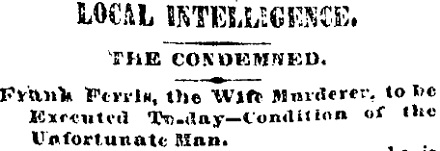
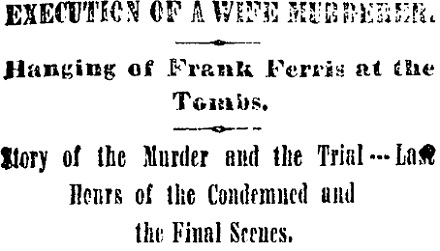
1866: Frank Ferris, a Portuguese ax murderer in New York

New York Times, Oct. 19, 1866:

FRANK FERRIS, the unfortunate man who is condemned to be executed to-day for the murder of his wife, has been positively refused a further respite by GOV. FENTON. No efforts have been spared by the Portuguese Minister, or Mr. Kintzing, his counsel, to secure a commutation of sentence to imprisonment for life. Both these gentlemen have personally importuned the Governor, but without avail, as he yesterday declared, for the last time, that he could see no reason for clemency in this case.

The murder of which FERRIS was convicted was committed on the night of the 9th of September, 1964, and seems to have been as deliberate as it was horrible. After having announced his purpose, he went to the room occupied by his wife, and after breaking in the door with an ax, beat her brains out with the same instrument. He was arrested by the side of his victim, with the murderous weapon in his hand.

He was formally indicted, tried, and, on conviction, sentenced to be hanged in April last. The case was appealed, and after a review of the proceedings he was resentenced. A respite was granted form the 17th of August until to-day, when the execution will take place.

FERRIS has been a very troublesome prisoner during his incarceration, his querulous and jealous disposition occasioning the keepers much trouble. He found fault with everybody and everything that came near him — the physicians, the keepers, his counsel, his friends, his food and his accommodation, and even so late as yesterday, repeated to our reporter the long list of fictitious grievances which have troubled his mind so much. His nature seemed to be devoid of gratitude, and for all the favors gratuitously heaped upon him by the representatives of his country, his counsel and the prison officials, he has had no word of thanks, but rather of censure.

Although he has been carefully examined by experts in reference to his sanity, and pronounced a responsible person, there are certain points upon which his perverseness would seem to amount to insanity. He says that he has forgiven all his enemies and is prepared to die, yet speaks with great bitterness regarding some of the witnesses who testified against him, and persons who have been of service to him since his arrest.

Twice since his sentence was pronounced he has been deprived of the means of self-destruction. Once he made a great fuss because he had no looking glass. One was furnished him, and shortly afterward a quantity of strychnine was found concealed between the glass and the frame. Subsequently an apple was found in his cell stuck full of matches. Matches had been furnished him for lighting his pipe, and he had stuck the ends of these, which contained the phosphorous and brimstone, into an apple, doubtless intending, when a sufficient supply of the poison was obtained, to eat the apple.

FERRIS had been attended constantly of late by Fathers DURANQUET and MCKENNA, who have endeavored to prepare him for his fate. While he talks fairly upon religious subjects, it is evident from the manner in which he converses upon other subjects, that his thoughts are “of the world worldly.” He appears in good health, is strong and vigorous, and says he will walk manfully to his death. He did contemplate making a speech under the scaffold, but at the instance of his spiritual advisers has relinquished the idea.

All the preparations for the execution are completed. The gallows — on which GONZALES and PELLICIER were hung last Friday — was erected yesterday, and the usual preliminaries arranged. During the erection of the gallows, FERRIS was removed from the condemned end of the first floor of the prison to one in the second corridor, where the sound of the carpenter’s hammer could not reach his ears. The execution will take place around 10 o’clock to-day.


New York Times, Oct. 20, 1866:

FRANK FERRIS, alias FRANCISCO FERREIRA, was executed yesterday morning at the Tombs for the murder of his wife, MARY FERRIS, on the night of Sept. 9, 1864. The murderer was a Portuguese, 36 years of age, and was a sea-faring man. His victim was an Irish woman, the mother of three children, two of them by a former husband. FERRIS was an intemperate man, of violent temper, and often had severe quarrels with his wife. Instead of contributing to the support of his wife and children, FERRIS squandered in drink the money earned by his wife by washing and ironing. He enlisted as a private soldier in a Massachusetts regiment early in 186, but after a few months’ service was discharged for disability. He returned to New York, resuming his old habits, and his wife refused to live with him. He became jealous, and in his drunken frenzy frequently threatened to take her life. Unfortunately those threats were not heeded, and the brutal murder was committed.

THE MURDER.

MARY FERRIS, the wife of FRANK FERRIS, occupied the top floor of the tenement-house, No. 31 James-street. She was living with her children apart from her husband. She is spoken of by some as a hard-working, industrious, patient woman. Others alleged, and her husband among their number, that she was a prostitute and a disorderly character. No evidence of this kind, however, was adduced at the trial, but a good character was given her.

Her husband had been striving to insinuate himself into her lodgings for weeks, and on her refusal to live with him, had beaten her repeatedly. But a short time before the murder he had assaulted her with an ax, and inflicted such wounds upon her that her life was despaired of. At the instance of her friends she procured the arrest of her husband, and on her complaint he was sentenced to the Penitentiary.

Upon the expiration of his sentence, FERRIS returned to New-York and commenced a search for his wife, but for two or three days he was unable to find her. He finally traced her to her lodgings, and on the 9th of September he called there. MRS. FERRIS was not in and he went away. He had been drinking freely, and while in the house where his wife lived he made terrible threats against her. At one place where he called on that afternoon to inquire for her, he knelt in the middle of the room and said: “I swear by the Virgin Mary and Jesus Christ that I will kill her before 9 o’clock to-night …”

He also swore that he would kill himself.

When asked what would become of his children, he replied that they could go on the island. He was observed during the day sharpening a knife on the curbstone in front of the house in which his wife lived. When MRS. FERRIS returned from her work she was informed of the threats made by her husband, and, yielding to the entreaties of her friends, she removed her children and some of her things to the room of a neighbor on a lower floor of the building, where she gave the children supper and put them to bed, intending to remain there with them.

About 8 o’clock in the evening, FERRIS, armed with a heavy, dull ax, went to his wife’s room, and finding the door fastened broke it in with the ax. Disappointed at not finding his wife within, he commenced destroying the furniture. MRS. FERRIS hearing the noise, and hoping to save her furniture, rushed up to her room despite the warnings of her friends. She found the door shut, and a few words were exchanged by her on one side of the door and him on the other. The door then opened, and the woman passed into the room. A moment later she appeared at the window, screaming “Murder, watch!”

UNDER THE GALLOWS.

Yesterday morning about 200 persons gathered within the walls of the prison to witness the execution. Capt. JOURDAN, of the Sixth precinct, was in attendance with a force of 150 policemen, for the purpose of preserving order within and without the prison. The clergymen were saying the last prayers in company with the prisoner in his cell as the spectators were assembling. Sheriff KELLY was with him also most of the morning, and superintended his dressing for the scaffold. The fatal cord was adjusted about his neck, and the black cap was fitted to his head by Mr. GEORGE ISAACS, upon whom the duty of executioner devolves.

FERRIS then bade good bye to all present, and everything being in readiness the solemn procession moved toward the gallows, FERRIS walking between Sheriff KELLY and Mr. ISAACS, preceded by the clergymen. As they emerged from the cell the condemned man began singing, in a clear and distinct voice, a Portuguese hymn, usually sung by his countrymen when the holy sacrament is being given to a dying man. He continued singing as he walked through the line of spectators, concluding the hymn as he took his place beneath the gallows.

In his hand he carried an ebony crucifix, and as he ceased singing he kissed this several times. He then knelt down between the priests, the Sheriff and his assistants kneeling also, and the last prayers were said. He then rose to his feet, and on being asked if he wished to say anything, he replied that he did. In a clear voice, but in scarcely intelligible English, he spoke as follows:

HIS LAST WORDS.

My Dear Gentlemen: I am going to die, and I am innocent of the crime for which I suffer. I do not mean I did not do it, but, though my hand is guilty, my heart is innocent. But for Father DURANQUET and the good Sisters of Mercy, I would have had more to say, and give an account of some people. Good bye, my dear brothers — Amen.

He then thanked Sheriff KELLY for his kindness to him, and resumed his position under the rope. Mr. ISAACS then pulled the black cap over his face, adjusted the rope which was around his neck to that dangling from the beam and all was ready. The Sheriff, with his handkerchief, gave the signal, and with the fall of the heavy weights behind the screen, the body of FRANK FERRIS was drawn into the air. There were a few spasmodic twitchings of the limbs, a convulsive clutching of the hands, and then all was quiet. It was just 9 o’clock and 50 minutes when the weights fell, and in fifteen minutes pulsation had ceased. The body was partially lowered and examined by several physicians, and a few minutes later was taken down and deposited in a plain coffin.

BURIAL.

The body of FERRIS is to be buried in Calvary Cemetery, the Portuguese Consul having made arrangements to that effect, and defraying the expenses of burial.

THE CHILDREN.

The orphan children of FRANK FERRIS and his murdered wife have been cared for by the Catholic charitable institutions of the City. The Sisters of Mercy have taken the two girls, and the Brothers of Mercy the little crippled boy. The injury to this child was received after the incarceration of the father, and while in the care of Mrs. FERRIS’ sister. The father manifested much affection for the boy, and not till recently, if ever, forgave his sister-in-law for her carelessness in permitting the child to fall out of a window.

On this day..

1862: Ten Confederate hostages in the Palmyra Massacre

On this date in 1862, Union Gen. John McNeil had ten Confederate soldiers shot in what history has recorded as the Palmyra Massacre.

The Slave Power’s northern salient, Missouri was surrounded to the east, north, and west by free soil — which made it an antebellum flashpoint since the days of the Missouri Compromise.*

In the 1850s, the Missouri conflict spilled into neighboring Kansas as the enemy sides of the slavery question fought to determine whether Kansas would enter the Union as slave state or free. The Missouri borderlands of Bleeding Kansas was where the radical abolitionist martyr John Brown made his name, commanding free state militia in a guerrilla war that presaged the coming clash of North and South.

By the time we lay our scene in 1862, John Brown has exited courtesy of Virginia’s gallows, and the dragon’s teeth sown in Missouri and Kansas and everywhere else had sprung to horrible life. Missouri’s own civil war pitted neighbor against neighbor throughout the state in a bushwhacking conflict that extended locally for many years after Appomattox.**

The nastiness of the years to come is aptly suggested by this date’s events.

Like neighboring Kentucky, Missouri was a border state with a Union government, albeit one contested by a rival Confederate government. From the standpoint of the North, all Confederate activity there was behind its lines and the perpetrators therefore potentially subject to treatment (up to and including execution) as spies, saboteurs, and the like.†

Joseph Chrisman Porter, a Confederate officer, was one such possible client of this here site, tapped as he was for recruiting and raiding operations in northeast Missouri. His Union adversary Gen. John McNeil saw Porter as basically a terrorist. In August of 1862, Porter’s aide Frisby McCullough fell into McNeil’s hands: the Union general had McCullough shot.

On September 12, Porter raided the town of Palmyra, where McNeil held a number of Confederate prisoners. In the course of the raid, he kidnapped Andrew Allsman, a 60-year-old Palmyra resident. “It was said of him that he was able to inform the military authorities of certain movements of the enemy, and that he gave definitive information as to the homes and whereabouts of many men of Confederate leanings,” in the words of this pro-Confederate 1902 pamphlet on the incident. “Naturally, this placed him in disfavor with the Southern sympathizers and those who were fighting in that cause.”

What happened next — though it was not known to the Union at the time — was that Allsman was shot. The pamphlet just cited attempts to obfuscate this event into the fog of war and not really Porter’s fault. The bare fact is that his raiders had gone out of their way to seize an aged non-combatant and then summarily executed him.

Not knowing Allsman’s fate, McNeil responded with an ultimatum to his opposite number.

Palmyra, Mo., Oct. 8, 1862.

To Joseph C. Porter.

Sir: — Andrew Allsman, an aged citizen of Palmyra and a non-combatant, having been carried away from his home by a band of persons unlawfully arraigned against the peace and good order of the State of Missouri, and which band was under your control, this is to notify you that, unless Andrew Allsman is returned unharmed to his family within ten days from date, ten men, who have belonged to your band, and unlawfully sworn by you to carry arms against the government of the United States, and who are now in custody, will be shot as a meet reward for their crimes, amongst which is the illegal restraining of said Allsman of his liberty, and if not returned, of presumptively aiding in his murder. Your prompt attention to this will save much suffering.

Yours, etc.,

W.R. Strachan
Provost Marshal General Northeast District of Missouri
By order of Brigadier General commanding McNeil’s column

The Confederates, of course, could not produce Allsman.

So, on the evening of Oct. 17, five rebel prisoners in the Palmyra stockade plus five more held in Hannibal were informed that they would be shot the next afternoon, in ruthless enforcement of the threat.

The men who died this date in 1862 by a volley of musketry at the Palmyra fairgrounds were:

  • Captain Thomas Sidenor
  • William T. Baker
  • Thomas Humston
  • Morgan Bixler
  • John McPheeters
  • Hiram Smith
  • Herbert Hudson
  • John Wade
  • Marion Lair
  • Eleazer Lake

Their names adorn the base of a monument erected in Palmyra in 1907 commemorating the so-called “Palmyra Massacre”. The state of Missouri as a digital archive of original documents relating to the affair available here.

* Missouri was where the slave Dred Scott lived; his owner taking him to the neighboring free state of Illinois and thence points north occasioned the notorious Supreme Court case that bears his name.

** Frank and Jesse James were Confederate partisans for William Quantrill in the Missouri war; they segued directly into their more celebrated career in outlawry right after the war ended — robbing banks whilst settling scores with pro-Union men for the rest of the 1860s, before branching out to other points on the frontier.

† The Union might obviously have chosen to treat the entire Confederacy as a treasonable enterprise rather than a legitimate enemy belligerent. As a historical matter, it did not take this perspective.

On this day..

1677: John S., William Fletcher, and Robert Perkins

The Confession and Execution of the Three Prisoners suffering at Tyburn on Wednesday the 17th of October, 1677

At the Sessions of Oyer and Terminer for London, and Gaole-delivery of Newgate begun at Justice-Hall in the Old Bayly, 10 Octob. and ending on the 12 of the same Month, there were in all (as by a Printed Narrative you may already have heard) Five persons, who being Convicted on fair Tryals (per Patriam) of several capital Crimes, received Sentence of Death: But Two of them, whose Crime was stealing of two horses, appearing to be objects of mercy, as having never been concern’d in any such offences before, and seeming now extremely penitent for the same, obtained a Gracious Reprieve. The other Three were this present Wednesday 17 Octob. carryed to the place of execution, and by a shameful death surrendered their unhappie lives as Victims duely forfeited to the Justice of the Law.

These were all three old notorious offenders; two of them (taken in Gardiners-lane, Westminster) had long followed the Padd, as they called it, that is, Robbed upon the Highway: The other had made it his trade to break open houses, and pilfer away peoples Goods, being burnt in the hand but two Sessions ago: So that if such Malefactors should have longer been endured, honest Subjects would not be able either to sleep securely in their Dwellings, or travel abroad with safety on their lawful occasions; but both within doors and without, been liable to the spoils and outrages of these barbarous Savages.

To assist these poor wretches for the good of their Souls after the time of their Condemnation, the Sheriffs not onely manifested their pious Charity in sending them able Divines to instruct them, and especially Mr. Ordinary, who very laboriously discharges his weighty office on such occasions, but likewise several godly Ministers of their own accord, in Christian-compassion to their perishing condition, were pleased to visit them. Who laid before them the miserable state they were in; That now their days we [sic] numbered, nay their very hours and minutes which they had to live in this world; and yet these few minutes were all the time and opportunity they had to provide for eternity. That they were doom’d by Justice to a certain death; and though ’twas vain for them to flatter themselves with hopes of longer life in this world, yet there was means left, by a speedy, thorow, sincere and hearty repentance of their sins, and fleeing to Christ for mercy and forgiveness, to secure themselves, by vertue of his merits and righteousness, of a most happy and everlasting life in the world to come. That to such vile and sinful wretches as they had been, it was unspeakable mercy that they had yet a little space left, wherein to make peace with their God: for they might have gone on still in riot and wickedness, and been suddenly snatcht away in the very acts of their impiety Etc. These and many other pressing exhortations, together with severe threatnings to affright them and sweet promises to allure them, taken from the Word of God, were made use of, to bring them to a due sense of their sins, and to cry mightily to God for salvation. But the deaf adder refuses the voice of the charmer, charm he never so wisely All this good seed could take no root, or produce very little visible fruit on the stony ground of two of these Prisoners obdurate hearts; they not seeming (to outward appearance at least) to take that due and sensible notice of this most important counsel, as might be expected from persons in their condition. But the Spirit bloweth where it listeth. The third seemed much affected with this pious advice, and was very earnest and frequent in bewailing his sins, and condemning himself bitterly for having so wickedly mis-spent his precious time heretoforr. He acknowledged to some, that he had several years been a Thief, but not till of late upon the High-way: that at fust his Conscience would after every fact severely check him; but since custom of sinning taking away the sense, he had run on from one degree of wickedness to a greater without controul. He was very frequent in Prayer, wherein he has been heard to express himself to this effect.

Most dreadful and glorious God, though then hatest all the workers of iniquity, yet through the Mediation of they blessed son, with pity behold me a miserable sinner. Had I lived according to thy Commandments, or submitted to the Gospel of thy son, I might approach thee with the confidence of a childe: but I have been a Rebel against thee from my youth up, forgetting the God that made me, and the saviour that redeemed me, quenching and grieving the holy spirit, and slighting the endless Glory which thou hast prepared for me. Oh the precious time which I have lost, which all the world cannot call back; the wonderful love which I unthankfully rejected! How have I lived in continual acts of all kinde of Profaneness, all kind of Debanchery, whoring, swearing, Drunkenness, and especially Theft, which now has brought me to this woful, forlorn, condemned case wherein I am a shame to my friends, and burden to my self; and thou, O God, art my Terrour, who shouldot be my onely Hope and Comfort. Lord, thou knowest my secret sins, which yet are unknown to men, and all their Aggravations. Mine iniquities, Lord, have found me out; my fears and sorrows overwhelm me: a shameful death expects me in this world, and endless torments are ready to receive me in the other. But, Lord! thy Goodness is equal to thy Greatness, thy Mercy over all thy works. Good God, be merciful therefore unto me, the vilest of sinners: save me for thy abundant mercy, for the merit of thy Son, and for the promise of forgiveness which thou hast made through him; for in these alone is all my trust. Thou who didst patiently endure me when I despised thee, Oh do not refuse me now I seek unto thee, and in the dust implore thy mercy. Lord, I ask not for longer life in this world, but for life eternal; not for liberty to sin again, but for deliverance from this sinning nature, and that body of death which overwhelms me. To this purpose Lord give me thy grace to improve these few minutes, and prepare me for death and Judgement; that when I leave this world with Shame, I may be received into glory, and yeeld my departing soul with joy into the faithful hands of my Redeemer. Amen.

He behaved himself very penitently in the Cart, Prayed a considerable time by himself privately at the place of Execution; desired all people to take warning by him to avoid Idleness and Ill Company, which brought him to this Ignominious End. The other joyned in the publick Prayers, but said very little that could be heard. But all of them together suffered very patiently, and with submissive acknowledgements of the Justice of the Sentence.

(Via the invaluable Old Bailey Online)

On this day..