1730: Nevsehirli Damat Ibrahim Pasha, Tulip Era Grand Vizier

On this date in 1730, the Ottoman Grand Vizier Nevsehirli Damat Ibrahim Pasha was deposed by strangulation.

Ibrahim Pasha (English Wikipedia entry | Turkish)* was the minister of Sultan Ahmed III; more than that, he was the sultan’s son-in-law.**

It was the Lâle Devri in Istanbul, whose great families thrilled to the voluptuary pleasures of tulips — a consumption conspicuous not only of wealth but of European affectation.†

Ibrahim himself was a great connoisseur of the fashionable bulb that defines his 1718-1730 administration as the “Tulip Period”. Arts and culture in the empire — there’s no other way to say it — flowered.

But neither horticulture nor family ties were safety in Istanbul when events required of the sultan a politically expedient purge.

For the mass of Turks unable to entertain French noblemen in their cultivated gardens, resentments both economical and cultural accumulated during in Tulip Period until they were discharged by a ham-handed tax imposition in 1730 into a huge mob rising. We have previously covered this revolt; suffice to say that it was briefly a mortal threat to which the ruling dynasty was obliged to sacrifice a few elites: an Albanian shopkeeper named Patrona Halil basically ruled Istanbul for a few weeks, and one of the concessions his angry supporters required of the sultan was the death of his son-in-law. Ahmed himself got off “easy” and was simply made to resign in favor of his nephew.

The end for Nevsehirli Damat Ibrahim Pasha also meant the end of the Tulip Era; periodization aside, however, the flower does remain a popular Turkish symbol. (Even the word for tulip, Lale, is used as a feminine name.) They’re planted all over in present-day Istanbul, and bloom gloriously in the spring; Turkish Airlines also uses a stylized tulip as its logo.

* Not to be confused with the Damat Ibrahim Pasha who was Grand Vizier from 1596 to 1601, and still less with the Grand Vizier executed by Suleiman the Magnificent, Pargali Ibrahim Pasha.

** His wife Hatice Sultan wielded considerable power of her own; after her husband’s death and her father’s resignation, she played a leading role in statecraft for the government-averse successor sultan.

† This is, however, a century after the completely unrelated Dutch tulip mania. The flower is native to Anatolia, not to the Low Countries.

On this day..

1651: James Stanley, Earl of Derby

Oliver Cromwell famously called his victory in the last battle of the English Civil War “a crowning mercy” … but it was anything but for royalist nobleman James Stanley, who was beheaded a few weeks afterwards, on this date in 1651.

Packing the marvelous title of Earl of Derby and the Marvel Comics-esque one of Baron Strange, Stanley was the maternal grandson of playwright Edward de Vere.

He had fought the cavalier side in the 1640s and made his name notorious with the storming of Bolton that resulted in the Bolton Massacre. Weeks later, he was present when royalist fortunes went pear-shaped in the north at the Battle of Marston Moor.

Stanley holed up on the Isle of Man after King Charles I lost his head, refusing his enemies’ every blandishment until he could re-enter the field as a commander for Charles II‘s reboot of hostilities.

This also proved a catastrophic failure, and while Charles was able to slip back to continental exile the Lord Derby could not find such obliging oak trees as served his master.*

Though given terms by his captors, a court martial subsequently disallowed such liberality to the butcher of Bolton and condemned him as a traitor.

The parliamentarians would take him back to Bolton to face his punishment; the spot of the beheading is marked by a column in Bolton’s market cross.

Undependable local folklore holds that Lord Derby spent his last night in the ancient (and still-extant) Ye Olde Man and Scythe inn, whose environs exhibit some artifacts of Lord Derby, including a prop severed head.

It’s even said that Stanley’s ghost haunts the pub.

* Stanley was also the Lord of Mann (i.e., of the Isle of Man), and the efforts of Stanley’s wife to negotiate surrender of the royalist island in exchange for her husband’s safety triggered the rebellion of Illiam Dhone.

On this day..

1638: Stepan Ostryanin, Cossack hetman

(Thanks to friend of the blog Sonechka for research, translation, and background information touching this post. -ed.)

October 14 (October 1 O.S.) is a liturgical feast celebrating the protective intercession of the Virgin Mary, a date of particular significance in Russia and Ukraine. Indeed, Red Square’s St. Basil’s Cathedral is actually the Cathedral of the Intercession of the Most Holy Theotokos [i.e., Mary] on the Moat, just one of many Orthodox churches so named.

Also known as Pokrov — a quaint Slavic term for covering, denoting safeguarding — the holiday celebrates an incident from 10th century Byzantium when a saint beheld Mary descend through the dome of the church, then spread her garment protectively over the entire congregation.

It is of special significance in Ukraine where the ecclesiastical celebration pulls double duty as the Day of the Ukrainian Cossacks. And it is in honor of Pokrov that we dedicate this post.


17th century icon of the Madonna’s broad cloak protecting Ukrainians.

On an unspecified date in 1638, a Cossack named Ostryanin was broken on the wheel in Warsaw … maybe.

The Ostryanin Uprising of 1638 was one of the ongoing cycle of Cossack disturbances in the southern reaches of the Polish-Lithuanian Empire — modern-day Ukraine. Like many of these, it was a short-lived affair considered on its own, but the pattern of disaffected Cossacks struggling against the Polish crown for some combination of recognition, largesse, and autonomy was an ongoing pattern in the 17th century — and by the 1650s it would begin tearing apart the formerly mighty Polish-Lithuanian realm and transferring Ukrainian territory from Polish to Russian domination.

Tradition held that after the rising was stamped out in the summer of 1638, Stepan Ostryanin himself was treacherously seized and taken to Warsaw for execution. A late 18th century chronicle* of a distinctly patriotic bent called Istoriya Russov embroiders upon that death by breaking-wheel with racist gusto:

in accord with their treachery, insidious and duplicitous, having learned through their Jew spies that hetman Ostryanin’s would travel unguarded … the Lyakhs [term for “Poles”; it’s derogatory in present-day Russian but may have been less so at the time -ed.] surrounded him in Kanev monastery with a host of men. They, having tied the hetman and his men, altogether thirty seven people, … prepared an execution for them in Warsaw unprecedented in its cruelty, which posterity will scarcely believe to be true, because it would not occur to even the most barbarous and ferocious Japanese (!) and the reality of which would terrify the very beasts and monsters.

On the other hand, a Cossack named Yakiv Ostryanin was to be found on Russian soil in the subsequent years, until he was murdered in 1641. Some historians think that he was the very same namesake Cossack rebel escaped from Polish vengeance, and the story about him being broken on the wheel in Poland is pure sentimental folklore; alternatively, Stepan and Yakiv might have just been two different Cossacks named Ostryanin who met two different fates.

Quite a difference for our supposed Stepan Ostryanin, but a minor mystery from this distance in time. Nevertheless, our man, whoever he was, had a posthumous contribution yet to make to the letters of his Slavic brethren.

Polish historian Szymon Okolski rode along with the Polish commander Mikolaj Potocki in Potocki’s successful campaign of the spring-summer 1638 to suppress this rebellion. Okolski’s field diaries of the campaign are a key historical source on the Cossacks and are thought to have been used extensively by the Cossack-descended writer Nikolai Gogol in composing his short story Taras Bulba.

A product of Gogol’s youth, Taras Bulba has a rough romanticism — and a romanticism for the Cossack (read: national Ukrainian) cause specifically that nonplussed Russian authorities at the time. (And probably now, too.)

Taras Bulba‘s title character is a mature Cossack patriot who with his two sons joins the Cossack risings against Poland. Its location in time is indeterminate, not unlike the unending cycle of risings themselves. Taras Bulba is a nearly eternal character, almost a fixture of nature, because his war seemed eternal too.

And of course it contains some cracking execution scenes. The execution by breaking-wheel of Taras Bulba’s son might have been inspired by the Istoriya Russov‘s outraged account of that full Japanese barbarism. The excerpt below hails from this public-domain English translation.


Ostap had been seized and bound before his very eyes, and that he was now in the hands of the Lyakhs. Grief overpowered him. He pulled off and tore in pieces the bandages from his wounds, and threw them far from him; he tried to say something, but only articulated some incoherent words. Fever and delirium seized upon him afresh, and he uttered wild and incoherent speeches. Meanwhile his faithful comrade stood beside him, scolding and showering harsh, reproachful words upon him without stint. Finally, he seized him by the arms and legs, wrapped him up like a child, arranged all his bandages, rolled him in an ox-hide, bound him with bast, and, fastening him with ropes to his saddle, rode with him again at full speed along the road.

“I’ll get you there, even if it be not alive! I will not abandon your body for the Lyakhs to make merry over you, and cut your body in twain and fling it into the water. Let the eagle tear out your eyes if it must be so; but let it be our eagle of the steppe and not a Polish eagle, not one which has flown hither from Polish soil. I will bring you, though it be a corpse, to the Ukraine!”

Thus spoke his faithful companion. He rode without drawing rein, day and night, and brought Taras still insensible into the Zaporozhian Setch itself. There he undertook to cure him, with unswerving care, by the aid of herbs and liniments. He sought out a skilled Jewess, who made Taras drink various potions for a whole month, and at length he improved. Whether it was owing to the medicine or to his iron constitution gaining the upper hand, at all events, in six weeks he was on his feet. His wounds had closed, and only the scars of the sabre-cuts showed how deeply injured the old Cossack had been. But he was markedly sad and morose. Three deep wrinkles engraved themselves upon his brow and never more departed thence. Then he looked around him. All was new in the Setch; all his old companions were dead. Not one was left of those who had stood up for the right, for faith and brotherhood. And those who had gone forth with the Koschevoi in pursuit of the Tatars, they also had long since disappeared. All had perished. One had lost his head in battle; another had died for lack of food, amid the salt marshes of the Crimea; another had fallen in captivity and been unable to survive the disgrace. Their former Koschevoi was no longer living, nor any of his old companions, and the grass was growing over those once alert with power. He felt as one who had given a feast, a great noisy feast. All the dishes had been smashed in pieces; not a drop of wine was left anywhere; the guests and servants had all stolen valuable cups and platters; and he, like the master of the house, stood sadly thinking that it would have been no feast. In vain did they try to cheer Taras and to divert his mind; in vain did the long-bearded, grey-haired guitar-players come by twos and threes to glorify his Cossack deeds. He gazed grimly and indifferently at everything, with inappeasable grief printed on his stolid face; and said softly, as he drooped his head, “My son, my Ostap!”

The square on which the execution was to take place was not hard to find: for the people were thronging thither from all quarters. In that savage age such a thing constituted one of the most noteworthy spectacles, not only for the common people, but among the higher classes. A number of the most pious old men, a throng of young girls, and the most cowardly women, who dreamed the whole night afterwards of their bloody corpses, and shrieked as loudly in their sleep as a drunken hussar, missed, nevertheless, no opportunity of gratifying their curiosity. “Ah, what tortures!” many of them would cry, hysterically, covering their eyes and turning away; but they stood their ground for a good while, all the same. Many a one, with gaping mouth and outstretched hands, would have liked to jump upon other folk’s heads, to get a better view. Above the crowd towered a bulky butcher, admiring the whole process with the air of a connoisseur, and exchanging brief remarks with a gunsmith, whom he addressed as “Gossip,” because he got drunk in the same alehouse with him on holidays. Some entered into warm discussions, others even laid wagers. But the majority were of the species who, all the world over, look on at the world and at everything that goes on in it and merely scratch their noses. In the front ranks, close to the bearded civic-guards, stood a young noble, in warlike array, who had certainly put his whole wardrobe on his back, leaving only his torn shirt and old shoes at his quarters. Two chains, one above the other, hung around his neck. He stood beside his mistress, Usisya, and glanced about incessantly to see that no one soiled her silk gown. He explained everything to her so perfectly that no one could have added a word. “All these people whom you see, my dear Usisya,” he said, “have come to see the criminals executed; and that man, my love, yonder, holding the axe and other instruments in his hands, is the executioner, who will despatch them. When he begins to break them on the wheel, and torture them in other ways, the criminals will still be alive; but when he cuts off their heads, then, my love, they will die at once. Before that, they will cry and move; but as soon as their heads are cut off, it will be impossible for them to cry, or to eat or drink, because, my dear, they will no longer have any head.” Usisya listened to all this with terror and curiosity.

The upper stories of the houses were filled with people. From the windows in the roof peered strange faces with beards and something resembling caps. Upon the balconies, beneath shady awnings, sat the aristocracy. The hands of smiling young ladies, brilliant as white sugar, rested on the railings. Portly nobles looked on with dignity. Servants in rich garb, with flowing sleeves, handed round various refreshments. Sometimes a black-eyed young rogue would take her cake or fruit and fling it among the crowd with her own noble little hand. The crowd of hungry gentles held up their caps to receive it; and some tall noble, whose head rose amid the throng, with his faded red jacket and discoloured gold braid, and who was the first to catch it with the aid of his long arms, would kiss his booty, press it to his heart, and finally put it in his mouth. The hawk, suspended beneath the balcony in a golden cage, was also a spectator; with beak inclined to one side, and with one foot raised, he, too, watched the people attentively. But suddenly a murmur ran through the crowd, and a rumour spread, “They are coming! they are coming! the Cossacks!”

They were bare-headed, with their long locks floating in the air. Their beards had grown, and their once handsome garments were worn out, and hung about them in tatters. They walked neither timidly nor surlily, but with a certain pride, neither looking at nor bowing to the people. At the head of all came Ostap.

What were old Taras’s feelings when thus he beheld his Ostap? What filled his heart then? He gazed at him from amid the crowd, and lost not a single movement of his. They reached the place of execution. Ostap stopped. He was to be the first to drink the bitter cup. He glanced at his comrades, raised his hand, and said in a loud voice: “God grant that none of the heretics who stand here may hear, the unclean dogs, how Christians suffer! Let none of us utter a single word.” After this he ascended the scaffold.

“Well done, son! well done!” said Bulba, softly, and bent his grey head.

The executioner tore off his old rags; they fastened his hands and feet in stocks prepared expressly, and—We will not pain the reader with a picture of the hellish tortures which would make his hair rise upright on his head. They were the outcome of that coarse, wild age, when men still led a life of warfare which hardened their souls until no sense of humanity was left in them. In vain did some, not many, in that age make a stand against such terrible measures. In vain did the king and many nobles, enlightened in mind and spirit, demonstrate that such severity of punishment could but fan the flame of vengeance in the Cossack nation. But the power of the king, and the opinion of the wise, was as nothing before the savage will of the magnates of the kingdom, who, by their thoughtlessness and unconquerable lack of all far-sighted policy, their childish self-love and miserable pride, converted the Diet into the mockery of a government. Ostap endured the torture like a giant. Not a cry, not a groan, was heard. Even when they began to break the bones in his hands and feet, when, amid the death-like stillness of the crowd, the horrible cracking was audible to the most distant spectators; when even his tormentors turned aside their eyes, nothing like a groan escaped his lips, nor did his face quiver. Taras stood in the crowd with bowed head; and, raising his eyes proudly at that moment, he said, approvingly, “Well done, boy! well done!”

But when they took him to the last deadly tortures, it seemed as though his strength were failing. He cast his eyes around.

O God! all strangers, all unknown faces! If only some of his relatives had been present at his death! He would not have cared to hear the sobs and anguish of his poor, weak mother, nor the unreasoning cries of a wife, tearing her hair and beating her white breast; but he would have liked to see a strong man who might refresh him with a word of wisdom, and cheer his end. And his strength failed him, and he cried in the weakness of his soul, “Father! where are you? do you hear?”

“I hear!” rang through the universal silence, and those thousands of people shuddered in concert. A detachment of cavalry hastened to search through the throng of people. Yankel turned pale as death, and when the horsemen had got within a short distance of him, turned round in terror to look for Taras; but Taras was no longer beside him; every trace of him was lost.


Despite his cunning escape on this occasion, Taras Bulba himself is also in the end put to death: the story ends with him going to the stake as his soul summons the brethren he can still see in the distance to resume the fight, again and again.


[A] band of Lyakhs suddenly rushed up, and seized him by the shoulders. He struggled with all might; but he could not scatter on the earth, as he had been wont to do, the heydukes who had seized him. “Oh, old age, old age!” he exclaimed: and the stout old Cossack wept. But his age was not to blame: nearly thirty men were clinging to his arms and legs.

“The raven is caught!” yelled the Lyakhs. “We must think how we can show him the most honour, the dog!” They decided, with the permission of the hetman, to burn him alive in the sight of all. There stood hard by a leafless tree, the summit of which had been struck by lightning. They fastened him with iron chains and nails driven through his hands high up on the trunk of the tree, so that he might be seen from all sides; and began at once to place fagots at its foot. But Taras did not look at the wood, nor did he think of the fire with which they were preparing to roast him: he gazed anxiously in the direction whence his Cossacks were firing. From his high point of observation he could see everything as in the palm of his hand.

“Farewell, comrades!” he shouted to them from above; “remember me, and come hither again next spring and make merry in the same fashion! What! cursed Lyakhs, have ye caught me? Think ye there is anything in the world that a Cossack fears? Wait; the time will come when ye shall learn what the orthodox Russian faith is! Already the people scent it far and near. A czar shall arise from Russian soil, and there shall not be a power in the world which shall not submit to him!” But fire had already risen from the fagots; it lapped his feet, and the flame spread to the tree…. But can any fire, flames, or power be found on earth which are capable of overpowering Russian strength?

Broad is the river Dniester, and in it are many deep pools, dense reed-beds, clear shallows and little bays; its watery mirror gleams, filled with the melodious plaint of the swan, the proud wild goose glides swiftly over it; and snipe, red-throated ruffs, and other birds are to be found among the reeds and along the banks. The Cossacks rowed swiftly on in the narrow double-ruddered boats—rowed stoutly, carefully shunning the sand bars, and cleaving the ranks of the birds, which took wing—rowed, and talked of their hetman.

* The Istoriya Russov had a great influence on young writers in the early 19th century. The text can be read as advancing a nationalism of all the Russias, or as speaking in a more specifically Ukrainian voice. See The Cossack Myth: History and Nationhood in the Age of Empires.

On this day..

1909: Francisco Ferrer, martyred teacher

(Thanks to Emma Goldman for the guest post on her anarchist contemporary; it originally appeared in her Anarchism and Other Essays -ed.)

Experience has come to be considered the best school of life. The man or woman who does not learn some vital lesson in that school is looked upon as a dunce indeed. Yet strange to say, that though organized institutions continue perpetuating errors, though they learn nothing from experience, we acquiesce, as a matter of course.
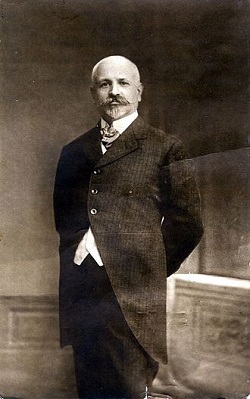
There lived and worked in Barcelona a man by the name of Francisco Ferrer. A teacher of children he was, known and loved by his people. Outside of Spain only the cultured few knew of Francisco Ferrer’s work. To the world at large this teacher was non-existent.

On the first of September, 1909, the Spanish government — at the behest of the Catholic Church — arrested Francisco Ferrer. On the thirteenth of October, after a mock trial, he was placed in the ditch at Montjuich prison, against the hideous wall of many sighs, and shot dead. Instantly Ferrer, the obscure teacher, became a universal figure, blazing forth the indignation and wrath of the whole civilized world against the wanton murder.

The killing of Francisco Ferrer was not the first crime committed by the Spanish government and the Catholic Church. The history of these institutions is one long stream of fire and blood. Still they have not learned through experience, nor yet come to realize that every frail being slain by Church and State grows and grows into a mighty giant, who will some day free humanity from their perilous hold.

Francisco Ferrer was born in 1859, of humble parents. They were Catholics, and therefore hoped to raise their son in the same faith. They did not know that the boy was to become the harbinger of a great truth, that his mind would refuse to travel in the old path. At an early age Ferrer began to question the faith of his fathers. He demanded to know how it is that the God who spoke to him of goodness and love would mar the sleep of the innocent child with dread and awe of tortures, of suffering, of hell. Alert and of a vivid and investigating mind, it did not take him long to discover the hideousness of that black monster, the Catholic Church. He would have none of it.

Francisco Ferrer was not only a doubter, a searcher for truth; he was also a rebel. His spirit would rise in just indignation against the iron régime of his country, and when a band of rebels, led by the brave patriot General Villacampa, under the banner of the Republican ideal, made an onslaught on that regime, none was more ardent a fighter than young Francisco Ferrer. The Republican ideal, — I hope no one will confound it with the Republicanism of this country. Whatever objection I, as an Anarchist, have to the Republicans of Latin countries, I know they tower high above that corrupt and reactionary party which, in America, is destroying every vestige of liberty and justice. One has but to think of the Mazzinis, the Garibaldis, the scores of others, to realize that their efforts were directed, not merely against the overthrow of despotism, but particularly against the Catholic Church, which from its very inception has been the enemy of all progress and liberalism.

In America it is just the reverse. Republicanism stands for vested rights, for imperialism, for graft, for the annihilation of every semblance of liberty. Its ideal is the oily, creepy respectability of a McKinley, and the brutal arrogance of a Roosevelt.

The Spanish republican rebels were subdued. It takes more than one brave effort to split the rock of ages, to cut off the head of that hydra monster, the Catholic Church and the Spanish throne. Arrest, persecution, and punishment followed the heroic attempt of the little band. Those who could escape the bloodhounds had to flee for safety to foreign shores. Francisco Ferrer was among the latter. He went to France.

How his soul must have expanded in the new land! France, the cradle of liberty, of ideas, of action. Paris, the ever young, intense Paris, with her pulsating life, after the gloom of his own belated country, — how she must have inspired him. What opportunities, what a glorious chance for a young idealist.

Francisco Ferrer lost no time. Like one famished he threw himself into the various liberal movements, met all kinds of people, learned, absorbed, and grew. While there, he also saw in operation the Modern School, which was to play such an important and fatal part in his life.

The Modern School in France was founded long before Ferrer’s time. Its originator, though on a small scale, was that sweet spirit Louise Michel. Whether consciously or unconsciously, our own great Louise felt long ago that the future belongs to the young generation; that unless the young be rescued from that mind and soul-destroying institution, the bourgeois school, social evils will continue to exist. Perhaps she thought, with Ibsen, that the atmosphere is saturated with ghosts, that the adult man and woman have so many superstitions to overcome. No sooner do they outgrow the deathlike grip of one spook, lo! they find themselves in the thraldom of ninety-nine other spooks. Thus but a few reach the mountain peak of complete regeneration.

The child, however, has no traditions to overcome. Its mind is not burdened with set ideas, its heart has not grown cold with class and caste distinctions. The child is to the teacher what clay is to the sculptor. Whether the world will receive a work of art or a wretched imitation, depends to a large extent on the creative power of the teacher.

Francisco Ferrer could not escape this great wave of Modern School attempts. He saw its possibilities, not merely in theoretic form, but in their practical application to every-day needs. He must have realized that Spain, more than any other country, stands in need of just such schools, if it is ever to throw off the double yoke of priest and soldier.

When we consider that the entire system of education in Spain is in the hands of the Catholic Church, and when we further remember the Catholic formula, “To inculcate Catholicism in the mind of the child until it is nine years of age is to ruin it forever for any other idea,” we will understand the tremendous task of Ferrer in bringing the new light to his people. Fate soon assisted him in realizing his great dream.

Mlle. Meunier, a pupil of Francisco Ferrer, and a lady of wealth, became interested in the Modern School project. When she died, she left Ferrer some valuable property and twelve thousand francs yearly income for the School.

It is said that mean souls can conceive of naught but mean ideas. If so, the contemptible methods of the Catholic Church to blackguard Ferrer’s character, in order to justify her own black crime, can readily be explained. Thus the lie was spread in American Catholic papers that Ferrer used his intimacy with Mlle. Meunier to get passession of her money.

Personally, I hold that the intimacy, of whatever nature, between a man and a woman, is their own affair, their sacred own. I would therefore not lose a word in referring to the matter, if it were not one of the many dastardly lies circulated about Ferrer. Of course, those who know the purity of the Catholic clergy will understand the insinuation. Have the Catholic priests ever looked upon woman as anything but a sex commodity? The historical data regarding the discoveries in the cloisters and monasteries will bear me out in that. How, then, are they to understand the co-operation of a man and a woman, except on a sex basis?

As a matter of fact, Mlle. Meunier was considerably Ferrer’s senior. Having spent her childhood and girlhood with a miserly father and a submissive mother, she could easily appreciate the necessity of love and joy in child life. She must have seen that Francisco Ferrer was a teacher, not college, machine, or diploma-made, but one endowed with genius for that calling.

Equipped with knowledge, with experience, and with the necessary means; above all, imbued with the divine fire of his mission, our Comrade came back to Spain, and there began his life’s work. On the ninth of September, 1901, the first Modern School was opened. It was enthusiastically received by the people of Barcelona, who pledged their support. In a short address at the opening of the School, Ferrer submitted his program to his friends. He said: “I am not a speaker, not a propagandist, not a fighter. I am a teacher; I love children above everything. I think I understand them. I want my contribution to the cause of liberty to be a young generation ready to meet a new era.” He was cautioned by his friends to be careful in his opposition to the Catholic Church. They knew to what lengths she would go to dispose of an enemy. Ferrer, too, knew. But, like Brand, he believed in all or nothing. He would not erect the Modern School on the same old lie. He would be frank and honest and open with the children.

Francisco Ferrer became a marked man. From the very first day of the opening of the School, he was shadowed. The school building was watched his little home in Mangat was watched. He was followed every step, even when he went to France or England to confer with his colleagues. He was a marked man, and it was only a question of time when the lurking enemy would tighten the noose.

It succeeded, almost, in 1906, when Ferrer was implicated in the attempt on the life of Alfonso. The evidence exonerating him was too strong even for the black crows; they had to let him go — not for good, however. They waited. Oh, they can wait, when they have set themselves to trap a victim.

The moment came at last, during the anti-military uprising in Spain, in July, 1909. One will have to search in vain the annals of revolutionary history to find a more remarkable protest against militarism. Having been soldier-ridden for centuries, the people of Spain could stand the yoke no longer. They would refuse to participate in useless slaughter. They saw no reason for aiding a despotic government in subduing and oppressing a small people fighting for their independence, as did the brave Riffs. No, they would not bear arms against them.

For eighteen hundred years the Catholic Church has preached the gospel of peace. Yet, when the people actually wanted to make this gospel a living reality, she urged the authorities to force them to bear arms. Thus the dynasty of Spain followed the murderous methods of the Russian dynasty, — the people were forced to the battlefield.

Then, and not until then, was their power of endurance at an end. Then, and not until then, did the workers of Spain turn against their masters, against those who, like leeches, had drained their strength, their very life — blood. Yes, they attacked the churches and the priests, but if the latter had a thousand lives, they could not possibly pay for the terrible outrages and crimes perpetrated upon the Spanish people.

Francisco Ferrer was arrested on the first of September, 1909. Until October first his friends and comrades did not even know what had become of him. On that day a letter was received by L’Humanité from which can be learned the whole mockery of the trial. And the next day his companion, Soledad Villafranca, received the following letter:

No reason to worry; you know I am absolutely innocent. Today I am particularly hopeful and joyous. It is the first time I can write to you, and the first time since my arrest that I can bathe in the rays of the sun, streaming generously through my cell window. You, too, must be joyous.

How pathetic that Ferrer should have believed, as late as October fourth, that he would not be condemned to death. Even more pathetic that his friends and comrades should once more have made the blunder in crediting the enemy with a sense of justice. Time and again they had placed faith in the judicial powers, only to see their brothers killed before their very eyes. They made no preparation to rescue Ferrer, not even a protest of any extent; nothing. “Why, it is impossible to condemn Ferrer; he is innocent.” But everything is possible with the Catholic Church. Is she not a practiced henchman, whose trials of her enemies are the worst mockery of justice?

On October fourth Ferrer sent the following letter to L’Humanite:

The Prison Cell, Oct. 4, 1909.

My dear Friends — Notwithstanding most absolute innocence, the prosecutor demands the death penalty, based on denunciations of the police, representing me as the chief of the world’s Anarchists, directing the labor syndicates of France, and guilty of conspiracies and insurrections everywhere, and declaring that my voyages to London and Paris were undertaken with no other object.

With such infamous lies they are trying to kill me.

The messenger is about to depart and I have not time for more. All the evidence presented to the investigating judge by the police is nothing but a tissue of lies and calumnious insinuations. But no proofs against me, having done nothing at all.

FERRER.

October thirteenth, 1909, Ferrer’s heart, so brave, so staunch, so loyal, was stilled. Poor fools! The last agonized throb of that heart had barely died away when it began to beat a hundredfold in the hearts of the civilized world, until it grew into terrific thunder, hurling forth its malediction upon the instigators of the black crime. Murderers of black garb and pious mien, to the bar of justice!

Did Francisco Ferrer participate in the anti-military uprising? According to the first indictment, which appeared in a Catholic paper in Madrid, signed by the Bishop and all the prelates of Barcelona, he was not even accused of participation. The indictment was to the effect that Francisco Ferrer was guilty of having organized godless schools, and having circulated godless literature. But in the twentieth century men can not be burned merely for their godless beliefs. Something else had to be devised; hence the charge of instigating the uprising.

In no authentic source so far investigated could a single proof be found to connect Ferrer with the uprising. But then, no proofs were wanted, or accepted, by the authorities. There were seventy-two witnesses, to be sure, but their testimony was taken on paper. They never were confronted with Ferrer, or he with them.

Is it psychologically possible that Ferrer should have participated? I do not believe it is, and here are my reasons. Francisco Ferrer was not only a great teacher, but he was also undoubtedly a marvelous organizer. In eight years, between 1901–1909, he had organized in Spain one hundred and nine schools, besides inducing the liberal element of his country to organize three hundred and eight other schools. In connection with his own school work, Ferrer had equipped a modern printing plant, organized a staff of translators, and spread broadcast one hundred and fifty thousand copies of modern scientific and sociologic works, not to forget the large quantity of rationalist text books. Surely none but the most methodical and efficient organizer could have accomplished such a feat.

On the other hand, it was absolutely proven that the anti-military uprising was not at all organized; that it came as a surprise to the people themselves, like a great many revolutionary waves on previous occasions. The people of Barcelona, for instance, had the city in their control for four days, and, according to the statement of tourists, greater order and peace never prevailed. Of course, the people were so little prepared that when the time came, they did not know what to do. In this regard they were like the people of Paris during the Commune of 1871. They, too, were unprepared. While they were starving, they protected the warehouses filled to the brim with provisions. They placed sentinels to guard the Bank of France, where the bourgeoisie kept the stolen money. The workers of Barcelona, too, watched over the spoils of their masters.

How pathetic is the stupidity of the underdog; how terribly tragic! But, then, have not his fetters been forged so deeply into his flesh, that he would not, even if he could, break them? The awe of authority, of law, of private property, hundredfold burned into his soul, — how is he to throw it off unprepared, unexpectedly?

Can anyone assume for a moment that a man like Ferrer would affiliate himself with such a spontaneous, unorganized effort? Would he not have known that it would result in a defeat, a disastrous defeat for the people? And is it not more likely that if he would have taken part, he, the experienced entrepreneur, would have thoroughly organized the attempt? If all other proofs were lacking, that one factor would be sufficient to exonerate Francisco Ferrer. But there are others equally convincing.

For the very date of the outbreak, July twenty-fifth, Ferrer had called a conference of his teachers and members of the League of Rational Education. It was to consider the autumn work, and particularly the publication of Elisée Reclus‘ great book, L’Homme et la Terre, and Peter Kropotkin‘s Great French Revolution. Is it at all likely, is it at all plausible that Ferrer, knowing of the uprising, being a party to it, would in cold blood invite his friends and colleagues to Barcelona for the day on which he realized their lives would be endangered? Surely, only the criminal, vicious mind of a Jesuit could credit such deliberate murder.

Francisco Ferrer had his life-work mapped out; he had everything to lose and nothing to gain, except ruin and disaster, were he to lend assistance to the outbreak. Not that he doubted the justice of the people’s wrath; but his work, his hope, his very nature was directed toward another goal.

In vain are the frantic efforts of the Catholic Church, her lies, falsehoods, calumnies. She stands condemned by the awakened human conscience of having once more repeated the foul crimes of the past.

Francisco Ferrer is accused of teaching the children the most blood-curdling ideas, — to hate God, for instance. Horrors! Francisco Ferrer did not believe in the existence of a God. Why teach the child to hate something which does not exist? Is it not more likely that he took the children out into the open, that he showed them the splendor of the sunset, the brilliancy of the starry heavens, the awe-inspiring wonder of the mountains and seas; that he explained to them in his simple, direct way the law of growth, of development, of the interrelation of all life? In so doing he made it forever impossible for the poisonous weeds of the Catholic Church to take root in the child’s mind.

It has been stated that Ferrer prepared the children to destroy the rich. Ghost stories of old maids. Is it not more likely that he prepared them to succor the poor? That he taught them the humiliation, the degradation, the awfulness of poverty, which is a vice and not a virtue; that he taught the dignity and importance of all creative efforts, which alone sustain life and build character. Is it not the best and most effective way of bringing into the proper light the absolute uselessness and injury of parasitism?

Last, but not least, Ferrer is charged with undermining the army by inculcating anti-military ideas. Indeed? He must have believed with Tolstoy that war is legalized slaughter, that it perpetuates hatred and arrogance, that it eats away the heart of nations, and turns them into raving maniacs.

However, we have Ferrer’s own word regarding his ideas of modern education:

I would like to call the attention of my readers to this idea: All the value of education rests in the respect for the physical, intellectual, and moral will of the child. Just as in science no demonstration is possible save by facts, just so there is no real education save that which is exempt from all dogmatism, which leaves to the child itself the direction of its effort, and confines itself to the seconding of its effort. Now, there is nothing easier than to alter this purpose, and nothing harder than to respect it. Education is always imposing, violating, constraining; the real educator is he who can best protect the child against his (the teacher’s) own ideas, his peculiar whims; he who can best appeal to the child’s own energies.

We are convinced that the education of the future will be of an entirely spontaneous nature; certainly we can not as yet realize it, but the evolution of methods in the direction of a wider comprehension of the phenomena of life, and the fact that all advances toward perfection mean the overcoming of restraint, — all this indicates that we are in the right when we hope for the deliverance of the child through science.

Let us not fear to say that we want men capable of evolving without stopping, capable of destroying and renewing their environments without cessation, of renewing themselves also; men, whose intellectual independence will be their greatest force, who will attach themselves to nothing, always ready to accept what is best, happy in the triumph of new ideas, aspiring to live multiple lives in one life. Society fears such men; we therefore must not hope that it will ever want an education able to give them to us.

We shall follow the labors of the scientists who study the child with the greatest attention, and we shall eagerly seek for means of applying their experience to the education which we want to build up, in the direction of an ever fuller liberation of the individual. But how can we attain our end? Shall it not be by putting ourselves directly to the work favoring the foundation of new schools, which shall be ruled as much as possible by this spirit of liberty, which we forefeel will dominate the entire work of education in the future?

A trial has been made, which, for the present, has already given excellent results. We can destroy all which in the present school answers to the organization of constraint, the artificial surroundings by which children are separated from nature and life, the intellectual and moral discipline made use of to impose ready-made ideas upon them, beliefs which deprave and annihilate natural bent. Without fear of deceiving ourselves, we can restore the child to the environment which entices it, the environment of nature in which he will be in contact with all that he loves, and in which impressions of life will replace fastidious book-learning. If we did no more than that, we should already have prepared in great part the deliverance of the child.

In such conditions we might already freely apply the data of science and labor most fruitfully.

I know very well we could not thus realize all our hopes, that we should often be forced, for lack of knowledge, to employ undesirable methods; but a certitude would sustain us in our efforts — namely, that even without reaching our aim completely we should do more and better in our still imperfect work than the present school accomplishes. I like the free spontaneity of a child who knows nothing, better than the world-knowledge and intellectual deformity of a child who has been subjected to our present education.

Had Ferrer actually organized the riots, had he fought on the barricades, had he hurled a hundred bombs, he could not have been so dangerous to the Catholic Church and to despotism, as with his opposition to discipline and restraint. Discipline and restraint — are they not back of all the evils in the world? Slavery, submission, poverty, all misery, all social iniquities result from discipline and restraint. Indeed, Ferrer was dangerous. Therefore he had to die, October thirteenth, 1909, in the ditch of Montjuich. Yet who dare say his death was in vain? In view of the tempestuous rise of universal indignation: Italy naming streets in memory of Francisco Ferrer, Belgium inaugurating a movement to erect a memorial; France calling to the front her most illustrious men to resume the heritage of the martyr; England being the first to issue a biography; all countries uniting in perpetuating the great work of Francisco Ferrer; America, even, tardy always in progressive ideas, giving birth to a Francisco Ferrer Association, its aim being to publish a complete life of Ferrer and to organize Modern Schools all over the country, — in the face of this international revolutionary wave, who is there to say Ferrer died in vain?

That death at Montjuich, — how wonderful, how dramatic it was, how it stirs the human soul. Proud and erect, the inner eye turned toward the light, Francisco Ferrer needed no lying priests to give him courage, nor did he upbraid a phantom for forsaking him. The consciousness that his executioners represented a dying age, and that his was the living truth, sustained him in the last heroic moments.

A dying age and a living truth,

The living burying the dead.

On this day..

1781: Benjamin Loveday and John Burke, “for the detestable Crime of Sodomy”

October 12, 1781 saw the hanging at Saint Michael’s Hill in Bristol of Benjamin Loveday and John Burke — “for the detestable Crime of Sodomy; they were both capitally convicted on the clearest Evidence, which is shocking to Human Nature to describe.”

The newspaper reporting, both slight and heartbreaking, can be perused at the website of gay history expert Rictor Norton, here. Between the lines, it suggests Loveday as the proprietor of a molly house or something very like it — an establishment catering to the underground market in same-sex desire, the like of which periodically surfaced in moral panic episodes in the 1700s and early 1800s. (See Norton’s topical Mother Claps Molly House: Gay Subculture in England 1700-1830.)

Loveday, “about 41 years of age … was formerly waiter at a principal inn in Bristol, but had lately kept a public-house in Tower Lane.” The younger Burke “had acted as a midshipman in the impress service, and he was the unlucky one. Three other men, Joseph Giles, James Lane, and William Ward, also faced potentially lethal charges of committing sodomy with Loveday at the same assizes; Giles and Lane got off with misdemeanor convictions and Ward was acquitted outright.

About Twelve o’Clock they were brought out of Newgate, and being placed in a Cart, moved in slow Procession to the fatal Tree, preceded by the Under-Sheriff on Horse-back, and other proper Offices; and attended in a Chariot by the Rev. Mr. Easterbrooke and two other Clergymen, who have frequently visited them since their Conviction, and earnestly laboured to bring them to a due Sense of their Crime, and a Confession of their Guilt. To and at the Place of Execution, their Behaviour was decent, and becoming their awful Situation; and though their Convicted was founded on clear and positive Evidence, yet with their last Breath, they both, in the most solemn Manner, protested their Innocence respecting the Crime for which they were doomed to suffer; but at the same Time acknowledged themselves to have been guilty of many heinous Offences. (Oxford Journal, Oct. 20, 1781)

On this day..

1689: Fyodor Shaklovity, marking the arrival of Peter the Great

On this date* in 1689, Fyodor Shaklovity was beheaded in Russia: a signal of the transfer of imperial power just days before to the young Peter the Great.

A commoner who rose to the apex of political power — or at least its orbit — Shaklovity (English Wikipedia entry | Russian) was the “second favorite”** of Sophia Alekseyevna during her run as the Russian regent in the 1680s.

She was able to occupy this position because the last tsar had died without issue in 1682. The result was a shaky power-share split between two male tsars who could not rule: Ivan, who was mentally disabled, and Peter, who was 10 years old.

But the problem with 10-year-olds is that, seven years later, they become 17-year-olds.

By 1689, Peter was chafing at his sister’s power. As the regent, how much longer could she expect to rule the tsar now that he was no longer a boy?

A disturbance on the night of August 7, 1689 brought the matter to a head. Moscow’s Streltsy, a body of soldiers who had murderously run amok in the Kremlin in 1682, paraded or demonstrated near the Kremlin.

Shaklovity would claim that this was nothing but a bodyguard for the routine procession of Sophia, but Peter — either actually alarmed or simulating it — bolted to the Trinity Monastery of St. Sergius north of Moscow and “immediately threw himself upon a bed and fell a weeping bitterly.”†

Peter accused Shaklovity of attempting to incite another Streltsy rising to win power for Sophia, and maybe that’s exactly what happened. But it might also have been the case that Peter’s party cynically engineered the crisis to force a confrontation.

In either event, the two rivals were now holed up in their respective compounds (Sophia’s was the Kremlin). The standoff never came to blows, for it soon demonstrated that Sophia’s support was distinctly inferior to Peter’s, to whom the legitimate government apparatus increasingly gravitated.‡ Muscovite soldiers, foreign diplomats, and even the Streltsy began abandoning Moscow for Peter’s monastery.

Sophia’s regency ended in September, and the proof of her capitulation was acceding to Peter’s demand that she hand over the “blatant criminal” Shaklovity for condign punishment as a failed regicide. Despite the late hour (10 p.m.), a vast concourse of commoners and elites alike saw Shaklovity’s head axed off by torchlight on the main road near the Trinity-St. Sergius monastery.

Peter had arrived: and over the next two generations, he would bend all Russia to his will.

* Per the Julian calendar still in use in Russia at the time.

** Per Peter the Great: A Biography, by Lindsey Hughes. The first favorite was Golitsyn, whom Peter exiled.

† Hughes, op. cit., quoting the diaries of the fascinating Scottish general Patrick Gordon, whose loyalty to Peter in 1689 helped to decide the conflict.

‡ The disastrous Russian performance in Crimean campaigns launched by Sophia did the regent no favors.

On this day..

1938: Ivan Stepanovich Razukhin


Soviet NKVD execution form records that Ivan Stepanovich Razukhin was shot by Lt. A.R. Polikarpov on October 9, 1938. From Zek: The Soviet Slave-Labor Empire and Its Successors, 1917-2000.

On this day..

1946: The Neuengamme camp war criminals

On this date in 1946, eleven men convicted by a British war crimes court of war crimes at the Neuengamme concentration camp hanged at Hamelin prison.

Neuengamme held about 106,000 prisoners from 1938 until the British overran it on May 3, 1945. (In a tragic coda, many of the last prisoners died when the ships to which they had been transferred were mistakenly strafed by the Royal Air Force that same day.)

Though its primary purpose was slave labor — Neuengamme inmates cranked out bricks and armaments — rather than extermination, close on half of its residents died of the maltreatment. Anne Frank’s elderly roommate-in-hiding “Albert Dussel” (his real name was Fritz Pfeffer) died there of enterocolitis in 1944; Suriname national hero Anton de Kom succumbed to tuberculosis at Neuengamme days before it was liberated.

Nor was Neuengamme above more direct methods — of course it wasn’t. As the Third Reich collapsed, Neuengamme was used to dispose of 71 leftists for no better reason than the Nazis begrudged their potential postwar life; meanwhile, Jewish children who had been subjected to medical experiments were hanged by their stonehearted SS doctor.

That gentleman, Alfred Trzebinski, was one of the men in the dock for Neuengamme, and ultimately, one of the men on the scaffold.*

Camp commandant Max Pauly and SS Schutzhaftlagerführer Anton Thumann were among the 10 others executed for Neuengamme, all together on October 8, 1946.

* Sigmund Freud’s grandson Walter worked for the War Crimes Investigation Unit on (among other cases) Trzebinski’s Bullenhuser Damm school hangings.

On this day..

1546: The Fourteen of Meaux

If the execution of the “Fourteen of Meaux” falls far short of the massacre of the Vaudois as regards the number of its victims, its strictly judicial character makes it more instructive as an example of the treatment of heretics.

In the year 1546 the Reformers of Meaux organised themselves into a Church after the pattern of that set up by the French refugees at Strassburg eight years before. They chose as their first pastor, a wool-carder, named Pierre Leclerc, a brother of the man who was burnt at Metz.

Their number increased under his ministry, and the matter soon came to the ear of the authorities. On September 8 a sudden descent was made on the congregation, and sixty persons were arrested and sent to Paris to be tried by the Parliament. Their greatest crime was that they had celebrated the Holy Communion.

On October 4 sentence was pronounced. Fourteen were sentenced to be tortured and burned, five to be flogged and banished; ten, all women, were set free, while the remainder were to undergo graduated forms of penance. The sentences were carried out at Meaux on October 7.*

Etienne Mangin, in whose house the services had always been held, and Leclerc, were carried to the stake on hurdles, the rest on tumbrils. They had all previously undergone what was known as “extraordinary” torture, and all had refused to reveal the names of other Reformers at Meaux. At the stake six yielded so far as to confess to a priest, thereby escaping the penalty of having their tongues cut out; the others who remained firm suffered this additional barbarity, which it was the custom to inflict on those who died impenitent. The congregation at Meaux was thus broken up, but the survivors carried the evangelical seeds to other towns in France.

The “Fourteen of Meaux” were not the only victims of the year 1546. Five others had already been burned at Paris, including the scholar and printer Etienne Dolet. Others were burned in the provinces. The next year, 1547, opened with fresh executions; and on January 14 the mutilation of a statue of the Virgin was expiated by a solemn procession at Paris.

Such was the policy which Francis I began definitely to adopt towards Protestantism after the affair of the placards, and which he put into active execution during the last seven years of his life. How far was it successful? As we have seen, it drove a large number of persons into exile; and these consisted chiefly of the better-born and better-educated among the Reformers.

It intimidated many into outward conformity with the Church. It prevented all public exercise of the Reformed religion, and all open propaganda. Religious meetings were held by night or in cellars; doctrines were spread by secret house-to-house teaching, or by treatises concealed amongst the wares of pretended pedlars.

On the other hand the frequent executions helped to spread the evil they were meant to repress. The firm courage with which the victims faced death did as much as the purity of their lives to convert others to their faith. Moreover, the influence of the exiles reacted on their old homes. From Geneva to the other Swiss centres of Protestantism missionaries came to evangelise France.

The Cambridge Modern History, vol. 2

* There are some sources that aver Oct. 6, and it appears that the primary documents are not explicit on the exact date of execution. This Proceedings of the Huguenot Society collects a great deal of information about the Fourteen of Meaux and settles on Thursday, Oct. 7 (see fn 54, page 101 and fn 64, page 103) — in part because the Parlement also demanded that the heretical house be razed, with Catholic services to be held there every Thursday.

On this day..

1918: Private Harry James Knight, deserter

“Owing to the state of my nerves, I find that I cannot carry on as I should. I’ve tried my best all through but four years has been a little too much.”

-British Private Harry James Knight of the The Queen’s (Royal West Surrey) Regiment 1st Battalion — shot as a deserter on October 6, 1918, five weeks before the armistice.

In honor of the 90th anniversary year of the war’s end back in 2008, the National Archives produced a podcast series titled “Voices of the Armistice”. The episode “Court Martial” dramatizes Knight’s fate via readings of archive records, and can be found here.

On this day..