1573: Maeykens Wens, Antwerp Anabaptist

On this date in 1573, Antwerp burned a clutch of Anabaptists, including the martr Maeykens Wens.

Thereupon on the next day, which was the 6th of October, this pious and God-fearing heroine of Jesus Christ, as also her other fellow believers, who in like manner had been condemned, were with their tongues screwed fast, like innocent sheep brought forward, and after each was tied to a stake in the market place, were robbed of life and body by a dreadful and horrible fire, and in a short time were burned to ashes. The oldest son of this aforementioned martyr, called Adrian Wens, about fifteen yars old, upon the day on which his dear mother was sacrificed, could not stay away from the place of execution, so he took his youngest brother, called Hans Matthias Wens, about three years old, on his arm, and stood on a bench not far from the burning-stake to witness his mother’s death. But when she was brought to the stake he fainted, fell down, and lay unconscious until his mother and the others were burned. Afterward, when the people had gone away and he came to himself, he went to the place where his mother was burnt, and hunted in the ashes until he found the screw with which her tongue had been screwed fast, and he kept it for a memento. There are now, 1659, still many descendants of this pious martyr living well known to us, who, after her name, are called Maeyken Wens.

On this day..

1736: Herry Moses, Jewish gangster

On this date in 1736, a Jewish gangster named Herry Moses was hanged as a highwayman at Vlaardingen, Netherlands.

Our source for Moses is Florike Egmond’s “Crime in Context: Jewish Involvement in Organized Crime in the Dutch Republic” from Jewish History, vol. 4, no. 1 (Spring 1989) — for whom Moses forms an window into the criminal life of Netherlands Jews. According to Egmond, Moses hailed from Frankfurt am Main, then an imperial Free City. He had no property or station, and spent the first decades of his life as a wandering beggar, a tinker, and one might guess a petty thief where the opportunity arose.

By 1723, when Moses was around 37 years old, he had washed up in the Dutch Republic — one of many Jews who had migrated to that more tolerant climate from Germany and points east.

In the Low Countries, these arrivistes filled many niches but one of the most noticeable was a burgeoning network of Jewish criminal gangs; per Egmond, in this period “between one-half and two-thirds of all Ashkenazim convicted of burglaries, theft, or robberies had been born outside the Dutch Republic.” The documentary record is far from thorough, but court cases suggest to Egmond the emergence of a small Jewish underground in the mid-17th century following the Thirty Years War, which was bolstered by subsequent immigration waves.

Jews filled plenty of more legitimate places too, of course — and we notice how diligently free of moral panic is the court that handles this minority outlaw. But the Dutch Republic endured in this period the decline of her former trading preeminence, and for the glut of new arrivals — who were sometimes legislated out of certain protected economic spheres — less legitimate occupations could not help but appeal.

Jewish gangs were accordingly quite prominent among the robbers and cutthroats prowling the roads; among other things, they were noteworthy for their willingness to raid churches, which Christian gangs tended to shy from attacking.

Similar “names, geographical background, occupation, travels, meeting places, and variable associations” populate the identifiable records of Jewish criminals, in Egmond’s words. They “were Ashkenazim, most of them poor, and a large majority were first-generation immigrants from Eastern and Central Europe.” Just as with Herry Moses.

So far as I have been able to tell, the annals do not supply us with the why in his strange story … which only deepens the intrigue of the what. Egmond:

In 1735 Herry Moses, alias Abraham Mordechai or Hessel Markus, confessed to a crime he did not commit. According to his version of the story, he murdered a Roman Catholic priest in his house in the Dutch town of Weesp and robbed him of aboug 3,000 guilders. The murder and theft were real enough, and a less scrupulous court than the schepenbank of Weesp (a high jurisdiction some twenty kilometers east of Amsterdam) might have sentenced Herry Moses to death on the strength of his confession alone. Adhering strictly to criminal procedure and confronted with some slight inconsistencies in Moses’ confession, the court tried to obtain more information. Could Moses have murdered the priest, as he declared, when standing behind the bedstead? (There was no room for a man to stand there.) Was he lying when he denounced several Jews and a Christian as his accomplices in both the murder and a burglary at The Hague? His descriptions proved accurate enough to track down some of these men and arrest them in different parts of the Netherlands, but they denied any involvement in the crimes and told the court that they did not even know their accuser. They were eventually released.

Herry Moses was interrogated a number of times during 1734 and most of 1735. Lengthy questioning yielded more detail and added more inconsistencies, but Moses continued to stand by his confession. The court, by now convinced of his innocence, saw no other solution than to torture him — not to obtain a confession but to have him retract it. Moses still did not oblige. The case was subsequently sent to a higher court (the Hof van Holland), which shared the doubts of the local court. Finally, at the end of 1735, Herry Moses was sentenced to whipping, branding, and banishment for life from the provinces of Holland and Zeeland, on account of his false accusations and his contempt for justice in general. Shortly before Herry’s sentencing — after he had been in prison for well over a year — the priest’s housekeeper and her husband confessed to having murdered the priest as well as the woman’s first husband. Both of them were sentenced to death.

As could be expected, Herry disappeared from sight after receiving his sentence, until September 1736, when he again stood trial in a Dutch criminal court. This time, there was no doubt about the indictment or the evidence. Passersby had caught him and his two accomplices in the act of attempting to strangle and rob a woman on a country road near Rotterdam. They arrived in time to save the woman’s life. Herry Moses was sentenced to death, and on 5 October 1736 was hanged at Vlaardingen.

On this day..

1872: John Barclay

On this date in 1872, John Barclay hanged in Ohio for murder — and was almost reanimated for science.

Barclay was a late-twenties knockabout of the area whom the Cincinnati Enquirer judged “does not look the diabolical murderer he is charged to be.” (“except his eyes”: from the May 23, 1872 edition, as are the subsequent quotes in this section)

Charles Garner, his victim, was a livestock merchant who specialized in supplying the Columbus butchers. On November 28, 1871, Garner headed out of Columbus rich with cash from a successful business trip. Barclay knew both Garner and the butcher with whom he was transacting business, one J.B. Rusk, and had hung about with them during the day — even holding open the bank door as Garner entered to cash Rusk’s check.

In the evening, hearing that Garner was about to depart, Barclay ducked into a nearby general store, inquired about buying a hatchet, and not being able to find a suitable one, settled for buying a yellow-handled hammer instead. Then he apparently hopped on the back of Garner’s wagon just as it set out, where a great heap of merchandise obscured him from the driver’s view.

Four miles out of town, at a bridge over Alum Creek, Barclay presented himself to his unknowing chauffeur and bludgeoned him with the hammer, “crushing in the skull so that the brain was exposed” — then fled on foot, having relieved the victim of several hundred dollars. The mortally wounded Garner somehow managed to drive the wagon to a house two miles further down the road, where he died five days later. A surgeon who attended him later testified that “brain, matter and blood [were] issuing from head and nose … a portion of forehead was an open wound; a portion of the brain was broken in and a portion lost.” Barclay would eventually confess the crime.


A most unusual postscript was appended to the execution of the hanging sentence.

Barclay willed his body to the benefit of the Starling Medical College in town, and there a local high school teacher named Thomas Corwin Mendenhall subjected it to the Frankensteinish jolts of a galvanic battery.

The dream, of course, was to reanimate the corpse altogether — although a history mused that the Supreme Court judges who also took enough interest to attend the experiment “might have to pass upon the uncanny question of Barclay’s legal status as a living person who had already suffered the death penalty.”*

Barclay hanged at 11:49 a.m.; by 12:23 p.m., his flesh was on the table under Mendenhall’s probes. Notwithstanding the dispatch of the scientists they did not accomplish his resuscitation, although the Cincinnati Commercial (Oct. 5, 1872) reported some ghoulish simulations of life:

The first test was on the spine. This caused the eyes to open, the left hand to become elevated, and the fingers to move, as if grasping for something. The hand finally fell, resting on the breast. The battery was then applied to the nerves on the face and neck, which caused the muscles of the face to move as in life. The test was next applied to the phrenic nerve of the left arm, and afterward to the sciatic nerve.

The next year, Mendenhall was hired as a physics instructor by the new Ohio Agricultural and Mechanical College in Columbus: while he would go on to a varied and widely-traveled career in the sciences, Mendenhall has the distinction of being the very first faculty member at the institution known today as Ohio State University, and the namesake of its Mendenhall Laboratory building. (Starling Medical College, site of the galvanic experiments, would also be absorbed into OSU’s college of medicine.)

* It ain’t like they’d be the only ones to ever confront that difficulty.

On this day..

1750: James Maclaine

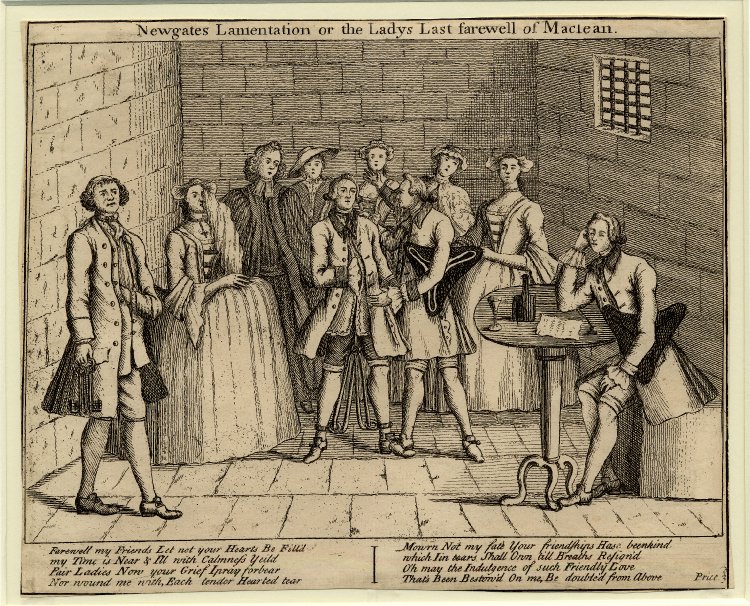
Gentleman highwayman James MacLaine hanged at Tyburn on this date in 1750.

The debauched son of a Presbyterian minister, MacLaine wasted first an inheritance and later a dowry on expensive clothes, gambling, and ladies of easy virtue; want, however, was his ticket to the immortality of the gallows when he joined fellow penniless gentleman William Plunkett to seek his revenue on the roads. (Inspiring the 1999 film Plunkett & Macleane — which uses one of several alternate spellings available for our man’s surname.)

For several months in 1749-1750 they prowled the environs of a lawless London, and notably Hyde Park, with the exaggerated courtesy demanded by romance of their profession. They found noteworthy prey: once, they stole a blunderbuss from the Earl of Eglington, though Eglington survived to suffer a noteworthy murder years later; in November 1749, they robbed M.P. Horace Walpole, even skimming his face with a pistol-ball that was inches wide from depriving posterity of the gothic novel.*

When caught** by mischance, the mannered† Maclaine became the object of public celebration, much to the bemusement of Walpole — who professed no ill will for his assailant but wondered that “there are as many prints and pamphlets about him as about the earthquake.”

Three thousand people are reported to have turned up on a sweltering summer Sunday to pay their admiration to the rogue, not excluding the very cream of society. Walpole teased his friends, court beauty Lady Caroline Fitzroy (wife of the Earl of Harrington) and her sidekick Miss Elizabeth Ashe, for presenting themselves among these masses to starfuck this latter-day Duval. “I call them Polly and Lucy,” he wrote, alluding to female conquests of the outlaw Macheath in The Beggar’s Opera, “and asked them if he did not sing,”

Thus I stand like the Turk with his doxies around.

Maclaine did not have to borrow Macheath’s ballads, for he was celebrated with verse dedicated all to him — like this “Jemmie Maclaine”, to the tune of Derry Down:

Ye Smarts and ye Jemmies, ye Ramillie Beaux,
With golden cocked hats, and with silver laced clothes,
Who by wit and invention your pockets maintain,
Come pity the fate of poor Jemmy Maclaine,

Derry down derry, etc.

He robb’d folks genteely, he robb’d with an air,
He robb’d them so well that he always took care
My lord was not hurt and my Lady not frighted,
And instead of being hanged he deserved to be knighted!

Derry down derry, etc.

William Hogarth‘s 1751 print cycle The Four Stages of Cruelty, one skeleton overseeing the operating theater where a hanged criminal is dissected is subtly labeled — Macleane.

* Walpole once remarked of the ubiquity of violent crime in London that “one is forced to travel, even at noon, as if one was going to battle.”

** Plunkett was never apprehended; it’s alleged that he ultimately escaped to North America.

† Although our man “has been called the gentleman highwayman,” the player-hating Ordinary of Newgate wrote, “and his dress and equipage very much affected the fine gentleman, yet to a man acquainted with good breeding, that can distinguish it from impudence and affectation, there was little in his address or behaviour, that could entitle him to that character.”

On this day..

1850: Henry Leander Foote, sex crazed

On this date in 1850, Henry Leander Foote was hanged in Connecticut.

Foote was an educated man who used his time languishing in jail — there was nearly a full year between his conviction and his execution — to bestow upon the world an autobiographical narrative of his peregrinations, which the reader can peruse in its entirety at the bottom of this post. Affected with wanderlust, he struck out from home as a teenager and began a rambling career that would take him all over America.

One of his first stops was the bustling and burgeoning metropolis that will become the hub of his narrative and, as Foote conceived it, the source of his ruin — New York city. There he was introduced to the city’s vast sexual marketplace.

At the end of two or three weeks, I found myself in the city of New York. What a place for a stranger, a young man of seventeen or eighteen years of age to visit alone, without any guardian to conduct him or advise him, and warn him against evil company! I had no acquaintances except three or four young men, whom I met on board the boat, who were also from Connecticut. They were in company, all belonging to one town, and then invited me to stop at the same public house with them. I had been informed that one of them was the son of a minister of the gospel, consequently I concluded that the company was good and safe to be with. But I found, to my astonishment, that this young man was the ring leader, the rudest and wildest of the crowd. The first night I was led to the Theater, from there to the brothel, and from there to the gambling house and drinking saloon. Here we must be fashionable and have a game of cards and a bottle or two of champane. [sic] … We played and drank till sometime past midnight, when we concluded it was time to retire.

Foote is coy here and suggests that his virginal young self repelled the subsequent invitation to a brothel. Whether or not this is so, he soon became by furtive subsequent visits whose purpose he was careful to conceal from his family an intimate of the city’s many whores.

These youthsome frolics are only foreshadowing for the excuses that Foote would be obliged to make many years later in the pall of the gallows. He spent the 1830s and 1840s bouncing around the growing republic — upstate New York, westward to Cleveland and St. Louis, south to Charleston where he married but lost his wife within a year to childbirth. (The son died, too.) After that, he enlisted in the cavalry and fought in the Seminole Wars.

Foote does not give us much of his sexual adventures on these trips, but between the lines it appears that the concupiscient fornicator and the New England prude ever travel side by side with him. He ships to Rio de Janeiro and does not fail to notice that “the dress of most of the women was not much better than none, being merely a short gown, all open in the neck and breast, and reaching only half way to the knee, fastened round the waist with a belt. They would make any civilized man blush from head to foot, but they were not at all particular as to what position they happened to be in.” Nevertheless, he affects shock when “a mixed-blood, half Spanish and half Indian publican” offers him a girl for the night. (According to Foote, he did not take the girl.)

As for the army, well, it “is a most dangerous and destructive place to the morals of young men. It is a school of intemperance, profanity, licentiousness, obscene language, filthy communications, and all kinds of vile and lewd company” thanks to the degrading example of officers who “when at home, or where they are known, always assume the character of gentlemen, and presume to walk in respectable society, unite with the ‘upper ten,’ and [associate] with virtuous females, who, if they knew their true character, would turn from them with disgust.”

By 1849 we find the peripatetic Foote back in his native hamlet of Northford, Connecticut, 37 years old and again, or still, preoccupying himself with the diversions of the Tenderloin. To the best of my knowledge he is the subject of no biography save his own, and since we find that the diverse sojourns of the previous 20 years have ultimately changed neither his conduct nor even his locale, we might be excused for speculating how many adventures were contrived by the author’s hand.

Wherever it was that he had been, he was becoming a worldly denizen of the bagnio.

A few months before the murder, I spent one week in the city of crime and pollution, viz., New York. As usual on former occasions, I spent my evenings and nights in a theater, gambling house, or brothel. Also on a former visit I had attended an exhibition of nudes, or model artists, as they are termed. But at this time the company had gone to New Orleans; a few of them, however, remained in New York, with one of which I had the misfortune to become acquainted. She was an arrogant prostitute, residing in a house of the higher class. I found her at the Bowery Theater; she enticed me, and I consented to accompany her home. As we entered her room she locked the door, laid aside her upper garments, and invited me to take a glass of wine with her. She poured out two glasses, and took a phial from the drawer of her toilet, drew the cork, and pretended to drop some of the contents in her glass of wine, but not a drop did she let fall. She said it was Cream of the Valley, it would give the wine a delightful flavor, and then made a motion to drop some into my glass. But I was too wide awake for her. I knew it was some drug that might upset my ideas, so I told her to save her cream, I did not need any cream of that sort. She looked at me, and said, “you are not so green as you pretend. I gues syou understand a game or two.” I replied, “I understand enough to know the nature of your cream.” And said I, “what was your object in giving it to me?” “O,” she replied, “I was only going to give you a drop or two, to make you feel keen.” She was very proud of her perfect symmetry of form, and proceeded to make a model artist of herself again, that she might give me a clear view of her model, and also of the extra manoeuvres which she had learned in the model artist plays.

After passing the night with his model artist’s “extra manoeuvres,” Foote pinched the potion for himself thinking to deploy it for his own benefit. He first called on a prostitute who had previously robbed him, engaged her charms for the night, and administered the drug to her, thereby having leisure to rob back the lost funds (“with interest,” Foote admits) as well as to leave behind a taunting note. He also found that she, too, possessed a dose of this potent Cream of the Valley, and duly replenished his supply.

Our dissolute principal was much given to exploiting his moment of notoriety for moral grandstanding, and we again should treat his account with caution.* Another author who visited Foote and published his observations in a pamphlet titled Death Cell Scenes, Or, Notes, Sketches and Momorandums of the Last Sixteen Days and Last Night of Henry Leander Foote is by no means hostile to his subject but often notices his unbecoming worldly preoccupations when he ought to be attending his imminent death with due gravity: he “showed a singular disposition to make money even at the hazard of his soul” by cranking out paintings to sell to the gawkers come to gape at him through the prison-bars and on one occasion arrives only to be brushed off as Foote is “in the height of glory and ambition, vending pamphlets and pictures to persons surrounding his cell with as much gusto as though he had to live twenty years or more!”

He was a doomed man with a keen sense of his audience; Foote even took the trouble to pre-order his own inscribed marble tombstone. (The stone can still be seen at Northford Old Cemetery in New Haven.)

He had a gift for rationalizing and segmenting his hypocrisies, surely honed by his years alternating Puritan piety with opportunistic harlotry. At the end when it could no longer be denied, he surfaced the contradiction by way of attenuating his own guilt.

“By this and other means, the hags who keep brothels contrive to get many of their recruits,” Foote wrote of the drugs like Cream of the Valley — subtly conflating his own loss of self-control with white slavery. “And if an inexperienced young man allows himself to visit their houses once, perhaps for mere curiosity, when he is not aware of any danger, they will bewitch him in some way that will induce him to come again; and so he will continue to go until his ruin is completed. Beware, young man, and shun all such places! Once in, you insensibly lose self-command. It is not easy to resist such temptations when once poisoned. These female Satans use the very arts of old Satan himself, and some that he does not use. Once in their power, you are not your own keeper.”

Not your own keeper — even as he admits and bewails his own crime, Foote wants to convey to posterity the notion of a Jekyll-and-Hyde: that there is a Foote distinct from the murderer.

Back at Northford, “my thoughts were continually revolving upon the obscene views which I had witnessed in New York, particularly upon the model artist female … I seemed to have a bewitching anxiety to see the same again, or to see something of the same kind, and this base desire I could not overcome. A curiosity to see and examine some female in the same state of nudity was constantly haunting my mind.”

Although he’s taken the care to secret the prostitutes’ powerful draught in his trunk, it is not quite he who addresses himself to the “bewitching anxiety”: he gets drunk, and then “Satan himself was certainly busy with me, driving me on to ruin with all his power … [using] me as an instrument for the destruction of innocent life.” At length, “Satan” suggests him his young cousin Emily as the object to satisfy his base desire. Foote intercepted her on the way to school and, he said, lured her into the woods to snack on some tomatoes which he had dosed with the sleeping potion after which, you know, stuff happened. For a guy who carried out a premeditated plan to incapacitate and molest his underage kin, he sure expected to be given a lot of latitude.**

But with shame! shame! do I write it, I now proceeded to examine her person, which inflamed my baser passion to an unmanageable degree; and after my eyes were satisfied, I violated and robbed her of her virgin purity. She gave no signs of feeling except to draw one deep sigh. My brutish passion was now satisfied. I meditated upon what I had done, the criminal nature of the awfully wicked deed, the meanness of the act itself, and the base stratagem which I had employed to gratify my shameful curiosity. In the first place I had no intention of doing any thing more than to satisfy my eyes; but this created a passion so strong as to overrule all better feelings, honor, and decency. I stood over the wreck of beauty, innocence, and purity, and sincerely wished I had never seen the city of New York, or any of its bewitching female satans … my head was wild, and my heart felt as if it had turned into a great stone. I would have given half of the town had I possessed it, if I could have undone what I had done that morning. But that was impossible.

And having come this far, Foote realized if he should allow her to revive and be on her way, her story would send him to prison. “As if I almost heard an audible voice,” “something” suggested to him that he murder her. Foote floridly describes himself alternately resisting and impelled to the idea until “I acceeded [sic] to the horrible proposal, and Satan used me as an insensible instrument for his nefarious, bloody, and soul-destroying purpose.” Then Satan used him to slash Emily’s neck through the windpipe.

It’s a bit difficult to disentangle the actual or purported sequence of steps to the next murder; Foote writes of it as if he was hurled into despair by his crime and only paused from his intention of suicide to murder his mother when he reflected that the incestuous rape-murder imputed him might destroy her after he was gone. We get a somewhat different picture from the period’s newspaper accounts which suggest that he was no suspect at all when Emily first turned up missing and coolly played it as if shocked, before getting drunk and bashing mom’s head with a hammer. If you liked his story about how Satan made him rape Emily, you’ll love this.

I drank several times during the forepart of the afternoon, and about three o’clock I went to get another drunk, but the jug was missing — my mother had hid it, and it was not to be found by me. This enraged me … if she had let the liquor alone, it is possible, and not improbable, that I would have drank so much as to render me incapable of making any attempt upon her life; and thereby she might have escaped entirely. But she was often very unwise in provoking me, especially when I had liquor in my head. It was a wrong way to deal with me, to take liquor from me to prevent my drinking, for I was generally sure to go and get a larger quantity and drink so much the more. But she has many times done it, and thereby caused me to behave much worse than I should otherwise have done. Late years my mother has been very petulant towards me; whether I had been drinking or not, it seemed to be about the same. This I attributed to trouble, and the influence of opium, which induced her to pack the faults of others upon me, charge me with things of which I was entirely innocent, and find fault with me when I was not in the least to blame; and to complain of things which I knew were right.

Foote insists that he tells us all this not “for the purpose of defending or screening myself from any blame” from the matricide he committed for mom’s own benefit. Just wanted to contribute to the historical record. And then he has the chutzpah to accuse a neighbor who came running to the battered woman’s shrieks of being a big old pussy for backing away and yelling for help when threatened with the bloody hammer. This is a man who required a more forceful minister, a good psychiatrist, or a better P.R. team. Even to the last, the killer’s self-awareness only amounted to his own narcissism.

“The last act of Foote in his cell,” writes the hanged man’s companion in Death Cell Scenes, “was to make use of a quantity of mus on his hair, six cents worth of which he had ordered the night previous, besides ‘two pleasant Spanish cigars.'”

* As pertains the potion specifically, Foote cites (and perhaps may be suspected of borrowing from) the story of temperance moralizer John Bartholomew Gough, who disappeared in New York for a week in 1845 and was discovered in a whorehouse, floating in an opiate daze.

** There was a witness who heard a scream, presumably by Emily. Foote’s account essentially renders the attack “non-violent” (he says, as if to complete his travesty of Eden, that at one point she shrieked when she caught sight of a snake). It really is entirely possible that he simply perpetrated an uncomplicated wilderness rape and subsequently concocted every other convenient detail. (“No intention of doing any thing more than to satisfy my eyes” indeed.)

On this day..

1970: Hilmar “Henry Stutzbach” Swinka

East Germany executed sociopath Hilmar Swinka* on this date in 1970 for three murders in Berlin.

Swinka’s trial and execution were conducted in great secrecy — the Communist bloc being oft lothe to acknowledge such bourgeois monsters as serial sex-killers. Hans Girod describes him in his German-language study of DDR criminals, Blutspuren (Bloodstains), using the pseudonym Henry Stutzbach.

Swinka/Stutzbach wasn’t the type where you say nobody could have seen it coming.

A disaffected loner abandoned by his violent father, he dropped out of his apprenticeship and rotated unskilled jobs through his twenties while passing his time with pugilism of both the sweet science and the barroom brawl varieties.

His last job, as an assistant at a pathology institute, creepily set up his crimes — where he made a nauseating mockery of dissection by strangling and then carving open two ex-lovers on February 13, 1969. The next day, Swinka honored St. Valentine by doing the same thing to his lawfully wedded wife.

Swinka was shot at a secret execution facility in Leipzig, by Hermann Lorenz — East Germany’s last executioner.


There’s a truncated version of this documentary about the Leipzig death chambers here.

* The surname means pig in Slavic languages.

On this day..

1567: The Michelade of Nimes

On this date in 1567, Huguenots in revolt in Nimes put to death dozens of Catholics in a courtyard butchery to climax a massacre remembered as La Michelade (English Wikipedia entry | the much more detailed French)

This name of sinister memory derives from one of the church calendar’s great autumnal feast, Michaelmas — and the sword-arm of its titular archangel would have been required to keep the peace between the rival religionists in the Languedoc.

Nimes went heavily for the Protestants, with the region’s royal governors unable to restrain the conquest of Catholic neighborhoods and churches by the predominant Huguenots through the 1560s: “the very wind which blew upon Nimes breathed heresy,” in the words of Dumas.

The years running up to our events of 1567 feature one of the numerous rancorous truces pocking France’s intractable Wars of Religion: this one is known as the “Armed Peace”, which gives you an idea where everyone’s heads were at. And in Nimes, the heresy in the wind was not such as to prevent the restoration of Catholic authorities to control of the civic institutions — to the undoubted irritation of the Huguenot grandees who endured the indignity of displacement alongside the sure knowledge of the popular weight that supported them.

This ripening conflict appropriately came to fruition via a vegetable market at a city fair on Michaelmas — September 29, 1567 — where an altercation turned into a sectarian riot and soon transformed into a municipal Protestant insurrection.

Huguenots still maintaining the preponderance of force in Nimes, they perpetrated the expected outrages during the excitement: sacking the cathedral, murdering some particularly hated Catholics. But the overall organization of the Huguenots and the organized participation of the city’s Huguenot elites suggests a good deal of advance orchestration, and perhaps coordination with the Huguenot attempt to kidnap the king just days before.

In the disturbance, Nimes’s first consul Guy Rochette — Catholic, naturally — sought refuge in the palace of Bishop Bernard d’Elbene; a Huguenot captain forced the door and arrested them, confiscating from Rochette the keys to the city. Though the bishop managed to escape, other prominent Catholics were systematically detained, too. According to Allan Tulchin’s That Men Would Praise the Lord: The Triumph of Protestantism in Nimes, 1530-1570, “[i]t seems clear that the Protestant leadership intended to conduct a general roundup of Catholic lay and clerical leadership. Protestant forces targeted at least half of the sixteen men who had served as consul between 1564 and 1567 … of the nine Catholic members of the presidial, only two did not appear among the victims.”

Captive Catholics were detained in several buildings around the city, notably in the city hall. It is not known to what extent the kill lists to cull from these unfortunates were preordained and to what extent they were improvised in the moment, but on the night of September 30, summons for specific victims went out, and Protestant squads complied by dragging them out of the city hall basement or wherever else they were held to the courtyard of the bishop’s palace. This would be the makeshift abattoir.

In the narration of Dumas,

when night came the large number of prisoners so imprudently taken began to be felt as an encumbrance by the insurgent chiefs, who therefore resolved to take advantage of the darkness to get rid of them without causing too much excitement in the city. They were therefore gathered together from the various houses in which they had been confined, and were brought to a large hall in the Hotel de Ville, capable of containing from four to five hundred persons, and which was soon full. An irregular tribunal arrogating to itself powers of life and death was formed, and a clerk was appointed to register its decrees. A list of all the prisoners was given him, a cross placed before a name indicating that its bearer was condemned to death, and, list in hand, he went from group to group calling out the names distinguished by the fatal sign. Those thus sorted out were then conducted to a spot which had been chosen beforehand as the place of execution.

This was the palace courtyard in the middle of which yawned a well twenty-four feet in circumference and fifty deep. The fanatics thus found a grave ready-digged as it were to their hand, and to save time, made use of it.

The unfortunate Catholics, led thither in groups, were either stabbed with daggers or mutilated with axes, and the bodies thrown down the well. Guy-Rochette was one of the first to be dragged up. For himself he asked neither mercy nor favour, but he begged that the life of his young brother might be spared, whose only crime was the bond of blood which united them; but the assassins, paying no heed to his prayers, struck down both man and boy and flung them into the well. The corpse of the vicar-general, who had been killed the day before, was in its turn dragged thither by a rope and added to the others. All night the massacre went on, the crimsoned water rising in the well as corpse after corpse was thrown in, till, at break of day, it overflowed, one hundred and twenty bodies being then hidden in its depths.

Dumas is indulging poetic exaggeration of the scene, and later estimations of the number of victims range well below 120 — but Tulchin quotes a leather worker who saw the courtyard on the following day and described it as “all covered with blood and the water of the well all red.” Even “merely” twenty or thirty victims slashed to death would have been a gory work.

In the days following, Huguenots would cement their control of Nimes with the systematic pillage of churches and (after a six-week siege) the capture of the city’s royal garrison. There was no general massacre after the Michelade; in the main, Catholics were forced into submission or exile instead of the grave.

But the effusion, combined with Huguenot attacks further north, helped to trigger the (very brief) “Second War” within the Wars of Religion which gave way after a short truce to the much bloodier “Third War” of 1568-1570 … whose peace would be broken by a Catholic sectarian massacre much better remembered to history than the Michelade.

On this day..

1891: Ed Leeper and James Powell

The Ballad of Leeper and Powell

Come all my friends and near relations;
Come and listen unto me.
I will sing about two men,
About two men that’s to be hung.

‘Twas on the eighteenth night of December,
In eighteen hundred ninety-five,*
‘Twas the night they did the murder
For which they had to give their lives.

One says, “Father and dear mother,
Won’t you both remember me,
When I’m dead and gone forever,
And my face no more you’ll see?”

“We were held long in this prison —
No one came to go our bail** —
God will aid and assist us
Now to break the Gatesville jail.”

And when started from that prison
And the guards surrounded them —
“I must die and I’m not guilty,”†
‘Twas the answer Jim made then.

Ed was tall and fair complected;
Jim was low and very neat.
They were pale and very silent,
And their lips did seem to meet.

One says, “Lord, oh, do have mercy
On those who swore my life away.”
They tied their wrists and their ankles,
Placed black caps upon their heads.

The trapdoor fell and left them hanging,
Between the earth and the sky.
It was for a dreadful murder
These two men were made to die.

They’s cut down, placed in their coffins,
Delivered over to their friends,
Who were there for that purpose,
To receive them at their end.

Come all young men, now take warning;
Live, oh, live a sober life.

* The crime(s) for which Leeper and Powell hanged actually occurred on the evening of December 17, in 1889. Two armed outlaws waylaid some farmers returning to the country after they sold their cotton in Gatesville; a J.T. Mathis was mortally wounded in the resulting firefights, lingering until December 18 before he finally succumbed. (Another man named W.H.H. Harvey was wounded, but survived.)

** Actually, Ed Leeper’s mother was a prosperous Tennessee matron who spent liberally on her son’s defense; the men’s appeals, even challenging the legality of the entire Texas penal code, went all the way to the U.S. Supreme Court — quite unusual for the time. But it is correct that they did not have bail: the enormity of the crime, and the fear of inviting a lynch mob, saw them behind bars and under heavy guard from the time of their arrest hours after the robbery.

This is not to say that Mrs. Leeper’s efforts were wholly without effect:

Newspaper article describing the death of a prosecuting attorney who was injured returning by train from Austin 'on the Leeper and Powell business'.
From the Dallas Morning News, September 30, 1891.

† Since the attack took place under cover of darkness, nobody could positively identify the assailants. Leeper and Powell, well-known local ruffians, were suspected at once and the suspicion appeared circumstantially supported.

Both men did continue to assert their innocence on the scaffold: “I die innocent and I die game for the crime of some one else,” in Powell’s words. (Dallas Morning News, September 30, 1891)

On this day..

1620: Sidonia von Borcke, the sorceress

On this date in 1620, Sidonia von Borcke was beheaded and then immolated in Stettin (Szczecin) — one of the most notorious witch executions in German history.

The Pre-Raphaelites quite fancied the Sidonia story: this is Edward Burne-Jones‘s 1860 watercolor Sidonia von Bork.

This Pomeranian noblewoman (English Wikipedia entry | German), aging and penniless, resided from 1604 in a Lutheran Stift, a secular convent for unmarried ladies. There she busied herself and the courts of the Holy Roman Empire with numerous lawsuits against the convent’s prioresses, other women in the cloister, and inheritance disputes with members of her family.

According to Gerda Riedl’s “‘Alles von rechts wegen!’ Frühneuzeitliches Hexenprozeß-(un-)wesen am Beispiel des Falles der Sidonia von Borcke” in Hexen: Historische FaktizitƤt und fiktive Bildlichkeit, the frayed nerves around Sidonia finally snapped at a church service where she and the sub-prioress got into an altercation and were both arrested.

It was July of 1619. Sidonia von Borcke was a cranky 71-year-old spinster with a knack for making enemies. And then the sub-prioress accused her of witchcraft.

The ordeals of the next year occupy over a thousand pages in the archives. A wandering fortune-teller named Wolde Albrechts was slated with channeling the infernal powers for Sidonia: when put to torture, that poor creature soon admitted all, complete with the obliging accusation of Sidonia.

Wolde Albrechts went to the stake on October 9, 1619. By December, 72 impressive charges were preferred against Sidonia von Borcke, by now transferred from confinement in her abbey (where she had attempted suicide) to the public prison. These included the murder by sorcery of every consequential person who had died in her vicinity in recent memory, from the previous prioress all the way up to the Duke of Pomerania, whose childless death at the tender age of 44 the previous year had thrown the political situation in Pomerania into confusion.* (Not to mention sexual contact with her loyal kitty Chim, in the latter’s guise as demonic familiar.)

Her ashes were barely cold when Sidonia passed into folklore and thence to legend, eventually to be seized and considerably embellished by Gothic poets in the 18th century. Her countryman Wilhelm Meinhold‘s Sidonia von Bork, die Klosterhexe situates her as a beautiful young woman balked of her dynastic marriages who goes on a midlife jag as a picaresque outlaw before repairing in her dotage to the abbey heavy with grievances. English translations of it were wildly popular, including one rendered by Oscar Wilde‘s mum.

* Succession started passing to the late duke’s brothers, and the Harry Potter-esque House of Griffin which had ruled Pomerania back to the 12th century was done by 1637. Their destruction juxtaposed to Sidonia’s own would help cement the latter’s immortality.

On this day..

1965: Kenneth Roraback and Rocky Versace, Vietnam War POWs

According to a UPI wire story from Saigon which ran in American newspapers beginning Monday, September 27,

The Viet Cong said they executed two American prisoners Sunday … Although the broadcast did not say so, the executions apparently were in retaliation for the deaths Thursday of three anti-American demonstrators. The demonstrators were convicted by a military tribunal of engaging in terrorist activities and put before a firing squad in a soccer stadium at Da Nang.

An earlier execution of a Viet Cong terrorist by the government June 24 brought an announcement from the Communists that they had executed Sgt. Harold G. Bennet[t], a captive from Arkansas.

The two men shot on September 26 — whose names are garbled in the initial news report, since “the names were received phonetically” — were Sgt. Kenneth Mills Roraback and Capt. Humbert Roque “Rocky” Versace.

In 2002, Versace would be posthumously awarded the Congressional Medal of Honor — the first Vietnam War soldier so decorated on grounds of unwavering defiance as a POW.

On this day..