1999: Zarmeena

On this date in 1999,* a burka-clad woman known only as Zarmeena (alternatively, Zarmina … or in some early reports, Zareena) was executed by gunshot in Kabul’s Ghazi Sports Stadium.

This first public execution of a woman under the Taliban — ordered because she had supposedly killed her husband** — was secretly filmed by a Revolutionary Association of the Woman of Afghanistan activist smuggling a camera under her own burka.

Caution: This video is (in)famous enough, thanks to its inclusion in the documentary Beneath the Veil, that you’ve probably already seen it. But it’s still a graphic image of a woman shot through the head at point-blank range. (From around 2:20)

The book With All Our Strength: The Revolutionary Association of the Women of Afghanistan expands somewhat on RAWA’s calculations on this occasion, on the young activist who pulled off the risky filming, and on the purportedly hostile-to-the-Taliban crowd reaction.

* Some web resources give Nov. 17 as the date, but all the (admittedly limited) primary documentation available appears to me to point definitively to Nov. 16. RAWA, which shot the video, posts it with this date; wire copy that ran in western papers on Nov. 16 (here) and Nov. 17 (here) attributed the execution to Nov. 16.

** It’s not clear to me how dependable the information about the executee is; it’s said that she had been in prison well over a year but was rather suddenly executed for the Taliban’s exigent reasons of public intimidation. It’s also said that her husband’s family forgave her — which, under sharia as practiced by, e.g., Saudi Arabia, ought to have spared her life — and that Zarmeena herself may not have understood or believed that she was actually going to be executed until the very last moment.

On this day..

1808: Sultan Mustafa IV, by his brother

On this date in 1808, the former, and now deposed, Ottoman Sultan Mustafa IV was strangled at the command of his successor and brother.

The Ottoman Empire, once the very terror of western Christendom, entered the 19th century in a stagnation that had it well on its way to its way to “sick man of Europe” status.

Its fate would be defined by the political — and sometimes literal — battle between its entrenched interests and forward-looking reformers who struggled to restructure the empire for the challenges that lay ahead.

And at this point, it wasn’t only the Ottoman polity that had to fret for its survival. Its very namesake dynasty was in danger of extinguishing itself. There hadn’t been a male born to the House of Osman in twenty years, and in the events herein narrated, internecine conflict would winnow the Osmans down to their very last man.

Aggressive Progressive

Reform was the project of our principal’s predecessor, Selim. In the years around the turn of the century, Selim endeavored to get Turkey out of its wasteful foreign conflicts to gain maneuvering room for more urgent domestic projects.*

Chief among the many oxes Selim proposed to gore were the Janissaries, the Ottomans’ powerful and increasingly archaic military elite, much given to destructive use of their martial prowess in various factional conflicts within the Empire.

Possessive Regressive

The Janissaries deposed Selim in 1807, elevating his cousin — our man, Mustafa, a mere handmaiden of the hidebound. (His contemporaries in Europe more commonly transliterated the name “Mustapha”)

They didn’t kill Selim … just left him alive within the palace where armed men could find him in a pinch.

That pinch arrived in June in the form of Mustafa Bayrakdar, a reformist official who marched on Istanbul to overthrow the reactionary elements. As Bayrakdar took the city in hand, Mustafa desperately ordered the executions of Selim and of Mustafa’s own brother, Mahmud.

Selim was disposed of. Mahmud got tipped off, and the servants — most famously, a Georgian harem girl named Cevri Kalfa — helped him escape to the roof. Mustafa Bayrakdar ousted the ousters before anyone who meant Mahmud ill could find him.

Impressive Successive

That left Mahmud the only choice for Sultan, and he followed his brother’s own questionable policy of consanguinary clemency. Mustafa’s demotion back to crown prince after having once ordered the now-sultan’s death must have made for some awkward chit-chat around the family table.

It didn’t last long. The London Times of January 16, 1809 reported** that

[o]n the 14th of November, at day-break, the Janissaries were seen assembling from all quarters, and being reinforced by those who were in the vicinity of Constantinople, they … massacred all the partisans of the Grand Vizier that came in their way. The contest spread to eveyr street in Constantinople … On the 15th, the Janissaries assaulted the high walls of the Seraglio; and it was at this moment that the Grand Vizier, after causing the unfortunate Mustapha IV, who was a prisoner there, to be strangled, blew himself up in his own Palace with gunpowder, of which he purposely provided a large quantity before-hand, to prevent his falling alive into the hands of his enemies.

Sauce for the goose was sauce for Mustafa, and on this same desperate day when he lost Bayrakdar to a vault of gunpowder, Mahmud had his brother put to death. This maneuver left Mahmud the last surviving male Osman.

Passive Aggressive?

The legacies of this date were varied and ambiguous.

Mahmud II remained on the Ottoman throne for the next three decades, ample time to secure the Osman line.

The Janissaries returned to their barracks, chastened; Mahmud would destroy them after an attempted revolt in 1826.

But Mahmud too was chastened by the experience — or else, too encumbered by the apparatus of the state, or too cautious of his legacy before that heir appeared (it took years), or simply too unskillful — and his reformist vision proceeded haltingly until the very end of his life, even as breakaway nations continued to erode the Porte’s influence.

In his The Decline and Fall of the Ottoman Empire, Alan Palmer says of Mahmud,

Over a century and a half after his death, Mahmud II remains the most puzzling of the thirty-six Ottoman Sultans … Was he a despot or a reformer, a capricious betrayer of trust or a dedicated ruler of a vision, a muddler who plunged into disastrous wars or a shrewd statesman who preserved his Empire from rapacious neighbors? Should we think of him as the ‘Infidel Sultan’ who imposed European ways on the Islamic faithful, or as Mahmud Adli (‘Mahmud the Just’), like Turks today? The contrasts seem endless. Mahmud is one of history’s most enigmatic figures …

* Selim was sucked back into armed conflict by the Napoleonic wars.

** Though two months after the fact, the report is in media res, since it was transcribing German papers from mail dispatched out of the Ottoman capital on Nov. 16 when “the utmost confusion still prevailed there.”

On this day..

1963: Four Cubans as CIA spies

On this date in 1963, the Cuban government shot four of its citizens as “counterrevolutionaries” and CIA spies — capping a week that had seen 13 such executions in all at Havana’s Cabana Fortress.

This date’s batch consisted of (per the Nov. 15, 1963 New York Times) Argimiro Fonseca Fernandez, Wilfredo Alfonso Ibanez, Israel Rodriguez Lima and Erasmo Machin Garcia; they were supposed to have scouted spots around the island for a potential landing of invading exiles. For some reason, Cuba was paranoid about the possibility.

Four others — Antonio Cobelas Rodriguez, Orlando Sanchez Saraza, Juan M. Milian Rodriguez and Jose S. Bolanos Morales, according to the Nov. 13 New York Times — had been shot on Nov. 12 for similar crimes; they had supposedly attempted to make an armed landing on a boat out of Florida. Five others (whose names I have not located) were reported executed on Nov. 8.

On this day..

1676: Col. Thomas Hansford, the first American independence martyr

Col. Thomas Hansford was hanged “a loyal subject and a lover of my country” on this date in 1676 — America’s first executed political martyr, since that “country” was not England, but Virginia.

Robert Beverly‘s 1705 History of Virginia recalls the genesis of that milestone dispute between settlers and mother England.

The occasion of this rebellion is not easy to be discovered: but ’tis certain there were many things that concurred towards it. For it cannot be imagined, that upon the instigation of two or three traders only, who aimed at a monopoly of the Indian trade, as some pretend to say, the whole country would have fallen into so much distraction; in which people did not only hazard their necks by rebellion, but endeavored to ruin a governor, whom they all entirely loved, and had unanimously chosen; a gentleman who had devoted his whole life and estate to the service of the country, and against whom in thirty-five years experience there had never been one single complaint. Neither can it be supposed, that upon so slight grounds, they would make choice of a leader they hardly knew, to oppose a gentleman that had been so long and so deservedly the darling of the people. So that in all probability there was something else in the wind, without which the body of the country had never been engaged in that insurrection.

Four things may be reckoned to have been the main ingredients towards this intestine commotion, viz., First, The extreme low price of tobacco, and the ill usage of the planters in the exchange of goods for it, which the country, with all their earnest endeavors, could not remedy. Secondly, The splitting the colony into proprieties, contrary to the original charters; and the extravagant taxes they were forced to undergo, to relieve themselves from those grants. Thirdly, The heavy restraints and burdens laid upon their trade by act of Parliament in England. Fourthly, The disturbance given by the Indians.

Tobacco aside, these are grievances straight from the next century’s Declaration of Independence at the outset of the (more successful) American Revolution:

cutting off our Trade with all parts of the world:

… imposing Taxes on us without our Consent:

endeavoured to bring on the inhabitants of our frontiers, the merciless Indian Savages whose known rule of warfare, is an undistinguished destruction of all ages, sexes and conditions.

So, tax revolt + political self-determination + impatience about arrangements with Indians who could be wiped out instead. Eventually, this would germinate a mighty empire.

In 1676, it germinated a colonial rebellion against the mighty empire — Bacon’s Rebellion, an unsuccessful rising that is easily read in retrospect as a prototype for the more illustrious revolt one century later.

The suppression of Bacon’s Rebellion also involved a rash of executions, which we’ve touched on before. King Charles II would complain that his Virginia governor’s severity “has taken more lives in that naked country than I have taken for the murder of my father.”

The man dignified to be the first of these executions — and therefore, if you like, the first man put to death in the service of American liberty — was actually nabbed by our historian’s father, also named Robert Beverly, “a parson calculated to the Lattitude of the Servis, which required descretion, Curage, & Celerity, as qualetys wholly subservant to military affares.” (source)

snapt up one Coll: Hansford, and his party … It is saide that Hansford, at (or a little before) the onslaut, had forsaken the Capitole of Marss, to pay his oblations in the Temple of Venus; which made him the easere preay to his enemies; but this I have onely upon report, and must not aver it upon my historicall reputation: But if it was soe, it was the last Sacryfize he ever after offered at the Shrine of that Luxurious Diety, for presently after that he came to Accomack, he had the ill luck to be the first Berginian borne that dyed upon a paire of Gallows. When that he came to the place of Execution (which was about a Mile removed from his prisson) he seemed very well resalved to undergo the utmost mallize of his not over kinde Destinie, onely Complaineing of the manner of his death: Being observed neather at the time of his tryall (which was by a Court Martiall) nor afterwards, to suplicate any other faviour, then that he might be shot like a Soulder, and not to be hang’d like a Dog. But it was tould him, that whwat he so passionately petitioned for could not be granted, in that he was not condem’d as he was merely a Soulder, but as a Rebell, taken in Arms against the King, whose Laws had ordained him that death. Dureing the short time he had to live, after his sentance, he approved to his best advantage for the well fare of his soule, by repentance and contrition for all his Sinns, in generall, excepting his Rebelellion, which he would not acknowledg; desireing the People, at the place of execution, to take notis that he dyed a Loyall Subject, and a lover of his Countrey; and that he had never taken up arms, but for the destruction of the Indians, who had murthered so many Christians.

(A modernized, and less atmospheric, version of the same passage can be read here.)

Hansford’s story and the larger one of Bacon’s Rebellion are treated at second hand in several public-domain histories available online — see here, here, and here.

It also seems that, besides being the first martyr to American liberty, Hansford also had the distinction of being the first native-born Virginian (white Virginian, we presume) ever executed.

On this day..

1977: Atnafu Abate, Mengistu’s last rival

On this date in 1977,* Ethiopian dictator Mengistu Haile Mariam eliminated one of his last political rivals with the execution of Atnafu Abate.

The men’s relationship had long been complex and unclear; Abate backed the Derg’s “Black Saturday” mass executions in 1974, and sometimes lined up as Mengistu’s ally over the succeeding years as part of the Derg military junta.

At the same time, there were rumors that things between Mengistu and Atnafu were so tense that they pulled guns at meetings.

Atnafu’s absence (by accident or design) during an early 1977 purge within the Derg left the conservative and Orthodox Atnafu officially second-in-command, and unofficially the last real or potential rival to Mengistu.

His elimination was widely expected, though exactly why it went down, when it went down has never been transparent. Mengistu’s grip on the country was already secure enough to have launched the Red Terror.

The New York Times‘ Nov. 15 report of this development captures a bit of the Alice-in-Wonderland political logic evidently at work.

The Ethiopian press agency, which made the announcement, also released what amounted to a six-page indictment listing “twelve specific antirevolutionary crimes,” and “five specific arch-reactionary stands” attributed to Colonel Atnafu, who had served as vice chairman of the provisional military administrative council.

The statement charged Colonel Atnafu with opposing “proclamations intensifying the revolution,” manifesting “a feudal arrogance while on visits to various provinces,” and consorting after working hours with what the statement called riff-raff of the aristocracy and military bourgeois, as well as “extremely dangerous imperialist agents — especially CIA agents.”

The statement also charged that “he had repeatedly confessed at meetings that he did not believe in the ideology of the working class.”

But perhaps the section of the statement that most accurately reflects the bewildering tone of political rhetoric and chaos in Addis Ababa, was one that charged that the proof of Colonel Atnafu’s “reactionary stands” was his placing of Ethiopian national interests before ideological considerations.

“At this time,” said the document, “when workers, farmers, the men in uniform and all the toiling masses are intensifying the revolutionary struggle guided by the principles of Marxism-Leninism, Lieut. Col. Atnafu has been antagonistic to the idea and has instead by way of dilatory tactic, argued that the interest of Ethiopia should be put before ideology.”

* As reported by the London Times gloss (articles Nov. 14 and Nov. 15) of a state radio report given in Ethiopia on Nov. 13. “A revolutionary measure” was the official euphemism for the action taken against Atnafu Abate.

On this day..

1761: John Perrott, bankrupt debtor

On this date in 1761, John Perrott was hanged at Smithfield for fraudulent bankruptcy.

Perrott was one of the bare handful of British subjects executed during the last century that bankruptcy legislation officially came with hemp teeth; he’s sometimes noted as the last bankrupt put to death, although in reality, he was simply the most famous of the last few.


John Perrott hanged at Smithfield (detail view; click for full image). From here.

He got famous in the usual way.

A once-reputable merchant who blew his fortune in the late 1750s? That backstory does not get you into the Newgate Calendar.

Fortune blown by siphoning creditors’ money to shady mistress, then refusing to divulge the particulars? Now you’re talking. It’s a wonderful vignette in the annals of moralism to find Perrott on the eve of his execution keeping mum on the subject because he had already received his last Sacrament — the inference being that in speaking, he would only sully his soul with a lie.

It was an aggravating position for his creditors, who had reason to believe that there remained recoverable cash, in the hands of his “Mrs. Ferne” or elsewhere.

Creditors always get stuck in a bind when debt goes bad.

The death penalty for bankruptcy has a long and illustrious history, back to the Roman Twelve Tables with its Shylock-like right for the aggrieved lenders to cut the debtor apart into parts proportional to their lost investments, de debitore in partes secando.*

Still, that stern corporal stricture has tended to run up against the simple fact that creditors are financially interested parties whose benefit is almost always better served by keeping their debtor among the living where he might be capable of repairing some part of his bond. Slavery, therefore, was often preferred by the ancients and retains a symbiotic relationship to debt to this day: to force the service of a debt, make a man your slave; likewise, to force someone into slavery, make him your debtor. Human traffickers love this tactic.

At any rate, English bankruptcy law as it evolved was a strange hybrid of public (criminal prosecutions) and private (creditors initiated and paid for the prosecutions). Bluffing a charge at the Old Bailey was just one potential strategem in the contentious relationship between borrower and lender, and not the most effective one, as this Duke law journal article (pdf) by Emily Kadens notes:

“[I]f this Bill Pass,” [critics of a 1706 bankruptcy measure] warned, “it will never be executed.” The latter prognostication turned out to be virtually correct. Creditors prosecuted infrequently because of the severity of the punishment and the cost and difficulty involved. Even when creditors did bring lawsuits, juries may have been reluctant to convict not only because of the penalty but also because they understood the potential for fraud in the bankruptcy system itself … A man was made a bankrupt by the ex parte declaration of a person claiming to be a creditor … The alleged bankrupt had no right to object … In the meantime, his alleged creditors had taken possession of his assets, leaving him nothing with which he could fight his case, unless he committed a felony by concealing his assets or had friends or family support him.

That fraud aspect was essential to making it, as Perrott did, so far as the gallows; plain-vanilla bankruptcy was not in itself a capital offense, but a debtor hiding his assets in the process changed matters. The law distinguished the accidental bankruptcy (e.g., the ship with your imports sunk) from the larcenous: “To the misfortunes … of debtors, the law has given a compassionate remedy,” Blackstone notes. “But denied it to their faults.” Which is not to say that many, many debtors did not indulge these “faults.”

It was nearly two full years from the time Perrott sat his lenders down in a tavern in — naturally — Cheapside to give them the bad news that he was a little bit short, until the time he met the hangman. In that span, auditors picking through the wreck of his estate gradually became aware that the numbers didn’t add up, and his bum business practices (selling 20% below cost to obtain ready cash) still left up to 17,000 missing pounds unexplained.

By the by, the emergence into the investigation of a paramour, who then turned out to be hiding Perrott-issued banknotes, transformed an ordinary bankruptcy into one of those felonious asset-concealment situations. (And, into fine tabloid fodder for the broadsheets.) When Perrott wouldn’t come clean with the whereabouts of his purloined boodle, his creditors had him up on hanging charges. And when Perrott still wouldn’t come clean — Sacrament and all — he stiffed his lenders at the last by leaving them no way to recover their swag.

Hopefully, Mrs. Ferne was worth the trouble.

* More discussion of the Roman jurisprudence here.

On this day..

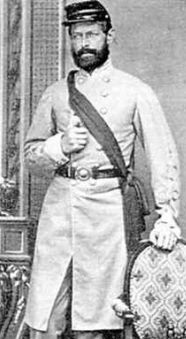
1865: Henry Wirz, for detainee abuse

On this date in 1865, Henry Wirz was hanged in Washington, D.C. for running a notorious Confederate prison camp.

A Swiss-born doctor (“Henrich” was the real handle) whom time and tide found practicing in Louisiana at the onset of the Civil War, Wirz apparently got into the prison-guarding ranks when a war injury left him unfit for the front lines.

But it was front-line fitness in the northern army that would set the scene for his controversial hanging.

The North’s advantage in men and materiel shaped Union strategy as the war progressed, and it eventually caused the Union to halt prisoner exchanges. Exchanging casualty for casualty was a winning strategy on the battlefield, so why return to your enemy a man for a man? Besides,

[Grant] said that I would agree with him that by the exchange of prisoners we get no men fit to go into our army, and every soldier we gave the Confederates went immediately into theirs, so that the exchange was virtually so much aid to them and none to us.

Benjamin Butler (we’ve met him before)

As designed, then, the South began piling up more and more POWs to maintain with its ever-straitened resources late in the war. And if exchange was out, that really only left one form of “release”.


Andersonville Prison survivor John L. Ransom’s view of the prison, from the Library of Congress.

Andersonville — officially, Camp Sumter, located near the tiny Georgia town of Andersonville — was only established in 1864, but acquired considerable notoriety in northern propaganda for the year and change that Wirz ran it. The prisoners didn’t enjoy it much, either.

Wuld that I was an artist & had the material to paint this camp & all its horors or the tounge of some eloquent Statesman and had the privleage of expresing my mind to our hon. rulers at Washington, I should gloery to describe this hell on earth where it takes 7 of its ocupiants to make a shadow.

Union prisoner diary, July 1864. Note the prisoner’s anger at Washington — whose refusal to exchange naturally infuriated its stranded POWs

Out of some 45,000 prisoners held at Andersonville during its existence (not all at one time), nearly 13,000 succumbed to disease and malnutrition.* After the war, photos of wasted survivors inflamed (northern) public opinion, already tetchy over Abraham Lincoln’s assassination. Walt Whitman wrote of Andersonville,

There are deeds, crimes that may be forgiven but this is not among them. It steeps its perpetrators in blackest, escapeless, endless damnation.

Damnation is up to higher powers, of course, but the North wanted somebody to answer for Andersonville on this mortal coil. Lincoln’s successor Andrew Johnson overruled mooted charges against Confederate President Jefferson Davis and his Secretary of War James Seddon, leaving — in that great American tradition — Heinrich Wirz holding the bag.**

Shatner sighting!

The trial had an undeniable aspect of victor’s justice.† Even at the gallows, the Union guards chanted, “Wirz, remember Andersonville!” as the condemned man was readied for the noose, and then dropped. The hanging failed to break the man’s neck, and he strangled as the chant continued.

Southern efforts to reshape the story of Andersonville began in the lifetimes of Wirz’s contemporaries; this fulsome volume supporting the charges answered Jefferson Davis in terms that sound strikingly contemporary:

So long as Southern leaders continue to distort history (and rekindle embers in order to make the opportunity for distorting it), so long will there rise up defenders of the truth of history … To deny the horrors of Andersonville is to deny there was a rebellion. Both are historic facts placed beyond the realm of doubt.

But of course, it does not require denying the horrors of Andersonville to notice the circumstances — the privation of the entire South late in the war — and to wonder that Wirz and Wirz alone was held to account. Plenty of people think he got a bum rap.


Daughters of the Confederacy monument to Wirz. (cc) image from divemasterking2000.


Pro-Wirz marker in Andersonville, Ga. (Click for easier-on-the-eyes version, reading in part, “Had he been an angel from heaven, he could not have changed the pitiful tale of privation and hunger unless he had possessed the power to repeat the miracle of the loaves and fishes”). (cc) image from Mark D L.

Recommended for general reading: the UMKC Famous Trials page on this case, several of whose pages have been linked in this entry. A number of nineteenth-century texts by (or citing) Andersonville survivors are available from Google books, including:

Since this is a controversy of the Civil War — and one that can be engaged without having to get into that whole slavery thing — there have been thousands of published pages written about it, with many more sure to come in future years.

A few books about Henry Wirz and Andersonville

As an interesting aside, Civil War POW camps including Andersonville (but not only Andersonville) gave us the term “deadline,” which had a more startlingly literal definition in the 1860s — a perimeter beyond which prisoners would be shot on sight, which policy could make a handy stand-in for walls. Gratuitously killing an insane prisoner who crossed Camp Sumter’s “dead line” was one of the atrocities laid to Wirz, who we take it would not have been at home to the word’s decreasingly urgent appropriation in the wider culture.

* Wirz’s defense showed, to no avail, that the prisoners and the guards received the same rations, with similarly deleterious effects among both, and that the commandant was on record pleading with his superiors for more.

** Wirz’s attorney claimed that his man was offered (and refused to take) a last-minute pardon on November 9 in exchange for implicating Jefferson Davis.

† Wirz and borderlands guerrilla Champ Ferguson were the only Confederates executed for their “war crimes”. There was at least one other prison guard who faced similar charges of prisoner maltreatment, John Henry Gee; Gee was acquitted and released in 1866. (For more on the latter, see “A Little-known Case from the American Civil War: The War Crimes Trial of Major General John H. Gee” by Guénaël Mettraux in the Journal of International Criminal Justice, 2010.)

On this day..

1610: Blessed George Napier

On this date in 1610, the Catholic priest George Napier (or Napper, or Nappier) was hanged, drawn, and quartered at Oxford, having said Mass that very morning.

A son of Oxford himself who went abroad to France for ordination in his outlawed faith, Napier cut a fairly typical martyrology for the Catholic clergy. He was caught red-handed with the implements of the Roman church, refused to avow the supremacy of the English crown, and aggravated his offense by converting a fellow-prisoner to Catholicism.

This unfortunate has made headlines recently around the fourth centennial of his martyrdom, for which occasion a pilgrimage of Catholic faithful unveiled a plaque in Nappier’s honor at Oxford Castle.


Archbishop Bernard Longley blessing on Oct. 23, 2010 the marker honoring George Napier. Images on this page (cc) Joseph Shaw.

On this day..

1969: Nahashon Isaac Njenga Njoroge, assassin of Tom Mboya

At 3 a.m. this date in 1969 at a Nairobi prison that Nahashon Isaac Njenga Njoroge swung for assassinating Kenyan Luo politician Tom Mboya earlier that year … never clarifying the cryptic question he uttered to the authorities, “Why don’t you go after the big man?”

“No African leader has an abler brain or a stronger will,” wrote one Englishwoman who knew Mboya during his lifetime.*

A trade unionist during the waning days of British authority, the ethnically Luo Mboya had become a leading anti-colonial figure as the ethnically Kikuyu Mau Mau were suppressed.

During Kenya’s last years as a British possession, Mboya organized the African American Students Foundation, to provide scholarships for students from British East Africa to study in the United States.

(It was on Mboya’s AASF program — funded by John F. Kennedy — that a promising young Kenyan economics student named Barack Obama studied at the University of Hawaii in the 1960-61 academic year, and got an American girl pregnant. The reader will be familiar with those semesters’ legacy.)

Upon Kenyan independence, Mboya became a Member of Parliament and a cabinet officer, holding the Economic Planning and Development portfolio until he was gunned down on the streets outside a pharmacy on July 5, 1969.

Mboya’s murder by Njoroge,** a youth activist for the Kikuyu-dominated Kenya African National Union party (KANU) that Mboya himself had also joined, was widely read as President Jomo Kenyatta consolidating his own grip on the country and eliminating potential rivals.†

Mboya certainly had the talent and ambition to aspire to leadership in Kenya; little wonder that anger among his Luo people boiled over when Mboya was laid to rest.

Njoroge’s hanging during the pre-dawn hours this date — just days after Kenyatta banned the Luo-based opposition party, making Kenya into a one-party state — was conducted in secret; word only got out in late November, and even then it was not through an official announcement.

Njoroge remains the official lone gunman in this case, the only person ever held to judicial account for Tom Mboya’s convenient elimination. Decades later, however, many are still searching for the real story.

* From the London Times‘ unsigned July 7, 1969 obituary of Mboya.

** Allegedly by Njoroge; the assassin was not caught on the scene and Njoroge denied pulling the trigger, telling the court that Mboya was his longtime friend. (London Times, September 10, 1969) There are plenty who consider Njoroge a fall guy.

Pio Gama Pinto (1965) and Josiah Mwangi Kariuki (1975) were similar

On this day..

1817: The Pentrich Rebellion leaders

On this date in 1817, Jeremiah Brandreth, William Turner, and Isaac Ludlum or Ludlam were hanged and posthumously beheaded for the Pentrich Revolution or Pentrich Rising.


Retrace the “revolution” on a walking trail (pdf). Scenic!

The executions this day were an ugly consequence of government vigilance against subversives after the Napoleonic Wars.

There was plenty of “subversion” to spark vigilance: economic realignments of the early Industrial Revolution pushed workers into untenable positions, and a political system overgrown with archaic privileges and undemocratic veto points could not respond pending desperately needed reform.

Political Hampden clubs interested in parliamentary reform had cropped up all over England. The government viewed them as potential Robespierres.

So not only the Pentrich rising’s suppression but the rising itself were the product of the state security apparatus. A government spy named William Oliver, in the employ of Home Secretary Lord Sidmouth, infiltrated himself into radical circles in the Derbyshire village, and convinced the real radicals that nationwide protests were planned for June 9.

Expecting sympathetic labor actions in London and elsewhere, a few dozen Pentrich men assembled themselves — alone in the nation, drenched in a downpouring rain. They marched towards Nottingham, killed a man along the way, dissolved pathetically and were rounded up by soldiers in the days ahead. Forty-five stood trial for treason: three doomed to die this day, others sentenced to jail terms or transportation. It was a warning shot against airing grievances, a harbinger of more infamous top-down violence to come.


These hangings and the throwback chopping-off-heads bit succeeded by just a few hours the sudden death of the young Princess Charlotte, a sort of Princess Di moment for the Hanoverians.

Percy Bysshe Shelley, who knew from scaffold bathos, produced for the occasion a meditation on the contrasting characters of their deaths, and the incommensurate public mourning reserved for privileged royalty as against suffering subjects.

The execution of Brandreth, Ludlam, and Turner, is an event of quite a different character from the death of the Princess Charlotte. These men were shut up in a horrible dungeon, for many months, with the fear of a hideous death and of everlasting hell thrust before their eyes; and at last were brought to the scaffold and hung. They too had domestic affections, and were remarkable for the exercise of private virtues. Perhaps their low station permitted the growth of those affections in a degree not consistent with a more exalted rank. They had sons, and brothers, and sisters, and fathers, who loved them, it should seem, more than the Princess Charlotte could be loved by those whom the regulations of her rank had held in perpetual estrangement from her. Her husband was to her as father, mother, and brethren. Ludlam and Turner were men of mature years, and the affections were ripened and strengthened within them. What those sufferers felt shall not be said. But what must have been the lone and various agony of their kindred may be inferred from Edward Turner, who, when he saw his brother dragged along upon the hurdle, shrieked horribly and fell in a fit, and was carried away like a corpse by two men. How fearful must have been their agony, sitting in solitude on that day when the tempestuous voice of horror from the crowd, told them that the head so dear to them was severed from the body! Yes—they listened to the maddening shriek which burst from the multitude: they heard the rush of ten thousand terror-stricken feet, the groans and the hootings which told them that the mangled and distorted head was then lifted into the air. … When man sheds the blood of man, revenge, and hatred, and a long train of executions, and assassinations, and proscriptions, is perpetuated to remotest time. … Their death, by hanging and beheading, and the circumstances of which it is the characteristic and the consequence, constitute a calamity such as the English nation ought to mourn with an unassuageable grief. …

On the 7th of November, Brandreth, Turner, and Ludlam ascended the scaffold. We feel for Brandreth the less, because it seems he killed a man. But recollect who instigated him to the proceedings which led to murder. On the word of a dying man, Brandreth tells us, that “OLIVER brought him to this”—that, “but for OLIVER, he would not have been there.” See, too, Ludlam and Turner, with their sons and brothers, and sisters, how they kneel together in a dreadful agony of prayer. Hell is before their eyes, and they shudder and feel sick with fear, lest some unrepented or some wilful sin should seal their doom in everlasting fire. With that dreadful penalty before their eyes—with that tremendous sanction for the truth of all he spoke, Turner exclaimed loudly and distinctly, while the executioner was putting the rope round his neck, “THIS IS ALL OLIVER AND THE GOVERNMENT.” What more he might have said we know not, because the chaplain prevented any further observations. Troops of horse, with keen and glittering swords, hemmed in the multitudes collected to witness this abominable exhibition. “When the stroke of the axe was heard, there was a burst of horror from the crowd. The instant the head was exhibited, there was a tremendous shriek set up, and the multitude ran violently in all directions, as if under the impulse of sudden frenzy. Those who resumed their stations, groaned and hooted.” It is a national calamity, that we endure men to rule over us, who sanction for whatever ends a conspiracy which is to arrive at its purpose through such a frightful pouring forth of human blood and agony. But when that purpose is to trample upon our rights and liberties for ever, to present to us the alternatives of anarchy and oppression, and triumph when the astonished nation accepts the latter at their hands, to maintain a vast standing army, and add, year by year, to a public debt, which, already, they know, cannot be discharged; and which, when the delusion that supports it fails, will produce as much misery and confusion through all classes of society as it has continued to produce of famine and degradation to the undefended poor; to imprison and calumniate those who may offend them, at will; when this, if not the purpose, is the effect of that conspiracy, how ought we not to mourn?

Mourn then People of England. Clothe yourselves in solemn black. Let the bells be tolled. Think of mortality and change. Shroud yourselves in solitude and the gloom of sacred sorrow. Spare no symbol of universal grief. Weep-mourn—lament. Fill the great City—fill the boundless fields, with lamentation and the echo of groans. A beautiful Princess is dead:—she who should have been the Queen of her beloved nation, and whose posterity should have ruled it for ever. She loved the domestic affections, and cherished arts which adorn, and valour which defends. She was amiable and would have become wise, but she was young, and in the flower of youth the despoiler came. LIBERTY is dead. Slave! I charge thee disturb not the depth and solemnity of our grief by any meaner sorrow. If One has died who was like her that should have ruled over this land, like Liberty, young, innocent, and lovely, know that the power through which that one perished was God, and that it was a private grief. But man has murdered Liberty, and whilst the life was ebbing from its wound, there descended on the heads and on the hearts of every human thing, the sympathy of an universal blast and curse. Fetters heavier than iron weigh upon us, because they bind our souls. We move about in a dungeon more pestilential than damp and narrow walls, because the earth is its floor and the heavens are its roof. Let us follow the corpse of British Liberty slowly and reverentially to its tomb: and if some glorious Phantom should appear, and make its throne of broken swords and sceptres and royal crowns trampled in the dust, let us say that the Spirit of Liberty has arisen from its grave and left all that was gross and mortal there, and kneel down and worship it as our Queen.

On this day..