1803: Johannes Bückler, “Schinderhannes”

On this date in 1803, the famous German bandit “Schinderhannes” and 19 others of his gang were efficiently guillotined in French-occupied Rhineland.

Schinderhannes with mistress Juliana Blasius and their child.

As low-born as they come, Johannes Bückler (English Wikipedia link | German) hailed from a family of executioners and knackers (his appellation means “John the Knacker”).

But this outcast was born to command, and in the wild Rhineland at the close of the 18th century, his audacity, charisma, and deft cruelty made him a legendary bandit king.

He stole, he blackmailed, he slipped his fetters … “he seemed to contest French authority” recently projected by the revolutionary citizen-army, and he preyed heavily on unpopular Jewish merchants, all of which gave Bückler purchase on folk hero status with the boldness to hold a public “robber’s ball” at the ruined castle his band occupied.

His legend grew in his own lifetime, and as such things do, it inflated quite past any capacity of its originator’s character to support.

When things got too hot on the French side of the Rhine, he ducked over the frontier to the Holy Roman Empire in the east, but was nabbed attempting to lay low in the imperial army under an assumed name, and handed back to the French.

The authorities turned his outlaw gallantry to good effect (or at least, that’s the cover story his apologists have made for his stool pigeoning) by threatening to come down on the mistress who bore him a child, leading Schinderhannes to get her off with a slap on the wrist by giving up his bandit brethren.

And with French law came French execution technology, whose proliferation in the train of Napoleon’s Grande Armee would bequeath the German condemned death by the “falling axe” down to Hitler’s time and even after.

A spectacle here as it was in France, tens of thousands turned up in Mainz this date in 1803 for what sounds like an anticlimactic six-minute show of a score of Schinderhannes’ gang losing their heads to the mechanical contraption.

Scottish scribbler Leitch Ritchie helped convey to posterity the legend with Schinderhannes, the robber of the Rhine, which romantically celebrates a knave who must have been less lovable to those who knew him from the business end of his blade. These, nevertheless, are all long gone, and Ritchie has the authority of historical mythologizing to vindicate his text’s last eulogy with its hero’s foot upon the scaffold:

The bandit-chief preserved his intrepidity to the last, and left to other times, unsullied by many of the basenesses of his tribe, the name of SCHINDERHANNES, THE ROBBER OF THE RHINE.

He sure did. From the practically mandatory ballad …

… to the stage …

… to the screen

… to vicious-looking Cambrian anomalocarid Schinderhannes bartelsi

… the outlaw has long outlived his guillotining, to the profit of the tourist trade in his former stomping-grounds.

On this day..

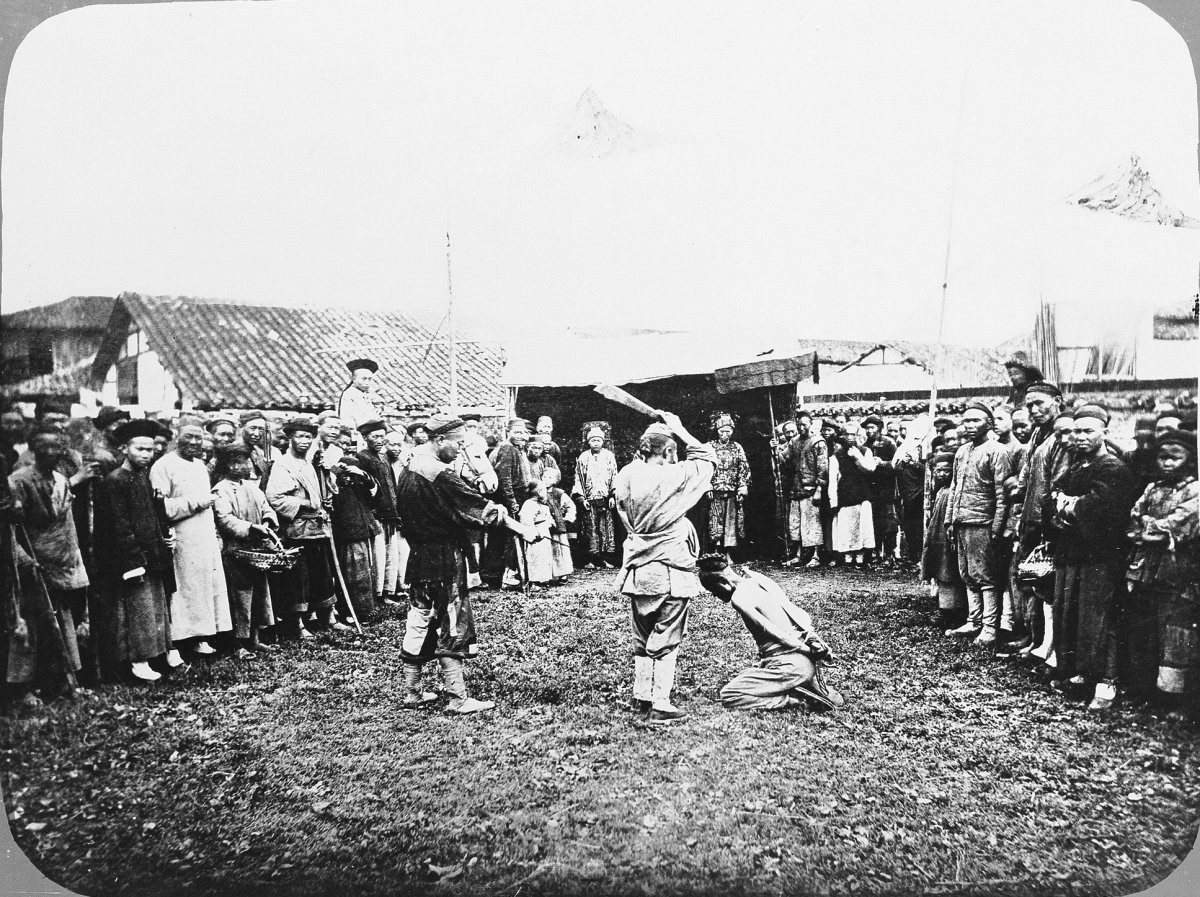
1864: Hong Tianguifu, in the Taiping Rebellion

On this date in 1864, the sins of the father were visited upon the son when the Qing Dynasty dealt a coup de grace in what is perhaps history’s bloodiest civil war, executing the luckless teenager to whom leadership of the Taiping Rebellion had fallen.

Strangely little-known, the Taiping Rebellion shook the weakened Chinese state through the middle of the 19th century, nearly to its very foundations.

From 1851 until the 1864 death of its queer leader figure, prophetic Christian convert Hong Xiuquan, it maintained its own state in southern China, the Taiping Heavenly Kingdom.

China’s defeat in the First Opium War in the 1840’s set the stage for Hong Xiuquan’s movement, and not only geopolitically: western powers had pried open the Orient to proselytizers as well as poppies, and though Christianity would find a rough go of it in China, it did win over Hong.

Fired by his supposed divine vision, Hong’s Heavenly Kingdom conquered the Yangtze Valley and much of the south, with an outlook radically progressive as against the hidebound Qing: egalitarian land distribution and gender equity (the Kingdom’s administrative acumen is less generously accounted). Naturally, the “real” Christian missionaries abhorred it, which sincere theology happily comported with the policy of their national statesmen who abhorred the Taiping’s encumbrance upon the opium trade.

This illustrated podcast does creditable coverage of the Qing’s twilight century; from about 14:17, it covers Hong Xiuquan and the Taiping Rebellion specifically.

The rebellion waxed while the Qing lost a second Opium War to the west, but a Taiping bid to capture Shanghai fell short in 1860. By this time, westerners had the Qing by the short-and-curlies and were not eager to see the client dynasty they had so painstakingly browbeaten supplanted by a bunch of millenarian Levellers without the common courtesy to promulgate smack; accordingly, China’s recent Opium War antagonists now helped China field the forces necessary to suppress the rebellion.

Charles George Gordon, a British evangelical Christian himself destined for eventual beheading, even led the pacification force swaggeringly branded the “Ever Victorious Army“.

We’ve reached the end here and only just met our day’s principal, the son and heir who at 15 was handed the helm of the collapsing state by his visionary father. (Hong Xiuquan conveniently proceeded to kick the bucket just before the Qing finished off the rebellion.)

Officially the second (and obviously the last) ruler of the Heavenly Kingdom, Hong Tianguifu had no juice with his military or administration, and no time to enjoy the more prosaic perquisites of regal authority, but was available as the object of official vengeance. (Thanks, dad.)


Less exalted Taiping Rebellion prisoners, from here (click through the pages for a detailed history of the rebellion).

The Taiping Rebellion features in the 2007 Chinese flick Tau ming chong (The Warlods), which represents a Qing-Taiping battle in the fine cinematic bloodbath below. Some 20 to 30 million people are thought to have perished in this civil war, which was also one of the last significant conflicts fought primarily with blades rather than bullets.

On this day..

1726: The Gypsy outlaws of Hesse-Darmstadt

On November 14 and 15, 1726, more than 20 Gypsy outlaws of Hesse-Darmstadt were executed en masse.

Detail view (click for full image) of the execution of the Gypsies at Giessen.

Gypsies in Europe still suffer ample discrimination today, so it’s little surprise to find early modern Europe thick with anti-Gypsy legislation.

No surprise, Angus Fraser writes in The Gypsies, this sort of thing

did in the end produce enormous changes in the life of the Gypsies in Europe. To survive, they had to adapt; they also had to make the most of the loopholes in a system which expressly sought, by denying them food and shelter, to make honest living impossible. Some found a degree of security in inaccessible waste-lands and forests. Some exploited differences in jurisdiction and the spasmodic nature of the authorities’ activity, by making a home in frontier regions … Many broke up into small groups when it was necessary to avoid attention; conversely, others gathered into larger bands to facilitate self-protection … sometimes resorting to violence. Certain Gypsy brigands gained notoriety in eighteenth-century Germany, large tracts of which were overrun with robber companies of mixed and varying origins. Some of these had a strong Gypsy element: numbering perhaps 50 or 100, armed and defiant, they stole for their sustenance and skirmished with the soldier-police sent to confine them.

“The poor Gypsies,” one poor Gypsy lamented to a contemporary German author,* “also want to have the right to live.”

Like the Gypsies’ other necessities, that right went as far as they themselves could secure it … and when secured by brigandage, it eventually brought down an overwhelming response.

The German author in question, J.B. Weissenbruch, relates the tale of a particularly notorious pack of Gypsy outlaws under the leadership of rough characters names of Antoine la Grave, aka “der Grosse Galantho” or “the Great Gallant”, and Johannes la Fortun, aka “Hemperla”.

These were no romantic Johnny Depp-esque Gypsies, at least according to Weissenbruch. Besides “their disposition to wandering, to idleness, to theft, to polygamy, or rather promiscuous license” — well, okay, sort of romantic — these went toe to toe with soldiery dispatched to corral them and had the chops to “take military possession” of a village for the purpose of exacting some corporal revenge.

We know where this ends up.

Though the Great Gallant escaped punishment,† Hemperla and 20-plus of his band (different sources quote slightly different figures) enjoyed the pleasures of the thumbscrew and the Spanish boot to secure confessions necessary to license their sentences. Some were hanged, others (including women) beheaded, and Hemperla and a few comrades were broken on the wheel.

* Cited here; regrettably, I have not been able to locate a browsable original of the Weissenbruch text.

** Same story in yet another Google books freebie.

This German book says his rank got him off the hook, but he lost his head just the same in 1733.

On this day..

1679: The hot-blooded Lady Christian Nimmo

On this date in 1679, a spurned lover laid her head on the block in Edinburgh and began her career as a spook.

Decadent widower James Forrester (or Forester), having run through his cash, was marking his time at the pub and in the arms of Lady Christian Nimmo.

She was a great deal younger than himself, and a niece of his first wife’s. This near relationship greatly increased the scandal, which was aggravated by Lord Forester having always professed to be a religious man, and a rigid Presbyterian. [Edinburgh’s rigid Presbyterians had a recurring misconduct problem. -ed.] Mrs. Nimmo, besides being a very beautiful woman, was of a violent and impulsive nature. She was believed always to carry a sword under her petticoats, and so was not a person to be treated lightly, especially by those who reflected what blood ran in her veins, — Mrs. Bedford, who had murdered her husband a few years before, being her cousin-german. She was also related to the unhappy Lady Warriston, who suffered death for the same crime in 1600. Lord Forester’s passion for her appears to have cooled; and, shutting his eyes to possible consequences, he permitted himself in one of his carouses to speak more than lightly of her. This came to her ears, and, seized with fury, she went at once to his castle at Corstorphine … a violent altercation took place between them. In the midst of it, she snatched the sword from his side, ran him through the body, and killed him.

… She confessed her crime, but pleaded that Lord Forester, being ferocious and intoxicated with drink, had drawn his sword; that, to save herself, she had snatched it from him, and that in the struggle he had fallen upon it, and so killed himself. In spite of this defence, sentence of death was passed upon her … [she was] beheaded at the Market Cross on the 12th November 1679. At her execution she appeared dressed in deep mourning, with a long veil, which, before laying her head on the block, she took off, and replaced with a white taffeta hood. She met her fate with great courage. It was said at the time that, in spite of his professed Presbyterianism, a dispensation from the Pope to marry Mrs. Nimmo was found among Lord Forester’s papers, and that his delay in using it had caused her fury. (Source)

An apparition known as “the white lady” is supposed to haunt the site of the murder with a melodramatic bloody sword.

On this day..

1550: Jon Arason, the last Catholic bishop of Iceland

At dawn this date in 1550, two sons* of Jon Arason were beheaded at Skalholt, followed by the energetic sextegenerian prelate himself — cementing Lutheranism in Iceland.

As bishop of the northern diocese of Holar and one of the most powerful pols in Iceland, Arason did what he could to maintain papal authority when the Danish King Christian III began pushing Protestantism.

Arason was a practical guy; remote from any prospect of aid, he was content to maintain a cordial balance between his diocese and the southern one of Skalholt. (The two sees were political rivals of long standing; Skalholt’s previous Catholic representative, Ogmundur, had at one point many years before our narrative excommunicated Arason and forced the latter to flee to Denmark.)

Whether driven by the prince or the bishop within,** Arason took advantage of his Protestant opposite number’s timely passing in 1548 to make a play for power in the south as well. Early returns augured well; Arason arrested the Lutheran replacement, got the Icelandic parliament to throw in with him, and captured key points in the Holar diocese, reconsecrating ecclesiastical properties as Catholic.†

But his rival Dadi Gudmundsson turned the tables on the man who was becoming the de facto ruler of the island by ambushing him at a parley. The cleric and the two sons, having been declared outlaws months before by Danish decree, were executed on that basis without trial, lest holding them for the planned hearing the following spring enable their supporters to rally. Arason’s beheading was reportedly botched.

Legally doubtful but practically effectual, the axe that (eventually) decapitated the divine did likewise to his flock. Lutheranism thereafter settled comfortably into the ascendancy: Iceland would not have another Catholic bishop for nearly four centuries, by which time its Catholic population had shrunk near the vanishing point.

Although his faith didn’t have legs on the island, Arason reads very easily as a proto-nationalist figure and political actor; he’s been well-loved by Protestant, Catholic, and irreligious posterity alike.

He also gave Icelandic a bit of vernacular on his way to shuffling off this mortal coil. When a priest named Sveinn proffered the solace, “There is a life after this one!” as the last bishop approached the block, he replied, “Veit ég það, Sveinki!”“This I know, Sveinki!”

In everyday conversation in Iceland, that phrase is still used to tease someone who has just stated the obvious.

* Although this is well into the period when Catholic clergy were supposed to be practicing celibacy, Arason’s indifference to this particular mortification of the flesh is just another bit of his charm. With his mistress Helga Sigurdardottir, he sired nine sons and daughters, marrying them into politically advantageous allegiances where possible. At least eight subsequent Lutheran bishops sprang from his seed; by the present, “virtually all Icelanders can validly claim direct descent” from Jon Arason, according to Iceland, the First New Society.

** Jon Arason was also a notable poet. Ljomur, whose attribution to Arason is speculative, can be enjoyed for free here.

† More particulars about the Icelandic political chessboard are available in this 19th century text (the pdf is easier on the eyes than the text), or in “An Icelandic Martyr: Jón Arason,” by Thomas Buck, in the Jesuit publication Studies: An Irish Quarterly Review, Vol. 46, No. 182 (Summer, 1957), pp. 213-222.

On this day..

1793: The smitten Adam Lux

Among all the strange and pathetic love-stories of the Revolution, when hearts were won within prison walls and wedded by the guillotine, is there another as fantastic and wonderful as that of Adam Luchs? (Source)

Adam Lux (as he’s better known, and a fitter name to his character could hardly be invented), German Republican turned French Revolution representative, was so lovestruck by the arresting figure of Charlotte Corday that it was downright … mortifying.

Many were men to whom the Norman maid played muse, like the poet Andre Chenier.

But Lux was something else.

Thrilled by this chaste heroine’s sacrificial blow against the Revolution’s monster, Lux was supposed to have fallen madly in love with the murderess the one time he actually saw her, on her serene way to the scaffold.

Eros thus yoked to Thanatos, the besotted fellow promptly hurled himself after the exaltation of death. Imitation, after all, is the sincerest form of flattery.

Certainly knowing it to be fatal, Adam Lux published under his own name a vindication of Ms. Public Enemy #1 and her “tyrannicide,” and generally went extravagantly mooning about in this sort of vein as he prepared to get his head cut off this date in 1793:

The guillotine is no longer a disgrace. It has become a sacred altar, from which every taint has been removed by the innocent blood shed there on the 17th of July. Forgive me, my divine Charlotte, if I find it impossible at the last moment to show the courage and the gentleness that were yours! I glory because you are superior to me, for it is right that she who is adored should be higher and more glorious than her adorer!

Adam came off a little needy, you’d have to say.

Not surprisingly, he didn’t get the girl in the end.

Adam Lux to Charlotte Corday
by William James Dawson

Red is the garb thou wearest, red is the deed thou hast done,
And red on a land of blood rises the morning sun.
Kings have ridden this road, conquerors mailed in gold,
But none in such red triumph as this that we behold.

Rose, thro’ a rose-red dawn, go to thy valourous fate,
Queen of all roses thou, splendid and passionate.
And lo ! at thy feet I fling, here, in the gallows-cart,
Passionate even as thine, the rose-flower of my heart.

Turn but a moment toward me, stoop in thy raiment red,
I answer thee look for look, I am warmed and comforted.
Twins are we of one womb, fated sister and brother,
Nursed on the bare bruised breasts of Freedom our great Mother!

Thou, whom none could master, proud and glorious head,
Come, O Rose, to my bosom, come when thou art dead!
They have shorn the beautiful hair, they have bound the strong fair hands,
Signal me with your eyes that love still understands!

Signal, and I will follow : I dwell where thou must dwell,
I shall know thy blood-red raiment either in heaven or hell!
Lo! at thy feet I fling, here, in the gallows-cart,
Passionate even as thine, the red rose of my heart!

On this day..

1463: David of Trebizond and his heirs

On this date in 1463, the last regal claimants of Byzantium’s last successor state were executed in Constantinople.

They were, by this time, two years deposed from actual power. David of Trebizond (aka David Comnenos) had inherited the enclave“empire” clinging to the Black Sea coast in 1459, and proved himself “a fit agent for consummating the ruin of an empire.”

Specifically, he cleverly set about needling the overwhelming Turkish power on his borders by vainly attempting to stir up another Crusade, and refused to pay the Mohammedan tribute.

Having recently reduced the impregnable fastness of Constantinople, Mehmed the Conqueror handily availed this provocation to overrun Trebizond.

David and kin made out okay by this calamitous extinction of the Byzantine candle, negotiating in the summer of 1461 an arrangement to settle in Adrianople under the sultan’s protection (and monitoring).

Two years later, David was reportedly caught plotting against the keeper of his gilded cage once more, and Mehmed had the former Emperor, his sons, a nephew and a brother-in-law beheaded, neatly extinguishing the last people with any lineal claim the late Greek imperium.

Theodore Spandounes, a Venetian of Byzantine refugee stock writing in the early 16th century,* claims this was a set-up by Mehmet, “ravenously thirsting for Christian blood,” and that the Komnenoi were given the chance to convert to Islam and atoned their poor statecraft with holy martyrdom.

Furthermore,

Mehmed confiscated all the property of the imperial family of Trebizond and condemned the Empress [Helen Kantakouzene or Cantacuzene] to pay 15,000 ducats within three days or be executed. Her servants, who were Mehmed’s prisoners in Constantinople, worked from dawn to dusk to raise the money and paid it … [but] she had no desire to remain in this world; and, clad in sackcloth, she who had been accustomed to regal finery, refused to eat meat any more and built herself a hovel covered in straw in which she slept rough. Mehmed had decreed that no one was to bury the bodies under pain of death. They were to be left for the dogs and ravens to devour. But the sainted Empress secretly acquired a spade and with her own delicate hands as best she could dug a trench in her hut. All day long she defended the corpses against the animals and at night she took them one by one and gave them burial. Thus did God give her the grace to bury her husband and her sons; and a few days later she too died.

* And writing, it should be observed, with the polemical intent of persuading western powers to go fight the Ottomans.

On this day..

1796: Lesurques, wrongly, and Couriol, rightly, for robbing the Lyons Mail

On this date* in 1796, France enacted what was long held to be one of its most notorious miscarriages of criminal justice by cutting off the head of Joseph Lesurques.

Lesurques was taken for the one of a gang who had sensationally robbed and murdered a mail courier early in 1796, and on the basis of slight eyewitness testimony condemned to die. The only reason he was associated with the crime in the first place was because his friend had been mistakenly accused, and then released, and Lesurques accompanied him to the court to retrieve the friend’s papers where he was “recognized.”

Eyewitness testimony having juridical pull far in excess of its dependability,** this “recognition” was worth the man’s life.

The famous French Revolution executioner Sanson was still in the game at this point, and his grandson (not yet born at this time) used the family notes to pull together this quasi-firsthand account in Memoirs of the Sansons. It’s a tale familiar to any present-day wrongful conviction scenario, of bad evidence snowballing, a blinkered prosecutor intent on conviction, pettifogging appellate authorities, and grim, relentless bureaucratic momentum.

(The names the Memoirs render as “Courriol” and “Dubosc” are also given as “Couriol” and “Dubosc” in other sources.)

the instructing magistrate … instead of imitating the prudence of his Parisian colleague and trying to discover the truth, applied himself to the collection of proofs of the guilt of the prisoners …

Fifteen witnesses on behalf of the defence proved an alibi in favour of Lesurques, eighty-three others spoke highly of his well-known respectability; but their evidence went for nothing in opposition to those who, with singular pertinacity, maintained that Lesurques was one of those who had been seen lurking near the scene of the murder on the night when it was committed …

On hearing his condemnation, Lesurques, who had been firm and collected throughout the trial, lost his self-possession, and raising his hands to heaven he exclaimed:

“The crime which is imputed to me is indeed atrocious and deserves death; but if it is horrible to murder on the high road it is not less so to abuse the law and convict an innocent man. A day will come when my innocence will be recognised, and then may my blood fall upon the jurors who have so lightly convicted me, and on the judges who have influenced their decision!”

On the 9th of Brumaire, year 5 (October 30, 1796), my grandfather and father proceeded to the Conciergerie, and found the convicts in the hall, through which so many had passed during the Reign of Terror. David Bernard† was in a state of utter prostration; Courriol, on the contrary, was excited. As to Lesurques, he was as calm and fearless as ever. When he saw my grandfather, whose white hair sufficiently designated him as the chief executioner, he stepped up to him, and said, holding out a sealed letter:

“Citizen, I hope for the honour of human justice that your functions do not often compel you to shed the blood of a guiltless man; I hope, therefore, that you will grant the last request of a man who is about to suffer for what he has not done. Be good enough to keep this letter, which may hereafter contribute to the restoration of the honour of my wife and poor children, whereof they have been so unjustly deprived.”

While one of his assistants was cutting the unfortunate man’s hair, my grandfather read the paper Lesurques had just given him. It was a letter addressed to Dubosc, the man in whose place he was condemned. It ran as follows:

“To Citizen Dubosc.

“Citizen Dubosc, — I do not even know you, and I am going to suffer the death which was reserved for you. Be satisfied with the sacrifice of my life. Should you ever be brought to account, remember my three children and their mother, who are disgraced for ever, and do not prolong their agony. Confess that you are the man.”

All preparations were now concluded. Lesurques, of his own choice, was dressed in spotless white, symbol of his innocence. He was the first to take his place in the cart; Courriol followed him, and Bernard, who had fainted, was deposited on the straw. Then began the most dismal and extraordinary journey that ever was made from the Conciergerie to the Place de Greve. Lesurques and Courriol stood in front. At every turn of the wheel, Courriol exclaimed in a piercing voice:

“I am guilty! Lesurques is innocent!”

And for twenty minutes, that is during the whole way to the guillotine, he perseveringly repeated his awful protest against justice. The crowd was horrified, and there were few who did not believe the murderer who confessed his crime, but who proclaimed his companion’s innocence. Courriol again repeated his words at the foot of the scaffold with extraordinary energy and vehemence, and the thump of the knife but just covered his supreme shriek:

“Lesurques is innocent!”

The judicial authorities have perseveringly refused to recognise this flagrant miscarriage of justice. And yet the innocence of Lesurques was amply demonstrated a short time after his execution: all the real murderers of the courier of Lyons designated by Courriol were captured; Dubosc himself, whose fatal resemblance to Lesurques was the cause of the latter’s death, was taken and tried … he was executed just four years after Lesurques …

The Lesurques heirs were left paupers by the state’s punitive confiscation of the “bandit’s” effects; after a quarter-century (during which the widow died in a madhouse), they were at least able to recoup their material loss, but although repeatedly challenged, the conviction itself was never reversed.

Judicial and literary skirmishing over the Lesurques matter continued for decades, gradually forming into a general consensus (whatever the courts might admit) that the man was wrongly accused.

As a result, Lesurques remained a potent symbol of capricious criminal justice overreach throughout the 19th century and into the 20th: this 1874 reader, Famous Cases of Circumstantial Evidence, has a full chapter on the case; a popular Victorian play titled The Lyons Mail was translated into a now-lost 1915 silent film and a 1931 talkie … albeit with a happy ending.

To a certain, inevitably well-represented, authoritarian demographic, any credence given to the self-evident proposition that wrongful convictions happen smacks of effrontery towards betters, and the Lesurques case was no exception … especially when paired with the coincident low ebb of public esteem for Power during the Dreyfus affair, which hit while The Lyons Mail was in vogue.


An advert insert in an unrelated 1903 book plumps a “Lesurques was guilty” position, riffing on the then-current Dreyfus controversy (“recent efforts in France to bring about the revision of a celebrated case”). This book is listed, but unavailable, on Amazon.com.

L’ affaire Lesurques never (so far as I can determine) reached a resolution; it simply faded away, 140 years or so after its namesake lost his head.

A late (1930) review of its particulars in the Journal of the American Institute of Criminal Law and Criminology (“The Moving Story of the Lyons Stage,” by Max Radin of UC-Berkeley, May 1930) proceeds with ingenuousness embarrassingly unbecoming a professor of the law.

Judicial errors do not occur in the United States. [!!!] Under these circumstances, we can look with some satisfaction on times and places in which this happy condition did not prevail. If in the cycle of existences our perfection should ever become visibly tainted, it may happen that we shall hang men or electrocute them and subsequently regret the fact. Perhaps some one will then recall the moving story of the Lyons stage.

Sounds like it’s ready for a revival.

* A few sources say March 10, 1797, but the most and best clearly lean to October 30, 1796.

** “Juries have an unfortunate faith in the accuracy of eyewitnesses,” William Davis Gross observes. “The propensity for blunder is so great that it is nearly equal to all other forms of error combined.” (“The Unfortunate Faith: A Solution to the Unwarranted Reliance Upon Eyewitness Testimony,” Texas Wesleyan Law Review, spring 1999)

† Bernard is a footnote in the story, but he seems to have received a raw deal himself: he was the liveryman who procured the horses for the highwaymen, but did not participate in the crime. Sanson passingly refers to Bernard as “but slightly guilty.”

On this day..

1409: Jean de Montagu

Six hundred years ago today, onetime royal favorite Jean de Montagu* was, at the instigation of his powerful noble rival, beheaded in Paris and his body hung up at Montfaucon.

Montagu (French link) was the 50-something scion of an ennobled notary — or else the illegitimate produce of King Charles V, whose ennobled notary had been induced to claim him. Regardless his blood, the lad made himself quite wealthy with a virtuous cycle of administrative acumen and political connection, winning a variety of honorary posts and riches aplenty he did not shy from displaying. Typical “New Money” type.

Sadly for Montagu, this cycle crested during the reign of Charles VI, also known as Charles the Mad for his bouts of illucidity.

“History,” wrote Barbara Tuchman, “never more cruelly demonstrated the vulnerability of a nation to the person of its chief of state than in the affliction of France beginning [with Charles’ first spell of insanity] in 1392.”

Charles the Mad’s erratic tenure would help bring French fortunes to the low ebb from which Joan of Arc would retrieve them.

Montagu’s period sob story was that his wealth earned him the enmity of nasty Duke of Burgundy John the Fearless,** who induced King Charles during one of the latter’s episodes to affix on Montagu responsibility for the crown’s financial shortfalls. Our day’s victim was arrested on October 7, 1409, tortured into a confession, and beheaded in Paris October 17.

Montagu’s surviving family had the verdict reversed within three years, which would have been a better deal for them had the family’s main branch not been wiped out three years after that at the Battle of Agincourt.

For the wider benefit of posterity, the beheaded lord also left a fair collection of endowed building projects in his lands in Marcoussis, including (French links all): the usual village church; a Celestine monastery; and a picturesque castle unfortunately devastated during the French Revolution but once resembling this:


Atmospheric old sketch from here; others here.

* Not to be confused with his (likewise beheaded) contemporary across the channel, John Montagu, Earl of Salisbury.

** John the Fearless had most recently been seen engineering the infamous murder of the king’s brother, and surviving by dint of his ransom potential the hecatomb of the last crusade.

On this day..

1898: The Six Gentlemen of the Hundred Days’ Reform

This afternoon in 1898, six liberals got the chop for their hopeless attempt to give a tottering empire the reforms it desperately needed.

The Hundred Days’ Reform — actually 103 days, from June 11 to September 21 — marked the attempt by China’s Guangxu Emperor to implement a far-reaching modernization programme backed by forward-thinking officials with a mind to correct China’s supine position vis-a-vis the West, and even vis-a-vis its neighbors.

“Reform has never come about in any country without the flow of blood. No one in China in modern times has sacrificed himself for the cause of reform, and because of this China is still a poor and backward country. Therefore, I request that the sacrifices begin with myself.” –Tan Sitong

The Wuxu Constitutional Reform still stands as the great attempt made by Chinese progressives who tried to follow the example of the modern powers in order to save China from extinction. Represented by Kang Youwei and Liang Qichao, the bourgeois reformists were imbued with the spirit of national salvation; they carefully set about designing a blueprint for a constitutional monarchy based on the example of Western countries. They advocated the establishment of parliament and a national conference, and wanted to see honest and fair-minded people with the courage to criticize authority installed in a position of power. National policies should be discussed by the monarch and the people. They also wanted a constitution to stipulate the rights and obligations of the monarch, officials, and the people. The constitution was to be the highest code for all people in the country. They also wanted to establish a system featuring a tripartite balance of forces: parliament was to legislate, the magistracy to deal with issues of justice, the government with administration. All of these would be under the monarch.

The constitutional reform was to take place with radical intellectuals submitting their memoranda to Emperor Guang Xu, who alone had the power to promulgate them. The feudal diehards being in a position of strength and the national bourgeoisie being weak, however, the new politics survived no more than 100 days or so. When the forces of reaction inevitably clamped down on the movement, the six reformists who had inspired the movement for constitutional reform met their deaths like heroes.

Although sincere in its aspirations, the reform movement was bound to fail, as it depended on a reform “from top to bottom”, which ultimately had to be enacted by the emperor. The Hundred Days’ Constitutional Reform, however, remains a landmark event in the modern history of China, its failure notwithstanding. The Chinese bourgeoisie in fact succeeded in spreading democratic and constitutionalist ideas widely, and this had a significant effect on future generations. The political and legal theory of the Western bourgeoisie could now take root in the soil of China.*

The emperor’s Machiavellian conservative aunt, the Empress Dowager Cixi, who had been the power behind the Chinese throne since 1861, made the sure reform didn’t see two hundred days with a “coup” that didn’t formally overthrow the Emperor — just made him irrelevant.

Troublemakers further down the food chain didn’t get off so easily.

Kang Youwei, the reform movement’s chief exponent, escaped to Japan. Six others suffered the wrath of the Dowager Empress: Kang Guangren (Kang Youwei’s brother), Lin Xu, Yang Shenxiu, Yang Rui and Liu Guangdi … along with the young reformer Tan Sitong, who notably refused imprecations to flee arrest.

The sword’s blade across my neck,
I look toward heaven — laughing.
-Etched on a prison wall, allegedly by Tan Sitong


Photo of an unspecified 1867 Qing beheading in Canton.

* “The Chinese Legal Tradition and the European View of the Rule of Law” by Wu Shu-Chen in The Rule of Law History, Theory and Criticism, Part VI.

On this day..