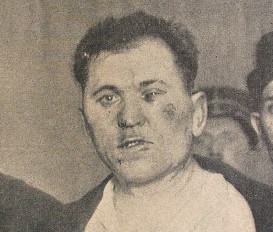
1764: Lt. Vasily Mirovich, for attempting to topple Catherine the Great

On this date* in 1764, one of history’s greatest monarchs cemented her still-uncertain hold on power by beheading a rebellious lieutenant.

Ivan VI: Born under a bad tsar.

Succession in the Russian Empire had been disputatious ever since Peter the Great went and killed off his last male son, eventually putting far-flung branches of the family into a contest for power.

To skip over much regal jockeying, Peter’s vicious niece Anna, who reigned in the 1730s, had installed her infant nephew Ivan VI as successor just before her own death.

The little Tsar of All the Russias was displaced before his second birthday by Peter the Great’s daughter Elizabeth, who clapped the former emperor in a dungeon in Schlusselburg fortress to grow up ignorant and alone, isolated from the parties who might scheme to bid for power in his name. Two Caesars are too many.

Into this dangerous scene stepped Sophia Augusta Frederica, better known to posterity by the name she took upon her politically savvy conversion to Orthodoxy: Catherine.

This Catherine immigrated to wed Elizabeth’s simpleminded heir, then overthrew him a few months into his reign.

Catherine had ultimate power, but she wasn’t yet “Catherine the Great”: as a foreigner with the late Romanov’s blood on her hands (if only indirectly), it was nowhere written that she would rule Russia for 34 brilliant years. And with the throne came its rival claimants … like Ivan, now an adult and potentially more “legitimate” than this imported German princess.

Ivan was held in Man in the Iron Mask-like secrecy, known only as “Nameless Prisoner Number One”; his warders had strict orders to murder him on the spot were any attempt made to liberate him.

Two years into Catherine’s reign, Lt. Vasily Mirovich, “a tormented young officer … with dreams of restoring his family’s fortunes,” attempted just that. As commanded, the guards put an end to Ivan’s troubles.

Those guards got cash rewards and promotions for their diligence. Mirovich got death. (Other soldiers whom he had rallied to his cause were condemned to run the gauntlet; I have been unable to ascertain if any were killed by this punishment.)

Mirovich was executed in St. Petersburg. When his head was held up to the crowd, it had a terrifying impact, the death penalty not actually having been exercised in Russia for 22 years.** Mirovich himself faced his execution calmly, convincing some of the bystanders that he was expecting to be pardoned at the last minute. His remains were left on public display until the evening, when they were burnt along with the gallows.

And so the first two years of the reign of Catherine II, who set so much store by reason and enlightened principles, had included two assassinations and an execution.

The woman of letters, the correspondent of philosophers, the Semiramis of the North … like the age’s other great enlightened despot, Frederick the Great, Catherine had to rule. She had not the luxury to dispense with statecraft’s cruel necessities.

Her admirers would have to be content with making her excuses. Fortunately, admirers always are.

“These are family matters with which I do not meddle,” wrote Voltaire. “Besides, it is not a bad thing to have a fault to repair; this engages her to make great efforts in order to force the public to esteem and admiration”

* September 26 (pdf) was the date on the Gregorian calendar then prevalent in Europe; it was September 15 by the older Julian calendar still used in Russia at the time.

** Not carrying out the death penalty had been a signature policy of Ivan’s usurper Elizabeth. The elimination of capital punishment in “backwards” Russia for an entire generation during the Age of Absolutism surely urges caution against any assumption that death penalty repeal is a one-way street.

On this day..

1932: Paul Gorguloff, who assassinated the French President

On this date in 1932, deranged Russian emigre Paul Gorguloff was guillotined for murdering President Paul Doumer four months before.


The forgettable Paul Doumer — distinguished for reasons quite beyond his control as the penultimate President of the Third Republic — was a week short of his one-year anniversary in office when the nutbar gunned him down at a Parisian book fair.

Disturbed 37-year-old Gorguloff had some impenetrably incoherent justification for the murder having to do with some “Idea” formed in a trance-like state.

From the moment of my arrival in Paris, and even in the train, I had a sort of hypnotic obsession that I must kill the President. I went and prayed in Notre Dame; then I drank heavily, and gradually decided to kill myself, the idea almost supplanting that of assassination. After drinking I conceived the idea of getting arrested to prevent me from committing the crime, so I asked a policeman on the Boulevard Saint-Michel a lot of stupid questions, hoping that he would ask for my papers and, finding them not to be in order, arrest me. All the time the Devil was saying: “Kill yourself, if you like, but only after you have killed the President.” Until 2 o’clock in the afternoon on the day of the crime I drank in a bar, emptying a bottle of cognac in the hope that I would get too drunk to do anything. Nevertheless I finally went to the book exhibition in the Rue Berryer, where the President was expected. After I had spoken with M. Farrere [he was later shot in the arm by Gorguloff] and looked at a few books, the President arrived. I was in a kind of hypnotic sleep, and fired without really knowing what I was doing. (The Times of London, May 18, 1932)

Whatever this daemon may have amounted to in Gorguloff’s mind, he cherished it; the brief trial was punctuated by repeated invocation of the never-explicated “Idea”:

France, listen to me! I am the apostle of my Idea. My crime was a great protest in the name of the miserable ones who wait ‘over there’ [in Russia] … My Idea is more precious than my life. Take my life, but save my Idea. (The Times of London, July 26, 1932)

The “idea” may have been fame. Gorguloff’s defense counsel — understandably pinning its hopes on an insanity defense (French link) — entered into the record a request the assassin had forwarded Czech authorities to be launched in a rocket to the moon; a correspondent for Le Matin discovered that the killer had nursed similarly half-baked plots to do in Hindenburg, Lenin, and Czech President Thomas Masaryk instead/as well.

Gorguloff was beheaded just before 6 a.m. outside La Sante Prison in Paris.

On this day..

1820: John Baird and Andrew Hardie, for the Radical War

On this date in 1820, Scottish radicals John Baird and Andrew Hardie were hanged and then posthumously beheaded (execution broadside | another) at Stirling for treason.

They were the casualties (along with James Wilson, who suffered the same fate on August 30) of the “Radical War”, a short-lived Scottish uprising for economic and political reform.

The whole realm was convulsed by the birth pangs of industrial capitalism: artisans driven into factories; urbanization, exacerbated by lagging political representation for burgeoning population centers; and the revolutionary ideas of 1789 everywhere afoot in Europe.

Indeed, ever since the cataclysmic French Revolution, nervous authorities had kept a very tight lid on excesses of popular agitation. On May 1, 1820, London police hanged the Cato Street conspirators, a small group of radicals baited into plotting an assassination by an agent provocateur who meant to destroy them.

Similar methods were employed further north.

Troubled by dangerous reform movements, the government itself helped instigate a violent rising so it could identify and round up radical elements.

Long story short: in spite of giving itself a bit of a fright with the breadth of response to a general strike, it got a few easily crushed firebreathers to march out in arms. Baird and Hardie, two weavers (an artisan profession that had been particularly affected and therefore particularly radicalized by incipient industrialization), were two of its leaders.

While this blog naturally gravitates to the activities of the iron fist, the crown had wit enough to wear the velvet glove as well. Agitation like the Radical War and the Cato Street conspiracy helped shape the context of gradual constitutional concessions that enabled the British Empire to adapt itself to its changing circumstances. In 1822, the great Scottish jurist Lord Jeffrey (who defended Baird and Hardie at the bar) would write in a private correspondence, “I rather think we are tending to a revolution, steadily, though slowly — so slowly, that it may not come for fifty years yet.”

Traitors’ heads were all a part of the dialectic of authority and legitimacy, the prospect of popular violence in the streets and official violence on the scaffold helping validate moderate reforms as sensible accommodations by both state and populace.

As Gordon Pentland puts it,*

The lesson was one for putative radicals and the authorities as well — attempted risings and executions were to be expected if the opportunities to engage in constitutional activities … were shut down in favour of relying on the machinations of spies.

This lesson looks simple enough in retrospect. But states that did not heed it as the 19th century unfolded ultimately charted a very different course.

That intervening history, Pentland observes, has left layers of contesting interpretative frameworks to debate the proper understanding of the Radical War “martyrs”.

The usability of 1820 was enhanced by its leaving, like William Wallace, precious little in the way of documentary information on actions and intentions. This has allowed the martyrs to be imagined and reimagined in a number of different ways and recruited to a range of political narratives: as the innocent victims of rancorous Tory persecution and as an object lesson in the strengths of British popular constitutionalism; as heirs to the Covenanters and as exemplars of the continuing constitutional duty to resist tyranny; as prototype proletarian revolutionaries; and, latterly, as insurrectionary republican nationalists.

* “‘Betrayed by Infamous Spies’? The Commemoration of Scotland’s ‘Radical War’ of 1820”, Past & Present, November 2008, 201(1).

On this day..

1685: Dame Alice Lisle, first victim of the Bloody Assizes

On this date in 1685, an infamous judicial bloodbath claimed its first and most controversial victim.

Dame Alice (or Alicia) Lisle (or Lyle) was beheaded in Winchester for harboring fugitives from the Battle of Sedgemoor, where pretender and fellow execution-fodder Monmouth was defeated.


Alice Lisle Concealing Fugitives, by Edward Matthew Ward. Detailed views here.

The aged woman had evidently taken in the fugitives John Hickes and Richard Nelthorpe as a humanitarian gesture when they happened to show up at her door; despite her late husband’s part in the regicide of Charles I, Alice Lisle doesn’t seem to have been the political type.

So the fact that Lisle was charged with treason was a national (indeed, transatlantic) controversy … and the fact that she was the first of the thousand-plus rebel prisoners tried set the tone for the legal circuit this month that became remembered as the Bloody Assizes.

In an attainder later reversed under William and Mary, Lisle was convicted and condemned to burn (the sentence was commuted to beheading) by notorious hanging judge Lord Jeffreys.

Macaulay describes this infamous landmark case.

If Lady Alice knew her guests to have been concerned in the insurrection, she was undoubtedly guilty of what in strictness is a capital crime … [t]he feeling which makes the most loyal subject shrink from the thought of giving up to a shameful death the rebel who, vanquished, hunted down, and in mortal agony, begs for a morsel of bread and a cup of water, may be a weakness: but it is surely a weakness very nearly allied to virtue … no English ruler who has been thus baffled, the savage and implacable James [II] alone excepted, has had the barbarity even to think of putting a lady to a cruel and shameful death for so venial and amiable a transgression.

Odious as the law was, it was strained for the purpose of destroying Alice Lisle … [T]he witnesses prevaricated. The jury, consisting of the principal gentlemen of Hampshire, shrank from the thought of sending a fellow creature to the stake for conduct which seemed deserving rather of praise than of blame. Jeffreys was beside himself with fury … He stormed, cursed, and swore in language which no wellbred man would have used at a race or a cockfight …

The jury retired, and remained long in consultation. The judge grew impatient. He could not conceive, he said, how, in so plain a case, they should even have left the box. He sent a messenger to tell them that, if they did not instantly return, he would adjourn the court and lock them up all night. Thus put to the torture, they came, but came to say that they doubted whether the charge had been made out. Jeffreys expostulated with them vehemently, and, after another consultation, they gave a reluctant verdict of Guilty.

Lisle was the only victim of the Assizes at Winchester, but her death would preview the wholesale slaughters to follow.

Jeffreys reached Dorchester the next day and his pitiless tribunal began its work of sentencing hundreds to the various modes of English execution, or else to convict transportation — a fate more lucrative for the crown, but little less terrible to its victims.

“More than three hundred prisoners were to be tried,” Macaulay noted. “The work seemed heavy; but Jeffreys had a contrivance for making it light. He let it be understood that the only chance of obtaining pardon or respite was to plead guilty.”

For all that, the Assizes greatly injured the Stuart cause, precisely because of indiscriminately butchering the likes of Alice Lisle.

Judge Jeffreys’ reputation as a vicious, politically-motivated jurist landed him in the Tower of London by 1689, when he, er, injudiciously stuck around after James II fled the country; reportedly, Jeffreys was lucky to make it to the Tower under guard from the mob that wanted to tear him apart.

Though posterity has the luxury of on-the-one-hand, on-the-other-hand assessment, he remains a villain to most accounts … like the vengeful verse to his memory that prefaces this Victorian text on the Assizes.

To Tyburn thee let carrion Horses draw,
In jolting Cart, without so much as straw;
Jaded, may they lye down i’ th’ road, and tyr’d,
And (worse than one fair hanging, twice bemir’d)
May’st thou be maul’d with Pulchers Sexton’s Sermon,
‘Till thou roar out for Hemp-sake, Drive on Car-man.
Pelted and Curst i’ th’ road by every one,
E’ne to be hang’d may’st thou the Gauntlet run.
Not one good Woman who in Conscience can
Cry out,–‘Tis pitty,–Troth, a proper Man.
Stupid and dull, may’st thou rub off like Hone,
Without an open, or a smother’d groan;
May the Knot miss the place, and fitted be
To plague and torture, not deliver thee;
Be half a day in Dying thus, and then
Revive like Savage, to be hang’d agen.
In Pity now thou shalt no longer Live,
For when thus satisfy’d, I can forgive.

Yikes. Jeffreys actually succumbed to a kidney disease a few months into his captivity. Close enough.

On this day..

1857: Adolf Schlagintweit, intrepid explorer

Sometimes it’s better to let your curiosity rest for a little while, especially when a violent despot takes charge of the region you want to do geological studies on. That was the takeaway lesson for Adolf Schlagintweit (English Wikipedia page | German) when Wali Khan discharged the German explorer’s head in 1857 in the Kashgar region of present-day China.

Schlagintweit and his brothers, Hermann and Robert, were in pursuit of knowledge, following up Hermann and Adolf’s drab and long-titled work Untersuchungen über die physikalische Geographie der Alpen, in ihren Beziehungen zu den phänomenon der Gletscher, zur Geologie, Meteorologie, und Pflanzengeographie (Studies of the Physical Geography of the Alps, in Relation to the Phenomena of Glaciers, Weather, and Phytogeography) and equally odorless (but far more accessibly titled) successor Neue Untersuchungen über die physikalische Geographie und Geologie der Alpen (New Studies of the Physical Geography and Geology of the Alps), authored by all three.

The Schlagintweits were successfully largely because of their ability to draw: their writing left much to be desired, and their scientific skills were frequently a target of ridicule after the voyage that saw the end of Adolf.

The East India Company funded that venture, which was intended to take magnetic field measurements, beginning in 1854. The trek was spurred on by the then-85-year-old Alexander von Humboldt, who had extensively traversed Latin America and attempted the first scientific description of its geology and wildlife; von Humboldt, a noted scientist throughout Europe, convinced the East India Company to pony up large amounts of money for what he expected to be a significant geological study, one that he long sought but could not undertake himself. This relationship is explored in-depth by Gabriel Finkelstein in his well-written History of Science article “‘Conquerors of the Künlün? The Schlagintweit Mission to High Asia, 1854–57”.

The brothers made their way to central India and from there journeyed north into the Himalayas. They did not travel together, but separated and re-united occasionally to go over samples, pictures, and notes.

After their last meeting in the fall of 1856, Adolf’s itinerary brought him through the mountains of Tibet and into present-day China, near the borders with Kyrgystan and Pakistan. It was in this Kashgar region that the geologist found himself embroiled in what would be the last in a series of revolts by the East Turkestan Khojas, a group claiming nobility in Eastern Kazakhstan from the time of Genghis Khan.*

Adolf’s end is largely shrouded in mystery, but some contemporaneous accounts given to the British government provide a minimal sketch. Schlagintweit’s ostensible goal was to reach the city of Kashgar; despite much of his party deserting, and in spite of a warning from fleeing refugees that the notably cruel Wali Khan had initiated a rebellion, Schlagintweit pressed on.

He was met at the city’s border and brought before the Khan, who, having little use for European interlopers wandering his territory, accused the scientist of being a spy and had Adolf summarily beheaded.

Adolf’s notebook was later purchased by a passing Persian from the tobacco shop, where its pages were being used to wrap tobacco leaves. The purchaser tracked down a skull he believed to be Schlagintweit’s and brought the chartaceous and skeletal evidence to India.

The book published from the travels of the Schlagintweits is available here. It has been widely panned as dull.

* Four years after Wali Khan was deposed once again by the Chinese, Uighurs successfully battled for the region’s brief independence. Tensions in the region, needless to say, have not settled.

On this day..

406: Radagaisus the Barbarian

Rome in the 5th Century was a difficult place for the general populace. The Roman Empire was at the front end of its long decline, and with its partitioning in 395 on the death of Theodosius I, a series of invasions was to follow that would shake confidence in the leadership of the Empire.

Possible etymological connection to the possibly proto-Slavic barbarian horde: shadowy Slavic god Radegast lends his gnarly visage to a Czech beer — and maybe to a Tolkein character.

Much of the activity in Rome at the time was tied to the young Visigoth King Alaric. Alaric initially invaded the Eastern Roman Empire, but he was met with resistance in Greece. During negotiations, the de facto head of the Western Roman Empire,* Stilicho, who has been claimed by some sources to have been born a Visigoth, marched on the Goths and prepared to engage in what likely would have been Alaric’s downfall.

According to accounts, Stilicho was called out of the neighboring province of Illyricum, and Alaric, now unencumbered of the prospect of a Western reinforcement, marched through Greece.

But Stilicho would not sit still, and in 397, he brought his army against the Goths and forced them into a difficult spot in the mountains of Pholoe, in the southern prefecture of Illia. Alaric slipped away,** moving his forces north and setting his sights on the Western Roman Empire, starting in northeastern Italy, in 400 AD.

While Stilicho was engaged on this eastern front, the Ostrogoths, led by the commander Radagaisus, prepared for their own invasion. While history is uncertain as to how the series of events transpired, it is clear that Stilicho bested Alaric at Pollentia and Verona and, because of a budding camaraderie with the defeated commander, enjoyed a few years’ respite from the Gothic invaders. Which was useful, because the Roman army had shrunken to a point where even small defeats were extremely costly to the Empire.

So it was that, when Radagaisus invaded Italy in 405, Stilicho had nearly all his army in place. Radagaisus marched with 100,000 people (likely) to 400,000 people (highly unlikely), though a relatively small percentage of these were thought to be armed. His trail of terror displaced uncounted Romans as Radagaisus made his way through northern Italy.

Finally, at the start of the 406 campaign, Stilicho had mustered sufficient forces to assault the invaders. As Radagaisus blockaded Florence, Stilicho amassed his regulars and, fortified also with recalled frontier soldiers, massacred the opposition. The battle was decisive, with the Roman army starving out the invading hordes, and Radagasius apparently quickly losing control of his loose band of warriors.

Whether he was turned on by his own men, or whether the Romans simply overran their enemies after a period of famine, Radagasius eventually fled the battlefield and was captured at one of Stilicho’s outposts. On 23 August 406, the man who called himself King Radagasius was beheaded.† Many of his soldiers defected to the Roman army — joining a long line of conscripts from conquered people — and his supporting band was scattered or enslaved.

Like Alaric, Radagasius has sometimes been indicated as King of the Goths, but his history is a little more murky than that. Radagasius (or Rhodogast, or Radegast, depending on the source) issued from northern Germany before making his march. He had united several tribes under his banner, but he could hardly be said to rule any region. And because of the remoteness of Ostrogoth territories and the limited written history on the region, it’s difficult to assess his true nature.

* Stilicho was protector of the underage Honorius, who has been regarded as weak and incompetent. Honorius died in 423, long after Stilicho was murdered.

** Alaric and Stilicho may have been conspiring at this point: Stilicho again claimed to have been recalled from the battlefield, but, owing to their common heritage and their later connections in defense of the Empire, it’s thought that Stilicho was actively recruiting Alaric for military service in defense of Rome.

† “The death of the royal captive, who was ignominiously beheaded, disgraced the triumph of Rome and of Christianity,” sniffed Edward Gibbon.

On this day..

1468: Charles de Melun, governor of Paris

On this date in 1468, Charles de Melun (French link) was executed at Andelys by Louis XI on a trumped-up treason charge.

The execution stemmed from a civil war fought by crown against nobles struggling to preserve their feudal rights — and specifically, a 1465 battle won by the nobles’ intrepid standard-bearer Charles the Bold. Louis was grumpy at his governor of Paris for not relieving him in time, and when the wheel of courtly politics turned sufficiently, that incident supplied enough suspicion to destroy Melun.

Hear now of Melun from The History of the Bastile, and of Its Principal Captives.

The war, caused by the League of the Public Good, which restored liberty and fortune to Chabannes, deprived his enemy, the count de Melun, not only of both, but of life also. When we are told that Melun was so addicted to pleasure, luxury and sloth, as to have acquired the name of the Sardanapalus of his times, we can form no very flattering estimate of his character. Yet he stood high in the good graces of Louis XI, and participated largely in the spoils of Chabannes. In his capacity of governor of Paris and the Bastile, he was also entrusted with the custody of that nobleman. It was not till after the battle of Montlheri that Louis began to suspect him. The monarch had, indeed, some excuse for suspicion. Melun had at least been criminally negligent, in a post which demanded the utmost vigilance. He had prevented a sally from the city during the battle, which might have turned the scale in the king’s favour, and he had been ignorant of, or winked at, a correspondence carried on with the chiefs of the League by some of the disaffected citizens. These indications of treachery were strengthened by two circumstances; some of the cannon of the Bastile had been spiked, and the gates of the fortress, on the side next the country, had been left open while the besiegers were making an attack. The escape of Chabannes might also afford a reason for doubting his keeper’s fidelity. Louis, however, was, at this moment, too closely pressed by his numerous enemies to enter into an investigation of the subject; and he, therefore, only dismissed the governor.


The Battle of Montlhery

Melun retired to his estates, and imagined that the storm was blown over. He was mistaken. As soon as Louis had disembarrassed himself, he instituted a rigid enquiry into the conduct of his disgraced favourite. One of the most active in pushing it on was a man who was indebted to the count for his rise in life; the cardinal Balue, of whom further mention is about to be made. The result of the enquiry was, a charge of having maintained a secret correspondence with the heads of the League, especially with the duke of Britanny. Melun was in consequence arrested, and conveyed to Chateau Galliard, in Normandy, by the provost Tristan l’Hermite, of infamous memory.*

The trial was commenced without delay, and, as he refused to confess to any crime, he was put to the torture. With respect to his correspondence with the chiefs of the League, he avowed it, but pleaded that it had the king’s sanction. It is probable that this was really the case. Many motives might have induced the king to allow of his officer corresponding with the enemy. But Louis had now resolved upon the destruction of Melun; and, as he never scrupled at falsehood when he had any point to gain by it, he denied that he had given the permission. By adding that he had long had cause to be dissatisfied with the prisoner, he gave a broad hint as to what kind of verdict he desired.** The judges, as in duty bound, pronounced Melun guilty, and he was consigned to the scaffold. His execution took place in 1468. Of his confiscated property, a considerable portion was bestowed on Charbannes.

It is said, that the executioner having only wounded him at the first stroke, Melun raised his head from the block, and declared, that he had not deserved death, but that, since the king willed it, he was satisfied. If this be true, we must own that tame submission to the injustice of a despot was never more strikingly displayed.

Had Melun lived but a little longer, he might have triumphed in the downfall and punishment of his ungrateful enemy, the cardinal, which took place in 1469 … The cardinal, and his his friend and agent William d’Harancourt, bishop of Verdun, were in close correspondence with his enemies.†

Though Melun generally goes down as a guy who caught a bum rap — probably even Louis XI thought so, given the subsequent fall of Melun’s rivals — this 19th century history of France observes that such consideration turns on noblesse oblige, for while “such crime on the part of a burgess was considered worthy of death, nobles practised breach of faith as a pastime, and a lucrative one, until it was rendered a serious matter by sending the guilty to the scaffold.”

* For instance, in Victor Hugo’s The Hunchback of Notre Dame, Tristan l’Hermite is the man dispatched by Louis XI to seize Esmeralda from the cathedral for hanging.

** According to The Law of Treason and Treason Trials in Later Medieval France, Louis XI actually testified at Melun’s trial. Talk about a star witness.

† More about Balue’s disgrace here.

On this day..

1626: Henri Talleyrand, Comte de Chalais

The name Talleyrand is generally synonymous with the famed “Prince of Diplomats” who spanned the Republic, Empire, and Kingdom.

But that Talleyrand — Charles Maurice de Talleyrand-Périgord, multiply French foreign minister, former Bishop of Autun, one-time Prince of Benevento, Ambassador to the United Kingdom — was just one in a long line of the Talleyrand-Perigords (pdf link) who made a name for themselves.

In 1626, Henri de Talleyrand-Périgord, Comte de Chalais, head of wardrobe to King Louis XIII, was one member of that house whose neck was shortened for an offense against the king’s court.

Henri — as he shall be herein known, so as not to confuse him with his many relatives — was the youngest of three children. Born in 1599, he served in the military at the unsuccessful Siege of Montauban in 1621 and 1622. (The defeat (temporarily) preserved Huguenot rights in France.)

In 1623, Henri returned from war and married Charlotte de Castille (not to be confused with the modern porn star!). It was not long after that rumors of Castille’s impropriety started making the rounds, as immortalized in Tallemant de Réaux‘s verse, whose rough translation is as follows:

Pontgibault boasts,
On seeing the slit
Of the Countess of Alais
Who likes the strong ballet,
And says hers is more charming
Than the Chalais’.

And that, not so roughly translated, is why Pontgibault received a visit from an irate Henri.

Henri is alleged to have challenged a duel, where he cock-blocked his cuckold — permanently. The European ideals of chivalry yet persisted, so there was some question whether this affair constituted murder, and the trial was the talk of France through the winter of 1623.

It was at this trial that the lines were drawn: Henri was joined in his effort to fight the charges by the Grand Prieur Alexandre de Vêndome, Monseiur Gaston d’Orléans (brother to the king), Jean-Baptiste d’Ornano, Louis de Bourbon (Comte de Soissons), and others.

Henri successfully defended himself, but this did not put the fire back into the marital bed. Instead, Henri’s loins turned toward Marie de Rohan-Montbazon, duchesse de Chevreuse.

Madame de Chevreuse, former lover of Henry Rich (later Earl of Holland), had a string of lovers, and it’s questionable whether Henri was among them. Whether he was or not, she ignited in him a passion that would lead to his execution.

The impetus for this execution was ostensibly a plot to save Gaston d’Orléans, who, by decree of Louis XIII, was to marry Marie de Bourbon, duchesse de Montpensier. The union would bring significant wealth into the family of Louis XIII.

Backed by his First Minister Cardinal Richelieu, the king was insistent. For several years, Richelieu had also been reducing the power of the nobility and consolidating central authority around the king, which was not the way Madame de Chevreuse envisioned the world.

Instead, she sought to install Gaston d’Orléans on the throne, thus advancing her agenda to restore power to the nobility. The forced marriage became a convenient excuse to enact her plan against Richelieu. And her charming way with men made it easy to find participants.

Madame de Chevreuse and d’Ornano were at the heart of the conspiracy, but their reach extended as far as England and Spain. She was also supported by Anne of Austria, who is thought to have played a critical role in organizing the conspirators. At the very least, the collective hope was to make Monseiur abandon Louis XIII’s court and seek an alliance with the Hugenots, who would be sympathetic to a cause against the Catholic Church.

The juicy details of the winter of 1625-1626 are cataloged in H. Noel Williams’ A Fair Conspirator Marie De Rohan, Duchesse De Chevreuse, but a summary version is sufficient here.

At some point, Richelieu caught wind of d’Ornano’s involvement in a conspiracy against the throne; not knowing the extent of the effort, he had d’Ornano detained. Lest their plot be found out, the conspirators encouraged Gaston to initiate a war; this was particularly true of Comte de Soissons, who posted a reward should Monseiur take up arms against his brother.

Gaston hesitated, and a new plan was enacted.

Instead, some of the conspirators would take audience with Richelieu and either detain or kill him, depending on the story. Needless to say, the plan failed, and the conspirators were found out. Chalais tried to lay low while the plot against the king and his minister unfolded, but he did not sufficiently distance himself from Madame de Chevreuse: Gaston was exposed and named names, and Chalais, not well-connected enough to fight the charges against him, was captured at Nantz on July 8.

Henri de Talleyrand-Périgord, Comte de Chalais, was sentenced to death by beheading for lèse-majesté, and on August 19, 1626, he mounted the scaffold at Place de Bouffay in Nantz. In a last, cruel twist, the conspiracy had bought off the town executioner in hopes that, lacking a practitioner of the macabre art, Chalais might be spared. But a replacement had been hastily found: a man himself condemned to death:

The [replacement] was so unskillful that, besides two blows from a Swiss sword, which had been purchased on the spot, he gave him thirty-four with an adze such as carpenters use; and was obliged to turn the body round to finish the severing of the neck, the patient exclaiming up to the twentieth blow: ‘Jesus, Maria et Regina Cali!’

No other conspirators were put to the sword, and Gaston and his brother eventually made up. Richelieu, meanwhile, gained more power and transitioned France from a feudal state to an absolute monarchy under Louis XIII and his successor, Louis XIV. His dealings form the backdrop of The Three Musketeers.

As for Madame de Chevreuse — who also figures in The Three Musketeers, scheming behind the scenes against Richelieu and crushed on by Aramis — she fled to Château d’Dampierre, then was exiled to England, where she fell in with the Duke of Lorraine (and became his mistress); she attempted to organize several more coups against the Red Eminence, but each fell short of the mark.

Madame de Chevreuse eventually ended up in Spain, then moved back to England, then shipped out to Flanders, where she connected once again with the Comte de Soissons and attempted to usurp the throne before it could be passed to Louis XIV. When Richelieu finally passed, she sought to oust his replacement, this time relying on César de Bourbon, duc de Vendôme, who was also involved in the Chalais conspiracy. After this failure, Madame de Chevreuse retired to Gagny.

Elizabeth Stone writes of Madame de Chevreuse in Political Women, “It was not she evidently who made of Buckingham a species of paladin without genius; a brilliant adventurer of Charles IV of Lorraine; of Chalais a hair-brained blunderer, rash enough to commit himself in a conspiracy against Richelieu, on the faith of the faithless Duke d’Orleans; of Châteauneaf, an ambitious statesman, impatient of holding second rank in the Government, without being capable of taking the first.”

Be that as it may, she is a compelling historical figure, and the Chalais conspiracy formed the basis for the operatic tragedy Maria di Rohan.

The conspiracy has also been used in an unusual modern form as an audio drama episode of Doctor Who.

(A complete discussion of Talleyrand-Périgord’s life can be found here. (French link) Breathless French court gossip in a 19th century biography of Chevreuse here.)

On this day..

1943: Blessed Franz Jagerstatter, conscientious objector

On this date in 1943, an Austrian farmer was beheaded in Berlin’s Plotzensee Prison for refusing to fight for the Third Reich.

Franz Jägerstätter, who lost his own father in World War I, was anschlussed right into the Third Reich when Germany absorbed Austria in 1938.

In Solitary Witness is the aptly-titled biography of the man; though his fatal refusal of mandatory military service (and his critique of Nazi Germany) sprang from his deep-rooted Catholicism, it was far from the norm for his German-Catholic neighbors.

“We must go courageously on the way of suffering,” he wrote, “whether we begin sooner or later.” Somewhat oddly neglected as a martyr figure in the immediate postwar period, Jagerstatter was recently beatified by Pope Benedict XVI — a German himself, of course, who did not refuse his tiny measure of youthful service to the Wehrmacht in those years, and who assuredly grasps the untapped public relations potential of this compelling figure.


An icon of Franz Jagerstatter, and a naked Nazi imp.

Jagerstatter’s widow is still alive; she and her children movingly keep Franz’s memory to this day — and his example continues to inspire Catholics who go the way of suffering today against war and injustice.

On this day..

1540: Thomas Cromwell

“Who cannot be sorrowful and amazed that he should be a traitor against your majesty? He that was so advanced by your majesty, he whose surety was only by your majesty, he who loved your majesty, as I ever thought, no less than God; he who studied always to set forward whatsoever was your majesty’s will and pleasure; he that cared for no man’s displeasure to serve your majesty; he that was such a servant, in my judgment, in wisdom, diligence, faithfulness, and experience, as no prince in this realm ever had …

If he be a Traitor, I am sorry that ever I loved him, or trusted him, and I am very glad that his treason is discovered in time; but yet again I am very sorrowful; for who shall your grace trust hereafter, if you might not trust him? Alas!”

Archbishop Thomas Cranmer, writing to King Henry VIII upon news of the arrest of Thomas Cromwell

It was on this date in 1540 that the Machiavellian minister of Henry VIII fell by the instrument he had wielded so ably against so many others.

While Henry strove to get his end away, Thomas Cromwell made the Reformation, setting his energetic hand to the needfully violent reordering of England.

In almost a decade as the king’s chief minister, he had dissolved so many monasteries, annulled so many noble prerogatives, backstabbed so many courtiers, and sent so many of every class to the scaffold that most at court had some reason to hate him. (Cranmer was the only one to (cautiously) object to his old partner’s arrest.)

Every matter of importance in 1530’s England concerned Cromwell. He raised and then destroyed Anne Boleyn; he managed the realm’s religious turmoil so fearsomely that his ouster was one of the demands of the Pilgrimage of Grace; he did what he had to do in the matter of Sir Thomas More.

Hilary Mantel’s acclaimed Man-Booker Prize-winning 2009 novel Wolf Hall humanizes Cromwell’s side of his clash with Thomas More. (Review)

Though it may be, as Edward Hall recorded, that “many lamented but more rejoiced” at Cromwell’s fall from the very height of his power — “and specially such as either had been religious men, or favoured religious persons; for they banqueted and triumphed together that night [of his execution], many wishing that that day had been seven year before” — the reasons for it are murky enough to invite recourse to the royal person’s irrationality.

The bedroom politics get all the press: Cromwell’s bit of marital statecraft arranging Henry’s marriage to Anne of Cleves was a famous dud, but negotiations to end it were well on their way by the time of Cromwell’s arrest.

Why, too, should the minister have been ennobled Duke of Essex in April 1540, months after the disastrous union? That Cromwell, whose own security rested upon the stability of the realm, was a radical Protestant promulgating inflammatory religious ideas — and he was condemned for both treason and heresy, incidentally giving the king wide latitude for just how painfully to kill his former servant — seems to beggar belief.

Once fallen, Cromwell was kept alive long enough to add testimony to the Cleves divorce; that much is clear. But then why keep him alive still three weeks more?

In the end, maybe it was inevitable that one in his position, at his time and place, had to follow to the scaffold the many he had sent thither, just the Tudor version of that familiar “bad advisors” trope: it were not treason to murmur against the aide whose ill counsel did wrong by His Majesty, and so Cromwell stood to accumulate the share of hostility that properly belonged to his sovereign. As an expert practitioner of the game of power politics, Thomas Cromwell could hardly be in a position to complain.

Oh, and by the by: with the German princess on the outs, the king’s wandering eye had fallen upon a niece of Cromwell’s enemy. On the day that Cromwell lost his head, Henry married Catherine Howard. No matter your brilliance, in Henrican England you only had to lose at court politics once, even if the king would be lamenting this injudicious trade within months.

Henry gave his loyal servant the easiest death, beheading on Tower Hill (although it turned out to be a botched job) — alongside a distinctly undercard attraction, Walter Hungerford, the first person executed under the Buggery Act.

Hall records Cromwell playing ball with a fine entry in the scaffold-speech genre that kept his son in the peerage.

I am come hether to dye, and not to purge my self, as maie happen, some thynke that I will, for if I should do so, I wer a very wretche and miser: I am by the Lawe comdempned to die, and thanke my lorde God that hath appoynted me this deathe, for myne offence: For sithence the tyme that I have had yeres of discrecion, I have lived a synner, and offended my Lorde God, for the whiche I aske hym hartely forgevenes. And it is not unknowne to many of you, that I have been a great traveler in this worlde, and beyng but of a base degree, was called to high estate, and sithes the tyme I came thereunto, I have offended my prince, for the whiche I aske hym hartely forgevenes, and beseche you all to praie to God with me, that he will forgeve me. O father forgeve me. O sonne forgeve me, O holy Ghost forgeve me: O thre persons in one God forgeve me. And now I praie you that be here, to beare me record, I die in the Catholicke faithe, not doubtyng in any article of my faith, no nor doubtyng in any Sacrament of the Churche.* Many hath sclaundered me, and reported that I have been a bearer, of suche as hath mainteigned evill opinions, whiche is untrue, but I confesse that like as God by his holy spirite, doth instruct us in the truthe, so the devill is redy to seduce us, and I have been seduced: but beare me witnes that I dye in the Catholicke faithe of the holy Churche. And I hartely desire you to praie for the Kynges grace, that he maie long live with you, maie long reigne over you. And once again I desire you to pray for me, that so long as life remaigneth in this fleshe, I waver nothyng in my faithe.

And then made he his praier, whiche was long, but not so long, as bothe Godly and learned, and after committed his soule, into the handes of God, and so paciently suffered the stroke of the axe, by a ragged and Boocherly miser, whiche very ungoodly perfourmed the Office.

If Cromwell’s dying sentiment concealed any lasting bitterness for the crown, maybe his spirit would take some satisfaction a century later when another of his name and family rose high enough to behead a king.

* Cromwell’s bit about the “Catholic faith” in his dying confession is to be carefully handled; it’s sometimes rendered “the traditional faith,” and occasionally treated by later Protestant polemicists as a phony addition made by Roman apologists. It’s not, appearances aside, walking back the Reformation; according to Charles Carlton’s “Thomas Cromwell: A Study in Interrogation” (Albion: A Quarterly Journal Concerned with British Studies, Vol. 5, No. 2 (Summer, 1973)) our day’s victim “did not see himself as a Catholic separate from the Church, but as a Christian, who, with his King, had escaped the Pope’s usurped authority.” Cromwell is also explicit in this passage about rejecting sacramentarianism, which was part of the heresy accusation against him.

On this day..