On this date in 1941, Nazi Berlin disposed of its railway killer.
Roger Moorhouse, author of a forthcoming book about Ogorzow, tells the story of this unjustly neglected homicidal maniac on his blog, and in a BBC History Magazine interview:
Paul Ogorzow (German link) plied his trade in a city blacked-out against British bombing, but he provides an illuminating glimpse at criminal investigation.
While Ogorzow benefited from Berlin’s preternatural darkness, he didn’t go greatly out of his way to cover his tracks otherwise. At least four of his eight murders were within a mile of his house; one woman who survived his attack reported the assailant was wearing German Railways kit.
The police, prone then as now to (sometimes hastily) settle on a theory and seek evidence to confirm it, remained blind to the seemingly obvious possibility that a railway worker was the culprit … even if he also happened to be a Nazi party member in good standing.
The official fixation on Untermenschen may not be surprising given the ideological climate, but Germany had had its share of noteworthy murderers in the interwar years who were neither Jews nor foreign laborers nor British agents — the suspect profiles favored by German investigators while Ogorzow continued his killing spree.
With the slightest measure of care, the S-Bahn Murderer might have plied his hobby unmolested until the wartime manpower shortages started making him look like an attractive bit of cannon-fodder for the eastern front. Alas for him, his voracious appetite for murder — eight victims with similar m.o. in just a few months — eventually made him so obvious that even the police could no longer overlook him.
Although the government kept the crime and its unedifying investigation fairly quiet, it was known. There was even a 1944 true crime potboiler by Wilhelm Ihde (pseudonymously writing as “Axel Alt”), Der Tod fuhr im Zug (Death Rode the Train). According to Todd Herzog,
Alt’s novel is representative of the dominant tendency of the period to celebrate the work of the criminal police while avoiding any portrayal of the totalitarian apparatus that surrounded criminal politics in the Third Reich.
Little surprise there.
Alt’s novel ultimately aligns itself with [Fritz] Lang’s film [M] in showing the methodical work of professional detectives to be ineffective in capturing the modern killer and explicitly calling for … recruitment of the public to aid the police in fighting crime.
She is of stately Norman figure; in her twenty-fifth year; of beautiful still countenance: her name is Charlotte Corday, heretofore styled d’Armans, while Nobility still was … A completeness, a decision is in this fair female Figure: ‘by energy she means the spirit that will prompt one to sacrifice himself for his country.’ What if she, this fair young Charlotte, had emerged from her secluded stillness, suddenly like a Star; cruel-lovely, with half-angelic, half-demonic splendour; to gleam for a moment, and in a moment be extinguished: to be held in memory, so bright complete was she, through long centuries!–Quitting Cimmerian Coalitions without, and the dim-simmering Twenty-five millions within, History will look fixedly at this one fair Apparition of a Charlotte Corday; will note whither Charlotte moves, how the little Life burns forth so radiant, then vanishes swallowed of the Night.
Hapless beautiful Charlotte; hapless squalid Marat! From Caen in the utmost West, from Neuchatel in the utmost East, they two are drawing nigh each other; they two have, very strangely, business together.
Or was it strange at all?
Implacable in her purpose, utopian in her design, unafraid to plant a butcher’s knife into the chest of an enemy of France, Corday has a little something in common with her mortal foe.
These make casting too easy: Marat, bad because he was ugly and ugly because he was bad; Charlotte, therefore, just the reverse. (She was also a virgin; they made sure to check at the autopsy.) Our Norman assassin’s looks have inordinately exercised her interlocutors from the moment of her arrest; her prosecutors, too, understood them as essential.
“Not at all pretty,” a contemporaneous government article (cited in Crisis in Representation) put about. “She was a virago, brawny rather than fresh, without grace, untidy as are almost all female philosophers and eggheads … an old maid … with a masculinized bearing … [who] had thrown herself absolutely outside of her sex.”
And there it is. Charlotte Corday’s power to excite both rapture and repulsion is plainly rooted in the unexpected contradiction between her sex and her crime. If she is a resolute political assassin, surely she is not feminine … or is it the other way around?
Take Andre Chenier‘s engorged ode: “Fair, young, resplendent, led to the executioners, you seemed to be riding in your bridal car … You alone were a man and vindicated the human race. And we, vile eunuchs, a cowardly and soulless herd, we know how to repeat some womanly whimper, but the steel would weigh heavy in our feeble hands. … One scoundrel less crawls in this slime. Virtue applauds you. Hear the majestic sound of its virile praise, heroic maid.” This is “throwing herself outside of her sex” in the affirmative sense of uplifting herself beyond mere womanhood, a girl so heroic she might almost qualify as a dude.
Place it at the historical pivot into a modernity unready to reckon with the place of the woman, and confusion reigns.
“The spectacle of such wickedness, beauty, and talent united in the same person,” a newspaper recorded, “the contrast between the magnitude of her crime and the weakness of her sex, her appearance of actual gaiety, and her smile before the judges, who could not fail to condemn her, all combined to create an impression on the spectators that is difficult to portray.”*
Still, this judgment offers more insight than some latterly “tributes,” like this Anglo magazine piece 30 years later: “an ornament and an honour to the sex of woman … Woman is the child of feeling. From this source spring up all her good and bad qualities. It is seldom ambition or policy which leads her on to any enterprise: it is the passions. … it was under the influence of such feelings that Charlotte Corday performed that act, which virtuous and generous minds, so far from considering a crime, will look upon as one of the most heroic deeds of recorded history.”
Which is a fascinating form of sexism, since it was precisely Corday’s unearthly calm — masculine virtue! — that awed the Revolutionary Tribunal. But everything about Charlotte Corday is up for interpretive grabs; Nina Rattner Gelbart even argues, in “The Blonding of Charlotte Corday” (Eighteenth-Century Studies 38.1 (2004)) that though a real-life brunette, her depictions trend increasingly flaxen-haired.**
As for Charlotte Corday her work is accomplished; the recompense of it is near and sure. The chere amie, and neighbours of the house, flying at her, she ‘overturns some movables,’ entrenches herself till the gendarmes arrive; then quietly surrenders; goes quietly to the Abbaye Prison: she alone quiet, all Paris sounding in wonder, in rage or admiration, round her. …
On Wednesday morning, the thronged Palais de Justice and Revolutionary Tribunal can see her face; beautiful and calm: she dates it ‘fourth day of the Preparation of Peace.’ A strange murmur ran through the Hall, at sight of her; you could not say of what character. Tinville has his indictments and tape-papers the cutler of the Palais Royal will testify that he sold her the sheath-knife; “all these details are needless,” interrupted Charlotte; “it is I that killed Marat.” By whose instigation? — “By no one’s.” What tempted you, then? His crimes. “I killed one man,” added she, raising her voice extremely (extremement), as they went on with their questions, “I killed one man to save a hundred thousand; a villain to save innocents; a savage wild-beast to give repose to my country. I was a Republican before the Revolution; I never wanted energy.” There is therefore nothing to be said. The public gazes astonished: the hasty limners sketch her features, Charlotte not disapproving; the men of law proceed with their formalities. The doom is Death as a murderess. To her Advocate she gives thanks; in gentle phrase, in high-flown classical spirit. To the Priest they send her she gives thanks; but needs not any shriving, or ghostly or other aid from him.
On this same evening, therefore, about half-past seven o’clock, from the gate of the Conciergerie, to a City all on tiptoe, the fatal Cart issues: seated on it a fair young creature, sheeted in red smock of Murderess; so beautiful, serene, so full of life; journeying towards death,–alone amid the world. Many take off their hats, saluting reverently; for what heart but must be touched? Others growl and howl. Adam Lux, of Mentz, declares that she is greater than Brutus; that it were beautiful to die with her: the head of this young man seems turned. At the Place de la Revolution, the countenance of Charlotte wears the same still smile. The executioners proceed to bind her feet; she resists, thinking it meant as an insult; on a word of explanation, she submits with cheerful apology. As the last act, all being now ready, they take the neckerchief from her neck: a blush of maidenly shame overspreads that fair face and neck; the cheeks were still tinged with it, when the executioner lifted the severed head, to shew it to the people. ‘It is most true,’ says Foster, ‘that he struck the cheek insultingly; for I saw it with my eyes: the Police imprisoned him for it.’†
In this manner have the Beautifullest and the Squalidest come in collision, and extinguished one another. Jean-Paul Marat and Marie-Anne Charlotte Corday both, suddenly, are no more. ‘Day of the Preparation of Peace?’ Alas, how were peace possible or preparable, while, for example, the hearts of lovely Maidens, in their convent-stillness, are dreaming not of Love- paradises, and the light of Life; but of Codrus’-sacrifices, and death well earned? That Twenty-five million hearts have got to such temper, this is the Anarchy; the soul of it lies in this: whereof not peace can be the embodyment! The death of Marat, whetting old animosities tenfold, will be worse than any life. O ye hapless Two, mutually extinctive, the Beautiful and the Squalid, sleep ye well,–in the Mother’s bosom that bore you both!
While the assassin went contentedly to her death, and left smitten admirers in her passing, more realistic politicians saw that all her magnificent stoicism, all her self-sacrifice, had doomed the liberals who were her political fellow-travelers and opened the door to the very Terror she meant to avert. (And also that the gesture might have been better directed elsewhere, since Marat was already dying.)
What meaning this leaves one with — any at all? — is the subject of the Peter Weiss play-within-a-play Marat/Sade, which sets a cast of lunatics in the Napoleonic era under the direction of the Marquisde Sade to portraying Marat’s rendezvous with Charlotte Corday.
* Cited by Elizabeth R. Kindleberger in “Charlotte Corday in Text and Image: A Case Study in the French Revolution and Women’s History,” French Historical Studies, Vol. 18, No. 4 (Autumn, 1994).
** Also of interest from Gelbart is the Vichy government’s affinity for our murderess: “Antisemitism made of Marat a Jew and a vile creature, dark, dirty, satanic, a bloodthirsty monster. In contrast, Corday was pure, saintly, beautiful, virginal, and of course fair.”
† The slap given Charlotte Corday’s severed head is historically attested by the French press (which was aghast); the famous story about it of a much more fantastic quality is that the severed head blushed — and, in the phrasing of Englishwoman Helen Maria Williams, “exhibited this last impression of offended modesty.” The legend of Charlotte’s crimsoned cheeks always comes up in the backstory of the guillotine’s experiments to determine if a head retained consciousness; Charlotte’s blush may in fact be credited as one of the reasons these experiments actually came to pass.
On this date in 1977, a 19-year-old royal adulteress and her paramour were executed in a Jeddah parking lot by the order of the girl’s powerful grandfather.
Princess Misha’al‘s fate has been obscured by secrecy and the Rashomon-like interpretations imposed upon it by observers.
In its outline (and the first stock interpretation we’re imposing) it’s that timeless human tragedy, the love story, in which headstrong royal daughter and suffocating traditional family square off over the seditious power of the feminine libido.
The princess, in a youthful arranged marriage by most accounts, took up with a Saudi boy while both were studying abroad in cosmopolitan Beirut, and dangerously attempted to maintain the affair back in the royal kingdom to the point of a quixotic (and obviously foiled) escape attempt. Whether under color of a judicial proceeding — the story says Misha’al refused to walk away by simply renouncing her lover and defiantly brought down the death sentence by confessing adultery — or simply on his own authority, the girl’s staunchly conservative* grandfather exercised his right as tribal patriarch to inflict an honor killing for the disgrace they had brought on the family.
The execution in Jeddah — she by gunshot,** he by a very clumsy beheading — that is supposed to have occurred on this date was public, but quiet; news of it got abroad only slowly and incompletely. Small wonder that, once it did, the blended motifs of Romeo and Juliet, harem titillation and oil politics made dynamite material for high-, middle- or lowbrow exploitation.
In 1980, the affair became the subject of one of the most notorious television programs ever aired, the docudrama Death of a Princess. This film’s airing in Britain in 1980 led Riyadh to expel the British ambassador, and cost £200 million of lost revenue for the UK from canceled orders and product boycotts by the Saudis.†
It was aired on in the United States on PBS in 1980 to similar controversy, as oil companies rushed to distance themselves from it.
Rebroadcast in 2005, Death of a Princess is available online for your judgment (as is this partial script): is this a muckraking expose of a shameful crime? orientalist heavy petting? “a sensitive and thoughtful exploration of the Arab dilemma,” as per its own advance publicity? and what did the official apologies (and in only a few countries, censorship) say about the political weight of the petroleum industry?
These, meanwhile, are the western reactions, already removed from events by a further layer of mediation, a forest of axes seeking grinding. If the writer who composed this piece is to be believed, the executed girl has posthumously achieved a sort of universal symbolic gravity in the Arab world, standing for the plight of any hopeless cause of justice dashed against authoritarian power.
* For the House of Saud, it must be recalled, the personal was political in the problematic confrontation between tradition and modernity athwart the desert kingdom’s sea of oil.
** “Princess Misha’al” was executed fully veiled, which permits the rumor that the slain woman was actually a surrogate and the onetime royal favorite lives on incognito somewhere.
Early this Monday morning in 1836, Louis Alibaud — having been condemned to death by the Chamber of Peers at trial the preceding Friday and Saturday — lost his head for taking a shot at oft–shot–at French King Louis-Philippe.
As related by the London Times (July 6, 1836),
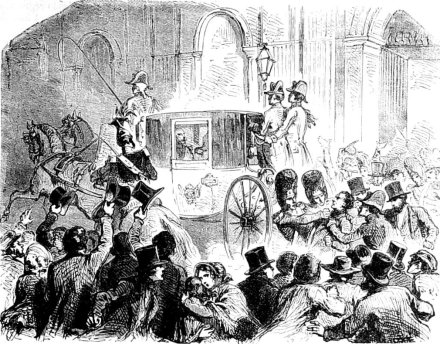
at half-past 6 in the afternoon of the 25th of June, 1836; the windows of the carriage were lowered, and it was passing through the gate [of the Tuileries palace] leading to the Pont Royale, when a man, who had been standing by a post in the court, raise [sic] a cane gun and discharged it against the King. By a miraculous chance the King was lowering his head to salute the National Guard under arms, and the ball passed just four lines above his head, and entered one of the angles of the carriage, settling about an inch deep in an oak beam.
The assassin was immediately arrested; he was a young man, of about 25 years of age, dressed in a dark coat, cloth pantaloons, and black hat, and wearing under his chin a thick brown beard.
Naturally, this line had neither the intent nor the effect of securing clemency, and he was repeatedly cautioned by the court against pursuing it; all concerned knew precisely where matters were headed, of course, and the state had no interest in providing a public forum for sedition.
At 4 o’clock in the morning this day — as a favor to her powerful father to limit the public spectacle — Jean Livingston lost her head for arranging the murder of her husband just three days before.
Provoked by one beating too many, Lady Waristoun (or Lady Warriston) got a servant to murder him in his bed on the night of July 1.
Robert Weir blew town — he wouldn’t be apprehended until 1604, whereupon he suffered one of the very few instances of execution on the breaking-wheel to occur in the British Isles — but the Lady and her nurse Janet Murdo were “caught red-handed”, an actual juridical concept in Scottish law which means what it says on the tin.
They were condemned to death by burning, which dad’s pull was able to mitigate for his daughter (but not the nurse), so
scho wes tare to the Girth Crosse upon the 5 day of Julii, and her heid struk fra her bodie at the Cannagait fit; quha diet verie patiently. Her nurische wes brunt at the same tyme, at 4 houres in the morneing, the 5 of Julii.
In the exceedingly brief time — about a day and a half — between sentence and execution, Lady Waristoun was reported to have undergone a wonderous transformation. The not-uninterested report* of her confessor offers these mournful final words, a stark contrast to her defiant state just after condemnation.
The occasion of my coming here is to show that I am, and have been, a great sinner, and hath offended the Lord’s Majesty; especially, of the cruel murdering of mine own husband, which, albeit I did not with mine own hands, for I never laid mine hands upon him all the time that he was murdering, yet I was the deviser of it, and so the committer. But my God hath been always merciful to me, and hath given me repentance for my sins; and I hope for mercy and grace at his Majesty’s hands, for his dear son Jesus Christ’s sake. And the Lord hath brought me hither to be an example to you, that you may not fall into the like sin as I have done. And I pray God, for his mercy, to keep all his faithful people from falling into the like inconvenient as I have done! And therefore I desire you all to pray to God for me, that he would be merciful to me!
Then, she had her head lopped off by the maiden while at the same hour Janet Murdo, much less wept for, was burnt alive at Castlehill.
This sudden and sensational fall of an elite, and allegedly beautiful, woman obviously made quite a splash, with printed accounts feeding almost inevitably into the Scots ballad tradition.
My mother was an ill woman,
In fifteen years she married me ;
I hadna wit to guide a man,
Alas! ill counsel guided me.
O Warriston, O Warriston,
I wish that ye may sink for sin;
I was but bare fifteen years auld,
When first I enter’d your yates within.
I hadna been a month married,
Till my gude Lord went to the sea;
I bare a bairn ere he came hame,
And set it on the nourice knee.
But it fell ance upon a day,
That my gude lord return’d from sea;
Then I did dress in the best array,
As blythe as ony bird on tree.
I took my young son in my arms,
Likewise my nourice me forebye;
And I went down to yon shore side,
My gude lord’s vessel I might spy.
My lord he stood upon the deck,
I wyte he hail’d me courteouslie;
“Ye are thrice welcome, my lady gay,
Wha’se aught that bairn on your knee?”
She turn’d her right and round about,
Says, “Why take ye sic dreads o’ me?
Alas! I was too young married,
To love another man but thee.”
“Now hold your tongue, my lady gay,
Nae mair falsehoods ye’ll tell to me;
This bonny bairn is not mine,
You’ve loved another while I was on sea.”
In discontent then hame she went,
And aye the tear did blin’ her e’e;
Says, “Of this wretch I’ll be revenged,
For these harsh words he’s said to me.”
She’s counsell’d wi’ her father’s steward,
What way she cou’d revenged be;
Bad was the counsel then he gave, —
It was to gar her gude lord dee.
The nourice took the deed in hand,
I wat she was well paid her fee;
She kiest the knot, and the loop she ran,
Which soon did gar this young lord dee.
His brother lay in a room hard by,
Alas! that night he slept too soun’;
But then he waken’d wi’ a cry,
I fear my brother’s putten down.
O get me coal and candle-light,
And get me some gude companie;
But before the light was brought,
Warriston he was gart dee.
They’ve ta’en the lady and fause nouriee,
In prison strang they hae them boun’;
The nouriee she was hard o’ heart,
But the bonny lady fell in swoon.
In it came her brother dear,
And aye a sorry man was he;
“I wou’d gie a’ the lands I heir,
O bonny Jean, .to borrow thee.”
“O borrow me, brother, borrow me–
O borrow’d shall I never be;
For I gart kill my ain gude lord,
And life is nae pleasure to me.”
In it came her mother dear,
I wyte a sorry woman was she;
“I wou’d gie my white monie and gowd,
O bonny Jean, to borrow thee.”
“Borrow me, mother, borrow me,–
O borrow’d shall I never be;
For I gart kill my ain gude lord,
And life’s now nae pleasure to me.”
Then in it came her father dear,
I wyte a sorry man was he;
Says, “Ohon! alas! my bonny Jean,
If I had you at hame wi’ me.
“Seven daughters I ha’e left at hame,
As fair women as fair can be;
But I would gie them ane by ane,
O bonny Jean, to borrow thee.”
“O borrow me, father, borrow me,–
O borrow’d shall I never be;
I that is worthy o’ the death,
It is but right that I shou’d dee.”
Than out it speaks the king himsell,
And aye as he steps in the fleer,
Says, “I grant you your life, lady,
Because you are of tender year.”
“A boon, a boon, my liege the king,
The boon I ask, ye’ll grant to me.”
“Ask on, ask on, my bonny Jean,
Whate’er ye ask, it’s granted be.”
Cause take me out at night, at night,
Lat not the sun upon me shine;
And take me to yon heading hill,
Strike aff this dowie head o’ mine.
Ye’ll take me out at night, at night,
When there are nane to gaze and see;
And ha’e me to yon heading hill,
And ye’ll gar head me speedilie.
They’ve ta’en her out at nine at night,
Loot not the sun upon her shine;
And had her to yon heading hill,
And headed her baith neat and fine.
Then out it speaks the king himsell,
I wyte a sorry man was he;
“I’ve travell’d east, I’ve travell’d west,
And sailed far beyond the sea,
But I never saw a woman’s face
I was sae sorry to see dee.
“But Warriston was sair to blame,
For slighting o’ his lady so;
He had the wyte o’ his ain death,
And his bonny lady’s overthrow.”
* Snappily titled, “A Worthy and Notable Memorial of the Great Work of Mercy which God wrought in the Conversion of Jean Livingstone Lady Warristoun, who was apprehended for the Vile and Horrible Murder of her own Husband, John Kincaid, committed on Tuesday, July 1, 1600, for which she was execute on Saturday following; Containing an Account of her Obstinacy, Earnest Repentance, and her Turning to God; of the Odd Speeches she used during her Imprisonment; of her Great and Marvellous Constancy; and of her Behaviour and Manner of Death: Observed by One who was both a Seer and Hearer of what was spoken.”
On this date in 1187, Saladin dealt the Crusader Kingdom a crippling blow at the Battle of Hattin — and a fatal beheading to douchebag French knight RaymondRaynald of Chatillon after the fray.
Conduct so ill comporting with Saladin‘s reputation for chivalry had been earned by Raynald’s own bad behavior.
Crusaders with a view to realpolitik saw that the Kingdom of Jerusalem had to coexist with its Muslim neighbors. Raynald (or Reynald, or Renaud) just preferred killing them.
His raids against Saladin’s caravans when the Crusader state was supposed to be at peace with the Ayyubids precipitated the war that would claim his own head — and, within three months of this date, Jerusalem itself.
The Muslim commander vowed going in to slaughter the notoriously vicious Raynald if he captured him. Here he is making good the threat in the Ridley Scott epic Kingdom of Heaven:
According to the account (sourced to Wikipedia, such as it is) of Saladin house historian Imad ad-Din al-Isfahani, an eyewitness to the event,
Saladin invited the king [Guy] to sit beside him, and when Arnat [Raynald] entered in his turn, he seated him next to his king and reminded him of his misdeeds. “How many times have you sworn an oath and violated it? How many times have you signed agreements you have never respected?” Raynald answered through a translator: “Kings have always acted thus. I did nothing more.” During this time King Guy was gasping with thirst, his head dangling as though drunk, his face betraying great fright. Saladin spoke reassuring words to him, had cold water brought, and offered it to him. The king drank, then handed what remained to Raynald, who slaked his thirst in turn. The sultan then said to Guy: “You did not ask permission before giving him water. I am therefore not obliged to grant him mercy.” After pronouncing these words, the sultan smiled, mounted his horse, and rode off, leaving the captives in terror. He supervised the return of the troops, and then came back to his tent. He ordered Raynald brought there, then advanced before him, sword in hand, and struck him between the neck and the shoulder-blade. When Raynald fell, he cut off his head and dragged the body by its feet to the king, who began to tremble. Seeing him thus upset, Saladin said to him in a reassuring tone: “This man was killed only because of his maleficence and perfidy.”
The Egyptian classic El Naser Salah el Dine, whose composition and subject matter reflect its production at the acme of Nasser-led Pan-Arabism, noticeably soft-pedals this scene, with Raynald as an over-the-top boor who challenges his captor to a duel and is slain in a fair fight. (Skip to about 35:25 in the clip below to see it, but the whole thing is well worth the watching.)
June 29 is the shared feast day (in both the Latin and Greek rites) of the two biggest wheels in first century Christianity, Saint Peter and Saint Paul.
Tradition holds that both men were martyred in Rome during the persecutions of Emperor Nero after Rome burned: Paul beheaded, Peter crucified upside-down at his own request not to die in the manner of his lord.* Some traditions have both being put to death on the same day; others do not.
Concrete dates** are going to be hard to come by, of course, and the purported historical doings of New Testament Christians are inextricably conjoined to theological ox-goring.
But it is their lives and not their deaths that make them memorable, and to judge by the conquest of the faith they propounded, their feast day honors are richly deserved. Some scholars with no fear for their soul will tell you that Paul in particular can be rated a more consequential historical person than the Nazarene himself, having formulated the doctrine and conducted the ministry needed to turn a dead-end Jewish sect or inchoate reform movement into a surging universal religion that would play to Praetorians.
More from this program — and other resources on early Christianity — at this Frontline page.
While linked on this day, Peter and Paul appear in the Bible as sometime rivals. One might well speculate at the dynamics between them: Peter, after all, got his commission straight from the Savior himself; the upstart Saul of Tarsus, late of the Jewish establishment, arrived fired with the zeal of the converted and went from persecuting Christians to appropriating their doctrine, even calling Peter out publicly.
However they sublimated that awkwardness, their respective offices as Apostle to the Jews (Peter) and Apostle to the Gentiles (Paul) allude to an oft-explored problem whose resolution would prove decisive for the nascent faith: did Christianity require adherence to the strict Mosaic law?
Paul looks like the firebrand, boldly and tirelessly enacting his revolutionary faith-alone revelation (so central to the Protestant Reformation 15 centuries later) on the pacified highways and sea lanes of the Pax Romana; Peter seems the compromiser (or a vacillator), instinctively granting precedence to the Jewish tradition but being carried along by events towards Paul.
Peter is seen in the Bible acceding to Paul’s opposition to making Greeks eat kosher and circumcise, and even persuading the most august Judaizer and leader of the Jewish Christians at Jerusalem, Saint James.
Amongst these illustrious names, we may perceive or imagine — “through a glass darkly”, as it were — what must have been a blossoming multitude of contending beliefs and practices.
Paul made Christian doctrine amenable† to the practices that would make it a phenomenal evangelical success (and separate it from the faith of Abraham), but on that same winners-write-history basis one is entitled to wonder whether the authority of Peter and James have been appropriated ex post facto by the Biblical writers of the Pauline party. If so, you wouldn’t say his reputation has suffered for it: the pope still claims to speak as “the unworthy heir of St. Peter” … and in St. Peter’s Basilica.
Whatever the faithful and the merely interested may speculate about their historicity, their names are on the founding charter of Christianity.
I have fought the good fight, I have finished the race, I have kept the faith. Now there is in store for me the crown of righteousness, which the Lord, the righteous Judge, will award to me on that day … (St. Paul, 2 Timothy 4:7-8)
A very few of the very many books about Peter and Paul and their times
** Italian archaeologist Margherita Guarducci, however, argued that Peter’s death could be assigned to a precise date: October 13, 64. We can pose against this skepticism that Peter ever went to Rome at all, a sometime Protestant hobby-horse supposed to undermine the primacy of the Holy See.
† But not so decisively that he wasn’t soon at loggerheads with the Jerusalem Jewish Christians again.
Update: Just as this post was getting set to publish, the Vatican announced the discovery of what it claims may be the oldest image of St. Paul, a 4th century fresco uncovered in a Roman catacomb.
On this date in 1574, Gabriel de Lorges was beheaded in Paris for treason.
Known by the time of his death as the Comte de Montgomery (English Wikipedia entry | French) — though the title was punitively stripped from the man and his heirs, causing him to spit at the scaffold, “tell my children, if they are not able to reclaim their position, I curse them from the grave” — Lorges’ treason was going Protestant and fighting for the Huguenots in the wars of religion ravaging France.
But his claim to fame, and indeed (if quite unjustly) one of the explicit charges laid against him, was a regicide that fueled those wars and helped bring down the Valois dynasty.
The ol’ lance-in-the-eye
The vigorous 40-year-old French king Henri II seemingly had the Valois in good shape and anti-Huguenot policy firmly in the saddle.
In 1559, though, the sporting monarch put his own butt in the saddle at a joust with our day’s principal, then a captain of Henri’s Scots Guards (and a Catholic).
Gabriel’s shattered lance somehow found a chink in the king’s visor and managed to tolchock the royal gulliver just beside the eye.* After a week and a half in agony, Henri succumbed to the injury.**
Henri’s sudden death was bad news for France, because the oldest† of his seven children was only 15 years old, and feeble. He died the next year.
As the widowed Italian queen Catherine de’ Medici struggled over the ensuing decades to find a stable Valois heir among her brood, the aggressively Catholic House of Guise‡ flexed its political muscle to the resentment of the Bourbons and the Huguenot lords, and pitched France towards civil war.
Our errant knight, meanwhile, although forgiven by the dying Henri II, had despairingly retired and hurled himself into study that soon converted him to the Protestant party.
Quickly distinguishing himself as perhaps the ablest Huguenot commander, Montgomery was in Paris in 1572 during an ostensible truce for interparty dynastic nuptials when the Catholic faction sprang the St. Bartholomew’s Day massacre.
Though Montgomery was a specific target for assassination that day, he somehow managed to escape. He gave the Catholics fits for the two years left him, enough that the crown tried to buy him off. (Like most Protestants, he was distrustfully defiant after the horrors of St. Bartholomew’s Day.)
He was finally overcome in 1574; as Henri’s second son had just kicked the bucket without an heir, Catherine assumed the regency while a third boy was fetched from Poland, and got herself some gratifying but untoward revenge on the inadvertent author of her family’s unfolding ruin.
No time was lost in condemning [Montgomery] to the penalties of high treason; he was beheaded at the Greve, his body quartered, and his family degraded from their nobility. Previous to his execution, he was cruelly tortured to make him confess the existence of the late admiral‘s conspiracy, but the pain drew no such acknowledgment from him, and mangled and wounded as he was, he went to the scaffold with remarkable serenity. We have an account, given by a contemporary, of his steady attachment to his principles: “He would not confess to the Archbishop of Narbonne, who went to him in the chapel to admonish him; nor would he take or kiss the crucifix, which is usually presented to those who are being led to execution; nor in any way attend to the priest, who had been placed in the cart by his side. A cordelier thinking to draw him out of error, began to speak to him, and said that he had been abused. Looking at him steadily, he answered, ‘How! abused? and if I have been it is by those of your order: for the first person who ever handed me a Bible in French, and made me read it, was a cordelier like you; and therein I have learned the religion which I hold, which alone is the true religion, and in which, having since lived, I wish now by the grace of God to die.'”
(Some sources place Montgomery’s execution on May 27, which I believe confuses his date of death with his date of capture.)
Just like Montgomery himself, the Huguenot cause proved resistant to every policy of Catherine or the Guises; this day’s execution only screwed up the nerve of a party that had been given notice on St. Bartholomew’s Day that their lot must be to conquer or die. Since Henri II’s boys could neither, over 30 years’ time, produce an heir nor master their foes at arms, the Huguenots conquered when the throne finally passed to a Bourbon.
A public-domain biography of Gabriel de Lorges, comte de Montgomery, can be enjoyed by French-speakers here. For the English-speakers, Alexandre Dumas’ fictionalized treatment, The Two Dianas, is freely available in translation.
* French surgeon Ambroise Pare attended the dying monarch. Pare’s grim description of the king’s injuries appears in this biography of the physician, which also reports that Henri’s caregivers
secured the heads of four criminals that had been beheaded and experimented upon them with a lance in order to ascertain the probable course of the splinters.
** The fatal joust is alleged to be one of the vindicated prophecies of Nostradamus. Prophecy or no, the family had bad luck with sports; Henri came in line for the throne when his older brother dropped dead after playing tennis.
† Henri II’s immediate heir Francis II was married to Mary, Queen of Scots. After the death of her husband, she unhappily shipped back out to Scotland to contest the English throne, with unsatisfactory results.
On this date in 1749, an aged subprioress of the Unterzell nunnery was beheaded and burnt in Wurzburg for witchcraft … and for the principle of witchcraft.
Maria Renata Singer (or Singerin — here’s her German Wikipedia page) had been a reclusive denizen of the convent for half a century.
A dying nun accused her of working black magic, and everything snowballed in the usual way: other nuns got into the act, often in the throes of exorcism. Confinement and interrogation (torture is not recorded) eventually induced her to confess to having been a witch for more than 60 years. (Details of the unfolding procedure here, in German.)
On this morning 260 years ago, her sentence — moderated from burning alive — was carried out: Singer’s head was struck off and mounted on a pole, and her body burned to ashes.
Witnesses reported seeing a vulture appear when the body was burned.
Nothing so remarkable, really, in the annals of witchcraft. Nothing except the date. Witch-burnings in 1749! Voltaire was in his fifties. Thomas Jefferson was alive. Wurzburg itself hadn’t seen witchcraft executions since the madness of the Thirty Years’ War.
But even in the Age of Enlightenment, the benighted world got its licks in. And in this instance, the case of the witch-nun of Bavaria was bulletin-board material in an unfolding public debate over witchcraft.
Scholars and theologians were burdening the mid-18th century printing presses with treatises on the legitimacy of witchcraft persecutions. Singer herself, when first confronted with the accusation, had not simply denied it: she had denied there was any such thing as a witch.
Tartarotti’s work fit into a growing critique naturally animated by the rationalist spirit of the times.
Partly through Singer’s execution, the witchsniffers’ intellectual defenders mounted their last defense.
Jesuit Georg Gaar, who had been Singer’s confessor before death, preached a sermon at her cremation “praising the wise severity of laws against these crimes, and speculating that this might be God’s warning against the men of our time who do not believe in witches, or magic, or the devil, or God. Father Gaar plainly thought himself, and told the people, that they only needed to read the evidence from Unterzell to be persuaded of the justice of the sentence and the truth about witchcraft.”
Tartarotti reprinted this sermon with a critical commentary. But some theologians (and not only Bavarians*) were ready to go to bat for the traditional superstitions.**
According to Brian Copenhaver, writing in the Journal of the History of Philosophy (January, 1979):
The rigorist Dominican Daniele Concina [Italian link -ed] argued that God permits witchcraft “for the greater confirmation of faith,” and he disposed of the skeptical sections of the Canon episcopi as a forger’s work. In a variation on Pangloss’s reasoning about noses and spectacles, Benedetto Bonelli deduced the reality of witchcraft from the existence of laws against witches.
As another critic of Tartarotti fretted, “Does not the denial of the existence of demons open the way and lead directly to the denial of the existence of God?”
Interestingly, Tartarotti accepted the reality of “magic” while denying the existence of witches, ascribing the latter’s survival as folklore to incomplete Christianization. While (see Copenhaver once again) this tack could be read as a tactical choice of moderation on Tartarotti’s part to achieve the pragmatic end of eliminating witchcraft trials, it put him in the crossfire between more rigorously rationalist intellectuals and the likes of Georg Gaar.
This angle of Tartarotti’s, especially given his simultaneous interest in the occult, has led to his work’s subsequent adoption as an antecedent to the still-popular if academically disreputable theory that underground sects of pagan practitioners really did persist in Europe, and were the true targets of witch-hunts like the one that killed Maria Renata Singer.
A lengthy 19th-century treatment of the case is available in German in a public domain Google books entry here.
* 18th century English theologian John Wesley, feeling himself pinned by the Old Testament verses about not-suffering-a-witch-to-live and all that, insisted that “giving up witchcraft is, in effect, giving up the Bible” and “the credit of all history, sacred and profane.”
** Conversely, a German scholar sneered at the backward prejudices of “the common rabble, especially in our beloved Bavaria.”
On this date in 1795, the Mountain that had so recently dominated revolutionary France was destroyed by the blade.
This largely forgotten date is actually a significant milestone of those years’ imbroglio: the date on which the French bourgeoisie achieved its revolution by slaying the last sans-culottes-affiliated deputies in punishment for the last sans-culottes uprising.
In the year since the fall of Robespierre, a White Terror had purged his former adherents — or in class terms, had put Madame Guillotine to work pushing the Paris working class out of its former political authority.
The latter’s last hurrah of resistance was the Prairal Rebellion of May 20, 1795, when a mob stormed the Convention.
[I]t billows free through all Corridors; within and without, far as the eye reaches, nothing but Bedlam, and the great Deep broken loose! … Insurrection rages; rolls its drums; will read its Paper of Grievances, will have this decreed, will have that.
… National Representation, deluged with black Sansculottism, glides out; for help elsewhere, for safety elsewhere; here is no help.
About four in the afternoon, there remain hardly more than some Sixty Members: mere friends, or even secret leaders; a remnant of the Mountain-crest, held in silence by Thermidorian thraldom. Now is the time for them; now or never let them descend, and speak! They descend, these Sixty, invited by Sansculottism: Romme of the New Calendar, Ruhl of the Sacred Phial, Goujon, Duquesnoy, Soubrany, and the rest. Glad Sansculottism forms a ring for them; Romme takes the President’s chair; they begin resolving and decreeing. Fast enough now comes Decree after Decree, in alternate brief strains, or strophe and antistrophe, — what will cheapen bread, what will awaken the dormant lion. And at every new decree,* Sansculottism shouts “Decreed, decreed!” and rolls its drums.
Fast enough; the work of months in hours, — when see, a Figure enters … And then Gilt Youth, with levelled bayonets, countenances screwed to the sticking-place! Tramp, tramp, with bayonets gleaming in the lamp-light: what can one do, worn down with long riot, grown heartless, dark, hungry, but roll back, but rush back, and escape who can? The very windows need to be thrown up, that Sansculottism may escape fast enough. Money-changer Sections and Gilt Youth sweep them forth, with steel besom, far into the depths of Saint-Antoine. Triumph once more! The Decrees of that Sixty are not so much as rescinded; they are declared null and non-extant. Romme, Ruhl, Goujon and the ringleaders, some thirteen in all, are decreed Accused. Permanent-session ends at three in the morning. Sansculottism, once more flung resupine, lies sprawling; sprawling its last.
The so-called Cretois were hailed before a tribunal; six were condemned to death on this date.**
They dramatically attempted to cheat the headsman by stabbing themselves after the trial, somehow passing down the line without intervention a single knife smuggled by Goujon.
Three of them died of their self-inflicted injuries. The other three went immediately to the guillotine.
“They were,” Carlyle concludes, “the Ultimi Romanorum … Sansculottism sprawls no more. The dormant lion has become a dead one; and now, as we see, any hoof may smite him.”
** Other less treasonably culpable former Montagnards who had not cast their lot squarely with the Thermidorians were proscribed or otherwise cut off from power in the aftermath of the Prairal rebellion.

 Paul Ogorzow (German link) plied his trade in a city blacked-out against British bombing, but he provides an illuminating glimpse at criminal investigation.



 Known by the time of his death as the Comte de Montgomery (


